Dr. Thrijil Krishnan E M. BAMS,CRAV ( Panchakarma)
PG Scholar
Department of Anatomy ( Ay)
SDM College of Ayurveda,Hassan
Introduction
• The glossopharyngeal nerve is the ninth (IX) of twelve pairs of
cranial nerves (24 nerves total).
• "Glosso-" comes from the Greek "glossa", the tongue
and
"pharynx" is the Greek for throat
So the glossopharyngeal nerve is the nerve that serves the
tongue & throat
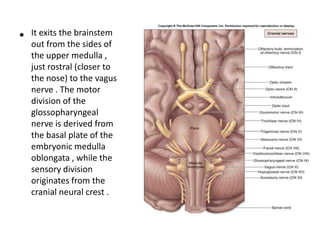
• It exits the brainstem
out from the sides of
the upper medulla ,
just rostral (closer to
the nose) to the vagus
nerve . The motor
division of the
glossopharyngeal
nerve is derived from
the basal plate of the
embryonic medulla
oblongata , while the
sensory division
originates from the
cranial neural crest .
Functions
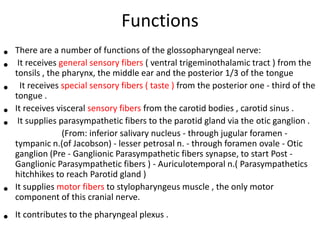
• There are a number of functions of the glossopharyngeal nerve:
• It receives general sensory fibers ( ventral trigeminothalamic tract ) from the
tonsils , the pharynx, the middle ear and the posterior 1/3 of the tongue
• It receives special sensory fibers ( taste ) from the posterior one - third of the
tongue .
• It receives visceral sensory fibers from the carotid bodies , carotid sinus .
• It supplies parasympathetic fibers to the parotid gland via the otic ganglion .
(From: inferior salivary nucleus - through jugular foramen -
tympanic n.(of Jacobson) - lesser petrosal n. - through foramen ovale - Otic
ganglion (Pre - Ganglionic Parasympathetic fibers synapse, to start Post -
Ganglionic Parasympathetic fibers ) - Auriculotemporal n.( Parasympathetics
hitchhikes to reach Parotid gland )
• It supplies motor fibers to stylopharyngeus muscle , the only motor
component of this cranial nerve.
• It contributes to the pharyngeal plexus .
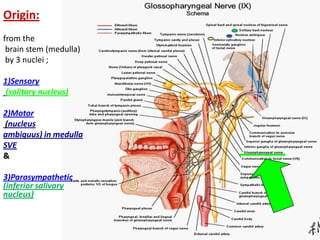
Origin:
from the
brain stem (medulla)
by 3 nuclei ;
1)Sensory
(solitary nucleus)
2)Motor
(nucleus
ambiguus) in medulla
SVE
&
3)Parasympathetic
(inferior salivary
nucleus)
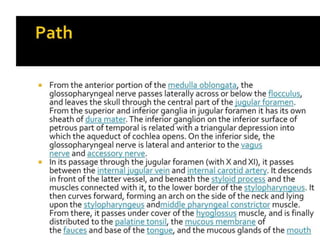
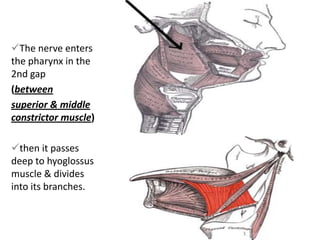
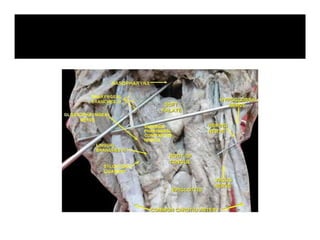
The nerve enters
the pharynx in the
2nd gap
(between
superior & middle
constrictor muscle)
then it passes
deep to hyoglossus
muscle & divides
into its branches.
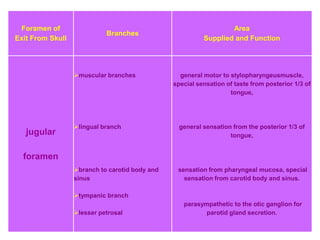
Foramen of
Exit From Skull
Branches
Area
Supplied and Function
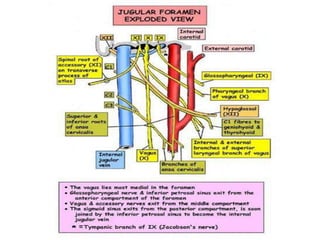
jugular
foramen
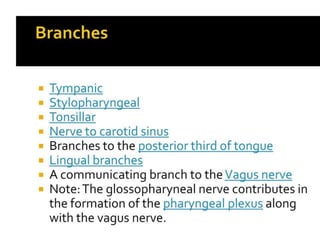
muscular branches
lingual branch
branch to carotid body and
sinus
tympanic branch
lesser petrosal
general motor to stylopharyngeusmuscle,
special sensation of taste from posterior 1/3 of
tongue,
general sensation from the posterior 1/3 of
tongue,
sensation from pharyngeal mucosa, special
sensation from carotid body and sinus.
parasympathetic to the otic ganglion for
parotid gland secretion.
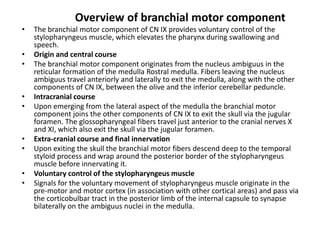
Overview of branchial motor component
• The branchial motor component of CN IX provides voluntary control of the
stylopharyngeus muscle, which elevates the pharynx during swallowing and
speech.
• Origin and central course
• The branchial motor component originates from the nucleus ambiguus in the
reticular formation of the medulla Rostral medulla. Fibers leaving the nucleus
ambiguus travel anteriorly and laterally to exit the medulla, along with the other
components of CN IX, between the olive and the inferior cerebellar peduncle.
• Intracranial course
• Upon emerging from the lateral aspect of the medulla the branchial motor
component joins the other components of CN IX to exit the skull via the jugular
foramen. The glossopharyngeal fibers travel just anterior to the cranial nerves X
and XI, which also exit the skull via the jugular foramen.
• Extra-cranial course and final innervation
• Upon exiting the skull the branchial motor fibers descend deep to the temporal
styloid process and wrap around the posterior border of the stylopharyngeus
muscle before innervating it.
• Voluntary control of the stylopharyngeus muscle
• Signals for the voluntary movement of stylopharyngeus muscle originate in the
pre-motor and motor cortex (in association with other cortical areas) and pass via
the corticobulbar tract in the posterior limb of the internal capsule to synapse
bilaterally on the ambiguus nuclei in the medulla.
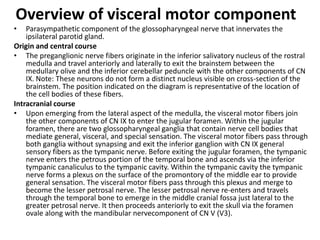
Overview of visceral motor component
• Parasympathetic component of the glossopharyngeal nerve that innervates the
ipsilateral parotid gland.
Origin and central course
• The preganglionic nerve fibers originate in the inferior salivatory nucleus of the rostral
medulla and travel anteriorly and laterally to exit the brainstem between the
medullary olive and the inferior cerebellar peduncle with the other components of CN
IX. Note: These neurons do not form a distinct nucleus visible on cross-section of the
brainstem. The position indicated on the diagram is representative of the location of
the cell bodies of these fibers.
Intracranial course
• Upon emerging from the lateral aspect of the medulla, the visceral motor fibers join
the other components of CN IX to enter the jugular foramen. Within the jugular
foramen, there are two glossopharyngeal ganglia that contain nerve cell bodies that
mediate general, visceral, and special sensation. The visceral motor fibers pass through
both ganglia without synapsing and exit the inferior ganglion with CN IX general
sensory fibers as the tympanic nerve. Before exiting the jugular foramen, the tympanic
nerve enters the petrous portion of the temporal bone and ascends via the inferior
tympanic canaliculus to the tympanic cavity. Within the tympanic cavity the tympanic
nerve forms a plexus on the surface of the promontory of the middle ear to provide
general sensation. The visceral motor fibers pass through this plexus and merge to
become the lesser petrosal nerve. The lesser petrosal nerve re-enters and travels
through the temporal bone to emerge in the middle cranial fossa just lateral to the
greater petrosal nerve. It then proceeds anteriorly to exit the skull via the foramen
ovale along with the mandibular nervecomponent of CN V (V3).
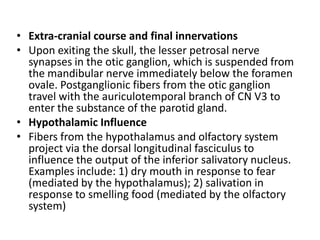
• Extra-cranial course and final innervations
• Upon exiting the skull, the lesser petrosal nerve
synapses in the otic ganglion, which is suspended from
the mandibular nerve immediately below the foramen
ovale. Postganglionic fibers from the otic ganglion
travel with the auriculotemporal branch of CN V3 to
enter the substance of the parotid gland.
• Hypothalamic Influence
• Fibers from the hypothalamus and olfactory system
project via the dorsal longitudinal fasciculus to
influence the output of the inferior salivatory nucleus.
Examples include: 1) dry mouth in response to fear
(mediated by the hypothalamus); 2) salivation in
response to smelling food (mediated by the olfactory
system)
Overview of visceral sensory component
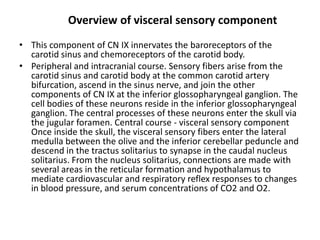
• This component of CN IX innervates the baroreceptors of the
carotid sinus and chemoreceptors of the carotid body.
• Peripheral and intracranial course. Sensory fibers arise from the
carotid sinus and carotid body at the common carotid artery
bifurcation, ascend in the sinus nerve, and join the other
components of CN IX at the inferior glossopharyngeal ganglion. The
cell bodies of these neurons reside in the inferior glossopharyngeal
ganglion. The central processes of these neurons enter the skull via
the jugular foramen. Central course - visceral sensory component
Once inside the skull, the visceral sensory fibers enter the lateral
medulla between the olive and the inferior cerebellar peduncle and
descend in the tractus solitarius to synapse in the caudal nucleus
solitarius. From the nucleus solitarius, connections are made with
several areas in the reticular formation and hypothalamus to
mediate cardiovascular and respiratory reflex responses to changes
in blood pressure, and serum concentrations of CO2 and O2.
Overview of general sensory component
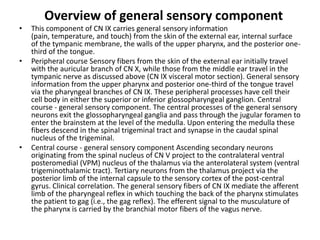
• This component of CN IX carries general sensory information
(pain, temperature, and touch) from the skin of the external ear, internal surface
of the tympanic membrane, the walls of the upper pharynx, and the posterior one-
third of the tongue.
• Peripheral course Sensory fibers from the skin of the external ear initially travel
with the auricular branch of CN X, while those from the middle ear travel in the
tympanic nerve as discussed above (CN IX visceral motor section). General sensory
information from the upper pharynx and posterior one-third of the tongue travel
via the pharyngeal branches of CN IX. These peripheral processes have cell their
cell body in either the superior or inferior glossopharyngeal ganglion. Central
course - general sensory component. The central processes of the general sensory
neurons exit the glossopharyngeal ganglia and pass through the jugular foramen to
enter the brainstem at the level of the medulla. Upon entering the medulla these
fibers descend in the spinal trigeminal tract and synapse in the caudal spinal
nucleus of the trigeminal.
• Central course - general sensory component Ascending secondary neurons
originating from the spinal nucleus of CN V project to the contralateral ventral
posteromedial (VPM) nucleus of the thalamus via the anterolateral system (ventral
trigeminothalamic tract). Tertiary neurons from the thalamus project via the
posterior limb of the internal capsule to the sensory cortex of the post-central
gyrus. Clinical correlation. The general sensory fibers of CN IX mediate the afferent
limb of the pharyngeal reflex in which touching the back of the pharynx stimulates
the patient to gag (i.e., the gag reflex). The efferent signal to the musculature of
the pharynx is carried by the branchial motor fibers of the vagus nerve.
Overview of special sensory component
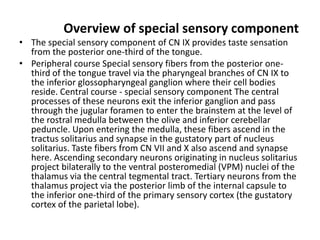
• The special sensory component of CN IX provides taste sensation
from the posterior one-third of the tongue.
• Peripheral course Special sensory fibers from the posterior one-
third of the tongue travel via the pharyngeal branches of CN IX to
the inferior glossopharyngeal ganglion where their cell bodies
reside. Central course - special sensory component The central
processes of these neurons exit the inferior ganglion and pass
through the jugular foramen to enter the brainstem at the level of
the rostral medulla between the olive and inferior cerebellar
peduncle. Upon entering the medulla, these fibers ascend in the
tractus solitarius and synapse in the gustatory part of nucleus
solitarius. Taste fibers from CN VII and X also ascend and synapse
here. Ascending secondary neurons originating in nucleus solitarius
project bilaterally to the ventral posteromedial (VPM) nuclei of the
thalamus via the central tegmental tract. Tertiary neurons from the
thalamus project via the posterior limb of the internal capsule to
the inferior one-third of the primary sensory cortex (the gustatory
cortex of the parietal lobe).
Brainstem connections
• The glossopharyngeal nerve is mostly sensory. The
glossopharyngeal nerve also aids in tasting, swallowing and
salivary secretions. Its superior and inferior (petrous)
ganglia contain the cell bodies of pain fibers. It also projects
into many different structures in the brainstem:
• Solitary nucleus: Taste from the posterior one-third of the
tongue and information from carotid baroreceptorsand
carotid body chemoreceptors
• Spinal nucleus of the trigeminal nerve: Somatic sensory
fibers from the middle ear
• Lateral Nucleus of Ala Cinerea: Visceral pain
• Nucleus ambiguus: The lower motor neurons for the
stylopharyngeus muscle
• Inferior salivatory nucleus: Parasympathetic input to the
parotid and mucous glands.
Clinical significance
Damage
• The glossopharyngeal nerve if damaged can
have several effects on the human body.
These effects include loss of bitter and sour
taste, and impaired swallowing.
Examination
• The clinical tests used to determine if the glossopharyngeal
nerve has been damaged include testing the gag reflex of
the mouth, asking the patient to swallow or cough, and
evaluating for speech impediments. The clinician may also
test the posterior one-third of the tongue with bitter and
sour substances to evaluate for impairment of taste.
• The integrity of the glossopharyngeal nerve may be
evaluated by testing the patient's general sensation and
that of taste on the posterior third of the tongue. The gag
reflex can also be used to evaluate the glossphyaryngeal
nerve, but also tests the vagus nerve, as only the afferent
fibres involved in the reflex are carried by the
glossopharyngeal nerve.
Pharyngeal reflex
The pharyngeal reflex or gag reflex
(also known as a laryngeal spasm) is a reflex
contraction of the back of the throat ,evoked
by touching the roof of the mouth, the back of
the tongue, the area around the tonsils and
the back of the throat. It, along with other
aero digestive reflexes such as reflexive
pharyngeal swallowing, prevents something
from entering the throat except as part of
normal swallowing and helps prevent choking.
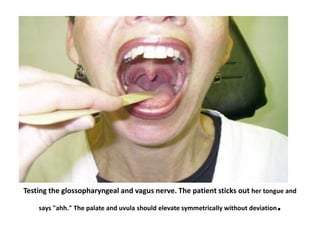
• The motor division of CN 9 and CN 10 is tested
by having the patient say "ahh" or "kah" . The
palate should rise symmetrically in the back of
the oral cavity . Paralysis of the ninth nerve
causes a pulling of the uvula to the unaffected
side. The ninth, tenth, and eleventh cranial
nerve pathways are physically so close
together that isolated lesions are rarely seen.
•
Testing the glossopharyngeal and vagus nerve. The patient sticks out her tongue and
says "ahh." The palate and uvula should elevate symmetrically without deviation.
•
Its absence
• About a third of healthy adults do not have a
gag reflex. However, in certain cases, absence
of the gag reflex and pharyngeal sensation can
be a symptom of a number of severe medical
conditions, such as damage to the
glossopharyngeal nerve, the vagus nerve, or
brain death.
Clinical  anatomy  of 9 th cranial nerve

Clinical anatomy of 9 th cranial nerve

  • 1.
    Dr. Thrijil KrishnanE M. BAMS,CRAV ( Panchakarma) PG Scholar Department of Anatomy ( Ay) SDM College of Ayurveda,Hassan
  • 3.
    Introduction • The glossopharyngealnerve is the ninth (IX) of twelve pairs of cranial nerves (24 nerves total). • "Glosso-" comes from the Greek "glossa", the tongue and "pharynx" is the Greek for throat So the glossopharyngeal nerve is the nerve that serves the tongue & throat
  • 4.
    • It exitsthe brainstem out from the sides of the upper medulla , just rostral (closer to the nose) to the vagus nerve . The motor division of the glossopharyngeal nerve is derived from the basal plate of the embryonic medulla oblongata , while the sensory division originates from the cranial neural crest .
  • 5.
    Functions • There area number of functions of the glossopharyngeal nerve: • It receives general sensory fibers ( ventral trigeminothalamic tract ) from the tonsils , the pharynx, the middle ear and the posterior 1/3 of the tongue • It receives special sensory fibers ( taste ) from the posterior one - third of the tongue . • It receives visceral sensory fibers from the carotid bodies , carotid sinus . • It supplies parasympathetic fibers to the parotid gland via the otic ganglion . (From: inferior salivary nucleus - through jugular foramen - tympanic n.(of Jacobson) - lesser petrosal n. - through foramen ovale - Otic ganglion (Pre - Ganglionic Parasympathetic fibers synapse, to start Post - Ganglionic Parasympathetic fibers ) - Auriculotemporal n.( Parasympathetics hitchhikes to reach Parotid gland ) • It supplies motor fibers to stylopharyngeus muscle , the only motor component of this cranial nerve. • It contributes to the pharyngeal plexus .
  • 6.
    Origin: from the brain stem(medulla) by 3 nuclei ; 1)Sensory (solitary nucleus) 2)Motor (nucleus ambiguus) in medulla SVE & 3)Parasympathetic (inferior salivary nucleus)
  • 10.
    The nerve enters thepharynx in the 2nd gap (between superior & middle constrictor muscle) then it passes deep to hyoglossus muscle & divides into its branches.
  • 13.
    Foramen of Exit FromSkull Branches Area Supplied and Function jugular foramen muscular branches lingual branch branch to carotid body and sinus tympanic branch lesser petrosal general motor to stylopharyngeusmuscle, special sensation of taste from posterior 1/3 of tongue, general sensation from the posterior 1/3 of tongue, sensation from pharyngeal mucosa, special sensation from carotid body and sinus. parasympathetic to the otic ganglion for parotid gland secretion.
  • 14.
    Overview of branchialmotor component • The branchial motor component of CN IX provides voluntary control of the stylopharyngeus muscle, which elevates the pharynx during swallowing and speech. • Origin and central course • The branchial motor component originates from the nucleus ambiguus in the reticular formation of the medulla Rostral medulla. Fibers leaving the nucleus ambiguus travel anteriorly and laterally to exit the medulla, along with the other components of CN IX, between the olive and the inferior cerebellar peduncle. • Intracranial course • Upon emerging from the lateral aspect of the medulla the branchial motor component joins the other components of CN IX to exit the skull via the jugular foramen. The glossopharyngeal fibers travel just anterior to the cranial nerves X and XI, which also exit the skull via the jugular foramen. • Extra-cranial course and final innervation • Upon exiting the skull the branchial motor fibers descend deep to the temporal styloid process and wrap around the posterior border of the stylopharyngeus muscle before innervating it. • Voluntary control of the stylopharyngeus muscle • Signals for the voluntary movement of stylopharyngeus muscle originate in the pre-motor and motor cortex (in association with other cortical areas) and pass via the corticobulbar tract in the posterior limb of the internal capsule to synapse bilaterally on the ambiguus nuclei in the medulla.
  • 15.
    Overview of visceralmotor component • Parasympathetic component of the glossopharyngeal nerve that innervates the ipsilateral parotid gland. Origin and central course • The preganglionic nerve fibers originate in the inferior salivatory nucleus of the rostral medulla and travel anteriorly and laterally to exit the brainstem between the medullary olive and the inferior cerebellar peduncle with the other components of CN IX. Note: These neurons do not form a distinct nucleus visible on cross-section of the brainstem. The position indicated on the diagram is representative of the location of the cell bodies of these fibers. Intracranial course • Upon emerging from the lateral aspect of the medulla, the visceral motor fibers join the other components of CN IX to enter the jugular foramen. Within the jugular foramen, there are two glossopharyngeal ganglia that contain nerve cell bodies that mediate general, visceral, and special sensation. The visceral motor fibers pass through both ganglia without synapsing and exit the inferior ganglion with CN IX general sensory fibers as the tympanic nerve. Before exiting the jugular foramen, the tympanic nerve enters the petrous portion of the temporal bone and ascends via the inferior tympanic canaliculus to the tympanic cavity. Within the tympanic cavity the tympanic nerve forms a plexus on the surface of the promontory of the middle ear to provide general sensation. The visceral motor fibers pass through this plexus and merge to become the lesser petrosal nerve. The lesser petrosal nerve re-enters and travels through the temporal bone to emerge in the middle cranial fossa just lateral to the greater petrosal nerve. It then proceeds anteriorly to exit the skull via the foramen ovale along with the mandibular nervecomponent of CN V (V3).
  • 16.
    • Extra-cranial courseand final innervations • Upon exiting the skull, the lesser petrosal nerve synapses in the otic ganglion, which is suspended from the mandibular nerve immediately below the foramen ovale. Postganglionic fibers from the otic ganglion travel with the auriculotemporal branch of CN V3 to enter the substance of the parotid gland. • Hypothalamic Influence • Fibers from the hypothalamus and olfactory system project via the dorsal longitudinal fasciculus to influence the output of the inferior salivatory nucleus. Examples include: 1) dry mouth in response to fear (mediated by the hypothalamus); 2) salivation in response to smelling food (mediated by the olfactory system)
  • 17.
    Overview of visceralsensory component • This component of CN IX innervates the baroreceptors of the carotid sinus and chemoreceptors of the carotid body. • Peripheral and intracranial course. Sensory fibers arise from the carotid sinus and carotid body at the common carotid artery bifurcation, ascend in the sinus nerve, and join the other components of CN IX at the inferior glossopharyngeal ganglion. The cell bodies of these neurons reside in the inferior glossopharyngeal ganglion. The central processes of these neurons enter the skull via the jugular foramen. Central course - visceral sensory component Once inside the skull, the visceral sensory fibers enter the lateral medulla between the olive and the inferior cerebellar peduncle and descend in the tractus solitarius to synapse in the caudal nucleus solitarius. From the nucleus solitarius, connections are made with several areas in the reticular formation and hypothalamus to mediate cardiovascular and respiratory reflex responses to changes in blood pressure, and serum concentrations of CO2 and O2.
  • 18.
    Overview of generalsensory component • This component of CN IX carries general sensory information (pain, temperature, and touch) from the skin of the external ear, internal surface of the tympanic membrane, the walls of the upper pharynx, and the posterior one- third of the tongue. • Peripheral course Sensory fibers from the skin of the external ear initially travel with the auricular branch of CN X, while those from the middle ear travel in the tympanic nerve as discussed above (CN IX visceral motor section). General sensory information from the upper pharynx and posterior one-third of the tongue travel via the pharyngeal branches of CN IX. These peripheral processes have cell their cell body in either the superior or inferior glossopharyngeal ganglion. Central course - general sensory component. The central processes of the general sensory neurons exit the glossopharyngeal ganglia and pass through the jugular foramen to enter the brainstem at the level of the medulla. Upon entering the medulla these fibers descend in the spinal trigeminal tract and synapse in the caudal spinal nucleus of the trigeminal. • Central course - general sensory component Ascending secondary neurons originating from the spinal nucleus of CN V project to the contralateral ventral posteromedial (VPM) nucleus of the thalamus via the anterolateral system (ventral trigeminothalamic tract). Tertiary neurons from the thalamus project via the posterior limb of the internal capsule to the sensory cortex of the post-central gyrus. Clinical correlation. The general sensory fibers of CN IX mediate the afferent limb of the pharyngeal reflex in which touching the back of the pharynx stimulates the patient to gag (i.e., the gag reflex). The efferent signal to the musculature of the pharynx is carried by the branchial motor fibers of the vagus nerve.
  • 19.
    Overview of specialsensory component • The special sensory component of CN IX provides taste sensation from the posterior one-third of the tongue. • Peripheral course Special sensory fibers from the posterior one- third of the tongue travel via the pharyngeal branches of CN IX to the inferior glossopharyngeal ganglion where their cell bodies reside. Central course - special sensory component The central processes of these neurons exit the inferior ganglion and pass through the jugular foramen to enter the brainstem at the level of the rostral medulla between the olive and inferior cerebellar peduncle. Upon entering the medulla, these fibers ascend in the tractus solitarius and synapse in the gustatory part of nucleus solitarius. Taste fibers from CN VII and X also ascend and synapse here. Ascending secondary neurons originating in nucleus solitarius project bilaterally to the ventral posteromedial (VPM) nuclei of the thalamus via the central tegmental tract. Tertiary neurons from the thalamus project via the posterior limb of the internal capsule to the inferior one-third of the primary sensory cortex (the gustatory cortex of the parietal lobe).
  • 20.
    Brainstem connections • Theglossopharyngeal nerve is mostly sensory. The glossopharyngeal nerve also aids in tasting, swallowing and salivary secretions. Its superior and inferior (petrous) ganglia contain the cell bodies of pain fibers. It also projects into many different structures in the brainstem: • Solitary nucleus: Taste from the posterior one-third of the tongue and information from carotid baroreceptorsand carotid body chemoreceptors • Spinal nucleus of the trigeminal nerve: Somatic sensory fibers from the middle ear • Lateral Nucleus of Ala Cinerea: Visceral pain • Nucleus ambiguus: The lower motor neurons for the stylopharyngeus muscle • Inferior salivatory nucleus: Parasympathetic input to the parotid and mucous glands.
  • 21.
    Clinical significance Damage • Theglossopharyngeal nerve if damaged can have several effects on the human body. These effects include loss of bitter and sour taste, and impaired swallowing.
  • 22.
    Examination • The clinicaltests used to determine if the glossopharyngeal nerve has been damaged include testing the gag reflex of the mouth, asking the patient to swallow or cough, and evaluating for speech impediments. The clinician may also test the posterior one-third of the tongue with bitter and sour substances to evaluate for impairment of taste. • The integrity of the glossopharyngeal nerve may be evaluated by testing the patient's general sensation and that of taste on the posterior third of the tongue. The gag reflex can also be used to evaluate the glossphyaryngeal nerve, but also tests the vagus nerve, as only the afferent fibres involved in the reflex are carried by the glossopharyngeal nerve.
  • 23.
    Pharyngeal reflex The pharyngealreflex or gag reflex (also known as a laryngeal spasm) is a reflex contraction of the back of the throat ,evoked by touching the roof of the mouth, the back of the tongue, the area around the tonsils and the back of the throat. It, along with other aero digestive reflexes such as reflexive pharyngeal swallowing, prevents something from entering the throat except as part of normal swallowing and helps prevent choking.
  • 24.
    • The motordivision of CN 9 and CN 10 is tested by having the patient say "ahh" or "kah" . The palate should rise symmetrically in the back of the oral cavity . Paralysis of the ninth nerve causes a pulling of the uvula to the unaffected side. The ninth, tenth, and eleventh cranial nerve pathways are physically so close together that isolated lesions are rarely seen. •
  • 25.
    Testing the glossopharyngealand vagus nerve. The patient sticks out her tongue and says "ahh." The palate and uvula should elevate symmetrically without deviation. •
  • 26.
    Its absence • Abouta third of healthy adults do not have a gag reflex. However, in certain cases, absence of the gag reflex and pharyngeal sensation can be a symptom of a number of severe medical conditions, such as damage to the glossopharyngeal nerve, the vagus nerve, or brain death.