Submitted By,
R. Siva Dharshini,
16PZO011,
I MSc., Zoology
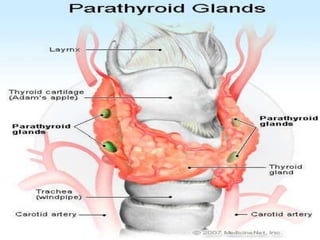
 The parathyroid glands are small pea-
sized glands located in the neck just
behind the butterfly-shaped thyroid
gland.
 Most people have four parathyroid
glands, with two parathyroid glands
lying behind each 'wing' of the thyroid
gland.
 Parathyroid hormone is secreted from the four
parathyroid glands, which are small glands in
the neck, located behind the thyroid gland.
 Parathyroid hormone regulates calcium levels
in the blood, largely by increasing the levels
when they are too low.
 It does this through its actions on the kidneys,
bones and intestine
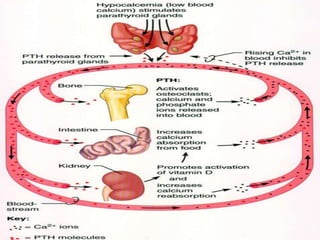
 Bones - Parathyroid hormone stimulates the release of
calcium from large calcium stores in the bones into the
bloodstream. This increases bone destruction and
decreases the formation of new bone.
 Kidneys - Parathyroid hormone reduces loss of calcium
in urine. Parathyroid hormone also stimulates the
production of active vitamin D in the kidneys.
 Intestine - Parathyroid hormone increases calcium
absorption in the intestine from food via its effects on
vitamin D metabolism.
 The parathyroid glands are important in tightly
controlling calcium levels in the bloodstream. Because
of this, calcium levels are generally very stable. This is
important to ensure the nervous system and the body’s
muscles can work properly, and also that bones remain
strong.
 The main target organs where parathyroid hormone
exerts its effects are the bones and the kidneys. When
needed, parathyroid hormone is released by the
parathyroid glands into the blood and causes the bones
to release calcium and increase levels in the
bloodstream. It also causes the kidneys to stop calcium
being lost in urine as well as stimulating the kidneys to
regulate vitamin D metabolism .
 If someone does not take in enough calcium
through their diet or does not have enough
vitamin D, the circulating calcium levels fall and
the parathyroid glands produce more parathyroid
hormone. This brings calcium levels in the
bloodstream back up to normal.
 Another method that parathyroid hormone uses to
increase calcium levels in the bloodstream is
activation of vitamin D. This occurs in the kidney
too; the activated vitamin D then increases calcium
absorption from the gut.
 Sometimes the parathyroid glands can make too much
parathyroid hormone. In this case, patients develop a blood level
of calcium that is too high (hypercalcaemia), which in turn can
make them feel generally unwell. The commonest condition which
cause this is called primary hyperparathyroidism.
 If the high level of parathyroid hormone remains undetected for a
long time, it can cause calcium from the bones to be lost into blood
and subsequently the urine. This can eventually cause bones to
become thin or spongy (osteoporosis). Too much calcium in the
urine can also cause calcium stones in the kidney.
 Occasionally, the parathyroid glands do not produce enough
parathyroid hormone leading to low blood calcium levels
(hypocalcaemia). This condition is called hypoparathyroidism.

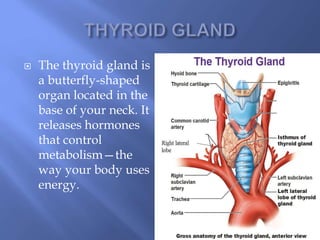
 The thyroid gland is
a butterfly-shaped
organ located in the
base of your neck. It
releases hormones
that control
metabolism—the
way your body uses
energy.
 The thyroid gland is about 2-inches long and
lies in front of your throat below the
prominence of thyroid cartilage sometimes
called the Adam's apple.
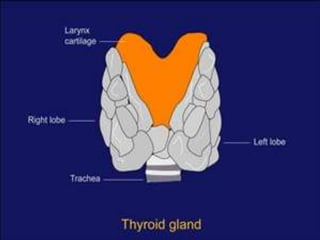
 The thyroid has two sides called lobes that lie
on either side of your windpipe, and is usually
connected by a strip of thyroid tissue known as
an isthmus.
 Some people do not have an isthmus, and
instead have two separate thyroid lobes.
The thyroid's hormones regulate vital body
functions, including:
 Breathing
 Heart rate
 Central and peripheral nervous systems
 Body weight
 Muscle strength
 Menstrual cycles
 Body temperature
 Cholesterol levels
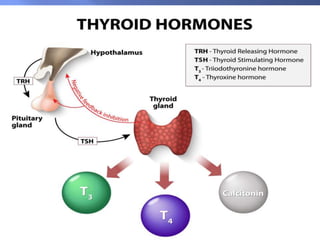
 The thyroid gland produces thyroxine (T4), which is a
relatively inactive prohormone and lower amounts of
the active hormone, triiodothyronine (T3).
 Collectively, T3 and T4 are referred to as the thyroid
hormones. Twenty percent of the body’s
triiodothyronine is made by the thyroid gland; the
other 80% comes from thyroxine converted by organs
such as the liver or kidneys.
 The thyroid gland also produces calcitonin from cells
called C-cells. Calcitonin is understood to play a role
in regulating calcium levels in the body, but its exact
function in humans remains unclear.
 GOITER
 THYROIDITIS
 HYPERTHYROIDISM
 HYPOTHYROIDISM
 GRAVES DISEASE
 THYROID CANCER
 THYROID NODULE
 THYROID STORM
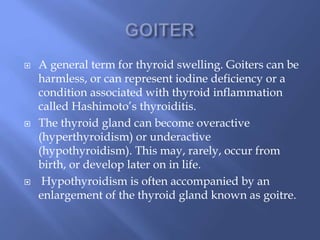
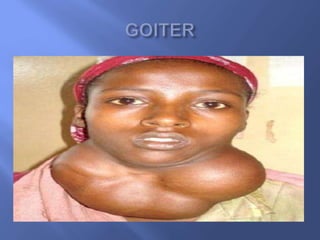
 A general term for thyroid swelling. Goiters can be
harmless, or can represent iodine deficiency or a
condition associated with thyroid inflammation
called Hashimoto’s thyroiditis.
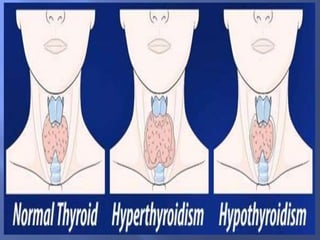
 The thyroid gland can become overactive
(hyperthyroidism) or underactive
(hypothyroidism). This may, rarely, occur from
birth, or develop later on in life.
 Hypothyroidism is often accompanied by an
enlargement of the thyroid gland known as goitre.
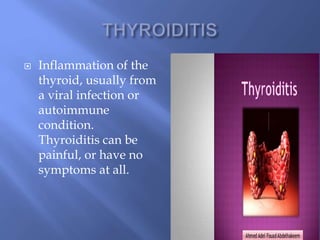
 Inflammation of the
thyroid, usually from
a viral infection or
autoimmune
condition.
Thyroiditis can be
painful, or have no
symptoms at all.
HYPERTHYROIDISM:
Excessive thyroid hormone
production. Hyperthyroidism is most often
caused by Graves disease or an overactive
thyroid nodule.
Hypothyroidism:
Low production of thyroid
hormone. Thyroid damage caused by
autoimmune disease is the most common
cause of hypothyroidism .
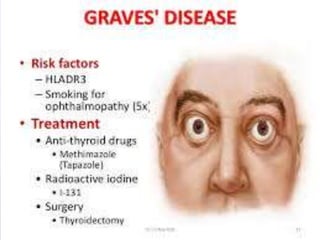
 Graves disease:
An autoimmune condition in which
the thyroid is overstimulated, causing
hyperthyroidism.
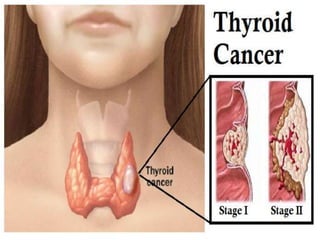
 Thyroid cancer:
An uncommon form of cancer,
thyroid cancer is usually curable. Surgery,
radiation, and hormone treatments may be used
to treat thyroid cancer.
THYROTOXICOSIS
The term given when there is too much thyroid
hormone in the bloodstream. It may be a result of overactivity of the
thyroid gland (hyperthyroidism) as in Graves’ disease, inflammation of
the thyroid or a benign thyroid tumour.
Symptoms of thyrotoxicosis include
 intolerance to heat
 weight loss
 increased appetite
 increased bowel movements
 irregular menstrual cycle
 rapid and irregular heartbeat
 palpitations
 tiredness
 irritability
 tumor
 hair loss and
 retraction of the eyelids resulting in a ‘staring’ appearance.
 Hypothyroidism is the term given when
low levels of thyroid hormones are
produced by the thyroid gland. It may
result from autoimmune diseases (when
the person’s immune system starts to
attack the body's own organs), poor
iodine intake or be brought on by use of
certain drugs.
 Since thyroid hormones are essential for
physical and mental development,
hypothyroidism during development (ie,
before birth and during childhood) can result
in learning difficulties and reduced physical
growth.
 Hypothyroidism in adults results in decreased
metabolic rate.
 This causes symptoms which include fatigue,
intolerance of cold temperatures, low heart
rate, weight gain, reduced appetite, poor
memory, depression, stiffness of muscles and
infertility.
 Anti- APO Antibodies
 Thyroid scan
 Thyroid Biopsy
 Test for Thyroid Stimulating Hormone
 T3 and T4 Thyraxine
 Thyroglobulins
 Imaging test like CT Scan , PET Scan and MRI
 Thyroid surgery
Cancer
Goiter
Hyperthyroidism
Anti Thyroid medications
Radioactive Iodine
External Radiation
Thyroid hormone pills
Recombinant human TSH
Parathyroid and thyroid glands

Parathyroid and thyroid glands

  • 1.
    Submitted By, R. SivaDharshini, 16PZO011, I MSc., Zoology
  • 2.
     The parathyroidglands are small pea- sized glands located in the neck just behind the butterfly-shaped thyroid gland.  Most people have four parathyroid glands, with two parathyroid glands lying behind each 'wing' of the thyroid gland.
  • 4.
     Parathyroid hormoneis secreted from the four parathyroid glands, which are small glands in the neck, located behind the thyroid gland.  Parathyroid hormone regulates calcium levels in the blood, largely by increasing the levels when they are too low.  It does this through its actions on the kidneys, bones and intestine
  • 5.
     Bones -Parathyroid hormone stimulates the release of calcium from large calcium stores in the bones into the bloodstream. This increases bone destruction and decreases the formation of new bone.  Kidneys - Parathyroid hormone reduces loss of calcium in urine. Parathyroid hormone also stimulates the production of active vitamin D in the kidneys.  Intestine - Parathyroid hormone increases calcium absorption in the intestine from food via its effects on vitamin D metabolism.
  • 7.
     The parathyroidglands are important in tightly controlling calcium levels in the bloodstream. Because of this, calcium levels are generally very stable. This is important to ensure the nervous system and the body’s muscles can work properly, and also that bones remain strong.  The main target organs where parathyroid hormone exerts its effects are the bones and the kidneys. When needed, parathyroid hormone is released by the parathyroid glands into the blood and causes the bones to release calcium and increase levels in the bloodstream. It also causes the kidneys to stop calcium being lost in urine as well as stimulating the kidneys to regulate vitamin D metabolism .
  • 8.
     If someonedoes not take in enough calcium through their diet or does not have enough vitamin D, the circulating calcium levels fall and the parathyroid glands produce more parathyroid hormone. This brings calcium levels in the bloodstream back up to normal.  Another method that parathyroid hormone uses to increase calcium levels in the bloodstream is activation of vitamin D. This occurs in the kidney too; the activated vitamin D then increases calcium absorption from the gut.
  • 9.
     Sometimes theparathyroid glands can make too much parathyroid hormone. In this case, patients develop a blood level of calcium that is too high (hypercalcaemia), which in turn can make them feel generally unwell. The commonest condition which cause this is called primary hyperparathyroidism.  If the high level of parathyroid hormone remains undetected for a long time, it can cause calcium from the bones to be lost into blood and subsequently the urine. This can eventually cause bones to become thin or spongy (osteoporosis). Too much calcium in the urine can also cause calcium stones in the kidney.  Occasionally, the parathyroid glands do not produce enough parathyroid hormone leading to low blood calcium levels (hypocalcaemia). This condition is called hypoparathyroidism. 
  • 10.
     The thyroidgland is a butterfly-shaped organ located in the base of your neck. It releases hormones that control metabolism—the way your body uses energy.
  • 11.
     The thyroidgland is about 2-inches long and lies in front of your throat below the prominence of thyroid cartilage sometimes called the Adam's apple.  The thyroid has two sides called lobes that lie on either side of your windpipe, and is usually connected by a strip of thyroid tissue known as an isthmus.  Some people do not have an isthmus, and instead have two separate thyroid lobes.
  • 13.
    The thyroid's hormonesregulate vital body functions, including:  Breathing  Heart rate  Central and peripheral nervous systems  Body weight  Muscle strength  Menstrual cycles  Body temperature  Cholesterol levels
  • 14.
     The thyroidgland produces thyroxine (T4), which is a relatively inactive prohormone and lower amounts of the active hormone, triiodothyronine (T3).  Collectively, T3 and T4 are referred to as the thyroid hormones. Twenty percent of the body’s triiodothyronine is made by the thyroid gland; the other 80% comes from thyroxine converted by organs such as the liver or kidneys.  The thyroid gland also produces calcitonin from cells called C-cells. Calcitonin is understood to play a role in regulating calcium levels in the body, but its exact function in humans remains unclear.
  • 16.
     GOITER  THYROIDITIS HYPERTHYROIDISM  HYPOTHYROIDISM  GRAVES DISEASE  THYROID CANCER  THYROID NODULE  THYROID STORM
  • 17.
     A generalterm for thyroid swelling. Goiters can be harmless, or can represent iodine deficiency or a condition associated with thyroid inflammation called Hashimoto’s thyroiditis.  The thyroid gland can become overactive (hyperthyroidism) or underactive (hypothyroidism). This may, rarely, occur from birth, or develop later on in life.  Hypothyroidism is often accompanied by an enlargement of the thyroid gland known as goitre.
  • 19.
     Inflammation ofthe thyroid, usually from a viral infection or autoimmune condition. Thyroiditis can be painful, or have no symptoms at all.
  • 20.
    HYPERTHYROIDISM: Excessive thyroid hormone production.Hyperthyroidism is most often caused by Graves disease or an overactive thyroid nodule. Hypothyroidism: Low production of thyroid hormone. Thyroid damage caused by autoimmune disease is the most common cause of hypothyroidism .
  • 21.
     Graves disease: Anautoimmune condition in which the thyroid is overstimulated, causing hyperthyroidism.  Thyroid cancer: An uncommon form of cancer, thyroid cancer is usually curable. Surgery, radiation, and hormone treatments may be used to treat thyroid cancer.
  • 24.
    THYROTOXICOSIS The term givenwhen there is too much thyroid hormone in the bloodstream. It may be a result of overactivity of the thyroid gland (hyperthyroidism) as in Graves’ disease, inflammation of the thyroid or a benign thyroid tumour. Symptoms of thyrotoxicosis include  intolerance to heat  weight loss  increased appetite  increased bowel movements  irregular menstrual cycle  rapid and irregular heartbeat  palpitations  tiredness  irritability  tumor  hair loss and  retraction of the eyelids resulting in a ‘staring’ appearance.
  • 25.
     Hypothyroidism isthe term given when low levels of thyroid hormones are produced by the thyroid gland. It may result from autoimmune diseases (when the person’s immune system starts to attack the body's own organs), poor iodine intake or be brought on by use of certain drugs.
  • 27.
     Since thyroidhormones are essential for physical and mental development, hypothyroidism during development (ie, before birth and during childhood) can result in learning difficulties and reduced physical growth.  Hypothyroidism in adults results in decreased metabolic rate.  This causes symptoms which include fatigue, intolerance of cold temperatures, low heart rate, weight gain, reduced appetite, poor memory, depression, stiffness of muscles and infertility.
  • 28.
     Anti- APOAntibodies  Thyroid scan  Thyroid Biopsy  Test for Thyroid Stimulating Hormone  T3 and T4 Thyraxine  Thyroglobulins  Imaging test like CT Scan , PET Scan and MRI
  • 29.
     Thyroid surgery Cancer Goiter Hyperthyroidism AntiThyroid medications Radioactive Iodine External Radiation Thyroid hormone pills Recombinant human TSH