IJRET: International Journal of Research in Engineering and Technology eISSN: 2319-1163 | pISSN: 2321-7308
_______________________________________________________________________________________
Volume: 04 Issue: 04 | Apr-2015, Available @ http://www.ijret.org 452
PARAMETRIC STUDY ON SLENDER COLUMN FOR FLAT PLATE
STRUCTURE
Shinde S. S1
, Patil P. S2
1
PG Scholar, Department of Civil Engineering, RIT Islampur, Maharashtra, India
2
Professor, Department of Civil Engineering, RIT Islampur, Maharashtra, India
Abstract
This paper deals with effect of slender column on flat plate structure. The column is called slender if the height of is increased for
functional purpose. The study is conducted on 18 flat-plate reinforced cement concrete (RCC) structural models. Among these18
models, 54 columns at three different locations (i.e. corner, edge and inner columns) are chosen for study. The models are
developed using ETABS Software. Parametric study is performed by considering six different height of column ranging from 3048
mm to 6858 mm, using an increment of 762 mm along with three slab panels of size 4572 mm x 4572 mm, 6096 mm x6096 mm and
7620 mm x 7620 mm with five panels in both ways, considering both gravity and environmental load. The effect of slenderness
ratio on load carrying capacity, design load and steel ratio is considered along with this the effect of additional moment due to
slender compression member is also taken into account. It is observed that, columns in flat-plate structures are generally very
sensitive if they are slender. It is observed that as the column length increases from 5502 mm and further, the steel ratio suddenly
increases and it exceeds maximum allowed. As slenderness ratio increases, ratio of design load to the critical buckling load
increases. Also resulting in increase of additional moment, decreasing load carrying capacity of column. This forces the design
engineer to study effect of different parameter of the structure while designing high rise flat plate structure.
Keywords: Flat Plate Structure, ETABS, Slenderness, Environmental load, design load and buckling load.
--------------------------------------------------------------------***----------------------------------------------------------------------
1. INTRODUCTION
The slender column is one having smaller cross sectional
dimensions as compared to its length. In a structure, a
slender column has less strength as compared to short
column with the same sectional area. Due to this the slender
column carries lesser load as compared to the short column.
Generally in India the two type of structure is constructed
such as beam-column frame structure and flat plat structure
including sway & non sway frame.
Slender columns are those members whose ultimate load
carrying capacities are affected by the slenderness effect,
which produces additional bending stresses or instability of
columns. Therefore, evaluation of a slender column involves
consideration of the column length in addition to its cross
section. The column having ratio of effective length to its
list lateral dimension exceed or equal to 12 according to IS
456-2000 is treated as slender column.
The slender column is developed in multistoried structure
due to increasing ground floor height for functional purpose
or architectural purpose. On the other hand, the modern
trend is towards taller and slender structures.
Flat plate buildings have been damaged on a very large
scale, because these structure are analyzed and designed as
per IS code. Hence it is required to evaluate actual
performance of flat plate structure subjected to dynamic and
gravity loads.
2. MODELLING AND ANALYSIS
2.1 Model Development
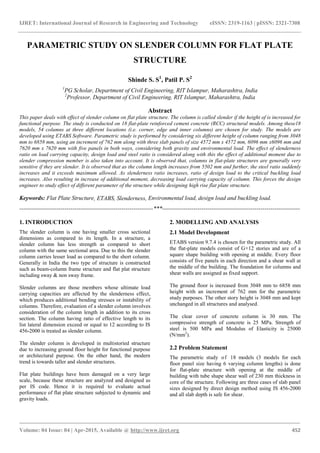
ETABS version 9.7.4 is chosen for the parametric study. All
the flat-plate models consist of G+12 stories and are of a
square shape building with opening at middle. Every floor
consists of five panels in each direction and a shear wall at
the middle of the building. The foundation for columns and
shear walls are assigned as fixed support.
The ground floor is increased from 3048 mm to 6858 mm
height with an increment of 762 mm for the parametric
study purposes. The other story height is 3048 mm and kept
unchanged in all structures and analysed.
The clear cover of concrete column is 30 mm. The
compressive strength of concrete is 25 MPa. Strength of
steel is 500 MPa and Modulus of Elasticity is 25000
(N/mm2
).
2.2 Problem Statement
The parametric study of 18 models (3 models for each
floor panel size having 6 varying column lengths) is done
for flat-plate structure with opening at the middle of
building with tube shape shear wall of 230 mm thickness in
core of the structure. Following are three cases of slab panel
sizes designed by direct design method using IS 456-2000
and all slab depth is safe for shear.
IJRET: International Journal of Research in Engineering and Technology eISSN: 2319-1163 | pISSN: 2321-7308
_______________________________________________________________________________________
Volume: 04 Issue: 04 | Apr-2015, Available @ http://www.ijret.org 453
Table -1: Parameters for parametric study (a)
Case
Floor panel
size in
mm@
opening size
in mm x
mm.
Slab
Thick.
in mm
Peri.
beam
size in
mm
Drop panel
size in mm
@ thickness
in mm
1
4572 x4572
@1524
x1524
215
230 x
500
1524 x 1524
@ 60
2
6096 x
6096 @3048
x 3048
260
380 x
380
2000 x 2000
@ 70
3
7620 x
7620 @
3048 x 3048
300
600 x
600
2540 x 2540
@ 80
Table -2: Parameters for parametric study (a cont...)
Cases
Column
position
Column length
@ ground level
in mm
Column size
in mm
Case
1
Corner column
3048 to 6858
@ 762
increment
300 x 385
Edge column similar 385 x 450
Inner column similar 450 x 450
Case
2
Corner column similar 300 x 500
Edge column similar 385 x 750
Inner column similar 450 x 600
Case
3
Corner column similar 300 x 650
Edge column similar 385 x 1200
Inner column similar 450 x 850
Table -2: Earthquake Parameters (IS1893-2000)
1 Dead load on Terrace Floor 2.5 KN/m2
2 live load on Terrace Floor 1.5 KN/m2
3 Dead load on Remaining floor 1 KN/m2
4 live load on Remaining floor 2.5 KN/m2
5 Parapet Wall Load on beam 5.52 KN/m
6 Wall Load on Remaining beam 11.72 KN/m
7 Basic wind speed 44 m/sec
8 Type of Structure SMRF
9 Seismic Zone III
10 Type of Soil Medium soil
11 Damping 5 %
12 Zone factor (Z) 0.16
13 Importance factor 1
14 Response Reduction Factor 5 (SMRF)
Fig -1: Plan of G+12 storied flat slabs building of case1
consider for study in ETABS
2.3 Load Combination considered for Study
Following load combinations are considered for study.
1) 1.5(DL+ LL)
2) 1.5 (DL ± Spect1 )
3) 1.2 DL ± 0.3 LL ± 1.2 Spect1
4) 1.5 DL ± 1.5 WLX
5) 1.2 (DL ± LL ± WLX)
6) 0.9 DL ± 1.5 Spect1
7) 0.9 DL ± 1.5 WLX
3. VALIDATION OF RESULTS
For the validation of results, a G+12 storied flat slab
building has been analyzed by the IS 1893-2000 code
method manually and using ETABS v 9.7.4 software. The
dynamic analysis is carried out for case1 with floor height of
size 3048 mm for the entire floor. All parameters are defined
in Table 1 and Table 2. The time period of 2.662 sec. (from
ETABS) is used for manual calculation.
Chart -1: Variations of story shear for case 1
0 200 400 600
1
2
3
4
5
6
7
8
9
10
11
12
13
Story Shear in kN
Storylevels
Story Shear
From Manual
calculation
From ETABS
IJRET: International Journal of Research in Engineering and Technology eISSN: 2319-1163 | pISSN: 2321-7308
_______________________________________________________________________________________
Volume: 04 Issue: 04 | Apr-2015, Available @ http://www.ijret.org 454
Table -3: Validation by software result
Parameters
From
ETABS
From manual
calculation
% of
Error
Base Shear in
kN
566.15 566.4974 0.06
Total Seismic
Weight of
Structure in kN
69260.5
6
69302.21 0.06
Result of Base shear obtained from manual calculation and
from ETABS v9.7.4 is 566.4974 KN and 566.15 KN
respectively. The percentage difference is 0.06%, hence
results of software is valid.
4. RESULT AND DISSCUSTION
4.1 Effect on Column
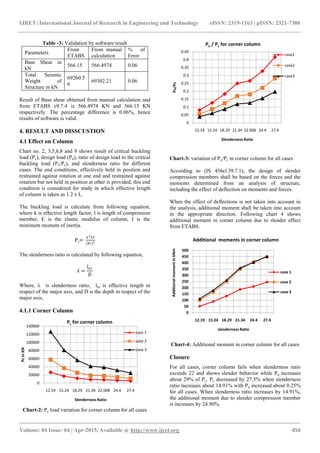
Chart no. 2, 3,5,6,8 and 9 shows result of critical buckling
load (Pc), design load (Pu), ratio of design load to the critical
buckling load (Pu/Pc), and slenderness ratio for different
cases. The end conditions, effectively held in position and
restrained against rotation at one end and restrained against
rotation but not held in position at other is provided, this end
condition is considered for study in which effective length
of column is taken as 1.2 x L.
The buckling load is calculate from following equation,
where k is effective length factor, l is length of compression
member, E is the elastic modulus of column, I is the
minimum moment of inertia.
Pc=
𝜋2 𝐸𝐼
(𝑘𝑙)2
The slenderness ratio is calculated by following equation,
𝜆 =
𝑙 𝑒𝑥
𝐷
Where, λ is slenderness ratio, lex is effective length in
respect of the major axis, and D is the depth in respect of the
major axis,
4.1.1 Corner Column
Chart-2: Pc load variation for corner column for all cases
Chart-3: variation of Pu/Pc in corner column for all cases
According to (IS 456cl.39.7.1), the design of slender
compression members shall be based on the forces and the
moments determined from an analysis of structure,
including the effect of deflection on moments and forces.
When the effect of deflections is not taken into account in
the analysis, additional moment shall be taken into account
in the appropriate direction. Following chart 4 shows
additional moment in corner column due to slender effect
from ETABS.
Chart-4: Additional moment in corner column for all cases
Closure
For all cases, corner column fails when slenderness ratio
exceeds 22 and shows slender behavior while Pu increases
about 29% of Pc. Pc decreased by 27.5% when slenderness
ratio increases about 14.91% with Pu increased about 0.25%
for all cases. When slenderness ratio increases by 14.91%,
the additional moment due to slender compression member
is increases by 24.90%.
0
20000
40000
60000
80000
100000
120000
140000
12.19 15.24 18.29 21.34 22.008 24.4 27.4
PcinKN
Slenderness Ratio
Pc for corner column
case 1
case 2
case 3
0
0.05
0.1
0.15
0.2
0.25
0.3
0.35
0.4
0.45
12.19 15.24 18.29 21.34 22.008 24.4 27.4
Pu/Pc
Slenderness Ratio
Pu / Pc for corner column
case1
case2
case3
0
50
100
150
200
250
300
350
400
450
500
12.19 15.24 18.29 21.34 24.4 27.4
AdditionalmomentinkNm
slenderness Ratio
Additional moments in corner column
case 1
case 2
case 3
IJRET: International Journal of Research in Engineering and Technology eISSN: 2319-1163 | pISSN: 2321-7308
_______________________________________________________________________________________
Volume: 04 Issue: 04 | Apr-2015, Available @ http://www.ijret.org 455
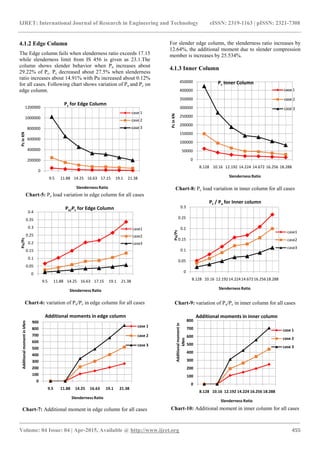
4.1.2 Edge Column
The Edge column fails when slenderness ratio exceeds 17.15
while slenderness limit from IS 456 is given as 23.1.The
column shows slender behavior when Pu increases about
29.22% of Pc. Pc decreased about 27.5% when slenderness
ratio increases about 14.91% with Pu increased about 0.12%
for all cases. Following chart shows variation of Pu and Pc on
edge column.
Chart-5: Pc load variation in edge column for all cases
Chart-6: variation of Pu/Pc in edge column for all cases
Chart-7: Additional moment in edge column for all cases
For slender edge column, the slenderness ratio increases by
12.64%, the additional moment due to slender compression
member is increases by 25.534%.
4.1.3 Inner Column
Chart-8: Pc load variation in inner column for all cases
Chart-9: variation of Pu/Pc in inner column for all cases
Chart-10: Additional moment in inner column for all cases
0
200000
400000
600000
800000
1000000
1200000
9.5 11.88 14.25 16.63 17.15 19.1 21.38
PcinKN
Slenderness Ratio
Pc for Edge Column
case 1
case 2
case 3
0
0.05
0.1
0.15
0.2
0.25
0.3
0.35
0.4
9.5 11.88 14.25 16.63 17.15 19.1 21.38
Pu/Pc
Slenderness Ratio
Pu/Pc for Edge Column
case1
case2
case3
0
100
200
300
400
500
600
700
800
900
9.5 11.88 14.25 16.63 19.1 21.38
AdditionalmomentinkNm
Slenderness Ratio
Additional moments in edge column
case 1
case 2
case 3
0
50000
100000
150000
200000
250000
300000
350000
400000
450000
8.128 10.16 12.192 14.224 14.672 16.256 18.288
PcinKN
Slenderness Ratio
Pc Inner Column
case 1
case 2
case 3
0
0.05
0.1
0.15
0.2
0.25
0.3
8.128 10.16 12.19214.22414.67216.25618.288
Pu/Pc
Slenderness Ratio
Pc / Pu for Inner column
case1
case2
case3
0
100
200
300
400
500
600
700
800
8.128 10.16 12.192 14.224 16.256 18.288
Additionalmomentin
kNm
Slenderness Ratio
Additional moments in inner column
case 1
case 2
case 3
IJRET: International Journal of Research in Engineering and Technology eISSN: 2319-1163 | pISSN: 2321-7308
_______________________________________________________________________________________
Volume: 04 Issue: 04 | Apr-2015, Available @ http://www.ijret.org 456
Closure
For case 3, inner columns fail when slenderness ratio
exceeds 16.256. The column shows slender behavior when
Pu increases about 26.26 % of Pc. When slenderness ratio
increases about 14.91%, Pc decreased about 27.5% and Pu
increased about 0.8% for all cases. For slender inner
column, the slenderness ratio increases by 12.64%, the
additional moment due to slender compression member is
increases by 23.845%.An inner column for case 3 needs
more attention than for same column in case1.
5. CONCLUSION
From the research work done as per above, following
conclusion can be drawn, Design load increases about 30%
of critical buckling load for all panels. The buckling load
decreases by 27.5% along with increase in additional
moments by 25%, when slenderness ratio increases about
14.91%.Thus in flat plate structure, corner and edge
columns are more sensitive to slender effect than that of
inner column. A corner column for all case needs more
attention than edge and inner column.
REFERENCES
Journals:
[1]. Hossain Mohammad., Hossain Tahsin.(2014),‘Finite
Element Approach to Perform Parametric Study on Slender
Column for Flat Plate Structure’, International Journal of
Civil and Structural Engineering Research, ISSN 2348-
7607, vol. 2, pp.15-24.
[2]. Micallef K., Sagaseta J., et al.(2014),‘Assessing
Punching Shear Failure in Reinforced Concrete Flat Slab
subjected to Localized Impact Loading’, International
Journal of Impact Engineering, vol.71, pp.17-33.
[3]. P M B Raj Kiran Nanduri, Dr. B. Dean Kumar, et
al.(2012), ‘Comparative Study of Wind Load Analysis of
Flat Plate Multistoried Frames With and Without Reinforced
Concrete Infilled Walls’, International Journal of Emerging
Technology and Advanced Engineering, ISSN 2250-2459,
vol. 2, pp.177-182.
[4]. Sagaseta J., Tassinari L., et al. (2014), ‘Punching of Flat
Slab supported on Rectangular Column’, Engineering
Structure, vol. 77, pp. 17-33.
[5]. Silva N. F., et al. (2013), ‘Experimental and Parametric
3D nonlinear Finite Element Analysis on Punching of Flat
Slab with Orthogonal Reinforcement’, Engineering
Structure, vol.48, pp. 442-457.
[6]. Thomas H.,Wallace J., et al. (2004),‘Shake Table Tests
of Reinforced Concrete Flat Plate Frames and Post-
Tensioned Flat Plate Frames’,13th
World Conference on
Earthquake Engineering Vancouver, B.C., Canada, pp. 11-
19.
[7]. Wimbadi Iman, Winoto Paulus. (2010), ‘Slenderness
Study of Square Reinforcement Concrete Column with
Software’, International Seminar on Applied Technology,
Science and Arts, Surabaya .ISSN 2086-1931, pp. 1-4.
Codes:
[8]. IS 456-2000: Indian Standard Plain and Reinforced
Concrete – Code of Practice. Fourth Revision.
[9]. IS1893 (Part 1) 2002: Indian Standard Criteria for
Earthquake Resistant Design Of Structures. Part 1 General
Provision and Buildings. Fifth Revision.
Books:
[10]. Punmia B. C. et al. (2006), ‘RCC Designs, Reinforced
concrete structures’, Tenth edition, Lakshmi Publication.
[11]. Shrikhande M. and Agrawal P. (2006), ‘Earthquake
Resistance Design of Structure’, First Revised Edition. New
Delhi: PHI Learning Private Limited.
BIOGRAPHIES
Shinde S. S., P.G. (Civil Structures)
Scholar, Department of Civil Engineering,
RIT Islampur, Sangli, Maharashtra, India
Email: sudhirshinde750@gmail.com
Patil P. S., Professor, Department of Civil
Engineering, RIT Islampur, Sangli,
Maharashtra, India.
Email:pandurang.patil@ritindia.edu

Parametric study on slender column for flat plate structure

  • 1.
    IJRET: International Journalof Research in Engineering and Technology eISSN: 2319-1163 | pISSN: 2321-7308 _______________________________________________________________________________________ Volume: 04 Issue: 04 | Apr-2015, Available @ http://www.ijret.org 452 PARAMETRIC STUDY ON SLENDER COLUMN FOR FLAT PLATE STRUCTURE Shinde S. S1 , Patil P. S2 1 PG Scholar, Department of Civil Engineering, RIT Islampur, Maharashtra, India 2 Professor, Department of Civil Engineering, RIT Islampur, Maharashtra, India Abstract This paper deals with effect of slender column on flat plate structure. The column is called slender if the height of is increased for functional purpose. The study is conducted on 18 flat-plate reinforced cement concrete (RCC) structural models. Among these18 models, 54 columns at three different locations (i.e. corner, edge and inner columns) are chosen for study. The models are developed using ETABS Software. Parametric study is performed by considering six different height of column ranging from 3048 mm to 6858 mm, using an increment of 762 mm along with three slab panels of size 4572 mm x 4572 mm, 6096 mm x6096 mm and 7620 mm x 7620 mm with five panels in both ways, considering both gravity and environmental load. The effect of slenderness ratio on load carrying capacity, design load and steel ratio is considered along with this the effect of additional moment due to slender compression member is also taken into account. It is observed that, columns in flat-plate structures are generally very sensitive if they are slender. It is observed that as the column length increases from 5502 mm and further, the steel ratio suddenly increases and it exceeds maximum allowed. As slenderness ratio increases, ratio of design load to the critical buckling load increases. Also resulting in increase of additional moment, decreasing load carrying capacity of column. This forces the design engineer to study effect of different parameter of the structure while designing high rise flat plate structure. Keywords: Flat Plate Structure, ETABS, Slenderness, Environmental load, design load and buckling load. --------------------------------------------------------------------***---------------------------------------------------------------------- 1. INTRODUCTION The slender column is one having smaller cross sectional dimensions as compared to its length. In a structure, a slender column has less strength as compared to short column with the same sectional area. Due to this the slender column carries lesser load as compared to the short column. Generally in India the two type of structure is constructed such as beam-column frame structure and flat plat structure including sway & non sway frame. Slender columns are those members whose ultimate load carrying capacities are affected by the slenderness effect, which produces additional bending stresses or instability of columns. Therefore, evaluation of a slender column involves consideration of the column length in addition to its cross section. The column having ratio of effective length to its list lateral dimension exceed or equal to 12 according to IS 456-2000 is treated as slender column. The slender column is developed in multistoried structure due to increasing ground floor height for functional purpose or architectural purpose. On the other hand, the modern trend is towards taller and slender structures. Flat plate buildings have been damaged on a very large scale, because these structure are analyzed and designed as per IS code. Hence it is required to evaluate actual performance of flat plate structure subjected to dynamic and gravity loads. 2. MODELLING AND ANALYSIS 2.1 Model Development ETABS version 9.7.4 is chosen for the parametric study. All the flat-plate models consist of G+12 stories and are of a square shape building with opening at middle. Every floor consists of five panels in each direction and a shear wall at the middle of the building. The foundation for columns and shear walls are assigned as fixed support. The ground floor is increased from 3048 mm to 6858 mm height with an increment of 762 mm for the parametric study purposes. The other story height is 3048 mm and kept unchanged in all structures and analysed. The clear cover of concrete column is 30 mm. The compressive strength of concrete is 25 MPa. Strength of steel is 500 MPa and Modulus of Elasticity is 25000 (N/mm2 ). 2.2 Problem Statement The parametric study of 18 models (3 models for each floor panel size having 6 varying column lengths) is done for flat-plate structure with opening at the middle of building with tube shape shear wall of 230 mm thickness in core of the structure. Following are three cases of slab panel sizes designed by direct design method using IS 456-2000 and all slab depth is safe for shear.
  • 2.
    IJRET: International Journalof Research in Engineering and Technology eISSN: 2319-1163 | pISSN: 2321-7308 _______________________________________________________________________________________ Volume: 04 Issue: 04 | Apr-2015, Available @ http://www.ijret.org 453 Table -1: Parameters for parametric study (a) Case Floor panel size in mm@ opening size in mm x mm. Slab Thick. in mm Peri. beam size in mm Drop panel size in mm @ thickness in mm 1 4572 x4572 @1524 x1524 215 230 x 500 1524 x 1524 @ 60 2 6096 x 6096 @3048 x 3048 260 380 x 380 2000 x 2000 @ 70 3 7620 x 7620 @ 3048 x 3048 300 600 x 600 2540 x 2540 @ 80 Table -2: Parameters for parametric study (a cont...) Cases Column position Column length @ ground level in mm Column size in mm Case 1 Corner column 3048 to 6858 @ 762 increment 300 x 385 Edge column similar 385 x 450 Inner column similar 450 x 450 Case 2 Corner column similar 300 x 500 Edge column similar 385 x 750 Inner column similar 450 x 600 Case 3 Corner column similar 300 x 650 Edge column similar 385 x 1200 Inner column similar 450 x 850 Table -2: Earthquake Parameters (IS1893-2000) 1 Dead load on Terrace Floor 2.5 KN/m2 2 live load on Terrace Floor 1.5 KN/m2 3 Dead load on Remaining floor 1 KN/m2 4 live load on Remaining floor 2.5 KN/m2 5 Parapet Wall Load on beam 5.52 KN/m 6 Wall Load on Remaining beam 11.72 KN/m 7 Basic wind speed 44 m/sec 8 Type of Structure SMRF 9 Seismic Zone III 10 Type of Soil Medium soil 11 Damping 5 % 12 Zone factor (Z) 0.16 13 Importance factor 1 14 Response Reduction Factor 5 (SMRF) Fig -1: Plan of G+12 storied flat slabs building of case1 consider for study in ETABS 2.3 Load Combination considered for Study Following load combinations are considered for study. 1) 1.5(DL+ LL) 2) 1.5 (DL ± Spect1 ) 3) 1.2 DL ± 0.3 LL ± 1.2 Spect1 4) 1.5 DL ± 1.5 WLX 5) 1.2 (DL ± LL ± WLX) 6) 0.9 DL ± 1.5 Spect1 7) 0.9 DL ± 1.5 WLX 3. VALIDATION OF RESULTS For the validation of results, a G+12 storied flat slab building has been analyzed by the IS 1893-2000 code method manually and using ETABS v 9.7.4 software. The dynamic analysis is carried out for case1 with floor height of size 3048 mm for the entire floor. All parameters are defined in Table 1 and Table 2. The time period of 2.662 sec. (from ETABS) is used for manual calculation. Chart -1: Variations of story shear for case 1 0 200 400 600 1 2 3 4 5 6 7 8 9 10 11 12 13 Story Shear in kN Storylevels Story Shear From Manual calculation From ETABS
  • 3.
    IJRET: International Journalof Research in Engineering and Technology eISSN: 2319-1163 | pISSN: 2321-7308 _______________________________________________________________________________________ Volume: 04 Issue: 04 | Apr-2015, Available @ http://www.ijret.org 454 Table -3: Validation by software result Parameters From ETABS From manual calculation % of Error Base Shear in kN 566.15 566.4974 0.06 Total Seismic Weight of Structure in kN 69260.5 6 69302.21 0.06 Result of Base shear obtained from manual calculation and from ETABS v9.7.4 is 566.4974 KN and 566.15 KN respectively. The percentage difference is 0.06%, hence results of software is valid. 4. RESULT AND DISSCUSTION 4.1 Effect on Column Chart no. 2, 3,5,6,8 and 9 shows result of critical buckling load (Pc), design load (Pu), ratio of design load to the critical buckling load (Pu/Pc), and slenderness ratio for different cases. The end conditions, effectively held in position and restrained against rotation at one end and restrained against rotation but not held in position at other is provided, this end condition is considered for study in which effective length of column is taken as 1.2 x L. The buckling load is calculate from following equation, where k is effective length factor, l is length of compression member, E is the elastic modulus of column, I is the minimum moment of inertia. Pc= 𝜋2 𝐸𝐼 (𝑘𝑙)2 The slenderness ratio is calculated by following equation, 𝜆 = 𝑙 𝑒𝑥 𝐷 Where, λ is slenderness ratio, lex is effective length in respect of the major axis, and D is the depth in respect of the major axis, 4.1.1 Corner Column Chart-2: Pc load variation for corner column for all cases Chart-3: variation of Pu/Pc in corner column for all cases According to (IS 456cl.39.7.1), the design of slender compression members shall be based on the forces and the moments determined from an analysis of structure, including the effect of deflection on moments and forces. When the effect of deflections is not taken into account in the analysis, additional moment shall be taken into account in the appropriate direction. Following chart 4 shows additional moment in corner column due to slender effect from ETABS. Chart-4: Additional moment in corner column for all cases Closure For all cases, corner column fails when slenderness ratio exceeds 22 and shows slender behavior while Pu increases about 29% of Pc. Pc decreased by 27.5% when slenderness ratio increases about 14.91% with Pu increased about 0.25% for all cases. When slenderness ratio increases by 14.91%, the additional moment due to slender compression member is increases by 24.90%. 0 20000 40000 60000 80000 100000 120000 140000 12.19 15.24 18.29 21.34 22.008 24.4 27.4 PcinKN Slenderness Ratio Pc for corner column case 1 case 2 case 3 0 0.05 0.1 0.15 0.2 0.25 0.3 0.35 0.4 0.45 12.19 15.24 18.29 21.34 22.008 24.4 27.4 Pu/Pc Slenderness Ratio Pu / Pc for corner column case1 case2 case3 0 50 100 150 200 250 300 350 400 450 500 12.19 15.24 18.29 21.34 24.4 27.4 AdditionalmomentinkNm slenderness Ratio Additional moments in corner column case 1 case 2 case 3
  • 4.
    IJRET: International Journalof Research in Engineering and Technology eISSN: 2319-1163 | pISSN: 2321-7308 _______________________________________________________________________________________ Volume: 04 Issue: 04 | Apr-2015, Available @ http://www.ijret.org 455 4.1.2 Edge Column The Edge column fails when slenderness ratio exceeds 17.15 while slenderness limit from IS 456 is given as 23.1.The column shows slender behavior when Pu increases about 29.22% of Pc. Pc decreased about 27.5% when slenderness ratio increases about 14.91% with Pu increased about 0.12% for all cases. Following chart shows variation of Pu and Pc on edge column. Chart-5: Pc load variation in edge column for all cases Chart-6: variation of Pu/Pc in edge column for all cases Chart-7: Additional moment in edge column for all cases For slender edge column, the slenderness ratio increases by 12.64%, the additional moment due to slender compression member is increases by 25.534%. 4.1.3 Inner Column Chart-8: Pc load variation in inner column for all cases Chart-9: variation of Pu/Pc in inner column for all cases Chart-10: Additional moment in inner column for all cases 0 200000 400000 600000 800000 1000000 1200000 9.5 11.88 14.25 16.63 17.15 19.1 21.38 PcinKN Slenderness Ratio Pc for Edge Column case 1 case 2 case 3 0 0.05 0.1 0.15 0.2 0.25 0.3 0.35 0.4 9.5 11.88 14.25 16.63 17.15 19.1 21.38 Pu/Pc Slenderness Ratio Pu/Pc for Edge Column case1 case2 case3 0 100 200 300 400 500 600 700 800 900 9.5 11.88 14.25 16.63 19.1 21.38 AdditionalmomentinkNm Slenderness Ratio Additional moments in edge column case 1 case 2 case 3 0 50000 100000 150000 200000 250000 300000 350000 400000 450000 8.128 10.16 12.192 14.224 14.672 16.256 18.288 PcinKN Slenderness Ratio Pc Inner Column case 1 case 2 case 3 0 0.05 0.1 0.15 0.2 0.25 0.3 8.128 10.16 12.19214.22414.67216.25618.288 Pu/Pc Slenderness Ratio Pc / Pu for Inner column case1 case2 case3 0 100 200 300 400 500 600 700 800 8.128 10.16 12.192 14.224 16.256 18.288 Additionalmomentin kNm Slenderness Ratio Additional moments in inner column case 1 case 2 case 3
  • 5.
    IJRET: International Journalof Research in Engineering and Technology eISSN: 2319-1163 | pISSN: 2321-7308 _______________________________________________________________________________________ Volume: 04 Issue: 04 | Apr-2015, Available @ http://www.ijret.org 456 Closure For case 3, inner columns fail when slenderness ratio exceeds 16.256. The column shows slender behavior when Pu increases about 26.26 % of Pc. When slenderness ratio increases about 14.91%, Pc decreased about 27.5% and Pu increased about 0.8% for all cases. For slender inner column, the slenderness ratio increases by 12.64%, the additional moment due to slender compression member is increases by 23.845%.An inner column for case 3 needs more attention than for same column in case1. 5. CONCLUSION From the research work done as per above, following conclusion can be drawn, Design load increases about 30% of critical buckling load for all panels. The buckling load decreases by 27.5% along with increase in additional moments by 25%, when slenderness ratio increases about 14.91%.Thus in flat plate structure, corner and edge columns are more sensitive to slender effect than that of inner column. A corner column for all case needs more attention than edge and inner column. REFERENCES Journals: [1]. Hossain Mohammad., Hossain Tahsin.(2014),‘Finite Element Approach to Perform Parametric Study on Slender Column for Flat Plate Structure’, International Journal of Civil and Structural Engineering Research, ISSN 2348- 7607, vol. 2, pp.15-24. [2]. Micallef K., Sagaseta J., et al.(2014),‘Assessing Punching Shear Failure in Reinforced Concrete Flat Slab subjected to Localized Impact Loading’, International Journal of Impact Engineering, vol.71, pp.17-33. [3]. P M B Raj Kiran Nanduri, Dr. B. Dean Kumar, et al.(2012), ‘Comparative Study of Wind Load Analysis of Flat Plate Multistoried Frames With and Without Reinforced Concrete Infilled Walls’, International Journal of Emerging Technology and Advanced Engineering, ISSN 2250-2459, vol. 2, pp.177-182. [4]. Sagaseta J., Tassinari L., et al. (2014), ‘Punching of Flat Slab supported on Rectangular Column’, Engineering Structure, vol. 77, pp. 17-33. [5]. Silva N. F., et al. (2013), ‘Experimental and Parametric 3D nonlinear Finite Element Analysis on Punching of Flat Slab with Orthogonal Reinforcement’, Engineering Structure, vol.48, pp. 442-457. [6]. Thomas H.,Wallace J., et al. (2004),‘Shake Table Tests of Reinforced Concrete Flat Plate Frames and Post- Tensioned Flat Plate Frames’,13th World Conference on Earthquake Engineering Vancouver, B.C., Canada, pp. 11- 19. [7]. Wimbadi Iman, Winoto Paulus. (2010), ‘Slenderness Study of Square Reinforcement Concrete Column with Software’, International Seminar on Applied Technology, Science and Arts, Surabaya .ISSN 2086-1931, pp. 1-4. Codes: [8]. IS 456-2000: Indian Standard Plain and Reinforced Concrete – Code of Practice. Fourth Revision. [9]. IS1893 (Part 1) 2002: Indian Standard Criteria for Earthquake Resistant Design Of Structures. Part 1 General Provision and Buildings. Fifth Revision. Books: [10]. Punmia B. C. et al. (2006), ‘RCC Designs, Reinforced concrete structures’, Tenth edition, Lakshmi Publication. [11]. Shrikhande M. and Agrawal P. (2006), ‘Earthquake Resistance Design of Structure’, First Revised Edition. New Delhi: PHI Learning Private Limited. BIOGRAPHIES Shinde S. S., P.G. (Civil Structures) Scholar, Department of Civil Engineering, RIT Islampur, Sangli, Maharashtra, India Email: sudhirshinde750@gmail.com Patil P. S., Professor, Department of Civil Engineering, RIT Islampur, Sangli, Maharashtra, India. Email:pandurang.patil@ritindia.edu