International Journal of Modern Engineering Research (IJMER)
www.ijmer.com Vol. 3, Issue. 4, Jul - Aug. 2013 pp-2166-2169 ISSN: 2249-6645
www.ijmer.com 2166 | Page
Singh Jaspreet1
, Singh Mukhtiar2
and Singh Harpreet3
1, 2, 3
Lovely Professional University, Phagwara, Punjab.
ABSTRACT: Electric discharge machining is used for machining of hard materials like steel. In this paper, the effect
of electrical discharge machining (EDM) parameters such as pulse-on time (TON), pulse-off time (TOFF), and current (I)
on material removal rate (MRR) in 202 stainless steel was studied. The experiments are carried out as per design of
experiments approach using L27 orthogonal array. The results were analyzed using analysis of variance and response
graphs. From this study, it is found that different combinations of EDM process parameters are required to achieve
higher MRR and greater surface finish. Signal to noise ratio (S/N) and analysis of variance (ANOVA) is used to
analyze the effect of the parameters on MRR and also to identify the optimum cutting parameters. The contrib ution of
each cutting parameter towards the MRR is also identified.
Keyword: Material Removal Rate, Taguchi method, 202 stainless steel.
I. INTRODUCTION
Electrical discharge machine (EDM) technology is increasingly being used in tool, die and mould making
industries, for machining of heat treated tool steels and advanced materials (super alloys, ceramics, and metal matrix
composites) requiring high precision, complex shapes and high surface finish. Traditional machining technique is often
based on the material removal using tool material harder than the work material and is unable to machine them
economically. An electrical discharge machining (EDM) is based on the eroding effect of an electric spark on both the
electrodes used. Electrical discharge machining (EDM) actually is a process of utilizing the removal phenomenon of
electrical-discharge in dielectric. Therefore, the electrode plays an important role, which affects the material removal
rate and the tool wear rate. In non-traditional processing electrical discharge machining (EDM) has tremendous
potential on account of the versatility of its application and it is except to be successfully and commercial utilized
in modern industries (Habib,2009). In the EDM process to obtain the maximum material removal with minimum
tool wear, the work material and tool must be set at positive and negative electrode (Che Haron et al.,2008).
Electric discharge machining one of the most popular non-traditional material removals process and has become basic
machining method for the manufacturing industries of aerospace, automotive, nuclear and medical . The source of
energy used is amplified light, ionized material and high voltage. Examples are laser beam machining, ion beam
machining, and plasma arc machining and electric discharge machining (Kiyak et al, 2007).
II. EXPERIMENTATION
Electric discharge machining of 202 stainless steel using different parameters:
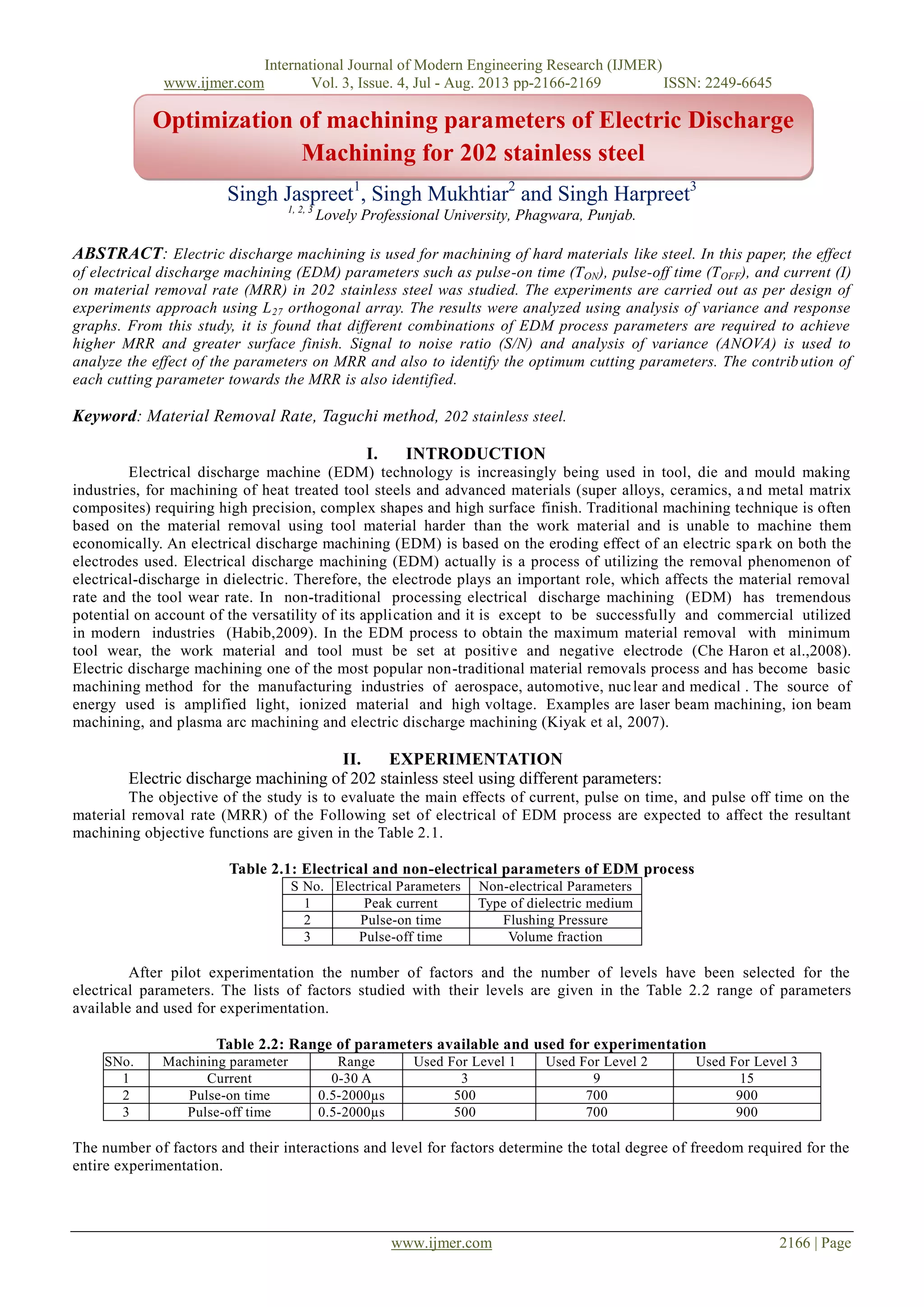
The objective of the study is to evaluate the main effects of current, pulse on time, and pulse off time on the
material removal rate (MRR) of the Following set of electrical of EDM process are expected to affect the resultant
machining objective functions are given in the Table 2.1.
Table 2.1: Electrical and non-electrical parameters of EDM process
S No. Electrical Parameters Non-electrical Parameters
1 Peak current Type of dielectric medium
2 Pulse-on time Flushing Pressure
3 Pulse-off time Volume fraction
After pilot experimentation the number of factors and the number of levels have been selected for the
electrical parameters. The lists of factors studied with their levels are given in the Table 2.2 range of parameters
available and used for experimentation.
Table 2.2: Range of parameters available and used for experimentation
SNo. Machining parameter Range Used For Level 1 Used For Level 2 Used For Level 3
1 Current 0-30 A 3 9 15
2 Pulse-on time 0.5-2000µs 500 700 900
3 Pulse-off time 0.5-2000µs 500 700 900
The number of factors and their interactions and level for factors determine the total degree of freedom required for the
entire experimentation.
Optimization of machining parameters of Electric Discharge
Machining for 202 stainless steel
International Journal of Modern Engineering Research (IJMER)
www.ijmer.com Vol. 3, Issue. 4, Jul - Aug. 2013 pp-2166-2169 ISSN: 2249-6645
www.ijmer.com 2167 | Page
Table 2.3: Orthogonal arrays experiments
S.No. CURRENT T-ON T-OFF
1 3 500 500
2 3 500 700
3 3 500 900
4 3 700 500
5 3 700 700
6 3 700 900
7 3 900 500
8 3 900 700
9 3 900 900
10 9 500 500
11 9 500 700
12 9 500 900
13 9 700 500
14 9 700 700
15 9 700 900
16 9 900 500
17 9 900 700
18 9 900 900
19 15 500 500
20 15 500 700
21 15 500 900
22 15 700 500
23 15 700 700
24 15 700 900
25 15 900 500
26 15 900 700
27 15 900 900
ANOVA helps us to compare variability within experimental data. ANOVA table is made with help of
MINITAB 15 software. When performance varies one determines the average loss by statistically averaging the
quadratic loss.
III. RESULT AND DISCUSSION
The effect of parameters i.e. pulse on time, pulse off time and current some of their interactions were
evaluated using ANOVA. A confidence interval of 95% has been used for the analysis. 27 experiments were completed
so as to measure Signal to Noise ratio (S/N ratio) calculated by the formula . The
variation data for each factor and their interactions were F-tested to find significance of each calculated by the
formula . The principle of the F-test is that the larger the F value for a particular parameter, the
greater the effect on the performance characteristic due to the change in that process parameter. In this work, 202
stainless steel samples were machined with non-conventional method (EDM) by varying the EDM parameters, after
that the experimental outcomes are optimized using ANOVA. The following conclusions were found from the
optimized results after ANOVA. These significant values are shown in table. 3.1. In order to obtain the effect for
machining parameters for each level, the S/N ratio value of each fixed parameter and level in each machining
performance is summed up.
Table 3.1 Experimental result with S/N ratio for material removal rate
Exp.No. CURRENT T-ON T-OFF
Material Removal
Rate (gms/min)
S/N Ratio
1 3 500 500 16.000 24.0824
2 3 500 700 16.000 24.0824
3 3 500 900 12.000 21.5836
4 3 700 500 12.000 21.5836
5 3 700 700 8.000 18.0618
6 3 700 900 14.000 22.9226
7 3 900 500 6.000 15.5630
8 3 900 700 10.000 20.0000
9 3 900 900 10.000 20.0000
10 9 500 500 63.333 36.0326
11 9 500 700 73.333 37.3060
12 9 500 900 83.333 38.4164
13 9 700 500 66.667 36.4782
14 9 700 700 53.333 34.5400
15 9 700 900 80.000 38.0618
16 9 900 500 30.000 29.5424
17 9 900 700 13.333 22.4988
18 9 900 900 30.000 29.5424
19 15 500 500 75.000 37.5012
20 15 500 700 115.000 41.2140
International Journal of Modern Engineering Research (IJMER)
www.ijmer.com Vol. 3, Issue. 4, Jul - Aug. 2013 pp-2166-2169 ISSN: 2249-6645
www.ijmer.com 2168 | Page
21 15 500 900 80.000 38.0618
22 15 700 500 100.000 40.0000
23 15 700 700 75.000 37.5012
24 15 700 900 125.000 41.9382
25 15 900 500 95.000 39.5545
26 15 900 700 105.000 40.4238
27 15 900 900 110.000 40.8279
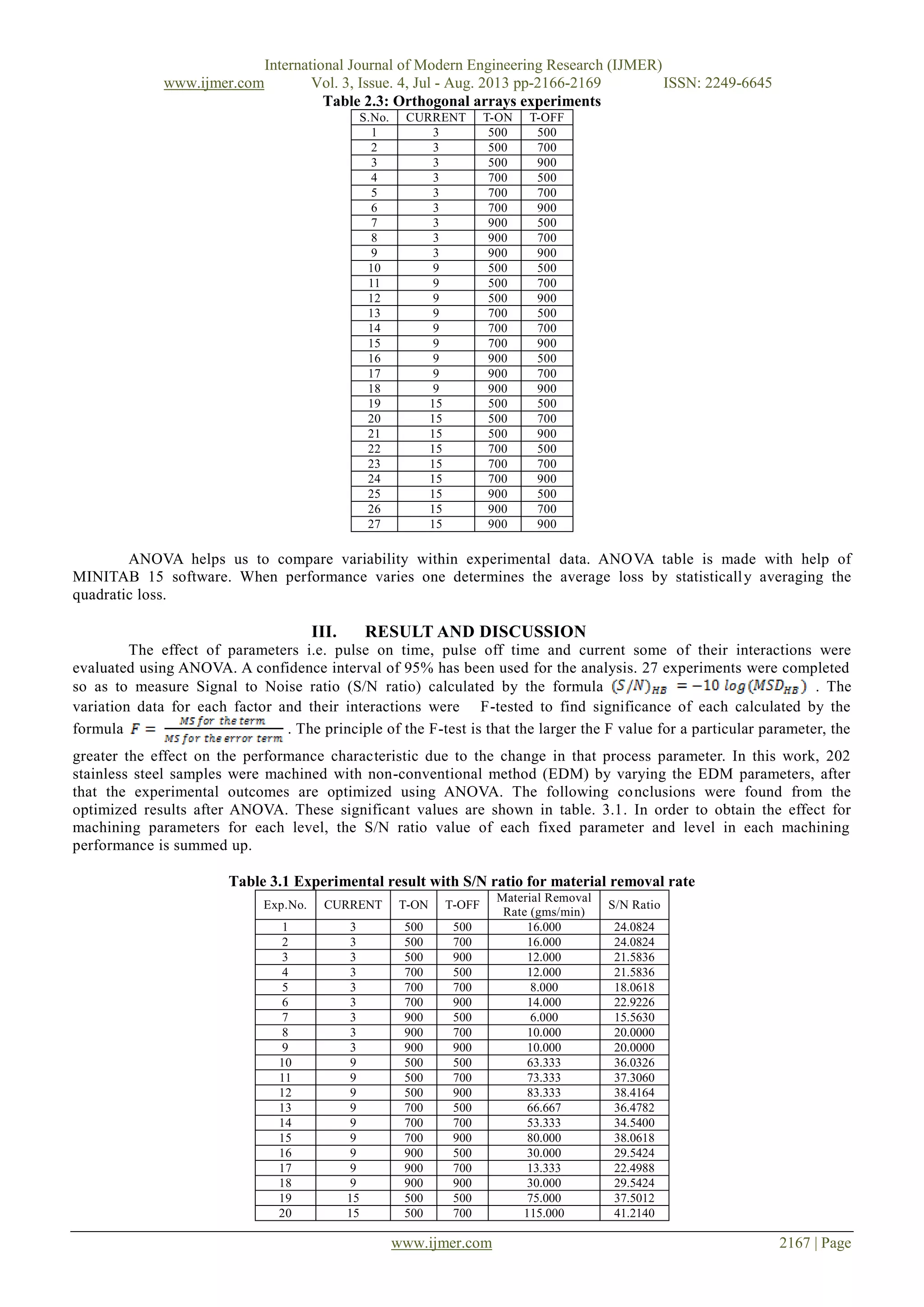
From the calculation of main effects for each level of the factors, the main effects values are presented in table
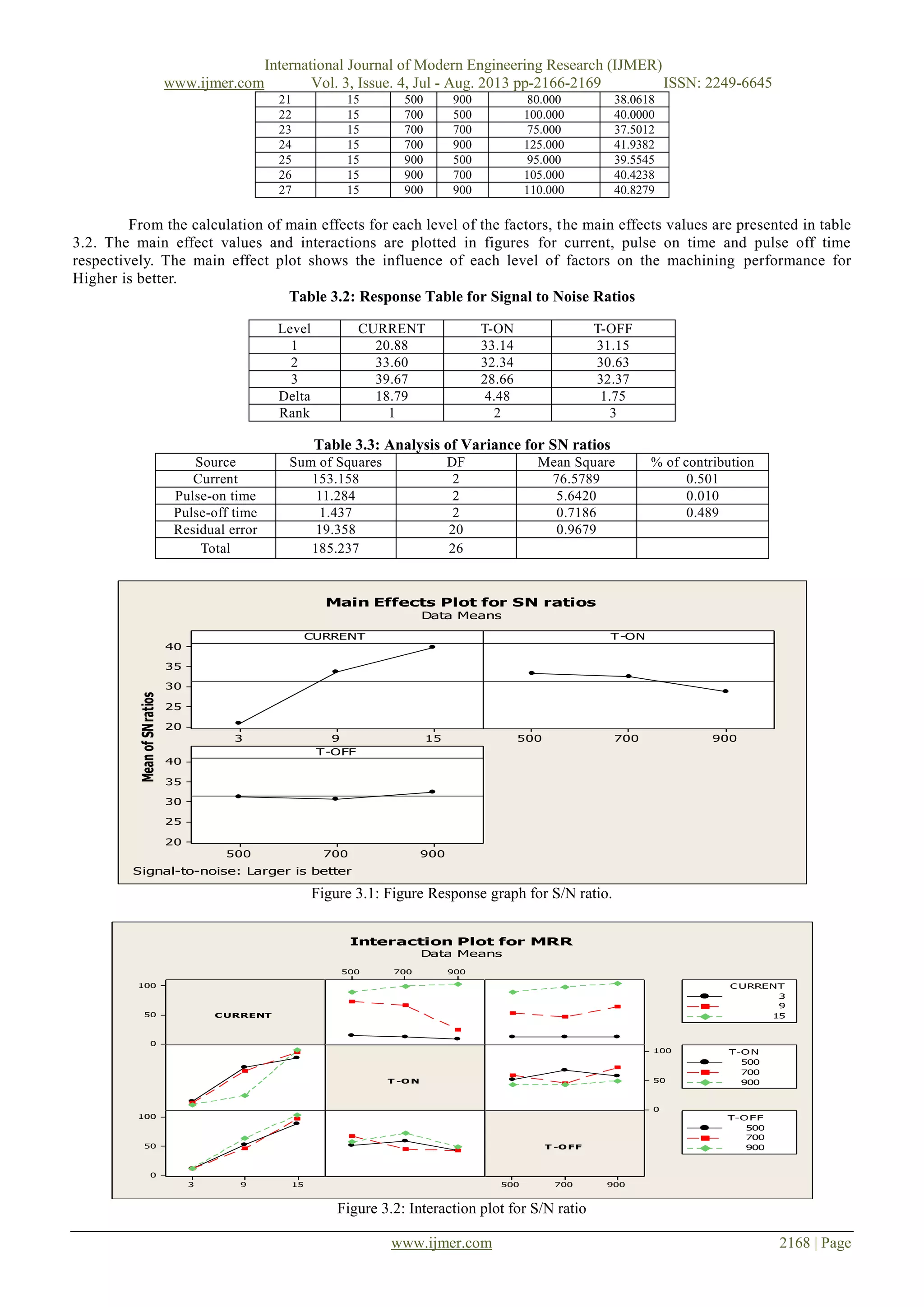
3.2. The main effect values and interactions are plotted in figures for current, pulse on time and pulse off time
respectively. The main effect plot shows the influence of each level of factors on the machining performance for
Higher is better.
Table 3.2: Response Table for Signal to Noise Ratios
Table 3.3: Analysis of Variance for SN ratios
Source Sum of Squares DF Mean Square % of contribution
Current 153.158 2 76.5789 0.501
Pulse-on time 11.284 2 5.6420 0.010
Pulse-off time 1.437 2 0.7186 0.489
Residual error 19.358 20 0.9679
Total 185.237 26
1593
40
35
30
25
20
900700500
900700500
40
35
30
25
20
CURRENT
MeanofSNratios
T-ON
T-OFF
Main Effects Plot for SN ratios
Data Means
Signal-to-noise: Larger is better
Figure 3.1: Figure Response graph for S/N ratio.
100
50
0
900700500
900700500
100
50
0
1593
100
50
0
C URRENT
T -O N
T -O FF
3
9
15
C URRENT
500
700
900
T-O N
500
700
900
T-O FF
Interaction Plot for MRR
Data Means
Figure 3.2: Interaction plot for S/N ratio
Level CURRENT T-ON T-OFF
1 20.88 33.14 31.15
2 33.60 32.34 30.63
3 39.67 28.66 32.37
Delta 18.79 4.48 1.75
Rank 1 2 3
International Journal of Modern Engineering Research (IJMER)
www.ijmer.com Vol. 3, Issue. 4, Jul - Aug. 2013 pp-2166-2169 ISSN: 2249-6645
www.ijmer.com 2169 | Page
IV. CONCLUSION
The relative importance of the cutting parameters with respect to the pulse on time, pulse off time and current
on MRR. From the analysis of the figures 3.1 & 2 and table 3.2 the optimal value for MRR is current 15A, pulse on
time 500µs and pulse off time 900 µs. The according to percentage contribution data current and pulse off time are the
affecting parameters.
REFERENCES
[1]. Habib, S. S., Study of the parameters in electrical discharge machining through response surface methodology
approach. App. Math. Model. 33, 2009. 4397-4407.
[2]. Haron, C.H Che., Ghani, J.A., Burhanuddin, Y., Seong, Y.K., S wee, C.Y., Copper and graphite electrodes
performance in electrical-discharge machining of XW42 tool steel. J. Mater. Process. Techno. 201, 2008. 570-573.
[3]. Kiyak, M., Cakir, O., 2007. Examination of machining parameters on surface roughness in EDM of tool steel. J.
Mater. Process.
[4]. Santanu Dey, Dr. D.C.Roy Experimental Study Using Different Tools/Electrodes E.G.Copper, Graphite on M.R.R of
E.D.M Process and Selecting The Best One for Maximum M.R.R in Optimum Condition International Journal of Modern
Engineering Research (IJMER) Vol.3, Issue.3, May-June. 2013 pp-1263-1267

Optimization of machining parameters of Electric Discharge Machining for 202 stainless steel

  • 1.
    International Journal ofModern Engineering Research (IJMER) www.ijmer.com Vol. 3, Issue. 4, Jul - Aug. 2013 pp-2166-2169 ISSN: 2249-6645 www.ijmer.com 2166 | Page Singh Jaspreet1 , Singh Mukhtiar2 and Singh Harpreet3 1, 2, 3 Lovely Professional University, Phagwara, Punjab. ABSTRACT: Electric discharge machining is used for machining of hard materials like steel. In this paper, the effect of electrical discharge machining (EDM) parameters such as pulse-on time (TON), pulse-off time (TOFF), and current (I) on material removal rate (MRR) in 202 stainless steel was studied. The experiments are carried out as per design of experiments approach using L27 orthogonal array. The results were analyzed using analysis of variance and response graphs. From this study, it is found that different combinations of EDM process parameters are required to achieve higher MRR and greater surface finish. Signal to noise ratio (S/N) and analysis of variance (ANOVA) is used to analyze the effect of the parameters on MRR and also to identify the optimum cutting parameters. The contrib ution of each cutting parameter towards the MRR is also identified. Keyword: Material Removal Rate, Taguchi method, 202 stainless steel. I. INTRODUCTION Electrical discharge machine (EDM) technology is increasingly being used in tool, die and mould making industries, for machining of heat treated tool steels and advanced materials (super alloys, ceramics, and metal matrix composites) requiring high precision, complex shapes and high surface finish. Traditional machining technique is often based on the material removal using tool material harder than the work material and is unable to machine them economically. An electrical discharge machining (EDM) is based on the eroding effect of an electric spark on both the electrodes used. Electrical discharge machining (EDM) actually is a process of utilizing the removal phenomenon of electrical-discharge in dielectric. Therefore, the electrode plays an important role, which affects the material removal rate and the tool wear rate. In non-traditional processing electrical discharge machining (EDM) has tremendous potential on account of the versatility of its application and it is except to be successfully and commercial utilized in modern industries (Habib,2009). In the EDM process to obtain the maximum material removal with minimum tool wear, the work material and tool must be set at positive and negative electrode (Che Haron et al.,2008). Electric discharge machining one of the most popular non-traditional material removals process and has become basic machining method for the manufacturing industries of aerospace, automotive, nuclear and medical . The source of energy used is amplified light, ionized material and high voltage. Examples are laser beam machining, ion beam machining, and plasma arc machining and electric discharge machining (Kiyak et al, 2007). II. EXPERIMENTATION Electric discharge machining of 202 stainless steel using different parameters: The objective of the study is to evaluate the main effects of current, pulse on time, and pulse off time on the material removal rate (MRR) of the Following set of electrical of EDM process are expected to affect the resultant machining objective functions are given in the Table 2.1. Table 2.1: Electrical and non-electrical parameters of EDM process S No. Electrical Parameters Non-electrical Parameters 1 Peak current Type of dielectric medium 2 Pulse-on time Flushing Pressure 3 Pulse-off time Volume fraction After pilot experimentation the number of factors and the number of levels have been selected for the electrical parameters. The lists of factors studied with their levels are given in the Table 2.2 range of parameters available and used for experimentation. Table 2.2: Range of parameters available and used for experimentation SNo. Machining parameter Range Used For Level 1 Used For Level 2 Used For Level 3 1 Current 0-30 A 3 9 15 2 Pulse-on time 0.5-2000µs 500 700 900 3 Pulse-off time 0.5-2000µs 500 700 900 The number of factors and their interactions and level for factors determine the total degree of freedom required for the entire experimentation. Optimization of machining parameters of Electric Discharge Machining for 202 stainless steel
  • 2.
    International Journal ofModern Engineering Research (IJMER) www.ijmer.com Vol. 3, Issue. 4, Jul - Aug. 2013 pp-2166-2169 ISSN: 2249-6645 www.ijmer.com 2167 | Page Table 2.3: Orthogonal arrays experiments S.No. CURRENT T-ON T-OFF 1 3 500 500 2 3 500 700 3 3 500 900 4 3 700 500 5 3 700 700 6 3 700 900 7 3 900 500 8 3 900 700 9 3 900 900 10 9 500 500 11 9 500 700 12 9 500 900 13 9 700 500 14 9 700 700 15 9 700 900 16 9 900 500 17 9 900 700 18 9 900 900 19 15 500 500 20 15 500 700 21 15 500 900 22 15 700 500 23 15 700 700 24 15 700 900 25 15 900 500 26 15 900 700 27 15 900 900 ANOVA helps us to compare variability within experimental data. ANOVA table is made with help of MINITAB 15 software. When performance varies one determines the average loss by statistically averaging the quadratic loss. III. RESULT AND DISCUSSION The effect of parameters i.e. pulse on time, pulse off time and current some of their interactions were evaluated using ANOVA. A confidence interval of 95% has been used for the analysis. 27 experiments were completed so as to measure Signal to Noise ratio (S/N ratio) calculated by the formula . The variation data for each factor and their interactions were F-tested to find significance of each calculated by the formula . The principle of the F-test is that the larger the F value for a particular parameter, the greater the effect on the performance characteristic due to the change in that process parameter. In this work, 202 stainless steel samples were machined with non-conventional method (EDM) by varying the EDM parameters, after that the experimental outcomes are optimized using ANOVA. The following conclusions were found from the optimized results after ANOVA. These significant values are shown in table. 3.1. In order to obtain the effect for machining parameters for each level, the S/N ratio value of each fixed parameter and level in each machining performance is summed up. Table 3.1 Experimental result with S/N ratio for material removal rate Exp.No. CURRENT T-ON T-OFF Material Removal Rate (gms/min) S/N Ratio 1 3 500 500 16.000 24.0824 2 3 500 700 16.000 24.0824 3 3 500 900 12.000 21.5836 4 3 700 500 12.000 21.5836 5 3 700 700 8.000 18.0618 6 3 700 900 14.000 22.9226 7 3 900 500 6.000 15.5630 8 3 900 700 10.000 20.0000 9 3 900 900 10.000 20.0000 10 9 500 500 63.333 36.0326 11 9 500 700 73.333 37.3060 12 9 500 900 83.333 38.4164 13 9 700 500 66.667 36.4782 14 9 700 700 53.333 34.5400 15 9 700 900 80.000 38.0618 16 9 900 500 30.000 29.5424 17 9 900 700 13.333 22.4988 18 9 900 900 30.000 29.5424 19 15 500 500 75.000 37.5012 20 15 500 700 115.000 41.2140
  • 3.
    International Journal ofModern Engineering Research (IJMER) www.ijmer.com Vol. 3, Issue. 4, Jul - Aug. 2013 pp-2166-2169 ISSN: 2249-6645 www.ijmer.com 2168 | Page 21 15 500 900 80.000 38.0618 22 15 700 500 100.000 40.0000 23 15 700 700 75.000 37.5012 24 15 700 900 125.000 41.9382 25 15 900 500 95.000 39.5545 26 15 900 700 105.000 40.4238 27 15 900 900 110.000 40.8279 From the calculation of main effects for each level of the factors, the main effects values are presented in table 3.2. The main effect values and interactions are plotted in figures for current, pulse on time and pulse off time respectively. The main effect plot shows the influence of each level of factors on the machining performance for Higher is better. Table 3.2: Response Table for Signal to Noise Ratios Table 3.3: Analysis of Variance for SN ratios Source Sum of Squares DF Mean Square % of contribution Current 153.158 2 76.5789 0.501 Pulse-on time 11.284 2 5.6420 0.010 Pulse-off time 1.437 2 0.7186 0.489 Residual error 19.358 20 0.9679 Total 185.237 26 1593 40 35 30 25 20 900700500 900700500 40 35 30 25 20 CURRENT MeanofSNratios T-ON T-OFF Main Effects Plot for SN ratios Data Means Signal-to-noise: Larger is better Figure 3.1: Figure Response graph for S/N ratio. 100 50 0 900700500 900700500 100 50 0 1593 100 50 0 C URRENT T -O N T -O FF 3 9 15 C URRENT 500 700 900 T-O N 500 700 900 T-O FF Interaction Plot for MRR Data Means Figure 3.2: Interaction plot for S/N ratio Level CURRENT T-ON T-OFF 1 20.88 33.14 31.15 2 33.60 32.34 30.63 3 39.67 28.66 32.37 Delta 18.79 4.48 1.75 Rank 1 2 3
  • 4.
    International Journal ofModern Engineering Research (IJMER) www.ijmer.com Vol. 3, Issue. 4, Jul - Aug. 2013 pp-2166-2169 ISSN: 2249-6645 www.ijmer.com 2169 | Page IV. CONCLUSION The relative importance of the cutting parameters with respect to the pulse on time, pulse off time and current on MRR. From the analysis of the figures 3.1 & 2 and table 3.2 the optimal value for MRR is current 15A, pulse on time 500µs and pulse off time 900 µs. The according to percentage contribution data current and pulse off time are the affecting parameters. REFERENCES [1]. Habib, S. S., Study of the parameters in electrical discharge machining through response surface methodology approach. App. Math. Model. 33, 2009. 4397-4407. [2]. Haron, C.H Che., Ghani, J.A., Burhanuddin, Y., Seong, Y.K., S wee, C.Y., Copper and graphite electrodes performance in electrical-discharge machining of XW42 tool steel. J. Mater. Process. Techno. 201, 2008. 570-573. [3]. Kiyak, M., Cakir, O., 2007. Examination of machining parameters on surface roughness in EDM of tool steel. J. Mater. Process. [4]. Santanu Dey, Dr. D.C.Roy Experimental Study Using Different Tools/Electrodes E.G.Copper, Graphite on M.R.R of E.D.M Process and Selecting The Best One for Maximum M.R.R in Optimum Condition International Journal of Modern Engineering Research (IJMER) Vol.3, Issue.3, May-June. 2013 pp-1263-1267