Parallel Rendering
1
Introduction
• In many situations, a standard rendering pipeline might not be
sufficient
• Need higher resolution display
• More primitives than one pipeline can handle
• Want to use commodity components to build a system that can
render in parallel
• Use standard network to connect
2
Power Walls
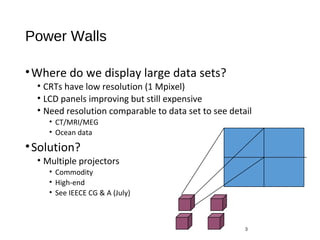
•Where do we display large data sets?
• CRTs have low resolution (1 Mpixel)
• LCD panels improving but still expensive
• Need resolution comparable to data set to see detail
• CT/MRI/MEG
• Ocean data
•Solution?
• Multiple projectors
• Commodity
• High-end
• See IEECE CG & A (July)
3
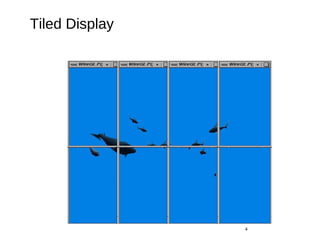
Tiled Display
4
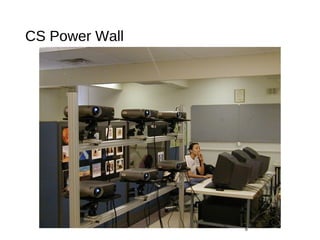
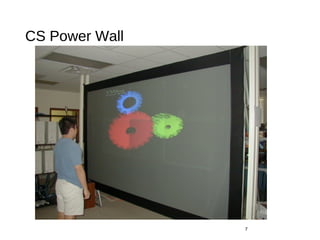
CS Power Wall
• 6 dual processor Intellestations
• G Force 3 Graphics cards
• 6 commodity projectors (1024 x 768)
• Gigabit ethernet
• Back projected screen
• Shared facility with scalable system group
• Investigate OS and network issues
5
CS Power Wall
6
CS Power Wall
7
Power Wall
• Inexpensive solution but there are some problems
• Color matching
• Vignetting
• Alignment
• Overlap areas
•Synching
•Dark field
8
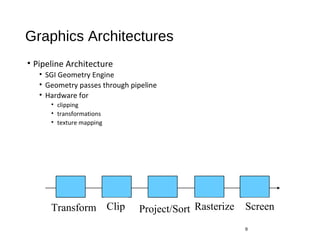
Graphics Architectures
• Pipeline Architecture
• SGI Geometry Engine
• Geometry passes through pipeline
• Hardware for
• clipping
• transformations
• texture mapping
9
Project/SortClipTransform Rasterize Screen
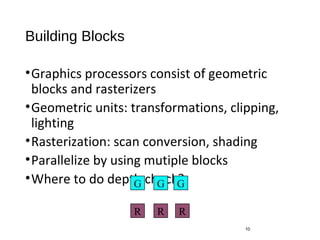
Building Blocks
•Graphics processors consist of geometric
blocks and rasterizers
•Geometric units: transformations, clipping,
lighting
•Rasterization: scan conversion, shading
•Parallelize by using mutiple blocks
•Where to do depth check?
10
R
G G G
R R
Sorting Paradigm
• We can categorize different ways of interconnecting blocks using a
sorting paradigm: each projector is responsible for one area of the
screen. Hence, we must sort the primitives and assign them to the
proper projector
• Algorithms can be categorized by where this sorting occurs
11
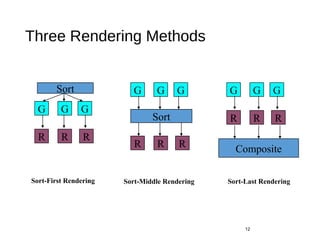
Three Rendering Methods
12
Sort-First Rendering Sort-Middle Rendering Sort-Last Rendering
R
G G G
R R
Sort G G G
R R R
Sort R
G G G
R R
Composite
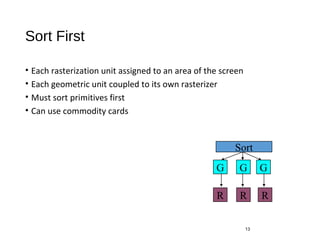
Sort First
• Each rasterization unit assigned to an area of the screen
• Each geometric unit coupled to its own rasterizer
• Must sort primitives first
• Can use commodity cards
13
R
G G G
R R
Sort
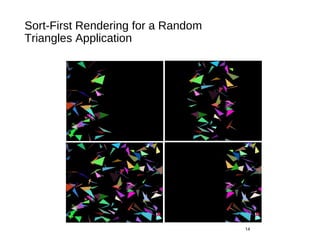
Sort-First Rendering for a Random
Triangles Application
14
Sort Middle
•Geometric units and rasterization units decoupled
•Each geometric unit can be assigned any group of
objects
•Each rasterizer is assigned to an area of the screen
•Must sort between stages
15
G G G
R R R
Sort
Sort Last
• Couple rasterizers and geometric units
• Assign objects to geometric units to load balance or via application
• Composite results at end
16
R
G G G
R R
Composite
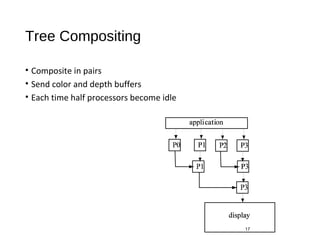
Tree Compositing
• Composite in pairs
• Send color and depth buffers
• Each time half processors become idle
17
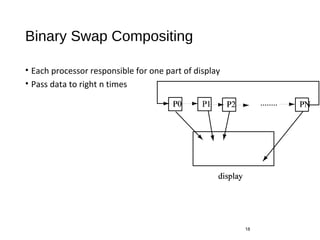
Binary Swap Compositing
• Each processor responsible for one part of display
• Pass data to right n times
18
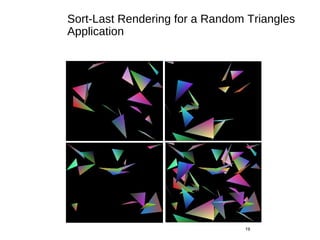
Sort-Last Rendering for a Random Triangles
Application
19
Comparison
• Sort first
• Appealing but hard to implement
• Sort middle
• Used in hardware pipelines
• More difficult to implement with add-on commodity cards
• Sort last
• Easy to implement with a compositing stage
• High network traffic
20
Mapping to Clusters
• Different architectures
• Shared vs distributed memory
• Communication overhead
• Parallel vs distributed algorithms
• Easy to do sort last
• Must evaluate communication cost
• Standard visualization strategies are incorrect if transparency used
21
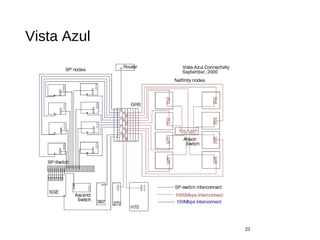
Vista Azul
• Experimental architecture from IBM donated to AHPCC
• Half Intel nodes, half AIX nodes
• Only one (PCI) graphics card per four processors
• Contained a Scalable Graphics Engine (SGE): high speed-high
resolution color buffer that is accessible by all processors
22
Vista Azul
23
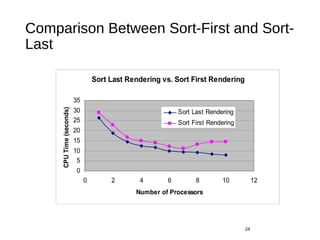
Comparison Between Sort-First and Sort-
Last
24
Sort Last Rendering vs. Sort First Rendering
0
5
10
15
20
25
30
35
0 2 4 6 8 10 12
Number of Processors
CPUTime(seconds)
Sort Last Rendering
Sort First Rendering
Performance on a PC Cluster
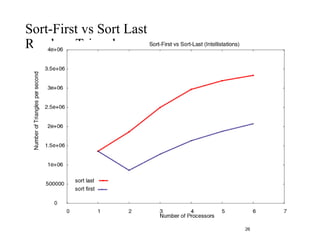
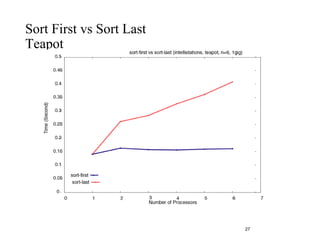
• Following experiments were done by Ye Cong on the CS cluster
• 6 Intellestations
• Gigabit Ethernet
• GForce 3 graphics
• Show the effect of network
25
Sort-First vs Sort Last
Random Triangles
26
Sort First vs Sort Last
Teapot
27
Azul vs Intellistations
28
Software for Parallel Rendering
• Write your own sort-first sort-last
• WireGL/Chromium (Stanford)
• Embed inside package (VTK)
29
WireGL: A Distributed Graphics System
•A software-based parallel rendering system that
unifies the rendering power of a collection of
cluster nodes
•Scalability is achieved by integrating parallel
applications into its sort-first parallel renders
•Each node in the cluster can be either a
rendering client or a rendering server
•Clients submit OpenGL commands concurrently
to servers, which render the final physical image
30
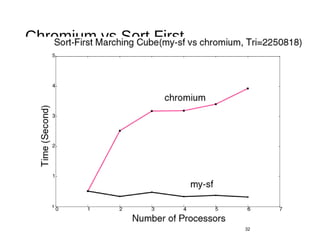
Chromium
• Successor toWireGL
• Allows both sort first and sort last rendering
• Implemented on CS cluster
• Most of gain in performance is bacause Chromium and WireGL can
group state-changing commands separately from rendering
commands
31
Chromium vs Sort First
MRI rotation
32

Parallel Rendering

  • 1.
  • 2.
    Introduction • In manysituations, a standard rendering pipeline might not be sufficient • Need higher resolution display • More primitives than one pipeline can handle • Want to use commodity components to build a system that can render in parallel • Use standard network to connect 2
  • 3.
    Power Walls •Where dowe display large data sets? • CRTs have low resolution (1 Mpixel) • LCD panels improving but still expensive • Need resolution comparable to data set to see detail • CT/MRI/MEG • Ocean data •Solution? • Multiple projectors • Commodity • High-end • See IEECE CG & A (July) 3
  • 4.
  • 5.
    CS Power Wall •6 dual processor Intellestations • G Force 3 Graphics cards • 6 commodity projectors (1024 x 768) • Gigabit ethernet • Back projected screen • Shared facility with scalable system group • Investigate OS and network issues 5
  • 6.
  • 7.
  • 8.
    Power Wall • Inexpensivesolution but there are some problems • Color matching • Vignetting • Alignment • Overlap areas •Synching •Dark field 8
  • 9.
    Graphics Architectures • PipelineArchitecture • SGI Geometry Engine • Geometry passes through pipeline • Hardware for • clipping • transformations • texture mapping 9 Project/SortClipTransform Rasterize Screen
  • 10.
    Building Blocks •Graphics processorsconsist of geometric blocks and rasterizers •Geometric units: transformations, clipping, lighting •Rasterization: scan conversion, shading •Parallelize by using mutiple blocks •Where to do depth check? 10 R G G G R R
  • 11.
    Sorting Paradigm • Wecan categorize different ways of interconnecting blocks using a sorting paradigm: each projector is responsible for one area of the screen. Hence, we must sort the primitives and assign them to the proper projector • Algorithms can be categorized by where this sorting occurs 11
  • 12.
    Three Rendering Methods 12 Sort-FirstRendering Sort-Middle Rendering Sort-Last Rendering R G G G R R Sort G G G R R R Sort R G G G R R Composite
  • 13.
    Sort First • Eachrasterization unit assigned to an area of the screen • Each geometric unit coupled to its own rasterizer • Must sort primitives first • Can use commodity cards 13 R G G G R R Sort
  • 14.
    Sort-First Rendering fora Random Triangles Application 14
  • 15.
    Sort Middle •Geometric unitsand rasterization units decoupled •Each geometric unit can be assigned any group of objects •Each rasterizer is assigned to an area of the screen •Must sort between stages 15 G G G R R R Sort
  • 16.
    Sort Last • Couplerasterizers and geometric units • Assign objects to geometric units to load balance or via application • Composite results at end 16 R G G G R R Composite
  • 17.
    Tree Compositing • Compositein pairs • Send color and depth buffers • Each time half processors become idle 17
  • 18.
    Binary Swap Compositing •Each processor responsible for one part of display • Pass data to right n times 18
  • 19.
    Sort-Last Rendering fora Random Triangles Application 19
  • 20.
    Comparison • Sort first •Appealing but hard to implement • Sort middle • Used in hardware pipelines • More difficult to implement with add-on commodity cards • Sort last • Easy to implement with a compositing stage • High network traffic 20
  • 21.
    Mapping to Clusters •Different architectures • Shared vs distributed memory • Communication overhead • Parallel vs distributed algorithms • Easy to do sort last • Must evaluate communication cost • Standard visualization strategies are incorrect if transparency used 21
  • 22.
    Vista Azul • Experimentalarchitecture from IBM donated to AHPCC • Half Intel nodes, half AIX nodes • Only one (PCI) graphics card per four processors • Contained a Scalable Graphics Engine (SGE): high speed-high resolution color buffer that is accessible by all processors 22
  • 23.
  • 24.
    Comparison Between Sort-Firstand Sort- Last 24 Sort Last Rendering vs. Sort First Rendering 0 5 10 15 20 25 30 35 0 2 4 6 8 10 12 Number of Processors CPUTime(seconds) Sort Last Rendering Sort First Rendering
  • 25.
    Performance on aPC Cluster • Following experiments were done by Ye Cong on the CS cluster • 6 Intellestations • Gigabit Ethernet • GForce 3 graphics • Show the effect of network 25
  • 26.
    Sort-First vs SortLast Random Triangles 26
  • 27.
    Sort First vsSort Last Teapot 27
  • 28.
  • 29.
    Software for ParallelRendering • Write your own sort-first sort-last • WireGL/Chromium (Stanford) • Embed inside package (VTK) 29
  • 30.
    WireGL: A DistributedGraphics System •A software-based parallel rendering system that unifies the rendering power of a collection of cluster nodes •Scalability is achieved by integrating parallel applications into its sort-first parallel renders •Each node in the cluster can be either a rendering client or a rendering server •Clients submit OpenGL commands concurrently to servers, which render the final physical image 30
  • 31.
    Chromium • Successor toWireGL •Allows both sort first and sort last rendering • Implemented on CS cluster • Most of gain in performance is bacause Chromium and WireGL can group state-changing commands separately from rendering commands 31
  • 32.
    Chromium vs SortFirst MRI rotation 32