Models and Architectures
1
Image Formation Revisited
• Can we mimic the synthetic camera model to design graphics
hardware software?
• Application Programmer Interface (API)
• Need only specify
• Objects
• Materials
• Viewer
• Lights
• But how is the API implemented?
2
Physical Approaches
•Ray tracing: follow rays of light from center of
projection until they either are absorbed by
objects or go off to infinity
• Can handle global effects
• Multiple reflections
• Translucent objects
• Slow
• Must have whole data base
available at all times
•Radiosity: Energy based approach
• Very slow
3
Practical Approach
• Process objects one at a time in the order they are generated by the
application
• Can consider only local lighting
• Pipeline architecture
• All steps can be implemented in hardware on the graphics card
4
application
program
display
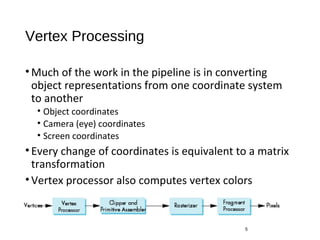
Vertex Processing
•Much of the work in the pipeline is in converting
object representations from one coordinate system
to another
• Object coordinates
• Camera (eye) coordinates
• Screen coordinates
•Every change of coordinates is equivalent to a matrix
transformation
•Vertex processor also computes vertex colors
5
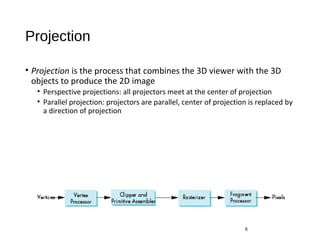
Projection
• Projection is the process that combines the 3D viewer with the 3D
objects to produce the 2D image
• Perspective projections: all projectors meet at the center of projection
• Parallel projection: projectors are parallel, center of projection is replaced by
a direction of projection
6
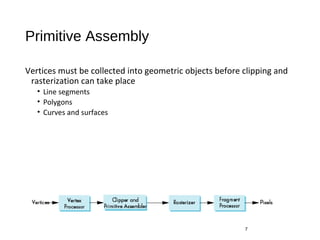
Primitive Assembly
Vertices must be collected into geometric objects before clipping and
rasterization can take place
• Line segments
• Polygons
• Curves and surfaces
7
Clipping
Just as a real camera cannot “see” the whole world, the virtual camera
can only see part of the world or object space
• Objects that are not within this volume are said to be clipped out of the
scene
8
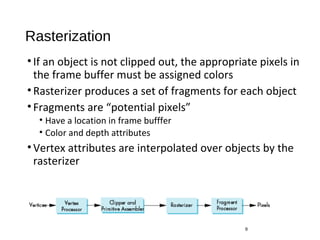
Rasterization
•If an object is not clipped out, the appropriate pixels in
the frame buffer must be assigned colors
•Rasterizer produces a set of fragments for each object
•Fragments are “potential pixels”
• Have a location in frame bufffer
• Color and depth attributes
•Vertex attributes are interpolated over objects by the
rasterizer
9
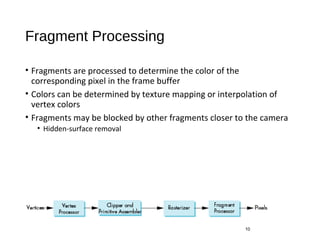
Fragment Processing
• Fragments are processed to determine the color of the
corresponding pixel in the frame buffer
• Colors can be determined by texture mapping or interpolation of
vertex colors
• Fragments may be blocked by other fragments closer to the camera
• Hidden-surface removal
10
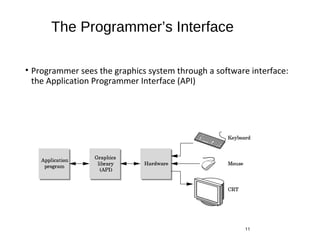
The Programmer’s Interface
• Programmer sees the graphics system through a software interface:
the Application Programmer Interface (API)
11
API Contents
• Functions that specify what we need to form an image
• Objects
• Viewer
• Light Source(s)
• Materials
• Other information
• Input from devices such as mouse and keyboard
• Capabilities of system
12
Object Specification
• Most APIs support a limited set of primitives including
• Points (0D object)
• Line segments (1D objects)
• Polygons (2D objects)
• Some curves and surfaces
• Quadrics
• Parametric polynomials
• All are defined through locations in space or vertices
13
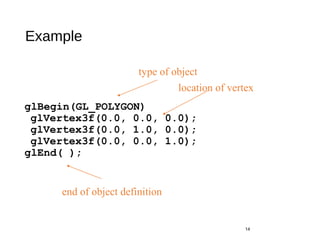
Example
glBegin(GL_POLYGON)
glVertex3f(0.0, 0.0, 0.0);
glVertex3f(0.0, 1.0, 0.0);
glVertex3f(0.0, 0.0, 1.0);
glEnd( );
14
type of object
location of vertex
end of object definition
Camera Specification
• Six degrees of freedom
• Position of center of lens
• Orientation
• Lens
• Film size
• Orientation of film plane
15
Lights and Materials
• Types of lights
• Point sources vs distributed sources
• Spot lights
• Near and far sources
• Color properties
• Material properties
• Absorption: color properties
• Scattering
• Diffuse
• Specular
16

Models and architectures

  • 1.
  • 2.
    Image Formation Revisited •Can we mimic the synthetic camera model to design graphics hardware software? • Application Programmer Interface (API) • Need only specify • Objects • Materials • Viewer • Lights • But how is the API implemented? 2
  • 3.
    Physical Approaches •Ray tracing:follow rays of light from center of projection until they either are absorbed by objects or go off to infinity • Can handle global effects • Multiple reflections • Translucent objects • Slow • Must have whole data base available at all times •Radiosity: Energy based approach • Very slow 3
  • 4.
    Practical Approach • Processobjects one at a time in the order they are generated by the application • Can consider only local lighting • Pipeline architecture • All steps can be implemented in hardware on the graphics card 4 application program display
  • 5.
    Vertex Processing •Much ofthe work in the pipeline is in converting object representations from one coordinate system to another • Object coordinates • Camera (eye) coordinates • Screen coordinates •Every change of coordinates is equivalent to a matrix transformation •Vertex processor also computes vertex colors 5
  • 6.
    Projection • Projection isthe process that combines the 3D viewer with the 3D objects to produce the 2D image • Perspective projections: all projectors meet at the center of projection • Parallel projection: projectors are parallel, center of projection is replaced by a direction of projection 6
  • 7.
    Primitive Assembly Vertices mustbe collected into geometric objects before clipping and rasterization can take place • Line segments • Polygons • Curves and surfaces 7
  • 8.
    Clipping Just as areal camera cannot “see” the whole world, the virtual camera can only see part of the world or object space • Objects that are not within this volume are said to be clipped out of the scene 8
  • 9.
    Rasterization •If an objectis not clipped out, the appropriate pixels in the frame buffer must be assigned colors •Rasterizer produces a set of fragments for each object •Fragments are “potential pixels” • Have a location in frame bufffer • Color and depth attributes •Vertex attributes are interpolated over objects by the rasterizer 9
  • 10.
    Fragment Processing • Fragmentsare processed to determine the color of the corresponding pixel in the frame buffer • Colors can be determined by texture mapping or interpolation of vertex colors • Fragments may be blocked by other fragments closer to the camera • Hidden-surface removal 10
  • 11.
    The Programmer’s Interface •Programmer sees the graphics system through a software interface: the Application Programmer Interface (API) 11
  • 12.
    API Contents • Functionsthat specify what we need to form an image • Objects • Viewer • Light Source(s) • Materials • Other information • Input from devices such as mouse and keyboard • Capabilities of system 12
  • 13.
    Object Specification • MostAPIs support a limited set of primitives including • Points (0D object) • Line segments (1D objects) • Polygons (2D objects) • Some curves and surfaces • Quadrics • Parametric polynomials • All are defined through locations in space or vertices 13
  • 14.
    Example glBegin(GL_POLYGON) glVertex3f(0.0, 0.0, 0.0); glVertex3f(0.0,1.0, 0.0); glVertex3f(0.0, 0.0, 1.0); glEnd( ); 14 type of object location of vertex end of object definition
  • 15.
    Camera Specification • Sixdegrees of freedom • Position of center of lens • Orientation • Lens • Film size • Orientation of film plane 15
  • 16.
    Lights and Materials •Types of lights • Point sources vs distributed sources • Spot lights • Near and far sources • Color properties • Material properties • Absorption: color properties • Scattering • Diffuse • Specular 16