GraphChi
Large-Scale Graph Computation on Just a PC
Presented by :- Rathod Jay
1
Can’t we just use the
Cloud?
Introduction
• Designing scalable systems is challenging
• Graph-based abstractions:- Pregel and GraphLab
• Distributing the computation across the clusters
– challenge of partitioning the graph across cluster nodes
• Would it be possible to do advanced graph computation on just a
personal computer?
2
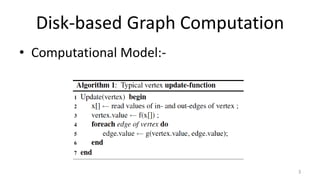
Disk-based Graph Computation
• Computational Model:-
3
Review of Possible Solutions
o Standard Sparse Graph Formats
• compressed sparse row (CSR)
• compressed sparse column (CSC)
o SSD as a memory extension
o Exploiting locality
o Graph compression
4
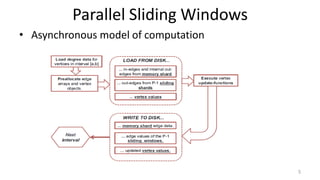
Parallel Sliding Windows
• Asynchronous model of computation
5
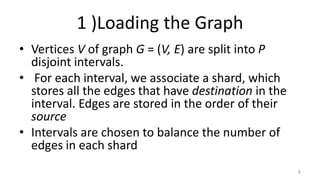
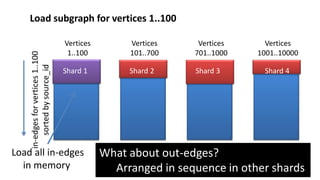
1 )Loading the Graph
• Vertices V of graph G = (V, E) are split into P
disjoint intervals.
• For each interval, we associate a shard, which
stores all the edges that have destination in the
interval. Edges are stored in the order of their
source
• Intervals are chosen to balance the number of
edges in each shard
6
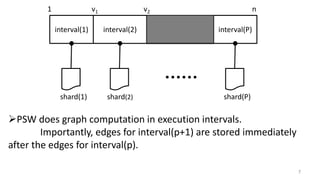
PSW does graph computation in execution intervals.
Importantly, edges for interval(p+1) are stored immediately
after the edges for interval(p).
7
shard(1)
interval(1) interval(2) interval(P)
shard(2) shard(P)
1 nv1 v2
Vertices
1..100
Vertices
101..700
Vertices
701..1000
Vertices
1001..10000
Load all in-edges
in memory
Load subgraph for vertices 1..100
What about out-edges?
Arranged in sequence in other shards
Shard 2 Shard 3 Shard 4Shard 1
in-edgesforvertices1..100
sortedbysource_id
Shard 1
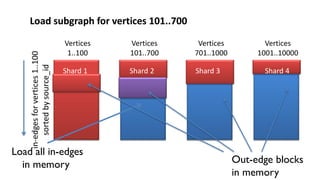
Load all in-edges
in memory
Load subgraph for vertices 101..700
Shard 2 Shard 3 Shard 4
Vertices
1..100
Vertices
101..700
Vertices
701..1000
Vertices
1001..10000
Out-edge blocks
in memory
in-edgesforvertices1..100
sortedbysource_id
2 )Parallel Updates
• External determinism
• Critical vertices are updated in sequential
order.
• Non-critical vertices do not share edges with
other vertices in the interval, and can be
updated safely in parallel
10
3 )Updating Graph to Disk
• Finally, the updated edge values need to be
written to disk and be visible to the next
execution interval.
• PSW can do this efficiently
• Edges are referenced as pointers to the cached
blocks
11
Application
• SpMV kernels, Pagerank
• Graph Mining
• Connected Components,
• Community Detection
• Triangle Counting
• Collaborative Filtering
• Probabilistic Graphical Models
12
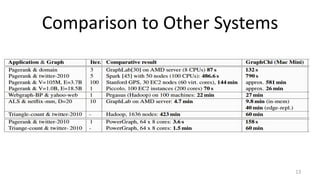
Comparison to Other Systems
13
Conclusions
• MapReduce deliver disappointing performance
when applied to real-world graphs
• PSW requires only a small number of sequential
disk block transfers, allowing it to perform well
on both SSDs and traditional hard disks.
• It can efficiently solve problems that were
previously only accessible to large-scale cluster
computing
14
References
• A. Aggarwal, J. Vitter, et al. The input/output complexity of sorting and related
problems. Communications of the ACM, 31(9):1116–1127, 1988.
• R. Chen, X. Weng, B. He, and M. Yang. Large graph processing in the cloud. In
Proceedings of the 2010 ACM SIGMOD International Conference on
Management of data, SIGMOD ’10, pages 1123–1126,Indianapolis, Indiana,
USA, 2010. ACM.
• G. Blelloch, H. Simhadri, and K. Tangwongsan. Parallel and i/o efficient set
covering algorithms. In Proc. of the 24th ACM symposium on Parallelism in
algorithms and architectures, pages 82–90, 2012.
• Complete source-code for the system and applications is released in open
source: http://graphchi.org.
15
16

Graph chi

  • 1.
    GraphChi Large-Scale Graph Computationon Just a PC Presented by :- Rathod Jay 1 Can’t we just use the Cloud?
  • 2.
    Introduction • Designing scalablesystems is challenging • Graph-based abstractions:- Pregel and GraphLab • Distributing the computation across the clusters – challenge of partitioning the graph across cluster nodes • Would it be possible to do advanced graph computation on just a personal computer? 2
  • 3.
    Disk-based Graph Computation •Computational Model:- 3
  • 4.
    Review of PossibleSolutions o Standard Sparse Graph Formats • compressed sparse row (CSR) • compressed sparse column (CSC) o SSD as a memory extension o Exploiting locality o Graph compression 4
  • 5.
    Parallel Sliding Windows •Asynchronous model of computation 5
  • 6.
    1 )Loading theGraph • Vertices V of graph G = (V, E) are split into P disjoint intervals. • For each interval, we associate a shard, which stores all the edges that have destination in the interval. Edges are stored in the order of their source • Intervals are chosen to balance the number of edges in each shard 6
  • 7.
    PSW does graphcomputation in execution intervals. Importantly, edges for interval(p+1) are stored immediately after the edges for interval(p). 7 shard(1) interval(1) interval(2) interval(P) shard(2) shard(P) 1 nv1 v2
  • 8.
    Vertices 1..100 Vertices 101..700 Vertices 701..1000 Vertices 1001..10000 Load all in-edges inmemory Load subgraph for vertices 1..100 What about out-edges? Arranged in sequence in other shards Shard 2 Shard 3 Shard 4Shard 1 in-edgesforvertices1..100 sortedbysource_id
  • 9.
    Shard 1 Load allin-edges in memory Load subgraph for vertices 101..700 Shard 2 Shard 3 Shard 4 Vertices 1..100 Vertices 101..700 Vertices 701..1000 Vertices 1001..10000 Out-edge blocks in memory in-edgesforvertices1..100 sortedbysource_id
  • 10.
    2 )Parallel Updates •External determinism • Critical vertices are updated in sequential order. • Non-critical vertices do not share edges with other vertices in the interval, and can be updated safely in parallel 10
  • 11.
    3 )Updating Graphto Disk • Finally, the updated edge values need to be written to disk and be visible to the next execution interval. • PSW can do this efficiently • Edges are referenced as pointers to the cached blocks 11
  • 12.
    Application • SpMV kernels,Pagerank • Graph Mining • Connected Components, • Community Detection • Triangle Counting • Collaborative Filtering • Probabilistic Graphical Models 12
  • 13.
  • 14.
    Conclusions • MapReduce deliverdisappointing performance when applied to real-world graphs • PSW requires only a small number of sequential disk block transfers, allowing it to perform well on both SSDs and traditional hard disks. • It can efficiently solve problems that were previously only accessible to large-scale cluster computing 14
  • 15.
    References • A. Aggarwal,J. Vitter, et al. The input/output complexity of sorting and related problems. Communications of the ACM, 31(9):1116–1127, 1988. • R. Chen, X. Weng, B. He, and M. Yang. Large graph processing in the cloud. In Proceedings of the 2010 ACM SIGMOD International Conference on Management of data, SIGMOD ’10, pages 1123–1126,Indianapolis, Indiana, USA, 2010. ACM. • G. Blelloch, H. Simhadri, and K. Tangwongsan. Parallel and i/o efficient set covering algorithms. In Proc. of the 24th ACM symposium on Parallelism in algorithms and architectures, pages 82–90, 2012. • Complete source-code for the system and applications is released in open source: http://graphchi.org. 15
  • 16.