Relations -Discrete Mathematics
Ms.Rachana Pathak
(rachanarpathak@gmail.com)
Assistant Professor, Dept of Computer Science and Engineering
Walchand Institute of Technology, Solapur
(www.witsolapur.org)
TARGET GATE CSE / IT 2019
Learning Outcome
2Walchand Institute of Technology, Solapur
At the end of this session,
Students will be able to explain Relations – domain and range, and solve
problems based on Relations.
Prerequisite
• Basics of Discrete Mathematics
• Students from CSE/IT Engineering branch
• Students appearing for GATE (CS)
Walchand Institute of Technology, Solapur 3
Introduction
Walchand Institute of Technology, Solapur 4
What is a
relation?
Walchand Institute of Technology, Solapur 5
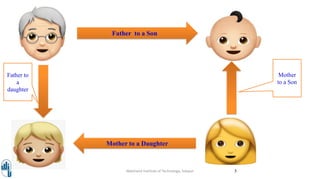
Father to a Son
Father to
a
daughter
Mother
to a Son
Mother to a Daughter
Walchand Institute of Technology, Solapur 6
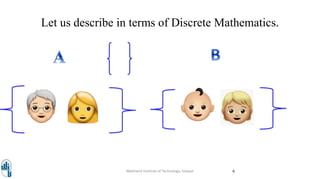
Let us describe in terms of Discrete Mathematics.
Walchand Institute of Technology, Solapur 7
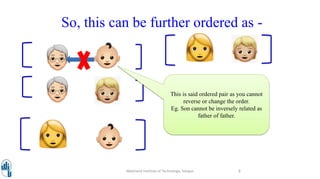
So, this can be further ordered as -
Walchand Institute of Technology, Solapur 8
This is said ordered pair as you cannot
reverse or change the order.
Eg. Son cannot be inversely related as
father of father.
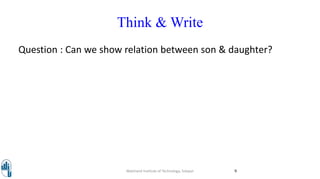
Think & Write
Question : Can we show relation between son & daughter?
Walchand Institute of Technology, Solapur 9
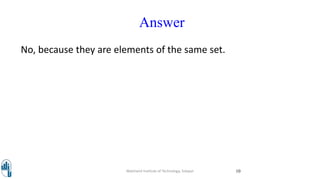
Answer
No, because they are elements of the same set.
Walchand Institute of Technology, Solapur 10
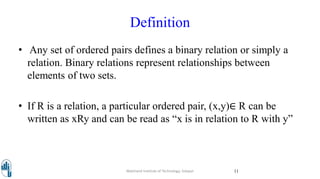
Definition
• Any set of ordered pairs defines a binary relation or simply a
relation. Binary relations represent relationships between
elements of two sets.
• If R is a relation, a particular ordered pair, (x,y)∈ R can be
written as xRy and can be read as “x is in relation to R with y”
Walchand Institute of Technology, Solapur 11
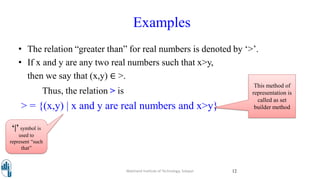
Examples
• The relation “greater than” for real numbers is denoted by ‘>’.
• If x and y are any two real numbers such that x>y,
then we say that (x,y) ∈ >.
Thus, the relation > is
> = {(x,y) | x and y are real numbers and x>y}
Walchand Institute of Technology, Solapur 12
This method of
representation is
called as set
builder method
‘|’ symbol is
used to
represent “such
that”
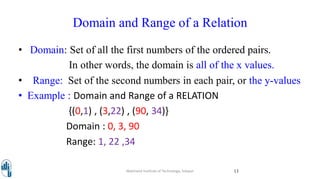
Domain and Range of a Relation
• Domain: Set of all the first numbers of the ordered pairs.
In other words, the domain is all of the x values.
• Range: Set of the second numbers in each pair, or the y-values
• Example : Domain and Range of a RELATION
{(0,1) , (3,22) , (90, 34)}
Domain : 0, 3, 90
Range: 1, 22 ,34
Walchand Institute of Technology, Solapur 13
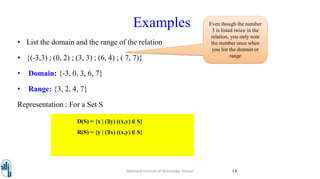
Examples
• List the domain and the range of the relation
• {(-3,3) ; (0, 2) ; (3, 3) ; (6, 4) ; ( 7, 7)}
• Domain: {-3, 0, 3, 6, 7}
• Range: {3, 2, 4, 7}
Representation : For a Set S
Walchand Institute of Technology, Solapur 14
Even though the number
3 is listed twice in the
relation, you only note
the number once when
you list the domain or
range
D(S) = {x | (∃y) ((x,y) ∈ S}
R(S) = {y | (∃x) ((x,y) ∈ S}
Conclusion :
In this session, We have studied all about Relations.
Walchand Institute of Technology, Solapur 15
References
• 1. Discrete mathematical structures with applications to computer science -- J. P.
Tremblay & R. Manohar (MGH International)
• Reference Books:
• 1. Discrete Mathematics with combinatorics and graph theory- S. SNTHA
(CENGAGE Learning)
• 2. Discrete Mathematical Structures – Bernard Kolman, Robert C. Busby (Pearson
Education)
• 3. Discrete mathematics -- Liu (MGH)
16Walchand Institute of Technology, Solapur
Thank You !!!
Walchand Institute of Technology, Solapur

Relations in Discrete Mathematical Structures

  • 1.
    Relations -Discrete Mathematics Ms.RachanaPathak (rachanarpathak@gmail.com) Assistant Professor, Dept of Computer Science and Engineering Walchand Institute of Technology, Solapur (www.witsolapur.org) TARGET GATE CSE / IT 2019
  • 2.
    Learning Outcome 2Walchand Instituteof Technology, Solapur At the end of this session, Students will be able to explain Relations – domain and range, and solve problems based on Relations.
  • 3.
    Prerequisite • Basics ofDiscrete Mathematics • Students from CSE/IT Engineering branch • Students appearing for GATE (CS) Walchand Institute of Technology, Solapur 3
  • 4.
    Introduction Walchand Institute ofTechnology, Solapur 4 What is a relation?
  • 5.
    Walchand Institute ofTechnology, Solapur 5 Father to a Son Father to a daughter Mother to a Son Mother to a Daughter
  • 6.
    Walchand Institute ofTechnology, Solapur 6 Let us describe in terms of Discrete Mathematics.
  • 7.
    Walchand Institute ofTechnology, Solapur 7
  • 8.
    So, this canbe further ordered as - Walchand Institute of Technology, Solapur 8 This is said ordered pair as you cannot reverse or change the order. Eg. Son cannot be inversely related as father of father.
  • 9.
    Think & Write Question: Can we show relation between son & daughter? Walchand Institute of Technology, Solapur 9
  • 10.
    Answer No, because theyare elements of the same set. Walchand Institute of Technology, Solapur 10
  • 11.
    Definition • Any setof ordered pairs defines a binary relation or simply a relation. Binary relations represent relationships between elements of two sets. • If R is a relation, a particular ordered pair, (x,y)∈ R can be written as xRy and can be read as “x is in relation to R with y” Walchand Institute of Technology, Solapur 11
  • 12.
    Examples • The relation“greater than” for real numbers is denoted by ‘>’. • If x and y are any two real numbers such that x>y, then we say that (x,y) ∈ >. Thus, the relation > is > = {(x,y) | x and y are real numbers and x>y} Walchand Institute of Technology, Solapur 12 This method of representation is called as set builder method ‘|’ symbol is used to represent “such that”
  • 13.
    Domain and Rangeof a Relation • Domain: Set of all the first numbers of the ordered pairs. In other words, the domain is all of the x values. • Range: Set of the second numbers in each pair, or the y-values • Example : Domain and Range of a RELATION {(0,1) , (3,22) , (90, 34)} Domain : 0, 3, 90 Range: 1, 22 ,34 Walchand Institute of Technology, Solapur 13
  • 14.
    Examples • List thedomain and the range of the relation • {(-3,3) ; (0, 2) ; (3, 3) ; (6, 4) ; ( 7, 7)} • Domain: {-3, 0, 3, 6, 7} • Range: {3, 2, 4, 7} Representation : For a Set S Walchand Institute of Technology, Solapur 14 Even though the number 3 is listed twice in the relation, you only note the number once when you list the domain or range D(S) = {x | (∃y) ((x,y) ∈ S} R(S) = {y | (∃x) ((x,y) ∈ S}
  • 15.
    Conclusion : In thissession, We have studied all about Relations. Walchand Institute of Technology, Solapur 15
  • 16.
    References • 1. Discretemathematical structures with applications to computer science -- J. P. Tremblay & R. Manohar (MGH International) • Reference Books: • 1. Discrete Mathematics with combinatorics and graph theory- S. SNTHA (CENGAGE Learning) • 2. Discrete Mathematical Structures – Bernard Kolman, Robert C. Busby (Pearson Education) • 3. Discrete mathematics -- Liu (MGH) 16Walchand Institute of Technology, Solapur
  • 17.
    Thank You !!! WalchandInstitute of Technology, Solapur