Dara Halaseh .
Amani Shaheen .
Zaina Abuhatab .
Supervised by Prof. Khaleel AL Bataineh.
Department of English Language &
Translation
 Amman Arab University
Paralanguage:
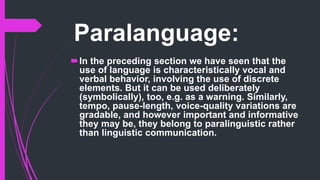
In the preceding section we have seen that the
use of language is characteristically vocal and
verbal behavior, involving the use of discrete
elements. But it can be used deliberately
(symbolically), too, e.g. as a warning. Similarly,
tempo, pause-length, voice-quality variations are
gradable, and however important and informative
they may be, they belong to paralinguistic rather
than linguistic communication.
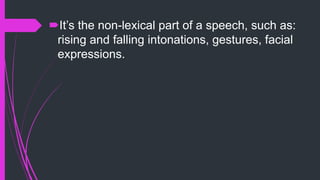
It’s the non-lexical part of a speech, such as:
rising and falling intonations, gestures, facial
expressions.
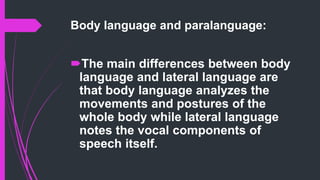
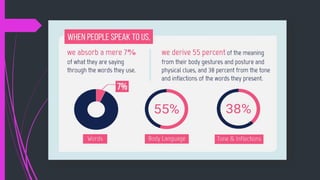
Body language and paralanguage:
The main differences between body
language and lateral language are
that body language analyzes the
movements and postures of the
whole body while lateral language
notes the vocal components of
speech itself.
It is the spoken phonological language
that acoustically associated with, and
not of, a speech, but is complementary
to it and affects its meaning, such as
adding to, or even reflecting, meaning.
Also introduced was auxiliary language,
adjoining language, language
analogues, paralingualism or
paralingualism.
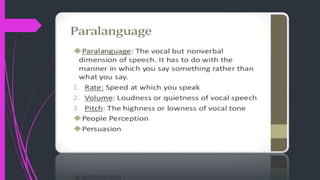
Paralanguage
Paralanguage
Paralanguage

Paralanguage

  • 1.
    Dara Halaseh . AmaniShaheen . Zaina Abuhatab . Supervised by Prof. Khaleel AL Bataineh. Department of English Language & Translation  Amman Arab University
  • 4.
    Paralanguage: In the precedingsection we have seen that the use of language is characteristically vocal and verbal behavior, involving the use of discrete elements. But it can be used deliberately (symbolically), too, e.g. as a warning. Similarly, tempo, pause-length, voice-quality variations are gradable, and however important and informative they may be, they belong to paralinguistic rather than linguistic communication.
  • 5.
    It’s the non-lexicalpart of a speech, such as: rising and falling intonations, gestures, facial expressions.
  • 6.
    Body language andparalanguage: The main differences between body language and lateral language are that body language analyzes the movements and postures of the whole body while lateral language notes the vocal components of speech itself.
  • 7.
    It is thespoken phonological language that acoustically associated with, and not of, a speech, but is complementary to it and affects its meaning, such as adding to, or even reflecting, meaning. Also introduced was auxiliary language, adjoining language, language analogues, paralingualism or paralingualism.