Introducing of Phonetics
and Phonology.
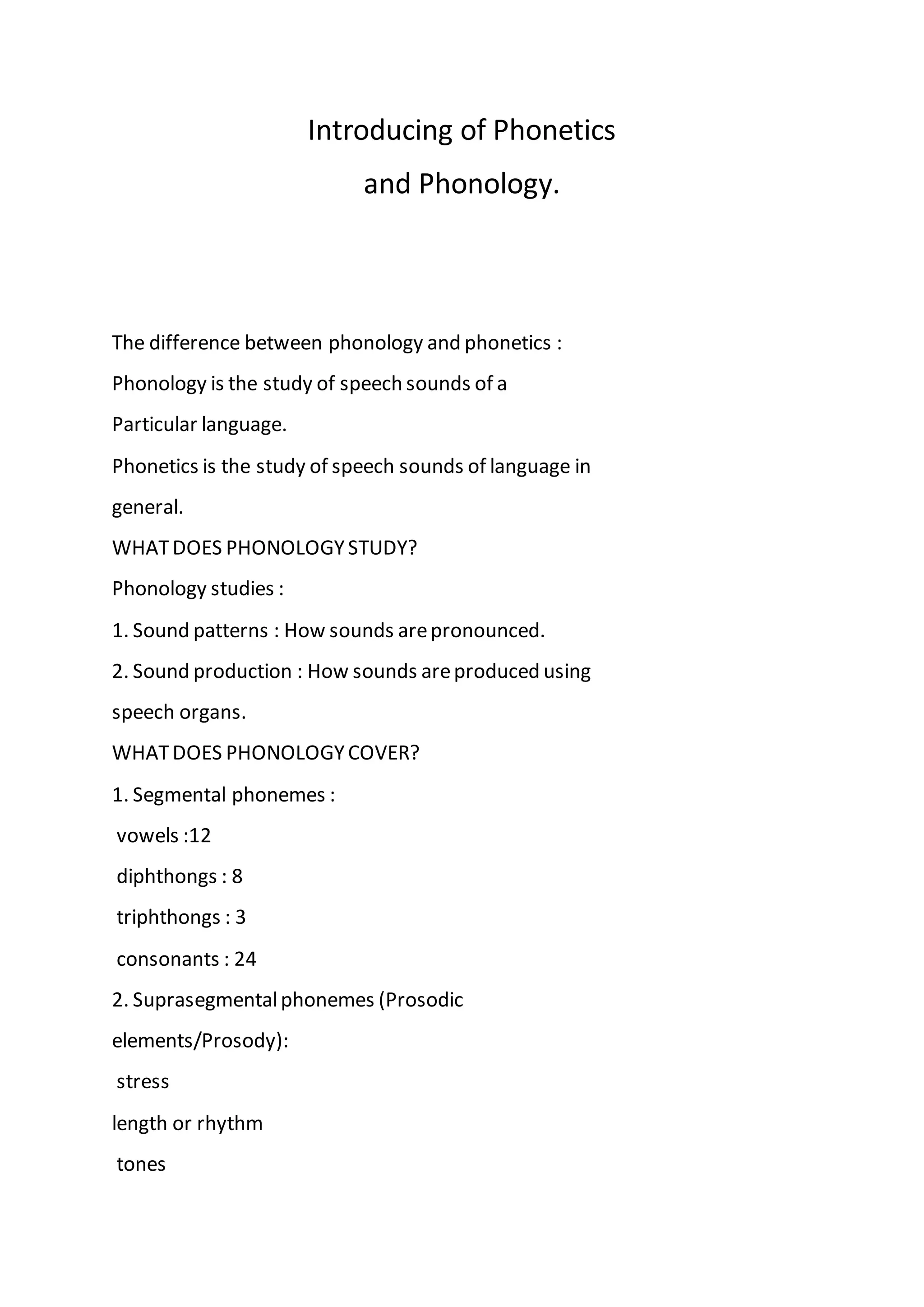
The difference between phonology and phonetics :
Phonology is the study of speech sounds of a
Particular language.
Phonetics is the study of speech sounds of language in
general.
WHATDOES PHONOLOGYSTUDY?
Phonology studies :
1. Sound patterns : How sounds arepronounced.
2. Sound production : How sounds areproduced using
speech organs.
WHATDOES PHONOLOGYCOVER?
1. Segmental phonemes :
vowels :12
diphthongs : 8
triphthongs : 3
consonants : 24
2. Suprasegmentalphonemes (Prosodic
elements/Prosody):
stress
length or rhythm
tones
intonations
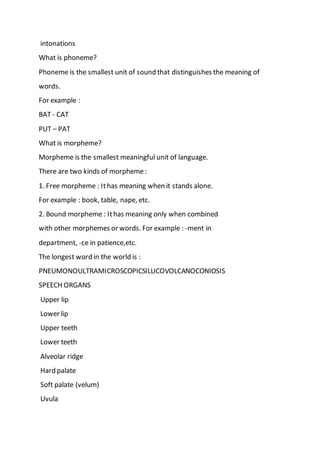
What is phoneme?
Phoneme is the smallest unit of sound that distinguishes the meaning of
words.
For example :
BAT - CAT
PUT – PAT
What is morpheme?
Morpheme is the smallest meaningful unit of language.
There are two kinds of morpheme:
1. Free morpheme : Ithas meaning when it stands alone.
For example : book, table, nape, etc.
2. Bound morpheme : Ithas meaning only when combined
with other morphemes or words. For example : -ment in
department, -ce in patience,etc.
The longest word in the world is :
PNEUMONOULTRAMICROSCOPICSILLICOVOLCANOCONIOSIS
SPEECH ORGANS
Upper lip
Lower lip
Upper teeth
Lower teeth
Alveolar ridge
Hard palate
Soft palate (velum)
Uvula
Pharynx
Trachea
Epiglottis
Larynx
Vocal cords
Apex (tongue tip)
Blades
Lungs
HOW ARE SOUNDS PRODUCED?
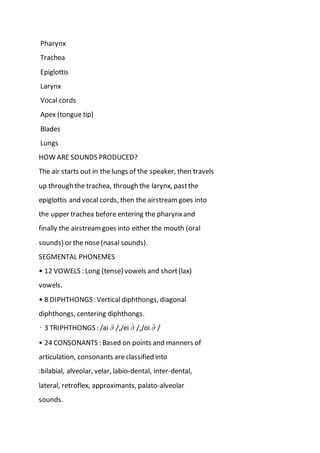
The air starts out in the lungs of the speaker, then travels
up through the trachea, through the larynx, pastthe
epiglottis and vocal cords, then the airstream goes into
the upper trachea before entering the pharynxand
finally the airstreamgoes into either the mouth (oral
sounds) or the nose(nasal sounds).
SEGMENTAL PHONEMES
• 12 VOWELS : Long (tense) vowels and short(lax)
vowels.
• 8 DIPHTHONGS: Vertical diphthongs, diagonal
diphthongs, centering diphthongs.
• 3 TRIPHTHONGS : /ai∂/,/ei∂/,/oi∂/
• 24 CONSONANTS : Based on points and manners of
articulation, consonants areclassified into
:bilabial, alveolar, velar, labio-dental, inter-dental,
lateral, retroflex, approximants, palato-alveolar
sounds.
altogether

The difference between phonology and phonetics

  • 1.
    Introducing of Phonetics andPhonology. The difference between phonology and phonetics : Phonology is the study of speech sounds of a Particular language. Phonetics is the study of speech sounds of language in general. WHATDOES PHONOLOGYSTUDY? Phonology studies : 1. Sound patterns : How sounds arepronounced. 2. Sound production : How sounds areproduced using speech organs. WHATDOES PHONOLOGYCOVER? 1. Segmental phonemes : vowels :12 diphthongs : 8 triphthongs : 3 consonants : 24 2. Suprasegmentalphonemes (Prosodic elements/Prosody): stress length or rhythm tones
  • 2.
    intonations What is phoneme? Phonemeis the smallest unit of sound that distinguishes the meaning of words. For example : BAT - CAT PUT – PAT What is morpheme? Morpheme is the smallest meaningful unit of language. There are two kinds of morpheme: 1. Free morpheme : Ithas meaning when it stands alone. For example : book, table, nape, etc. 2. Bound morpheme : Ithas meaning only when combined with other morphemes or words. For example : -ment in department, -ce in patience,etc. The longest word in the world is : PNEUMONOULTRAMICROSCOPICSILLICOVOLCANOCONIOSIS SPEECH ORGANS Upper lip Lower lip Upper teeth Lower teeth Alveolar ridge Hard palate Soft palate (velum) Uvula
  • 3.
    Pharynx Trachea Epiglottis Larynx Vocal cords Apex (tonguetip) Blades Lungs HOW ARE SOUNDS PRODUCED? The air starts out in the lungs of the speaker, then travels up through the trachea, through the larynx, pastthe epiglottis and vocal cords, then the airstream goes into the upper trachea before entering the pharynxand finally the airstreamgoes into either the mouth (oral sounds) or the nose(nasal sounds). SEGMENTAL PHONEMES • 12 VOWELS : Long (tense) vowels and short(lax) vowels. • 8 DIPHTHONGS: Vertical diphthongs, diagonal diphthongs, centering diphthongs. • 3 TRIPHTHONGS : /ai∂/,/ei∂/,/oi∂/ • 24 CONSONANTS : Based on points and manners of articulation, consonants areclassified into :bilabial, alveolar, velar, labio-dental, inter-dental, lateral, retroflex, approximants, palato-alveolar sounds.
  • 4.