we. create. space.

Kayser-Threde GmbH

The ExoMars Sample Handling and Distribution Subsystem
(SPDS)

Space
Industrial Applications

L. Richter, P. Hofmann, Q. Mühlbauer, R. Paul, D. Redlich (Kayser-Threde
GmbH, Munich, Germany), S.J. Antony (University of Leeds, UK)
Pietro Baglioni and Stephen Durrant, ESA/ESTEC, Noordwijk, The Netherlands
Fabio Musso, Thales Alenia Space, Torino, Italy

ISTVS 7th Americas Regional Conference, 4 - 7 November 2013

www.kayser–threde.com

1
Overview
 Recent results from on-going development of Sample Processing
and Distribution Subsystem (SPDS) for ExoMars rover
 Programmatic plans for evolutions of SPDS design targeted to
other missions
 Development activities on regolith sampling devices

2

20/12/2013

Kayser-Threde Presentation

2
3

20/12/2013

Kayser-Threde Presentation

3
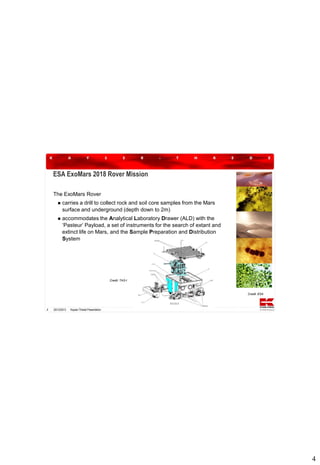
ESA ExoMars 2018 Rover Mission
The ExoMars Rover


carries a drill to collect rock and soil core samples from the Mars
surface and underground (depth down to 2m)



accommodates the Analytical Laboratory Drawer (ALD) with the
‘Pasteur’ Payload, a set of instruments for the search of extant and
extinct life on Mars, and the Sample Preparation and Distribution
System

Credit: TAS-I

Credit: ESA

4

20/12/2013

Kayser-Threde Presentation

4
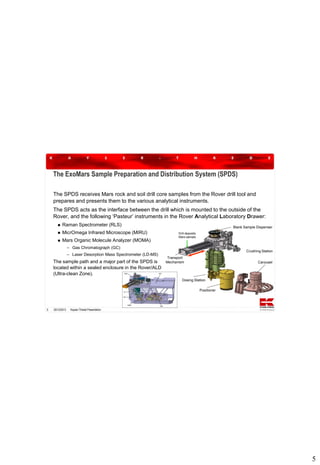
The ExoMars Sample Preparation and Distribution System (SPDS)
The SPDS receives Mars rock and soil drill core samples from the Rover drill tool and
prepares and presents them to the various analytical instruments.
The SPDS acts as the interface between the drill which is mounted to the outside of the
Rover, and the following ‘Pasteur’ instruments in the Rover Analytical Laboratory Drawer:


Raman Spectrometer (RLS)



MicrOmega Infrared Microscope (MIRU)



Mars Organic Molecule Analyzer (MOMA)

Blank Sample Dispenser
Drill deposits
Mars sample

– Gas Chromatograph (GC)
– Laser Desorption Mass Spectrometer (LD-MS)

The sample path and a major part of the SPDS is
located within a sealed enclosure in the Rover/ALD
(Ultra-clean Zone).

Crushing Station
Transport
Mechanism

Carousel

Dosing Station
Positioner

5

20/12/2013

Kayser-Threde Presentation

5
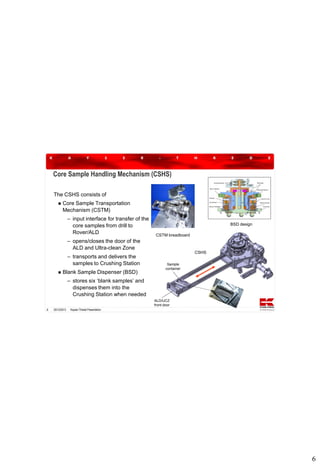
Core Sample Handling Mechanism (CSHS)
The CSHS consists of


Core Sample Transportation
Mechanism (CSTM)
– input interface for transfer of the
core samples from drill to
Rover/ALD

BSD design
CSTM breadboard

– opens/closes the door of the
ALD and Ultra-clean Zone
– transports and delivers the
samples to Crushing Station


Blank Sample Dispenser (BSD)

CSHS
Sample
container

– stores six ‘blank samples’ and
dispenses them into the
Crushing Station when needed
ALD/UCZ
front door
6

20/12/2013

Kayser-Threde Presentation

6
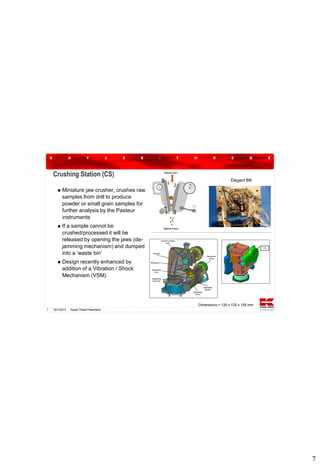
Crushing Station (CS)

Material Input

Elegant BB


Miniature jaw crusher, crushes raw
samples from drill to produce
powder or small grain samples for
further analysis by the Pasteur
instruments



If a sample cannot be
crushed/processed it will be
released by opening the jaws (dejamming mechanism) and dumped
into a ‘waste bin’



Design recently enhanced by
addition of a Vibration / Shock
Mechanism (VSM)

Material Output

Dimensions < 130 x 125 x 155 mm
7

20/12/2013

Kayser-Threde Presentation

7
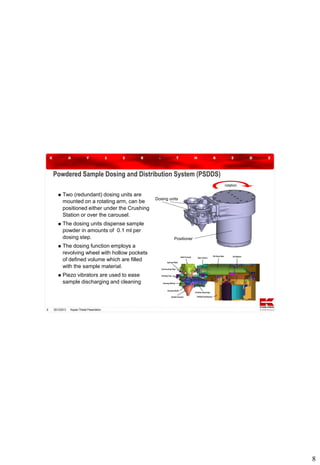
Powdered Sample Dosing and Distribution System (PSDDS)
rotation



Two (redundant) dosing units are
mounted on a rotating arm, can be
positioned either under the Crushing
Station or over the carousel.





The dosing function employs a
revolving wheel with hollow pockets
of defined volume which are filled
with the sample material.



8

The dosing units dispense sample
powder in amounts of 0.1 ml per
dosing step.

Dosing units

Piezo vibrators are used to ease
sample discharging and cleaning

20/12/2013

Positioner

Kayser-Threde Presentation

8
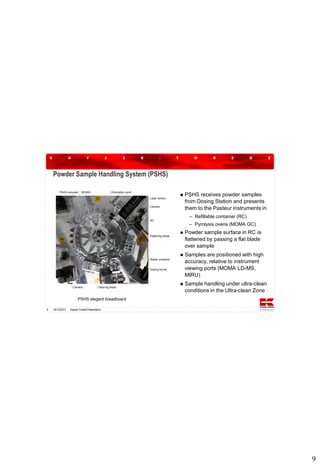
Powder Sample Handling System (PSHS)
PSHS carousel

MOMA

Orientation point


Laser sensor
Camera

PSHS receives powder samples
from Dosing Station and presents
them to the Pasteur instruments in
– Refillable container (RC)

RC

– Pyrolysis ovens (MOMA GC)


Powder sample surface in RC is
flattened by passing a flat blade
over sample



Samples are positioned with high
accuracy, relative to instrument
viewing ports (MOMA LD-MS,
MIRU)



Sample handling under ultra-clean
conditions in the Ultra-clean Zone

Flattening blade

Waste container

Dosing funnel

Camera

Cleaning blade

PSHS elegant breadboard
9

20/12/2013

Kayser-Threde Presentation

9
Effect of Mars Gravity
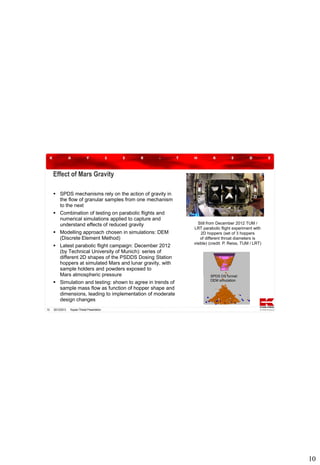
 SPDS mechanisms rely on the action of gravity in
the flow of granular samples from one mechanism
to the next
 Combination of testing on parabolic flights and
numerical simulations applied to capture and
understand effects of reduced gravity
 Modelling approach chosen in simulations: DEM
(Discrete Element Method)
 Latest parabolic flight campaign: December 2012
(by Technical University of Munich): series of
different 2D shapes of the PSDDS Dosing Station
hoppers at simulated Mars and lunar gravity, with
sample holders and powders exposed to
Mars atmospheric pressure
 Simulation and testing: shown to agree in trends of
sample mass flow as function of hopper shape and
dimensions, leading to implementation of moderate
design changes
10

20/12/2013

Still from December 2012 TUM /
LRT parabolic flight experiment with
2D hoppers (set of 3 hoppers
of different throat diameters is
visible) (credit: P. Reiss, TUM / LRT)

SPDS DS funnel:
DEM simulation

Kayser-Threde Presentation

10
Effect of Mars Gravity

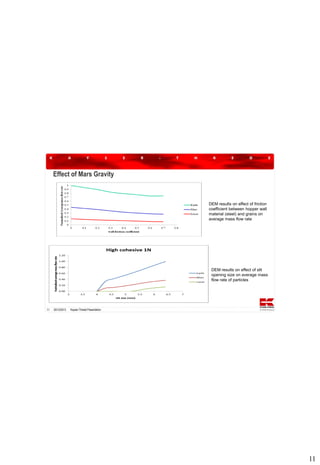
DEM results on effect of friction
coefficient between hopper wall
material (steel) and grains on
average mass flow rate

DEM results on effect of slit
opening size on average mass
flow rate of particles

11

20/12/2013

Kayser-Threde Presentation

11
SPDS Test Models and Test Campaigns


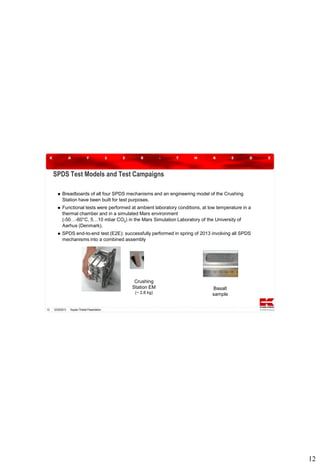
Breadboards of all four SPDS mechanisms and an engineering model of the Crushing
Station have been built for test purposes.



Functional tests were performed at ambient laboratory conditions, at low temperature in a
thermal chamber and in a simulated Mars environment
(-50…-60°C, 5…10 mbar CO2) in the Mars Simulation Laboratory of the University of
Aarhus (Denmark).



SPDS end-to-end test (E2E): successfully performed in spring of 2013 involving all SPDS
mechanisms into a combined assembly

Crushing
Station EM
(~ 2.8 kg)

12

12/20/2013

Basalt
sample

Kayser-Threde Presentation

12
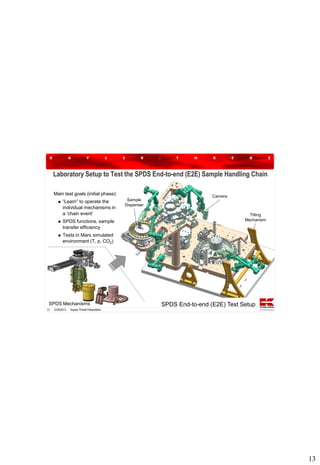
Laboratory Setup to Test the SPDS End-to-end (E2E) Sample Handling Chain
Main test goals (initial phase):


“Learn” to operate the
individual mechanisms in
a ‘chain event’



SPDS functions, sample
transfer efficiency



Camera

Tests in Mars simulated
environment (T, p, CO2)

SPDS Mechanisms
13

Sample
Dispenser

12/20/2013

Tilting
Mechanism

SPDS End-to-end (E2E) Test Setup

Kayser-Threde Presentation

13
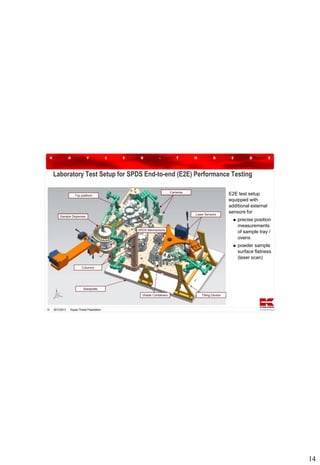
Laboratory Test Setup for SPDS End-to-end (E2E) Performance Testing
E2E test setup
equipped with
additional external
sensors for




14

20/12/2013

precise position
measurements
of sample tray /
ovens
powder sample
surface flatness
(laser scan)

Kayser-Threde Presentation

14
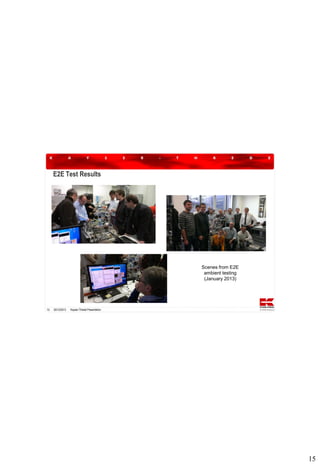
E2E Test Results

Scenes from E2E
ambient testing
(January 2013)

15

20/12/2013

Kayser-Threde Presentation

15
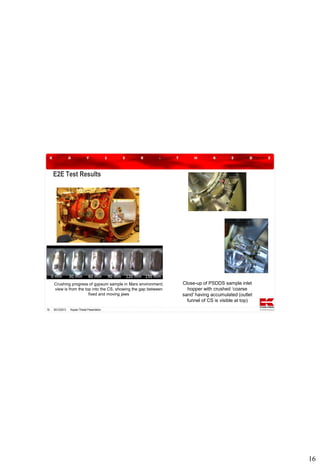
E2E Test Results

Crushing progress of gypsum sample in Mars environment;
view is from the top into the CS, showing the gap between
fixed and moving jaws

16

20/12/2013

Close-up of PSDDS sample inlet
hopper with crushed ‘coarse
sand’ having accumulated (outlet
funnel of CS is visible at top)

Kayser-Threde Presentation

16
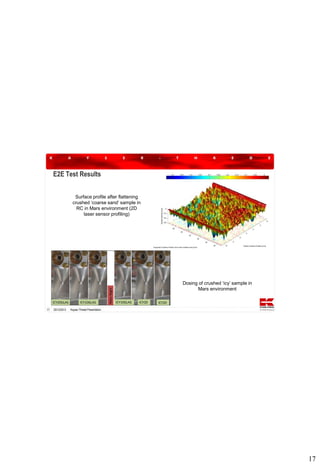
E2E Test Results

ICY20GLAS
17

20/12/2013

ICY10GLAS

Mars Night

Surface profile after flattening
crushed ‘coarse sand’ sample in
RC in Mars environment (2D
laser sensor profiling)

Dosing of crushed ‘icy’ sample in
Mars environment
ICY10GLAS

ICY20

ICY20

Kayser-Threde Presentation

17
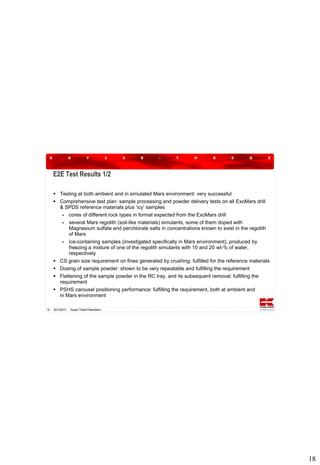
E2E Test Results 1/2
 Testing at both ambient and in simulated Mars environment: very successful
 Comprehensive test plan: sample processing and powder delivery tests on all ExoMars drill
& SPDS reference materials plus ‘icy’ samples
 cores of different rock types in format expected from the ExoMars drill
 several Mars regolith (soil-like materials) simulants, some of them doped with
Magnesium sulfate and perchlorate salts in concentrations known to exist in the regolith
of Mars
 ice-containing samples (investigated specifically in Mars environment), produced by
freezing a mixture of one of the regolith simulants with 10 and 20 wt-% of water,
respectively
 CS grain size requirement on fines generated by crushing: fulfilled for the reference materials
 Dosing of sample powder: shown to be very repeatable and fulfilling the requirement
 Flattening of the sample powder in the RC tray, and its subsequent removal: fulfilling the
requirement
 PSHS carousel positioning performance: fulfilling the requirement, both at ambient and
in Mars environment
18

20/12/2013

Kayser-Threde Presentation

18
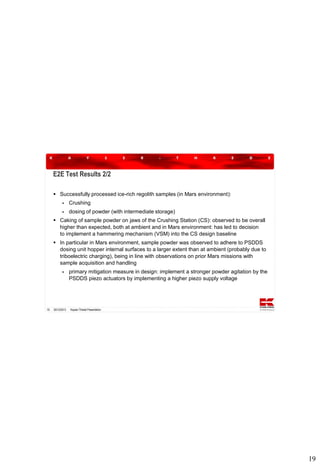
E2E Test Results 2/2
 Successfully processed ice-rich regolith samples (in Mars environment):


Crushing



dosing of powder (with intermediate storage)

 Caking of sample powder on jaws of the Crushing Station (CS): observed to be overall
higher than expected, both at ambient and in Mars environment: has led to decision
to implement a hammering mechanism (VSM) into the CS design baseline
 In particular in Mars environment, sample powder was observed to adhere to PSDDS
dosing unit hopper internal surfaces to a larger extent than at ambient (probably due to
triboelectric charging), being in line with observations on prior Mars missions with
sample acquisition and handling


19

20/12/2013

primary mitigation measure in design: implement a stronger powder agitation by the
PSDDS piezo actuators by implementing a higher piezo supply voltage

Kayser-Threde Presentation

19
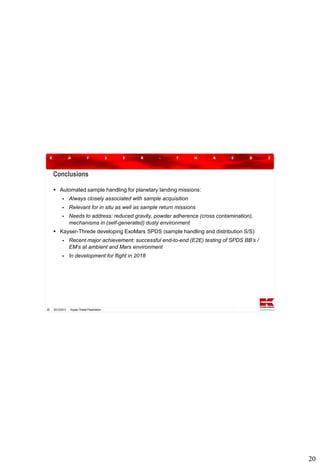
Conclusions
 Automated sample handling for planetary landing missions:


Always closely associated with sample acquisition



Relevant for in situ as well as sample return missions



Needs to address: reduced gravity, powder adherence (cross contamination),
mechanisms in (self-generated) dusty environment

 Kayser-Threde developing ExoMars SPDS (sample handling and distribution S/S)




20

Recent major achievement: successful end-to-end (E2E) testing of SPDS BB‘s /
EM‘s at ambient and Mars environment
In development for flight in 2018

20/12/2013

Kayser-Threde Presentation

20
Acknowledgement
The work reported in this paper was performed by Kayser-Threde (Germany) under
contract to Thales Alenia Space Italia (TAS-I), the ExoMars mission prime, and Selex
Electronics Systems with funding from the European Space Agency.
Several external entities contributed as a project partners.
The authors wish to thank ESA and TAS-I.

21

20/12/2013

Kayser-Threde Presentation

21

The ExoMars Sample Handling and Distribution Subsystem (SPDS)

  • 1.
    we. create. space. Kayser-ThredeGmbH The ExoMars Sample Handling and Distribution Subsystem (SPDS) Space Industrial Applications L. Richter, P. Hofmann, Q. Mühlbauer, R. Paul, D. Redlich (Kayser-Threde GmbH, Munich, Germany), S.J. Antony (University of Leeds, UK) Pietro Baglioni and Stephen Durrant, ESA/ESTEC, Noordwijk, The Netherlands Fabio Musso, Thales Alenia Space, Torino, Italy ISTVS 7th Americas Regional Conference, 4 - 7 November 2013 www.kayser–threde.com 1
  • 2.
    Overview  Recent resultsfrom on-going development of Sample Processing and Distribution Subsystem (SPDS) for ExoMars rover  Programmatic plans for evolutions of SPDS design targeted to other missions  Development activities on regolith sampling devices 2 20/12/2013 Kayser-Threde Presentation 2
  • 3.
  • 4.
    ESA ExoMars 2018Rover Mission The ExoMars Rover  carries a drill to collect rock and soil core samples from the Mars surface and underground (depth down to 2m)  accommodates the Analytical Laboratory Drawer (ALD) with the ‘Pasteur’ Payload, a set of instruments for the search of extant and extinct life on Mars, and the Sample Preparation and Distribution System Credit: TAS-I Credit: ESA 4 20/12/2013 Kayser-Threde Presentation 4
  • 5.
    The ExoMars SamplePreparation and Distribution System (SPDS) The SPDS receives Mars rock and soil drill core samples from the Rover drill tool and prepares and presents them to the various analytical instruments. The SPDS acts as the interface between the drill which is mounted to the outside of the Rover, and the following ‘Pasteur’ instruments in the Rover Analytical Laboratory Drawer:  Raman Spectrometer (RLS)  MicrOmega Infrared Microscope (MIRU)  Mars Organic Molecule Analyzer (MOMA) Blank Sample Dispenser Drill deposits Mars sample – Gas Chromatograph (GC) – Laser Desorption Mass Spectrometer (LD-MS) The sample path and a major part of the SPDS is located within a sealed enclosure in the Rover/ALD (Ultra-clean Zone). Crushing Station Transport Mechanism Carousel Dosing Station Positioner 5 20/12/2013 Kayser-Threde Presentation 5
  • 6.
    Core Sample HandlingMechanism (CSHS) The CSHS consists of  Core Sample Transportation Mechanism (CSTM) – input interface for transfer of the core samples from drill to Rover/ALD BSD design CSTM breadboard – opens/closes the door of the ALD and Ultra-clean Zone – transports and delivers the samples to Crushing Station  Blank Sample Dispenser (BSD) CSHS Sample container – stores six ‘blank samples’ and dispenses them into the Crushing Station when needed ALD/UCZ front door 6 20/12/2013 Kayser-Threde Presentation 6
  • 7.
    Crushing Station (CS) MaterialInput Elegant BB  Miniature jaw crusher, crushes raw samples from drill to produce powder or small grain samples for further analysis by the Pasteur instruments  If a sample cannot be crushed/processed it will be released by opening the jaws (dejamming mechanism) and dumped into a ‘waste bin’  Design recently enhanced by addition of a Vibration / Shock Mechanism (VSM) Material Output Dimensions < 130 x 125 x 155 mm 7 20/12/2013 Kayser-Threde Presentation 7
  • 8.
    Powdered Sample Dosingand Distribution System (PSDDS) rotation  Two (redundant) dosing units are mounted on a rotating arm, can be positioned either under the Crushing Station or over the carousel.   The dosing function employs a revolving wheel with hollow pockets of defined volume which are filled with the sample material.  8 The dosing units dispense sample powder in amounts of 0.1 ml per dosing step. Dosing units Piezo vibrators are used to ease sample discharging and cleaning 20/12/2013 Positioner Kayser-Threde Presentation 8
  • 9.
    Powder Sample HandlingSystem (PSHS) PSHS carousel MOMA Orientation point  Laser sensor Camera PSHS receives powder samples from Dosing Station and presents them to the Pasteur instruments in – Refillable container (RC) RC – Pyrolysis ovens (MOMA GC)  Powder sample surface in RC is flattened by passing a flat blade over sample  Samples are positioned with high accuracy, relative to instrument viewing ports (MOMA LD-MS, MIRU)  Sample handling under ultra-clean conditions in the Ultra-clean Zone Flattening blade Waste container Dosing funnel Camera Cleaning blade PSHS elegant breadboard 9 20/12/2013 Kayser-Threde Presentation 9
  • 10.
    Effect of MarsGravity  SPDS mechanisms rely on the action of gravity in the flow of granular samples from one mechanism to the next  Combination of testing on parabolic flights and numerical simulations applied to capture and understand effects of reduced gravity  Modelling approach chosen in simulations: DEM (Discrete Element Method)  Latest parabolic flight campaign: December 2012 (by Technical University of Munich): series of different 2D shapes of the PSDDS Dosing Station hoppers at simulated Mars and lunar gravity, with sample holders and powders exposed to Mars atmospheric pressure  Simulation and testing: shown to agree in trends of sample mass flow as function of hopper shape and dimensions, leading to implementation of moderate design changes 10 20/12/2013 Still from December 2012 TUM / LRT parabolic flight experiment with 2D hoppers (set of 3 hoppers of different throat diameters is visible) (credit: P. Reiss, TUM / LRT) SPDS DS funnel: DEM simulation Kayser-Threde Presentation 10
  • 11.
    Effect of MarsGravity DEM results on effect of friction coefficient between hopper wall material (steel) and grains on average mass flow rate DEM results on effect of slit opening size on average mass flow rate of particles 11 20/12/2013 Kayser-Threde Presentation 11
  • 12.
    SPDS Test Modelsand Test Campaigns  Breadboards of all four SPDS mechanisms and an engineering model of the Crushing Station have been built for test purposes.  Functional tests were performed at ambient laboratory conditions, at low temperature in a thermal chamber and in a simulated Mars environment (-50…-60°C, 5…10 mbar CO2) in the Mars Simulation Laboratory of the University of Aarhus (Denmark).  SPDS end-to-end test (E2E): successfully performed in spring of 2013 involving all SPDS mechanisms into a combined assembly Crushing Station EM (~ 2.8 kg) 12 12/20/2013 Basalt sample Kayser-Threde Presentation 12
  • 13.
    Laboratory Setup toTest the SPDS End-to-end (E2E) Sample Handling Chain Main test goals (initial phase):  “Learn” to operate the individual mechanisms in a ‘chain event’  SPDS functions, sample transfer efficiency  Camera Tests in Mars simulated environment (T, p, CO2) SPDS Mechanisms 13 Sample Dispenser 12/20/2013 Tilting Mechanism SPDS End-to-end (E2E) Test Setup Kayser-Threde Presentation 13
  • 14.
    Laboratory Test Setupfor SPDS End-to-end (E2E) Performance Testing E2E test setup equipped with additional external sensors for   14 20/12/2013 precise position measurements of sample tray / ovens powder sample surface flatness (laser scan) Kayser-Threde Presentation 14
  • 15.
    E2E Test Results Scenesfrom E2E ambient testing (January 2013) 15 20/12/2013 Kayser-Threde Presentation 15
  • 16.
    E2E Test Results Crushingprogress of gypsum sample in Mars environment; view is from the top into the CS, showing the gap between fixed and moving jaws 16 20/12/2013 Close-up of PSDDS sample inlet hopper with crushed ‘coarse sand’ having accumulated (outlet funnel of CS is visible at top) Kayser-Threde Presentation 16
  • 17.
    E2E Test Results ICY20GLAS 17 20/12/2013 ICY10GLAS MarsNight Surface profile after flattening crushed ‘coarse sand’ sample in RC in Mars environment (2D laser sensor profiling) Dosing of crushed ‘icy’ sample in Mars environment ICY10GLAS ICY20 ICY20 Kayser-Threde Presentation 17
  • 18.
    E2E Test Results1/2  Testing at both ambient and in simulated Mars environment: very successful  Comprehensive test plan: sample processing and powder delivery tests on all ExoMars drill & SPDS reference materials plus ‘icy’ samples  cores of different rock types in format expected from the ExoMars drill  several Mars regolith (soil-like materials) simulants, some of them doped with Magnesium sulfate and perchlorate salts in concentrations known to exist in the regolith of Mars  ice-containing samples (investigated specifically in Mars environment), produced by freezing a mixture of one of the regolith simulants with 10 and 20 wt-% of water, respectively  CS grain size requirement on fines generated by crushing: fulfilled for the reference materials  Dosing of sample powder: shown to be very repeatable and fulfilling the requirement  Flattening of the sample powder in the RC tray, and its subsequent removal: fulfilling the requirement  PSHS carousel positioning performance: fulfilling the requirement, both at ambient and in Mars environment 18 20/12/2013 Kayser-Threde Presentation 18
  • 19.
    E2E Test Results2/2  Successfully processed ice-rich regolith samples (in Mars environment):  Crushing  dosing of powder (with intermediate storage)  Caking of sample powder on jaws of the Crushing Station (CS): observed to be overall higher than expected, both at ambient and in Mars environment: has led to decision to implement a hammering mechanism (VSM) into the CS design baseline  In particular in Mars environment, sample powder was observed to adhere to PSDDS dosing unit hopper internal surfaces to a larger extent than at ambient (probably due to triboelectric charging), being in line with observations on prior Mars missions with sample acquisition and handling  19 20/12/2013 primary mitigation measure in design: implement a stronger powder agitation by the PSDDS piezo actuators by implementing a higher piezo supply voltage Kayser-Threde Presentation 19
  • 20.
    Conclusions  Automated samplehandling for planetary landing missions:  Always closely associated with sample acquisition  Relevant for in situ as well as sample return missions  Needs to address: reduced gravity, powder adherence (cross contamination), mechanisms in (self-generated) dusty environment  Kayser-Threde developing ExoMars SPDS (sample handling and distribution S/S)   20 Recent major achievement: successful end-to-end (E2E) testing of SPDS BB‘s / EM‘s at ambient and Mars environment In development for flight in 2018 20/12/2013 Kayser-Threde Presentation 20
  • 21.
    Acknowledgement The work reportedin this paper was performed by Kayser-Threde (Germany) under contract to Thales Alenia Space Italia (TAS-I), the ExoMars mission prime, and Selex Electronics Systems with funding from the European Space Agency. Several external entities contributed as a project partners. The authors wish to thank ESA and TAS-I. 21 20/12/2013 Kayser-Threde Presentation 21