12/20/2013

Comparison of DEM and Traditional Modeling
Methods for Simulating Steady-State WheelTerrain Interaction for Small Vehicles
7th Americas Conference of the ISTVS
Tuesday, November 5
Tampa, Florida
William Smith
Daniel Melanz
Carmine Senatore, Karl Iagnemma
Huei Peng

University of Michigan
University of Wisconsin
Massachusetts Institute of Technology
University of Michigan

1
12/20/2013

Motivation
•

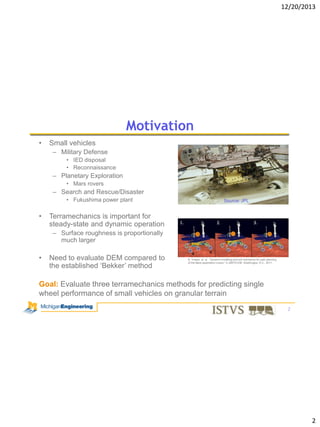
Small vehicles
– Military Defense
• IED disposal
• Reconnaissance

– Planetary Exploration
• Mars rovers

– Search and Rescue/Disaster
• Fukushima power plant

•

Source: JPL

Terramechanics is important for
steady-state and dynamic operation
– Surface roughness is proportionally
much larger

•

Need to evaluate DEM compared to
the established ‘Bekker’ method

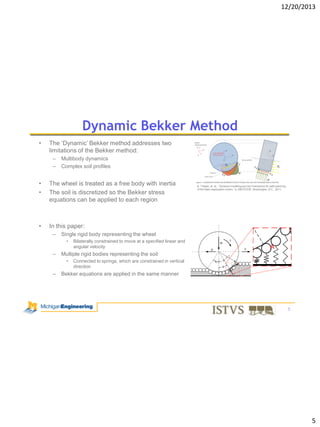
B. Trease, et. al., “Dynamic modeling and soil mechanics for path planning
of the Mars exploration rovers,” in IDETC/CIE, Washington, D.C., 2011.

Goal: Evaluate three terramechanics methods for predicting single
wheel performance of small vehicles on granular terrain
2

2
12/20/2013

TERRAMECHANICS METHODS
Bekker
Dynamic Bekker
Discrete Element Method

3

3
12/20/2013

Modeling Method: “Bekker”
•

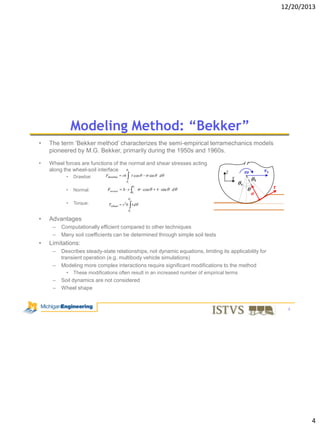
The term ‘Bekker method’ characterizes the semi-empirical terramechanics models
pioneered by M.G. Bekker, primarily during the 1950s and 1960s.

•

Wheel forces are functions of the normal and shear stresses acting
along the wheel-soil interface
f

•

Drawbar

Fdrawbar

rb

cos

sin

d

r

•

Normal:

Fnormal

f

b r

cos

sin

d

r

•

f

Torque:

Twheel

r 2b

d
r

•

Advantages
–
–

•

Computationally efficient compared to other techniques
Many soil coefficients can be determined through simple soil tests

Limitations:
–
–

Describes steady-state relationships, not dynamic equations, limiting its applicability for
transient operation (e.g. multibody vehicle simulations)
Modeling more complex interactions require significant modifications to the method

–
–

Soil dynamics are not considered
Wheel shape

•

These modifications often result in an increased number of empirical terms

4

4
12/20/2013

Dynamic Bekker Method
•

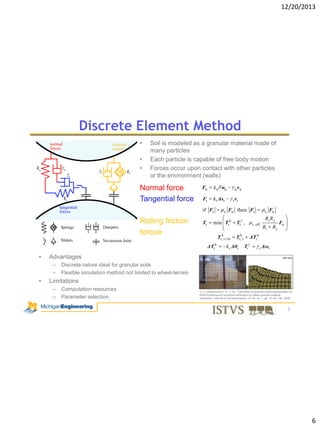
The ‘Dynamic’ Bekker method addresses two
limitations of the Bekker method:
–
–

Multibody dynamics
Complex soil profiles

•
•

The wheel is treated as a free body with inertia
The soil is discretized so the Bekker stress
equations can be applied to each region

•

In this paper:
–

Single rigid body representing the wheel
•

–

Bilaterally constrained to move at a specified linear and
angular velocity

Multiple rigid bodies representing the soil
•

–

B. Trease, et. al., “Dynamic modeling and soil mechanics for path planning
of the Mars exploration rovers,” in IDETC/CIE, Washington, D.C., 2011.

Connected to springs, which are constrained in vertical
direction

Bekker equations are applied in the same manner

5

5
12/20/2013

Discrete Element Method
•
•
•

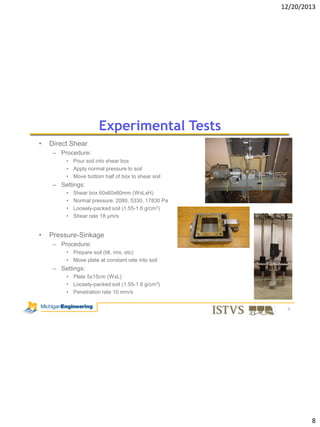
Soil is modeled as a granular material made of
many particles
Each particle is capable of free body motion
Forces occur upon contact with other particles
or the environment (walls)

Normal force
Tangential force

Fn

k n nij

Ft

k t Δst

if Ft

Rolling friction
torque

Fn then Ft

c

min Trk

Tr ,
Tr,kt

t

k r Δθr

c

Fn

Ri R j
r, eff

Ri

Rj

Fn

ΔTrk
Tr

r Δωr

Advantages
–
–

•

t vt

Tr,k t+

Tr

ΔTrk

•

n vn

Discrete nature ideal for granular soils
Flexible simulation method not limited to wheel-terrain

Limitations
–
–

Computation resources
Parameter selection

C. J. Coetzee and D. N. J. Els, “Calibration of granular material parameters for
DEM modelling and numercal verification by blade–granular material
interaction,” Journal of Terramechanics, vol. 46, no. 1, pp. 15–26, Feb. 2009.

6

6
12/20/2013

SOIL TESTING
Direct Shear
Pressure Sinkage

7

7
12/20/2013

Experimental Tests
•

Direct Shear
– Procedure:
• Pour soil into shear box
• Apply normal pressure to soil
• Move bottom half of box to shear soil

– Settings:
•
•
•
•

•

Shear box 60x60x60mm (WxLxH)
Normal pressure: 2080, 5330, 17830 Pa
Loosely-packed soil (1.55-1.6 g/cm3)
Shear rate 18 μm/s

Pressure-Sinkage
– Procedure:
• Prepare soil (till, mix, etc)
• Move plate at constant rate into soil

– Settings:
• Plate 5x15cm (WxL)
• Loosely-packed soil (1.55-1.6 g/cm3)
• Penetration rate 10 mm/s
8

8
12/20/2013

Bekker Parameter Identification
Direct Shear:
• Bekker parameters c, ϕ, and K were determined by
numerically minimizing the error given by:
2

arg min

j

c

tan

1 exp

c, ,K

j
K

Pressure-Sinkage:
• Bekker parameters k, and n were determined by
numerically minimizing the error given by:
n

arg min

z

k ,n

k

z

2

bplate

Parameter

Value

c [Pa]

139.280

ϕ [rad]

0.606

K [m]

5.151x10⁻⁴

k [Pa]

2.541x10⁵

n [-]

1.387

9

9
12/20/2013

DEM Direct Shear Tests
•
•
•

Same shear box dimensions as experimental
Normal pressure applied by using a rigid body of
closely-packed particles with necessary density
Increased shear rate required to limit computation
cost
– Reducing the shear rate further had negligible
impact on simulation results

•

Computation Time:
– Simulations were run on a single core of an Intel
Xeon 5160 (3.0 GHz), at a rate of 40 to 20 cpu
minutes per simulation second for time steps 1.5
and 3.8 μs, respectively
Parameter
shear box dimensions [mm]
normal load [Pa]
shear rate [mm/s]
shear displacement [mm]
number of soil particles
time step [sec]

Value
60 x 60 x 60 (W x L x H)
2080, 5330, 17830
0.66
6.6
~640
1.5 - 3.8x10⁻⁶

10

10
12/20/2013

DEM Pressure-Sinkage Tests
•
•

Same size plate dimensions as experimental
Soil bin was 3x size of plate (recommended by
MIT to limit edge effects)
– Periodic boundaries used to further remove wall
effects

•

Same sinkage rate as experimental

•

Computation Time:
– Simulations were run on a single core of an Intel
Xeon 5160 (3.0 GHz), at a rate of 6 to 3 hours
cpu per simulation second for time steps 1.5 and
3.8 μs, respectively
Parameter
soil bin dimensions [mm]
plate dimensions [mm]
sinkage rate [mm/s]
maximum sinkage [mm]
number of soil particles
time step [sec]

Value
150 x 400 x 160
(W x L x H)
50 x 130 x 10
(W x L x H)
10.0
20.0
~30,000
1.5 - 3.8x10⁻⁶

11

11
12/20/2013

New Rolling Resistance Model
•

The direct-shear and pressure-sinkage soil
tests have widely different shear/sinkage
rates
–
–

•

–

Increasing drag force when velocity increased
from 1 to 50 mm/s [1]
DEM pile formation simulations found rolling
friction depended on the relative motion
between particles [2]

Rolling Resistance Torque
Tr

min Trk

Tr,k t+

Shear rate 18 μm/s
Penetration rate 10 mm/s

The properties of granular soil have been
shown to be rate dependent
–

•

t

Tr,k t

Ri

Rj

Fn

ΔTrk

k r Δθr

Spring/Damper Components
kr
r

•

r, eff

r Δωr

Tr
ΔTrk

•

Ri R j

Tr ,

2.25k n

Ri R j
r, eff

Ri

2

Rj

2 k r I eff

Coefficients
I eff

r, eff

1.4

M i Ri2 M j R j2
M i Ri2

min

M j R j2
2

r

vt , 1.0

[1] B. Yeomans, C. M. Saaj, and M. Van Winnendael, “Walking
planetary rovers – Experimental analysis and modelling of leg thrust
in loose granular soils,” J. Terramechanics, vol. 50, no. 2, pp. 107–
120, Apr. 2013.
[2] A. P. Grima and P. W. Wypych, “Discrete element simulations of
granular pile formation: Method for calibrating discrete element
models,” Eng. Comput., vol. 28, no. 3, pp. 314–339, 2011.

12

12
12/20/2013

WHEEL TESTS

13

13
12/20/2013

Settings: Bekker Method
•

Some of the Bekker parameters cannot be determined from soil tests
– Parameters a0 and a1 used to determine the location of maximum shear stress
– These parameters can only be determined experimentally using wheel tests
Parameter
a0 [-]
a1 [-]
θr [rad]

•

Value
0.18
0.32
0

Parameter values were chosen assuming coefficients from the literature
– The goal is to predict, not to fit, wheel performance
J. Wong and A. Reece, “Prediction of rigid wheel performance based on the analysis of soil-wheel stresses part I.
Performance of driven rigid wheels,” J. Terramechanics, vol. 4, pp. 81–98, 1967.

•

Computation time
– ~43 ms to solve for a given slip ratio and normal load (using standard iterative
solving method, implemented in C)

14

14
12/20/2013

Settings: Dynamic Bekker Method
•

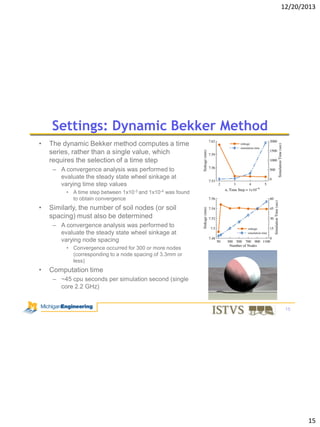
The dynamic Bekker method computes a time
series, rather than a single value, which
requires the selection of a time step
– A convergence analysis was performed to
evaluate the steady state wheel sinkage at
varying time step values
• A time step between 1x10⁻³ and 1x10⁻⁴ was found
to obtain convergence

•

Similarly, the number of soil nodes (or soil
spacing) must also be determined
– A convergence analysis was performed to
evaluate the steady state wheel sinkage at
varying node spacing
• Convergence occurred for 300 or more nodes
(corresponding to a node spacing of 3.3mm or
less)

•

Computation time
– ~45 cpu seconds per simulation second (single
core 2.2 GHz)

15

15
12/20/2013

Settings: DEM
•

DEM wheel composed of 1cm diameter
overlapping particles, grouped to act as a
single rigid body

•

Experimental wheel/soil bin dimensions
were maintained

•

Procedure:
– Wheel placed on soil, allowed to rest for 0.5
seconds
– An x-axis force and a y-axis torque were
applied to the wheel for 1 second to ramp-up
the longitudinal and angular velocities
– Wheel was simulated for a distance of 0.7m,
or until steady-state was reached

•

Parameter
soil bed dimensions [mm]
number of soil particles
number of wheel particles
time step [sec]

Value
600 x 1000 x 160
(W x L x H)
~300,000
~12,000
2.2x10⁻⁶

Computation time
– ~8.5 cpu hours per simulation second (8
cores 3.0 GHz)

16

16
12/20/2013

Steady-State Results

•

DEM shows better quantitative and qualitative agreement
–
–

•

Greatest benefit near zero slip
Bekker has discontinuity around zero slip

Bekker and dynamic Bekker are almost identical (expected)
– Differences are a result of implementation of normal stress in dynamic Bekker

17

17
12/20/2013

Time Series Results

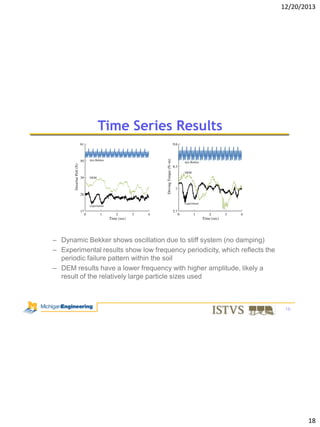
– Dynamic Bekker shows oscillation due to stiff system (no damping)
– Experimental results show low frequency periodicity, which reflects the
periodic failure pattern within the soil
– DEM results have a lower frequency with higher amplitude, likely a
result of the relatively large particle sizes used

18

18
12/20/2013

CONCLUSIONS

19

19
12/20/2013

Recap
Bekker method
– Extremely computationally efficient: ~43x10-3 cpu seconds
– Poor prediction of wheel performance using soil test tuning
– Some parameters cannot be determined from soil tests

Dynamic Bekker method
– Computationally efficient: ~45 cpu seconds/sim second
– Similar steady-state performance to Bekker method

Discrete element method
–
–
–
–

Computationally inefficient: ~24.5x10⁴ cpu seconds/sim second
Significantly better prediction of wheel performance
Also provides some time-series information
All parameters determined from soil test tuning

20

20
12/20/2013

DEM-Tuned Bekker Method
•
•

Bekker parameters can be tuned to produce similar results as DEM
When the Bekker method capabilities are sufficient, may be able to tune to DEM
simulations

Parameter
c [Pa]
ϕ [rad]
K [m]
k [Pa]
n [-]
a0 [-]
a1 [-]
θr [rad]

Soil-Tuned Values
139.280
0.606
5.151x10⁻⁴
2.541x10⁵
1.387
0.18*
0.32*
0

DEM-Tuned Values
96.240
0.606
4.534x10⁻³
2.305x10⁴
0.418
0.09
0.90
0

21

21
12/20/2013

THANK YOU
Questions?

22

22

Comparison of DEM and Traditional Modeling Methods for Simulating Steady-State Wheel-Terrain Interaction for Small Vehicles Paper81583

  • 1.
    12/20/2013 Comparison of DEMand Traditional Modeling Methods for Simulating Steady-State WheelTerrain Interaction for Small Vehicles 7th Americas Conference of the ISTVS Tuesday, November 5 Tampa, Florida William Smith Daniel Melanz Carmine Senatore, Karl Iagnemma Huei Peng University of Michigan University of Wisconsin Massachusetts Institute of Technology University of Michigan 1
  • 2.
    12/20/2013 Motivation • Small vehicles – MilitaryDefense • IED disposal • Reconnaissance – Planetary Exploration • Mars rovers – Search and Rescue/Disaster • Fukushima power plant • Source: JPL Terramechanics is important for steady-state and dynamic operation – Surface roughness is proportionally much larger • Need to evaluate DEM compared to the established ‘Bekker’ method B. Trease, et. al., “Dynamic modeling and soil mechanics for path planning of the Mars exploration rovers,” in IDETC/CIE, Washington, D.C., 2011. Goal: Evaluate three terramechanics methods for predicting single wheel performance of small vehicles on granular terrain 2 2
  • 3.
  • 4.
    12/20/2013 Modeling Method: “Bekker” • Theterm ‘Bekker method’ characterizes the semi-empirical terramechanics models pioneered by M.G. Bekker, primarily during the 1950s and 1960s. • Wheel forces are functions of the normal and shear stresses acting along the wheel-soil interface f • Drawbar Fdrawbar rb cos sin d r • Normal: Fnormal f b r cos sin d r • f Torque: Twheel r 2b d r • Advantages – – • Computationally efficient compared to other techniques Many soil coefficients can be determined through simple soil tests Limitations: – – Describes steady-state relationships, not dynamic equations, limiting its applicability for transient operation (e.g. multibody vehicle simulations) Modeling more complex interactions require significant modifications to the method – – Soil dynamics are not considered Wheel shape • These modifications often result in an increased number of empirical terms 4 4
  • 5.
    12/20/2013 Dynamic Bekker Method • The‘Dynamic’ Bekker method addresses two limitations of the Bekker method: – – Multibody dynamics Complex soil profiles • • The wheel is treated as a free body with inertia The soil is discretized so the Bekker stress equations can be applied to each region • In this paper: – Single rigid body representing the wheel • – Bilaterally constrained to move at a specified linear and angular velocity Multiple rigid bodies representing the soil • – B. Trease, et. al., “Dynamic modeling and soil mechanics for path planning of the Mars exploration rovers,” in IDETC/CIE, Washington, D.C., 2011. Connected to springs, which are constrained in vertical direction Bekker equations are applied in the same manner 5 5
  • 6.
    12/20/2013 Discrete Element Method • • • Soilis modeled as a granular material made of many particles Each particle is capable of free body motion Forces occur upon contact with other particles or the environment (walls) Normal force Tangential force Fn k n nij Ft k t Δst if Ft Rolling friction torque Fn then Ft c min Trk Tr , Tr,kt t k r Δθr c Fn Ri R j r, eff Ri Rj Fn ΔTrk Tr r Δωr Advantages – – • t vt Tr,k t+ Tr ΔTrk • n vn Discrete nature ideal for granular soils Flexible simulation method not limited to wheel-terrain Limitations – – Computation resources Parameter selection C. J. Coetzee and D. N. J. Els, “Calibration of granular material parameters for DEM modelling and numercal verification by blade–granular material interaction,” Journal of Terramechanics, vol. 46, no. 1, pp. 15–26, Feb. 2009. 6 6
  • 7.
  • 8.
    12/20/2013 Experimental Tests • Direct Shear –Procedure: • Pour soil into shear box • Apply normal pressure to soil • Move bottom half of box to shear soil – Settings: • • • • • Shear box 60x60x60mm (WxLxH) Normal pressure: 2080, 5330, 17830 Pa Loosely-packed soil (1.55-1.6 g/cm3) Shear rate 18 μm/s Pressure-Sinkage – Procedure: • Prepare soil (till, mix, etc) • Move plate at constant rate into soil – Settings: • Plate 5x15cm (WxL) • Loosely-packed soil (1.55-1.6 g/cm3) • Penetration rate 10 mm/s 8 8
  • 9.
    12/20/2013 Bekker Parameter Identification DirectShear: • Bekker parameters c, ϕ, and K were determined by numerically minimizing the error given by: 2 arg min j c tan 1 exp c, ,K j K Pressure-Sinkage: • Bekker parameters k, and n were determined by numerically minimizing the error given by: n arg min z k ,n k z 2 bplate Parameter Value c [Pa] 139.280 ϕ [rad] 0.606 K [m] 5.151x10⁻⁴ k [Pa] 2.541x10⁵ n [-] 1.387 9 9
  • 10.
    12/20/2013 DEM Direct ShearTests • • • Same shear box dimensions as experimental Normal pressure applied by using a rigid body of closely-packed particles with necessary density Increased shear rate required to limit computation cost – Reducing the shear rate further had negligible impact on simulation results • Computation Time: – Simulations were run on a single core of an Intel Xeon 5160 (3.0 GHz), at a rate of 40 to 20 cpu minutes per simulation second for time steps 1.5 and 3.8 μs, respectively Parameter shear box dimensions [mm] normal load [Pa] shear rate [mm/s] shear displacement [mm] number of soil particles time step [sec] Value 60 x 60 x 60 (W x L x H) 2080, 5330, 17830 0.66 6.6 ~640 1.5 - 3.8x10⁻⁶ 10 10
  • 11.
    12/20/2013 DEM Pressure-Sinkage Tests • • Samesize plate dimensions as experimental Soil bin was 3x size of plate (recommended by MIT to limit edge effects) – Periodic boundaries used to further remove wall effects • Same sinkage rate as experimental • Computation Time: – Simulations were run on a single core of an Intel Xeon 5160 (3.0 GHz), at a rate of 6 to 3 hours cpu per simulation second for time steps 1.5 and 3.8 μs, respectively Parameter soil bin dimensions [mm] plate dimensions [mm] sinkage rate [mm/s] maximum sinkage [mm] number of soil particles time step [sec] Value 150 x 400 x 160 (W x L x H) 50 x 130 x 10 (W x L x H) 10.0 20.0 ~30,000 1.5 - 3.8x10⁻⁶ 11 11
  • 12.
    12/20/2013 New Rolling ResistanceModel • The direct-shear and pressure-sinkage soil tests have widely different shear/sinkage rates – – • – Increasing drag force when velocity increased from 1 to 50 mm/s [1] DEM pile formation simulations found rolling friction depended on the relative motion between particles [2] Rolling Resistance Torque Tr min Trk Tr,k t+ Shear rate 18 μm/s Penetration rate 10 mm/s The properties of granular soil have been shown to be rate dependent – • t Tr,k t Ri Rj Fn ΔTrk k r Δθr Spring/Damper Components kr r • r, eff r Δωr Tr ΔTrk • Ri R j Tr , 2.25k n Ri R j r, eff Ri 2 Rj 2 k r I eff Coefficients I eff r, eff 1.4 M i Ri2 M j R j2 M i Ri2 min M j R j2 2 r vt , 1.0 [1] B. Yeomans, C. M. Saaj, and M. Van Winnendael, “Walking planetary rovers – Experimental analysis and modelling of leg thrust in loose granular soils,” J. Terramechanics, vol. 50, no. 2, pp. 107– 120, Apr. 2013. [2] A. P. Grima and P. W. Wypych, “Discrete element simulations of granular pile formation: Method for calibrating discrete element models,” Eng. Comput., vol. 28, no. 3, pp. 314–339, 2011. 12 12
  • 13.
  • 14.
    12/20/2013 Settings: Bekker Method • Someof the Bekker parameters cannot be determined from soil tests – Parameters a0 and a1 used to determine the location of maximum shear stress – These parameters can only be determined experimentally using wheel tests Parameter a0 [-] a1 [-] θr [rad] • Value 0.18 0.32 0 Parameter values were chosen assuming coefficients from the literature – The goal is to predict, not to fit, wheel performance J. Wong and A. Reece, “Prediction of rigid wheel performance based on the analysis of soil-wheel stresses part I. Performance of driven rigid wheels,” J. Terramechanics, vol. 4, pp. 81–98, 1967. • Computation time – ~43 ms to solve for a given slip ratio and normal load (using standard iterative solving method, implemented in C) 14 14
  • 15.
    12/20/2013 Settings: Dynamic BekkerMethod • The dynamic Bekker method computes a time series, rather than a single value, which requires the selection of a time step – A convergence analysis was performed to evaluate the steady state wheel sinkage at varying time step values • A time step between 1x10⁻³ and 1x10⁻⁴ was found to obtain convergence • Similarly, the number of soil nodes (or soil spacing) must also be determined – A convergence analysis was performed to evaluate the steady state wheel sinkage at varying node spacing • Convergence occurred for 300 or more nodes (corresponding to a node spacing of 3.3mm or less) • Computation time – ~45 cpu seconds per simulation second (single core 2.2 GHz) 15 15
  • 16.
    12/20/2013 Settings: DEM • DEM wheelcomposed of 1cm diameter overlapping particles, grouped to act as a single rigid body • Experimental wheel/soil bin dimensions were maintained • Procedure: – Wheel placed on soil, allowed to rest for 0.5 seconds – An x-axis force and a y-axis torque were applied to the wheel for 1 second to ramp-up the longitudinal and angular velocities – Wheel was simulated for a distance of 0.7m, or until steady-state was reached • Parameter soil bed dimensions [mm] number of soil particles number of wheel particles time step [sec] Value 600 x 1000 x 160 (W x L x H) ~300,000 ~12,000 2.2x10⁻⁶ Computation time – ~8.5 cpu hours per simulation second (8 cores 3.0 GHz) 16 16
  • 17.
    12/20/2013 Steady-State Results • DEM showsbetter quantitative and qualitative agreement – – • Greatest benefit near zero slip Bekker has discontinuity around zero slip Bekker and dynamic Bekker are almost identical (expected) – Differences are a result of implementation of normal stress in dynamic Bekker 17 17
  • 18.
    12/20/2013 Time Series Results –Dynamic Bekker shows oscillation due to stiff system (no damping) – Experimental results show low frequency periodicity, which reflects the periodic failure pattern within the soil – DEM results have a lower frequency with higher amplitude, likely a result of the relatively large particle sizes used 18 18
  • 19.
  • 20.
    12/20/2013 Recap Bekker method – Extremelycomputationally efficient: ~43x10-3 cpu seconds – Poor prediction of wheel performance using soil test tuning – Some parameters cannot be determined from soil tests Dynamic Bekker method – Computationally efficient: ~45 cpu seconds/sim second – Similar steady-state performance to Bekker method Discrete element method – – – – Computationally inefficient: ~24.5x10⁴ cpu seconds/sim second Significantly better prediction of wheel performance Also provides some time-series information All parameters determined from soil test tuning 20 20
  • 21.
    12/20/2013 DEM-Tuned Bekker Method • • Bekkerparameters can be tuned to produce similar results as DEM When the Bekker method capabilities are sufficient, may be able to tune to DEM simulations Parameter c [Pa] ϕ [rad] K [m] k [Pa] n [-] a0 [-] a1 [-] θr [rad] Soil-Tuned Values 139.280 0.606 5.151x10⁻⁴ 2.541x10⁵ 1.387 0.18* 0.32* 0 DEM-Tuned Values 96.240 0.606 4.534x10⁻³ 2.305x10⁴ 0.418 0.09 0.90 0 21 21
  • 22.