24/09/2015
Padova (IT)
On the role of subsurface
heterogeneity at hillslope
scale with Parflow
Gabriele Baroni
Sabine Attinger
Outline
 Quick overview of the project
 Motivations in our research unit
 The effect of soil heterogeneity at field/hillslope
 Outlook
2
Overview project
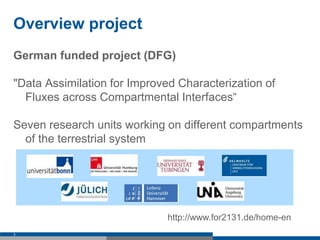
German funded project (DFG)
"Data Assimilation for Improved Characterization of
Fluxes across Compartmental Interfaces“
Seven research units working on different compartments
of the terrestrial system
3
http://www.for2131.de/home-en
Overview project and our unit
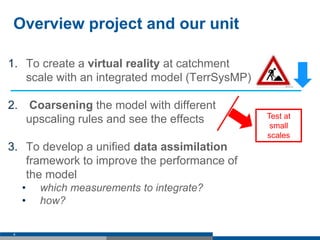
1. To create a virtual reality at catchment
scale with an integrated model (TerrSysMP)
2. Coarsening the model with different
upscaling rules and see the effects
3. To develop a unified data assimilation
framework to improve the performance of
the model
• which measurements to integrate?
• how?
4
Test at
small
scales
Motivations
heterogeneity and scaling effects
 Whenever we apply the current distributed
models (e.g. Richards eq.) we assume uniform
parameters within the grid
 Whatever is the scale of application (lab, field,
catchment) we do an upscaling exercise
5
Research questions
in this upscaling exercise?
 we have to find upscaling rules/effective
parameters
• different results functions of domain set-up,
parameters distributions, boundary conditions etc.
• Holy Grail of hydrology…worth searching for
even if a general solution might ultimate prove
impossible to find (Beven, 2006)
6
Hillslope
Rain/runoff
Flat field
Infiltration/drainage
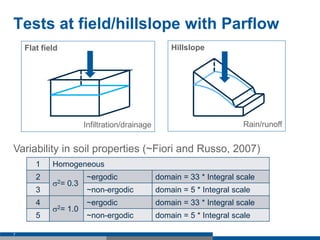
Tests at field/hillslope with Parflow
Variability in soil properties (~Fiori and Russo, 2007)
7
1 Homogeneous
2
s2= 0.3
~ergodic domain = 33 * Integral scale
3 ~non-ergodic domain = 5 * Integral scale
4
s2= 1.0
~ergodic domain = 33 * Integral scale
5 ~non-ergodic domain = 5 * Integral scale
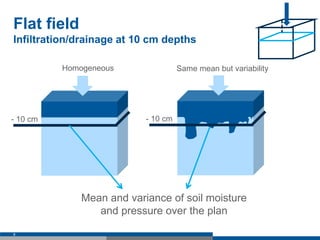
Same mean but variability
Flat field
Infiltration/drainage at 10 cm depths
8
Homogeneous
Mean and variance of soil moisture
and pressure over the plan
- 10 cm - 10 cm
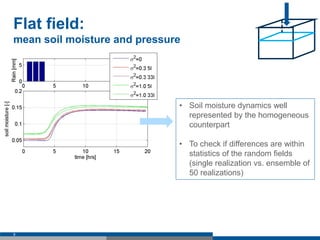
Flat field:
mean soil moisture and pressure
9
• Soil moisture dynamics well
represented by the homogeneous
counterpart
• To check if differences are within
statistics of the random fields
(single realization vs. ensemble of
50 realizations)
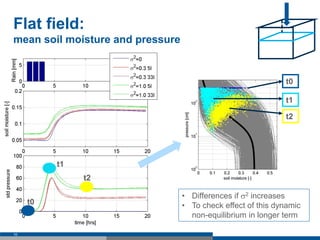
Flat field:
mean soil moisture and pressure
10
• Differences if s2 increases
• To check effect of this dynamic
non-equilibrium in longer term
t0
t1
t2
t0
t1
t2
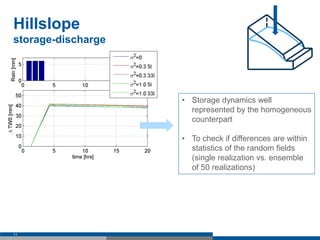
Hillslope
storage-discharge
11
• Storage dynamics well
represented by the homogeneous
counterpart
• To check if differences are within
statistics of the random fields
(single realization vs. ensemble
of 50 realizations)
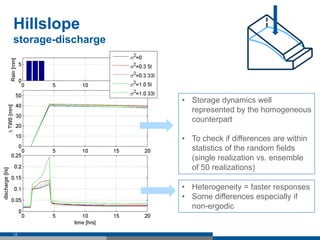
Hillslope
storage-discharge
12
• Storage dynamics well
represented by the homogeneous
counterpart
• To check if differences are within
statistics of the random fields
(single realization vs. ensemble
of 50 realizations)
• Heterogeneity = faster responses
• Some differences especially if
non-ergodic
To summarize so far…
With an homogeneous counterpart
 state dynamic well represented (i.e., soil
moisture or water storage)
 variability increases dynamic non–equilibrium
but to test implications at longer term
 non-ergodicity - more than variability - precludes
the use of general upscaling rules
13
To come…
 To generalize the tests at field/hillslope scale to
better understand the role of soil heterogeneity on
the hydrological responses
 To finalize the virtual reality and to analyse the
effect of coarsening with different upscaling rules
at catchment scale
14
…but a working hypothesis
15
Model
results
GOOD
BAD
Fine
grid
Coarse
grid
e.g.,
topographysoil
Ergodic D>>I
grid resolution
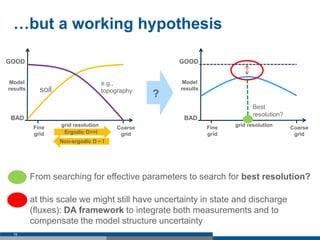
 From searching for effective parameters to search for best resolution?
grid resolution
GOOD
BAD
Fine
grid
Coarse
grid
Model
results
?
Best
resolution?
Non-ergodic D ~ I
 at this scale we might still have uncertainty in state and discharge
(fluxes): DA framework to integrate both measurements and to
compensate the model structure uncertainty
Thank you for the attention
16
Virtual reality
17
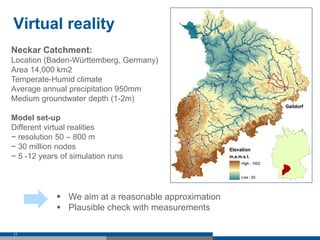
Neckar Catchment:
Location (Baden-Württemberg, Germany)
Area 14,000 km2
Temperate-Humid climate
Average annual precipitation 950mm
Medium groundwater depth (1-2m)
Model set-up
Different virtual realities
~ resolution 50 – 800 m
~ 30 million nodes
~ 5 -12 years of simulation runs
 We aim at a reasonable approximation
 Plausible check with measurements
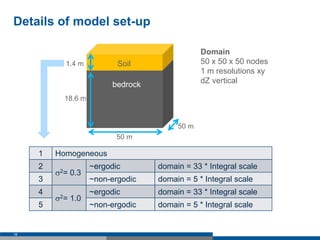
Details of model set-up
18
1 Homogeneous
2
s2= 0.3
~ergodic domain = 33 * Integral scale
3 ~non-ergodic domain = 5 * Integral scale
4
s2= 1.0
~ergodic domain = 33 * Integral scale
5 ~non-ergodic domain = 5 * Integral scale
Soil
Domain
50 x 50 x 50 nodes
1 m resolutions xy
dZ verticalbedrock
1.4 m
18.6 m
50 m
50 m
Details about soil variability (~Fiori and Russo, 2007)
19
Homogeneous
s2 = 0.3 s2 = 1.0
s2 CV s2 CV
Ksat [m/h] 0.02 (geom.) 0.3 0.6 1.0 1.3
a [m-1] 3.5 (geom.) 0.2 0.4 0.5 0.8
n [-] 2.0 (arithmetic) 0.02 0.05 0.05 0.1
qs [-] 0.42 (arithmetic) 0.001 0.05 0.002 0.1
Ksat [m/h] a [m-1] n [-] qs [-]
Ksat [m/h] 1
a [m-1] 0.8 1
n [-] 0.4 0.5 1
qs [-] -0.4 -0.2 -0.6 1
Correlation matrix
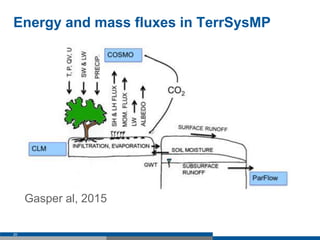
Energy and mass fluxes in TerrSysMP
20
Gasper al, 2015

Gabriele Baroni

  • 1.
    24/09/2015 Padova (IT) On therole of subsurface heterogeneity at hillslope scale with Parflow Gabriele Baroni Sabine Attinger
  • 2.
    Outline  Quick overviewof the project  Motivations in our research unit  The effect of soil heterogeneity at field/hillslope  Outlook 2
  • 3.
    Overview project German fundedproject (DFG) "Data Assimilation for Improved Characterization of Fluxes across Compartmental Interfaces“ Seven research units working on different compartments of the terrestrial system 3 http://www.for2131.de/home-en
  • 4.
    Overview project andour unit 1. To create a virtual reality at catchment scale with an integrated model (TerrSysMP) 2. Coarsening the model with different upscaling rules and see the effects 3. To develop a unified data assimilation framework to improve the performance of the model • which measurements to integrate? • how? 4 Test at small scales
  • 5.
    Motivations heterogeneity and scalingeffects  Whenever we apply the current distributed models (e.g. Richards eq.) we assume uniform parameters within the grid  Whatever is the scale of application (lab, field, catchment) we do an upscaling exercise 5
  • 6.
    Research questions in thisupscaling exercise?  we have to find upscaling rules/effective parameters • different results functions of domain set-up, parameters distributions, boundary conditions etc. • Holy Grail of hydrology…worth searching for even if a general solution might ultimate prove impossible to find (Beven, 2006) 6
  • 7.
    Hillslope Rain/runoff Flat field Infiltration/drainage Tests atfield/hillslope with Parflow Variability in soil properties (~Fiori and Russo, 2007) 7 1 Homogeneous 2 s2= 0.3 ~ergodic domain = 33 * Integral scale 3 ~non-ergodic domain = 5 * Integral scale 4 s2= 1.0 ~ergodic domain = 33 * Integral scale 5 ~non-ergodic domain = 5 * Integral scale
  • 8.
    Same mean butvariability Flat field Infiltration/drainage at 10 cm depths 8 Homogeneous Mean and variance of soil moisture and pressure over the plan - 10 cm - 10 cm
  • 9.
    Flat field: mean soilmoisture and pressure 9 • Soil moisture dynamics well represented by the homogeneous counterpart • To check if differences are within statistics of the random fields (single realization vs. ensemble of 50 realizations)
  • 10.
    Flat field: mean soilmoisture and pressure 10 • Differences if s2 increases • To check effect of this dynamic non-equilibrium in longer term t0 t1 t2 t0 t1 t2
  • 11.
    Hillslope storage-discharge 11 • Storage dynamicswell represented by the homogeneous counterpart • To check if differences are within statistics of the random fields (single realization vs. ensemble of 50 realizations)
  • 12.
    Hillslope storage-discharge 12 • Storage dynamicswell represented by the homogeneous counterpart • To check if differences are within statistics of the random fields (single realization vs. ensemble of 50 realizations) • Heterogeneity = faster responses • Some differences especially if non-ergodic
  • 13.
    To summarize sofar… With an homogeneous counterpart  state dynamic well represented (i.e., soil moisture or water storage)  variability increases dynamic non–equilibrium but to test implications at longer term  non-ergodicity - more than variability - precludes the use of general upscaling rules 13
  • 14.
    To come…  Togeneralize the tests at field/hillslope scale to better understand the role of soil heterogeneity on the hydrological responses  To finalize the virtual reality and to analyse the effect of coarsening with different upscaling rules at catchment scale 14
  • 15.
    …but a workinghypothesis 15 Model results GOOD BAD Fine grid Coarse grid e.g., topographysoil Ergodic D>>I grid resolution  From searching for effective parameters to search for best resolution? grid resolution GOOD BAD Fine grid Coarse grid Model results ? Best resolution? Non-ergodic D ~ I  at this scale we might still have uncertainty in state and discharge (fluxes): DA framework to integrate both measurements and to compensate the model structure uncertainty
  • 16.
    Thank you forthe attention 16
  • 17.
    Virtual reality 17 Neckar Catchment: Location(Baden-Württemberg, Germany) Area 14,000 km2 Temperate-Humid climate Average annual precipitation 950mm Medium groundwater depth (1-2m) Model set-up Different virtual realities ~ resolution 50 – 800 m ~ 30 million nodes ~ 5 -12 years of simulation runs  We aim at a reasonable approximation  Plausible check with measurements
  • 18.
    Details of modelset-up 18 1 Homogeneous 2 s2= 0.3 ~ergodic domain = 33 * Integral scale 3 ~non-ergodic domain = 5 * Integral scale 4 s2= 1.0 ~ergodic domain = 33 * Integral scale 5 ~non-ergodic domain = 5 * Integral scale Soil Domain 50 x 50 x 50 nodes 1 m resolutions xy dZ verticalbedrock 1.4 m 18.6 m 50 m 50 m
  • 19.
    Details about soilvariability (~Fiori and Russo, 2007) 19 Homogeneous s2 = 0.3 s2 = 1.0 s2 CV s2 CV Ksat [m/h] 0.02 (geom.) 0.3 0.6 1.0 1.3 a [m-1] 3.5 (geom.) 0.2 0.4 0.5 0.8 n [-] 2.0 (arithmetic) 0.02 0.05 0.05 0.1 qs [-] 0.42 (arithmetic) 0.001 0.05 0.002 0.1 Ksat [m/h] a [m-1] n [-] qs [-] Ksat [m/h] 1 a [m-1] 0.8 1 n [-] 0.4 0.5 1 qs [-] -0.4 -0.2 -0.6 1 Correlation matrix
  • 20.
    Energy and massfluxes in TerrSysMP 20 Gasper al, 2015