Swarm intelligence goal-oriented
approach to data-driven innovation
in customer churn management
From International Journal of Information Management
Jan Kozak, Krzysztof Kania, Przemysław Juszczuk, Maciej Mitręga(2021)
Presenter :CHEN,YOU-SHENG (Shane) 2022/02/21
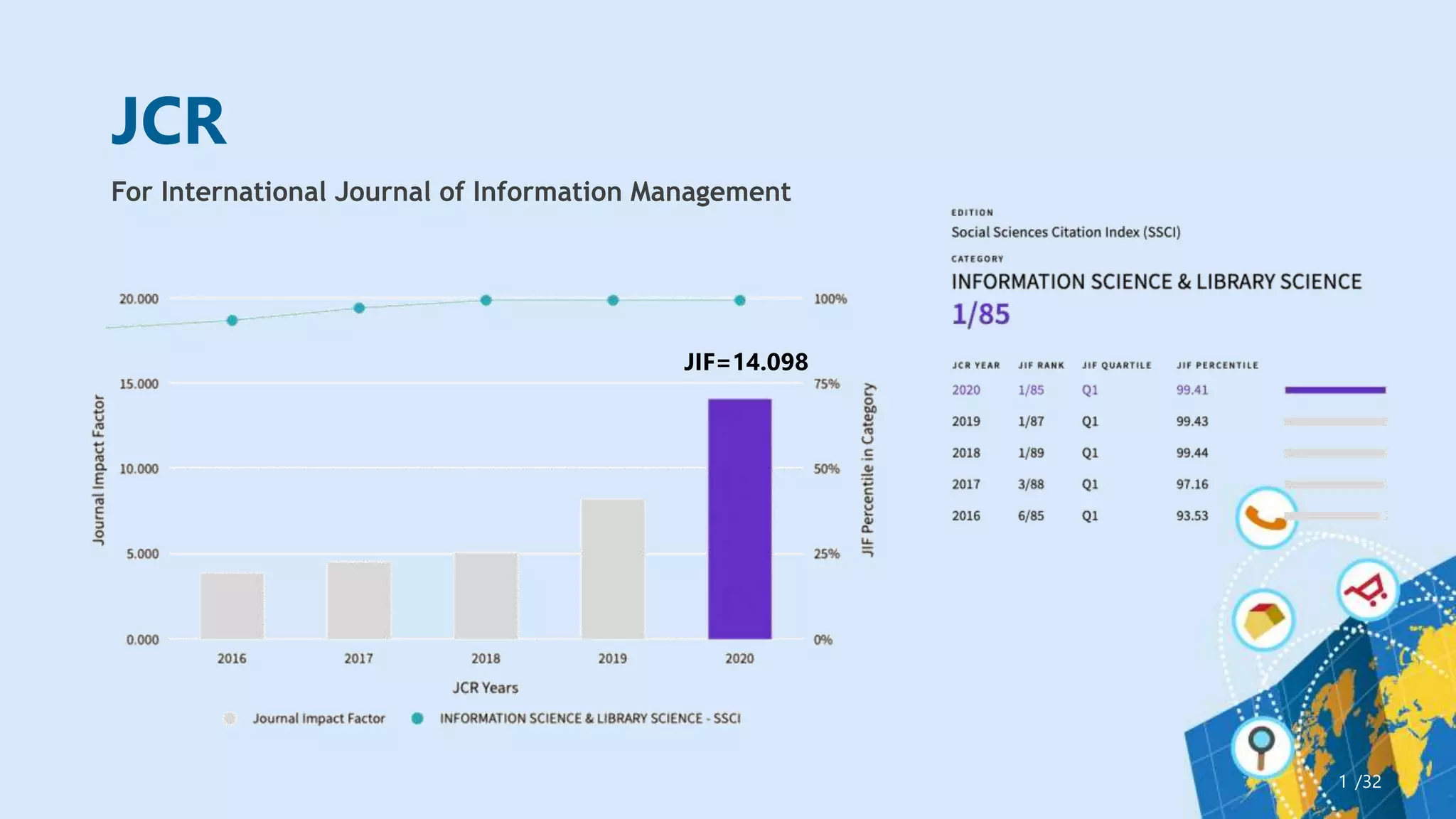
JCR
/32
1
JIF=14.098
For International Journal of Information Management
Vocabularies 1/3
/32
2
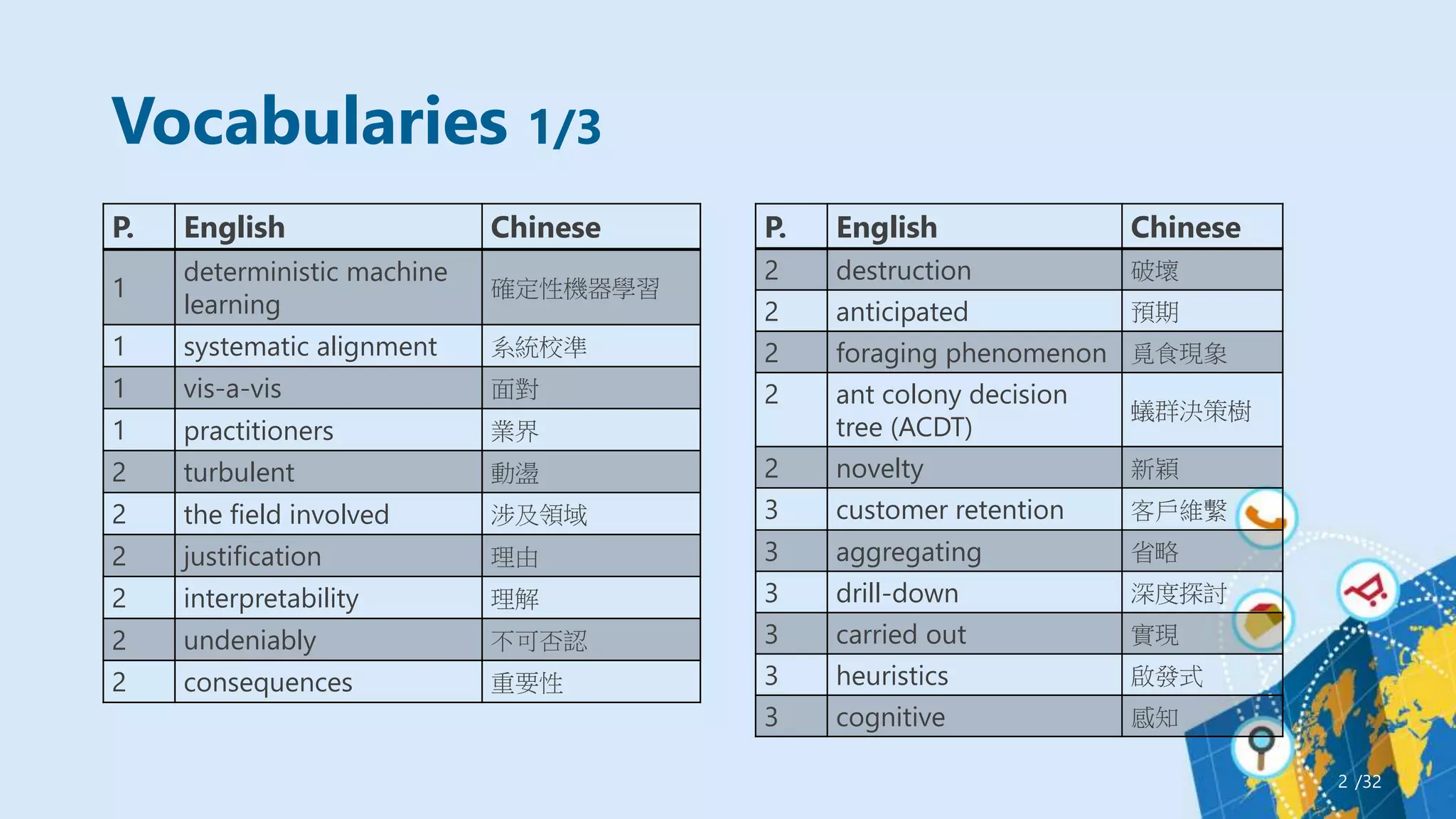
P. English Chinese
1
deterministic machine
learning
確定性機器學習
1 systematic alignment 系統校準
1 vis-a-vis 面對
1 practitioners 業界
2 turbulent 動盪
2 the field involved 涉及領域
2 justification 理由
2 interpretability 理解
2 undeniably 不可否認
2 consequences 重要性
P. English Chinese
2 destruction 破壞
2 anticipated 預期
2 foraging phenomenon 覓食現象
2 ant colony decision
tree (ACDT)
蟻群決策樹
2 novelty 新穎
3 customer retention 客戶維繫
3 aggregating 省略
3 drill-down 深度探討
3 carried out 實現
3 heuristics 啟發式
3 cognitive 感知
Vocabularies 2/3
/32
3
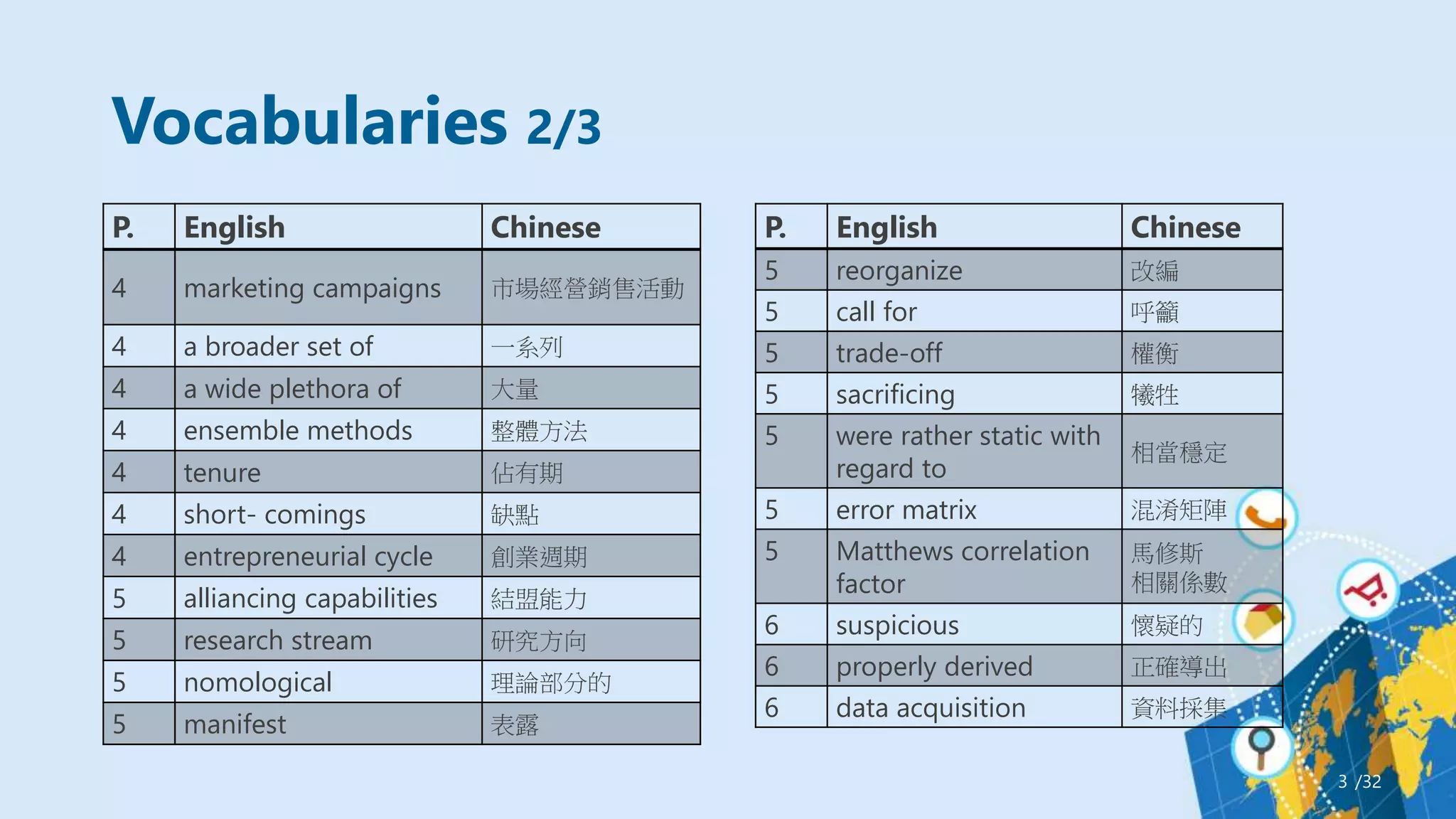
P. English Chinese
4 marketing campaigns 市場經營銷售活動
4 a broader set of 一系列
4 a wide plethora of 大量
4 ensemble methods 整體方法
4 tenure 佔有期
4 short- comings 缺點
4 entrepreneurial cycle 創業週期
5 alliancing capabilities 結盟能力
5 research stream 研究方向
5 nomological 理論部分的
5 manifest 表露
P. English Chinese
5 reorganize 改編
5 call for 呼籲
5 trade-off 權衡
5 sacrificing 犧牲
5 were rather static with
regard to
相當穩定
5 error matrix 混淆矩陣
5 Matthews correlation
factor
馬修斯
相關係數
6 suspicious 懷疑的
6 properly derived 正確導出
6 data acquisition 資料採集
Vocabularies 3/3
/32
4
P. English Chinese
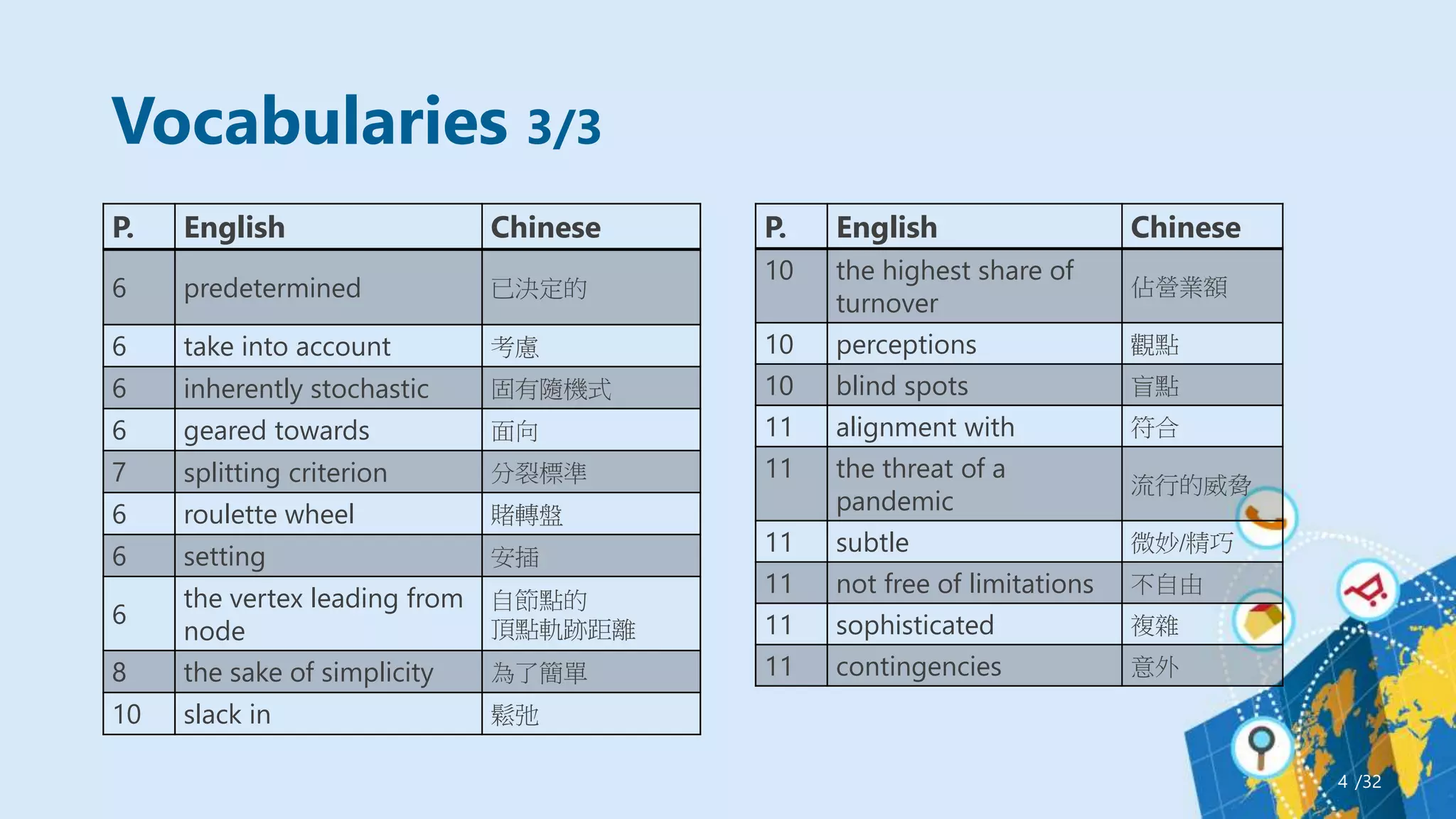
6 predetermined 已決定的
6 take into account 考慮
6 inherently stochastic 固有隨機式
6 geared towards 面向
7 splitting criterion 分裂標準
6 roulette wheel 賭轉盤
6 setting 安插
6
the vertex leading from
node
自節點的
頂點軌跡距離
8 the sake of simplicity 為了簡單
10 slack in 鬆弛
P. English Chinese
10 the highest share of
turnover
佔營業額
10 perceptions 觀點
10 blind spots 盲點
11 alignment with 符合
11 the threat of a
pandemic
流行的威脅
11 subtle 微妙/精巧
11 not free of limitations 不自由
11 sophisticated 複雜
11 contingencies 意外
CONTENTS
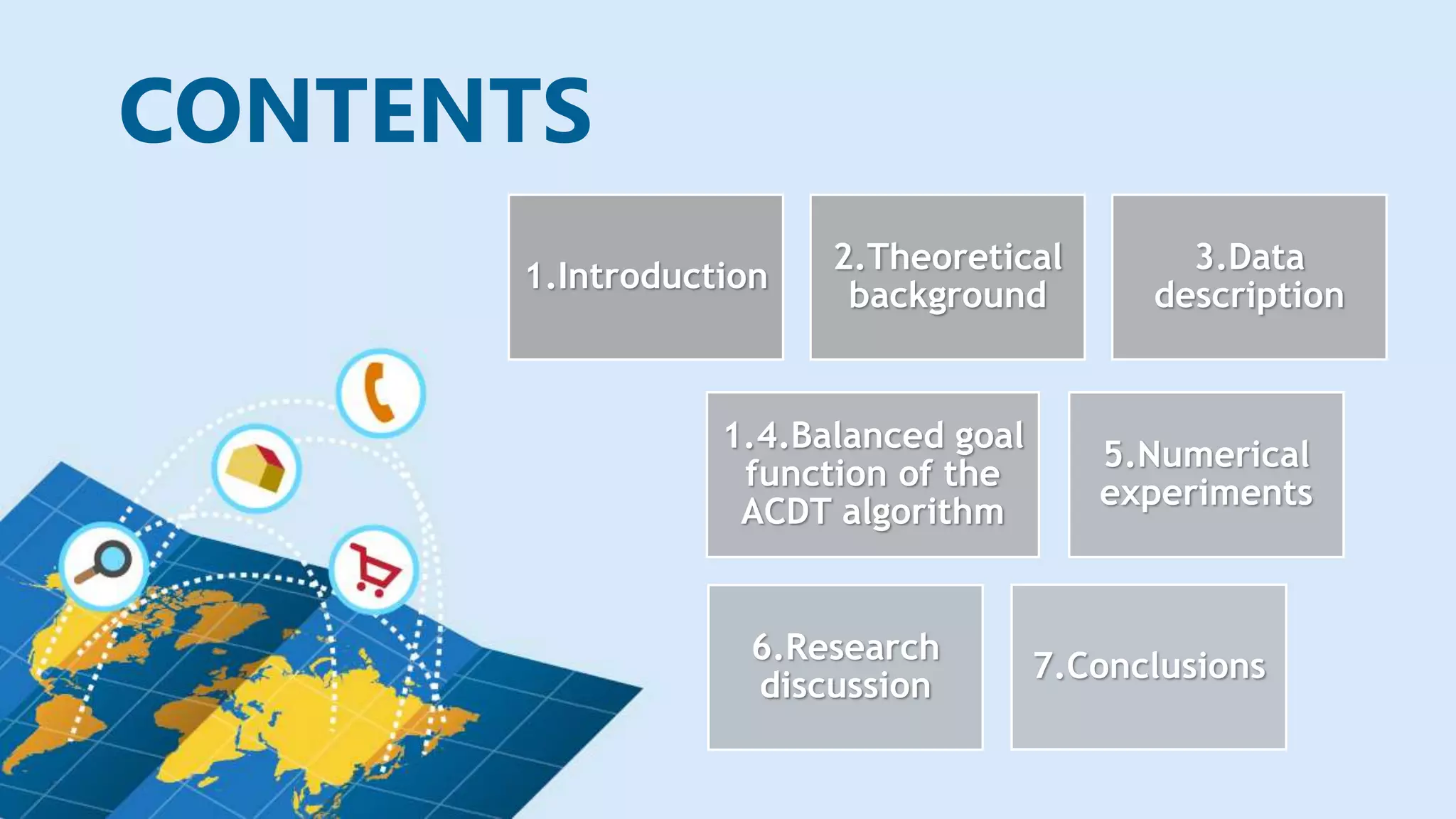
1.Introduction
2.Theoretical
background
3.Data
description
1.4.Balanced goal
function of the
ACDT algorithm
5.Numerical
experiments
6.Research
discussion
7.Conclusions
① Introduction
/32
6
This Photo by Unknown Author is licensed under CC BY-SA
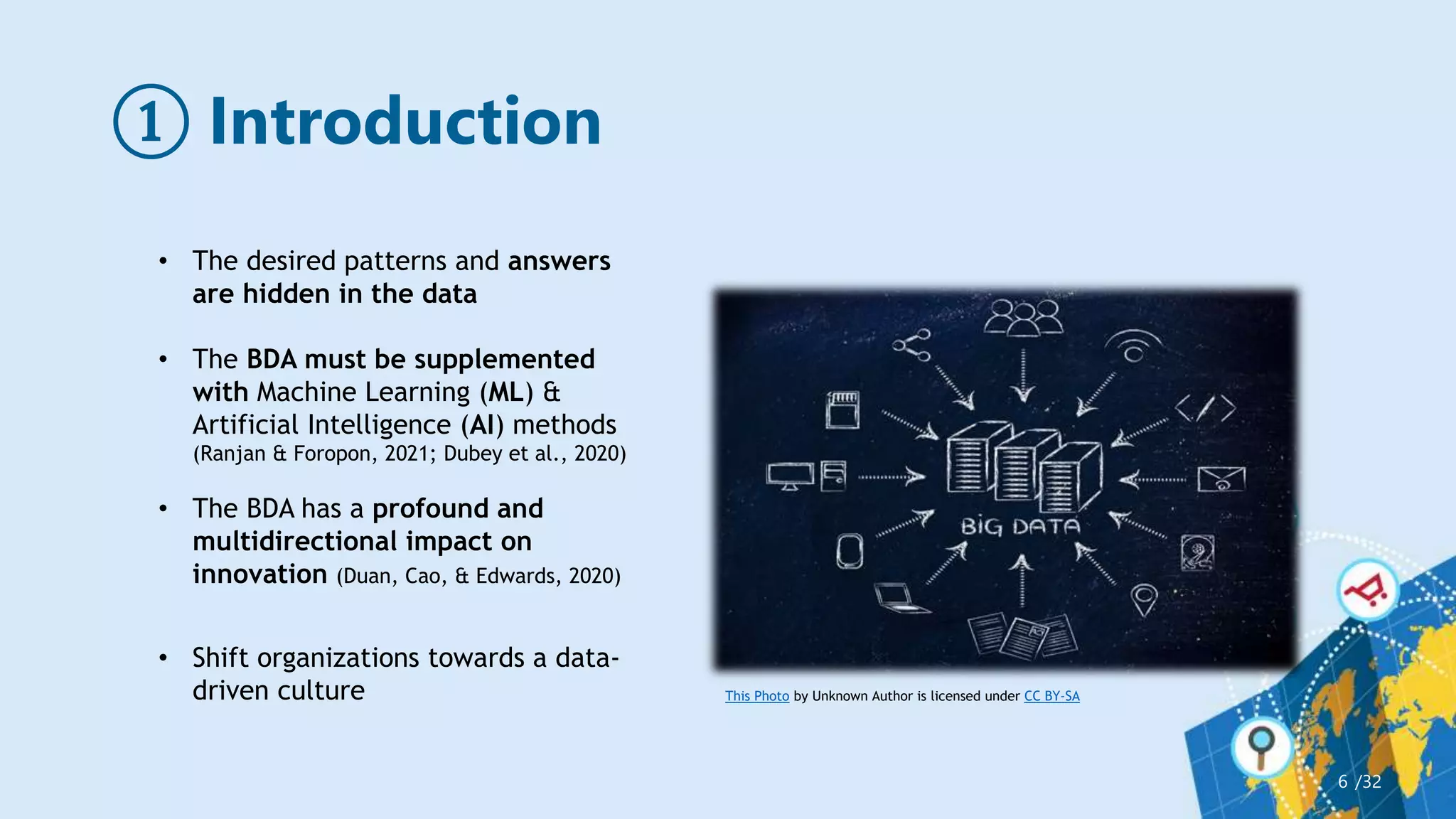
• The desired patterns and answers
are hidden in the data
• The BDA must be supplemented
with Machine Learning (ML) &
Artificial Intelligence (AI) methods
(Ranjan & Foropon, 2021; Dubey et al., 2020)
• The BDA has a profound and
multidirectional impact on
innovation (Duan, Cao, & Edwards, 2020)
• Shift organizations towards a data-
driven culture
① Introduction
/32
7
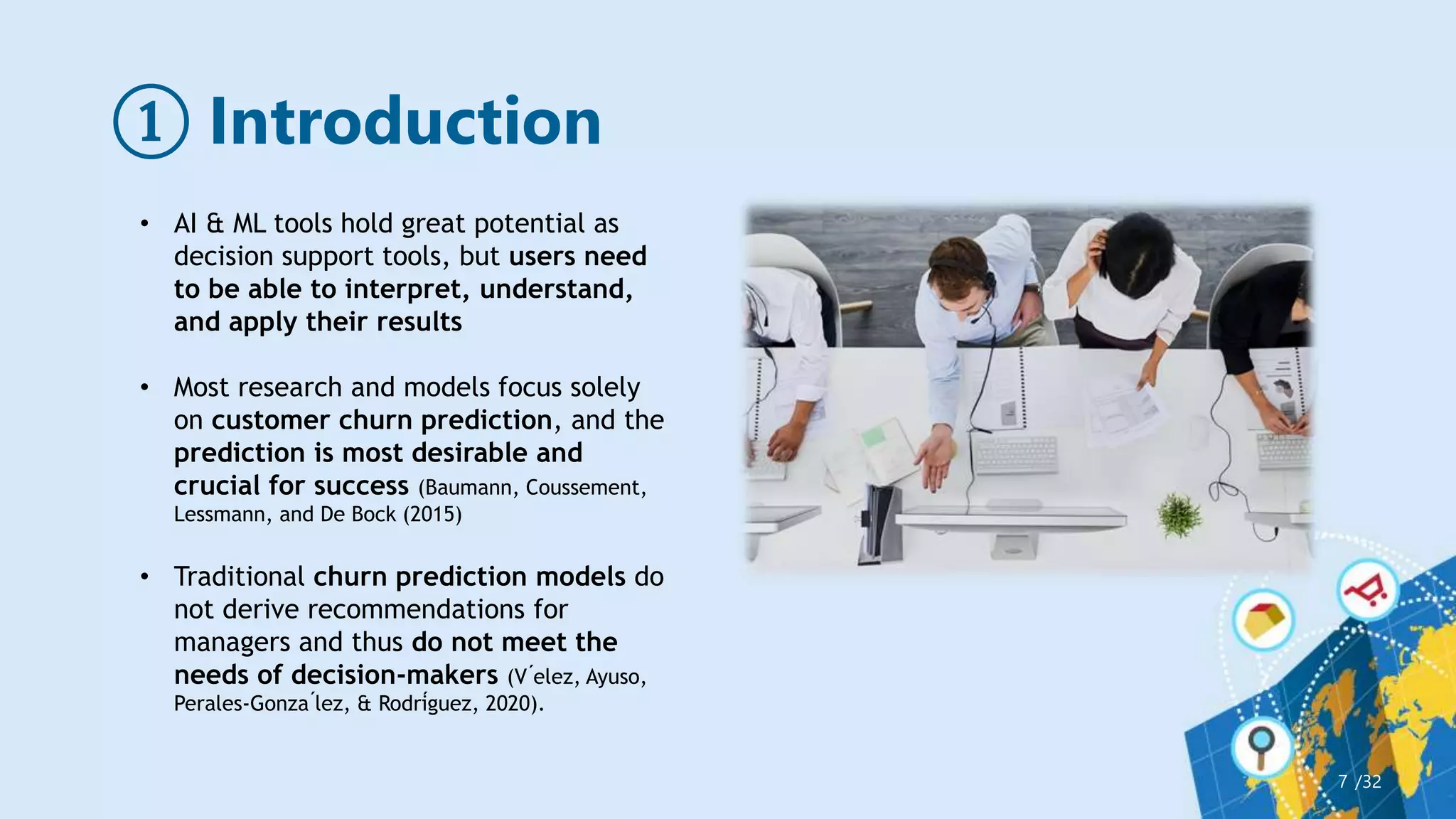
• AI & ML tools hold great potential as
decision support tools, but users need
to be able to interpret, understand,
and apply their results
• Most research and models focus solely
on customer churn prediction, and the
prediction is most desirable and
crucial for success (Baumann, Coussement,
Lessmann, and De Bock (2015)
• Traditional churn prediction models do
not derive recommendations for
managers and thus do not meet the
needs of decision-makers (V ́elez, Ayuso,
Perales-Gonza ́lez, & Rodríguez, 2020).
① Introduction
/32
8
This Photo by Unknown Author is licensed under CC BY
• Using a modified swarm intelligence
algorithm to enhance decision-makers’
capabilities
• A new, goal-oriented metaheuristic
modification of the ant colony decision
tree (ACDT) algorithm
• Improve the efficiency of marketing
activities aimed at segmenting and
targeting customers by building
models to optimize targeting decisions
and improve customer retention with
limited resources
Propose
② Theoretical background
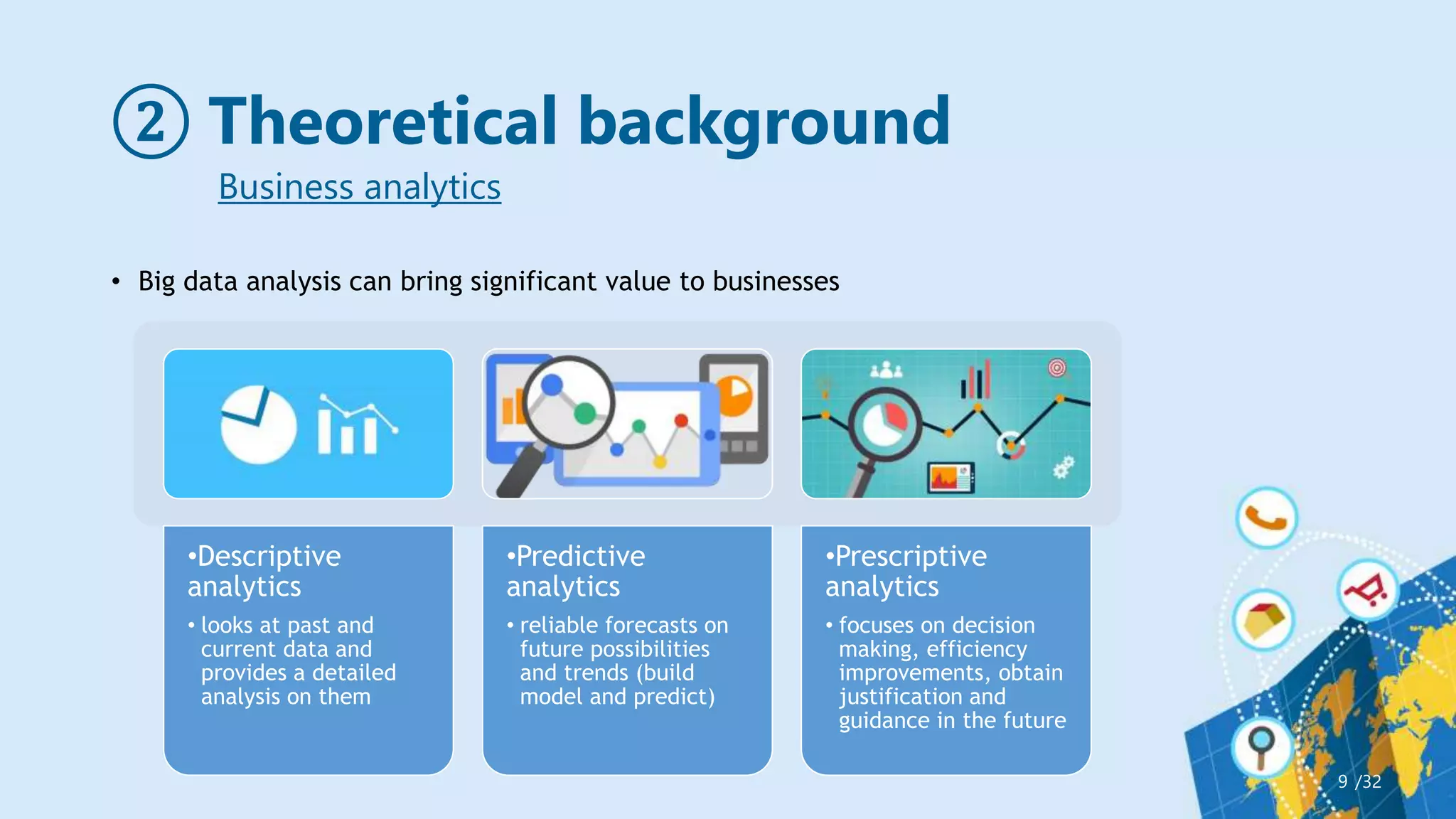
• Big data analysis can bring significant value to businesses
/32
9
Business analytics
•Descriptive
analytics
• looks at past and
current data and
provides a detailed
analysis on them
•Predictive
analytics
• reliable forecasts on
future possibilities
and trends (build
model and predict)
•Prescriptive
analytics
• focuses on decision
making, efficiency
improvements, obtain
justification and
guidance in the future
② Theoretical background
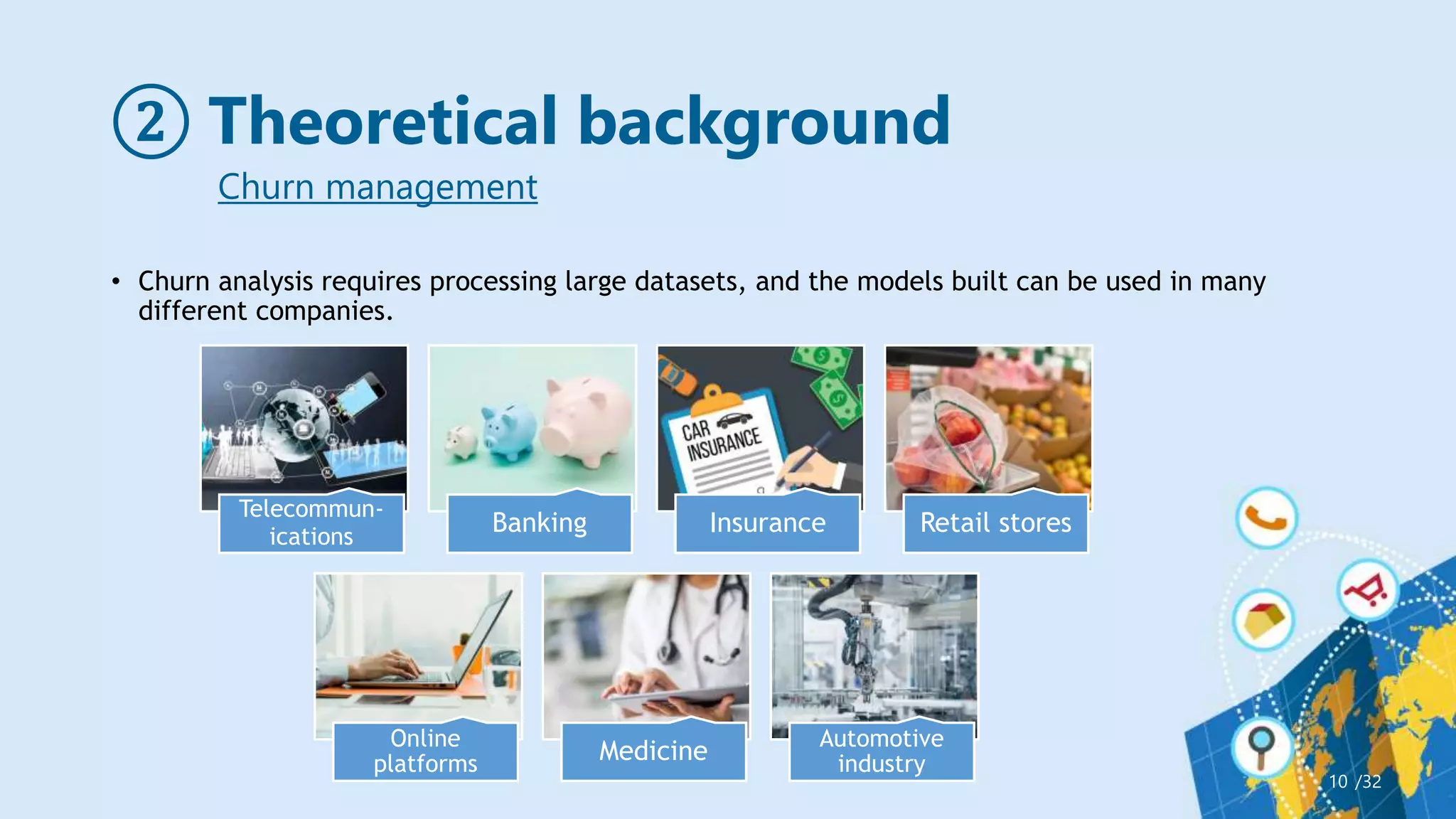
• Churn analysis requires processing large datasets, and the models built can be used in many
different companies.
/32
10
Churn management
Telecommun-
ications
Banking Insurance Retail stores
Online
platforms Medicine Automotive
industry
② Theoretical background
/32
11
Churn management
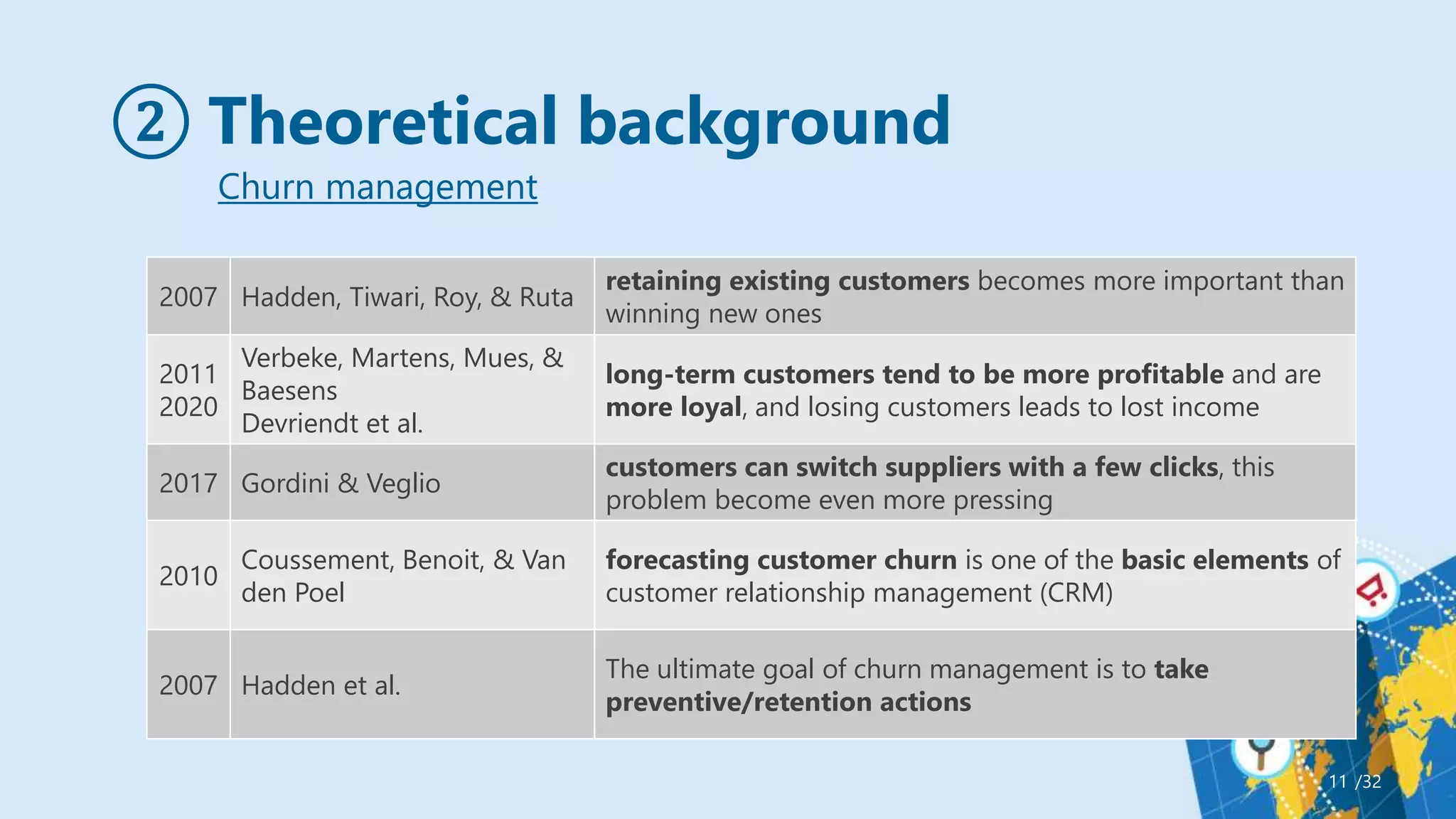
2007 Hadden, Tiwari, Roy, & Ruta
retaining existing customers becomes more important than
winning new ones
2011
2020
Verbeke, Martens, Mues, &
Baesens
Devriendt et al.
long-term customers tend to be more profitable and are
more loyal, and losing customers leads to lost income
2017 Gordini & Veglio
customers can switch suppliers with a few clicks, this
problem become even more pressing
2010
Coussement, Benoit, & Van
den Poel
forecasting customer churn is one of the basic elements of
customer relationship management (CRM)
2007 Hadden et al.
The ultimate goal of churn management is to take
preventive/retention actions
② Theoretical background
/32
12
Churn management
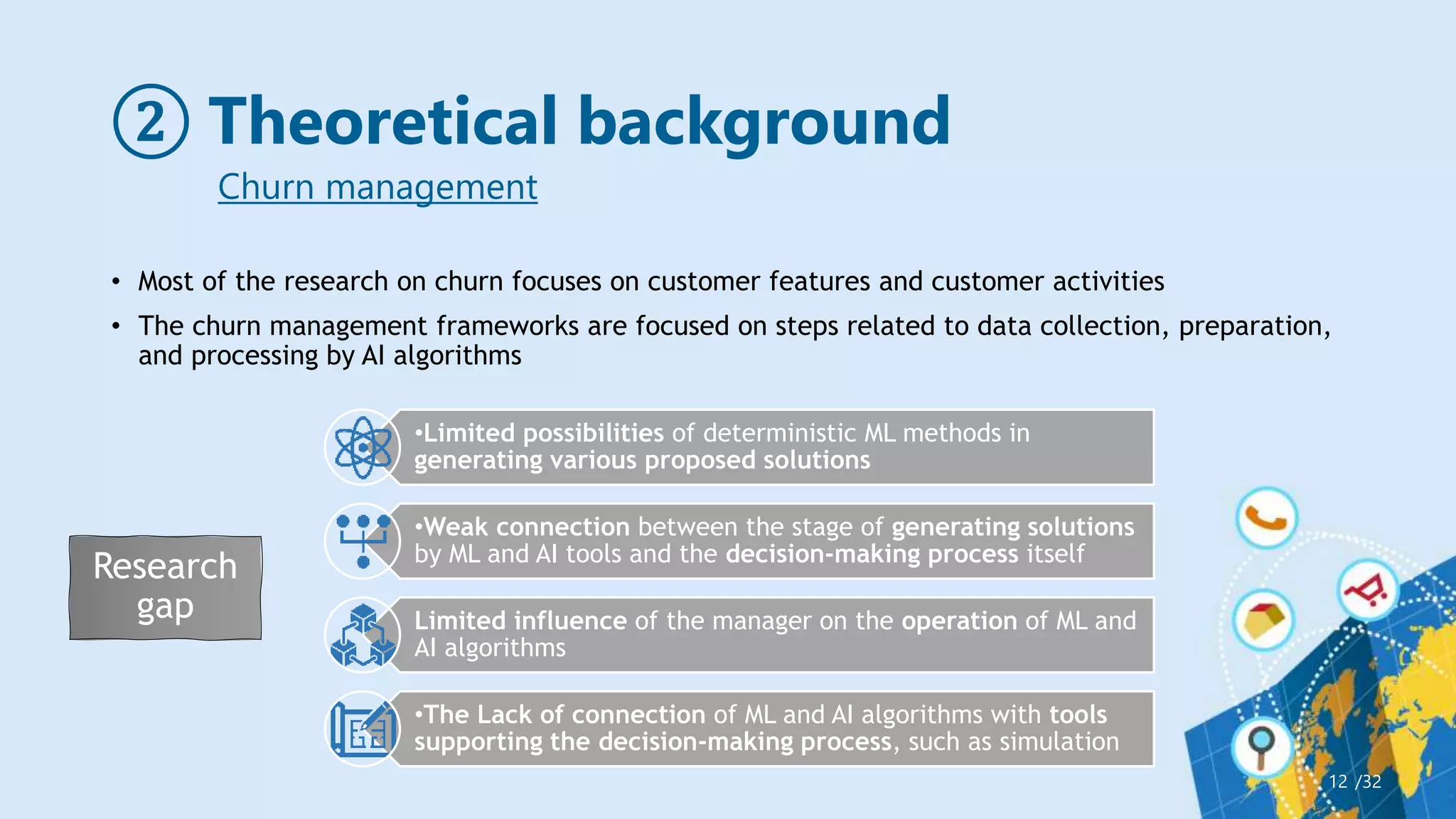
• Most of the research on churn focuses on customer features and customer activities
• The churn management frameworks are focused on steps related to data collection, preparation,
and processing by AI algorithms
•Limited possibilities of deterministic ML methods in
generating various proposed solutions
•Weak connection between the stage of generating solutions
by ML and AI tools and the decision-making process itself
Limited influence of the manager on the operation of ML and
AI algorithms
•The Lack of connection of ML and AI algorithms with tools
supporting the decision-making process, such as simulation
Research
gap
② Theoretical background
/32
13
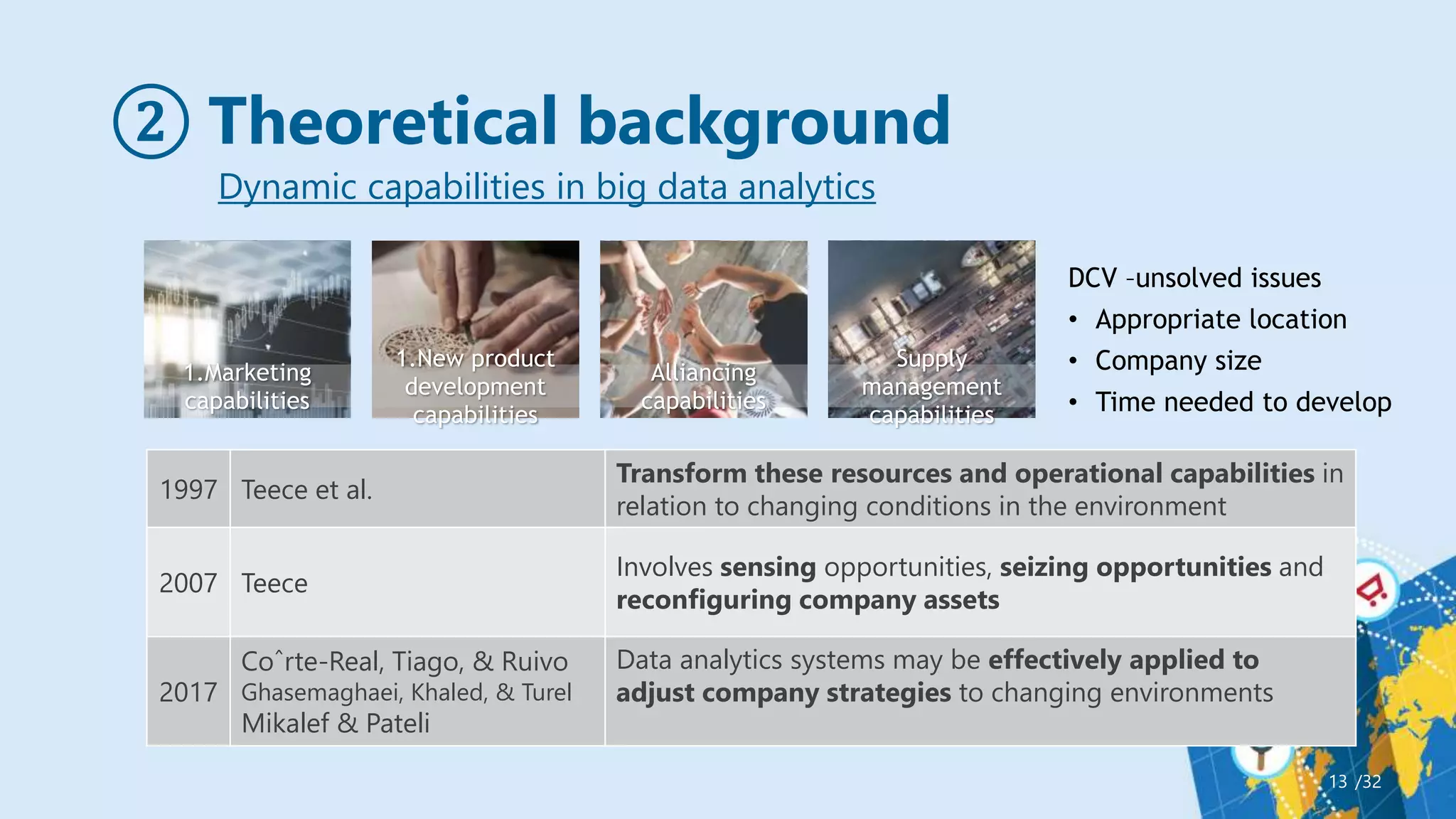
Dynamic capabilities in big data analytics
1997 Teece et al.
Transform these resources and operational capabilities in
relation to changing conditions in the environment
2007 Teece
Involves sensing opportunities, seizing opportunities and
reconfiguring company assets
2017
Coˆrte-Real, Tiago, & Ruivo
Ghasemaghaei, Khaled, & Turel
Mikalef & Pateli
Data analytics systems may be effectively applied to
adjust company strategies to changing environments
1.Marketing
capabilities
1.New product
development
capabilities
Alliancing
capabilities
Supply
management
capabilities
DCV –unsolved issues
• Appropriate location
• Company size
• Time needed to develop
② Theoretical background
/32
14
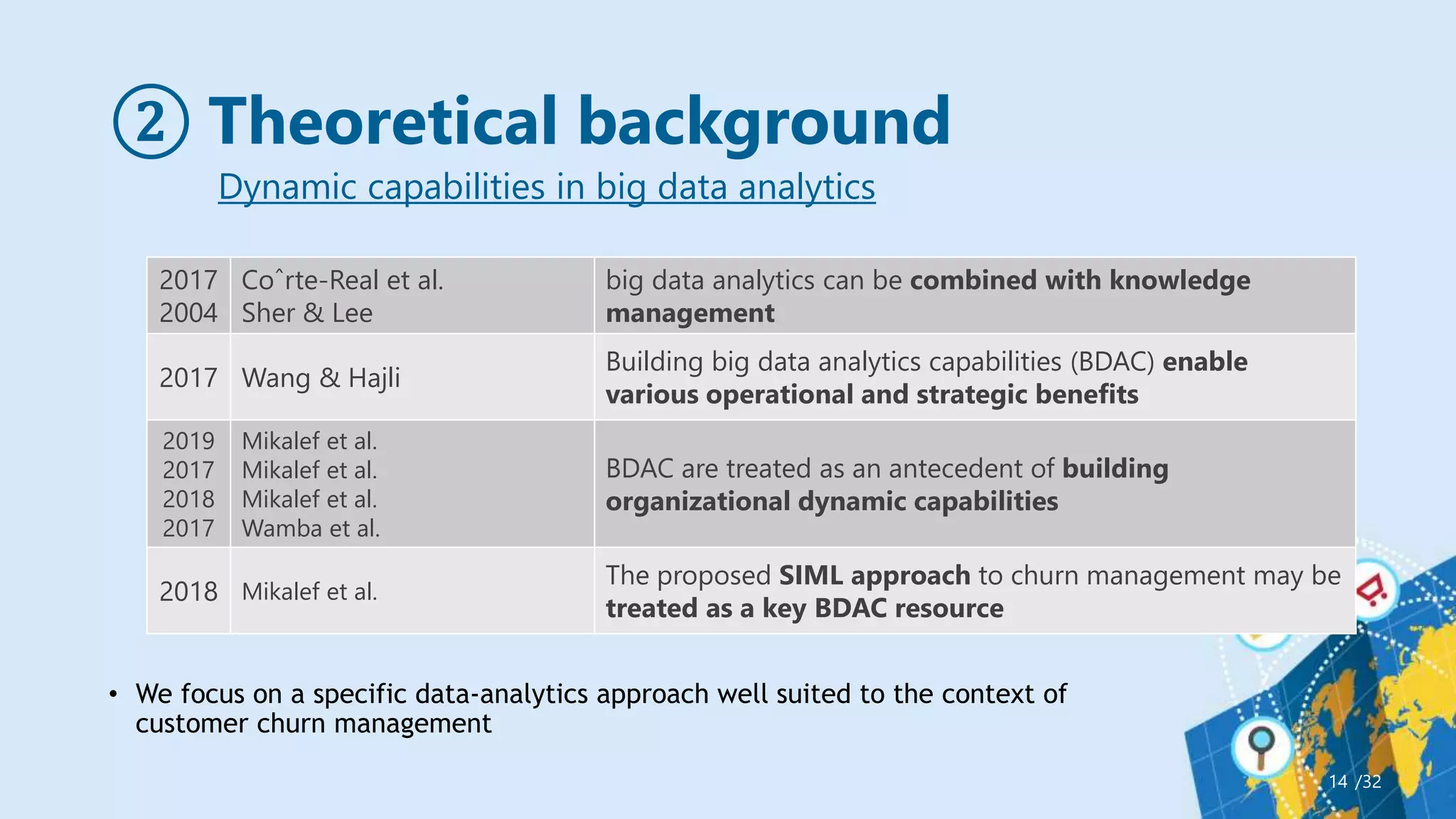
Dynamic capabilities in big data analytics
2017
2004
Coˆrte-Real et al.
Sher & Lee
big data analytics can be combined with knowledge
management
2017 Wang & Hajli
Building big data analytics capabilities (BDAC) enable
various operational and strategic benefits
2019
2017
2018
2017
Mikalef et al.
Mikalef et al.
Mikalef et al.
Wamba et al.
BDAC are treated as an antecedent of building
organizational dynamic capabilities
2018 Mikalef et al.
The proposed SIML approach to churn management may be
treated as a key BDAC resource
• We focus on a specific data-analytics approach well suited to the context of
customer churn management
② Theoretical background
/32
15
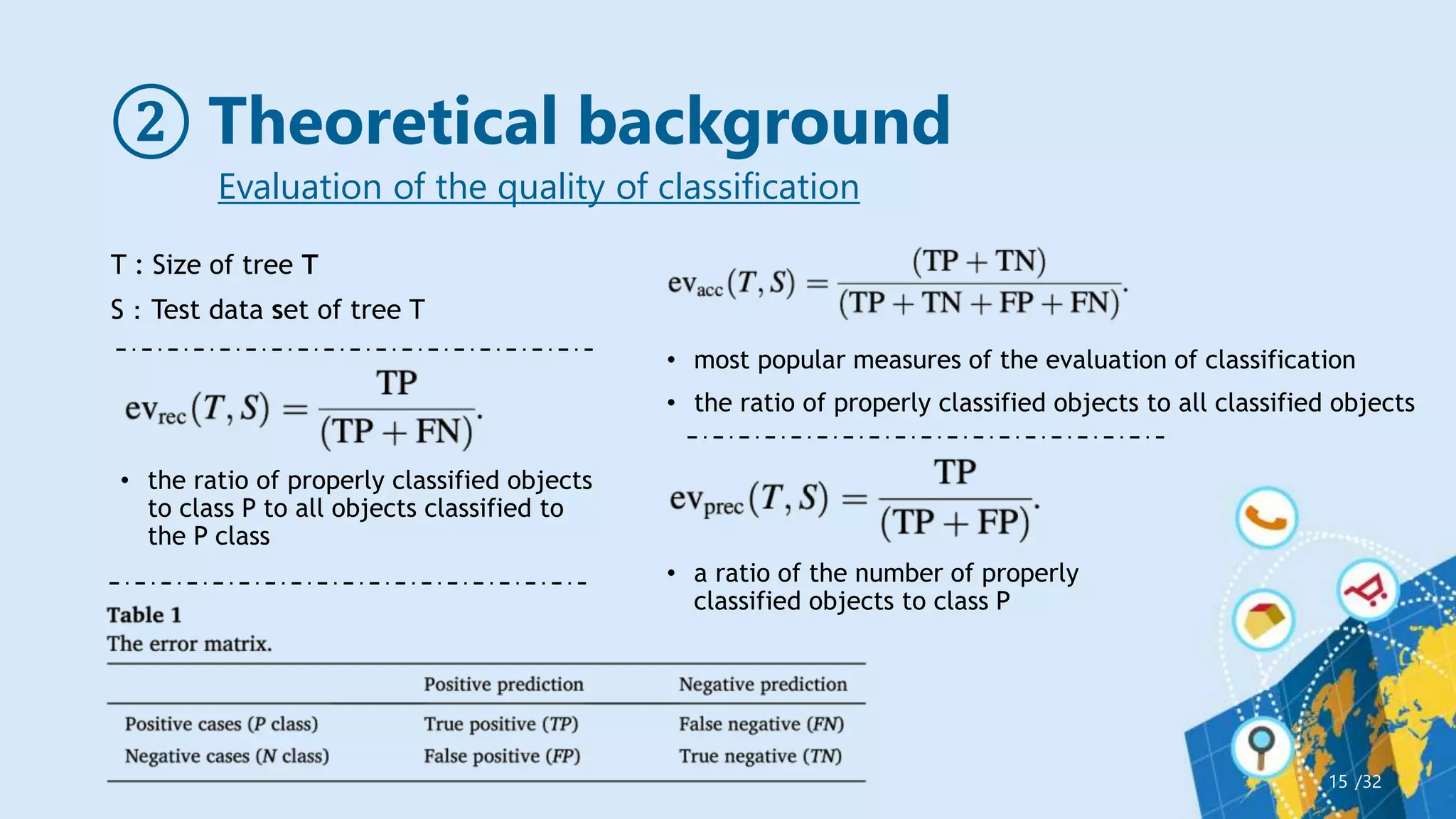
Evaluation of the quality of classification
T : Size of tree T
S:Test data set of tree T
• most popular measures of the evaluation of classification
• the ratio of properly classified objects to all classified objects
• the ratio of properly classified objects
to class P to all objects classified to
the P class
• a ratio of the number of properly
classified objects to class P
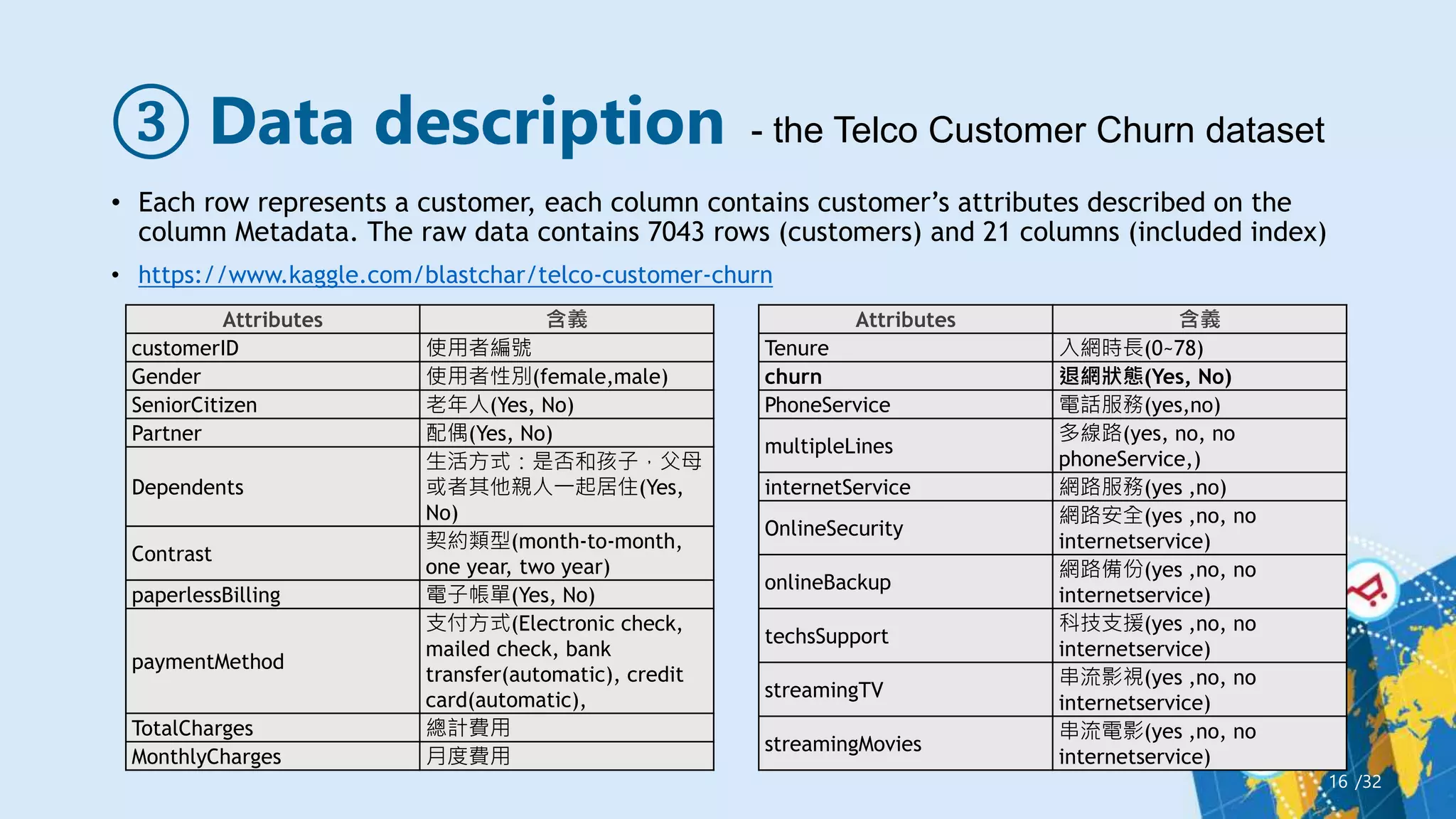
③ Data description
• Each row represents a customer, each column contains customer’s attributes described on the
column Metadata. The raw data contains 7043 rows (customers) and 21 columns (included index)
• https://www.kaggle.com/blastchar/telco-customer-churn
/32
16
Attributes 含義
customerID 使用者編號
Gender 使用者性別(female,male)
SeniorCitizen 老年人(Yes, No)
Partner 配偶(Yes, No)
Dependents
生活方式:是否和孩子,父母
或者其他親人一起居住(Yes,
No)
Contrast
契約類型(month-to-month,
one year, two year)
paperlessBilling 電子帳單(Yes, No)
paymentMethod
支付方式(Electronic check,
mailed check, bank
transfer(automatic), credit
card(automatic),
TotalCharges 總計費用
MonthlyCharges 月度費用
Attributes 含義
Tenure 入網時長(0~78)
churn 退網狀態(Yes, No)
PhoneService 電話服務(yes,no)
multipleLines
多線路(yes, no, no
phoneService,)
internetService 網路服務(yes ,no)
OnlineSecurity
網路安全(yes ,no, no
internetservice)
onlineBackup
網路備份(yes ,no, no
internetservice)
techsSupport
科技支援(yes ,no, no
internetservice)
streamingTV
串流影視(yes ,no, no
internetservice)
streamingMovies
串流電影(yes ,no, no
internetservice)
- the Telco Customer Churn dataset
④ Balanced goal function of the ACDT algorithm
/32
17
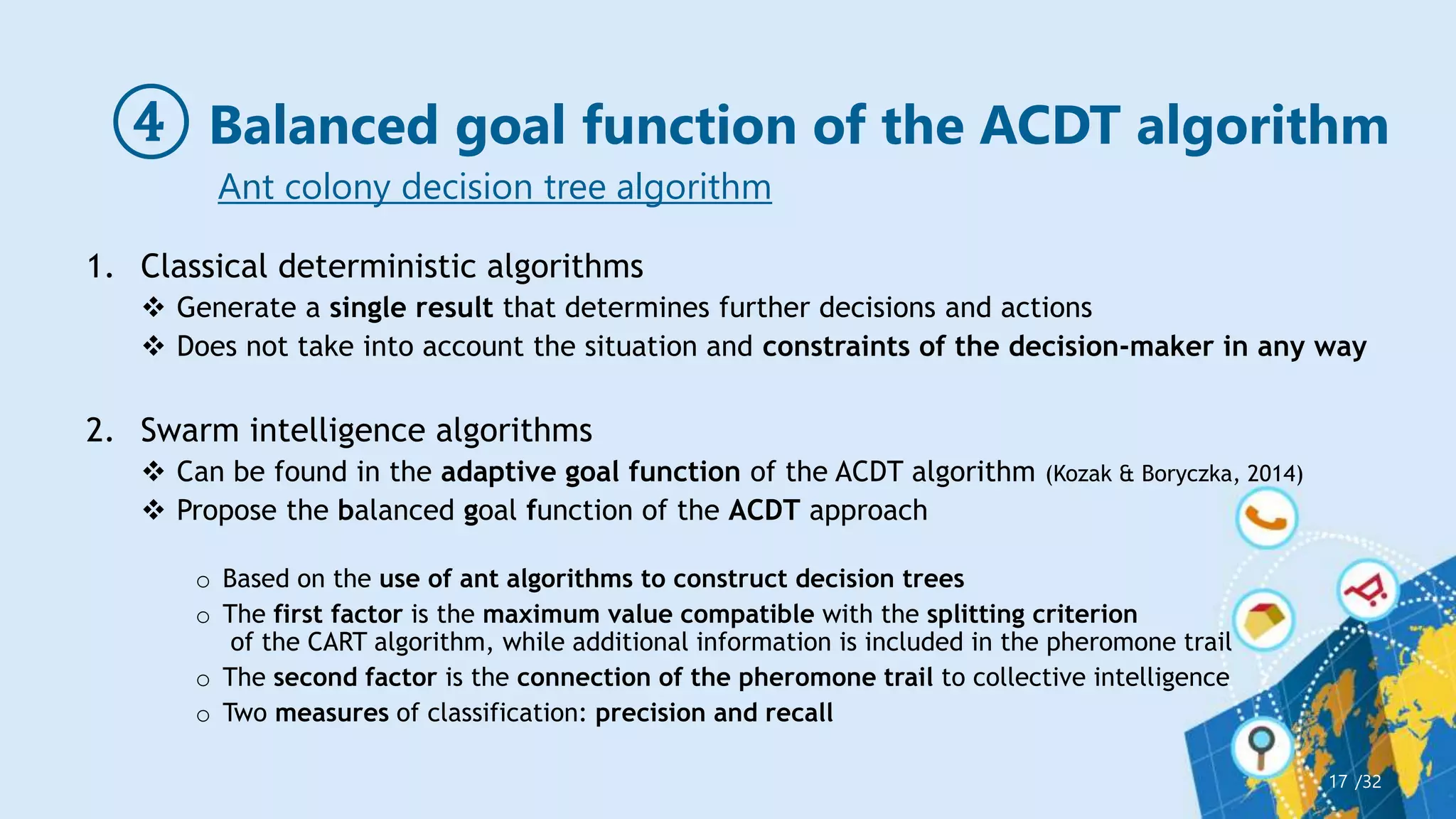
Ant colony decision tree algorithm
1. Classical deterministic algorithms
 Generate a single result that determines further decisions and actions
 Does not take into account the situation and constraints of the decision-maker in any way
2. Swarm intelligence algorithms
 Can be found in the adaptive goal function of the ACDT algorithm (Kozak & Boryczka, 2014)
 Propose the balanced goal function of the ACDT approach
o Based on the use of ant algorithms to construct decision trees
o The first factor is the maximum value compatible with the splitting criterion
of the CART algorithm, while additional information is included in the pheromone trail
o The second factor is the connection of the pheromone trail to collective intelligence
o Two measures of classification: precision and recall
④ Balanced goal function of the ACDT algorithm
/32
18
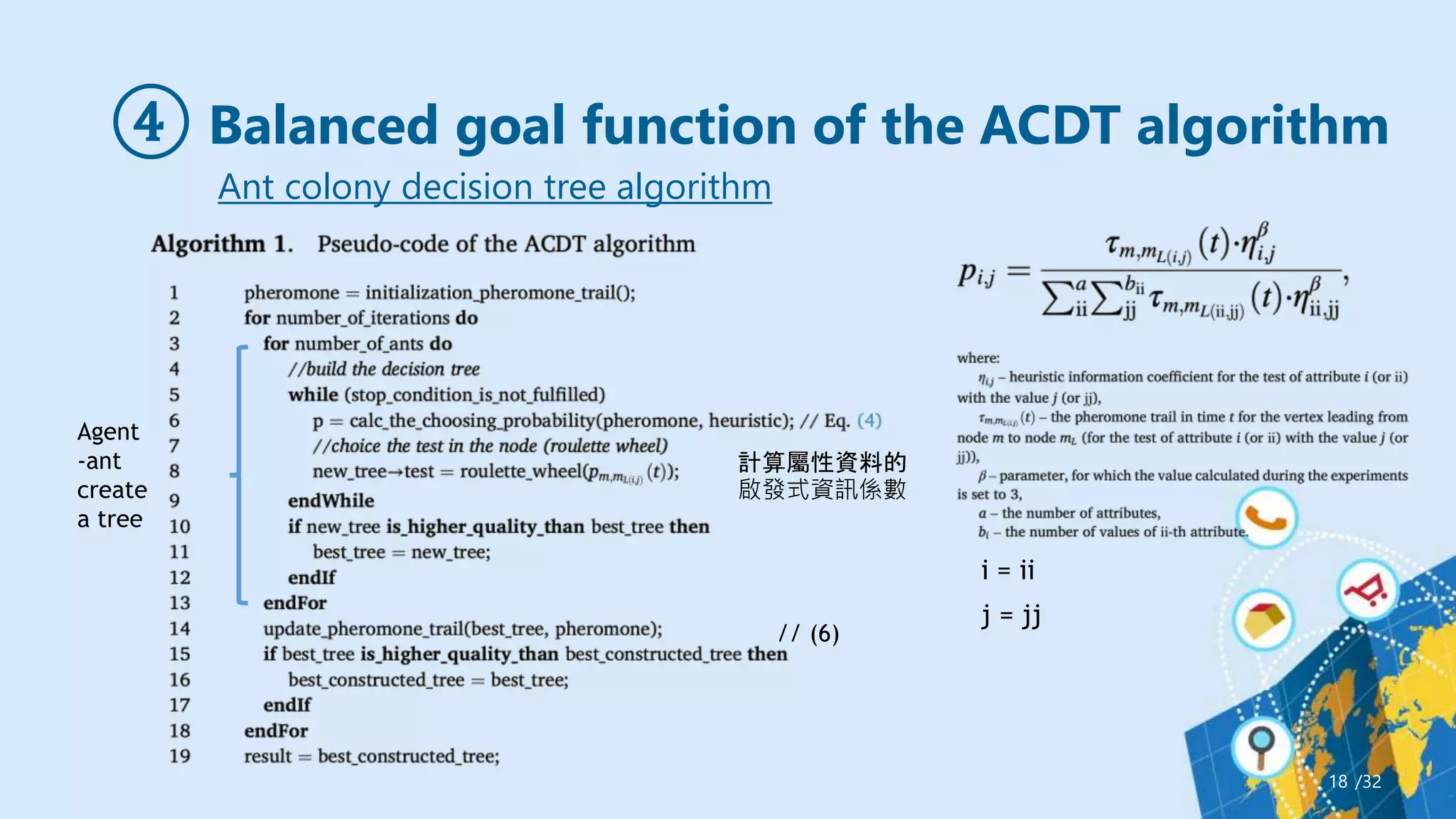
Ant colony decision tree algorithm
計算屬性資料的
啟發式資訊係數
Agent
-ant
create
a tree
// (6)
i = ii
j = jj
④ Balanced goal function of the ACDT algorithm
/32
19
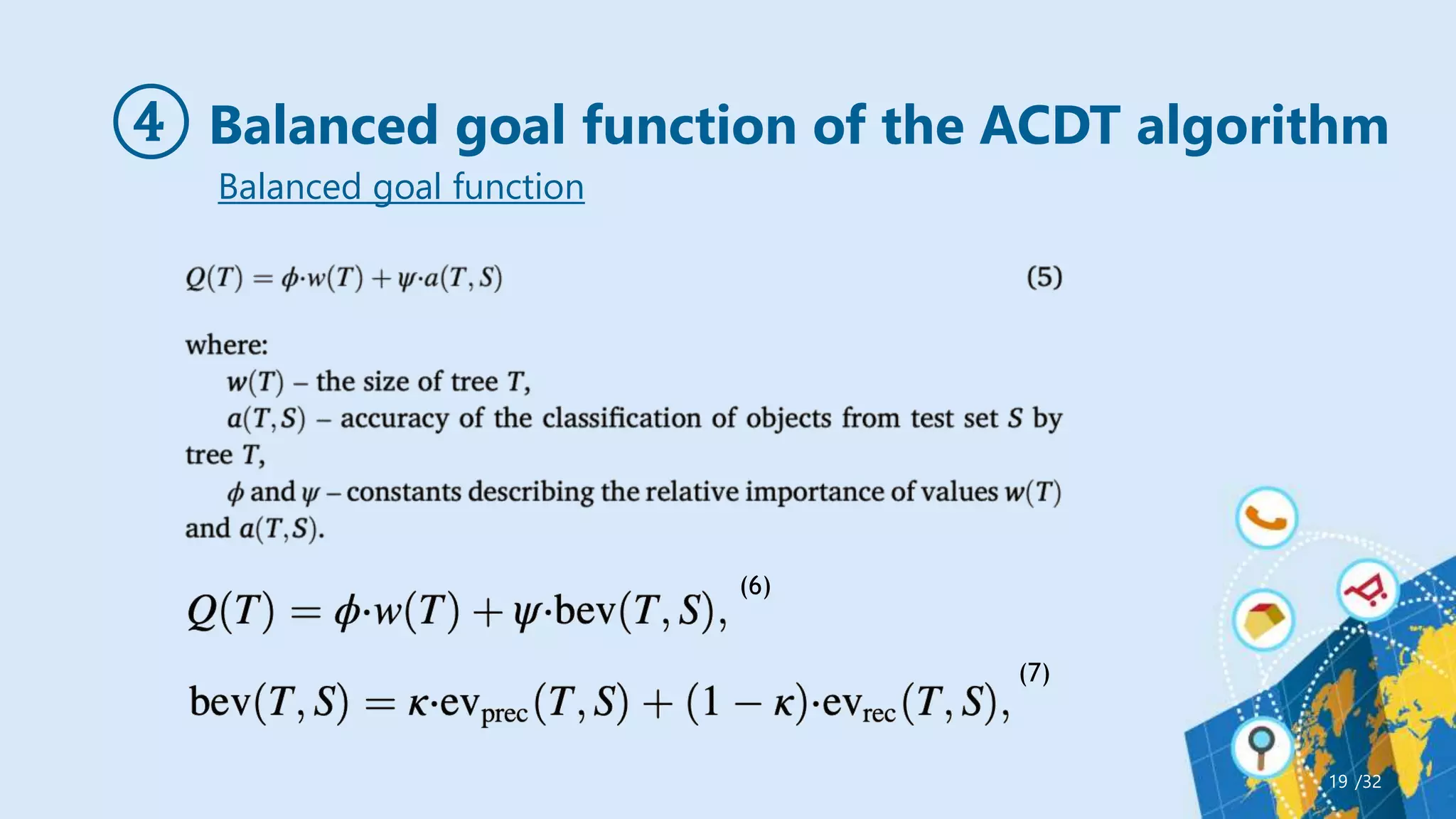
Balanced goal function
(6)
(7)
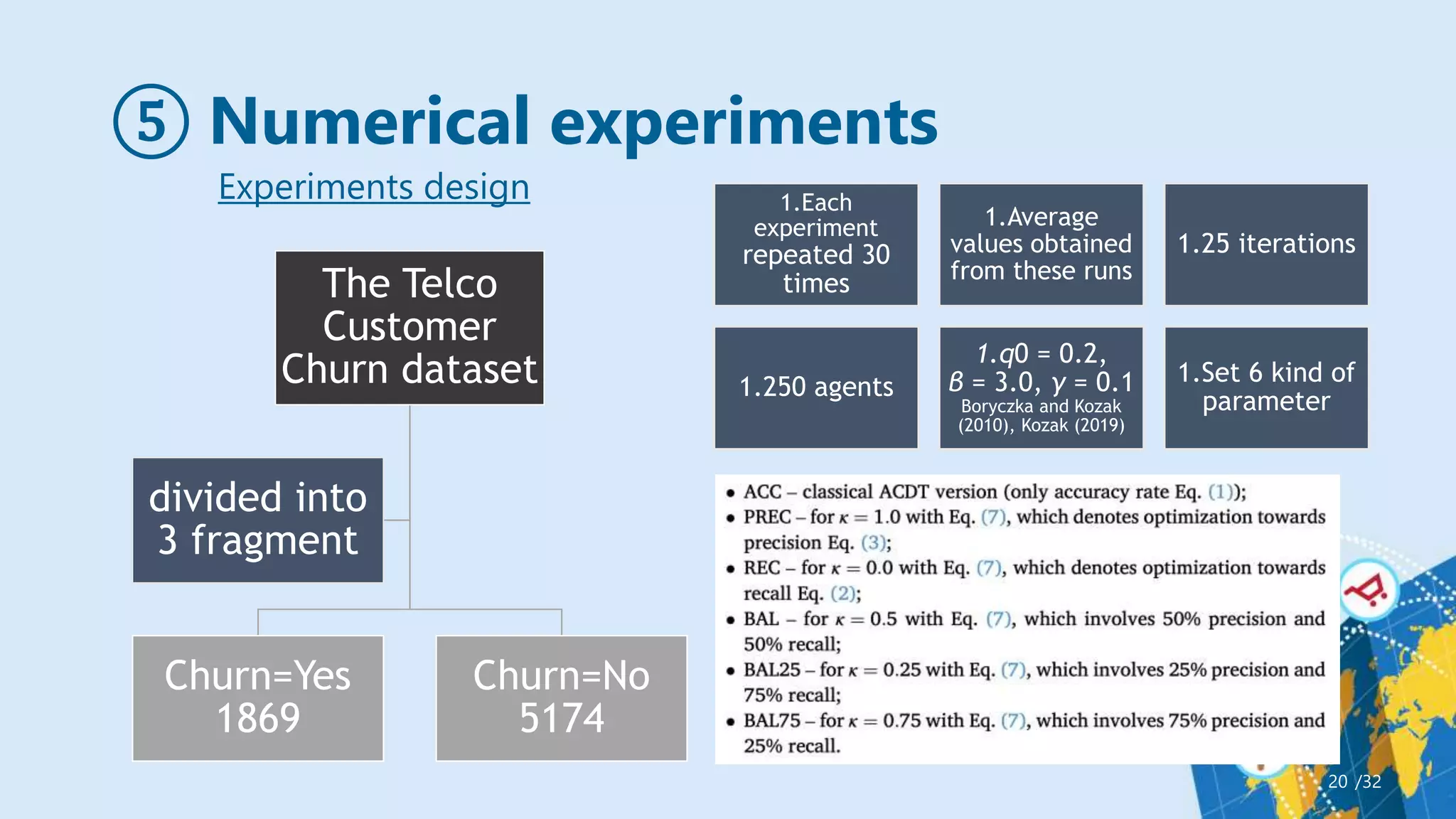
⑤ Numerical experiments
1.Each
experiment
repeated 30
times
1.Average
values obtained
from these runs
1.25 iterations
1.250 agents
1.q0 = 0.2,
β = 3.0, γ = 0.1
Boryczka and Kozak
(2010), Kozak (2019)
1.Set 6 kind of
parameter
/32
20
Experiments design
The Telco
Customer
Churn dataset
Churn=Yes
1869
Churn=No
5174
divided into
3 fragment
⑤ Numerical experiments
/32
21
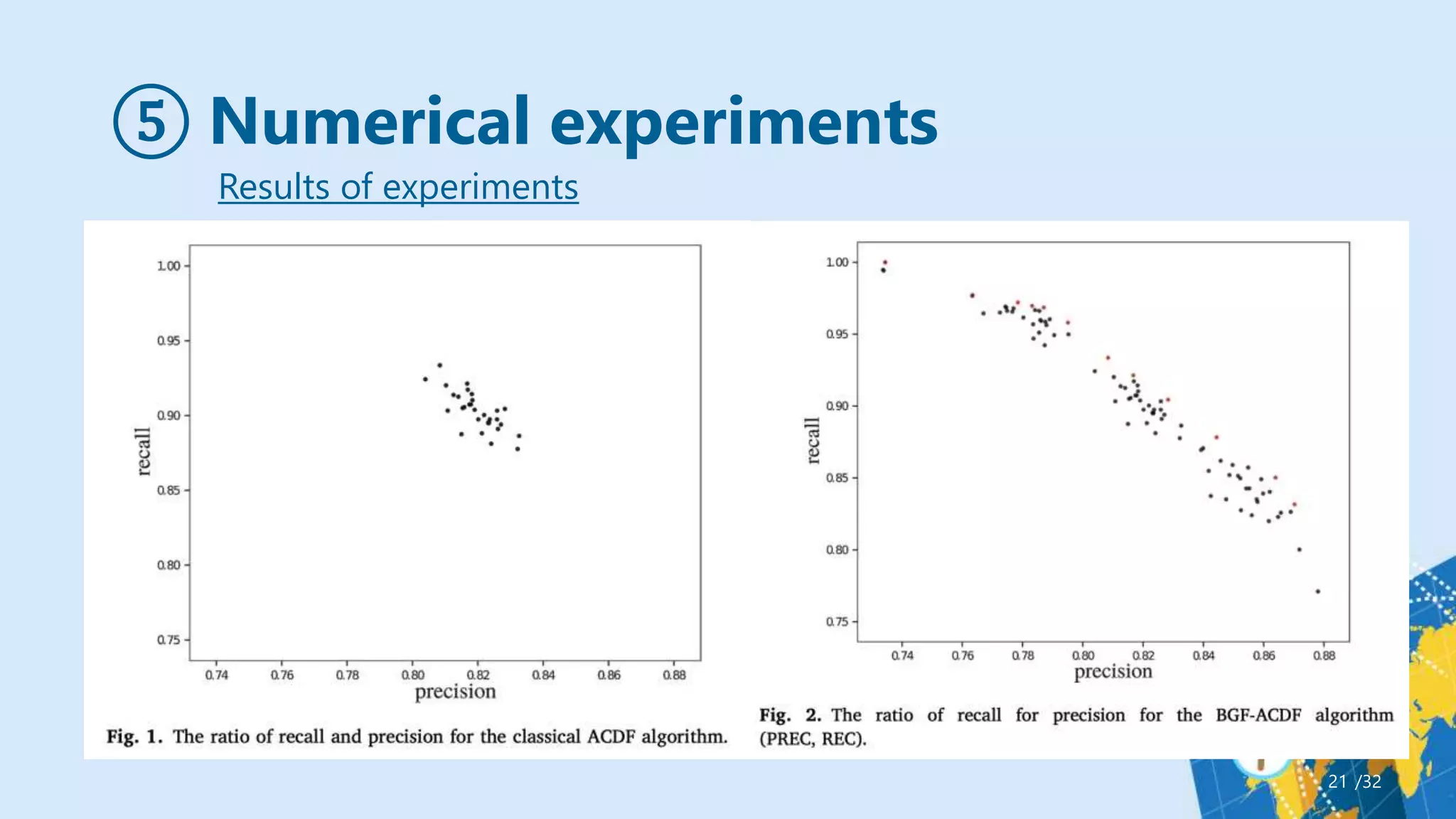
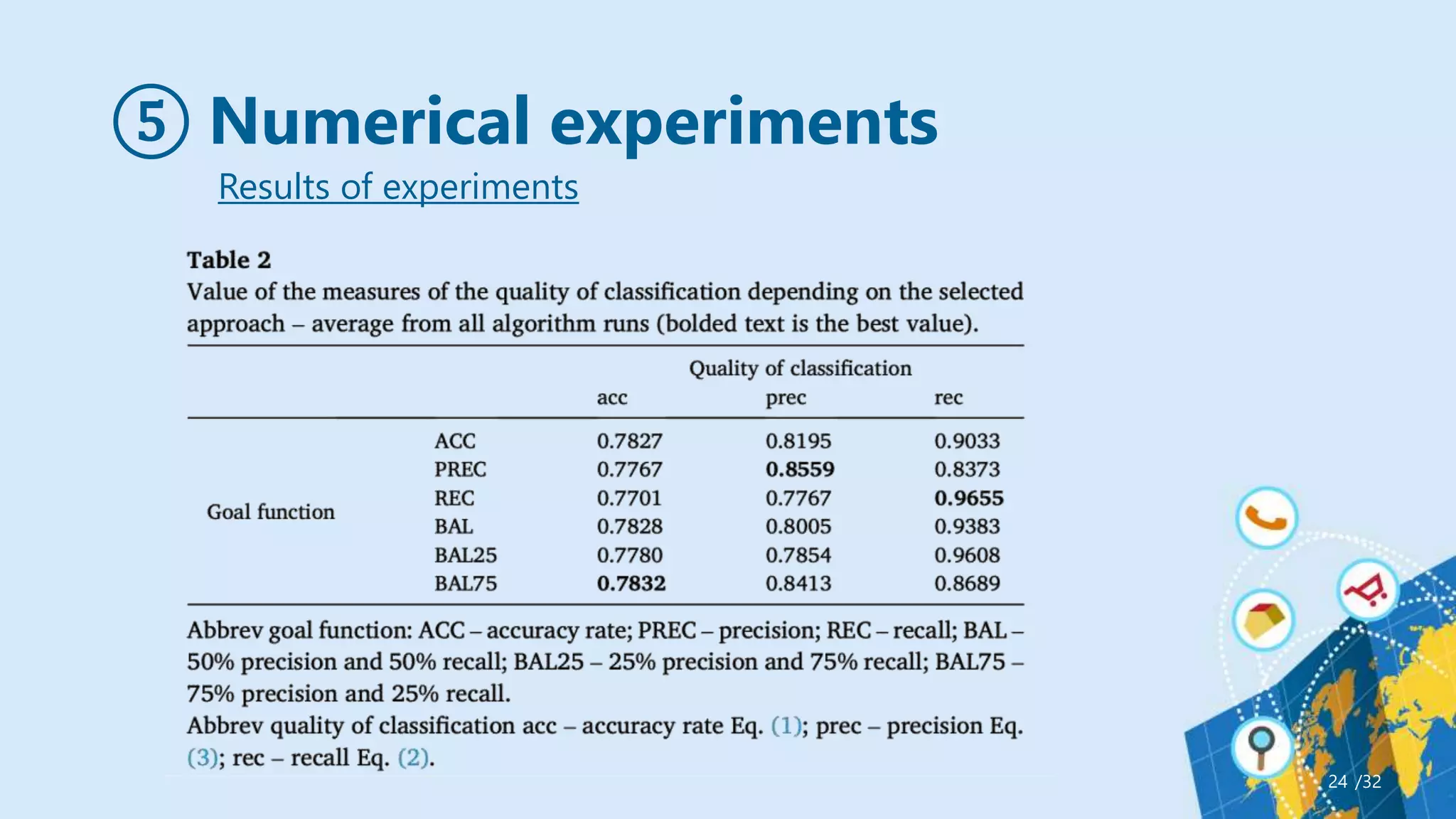
Results of experiments
⑤ Numerical experiments
/32
22
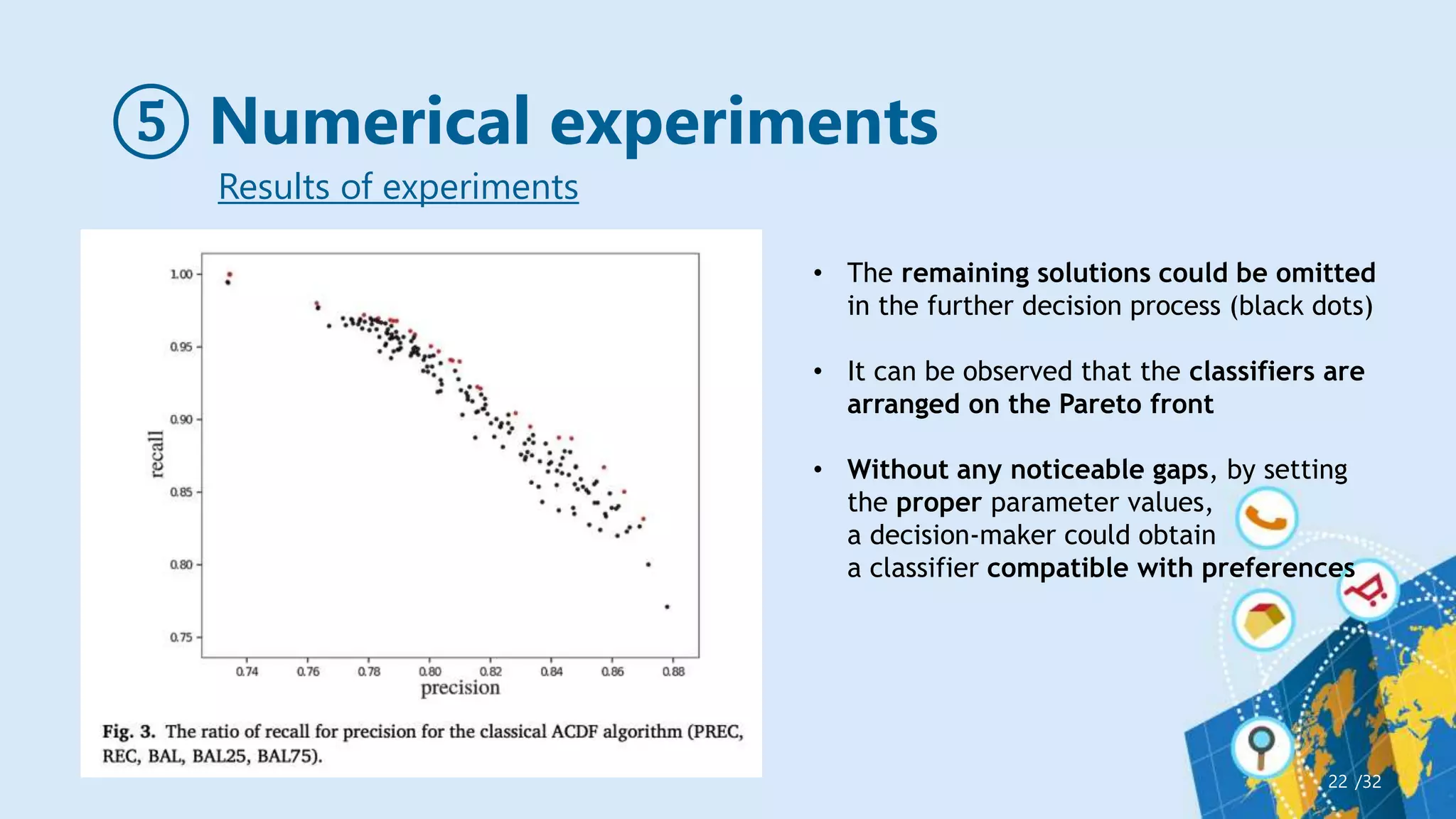
Results of experiments
• The remaining solutions could be omitted
in the further decision process (black dots)
• It can be observed that the classifiers are
arranged on the Pareto front
• Without any noticeable gaps, by setting
the proper parameter values,
a decision-maker could obtain
a classifier compatible with preferences
⑤ Numerical experiments
/32
23
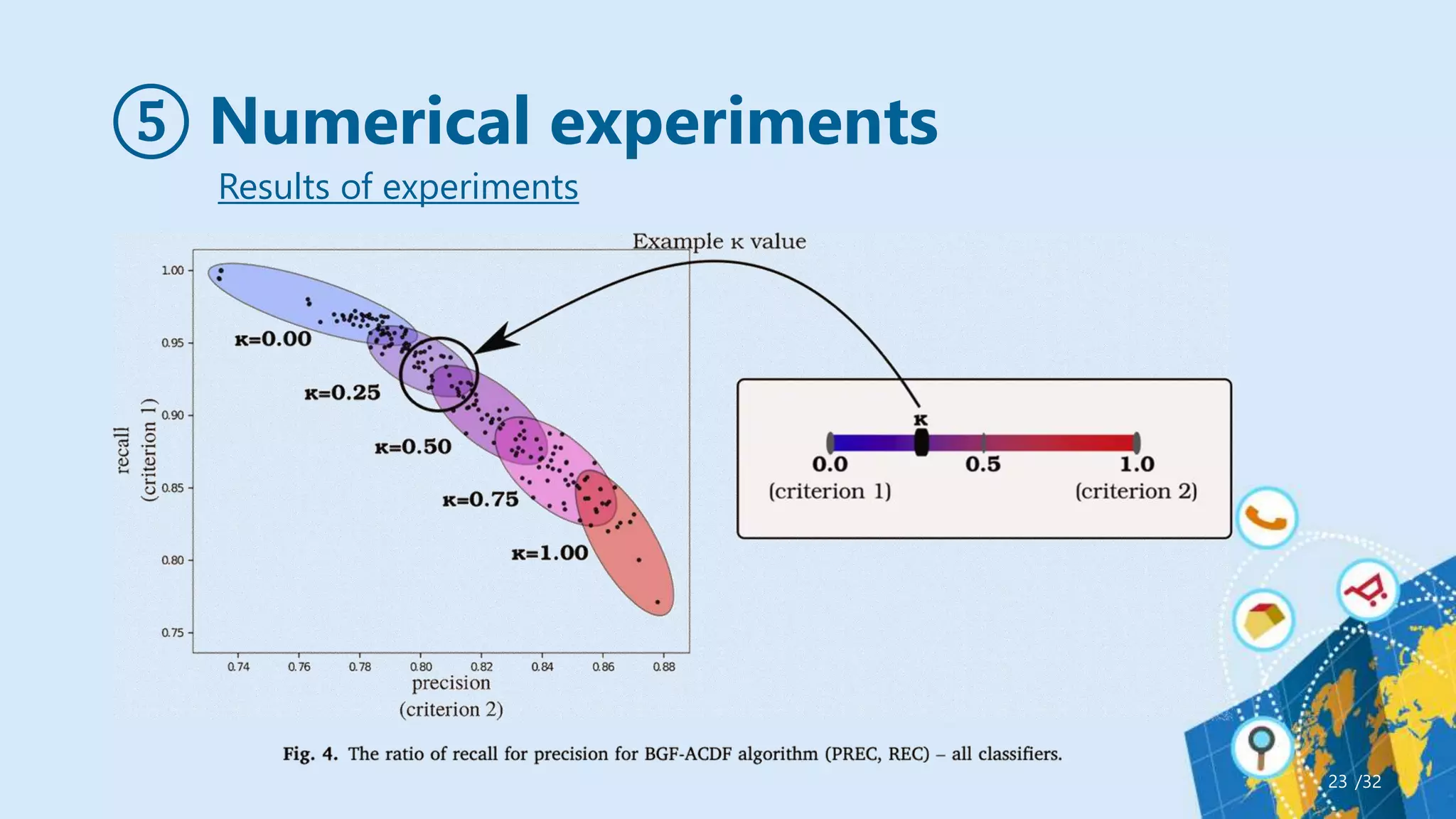
Results of experiments
⑤ Numerical experiments
/32
24
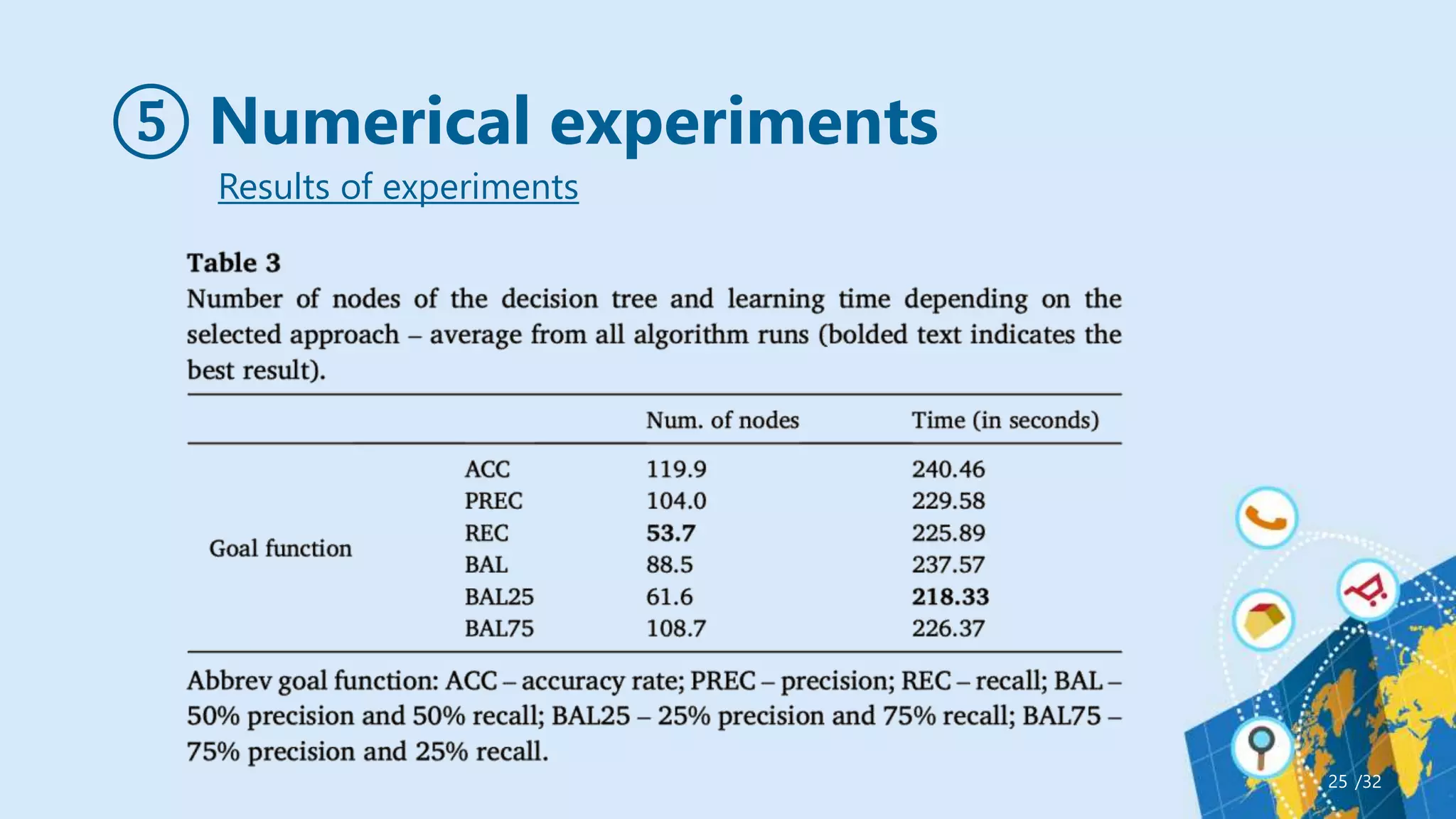
Results of experiments
⑤ Numerical experiments
/32
25
Results of experiments
⑥ Research discussion
/32
26
learning time
of the classifier
is not longer
enable real-time
solution use
enable
customer data
stream tracking
The accuracy
rate remains
rather
unchanged
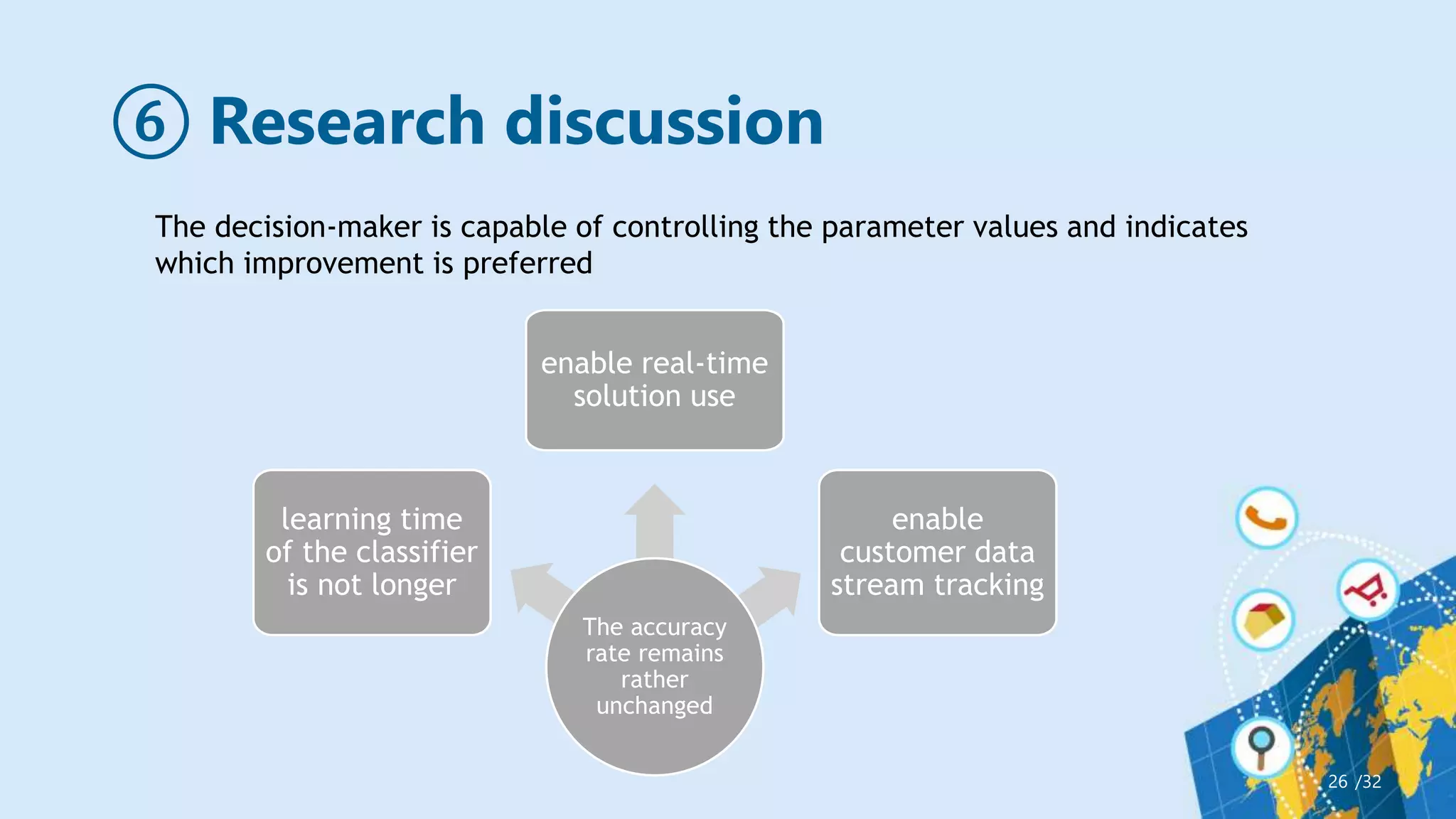
The decision-maker is capable of controlling the parameter values and indicates
which improvement is preferred
⑥ Research discussion
/32
27
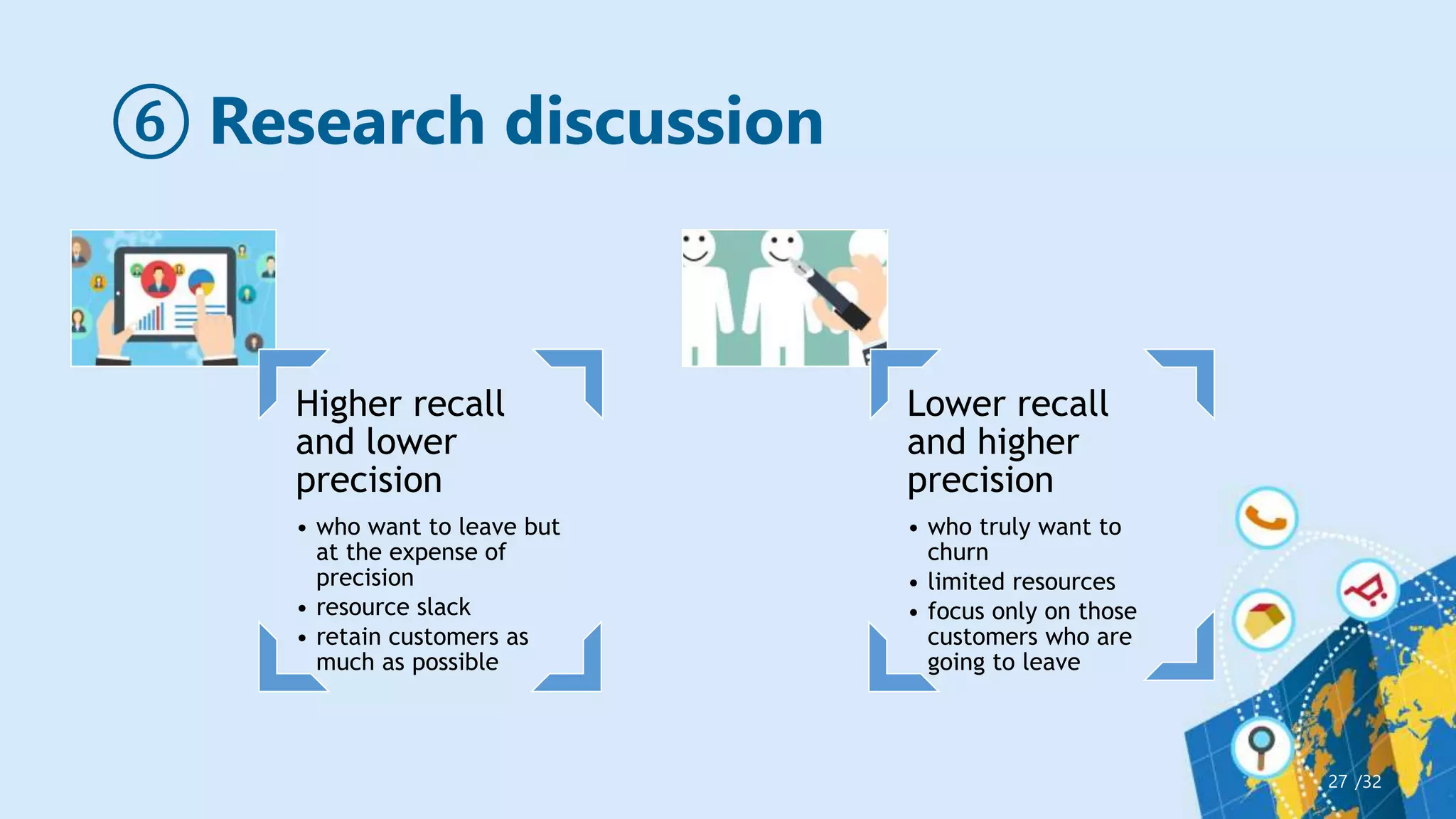
Higher recall
and lower
precision
• who want to leave but
at the expense of
precision
• resource slack
• retain customers as
much as possible
Lower recall
and higher
precision
• who truly want to
churn
• limited resources
• focus only on those
customers who are
going to leave
⑥ Research discussion
/32
28
Discussion and theoretical implications
2001 Keaveney & Parthasarathy limited access to customer data, especially attitudinal data
2012 Wa ̈gar et al.
any information base used in churn management is always
limited
2000 Eisenhardt & Mar- tin
the balancing parameters are important for dynamic
capabilities when confronted with rapid technological
changes
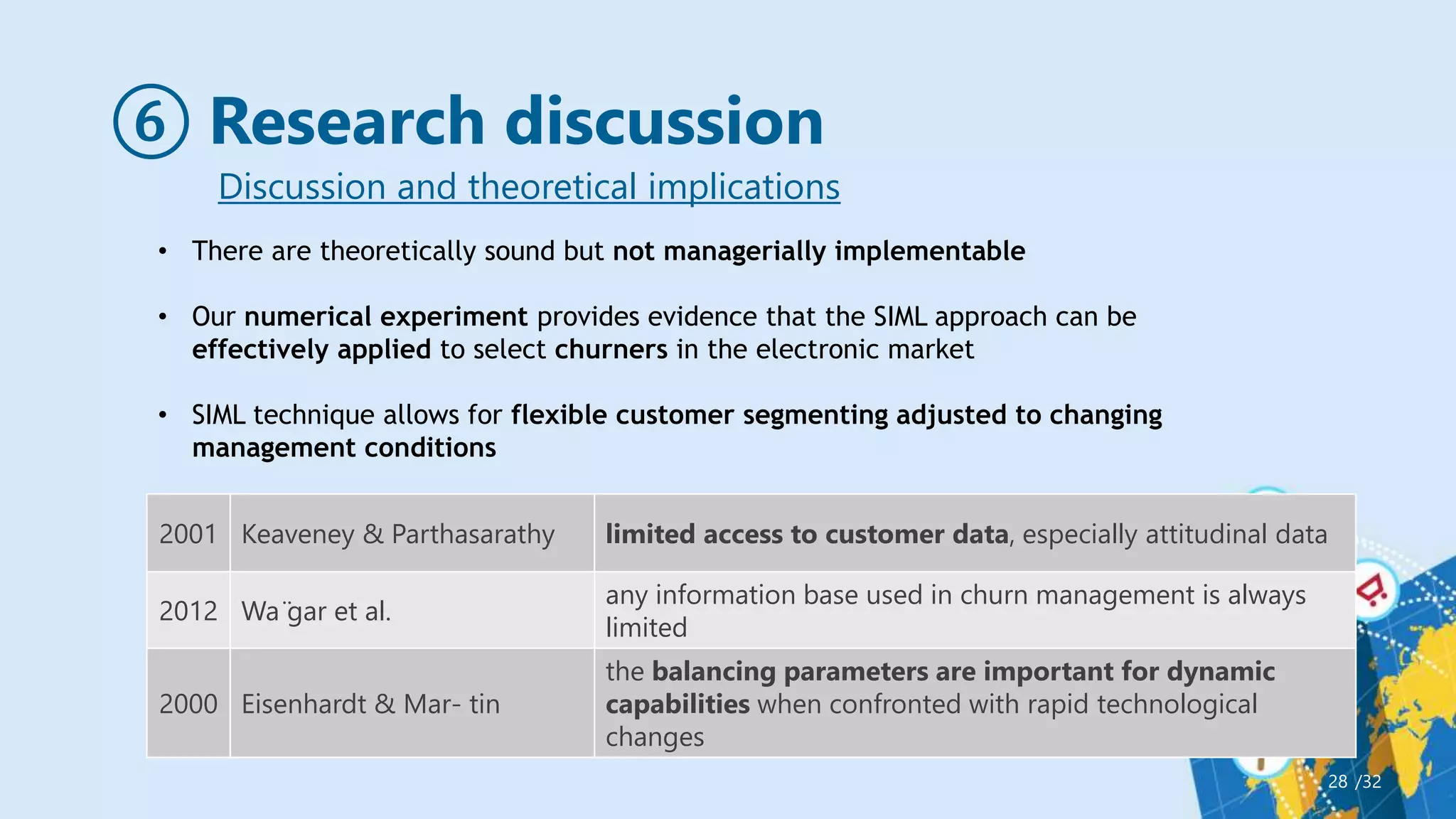
• There are theoretically sound but not managerially implementable
• Our numerical experiment provides evidence that the SIML approach can be
effectively applied to select churners in the electronic market
• SIML technique allows for flexible customer segmenting adjusted to changing
management conditions
⑥ Research discussion
/32
29
Practical implications
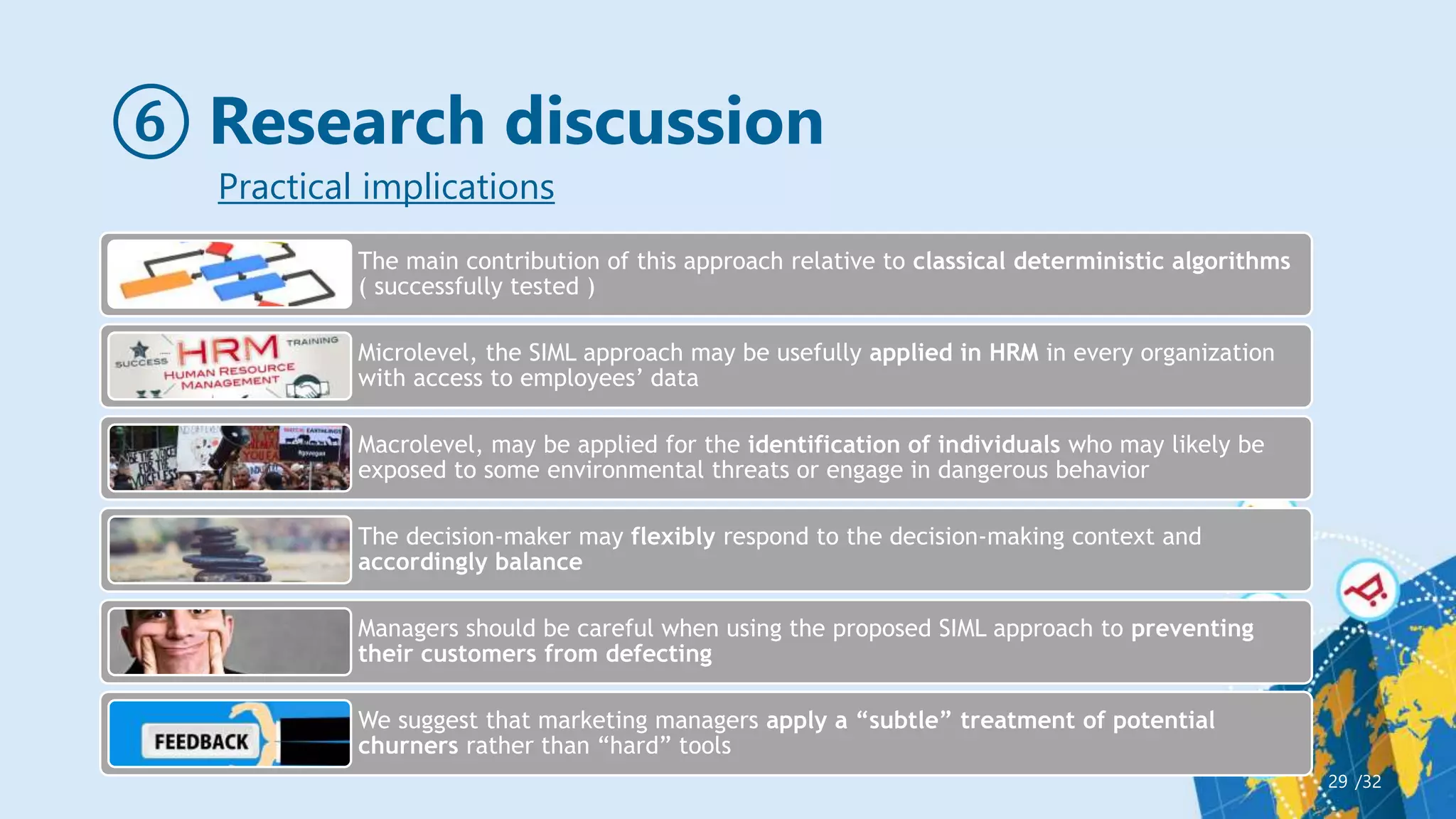
The main contribution of this approach relative to classical deterministic algorithms
( successfully tested )
Microlevel, the SIML approach may be usefully applied in HRM in every organization
with access to employees’ data
Macrolevel, may be applied for the identification of individuals who may likely be
exposed to some environmental threats or engage in dangerous behavior
The decision-maker may flexibly respond to the decision-making context and
accordingly balance
Managers should be careful when using the proposed SIML approach to preventing
their customers from defecting
We suggest that marketing managers apply a “subtle” treatment of potential
churners rather than “hard” tools
⑥ Research discussion
/32
30
Limitations and future research
This paper is not free of limitations
o Here to test the SIML approach uses historical data only
• would also measure the treatment implemented to prevent a selected customer from defecting
o Our numerical experiment relates to its focus on one telecom company dataset
• may use data from various industries, including variables related to customer attitudes
o Organizational and environmental contingencies can’t prevention
• proposed SIML approach to various areas of big data innovation
o Not based on the declarations of managers but instead on real conditions and
objective customer data, the self-reported bias were minimized here
⑦ Conclusions
/32
31
 Examined the impact of a goal-oriented computational intelligence algorithm
 Proposed was conceptualized as a building block of dynamic capabilities
 Proposed balanced goal function of the ACDT algorithm in churn prediction
 By using swarm intelligence algorithms
 enable focusing on a specific goal
 allow the solution to be customized
 possible to steer the construction of a classifier oriented
towards recall, precision
⑦ Conclusions
/32
32
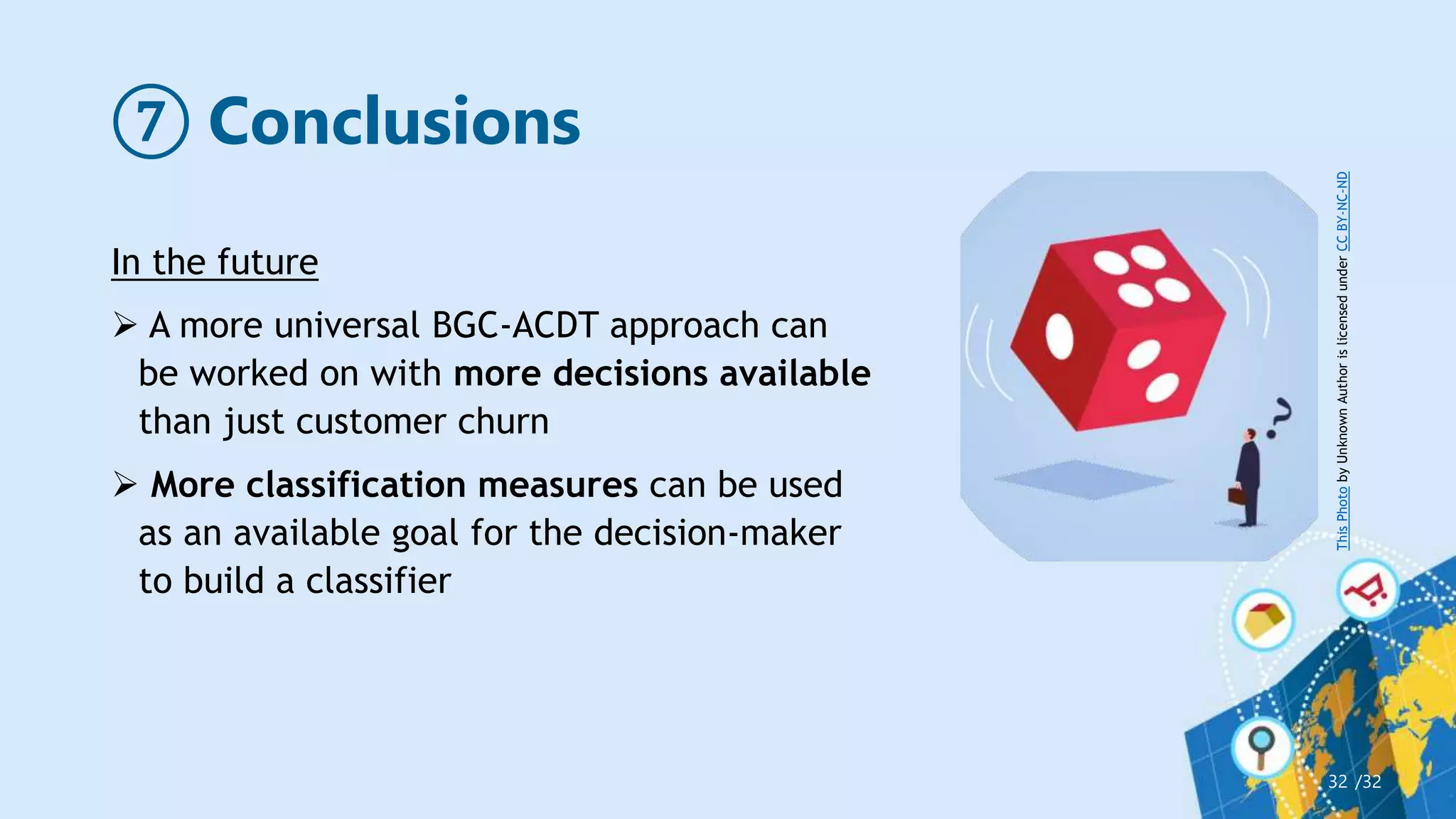
In the future
 A more universal BGC-ACDT approach can
be worked on with more decisions available
than just customer churn
 More classification measures can be used
as an available goal for the decision-maker
to build a classifier
This
Photo
by
Unknown
Author
is
licensed
under
CC
BY-NC-ND
Thank you
Resource
1. Jan Kozak, Krzysztof Kania, Przemysław Juszczuk, Maciej Mitręga, Swarm intelligence goal-
oriented approach to data-driven innovation in customer churn management, International
Journal of Information Management, Volume 60, 2021, 102357, ISSN 0268-4012,
https://doi.org/10.1016/j.ijinfomgt.2021.102357.
2. PPT template- Trade PowerPoint Template from https://prezentr.com/templates/trade-
powerpoint-template/
3. P6.9.12 Microsoft Stock images (royalty-free images)
Extended learning
• 元啟發演算法 https://zh.wikipedia.org/wiki/元启发算法
• CART決策樹(實作)
https://jamleecute.web.app/decision-tree-cart-%E6%B1%BA%E7%AD%96%E6%A8%B9/
https://zhuanlan.zhihu.com/p/139523931
• 決策樹算法 https://roger010620.medium.com/%E6%B1%BA%E7%AD%96%E6%A8%B9-decision-tree-
%E5%B8%B8%E8%A6%8B%E7%9A%84%E4%B8%89%E7%A8%AE%E7%AE%97%E6%B3%95-id3-c4-5-cart-
54091ca85044
• 蟻群演算法 https://ithelp.ithome.com.tw/m/articles/10226980
• 以Python實作蟻群演算法(Ant Colony Optimization, ACO)並解決旅行商人問題
https://medium.com/qiubingcheng/%E4%BB%A5python%E5%AF%A6%E4%BD%9C%E8%9F%BB%E7%BE%A4%E6%9C%80%E4%BD%B3%E5%8C%96%E6%BC%94%
E7%AE%97%E6%B3%95-ant-colony-optimization-aco-%E4%B8%A6%E8%A7%A3%E6%B1%BAtsp%E5%95%8F%E9%A1%8C-%E4%B8%8A-b8c1a345c5a1
• Telco Customer Churn https://zhuanlan.zhihu.com/p/361230568
• Non-deterministic Algorithm https://powers.pixnet.net/blog/post/111102
• 柏拉圖效率 https://zh.wikipedia.org/wiki/柏拉圖效率

Paper sharing_Swarm intelligence goal oriented approach to data-driven innovation in customer churn management

  • 1.
    Swarm intelligence goal-oriented approachto data-driven innovation in customer churn management From International Journal of Information Management Jan Kozak, Krzysztof Kania, Przemysław Juszczuk, Maciej Mitręga(2021) Presenter :CHEN,YOU-SHENG (Shane) 2022/02/21
  • 2.
  • 3.
    Vocabularies 1/3 /32 2 P. EnglishChinese 1 deterministic machine learning 確定性機器學習 1 systematic alignment 系統校準 1 vis-a-vis 面對 1 practitioners 業界 2 turbulent 動盪 2 the field involved 涉及領域 2 justification 理由 2 interpretability 理解 2 undeniably 不可否認 2 consequences 重要性 P. English Chinese 2 destruction 破壞 2 anticipated 預期 2 foraging phenomenon 覓食現象 2 ant colony decision tree (ACDT) 蟻群決策樹 2 novelty 新穎 3 customer retention 客戶維繫 3 aggregating 省略 3 drill-down 深度探討 3 carried out 實現 3 heuristics 啟發式 3 cognitive 感知
  • 4.
    Vocabularies 2/3 /32 3 P. EnglishChinese 4 marketing campaigns 市場經營銷售活動 4 a broader set of 一系列 4 a wide plethora of 大量 4 ensemble methods 整體方法 4 tenure 佔有期 4 short- comings 缺點 4 entrepreneurial cycle 創業週期 5 alliancing capabilities 結盟能力 5 research stream 研究方向 5 nomological 理論部分的 5 manifest 表露 P. English Chinese 5 reorganize 改編 5 call for 呼籲 5 trade-off 權衡 5 sacrificing 犧牲 5 were rather static with regard to 相當穩定 5 error matrix 混淆矩陣 5 Matthews correlation factor 馬修斯 相關係數 6 suspicious 懷疑的 6 properly derived 正確導出 6 data acquisition 資料採集
  • 5.
    Vocabularies 3/3 /32 4 P. EnglishChinese 6 predetermined 已決定的 6 take into account 考慮 6 inherently stochastic 固有隨機式 6 geared towards 面向 7 splitting criterion 分裂標準 6 roulette wheel 賭轉盤 6 setting 安插 6 the vertex leading from node 自節點的 頂點軌跡距離 8 the sake of simplicity 為了簡單 10 slack in 鬆弛 P. English Chinese 10 the highest share of turnover 佔營業額 10 perceptions 觀點 10 blind spots 盲點 11 alignment with 符合 11 the threat of a pandemic 流行的威脅 11 subtle 微妙/精巧 11 not free of limitations 不自由 11 sophisticated 複雜 11 contingencies 意外
  • 6.
    CONTENTS 1.Introduction 2.Theoretical background 3.Data description 1.4.Balanced goal function ofthe ACDT algorithm 5.Numerical experiments 6.Research discussion 7.Conclusions
  • 7.
    ① Introduction /32 6 This Photoby Unknown Author is licensed under CC BY-SA • The desired patterns and answers are hidden in the data • The BDA must be supplemented with Machine Learning (ML) & Artificial Intelligence (AI) methods (Ranjan & Foropon, 2021; Dubey et al., 2020) • The BDA has a profound and multidirectional impact on innovation (Duan, Cao, & Edwards, 2020) • Shift organizations towards a data- driven culture
  • 8.
    ① Introduction /32 7 • AI& ML tools hold great potential as decision support tools, but users need to be able to interpret, understand, and apply their results • Most research and models focus solely on customer churn prediction, and the prediction is most desirable and crucial for success (Baumann, Coussement, Lessmann, and De Bock (2015) • Traditional churn prediction models do not derive recommendations for managers and thus do not meet the needs of decision-makers (V ́elez, Ayuso, Perales-Gonza ́lez, & Rodríguez, 2020).
  • 9.
    ① Introduction /32 8 This Photoby Unknown Author is licensed under CC BY • Using a modified swarm intelligence algorithm to enhance decision-makers’ capabilities • A new, goal-oriented metaheuristic modification of the ant colony decision tree (ACDT) algorithm • Improve the efficiency of marketing activities aimed at segmenting and targeting customers by building models to optimize targeting decisions and improve customer retention with limited resources Propose
  • 10.
    ② Theoretical background •Big data analysis can bring significant value to businesses /32 9 Business analytics •Descriptive analytics • looks at past and current data and provides a detailed analysis on them •Predictive analytics • reliable forecasts on future possibilities and trends (build model and predict) •Prescriptive analytics • focuses on decision making, efficiency improvements, obtain justification and guidance in the future
  • 11.
    ② Theoretical background •Churn analysis requires processing large datasets, and the models built can be used in many different companies. /32 10 Churn management Telecommun- ications Banking Insurance Retail stores Online platforms Medicine Automotive industry
  • 12.
    ② Theoretical background /32 11 Churnmanagement 2007 Hadden, Tiwari, Roy, & Ruta retaining existing customers becomes more important than winning new ones 2011 2020 Verbeke, Martens, Mues, & Baesens Devriendt et al. long-term customers tend to be more profitable and are more loyal, and losing customers leads to lost income 2017 Gordini & Veglio customers can switch suppliers with a few clicks, this problem become even more pressing 2010 Coussement, Benoit, & Van den Poel forecasting customer churn is one of the basic elements of customer relationship management (CRM) 2007 Hadden et al. The ultimate goal of churn management is to take preventive/retention actions
  • 13.
    ② Theoretical background /32 12 Churnmanagement • Most of the research on churn focuses on customer features and customer activities • The churn management frameworks are focused on steps related to data collection, preparation, and processing by AI algorithms •Limited possibilities of deterministic ML methods in generating various proposed solutions •Weak connection between the stage of generating solutions by ML and AI tools and the decision-making process itself Limited influence of the manager on the operation of ML and AI algorithms •The Lack of connection of ML and AI algorithms with tools supporting the decision-making process, such as simulation Research gap
  • 14.
    ② Theoretical background /32 13 Dynamiccapabilities in big data analytics 1997 Teece et al. Transform these resources and operational capabilities in relation to changing conditions in the environment 2007 Teece Involves sensing opportunities, seizing opportunities and reconfiguring company assets 2017 Coˆrte-Real, Tiago, & Ruivo Ghasemaghaei, Khaled, & Turel Mikalef & Pateli Data analytics systems may be effectively applied to adjust company strategies to changing environments 1.Marketing capabilities 1.New product development capabilities Alliancing capabilities Supply management capabilities DCV –unsolved issues • Appropriate location • Company size • Time needed to develop
  • 15.
    ② Theoretical background /32 14 Dynamiccapabilities in big data analytics 2017 2004 Coˆrte-Real et al. Sher & Lee big data analytics can be combined with knowledge management 2017 Wang & Hajli Building big data analytics capabilities (BDAC) enable various operational and strategic benefits 2019 2017 2018 2017 Mikalef et al. Mikalef et al. Mikalef et al. Wamba et al. BDAC are treated as an antecedent of building organizational dynamic capabilities 2018 Mikalef et al. The proposed SIML approach to churn management may be treated as a key BDAC resource • We focus on a specific data-analytics approach well suited to the context of customer churn management
  • 16.
    ② Theoretical background /32 15 Evaluationof the quality of classification T : Size of tree T S:Test data set of tree T • most popular measures of the evaluation of classification • the ratio of properly classified objects to all classified objects • the ratio of properly classified objects to class P to all objects classified to the P class • a ratio of the number of properly classified objects to class P
  • 17.
    ③ Data description •Each row represents a customer, each column contains customer’s attributes described on the column Metadata. The raw data contains 7043 rows (customers) and 21 columns (included index) • https://www.kaggle.com/blastchar/telco-customer-churn /32 16 Attributes 含義 customerID 使用者編號 Gender 使用者性別(female,male) SeniorCitizen 老年人(Yes, No) Partner 配偶(Yes, No) Dependents 生活方式:是否和孩子,父母 或者其他親人一起居住(Yes, No) Contrast 契約類型(month-to-month, one year, two year) paperlessBilling 電子帳單(Yes, No) paymentMethod 支付方式(Electronic check, mailed check, bank transfer(automatic), credit card(automatic), TotalCharges 總計費用 MonthlyCharges 月度費用 Attributes 含義 Tenure 入網時長(0~78) churn 退網狀態(Yes, No) PhoneService 電話服務(yes,no) multipleLines 多線路(yes, no, no phoneService,) internetService 網路服務(yes ,no) OnlineSecurity 網路安全(yes ,no, no internetservice) onlineBackup 網路備份(yes ,no, no internetservice) techsSupport 科技支援(yes ,no, no internetservice) streamingTV 串流影視(yes ,no, no internetservice) streamingMovies 串流電影(yes ,no, no internetservice) - the Telco Customer Churn dataset
  • 18.
    ④ Balanced goalfunction of the ACDT algorithm /32 17 Ant colony decision tree algorithm 1. Classical deterministic algorithms  Generate a single result that determines further decisions and actions  Does not take into account the situation and constraints of the decision-maker in any way 2. Swarm intelligence algorithms  Can be found in the adaptive goal function of the ACDT algorithm (Kozak & Boryczka, 2014)  Propose the balanced goal function of the ACDT approach o Based on the use of ant algorithms to construct decision trees o The first factor is the maximum value compatible with the splitting criterion of the CART algorithm, while additional information is included in the pheromone trail o The second factor is the connection of the pheromone trail to collective intelligence o Two measures of classification: precision and recall
  • 19.
    ④ Balanced goalfunction of the ACDT algorithm /32 18 Ant colony decision tree algorithm 計算屬性資料的 啟發式資訊係數 Agent -ant create a tree // (6) i = ii j = jj
  • 20.
    ④ Balanced goalfunction of the ACDT algorithm /32 19 Balanced goal function (6) (7)
  • 21.
    ⑤ Numerical experiments 1.Each experiment repeated30 times 1.Average values obtained from these runs 1.25 iterations 1.250 agents 1.q0 = 0.2, β = 3.0, γ = 0.1 Boryczka and Kozak (2010), Kozak (2019) 1.Set 6 kind of parameter /32 20 Experiments design The Telco Customer Churn dataset Churn=Yes 1869 Churn=No 5174 divided into 3 fragment
  • 22.
  • 23.
    ⑤ Numerical experiments /32 22 Resultsof experiments • The remaining solutions could be omitted in the further decision process (black dots) • It can be observed that the classifiers are arranged on the Pareto front • Without any noticeable gaps, by setting the proper parameter values, a decision-maker could obtain a classifier compatible with preferences
  • 24.
  • 25.
  • 26.
  • 27.
    ⑥ Research discussion /32 26 learningtime of the classifier is not longer enable real-time solution use enable customer data stream tracking The accuracy rate remains rather unchanged The decision-maker is capable of controlling the parameter values and indicates which improvement is preferred
  • 28.
    ⑥ Research discussion /32 27 Higherrecall and lower precision • who want to leave but at the expense of precision • resource slack • retain customers as much as possible Lower recall and higher precision • who truly want to churn • limited resources • focus only on those customers who are going to leave
  • 29.
    ⑥ Research discussion /32 28 Discussionand theoretical implications 2001 Keaveney & Parthasarathy limited access to customer data, especially attitudinal data 2012 Wa ̈gar et al. any information base used in churn management is always limited 2000 Eisenhardt & Mar- tin the balancing parameters are important for dynamic capabilities when confronted with rapid technological changes • There are theoretically sound but not managerially implementable • Our numerical experiment provides evidence that the SIML approach can be effectively applied to select churners in the electronic market • SIML technique allows for flexible customer segmenting adjusted to changing management conditions
  • 30.
    ⑥ Research discussion /32 29 Practicalimplications The main contribution of this approach relative to classical deterministic algorithms ( successfully tested ) Microlevel, the SIML approach may be usefully applied in HRM in every organization with access to employees’ data Macrolevel, may be applied for the identification of individuals who may likely be exposed to some environmental threats or engage in dangerous behavior The decision-maker may flexibly respond to the decision-making context and accordingly balance Managers should be careful when using the proposed SIML approach to preventing their customers from defecting We suggest that marketing managers apply a “subtle” treatment of potential churners rather than “hard” tools
  • 31.
    ⑥ Research discussion /32 30 Limitationsand future research This paper is not free of limitations o Here to test the SIML approach uses historical data only • would also measure the treatment implemented to prevent a selected customer from defecting o Our numerical experiment relates to its focus on one telecom company dataset • may use data from various industries, including variables related to customer attitudes o Organizational and environmental contingencies can’t prevention • proposed SIML approach to various areas of big data innovation o Not based on the declarations of managers but instead on real conditions and objective customer data, the self-reported bias were minimized here
  • 32.
    ⑦ Conclusions /32 31  Examinedthe impact of a goal-oriented computational intelligence algorithm  Proposed was conceptualized as a building block of dynamic capabilities  Proposed balanced goal function of the ACDT algorithm in churn prediction  By using swarm intelligence algorithms  enable focusing on a specific goal  allow the solution to be customized  possible to steer the construction of a classifier oriented towards recall, precision
  • 33.
    ⑦ Conclusions /32 32 In thefuture  A more universal BGC-ACDT approach can be worked on with more decisions available than just customer churn  More classification measures can be used as an available goal for the decision-maker to build a classifier This Photo by Unknown Author is licensed under CC BY-NC-ND
  • 34.
  • 35.
    Resource 1. Jan Kozak,Krzysztof Kania, Przemysław Juszczuk, Maciej Mitręga, Swarm intelligence goal- oriented approach to data-driven innovation in customer churn management, International Journal of Information Management, Volume 60, 2021, 102357, ISSN 0268-4012, https://doi.org/10.1016/j.ijinfomgt.2021.102357. 2. PPT template- Trade PowerPoint Template from https://prezentr.com/templates/trade- powerpoint-template/ 3. P6.9.12 Microsoft Stock images (royalty-free images)
  • 36.
    Extended learning • 元啟發演算法https://zh.wikipedia.org/wiki/元启发算法 • CART決策樹(實作) https://jamleecute.web.app/decision-tree-cart-%E6%B1%BA%E7%AD%96%E6%A8%B9/ https://zhuanlan.zhihu.com/p/139523931 • 決策樹算法 https://roger010620.medium.com/%E6%B1%BA%E7%AD%96%E6%A8%B9-decision-tree- %E5%B8%B8%E8%A6%8B%E7%9A%84%E4%B8%89%E7%A8%AE%E7%AE%97%E6%B3%95-id3-c4-5-cart- 54091ca85044 • 蟻群演算法 https://ithelp.ithome.com.tw/m/articles/10226980 • 以Python實作蟻群演算法(Ant Colony Optimization, ACO)並解決旅行商人問題 https://medium.com/qiubingcheng/%E4%BB%A5python%E5%AF%A6%E4%BD%9C%E8%9F%BB%E7%BE%A4%E6%9C%80%E4%BD%B3%E5%8C%96%E6%BC%94% E7%AE%97%E6%B3%95-ant-colony-optimization-aco-%E4%B8%A6%E8%A7%A3%E6%B1%BAtsp%E5%95%8F%E9%A1%8C-%E4%B8%8A-b8c1a345c5a1 • Telco Customer Churn https://zhuanlan.zhihu.com/p/361230568 • Non-deterministic Algorithm https://powers.pixnet.net/blog/post/111102 • 柏拉圖效率 https://zh.wikipedia.org/wiki/柏拉圖效率