Computational IntelligenceComputational Intelligence
methods for churn predictionmethods for churn prediction
in telecommunicationin telecommunication
companiescompanies
Hossam Faris, PhD
Associate Professor
Business Information Technology Department
King Abdullah II School for Information Technology
The University of Jordan
hossam.faris@ju.edu.jo
7ossam@gmail.com
IntroductionIntroduction
The market is very dynamic and highly
competitive.
It is very easy for customers to switch
from one service provider to another for
a better price rates or service quality.
Telecommunication companies suffer a
loss of 20-40% of their customers every
year!
IntroductionIntroduction
• Companies are aware that attracting new
customers is much more costly than
keeping current customers.
• Companies in the telecommunication
market realize that customers are the
most important asset for them.
What isWhat is customer churncustomer churn ??
In business, “customer churn” is a term
commonly refers to customers who stop
using some services or terminate their
contract and subscription with a company
to switch to another competitor.
Customer churn has many reasons and
factors. Such reasons include quality and
cost of services.
Churn management and predictionChurn management and prediction
The goal of churn management is to keep
current customers as long as the company is
alive in the market.
Revenue comes from the creation and
maintaining long-term relationships with the
customers.
A better churn management can help
Customer Relationship Management (CRM) in
decision making and establishing effective
customer retention campaigns.
The targetThe target
• We need to identify (predict) those
customers who are probably will leave.
• Specific marketing campaigns could be
designed to target the most risky
customer segments.
• Special discounts and subscriptions could
be offered.
From where to start ?From where to start ?
Detecting a churn by observation is almost
impossible.
Traditional surveys based on running
questionnaires or interviews suffer from a
high cost, limited access to customer
population and data self-reporting
Telecom companies realize that their
existing customer database is the key.
Service providers started to invest more in
data mining techniques that can aid in having
an efficient churn prediction models
ChallengesChallenges
The available data is imbalanced.
Different cost for each class.
High number of related variables.
BigData
Customer related featuresCustomer related features
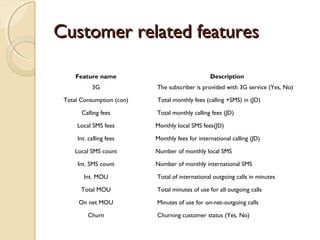
Feature name Description 
3G The subscriber is provided with 3G service (Yes, No)
Total Consumption (con) Total monthly fees (calling +SMS) in (JD)
Calling fees Total monthly calling fees (JD)
Local SMS fees Monthly local SMS fees(JD)
Int. calling fees Monthly fees for international calling (JD)
Local SMS count Number of monthly local SMS
Int. SMS count Number of monthly international SMS
Int. MOU Total of international outgoing calls in minutes
Total MOU Total minutes of use for all outgoing calls
On net MOU Minutes of use for on-net-outgoing calls
Churn Churning customer status (Yes, No)
Research linesResearch lines
 The state-of-art basic classifiers approaches:
create or modify the algorithms that exist for
churn prediction.
 Data level approaches: add a preprocessing step
where the data distribution is rebalanced in order
to decrease the effect of the skewed class
distribution in the learning process.
Ensembles of classifiers each ensemble is a group
of classifiers trained independently then all their
predictions are combines. Ensemble classifier
proofed to have better generalization and
outperform single classifiers.
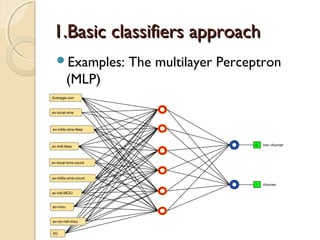
1.Basic classifiers approach1.Basic classifiers approach
Examples: The multilayer Perceptron
(MLP)
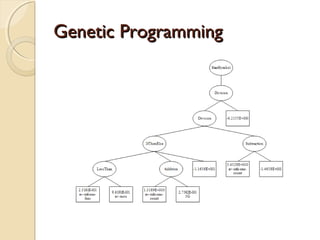
Genetic ProgrammingGenetic Programming
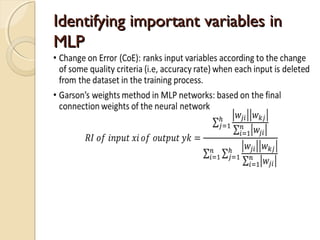
Identifying important variables inIdentifying important variables in
MLPMLP
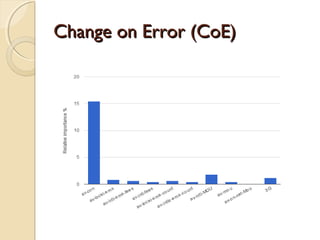
Change on Error (CoE)Change on Error (CoE)
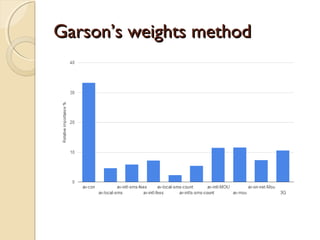
Garson’s weights methodGarson’s weights method
Identifying important variables inIdentifying important variables in
MLPMLP
During the evolutionary cycle of GP,
input features that help GP in improving
the fitness value of the generated
individuals will survive while the weak the
features will be excluded and disappear
from the remaining generations.
Variable Frequency in GPVariable Frequency in GP
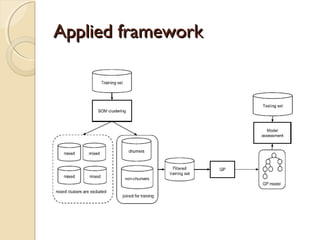
2.Data level approaches2.Data level approaches
This approach is performed on two stages:
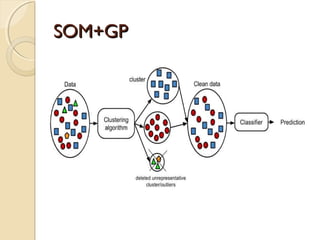
Cleaning the data : A clustering method is
used to identify different behavior patterns
of customers. Small and unrepresentative
data are treated as outliers and noise. So
they are eliminated.
Modeling: A classification technique is
applied to develop the final prediction
model.
SOM+GPSOM+GP
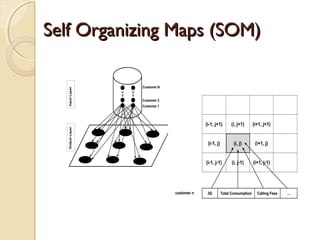
Self Organizing Maps (SOM)Self Organizing Maps (SOM)
Applied frameworkApplied framework
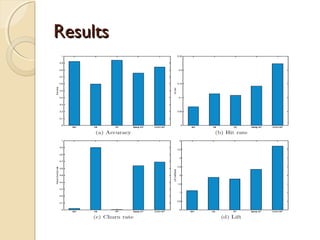
ResultsResults
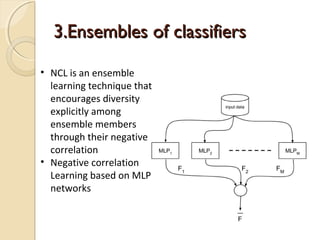
3.Ensembles of classifiers3.Ensembles of classifiers
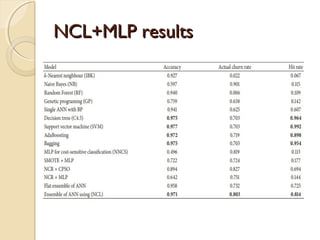
• NCL is an ensemble
learning technique that
encourages diversity
explicitly among
ensemble members
through their negative
correlation
• Negative correlation
Learning based on MLP
networks
NCL+MLP resultsNCL+MLP results
Future workFuture work
Investigating the application of cost-
sensitive methods in churn prediction.
It is very interesting to study the most
influencing factors that affect customer
churn in different regions.
Published researchPublished research
• Faris, Hossam, Bashar Al-Shboul, and Nazeeh Ghatasheh. "A
genetic programming based framework for churn prediction in
telecommunication industry." Computational Collective Intelligence.
Technologies and Applications. Springer International Publishing,
(2014).
• Rodan, Ali, Faris, Hossam and others. "A support vector machine
approach for churn prediction in telecom industry." International
Information Institute (Tokyo). Information17.8 (2014): 3961.
• Faris, Hossam. "Neighborhood cleaning rules and particle swarm
optimization for predicting customer churn behavior in telecom
industry."International Journal of Advanced Science and Technology 68
(2014): 11-22.
• Rodan, A., Fayyoumi, A., Faris, H., Alsakran, J., & Al-Kadi, O.
“Negative Correlation Learning for Customer Churn Prediction: A
Comparison Study”. The Scientific World Journal, (2015).
Questions ?Questions ?
Thank you 

Churn prediction

  • 1.
    Computational IntelligenceComputational Intelligence methodsfor churn predictionmethods for churn prediction in telecommunicationin telecommunication companiescompanies Hossam Faris, PhD Associate Professor Business Information Technology Department King Abdullah II School for Information Technology The University of Jordan hossam.faris@ju.edu.jo 7ossam@gmail.com
  • 2.
    IntroductionIntroduction The market isvery dynamic and highly competitive. It is very easy for customers to switch from one service provider to another for a better price rates or service quality. Telecommunication companies suffer a loss of 20-40% of their customers every year!
  • 3.
    IntroductionIntroduction • Companies areaware that attracting new customers is much more costly than keeping current customers. • Companies in the telecommunication market realize that customers are the most important asset for them.
  • 4.
    What isWhat iscustomer churncustomer churn ?? In business, “customer churn” is a term commonly refers to customers who stop using some services or terminate their contract and subscription with a company to switch to another competitor. Customer churn has many reasons and factors. Such reasons include quality and cost of services.
  • 5.
    Churn management andpredictionChurn management and prediction The goal of churn management is to keep current customers as long as the company is alive in the market. Revenue comes from the creation and maintaining long-term relationships with the customers. A better churn management can help Customer Relationship Management (CRM) in decision making and establishing effective customer retention campaigns.
  • 6.
    The targetThe target •We need to identify (predict) those customers who are probably will leave. • Specific marketing campaigns could be designed to target the most risky customer segments. • Special discounts and subscriptions could be offered.
  • 7.
    From where tostart ?From where to start ? Detecting a churn by observation is almost impossible. Traditional surveys based on running questionnaires or interviews suffer from a high cost, limited access to customer population and data self-reporting Telecom companies realize that their existing customer database is the key. Service providers started to invest more in data mining techniques that can aid in having an efficient churn prediction models
  • 8.
    ChallengesChallenges The available datais imbalanced. Different cost for each class. High number of related variables. BigData
  • 9.
    Customer related featuresCustomerrelated features Feature name Description  3G The subscriber is provided with 3G service (Yes, No) Total Consumption (con) Total monthly fees (calling +SMS) in (JD) Calling fees Total monthly calling fees (JD) Local SMS fees Monthly local SMS fees(JD) Int. calling fees Monthly fees for international calling (JD) Local SMS count Number of monthly local SMS Int. SMS count Number of monthly international SMS Int. MOU Total of international outgoing calls in minutes Total MOU Total minutes of use for all outgoing calls On net MOU Minutes of use for on-net-outgoing calls Churn Churning customer status (Yes, No)
  • 10.
    Research linesResearch lines The state-of-art basic classifiers approaches: create or modify the algorithms that exist for churn prediction.  Data level approaches: add a preprocessing step where the data distribution is rebalanced in order to decrease the effect of the skewed class distribution in the learning process. Ensembles of classifiers each ensemble is a group of classifiers trained independently then all their predictions are combines. Ensemble classifier proofed to have better generalization and outperform single classifiers.
  • 11.
    1.Basic classifiers approach1.Basicclassifiers approach Examples: The multilayer Perceptron (MLP)
  • 12.
  • 13.
    Identifying important variablesinIdentifying important variables in MLPMLP
  • 14.
    Change on Error(CoE)Change on Error (CoE)
  • 15.
  • 16.
    Identifying important variablesinIdentifying important variables in MLPMLP During the evolutionary cycle of GP, input features that help GP in improving the fitness value of the generated individuals will survive while the weak the features will be excluded and disappear from the remaining generations.
  • 17.
    Variable Frequency inGPVariable Frequency in GP
  • 18.
    2.Data level approaches2.Datalevel approaches This approach is performed on two stages: Cleaning the data : A clustering method is used to identify different behavior patterns of customers. Small and unrepresentative data are treated as outliers and noise. So they are eliminated. Modeling: A classification technique is applied to develop the final prediction model.
  • 19.
  • 20.
    Self Organizing Maps(SOM)Self Organizing Maps (SOM)
  • 21.
  • 22.
  • 23.
    3.Ensembles of classifiers3.Ensemblesof classifiers • NCL is an ensemble learning technique that encourages diversity explicitly among ensemble members through their negative correlation • Negative correlation Learning based on MLP networks
  • 24.
  • 25.
    Future workFuture work Investigatingthe application of cost- sensitive methods in churn prediction. It is very interesting to study the most influencing factors that affect customer churn in different regions.
  • 26.
    Published researchPublished research •Faris, Hossam, Bashar Al-Shboul, and Nazeeh Ghatasheh. "A genetic programming based framework for churn prediction in telecommunication industry." Computational Collective Intelligence. Technologies and Applications. Springer International Publishing, (2014). • Rodan, Ali, Faris, Hossam and others. "A support vector machine approach for churn prediction in telecom industry." International Information Institute (Tokyo). Information17.8 (2014): 3961. • Faris, Hossam. "Neighborhood cleaning rules and particle swarm optimization for predicting customer churn behavior in telecom industry."International Journal of Advanced Science and Technology 68 (2014): 11-22. • Rodan, A., Fayyoumi, A., Faris, H., Alsakran, J., & Al-Kadi, O. “Negative Correlation Learning for Customer Churn Prediction: A Comparison Study”. The Scientific World Journal, (2015).
  • 27.