Platform design framework:
conceptualisation and application
TECHNOLOGY ANALYSIS & STRATEGIC MANAGEMENT
作者 :Nina Tura, Antero Kutvonen and Paavo Ritala(2017)
報告人:陳佑昇
2021/06/11
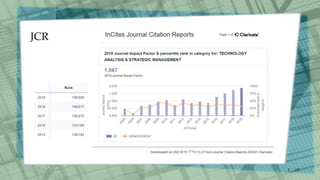
JCR
/30
1
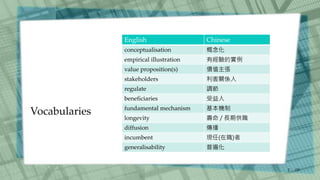
English Chinese
conceptualisation 概念化
empirical illustration 有經驗的實例
value proposition(s) 價值主張
stakeholders 利害關係人
regulate 調節
beneficiaries 受益人
fundamental mechanism 基本機制
longevity 壽命 / 長期供職
diffusion 傳播
incumbent 現任(在職)者
generalisability 普遍化
/30
2
Vocabularies
Content
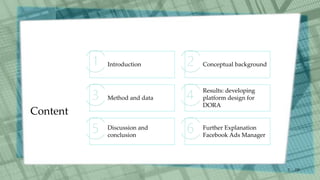
Introduction Conceptual background
Method and data
Results: developing
platform design for
DORA
Discussion and
conclusion
Further Explanation
Facebook Ads Manager
/30
3
Introduction
/30
4
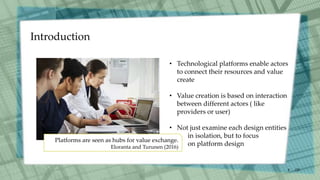
Platforms are seen as hubs for value exchange.
Eloranta and Turunen (2016)
• Technological platforms enable actors
to connect their resources and value
create
• Value creation is based on interaction
between different actors ( like
providers or user)
• Not just examine each design entities
in isolation, but to focus
on platform design
Introduction
/30
5
• Authors have conducted an
empirical study following the design
research methodology (Hevner 2007;
Peffers et al. 2007)
• They will focus on platform design to
take an explicit perspective on this
study
• MaaS Case: DORA (door to door
information for airports and airlines)
Conceptual background
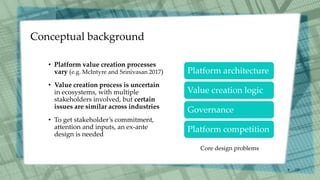
Platform architecture
Value creation logic
Governance
Platform competition
/30
6
• Platform value creation processes
vary (e.g. McIntyre and Srinivasan 2017)
• Value creation process is uncertain
in ecosystems, with multiple
stakeholders involved, but certain
issues are similar across industries
• To get stakeholder’s commitment,
attention and inputs, an ex-ante
design is needed
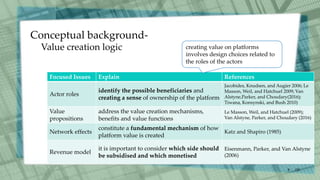
Core design problems
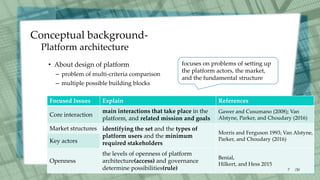
Focused Issues Explain References
Core interaction
main interactions that take place in the
platform, and related mission and goals
Gawer and Cusumano (2008); Van
Alstyne, Parker, and Choudary (2016)
Market structures identifying the set and the types of
platform users and the minimum
required stakeholders
Morris and Ferguson 1993; Van Alstyne,
Parker, and Choudary (2016)
Key actors
Openness
the levels of openness of platform
architecture(access) and governance
determine possibilities(rule)
Benial,
Hilkert, and Hess 2015
Conceptual background-
Platform architecture
/30
7
• About design of platform
– problem of multi-criteria comparison
– multiple possible building blocks
focuses on problems of setting up
the platform actors, the market,
and the fundamental structure
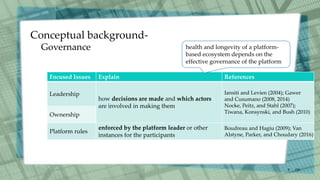
Focused Issues Explain References
Actor roles
identify the possible beneficiaries and
creating a sense of ownership of the platform
Jacobides, Knudsen, and Augier 2006; Le
Masson, Weil, and Hatchuel 2009; Van
Alstyne,Parker, and Choudary(2016);
Tiwana, Konsynski, and Bush 2010)
Value
propositions
address the value creation mechanisms,
benefits and value functions
Le Masson, Weil, and Hatchuel (2009);
Van Alstyne, Parker, and Choudary (2016)
Network effects
constitute a fundamental mechanism of how
platform value is created
Katz and Shapiro (1985)
Revenue model
it is important to consider which side should
be subsidised and which monetised
Eisenmann, Parker, and Van Alstyne
(2006)
Conceptual background-
Value creation logic
/30
8
creating value on platforms
involves design choices related to
the roles of the actors
Focused Issues Explain References
Leadership
how decisions are made and which actors
are involved in making them
Iansiti and Levien (2004); Gawer
and Cusumano (2008, 2014)
Nocke, Peitz, and Stahl (2007);
Tiwana, Konsynski, and Bush (2010)
Ownership
Platform rules
enforced by the platform leader or other
instances for the participants
Boudreau and Hagiu (2009); Van
Alstyne, Parker, and Choudary (2016)
Conceptual background-
Governance
/30
9
health and longevity of a platform-
based ecosystem depends on the
effective governance of the platform
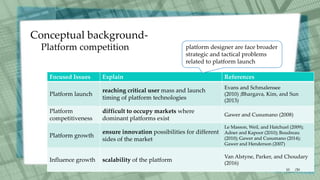
Focused Issues Explain References
Platform launch
reaching critical user mass and launch
timing of platform technologies
Evans and Schmalensee
(2010) ;Bhargava, Kim, and Sun
(2013)
Platform
competitiveness
difficult to occupy markets where
dominant platforms exist
Gawer and Cusumano (2008)
Platform growth
ensure innovation possibilities for different
sides of the market
Le Masson, Weil, and Hatchuel (2009);
Adner and Kapoor (2010); Boudreau
(2010); Gawer and Cusumano (2014);
Gawer and Henderson (2007)
Influence growth scalability of the platform
Van Alstyne, Parker, and Choudary
(2016)
Conceptual background-
Platform competition
/30
10
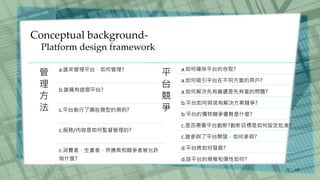
platform designer are face broader
strategic and tactical problems
related to platform launch
Conceptual background-
Platform design framework
/30
11
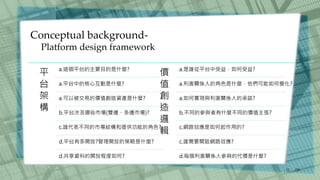
平
台
架
構
a.這個平台的主要目的是什麼?
a.平台中的核心互動是什麼?
a.可以被交易的價值創造資產是什麼?
b.平台涉及哪些市場(雙邊、多邊市場)?
c.誰代表不同的市場結構和提供功能的角色?
d.平台有多開放?管理開放的策略是什麼?
d.共享資料的開放程度如何?
價
值
創
造
邏
輯
a.是誰從平台中受益,如何受益?
a.利害關係人的角色是什麼,他們可能如何變化?
a.如何實現與利害關係人的承諾?
b.不同的參與者有什麼不同的價值主張?
c.網路效應是如何起作用的?
c.誰需要開啟網路效應?
d.每個利害關係人參與的代價是什麼?
Conceptual background-
Platform design framework
/30
12
管
理
方
法
a.誰來管理平台,如何管理?
b.誰擁有這個平台?
c.平台執行了哪些類型的規則?
c.服務/內容是如何監督管理的?
c.消費者、生產者、供應商和競爭者被允許
做什麼?
平
台
競
爭
a.如何確保平台的存取?
a.如何吸引平台在不同方面的用戶?
a.如何解決先有雞還是先有蛋的問題?
b.平台如何與現有解決方案競爭?
b.平台的獨特競爭優勢是什麼?
c.是否需要平台創新?創新目標是如何設定批准?
c.誰參與了平台開發,如何參與?
d.平台將如何發展?
d.該平台的規模和彈性如何?
Method and data
/30
13
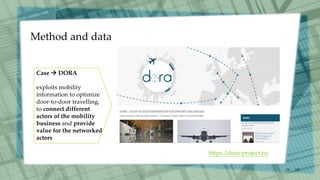
Case  DORA
exploits mobility
information to optimize
door-to-door travelling,
to connect different
actors of the mobility
business and provide
value for the networked
actors
https://dora-project.eu
Method and data
/30
14
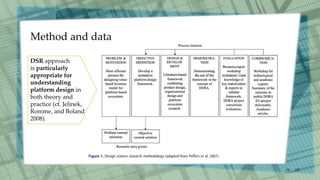
DSR approach
is particularly
appropriate for
understanding
platform design in
both theory and
practice (cf. Jelinek,
Romme, and Boland
2008).
Method and data
/30
15
/30
16
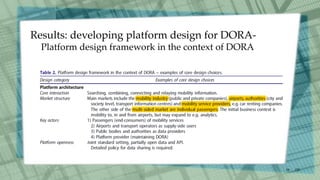
Results: developing platform design for DORA-
Platform design framework in the context of DORA
/30
17
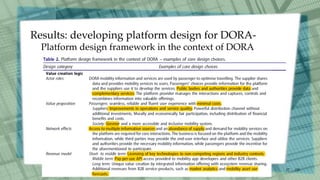
Results: developing platform design for DORA-
Platform design framework in the context of DORA
/30
18
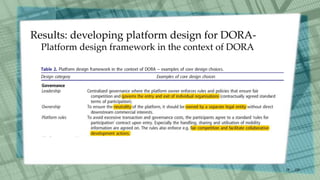
Results: developing platform design for DORA-
Platform design framework in the context of DORA
/30
19
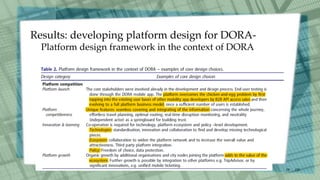
Results: developing platform design for DORA-
Platform design framework in the context of DORA
/30
20
• Our study contributes to this
literature by providing an
overarching framework of platform
design choices.
• Design choices are crucial for
continued operation and
sustainability of the business.
• Utilising the framework provided
new insights, leading to reframing
the business and the role of various
stakeholders
Discussion and conclusion-
Implications for research
/30
21
• The framework based on literature-
derived insights with limited
empirical validation
• The framework was developed to be
as simple to apply as possible
• The framework is a useful design
tool in facilitating the process of
linking different stakeholder
perspectives, finding common
understanding on value creation,
and accounting for platform
Discussion and conclusion-
Managerial implications
/30
22
• It’s often used for relatively content-
specific solutions, limiting the
generalisability of the results
• Further in other contexts would thus
increase generalizability
• Quantitative or simulation studies
could examine differences in the
platform design elements and
competitiveness
Discussion and conclusion-
Limitations and further research
Thank you
Continue for further explanation
Facebook Ads Manager…
/30
24
關於FB行銷媒體
• FB行銷媒體主要可以分為Earned Media與Paid Media
– Earned Media:因社群法則而獲得媒體曝光(口碑行銷)
• 個人動態發文:觸及到自己的所有好友圈
• 社群訊息:使用者加入某社團後,可以在該社團內分享訊息
→累積好友與社群
– Paid Media:購買廣告因付費所得到的媒體曝光
• 藉由購買廣告、可以將商品更精準地投放給目標客群
→受眾設定、計費選擇、執行、檢視效益
/30
25
/30
26
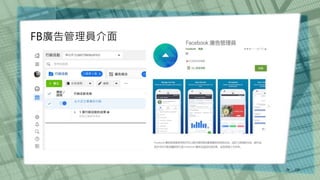
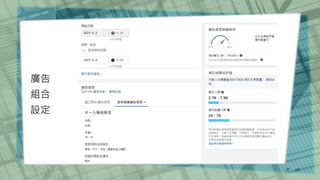
FB廣告管理員介面
/30
27
廣告
組合
設定
/30
28
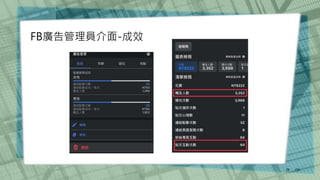
FB廣告管理員介面-成效
/30
29
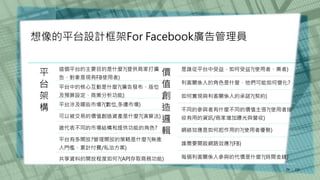
平
台
架
構
這個平台的主要目的是什麼?(提供商家打廣
告,對象是現有FB使用者)
平台中的核心互動是什麼?(廣告發布、版位
及預算設定、商業分析功能)
平台涉及哪些市場?(數位,多邊市場)
可以被交易的價值創造資產是什麼?(演算法)
誰代表不同的市場結構和提供功能的角色?
平台有多開放?管理開放的策略是什麼?(無進
入門檻,累計付費/私洽方案)
共享資料的開放程度如何?(API存取商務功能)
價
值
創
造
邏
輯
是誰從平台中受益,如何受益?(使用者、業者)
利害關係人的角色是什麼,他們可能如何變化?
如何實現與利害關係人的承諾?(契約)
不同的參與者有什麼不同的價值主張?(使用者接
收有用的資訊/商家增加曝光與營收)
網絡效應是如何起作用的?(使用者優勢)
誰需要開啟網路效應?(FB)
每個利害關係人參與的代價是什麼?(時間金錢)
想像的平台設計框架For Facebook廣告管理員
/30
30
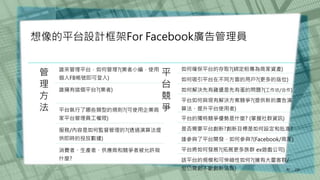
管
理
方
法
誰來管理平台,如何管理?(業者小編,使用
個人FB帳號即可登入)
誰擁有這個平台?(業者)
平台執行了哪些類型的規則?(可使用企業商
家平台管理員工權限)
服務/內容是如何監督管理的?(透過演算法提
供即時的投放數據)
消費者、生產者、供應商和競爭者被允許做
什麼?
平
台
競
爭
如何確保平台的存取?(綁定粉專為商家資產)
如何吸引平台在不同方面的用戶?(更多的版位)
如何解決先有雞還是先有蛋的問題?(工作坊/合作)
平台如何與現有解決方案競爭?(提供新的廣告演
算法、提升平台使用者)
平台的獨特競爭優勢是什麼? (掌握社群資訊)
是否需要平台創新?創新目標是如何設定和批准?
誰參與了平台開發,如何參與?(Facebook/商家)
平台將如何發展?(拓展更多族群 ex遊戲公司)
該平台的規模和可伸縮性如何?(擁有大量客群/
但仍需創不斷創新沾黏)
想像的平台設計框架For Facebook廣告管理員
Resources
• Tura, N., Kutvonen, A., & Ritala, P. (2017). Platform design framework:
conceptualisation and application. Technology Analysis & Strategic Management,
30(8), 881–894. doi:10.1080/09537325.2017.1390220
https://sci-hub.do/10.1080/09537325.2017.1390220
• P4,P5,P20-22 Microsoft Stock images (royalty-free images)
• P24 Screen capture from https://www.facebook.com/business/tools/ads-manager
• P25 吳仁和,資訊管理:企業創新與價值創造,7th Edition,台北:智勝,2018
• P26 Facebook廣告收費方式
https://www.facebook.com/business/help/716180208457684?id=179246593
4137726

Paper shareing_Platform design framework conceptualisation and application

Editor's Notes

  • #2 技術平台使參與者能夠跨越市場連接其資源,透過互補性和網絡效應創造價值
  • #7 Mobility as a Service(MaaS)又可稱為Transport as a Service(TaaS)服務的目的在打造一個比自己擁有車輛及使用車輛還更方便、更可靠、更經濟的交通服務,讓民眾的行為從擁有車輛轉變為擁有交通服務。因此,MaaS的根本精神在建立以使用者為核心的交通服務典範
  • #9 關於在設計這個技術平台會發現,其實會存在多標準比較也面臨多重建構區塊的問題
  • #11 Platform rules 由平台領導或其他實例執行給參與者
  • #14 多數具有網路外部性的市場,有兩邊以上的參與者存在,且其等透過共同平台進行交流而獲利。於此類市場的平台則面臨著名的雞生蛋、蛋生雞問題(chickedproblem,下簡稱「雞與蛋問題」),即必須兩邊都有足夠使用者願意使用該平台
  • #22 利用這個框架提供了新的觀點,從而重新規劃業務和各利害關係人的角色
  • #23 這個框架是一個實用的設計工具,可以促進連接不同利害關係人的觀點,也能理解共同的價值創造,並為平台解釋過程
  • #24 可以透過統計進行定量或模擬研究,檢驗平台設計元素和競爭力的差異