P.HARISH REDDY
INTRODUCTION
Churn prediction is one of the most
popular Big Data use cases in business.
It consists of detecting customers who
are likely to cancel a subscription to a
service.
Churn is a problem for telecom
companies because it is more expensive
to acquire a new customer than to keep
your existing one from leaving.
Wireless companies
today measure
voluntary churn by a
monthly figure, such
as 1.9 percent or 2.1
percent.
PROJECT OBJECTIVE
To predict Customer Churn.
Highlighting the main variables/factors
influencing Customer Churn.
Use various ML algorithms to build
prediction models, evaluate the accuracy
and performance of these models.
Finding out the best model for our
business case & providing executive
summary.
There are many ways: better
products, better delivery
methods, lower prices,
building satisfactory
customer relationships,
better marketing and, above
all, successful customer
communications.
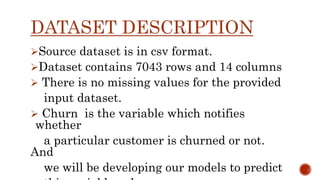
DATASET DESCRIPTION
Source dataset is in csv format.
Dataset contains 7043 rows and 14 columns
 There is no missing values for the provided
input dataset.
 Churn is the variable which notifies
whether
a particular customer is churned or not.
And
we will be developing our models to predict
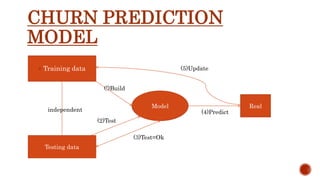
CHURN PREDICTION
MODEL
 Training data
Model
Testing data
Real
(3)Test=Ok
(5)Update
(2)Test
(!)Build
(4)Predictindependent
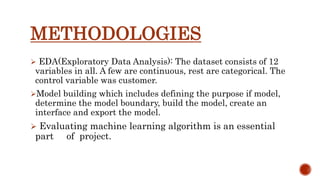
METHODOLOGIES
 EDA(Exploratory Data Analysis): The dataset consists of 12
variables in all. A few are continuous, rest are categorical. The
control variable was customer.
Model building which includes defining the purpose if model,
determine the model boundary, build the model, create an
interface and export the model.
 Evaluating machine learning algorithm is an essential
part of project.
EXPLORATORY DATA
ANALYSIS
Data visualisation using seaborn and matplotlib
Exploratory data analysis (EDA) is an approach to
analyse data sets & to summarize their main
characteristics, often with visual methods.
A Statistical model can be used or not, but
primarily EDA is for seeing what the data can tell
us beyond the formal modelling or hypothesis.
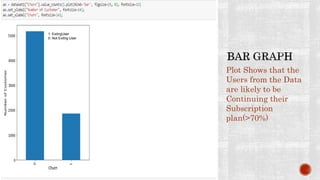
Plot Shows that the
Users from the Data
are likely to be
Continuing their
Subscription
plan(>70%)
1: ExitngUser
0: Not Exitng User
• We found outliers in
exiting customers which
is out of whiskers. An
Outlier is an observation
that is numerically
distant from the rest of
the data.
• Using Skew() method we
found that Churn data is
inconsistent
with tenure
• Customers who
disconnecting their
subscription plans are
selecting short tenure
Telecom Company need
to offer better plans for
those customers who
choose short tenures.
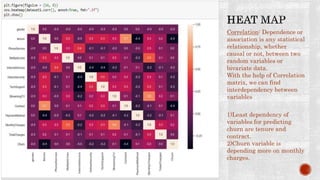
Correlation: Dependence or
association is any statistical
relationship, whether
causal or not, between two
random variables or
bivariate data.
With the help of Correlation
matrix, we can find
interdependency between
variables
1)Least dependency of
variables for predicting
churn are tenure and
contract.
2)Churn variable is
depending more on monthly
charges.
1)Female subscribers
are 49.5% of the total
2)Male subscribers
are 55.5% of the total
According to the collected
data information 73.5%
customers are continuing
their subscription
and 26.5% customers
disconnected.
1)Customers paying high
monthly charges for
short tenures are
disconnecting
2)Customers paying high
monthly charges for long
tenures continuing with
their subscription plans,
as it is reasonable cost
MODELS ACCURACY
KNN 62%
SVM 76%
ACCURACY OF VARIOUS
MODELS
SVM MODEL
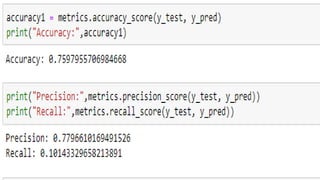
METRICS EVALUATION:
CONFUSION MATRIX:
ACCURACY: 76.12%
PRECISION : 77.96%
2589 26
815 92
NODE RED FLOW WIRING
UI OF MODEL
FINDINGS AND
SUGGESTIONS
Try to offer the better service for the churn customers ,see
how much this impact before and later .Some may use
your service better move them to your active customers.
Take the feedback and suggestions with in period of time
and improve it ,strive for better communication.
When your are taking the any change in plans of your
business just predict the positive and negative share of
that plan. If it is negative prepare the solution before
so You can handy easily.
HOW TO REDUCE
CUSTOMER CHURN
 Lean into your best customers.
 Be proactive with communication.
Define a roadmap for your new customers.
Offer incentives.
Ask for feedback often.
Analyze churn when it happens.
Stay competitive.
CONCLUSION
The importance of this type of research in the
telecom market is to help companies make more profit.
 It has become known that predicting churn is one of the
most important sources of income to Telecom
companies.
Hence, this research aimed to build a system
that predicts the churn of customers i telecom company.
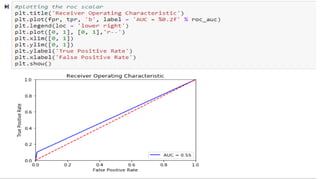
These prediction models need to achieve high AUC
values. To test and train the model, the sample data is
divided into 70% for training and 30% for testing.

Telecom Churn Prediction Presentation

  • 1.
  • 2.
    INTRODUCTION Churn prediction isone of the most popular Big Data use cases in business. It consists of detecting customers who are likely to cancel a subscription to a service. Churn is a problem for telecom companies because it is more expensive to acquire a new customer than to keep your existing one from leaving. Wireless companies today measure voluntary churn by a monthly figure, such as 1.9 percent or 2.1 percent.
  • 3.
    PROJECT OBJECTIVE To predictCustomer Churn. Highlighting the main variables/factors influencing Customer Churn. Use various ML algorithms to build prediction models, evaluate the accuracy and performance of these models. Finding out the best model for our business case & providing executive summary. There are many ways: better products, better delivery methods, lower prices, building satisfactory customer relationships, better marketing and, above all, successful customer communications.
  • 4.
    DATASET DESCRIPTION Source datasetis in csv format. Dataset contains 7043 rows and 14 columns  There is no missing values for the provided input dataset.  Churn is the variable which notifies whether a particular customer is churned or not. And we will be developing our models to predict
  • 5.
    CHURN PREDICTION MODEL  Trainingdata Model Testing data Real (3)Test=Ok (5)Update (2)Test (!)Build (4)Predictindependent
  • 6.
    METHODOLOGIES  EDA(Exploratory DataAnalysis): The dataset consists of 12 variables in all. A few are continuous, rest are categorical. The control variable was customer. Model building which includes defining the purpose if model, determine the model boundary, build the model, create an interface and export the model.  Evaluating machine learning algorithm is an essential part of project.
  • 7.
    EXPLORATORY DATA ANALYSIS Data visualisationusing seaborn and matplotlib Exploratory data analysis (EDA) is an approach to analyse data sets & to summarize their main characteristics, often with visual methods. A Statistical model can be used or not, but primarily EDA is for seeing what the data can tell us beyond the formal modelling or hypothesis.
  • 8.
    Plot Shows thatthe Users from the Data are likely to be Continuing their Subscription plan(>70%) 1: ExitngUser 0: Not Exitng User
  • 9.
    • We foundoutliers in exiting customers which is out of whiskers. An Outlier is an observation that is numerically distant from the rest of the data. • Using Skew() method we found that Churn data is inconsistent with tenure • Customers who disconnecting their subscription plans are selecting short tenure Telecom Company need to offer better plans for those customers who choose short tenures.
  • 10.
    Correlation: Dependence or associationis any statistical relationship, whether causal or not, between two random variables or bivariate data. With the help of Correlation matrix, we can find interdependency between variables 1)Least dependency of variables for predicting churn are tenure and contract. 2)Churn variable is depending more on monthly charges.
  • 11.
    1)Female subscribers are 49.5%of the total 2)Male subscribers are 55.5% of the total
  • 12.
    According to thecollected data information 73.5% customers are continuing their subscription and 26.5% customers disconnected.
  • 13.
    1)Customers paying high monthlycharges for short tenures are disconnecting 2)Customers paying high monthly charges for long tenures continuing with their subscription plans, as it is reasonable cost
  • 14.
    MODELS ACCURACY KNN 62% SVM76% ACCURACY OF VARIOUS MODELS
  • 15.
  • 18.
    METRICS EVALUATION: CONFUSION MATRIX: ACCURACY:76.12% PRECISION : 77.96% 2589 26 815 92
  • 19.
    NODE RED FLOWWIRING UI OF MODEL
  • 20.
    FINDINGS AND SUGGESTIONS Try tooffer the better service for the churn customers ,see how much this impact before and later .Some may use your service better move them to your active customers. Take the feedback and suggestions with in period of time and improve it ,strive for better communication. When your are taking the any change in plans of your business just predict the positive and negative share of that plan. If it is negative prepare the solution before so You can handy easily.
  • 21.
    HOW TO REDUCE CUSTOMERCHURN  Lean into your best customers.  Be proactive with communication. Define a roadmap for your new customers. Offer incentives. Ask for feedback often. Analyze churn when it happens. Stay competitive.
  • 22.
    CONCLUSION The importance ofthis type of research in the telecom market is to help companies make more profit.  It has become known that predicting churn is one of the most important sources of income to Telecom companies. Hence, this research aimed to build a system that predicts the churn of customers i telecom company. These prediction models need to achieve high AUC values. To test and train the model, the sample data is divided into 70% for training and 30% for testing.