From Journal of Manufacturing Systems
Fei Tao, Qinglin Qi, Ang Liu, Andrew Kusiak (2018)
報告人:陳佑昇
2021/07/16
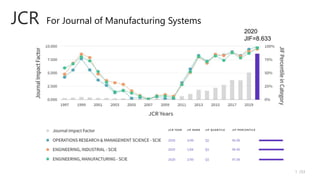
JCR
/33
1
For Journal of Manufacturing Systems
2020
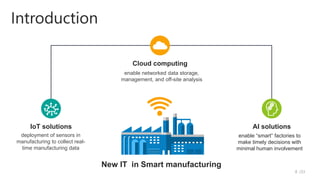
JIF=8.633
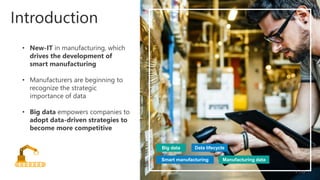
Smart
Manufacturing
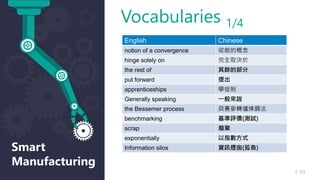
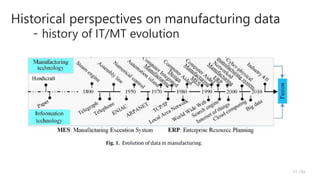
English Chinese
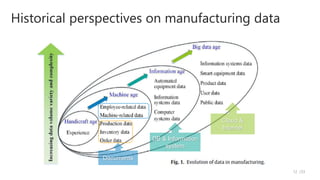
notion of a convergence 收斂的概念
hinge solely on 完全取決於
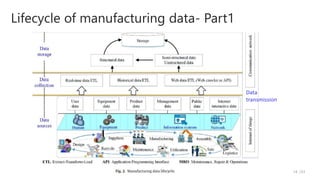
the rest of 其餘的部分
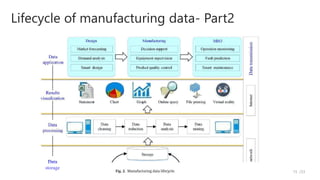
put forward 提出
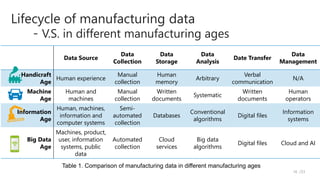
apprenticeships 學徒制
Generally speaking 一般來說
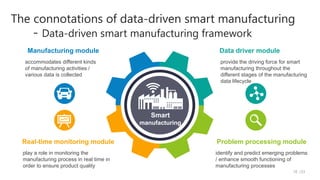
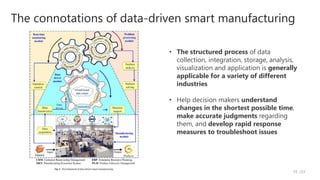
the Bessemer process 貝賽麥轉爐煉鋼法
benchmarking 基準評價(測試)
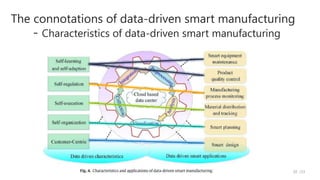
scrap 廢棄
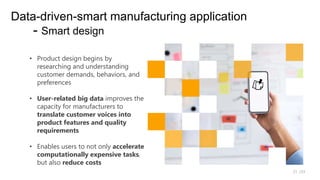
exponentially 以指數方式
Information silos 資訊煙囪(孤島)
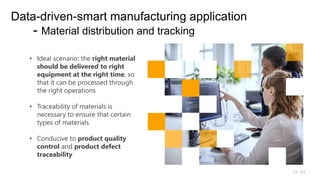
/33
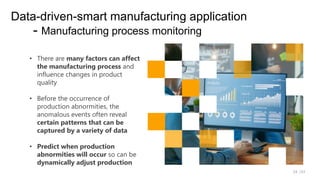
2
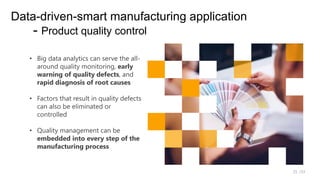
Vocabularies 1/4
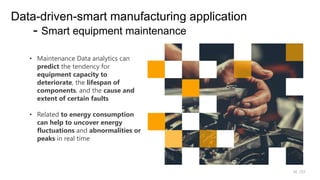
Smart
Manufacturing
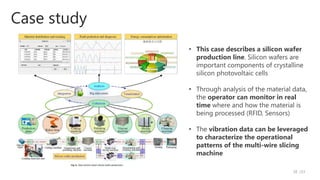
/33
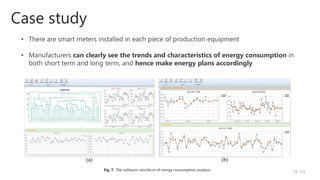
3
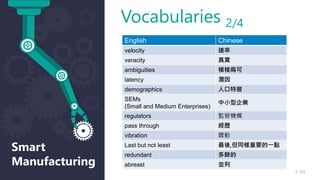
Vocabularies 2/4
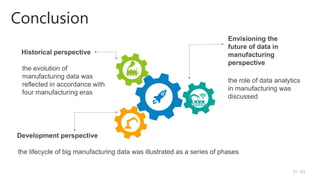
English Chinese
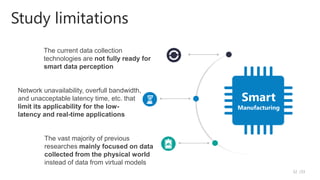
velocity 速率
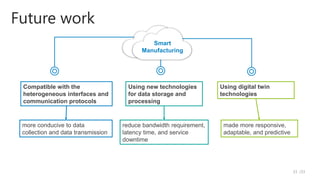
veracity 真實
ambiguities 模稜兩可
latency 潛因
demographics 人口特徵
SEMs
(Small and Medium Enterprises)
中小型企業
regulators 監管機構
pass through 經歷
vibration 震動
Last but not least 最後,但同樣重要的一點
redundant 多餘的
abreast 並列
Smart
Manufacturing
/33
4
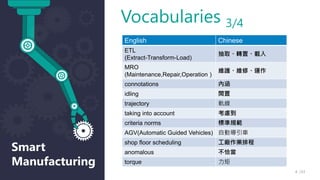
Vocabularies 3/4
English Chinese
ETL
(Extract-Transform-Load)
抽取、轉置、載入
MRO
(Maintenance,Repair,Operation )
維護、維修、運作
connotations 內涵
idling 閒置
trajectory 軌線
taking into account 考慮到
criteria norms 標準規範
AGV(Automatic Guided Vehicles) 自動導引車
shop floor scheduling 工廠作業排程
anomalous 不恰當
torque 力矩
Smart
Manufacturing
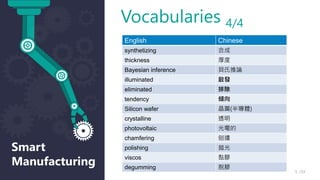
English Chinese
synthetizing 合成
thickness 厚度
Bayesian inference 貝氏推論
illuminated 啟發
eliminated 排除
tendency 傾向
Silicon wafer 晶圓(半導體)
crystalline 透明
photovoltaic 光電的
chamfering 刨邊
polishing 拋光
viscos 黏膠
degumming 脫膠
/33
5
Vocabularies 4/4
Smart
Manufacturing
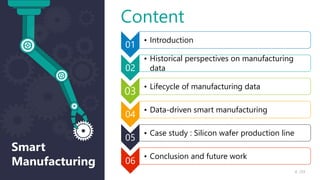
Content
01
• Introduction
02
• Historical perspectives on manufacturing
data
03
• Lifecycle of manufacturing data
04
• Data-driven smart manufacturing
05
• Case study : Silicon wafer production line
06
• Conclusion and future work
/33
6
1. Introduction
Introduction
IoT solutions
deployment of sensors in
manufacturing to collect real-
time manufacturing data
AI solutions
enable “smart” factories to
make timely decisions with
minimal human involvement
Cloud computing
enable networked data storage,
management, and off-site analysis
New IT in Smart manufacturing
/33
8
• New-IT in manufacturing, which
drives the development of
smart manufacturing
• Manufacturers are beginning to
recognize the strategic
importance of data
• Big data empowers companies to
adopt data-driven strategies to
become more competitive
Data lifecycle
Big data
Manufacturing data
/33
9
Smart manufacturing
2. Historical perspectives on
manufacturing data
Historical perspectives on manufacturing data
- history of IT/MT evolution
/33
11
Historical perspectives on manufacturing data
Documents
DB & Information
system
Cloud &
Internet
/33
12
3. Lifecycle of manufacturing data
data collection, transmission, storage,
processing, visualization, and application
Lifecycle of manufacturing data- Part1
/33
14
Data
transmission
Lifecycle of manufacturing data- Part2
/33
15
Data
storage
Data Source
Data
Collection
Data
Storage
Data
Analysis
Date Transfer
Data
Management
Handicraft
Age
Human experience
Manual
collection
Human
memory
Arbitrary
Verbal
communication
N/A
Machine
Age
Human and
machines
Manual
collection
Written
documents
Systematic
Written
documents
Human
operators
Information
Age
Human, machines,
information and
computer systems
Semi-
automated
collection
Databases
Conventional
algorithms
Digital files
Information
systems
Big Data
Age
Machines, product,
user, information
systems, public
data
Automated
collection
Cloud
services
Big data
algorithms
Digital files Cloud and AI
Lifecycle of manufacturing data
- V.S. in different manufacturing ages
Table 1. Comparison of manufacturing data in different manufacturing ages
/33
16
4. Data-driven smart manufacturing
Smart
manufacturing
play a role in monitoring the
manufacturing process in real time in
order to ensure product quality
Real-time monitoring module
identify and predict emerging problems
/ enhance smooth functioning of
manufacturing processes
Problem processing module
provide the driving force for smart
manufacturing throughout the
different stages of the manufacturing
data lifecycle
Data driver module
accommodates different kinds
of manufacturing activities /
various data is collected
Manufacturing module
The connotations of data-driven smart manufacturing
- Data-driven smart manufacturing framework
/33
18
The connotations of data-driven smart manufacturing
/33
19
• The structured process of data
collection, integration, storage, analysis,
visualization and application is generally
applicable for a variety of different
industries
• Help decision makers understand
changes in the shortest possible time,
make accurate judgments regarding
them, and develop rapid response
measures to troubleshoot issues
/33
20
The connotations of data-driven smart manufacturing
- Characteristics of data-driven smart manufacturing
/33
21
Data-driven-smart manufacturing application
- Smart design
• Product design begins by
researching and understanding
customer demands, behaviors, and
preferences
• User-related big data improves the
capacity for manufacturers to
translate customer voices into
product features and quality
requirements
• Enables users to not only accelerate
computationally expensive tasks,
but also reduce costs
/33
22
Data-driven-smart manufacturing application
- Smart planning and process optimization
• Production planning is necessary to
determine the production
capacity of a manufacturing
facility
• Using intelligent optimization
algorithms to optimize
manufacturing resources and the
execution procedures for the task
• Can result in improved
productivity and product quality,
as well as reduced costs
/33
23
Data-driven-smart manufacturing application
- Material distribution and tracking
• Ideal scenario: the right material
should be delivered to right
equipment at the right time, so
that it can be processed through
the right operations
• Traceability of materials is
necessary to ensure that certain
types of materials
• Conducive to product quality
control and product defect
traceability
/33
24
Data-driven-smart manufacturing application
- Manufacturing process monitoring
• There are many factors can affect
the manufacturing process and
influence changes in product
quality
• Before the occurrence of
production abnormities, the
anomalous events often reveal
certain patterns that can be
captured by a variety of data
• Predict when production
abnormities will occur so can be
dynamically adjust production
/33
25
Data-driven-smart manufacturing application
- Product quality control
• Big data analytics can serve the all-
around quality monitoring, early
warning of quality defects, and
rapid diagnosis of root causes
• Factors that result in quality defects
can also be eliminated or
controlled
• Quality management can be
embedded into every step of the
manufacturing process
/33
26
Data-driven-smart manufacturing application
- Smart equipment maintenance
• Maintenance Data analytics can
predict the tendency for
equipment capacity to
deteriorate, the lifespan of
components, and the cause and
extent of certain faults
• Related to energy consumption
can help to uncover energy
fluctuations and abnormalities or
peaks in real time
5. Case study:
Silicon wafer production line
Case study
/33
28
• This case describes a silicon wafer
production line. Silicon wafers are
important components of crystalline
silicon photovoltaic cells
• Through analysis of the material data,
the operator can monitor in real
time where and how the material is
being processed (RFID, Sensors)
• The vibration data can be leveraged
to characterize the operational
patterns of the multi-wire slicing
machine
Case study
/33
29
• There are smart meters installed in each piece of production equipment
• Manufacturers can clearly see the trends and characteristics of energy consumption in
both short term and long term, and hence make energy plans accordingly
6. Conclusion and future work
Conclusion
Envisioning the
future of data in
manufacturing
perspective
the role of data analytics
in manufacturing was
discussed
Development perspective
the lifecycle of big manufacturing data was illustrated as a series of phases
Historical perspective
the evolution of
manufacturing data was
reflected in accordance with
four manufacturing eras
/33
31
Study limitations
The current data collection
technologies are not fully ready for
smart data perception
The vast majority of previous
researches mainly focused on data
collected from the physical world
instead of data from virtual models
Network unavailability, overfull bandwidth,
and unacceptable latency time, etc. that
limit its applicability for the low-
latency and real-time applications
Smart
Manufacturing
/33
32
Future work
Smart
Manufacturing
more conducive to data
collection and data transmission
Compatible with the
heterogeneous interfaces and
communication protocols
reduce bandwidth requirement,
latency time, and service
downtime
Using new technologies
for data storage and
processing
made more responsive,
adaptable, and predictive
Using digital twin
technologies
/33
33
Thank You
Smart
Manufacturing
Sources
1) Data-driven smart manufacturing/ Journal of Manufacturing
Systems 48 (2018) 157–169/Fei Taoa, Qinglin Qia, Ang Liub,
Andrew/ Download form Data-driven smart manufacturing –
ScienceDirect
2) PPT template, all images and graphics (shapes) in this
template are produced by allppt.com. Redistribution of the
template or the extraction graphics is completely prohibited.
3) P1. Journal Citation Reports from
https://jcr.clarivate.com/jcr/home
4) P9. P21-26. Microsoft Stock images (royalty-free images)
Smart manufacturing security challenges
• Trust –
Edge nodes that offer services to IoT
devices should be able to validate
• Shared Technology/Virtualization –
Insecure hypervisor can lead to a
single point failure and privilege
escalation attacks
• Provisioning –
Secure automatic configuration of
access credentials, node
management agents, and analytics
software
/5
1
Security challenges
Industrial Edge Computing represents an
attractive target for cyber-criminals
Global technical standards
/5
2
 IEC(International Electrotechnical Commission) prepares and publishes international
standards for all electrical, electronic and related technologies
• Published IEC 62443 on Industrial Network and System Security
 ETSI (European Telecommunications Standards Institute) supports the development and
testing of global technical standards for ICT-enabled systems, applications and services.
• Published ETSI TS 103 645 on Cyber security for consumer IoT
 ISO/IEC 27001 is an international standard on how to manage information security
Global technical standards- IEC 62443
/5
3
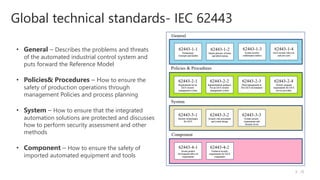
• General – Describes the problems and threats
of the automated industrial control system and
puts forward the Reference Model
• Policies& Procedures – How to ensure the
safety of production operations through
management Policies and process planning
• System – How to ensure that the integrated
automation solutions are protected and discusses
how to perform security assessment and other
methods
• Component – How to ensure the safety of
imported automated equipment and tools
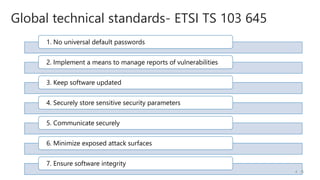
1. No universal default passwords

2. Implement a means to manage reports of vulnerabilities
3. Keep software updated
4. Securely store sensitive security parameters
5. Communicate securely
6. Minimize exposed attack surfaces
7. Ensure software integrity
Global technical standards- ETSI TS 103 645
/5
4
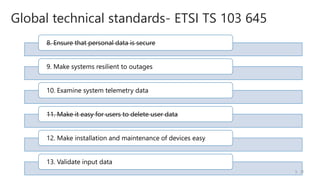
8. Ensure that personal data is secure
9. Make systems resilient to outages
10. Examine system telemetry data
11. Make it easy for users to delete user data
12. Make installation and maintenance of devices easy
13. Validate input data
Global technical standards- ETSI TS 103 645
/5
5
Smart
Manufacturing
Sources
1) 智慧製造的資訊安全 from https://www.rockwellautomation.com/zh-
tw/company/news/magazines/security-for-smart-manufacturing.html
2) Intel IIoT Security-The Industrial Internet of Things (IIoT) from
https://www.intel.sg/content/www/xa/en/internet-of-things/industrial-
iot/security/overview.html
3) BSI Group物聯網:正視網路安全(上篇) from
https://www.bsigroup.com/localfiles/zh-tw/e-news/no196/the-internet-of-things-
get-serious-about-security-part1.pdf
4) BSI Group物聯網:正視網路安全(下篇) from
https://www.bsigroup.com/localfiles/zh-tw/e-news/no197/the-internet-of-things-
get-serious-about-security-part2.pdf
5) 歐洲電信發展協會 ETSI TS 103 645 V2.1.2 (2020-06) from TS 103 645 - V2.1.2 - CYBER;
Cyber Security for Consumer Internet of Things: Baseline Requirements (etsi.org)
6) 工控遵循IEC 62443-2-4 因應資通安全法規範 from
https://www.netadmin.com.tw/netadmin/zh-
tw/viewpoint/DB1C1183C13C4ADC8EEDF61E2DBD22B9
7) P1. Image from https://cspingenieros.com/seguridad-informatica-y-ciberseguridad/
8) P3. 工控資安標準 IEC 62443 from 工控資安標準 IEC 62443 (ntu.edu.tw)

Paper sharing_data-driven smart manufacturing (include smart manufacturing security challenges)

  • 1.
    From Journal ofManufacturing Systems Fei Tao, Qinglin Qi, Ang Liu, Andrew Kusiak (2018) 報告人:陳佑昇 2021/07/16
  • 2.
    JCR /33 1 For Journal ofManufacturing Systems 2020 JIF=8.633
  • 3.
    Smart Manufacturing English Chinese notion ofa convergence 收斂的概念 hinge solely on 完全取決於 the rest of 其餘的部分 put forward 提出 apprenticeships 學徒制 Generally speaking 一般來說 the Bessemer process 貝賽麥轉爐煉鋼法 benchmarking 基準評價(測試) scrap 廢棄 exponentially 以指數方式 Information silos 資訊煙囪(孤島) /33 2 Vocabularies 1/4
  • 4.
    Smart Manufacturing /33 3 Vocabularies 2/4 English Chinese velocity速率 veracity 真實 ambiguities 模稜兩可 latency 潛因 demographics 人口特徵 SEMs (Small and Medium Enterprises) 中小型企業 regulators 監管機構 pass through 經歷 vibration 震動 Last but not least 最後,但同樣重要的一點 redundant 多餘的 abreast 並列
  • 5.
    Smart Manufacturing /33 4 Vocabularies 3/4 English Chinese ETL (Extract-Transform-Load) 抽取、轉置、載入 MRO (Maintenance,Repair,Operation) 維護、維修、運作 connotations 內涵 idling 閒置 trajectory 軌線 taking into account 考慮到 criteria norms 標準規範 AGV(Automatic Guided Vehicles) 自動導引車 shop floor scheduling 工廠作業排程 anomalous 不恰當 torque 力矩
  • 6.
    Smart Manufacturing English Chinese synthetizing 合成 thickness厚度 Bayesian inference 貝氏推論 illuminated 啟發 eliminated 排除 tendency 傾向 Silicon wafer 晶圓(半導體) crystalline 透明 photovoltaic 光電的 chamfering 刨邊 polishing 拋光 viscos 黏膠 degumming 脫膠 /33 5 Vocabularies 4/4
  • 7.
    Smart Manufacturing Content 01 • Introduction 02 • Historicalperspectives on manufacturing data 03 • Lifecycle of manufacturing data 04 • Data-driven smart manufacturing 05 • Case study : Silicon wafer production line 06 • Conclusion and future work /33 6
  • 8.
  • 9.
    Introduction IoT solutions deployment ofsensors in manufacturing to collect real- time manufacturing data AI solutions enable “smart” factories to make timely decisions with minimal human involvement Cloud computing enable networked data storage, management, and off-site analysis New IT in Smart manufacturing /33 8
  • 10.
    • New-IT inmanufacturing, which drives the development of smart manufacturing • Manufacturers are beginning to recognize the strategic importance of data • Big data empowers companies to adopt data-driven strategies to become more competitive Data lifecycle Big data Manufacturing data /33 9 Smart manufacturing
  • 11.
    2. Historical perspectiveson manufacturing data
  • 12.
    Historical perspectives onmanufacturing data - history of IT/MT evolution /33 11
  • 13.
    Historical perspectives onmanufacturing data Documents DB & Information system Cloud & Internet /33 12
  • 14.
    3. Lifecycle ofmanufacturing data data collection, transmission, storage, processing, visualization, and application
  • 15.
    Lifecycle of manufacturingdata- Part1 /33 14 Data transmission
  • 16.
    Lifecycle of manufacturingdata- Part2 /33 15 Data storage
  • 17.
    Data Source Data Collection Data Storage Data Analysis Date Transfer Data Management Handicraft Age Humanexperience Manual collection Human memory Arbitrary Verbal communication N/A Machine Age Human and machines Manual collection Written documents Systematic Written documents Human operators Information Age Human, machines, information and computer systems Semi- automated collection Databases Conventional algorithms Digital files Information systems Big Data Age Machines, product, user, information systems, public data Automated collection Cloud services Big data algorithms Digital files Cloud and AI Lifecycle of manufacturing data - V.S. in different manufacturing ages Table 1. Comparison of manufacturing data in different manufacturing ages /33 16
  • 18.
    4. Data-driven smartmanufacturing
  • 19.
    Smart manufacturing play a rolein monitoring the manufacturing process in real time in order to ensure product quality Real-time monitoring module identify and predict emerging problems / enhance smooth functioning of manufacturing processes Problem processing module provide the driving force for smart manufacturing throughout the different stages of the manufacturing data lifecycle Data driver module accommodates different kinds of manufacturing activities / various data is collected Manufacturing module The connotations of data-driven smart manufacturing - Data-driven smart manufacturing framework /33 18
  • 20.
    The connotations ofdata-driven smart manufacturing /33 19 • The structured process of data collection, integration, storage, analysis, visualization and application is generally applicable for a variety of different industries • Help decision makers understand changes in the shortest possible time, make accurate judgments regarding them, and develop rapid response measures to troubleshoot issues
  • 21.
    /33 20 The connotations ofdata-driven smart manufacturing - Characteristics of data-driven smart manufacturing
  • 22.
    /33 21 Data-driven-smart manufacturing application -Smart design • Product design begins by researching and understanding customer demands, behaviors, and preferences • User-related big data improves the capacity for manufacturers to translate customer voices into product features and quality requirements • Enables users to not only accelerate computationally expensive tasks, but also reduce costs
  • 23.
    /33 22 Data-driven-smart manufacturing application -Smart planning and process optimization • Production planning is necessary to determine the production capacity of a manufacturing facility • Using intelligent optimization algorithms to optimize manufacturing resources and the execution procedures for the task • Can result in improved productivity and product quality, as well as reduced costs
  • 24.
    /33 23 Data-driven-smart manufacturing application -Material distribution and tracking • Ideal scenario: the right material should be delivered to right equipment at the right time, so that it can be processed through the right operations • Traceability of materials is necessary to ensure that certain types of materials • Conducive to product quality control and product defect traceability
  • 25.
    /33 24 Data-driven-smart manufacturing application -Manufacturing process monitoring • There are many factors can affect the manufacturing process and influence changes in product quality • Before the occurrence of production abnormities, the anomalous events often reveal certain patterns that can be captured by a variety of data • Predict when production abnormities will occur so can be dynamically adjust production
  • 26.
    /33 25 Data-driven-smart manufacturing application -Product quality control • Big data analytics can serve the all- around quality monitoring, early warning of quality defects, and rapid diagnosis of root causes • Factors that result in quality defects can also be eliminated or controlled • Quality management can be embedded into every step of the manufacturing process
  • 27.
    /33 26 Data-driven-smart manufacturing application -Smart equipment maintenance • Maintenance Data analytics can predict the tendency for equipment capacity to deteriorate, the lifespan of components, and the cause and extent of certain faults • Related to energy consumption can help to uncover energy fluctuations and abnormalities or peaks in real time
  • 28.
    5. Case study: Siliconwafer production line
  • 29.
    Case study /33 28 • Thiscase describes a silicon wafer production line. Silicon wafers are important components of crystalline silicon photovoltaic cells • Through analysis of the material data, the operator can monitor in real time where and how the material is being processed (RFID, Sensors) • The vibration data can be leveraged to characterize the operational patterns of the multi-wire slicing machine
  • 30.
    Case study /33 29 • Thereare smart meters installed in each piece of production equipment • Manufacturers can clearly see the trends and characteristics of energy consumption in both short term and long term, and hence make energy plans accordingly
  • 31.
    6. Conclusion andfuture work
  • 32.
    Conclusion Envisioning the future ofdata in manufacturing perspective the role of data analytics in manufacturing was discussed Development perspective the lifecycle of big manufacturing data was illustrated as a series of phases Historical perspective the evolution of manufacturing data was reflected in accordance with four manufacturing eras /33 31
  • 33.
    Study limitations The currentdata collection technologies are not fully ready for smart data perception The vast majority of previous researches mainly focused on data collected from the physical world instead of data from virtual models Network unavailability, overfull bandwidth, and unacceptable latency time, etc. that limit its applicability for the low- latency and real-time applications Smart Manufacturing /33 32
  • 34.
    Future work Smart Manufacturing more conduciveto data collection and data transmission Compatible with the heterogeneous interfaces and communication protocols reduce bandwidth requirement, latency time, and service downtime Using new technologies for data storage and processing made more responsive, adaptable, and predictive Using digital twin technologies /33 33
  • 35.
  • 36.
    Smart Manufacturing Sources 1) Data-driven smartmanufacturing/ Journal of Manufacturing Systems 48 (2018) 157–169/Fei Taoa, Qinglin Qia, Ang Liub, Andrew/ Download form Data-driven smart manufacturing – ScienceDirect 2) PPT template, all images and graphics (shapes) in this template are produced by allppt.com. Redistribution of the template or the extraction graphics is completely prohibited. 3) P1. Journal Citation Reports from https://jcr.clarivate.com/jcr/home 4) P9. P21-26. Microsoft Stock images (royalty-free images)
  • 37.
  • 38.
    • Trust – Edgenodes that offer services to IoT devices should be able to validate • Shared Technology/Virtualization – Insecure hypervisor can lead to a single point failure and privilege escalation attacks • Provisioning – Secure automatic configuration of access credentials, node management agents, and analytics software /5 1 Security challenges Industrial Edge Computing represents an attractive target for cyber-criminals
  • 39.
    Global technical standards /5 2 IEC(International Electrotechnical Commission) prepares and publishes international standards for all electrical, electronic and related technologies • Published IEC 62443 on Industrial Network and System Security  ETSI (European Telecommunications Standards Institute) supports the development and testing of global technical standards for ICT-enabled systems, applications and services. • Published ETSI TS 103 645 on Cyber security for consumer IoT  ISO/IEC 27001 is an international standard on how to manage information security
  • 40.
    Global technical standards-IEC 62443 /5 3 • General – Describes the problems and threats of the automated industrial control system and puts forward the Reference Model • Policies& Procedures – How to ensure the safety of production operations through management Policies and process planning • System – How to ensure that the integrated automation solutions are protected and discusses how to perform security assessment and other methods • Component – How to ensure the safety of imported automated equipment and tools
  • 41.
    1. No universaldefault passwords 2. Implement a means to manage reports of vulnerabilities 3. Keep software updated 4. Securely store sensitive security parameters 5. Communicate securely 6. Minimize exposed attack surfaces 7. Ensure software integrity Global technical standards- ETSI TS 103 645 /5 4
  • 42.
    8. Ensure thatpersonal data is secure 9. Make systems resilient to outages 10. Examine system telemetry data 11. Make it easy for users to delete user data 12. Make installation and maintenance of devices easy 13. Validate input data Global technical standards- ETSI TS 103 645 /5 5
  • 43.
    Smart Manufacturing Sources 1) 智慧製造的資訊安全 fromhttps://www.rockwellautomation.com/zh- tw/company/news/magazines/security-for-smart-manufacturing.html 2) Intel IIoT Security-The Industrial Internet of Things (IIoT) from https://www.intel.sg/content/www/xa/en/internet-of-things/industrial- iot/security/overview.html 3) BSI Group物聯網:正視網路安全(上篇) from https://www.bsigroup.com/localfiles/zh-tw/e-news/no196/the-internet-of-things- get-serious-about-security-part1.pdf 4) BSI Group物聯網:正視網路安全(下篇) from https://www.bsigroup.com/localfiles/zh-tw/e-news/no197/the-internet-of-things- get-serious-about-security-part2.pdf 5) 歐洲電信發展協會 ETSI TS 103 645 V2.1.2 (2020-06) from TS 103 645 - V2.1.2 - CYBER; Cyber Security for Consumer Internet of Things: Baseline Requirements (etsi.org) 6) 工控遵循IEC 62443-2-4 因應資通安全法規範 from https://www.netadmin.com.tw/netadmin/zh- tw/viewpoint/DB1C1183C13C4ADC8EEDF61E2DBD22B9 7) P1. Image from https://cspingenieros.com/seguridad-informatica-y-ciberseguridad/ 8) P3. 工控資安標準 IEC 62443 from 工控資安標準 IEC 62443 (ntu.edu.tw)

Editor's Notes

  • #10 Networked off-site analysis 網路非現場分析
  • #41 一般(General)部分說明自動化工業控制系統的問題與威脅,透過風險管理的概念說明資訊安全的重要性,並提出工業控制網路架構的參考模型(Reference Model) ,協助企業分層分析與提供防護機制建議。 在政策與步驟(Policies& Procedures)部份,針對資產擁有者(Asset Owner),也就是工廠的管理者,說明應該如何透過管理政策和流程規劃以確保生產運作的安全性。 系統(System)部分是以系統整合商(System Integrator)的角度,說明透過需求討論、規劃設計、連線部署後的自動化運作工廠,從技術面如何確保這些整合後的自動化方案免於資訊安全攻擊的威脅,探討內容包含執行安全評估等方式。 最後一個元件(Component)部分,則探討產品供應商(Product Supplier)的安全,說明如何確保導入自動化的設備機具之安全性,也就是定義與規範如何開發一個安全的產品。
  • #42 1無預設密碼:所有物聯網裝置應設置不同密碼·並且不可被重置為任何通用預設值。 2.實施漏洞披露政策:所有提供Internet連接裝置與服務的公司都應採取漏洞披露政策·並提供對外的聯絡窗口·以便安全研究人員或其他人員能夠報告他們所發現的問題。這些被披露的漏洞·應及時採取措施處理。 3.保持軟體更新:連網裝置中的軟體元件應能適時更新(不影響裝置功能)。應針對終端裝置發佈報廢政策·明確規定裝置軟體的維護更新期限·以及訂定該支援期限的原因。此外·應清楚告知消費者各項更新的內容·且更新作業要容易實施。當裝置老舊且無法透過硬體升級方式更新時,則應進行隔離且汰換。 4.安全地儲存憑證與機敏資料:任何憑證都應安全地儲存在服務系統和裝置中。裝置軟體中的硬編碼(Hard­coded)憑證是不可被接受的。(對裝置和應用程式實施逆向工程· 便可以輕鬆找到憑證) 5.安全通訊:敏感性資料(包括任何遠端管理與控制)在傳輸過程中·應根據適合的技術和用途屬性進行加密·並該對所有加密金鑰進行安全管理。 6.減少暴露的攻擊面:所有裝置與服務應以「最小權限原則」進行運作。未使用的連接埠應予關閉`不應讓硬體暴露不必要的存取途徑、不須使用的服務則不應提供·且程式碼應儘量簡化; 僅提供服務運作必需之功能。使用適當權限執行軟體時·同時兼顧安全與功能性。 7.確保軟體完整性:應使用安全啟動 (Secure Boot) 機制驗證物聯網裝置上的軟體。如果檢測到未經授權的變更·則該裝置應向消費者/管理員發出警示·且該裝置不應連線到執行警告功能所需範圍之外的網路。
  • #43 8.確保個人資料受到保護:裝置和/或服務應根據適用的資料保護法進行資料處理·例如歐盟的《歐盟一般資料保護規範》 (GDPR) 和英國《資料保護法 2018》。裝置製造商和IoT服務供應商應針對每個裝置與服務·向消費者提供清楚透明的資訊·讓消費者知道他們的資料 是被如何使用、由誰使用 4 以及用於何種目的。這也適用於任何可能涉及的第三方(包括廣告商)。如果在徵得消費者同意的情況下對其儲人資料進行處理·則必須有效且合法地獲取這些資料·並提供管道讓消費者有機會隨時撤回這些資料。 9.使系統具備持續運作的韌性:應考慮到資料網路和電源中斷的可能性·並根據物聯網裝置與服務的使用情況或其他中繼系統的需要·確保物聯網裝置與服務具有韌性。只要合理可行範圍內·當網路中斷時·物聯網服務與本機皆應保持運作。當恢復電力時物聯網服務應可進行俐落的復原動作。裝置應該能夠在合理的方式連回網路·而非進行大規模的重新連線。 10.監控系統遙測數據:如果遙測數據是透過物聯網裝置與服務所收集·例如使用狀況和測量數據·則應監控其是否有安全異常的現象。 11.使消費者易於刪除個人資料:裝置與服務應採相關組態設定· 以便在所有權轉移、消費者欲刪除偏人資料和/或丟棄裝置時·可以輕鬆地從中刪除個人資料。對於消費者個人資料該如何刪除應予明確說明。 12.簡化裝置的安裝與維護:對於物聯網裝置的安裝和維護·應採用最少的設定步驟·並且應遵循可用性,相關的安全性最佳實務方式。還應向消費者提供有關如何對裝置進行安 全設定的指引。 13.驗證輸入資料:使用者介面輸入的資料`應用程式介面(API)所傳輸的資料·或在服務和裝置間 所傳輸的資料· 皆應進行驗證。