Pancreas – I
Exocrine pancreas
Dr A Rapsang
• The pancreas has
– Endocrine functions
– Exocrine function - major source of potent enzymes that
are essential for digestion.
• Retroperitoneal location of the pancreas - allow
many pancreatic diseases to progress undiagnosed
for a long time
• The pancreas is a transversely oriented
retroperitoneal organ extending from the duodenum
to the hilum of the spleen.
– Head
– Body
– Tail.
• The pancreas gets its name from the Greek pankreas,
meaning “all flesh,”
• It is a lobulated organ with endocrine and exocrine
elements.
Endocrine portion
• 1% to 2% of the pancreas
• Composed of about 1 million islets of Langerhans
• Secrete insulin, glucagon, and somatostatin.
• Causes
– Diabetes mellitus
– Neoplasms
Exocrine pancreas
• Composed of
– Acinar cells - produce the digestive enzymes
– Ductules and ducts - convey them to the
duodenum.
– The epithelial cells lining the ducts - active
participants in pancreatic secretion
– The cuboidal cells lining the smaller ductules -
secrete bicarbonate-rich fluid
– The columnar cells lining the larger ducts -
produce mucin.
CONGENITAL ANOMALIES
Agenesis
• Pancreas is totally absent – very rare
• Associated with additional severe malformations that
are incompatible with life.
Pancreas Divisum
• Most common
• Occurs when the duct systems of the fetal pancreas
fail to fuse.
• Main pancreatic duct drains only a small portion of
the head of the gland
• Has elevated intraductal pressures
• Increased risk for chronic pancreatitis.
• Annular Pancreas
• Pancreatic fusion in which a ring of pancreatic tissue
completely encircles the duodenum.
• Present as duodenal obstruction - gastric distention
and vomiting
Ectopic Pancreas
• Pancreas present in stomach, duodenum, jejunum,
Meckel diverticulum, and ileum.
• They are composed of normal pancreatic acini with
occasional islets.
• Usually asymptomatic
• Can cause pain from localized inflammation, or cause
mucosal bleeding.
Congenital Cysts
• Congenital cysts result from anomalous development
of the pancreatic ducts.
• Generally are and range from microscopic to 5 cm in
diameter.
• They are lined by either uniform cuboidal or
flattened epithelium and are enclosed in a thin,
fibrous capsule.
• These cysts contain clear serous fluid
PANCREATITIS
• Inflammatory disorders of the pancreas range in
severity from mild, self-limited disease to life-
threatening
• Acute pancreatitis - function can return to normal if
the underlying cause of inflammation is removed.
• Chronic pancreatitis – irreversible destruction of
exocrine pancreatic parenchyma.
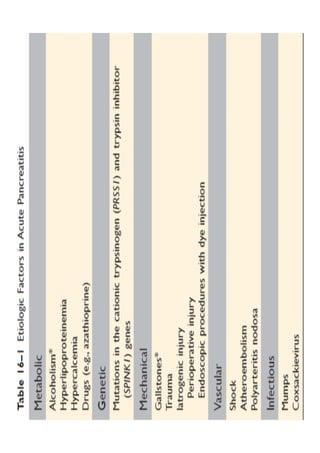
Acute Pancreatitis
• Can range from focal edema and fat necrosis to
widespread hemorrhagic parenchymal necrosis.
• Acute pancreatitis is relatively common
• Approximately 80% of cases are attributable to either
– Biliary tract disease
– Alcoholism
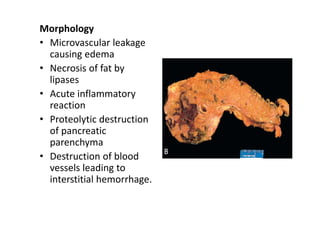
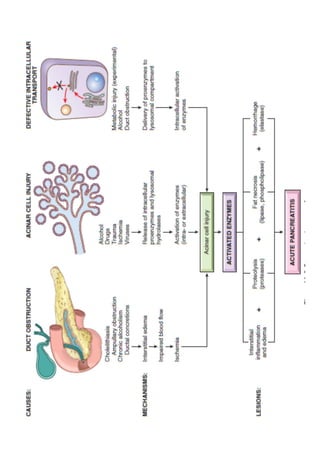
Morphology
• Microvascular leakage
causing edema
• Necrosis of fat by
lipases
• Acute inflammatory
reaction
• Proteolytic destruction
of pancreatic
parenchyma
• Destruction of blood
vessels leading to
interstitial hemorrhage.
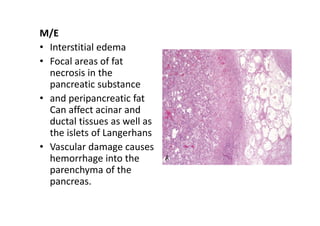
M/E
• Interstitial edema
• Focal areas of fat
necrosis in the
pancreatic substance
• and peripancreatic fat
Can affect acinar and
ductal tissues as well as
the islets of Langerhans
• Vascular damage causes
hemorrhage into the
parenchyma of the
pancreas.
Clinical Features
• Abdominal pain – mild to severe
– Constant and intense
– Often referred to the upper back
• Abdominal guarding
• Absence of bowel sounds
• Diagnosed by the presence of elevated plasma levels
of
– Amylase
– Lipase
– Exclusion of other causes of abdominal pain.
• Self limiting - 80% of cases acute pancreatitis
• Severe disease develop - 20%
• The manifestations of severe acute pancreatitis are
attributable to
– Systemic release of digestive enzymes
– Explosive activation of the inflammatory response.
• Patients may develop
– Disseminated intravascular coagulation
– Acute respiratory distress syndrome (due to alveolar
capillary injury)
– Diffuse fat necrosis.
– Peripheral vascular collapse (shock) – due to increased
microvascular permeability and hypovolemia with
endotoxemia (from breakdown of the barriers
between gastrointestinal flora and the bloodstream),
– Renal failure - due to acute tubular necrosis
Laboratory findings
• Markedly elevated serum amylase
• Rising serum lipase levels.
• Hypocalcemia - precipitation of calcium in areas of fat
necrosis
• CT/MRI – Enlarged inflamed pancreas
Treatment
• Supportive
– Maintaining blood pressure
– Alleviating pain
– “resting” the pancreas by total restriction of food and
fluids.
Complications
• Sterile or infected pancreatic “abscesses”
• Pancreatic pseudocysts.
Pancreatic Pseudocysts
• A common sequela of acute pancreatitis
• Liquefied areas of necrotic pancreatic tissue become
walled off by fibrous tissue to form a cystic space,
lacking an epithelial lining
• The cyst contents are rich in pancreatic enzymes
• Laboratory assessment of the cyst aspirate can be
diagnostic.
• Pseudocysts can
– Resolve spontaneously
– Become secondarily infected
– Compress/perforate into adjacent structures.
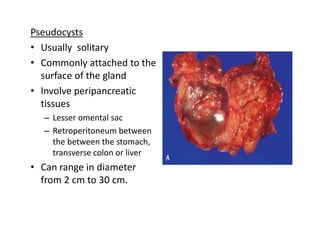
Pseudocysts
• Usually solitary
• Commonly attached to the
surface of the gland
• Involve peripancreatic
tissues
– Lesser omental sac
– Retroperitoneum between
the between the stomach,
transverse colon or liver
• Can range in diameter
from 2 cm to 30 cm.
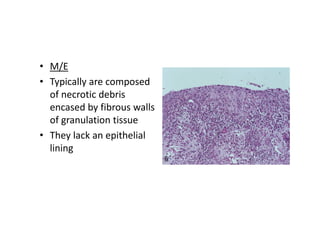
• M/E
• Typically are composed
of necrotic debris
encased by fibrous walls
of granulation tissue
• They lack an epithelial
lining
Chronic Pancreatitis
• Long-standing inflammation, fibrosis, and
destruction of the pancreas
• Irreversible impairment in pancreatic function
• The most common cause of chronic pancreatitis is
long-term alcohol abuse
• Other causes are
– Long-standing pancreatic duct obstruction - pseudocysts,
calculi, neoplasms, or pancreas divisum
– Genetic - Tropical pancreatitis
– Hereditary pancreatitis - mutations in the pancreatic
trypsinogen gene
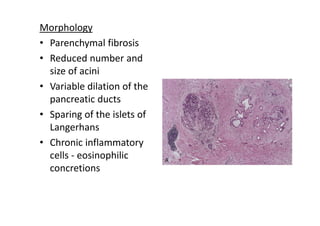
Morphology
• Parenchymal fibrosis
• Reduced number and
size of acini
• Variable dilation of the
pancreatic ducts
• Sparing of the islets of
Langerhans
• Chronic inflammatory
cells - eosinophilic
concretions
PATHOGENESIS
• Ductal obstruction by concretions.
• Toxic-metabolic.
Toxins/alcohol exert a direct toxic effect on acinar cells
↓
Lipid accumulation
Acinar cell loss
↓
Parenchymal fibrosis.
• Oxidative stress - generate free radicals in acinar cells,
leading to membrane damage, acinar cell necrosis,
inflammation, and fibrosis.
• Cytokines - induce the activation and proliferation of
periacinar myofibroblasts which deposit collagen
Clinical Features
• Repeated bouts of jaundice
• Vague indigestion
• Persistent or recurrent abdominal and back pain
• Weight loss
• Hypoalbuminemic edema
Attacks can be precipitated by
• Alcohol abuse
• Overeating
• Opiates or other drugs that increase the muscle tone
of the sphincter of Oddi.
Diagnosis
• Clinical suspicion.
• Mild/ no enzyme elevations
• CT/ USG - visualization of calcifications within the
pancreas
Complications
• Chronic malabsorption
• Severe chronic pain
• Pancreatic pseudocysts
• Pancreatic cancer.
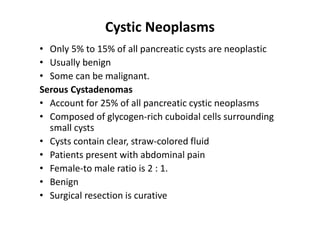
Cystic Neoplasms
• Only 5% to 15% of all pancreatic cysts are neoplastic
• Usually benign
• Some can be malignant.
Serous Cystadenomas
• Account for 25% of all pancreatic cystic neoplasms
• Composed of glycogen-rich cuboidal cells surrounding
small cysts
• Cysts contain clear, straw-colored fluid
• Patients present with abdominal pain
• Female-to male ratio is 2 : 1.
• Benign
• Surgical resection is curative
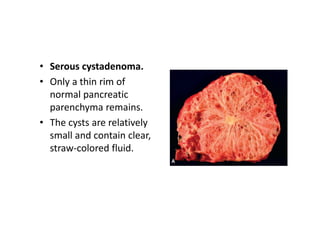
• Serous cystadenoma.
• Only a thin rim of
normal pancreatic
parenchyma remains.
• The cysts are relatively
small and contain clear,
straw-colored fluid.
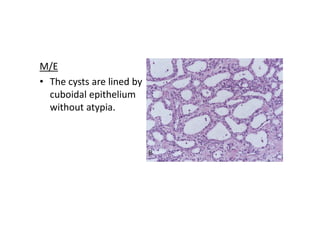
M/E
• The cysts are lined by
cuboidal epithelium
without atypia.
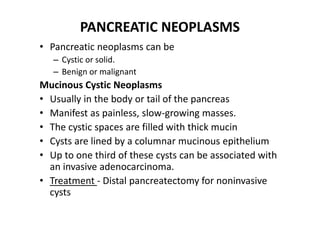
PANCREATIC NEOPLASMS
• Pancreatic neoplasms can be
– Cystic or solid.
– Benign or malignant
Mucinous Cystic Neoplasms
• Usually in the body or tail of the pancreas
• Manifest as painless, slow-growing masses.
• The cystic spaces are filled with thick mucin
• Cysts are lined by a columnar mucinous epithelium
• Up to one third of these cysts can be associated with
an invasive adenocarcinoma.
• Treatment - Distal pancreatectomy for noninvasive
cysts
Mucinous cystic neoplasm
• Mucinous multi-loculated cyst
• The cysts are large and filled with mucin.
M/E
• The cysts are lined by columnar mucinous epithelium
• They have a densely cellular “ovarian” stroma.
Intraductal Papillary Mucinous Neoplasms
• Mucin-producing intraductal neoplasms.
• More common in men
• More frequently involve the head of the pancreas.
• Various grades of dysplasia
• Associated with an invasive adenocarcinoma
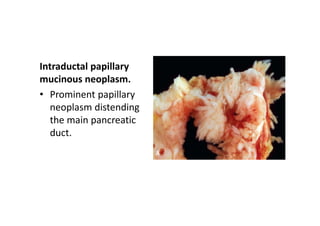
Intraductal papillary
mucinous neoplasm.
• Prominent papillary
neoplasm distending
the main pancreatic
duct.
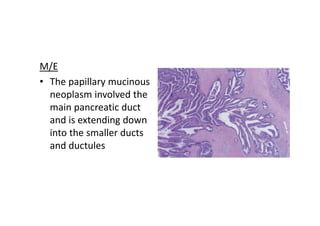
M/E
• The papillary mucinous
neoplasm involved the
main pancreatic duct
and is extending down
into the smaller ducts
and ductules
Pancreatic Carcinoma
• Infiltrating ductal adenocarcinoma of the pancreas
(“pancreatic cancer”) carries one of the highest
mortality rates.
PATHOGENESIS
• Inherited and acquired mutations in cancer-
associated genes.
• There is a progressive accumulation of genetic
changes in pancreatic epithelium as it proceeds from
non-neoplastic, to noninvasive to invasive carcinoma
• The most common lesions of pancreatic cancer arise
in small ducts and ductules, and are called pancreatic
intraepithelial neoplasias (PanINs).
• 60% - head
• 15% - body
• 5% - tail
• Remaining 20% - diffuse
• It is highly invasive
• It elicits an intense non-neoplastic host reaction
composed of fibroblasts, lymphocytes, and
extracellular matrix (desmoplastic response).
• Obstruction of common bile usually occurs in
carcinoma head pancreas - jaundice.
• Often extend through the retroperitoneal space,
entrapping adjacent nerves - pain
• Also invade the spleen, adrenals, vertebral column,
transverse colon, and stomach.
• Adjacent LNs are involved
• Liver often is enlarged due to metastatic deposits.
• Distant metastases may occur
– Lungs
– Bones.
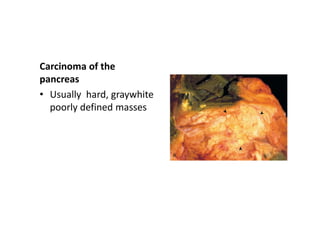
Carcinoma of the
pancreas
• Usually hard, graywhite
poorly defined masses
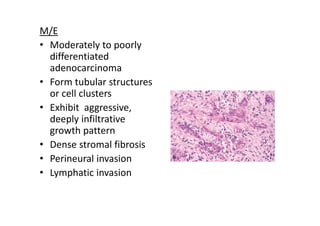
M/E
• Moderately to poorly
differentiated
adenocarcinoma
• Form tubular structures
or cell clusters
• Exhibit aggressive,
deeply infiltrative
growth pattern
• Dense stromal fibrosis
• Perineural invasion
• Lymphatic invasion
Clinical Features
• Typically remain silent until their extension impinges
on some other structure.
• Pain - first symptom
• Obstructive jaundice
• Weight loss, anorexia, and generalized malaise and
weakness
• Migratory thrombophlebitis (Trousseau syndrome)
occurs in about 10% of patients ( d/t platelet
aggregating factors and pro-coagulants from the
tumor or its necrotic products).
• The clinical course is rapidly progressive and brief.
• Less than 20% of pancreatic cancers are resectable at
the time of diagnosis.
• Early diagnosis is important - endoscopic USG, high-
resolution CT
Assignment
2 marks
• Name the hormones secreted by the pancreas
• Enzyme disturbance in pancreatitis (acute and chronic)
Long answer
• What are the causes of acute pancreatitis? Describe the
pathogenesis, pathological features (gross morphology,
cut section and M/E), clinical features and lab findings of
Acute pancreatitis.
• What are the causes of chronic pancreatitis? Describe
the pathogenesis, pathological features (gross
morphology, cut section and M/E), clinical features and
lab findings of chronic pancreatitis.
• Describe the pathogenesis, pathological features (gross
morphology, cut section and M/E), clinical features and
prognosis of pancreas carcinoma.

Pancreas.pdf pathology’s and diseases dysfunction

  • 1.
    Pancreas – I Exocrinepancreas Dr A Rapsang
  • 2.
    • The pancreashas – Endocrine functions – Exocrine function - major source of potent enzymes that are essential for digestion. • Retroperitoneal location of the pancreas - allow many pancreatic diseases to progress undiagnosed for a long time • The pancreas is a transversely oriented retroperitoneal organ extending from the duodenum to the hilum of the spleen. – Head – Body – Tail.
  • 3.
    • The pancreasgets its name from the Greek pankreas, meaning “all flesh,” • It is a lobulated organ with endocrine and exocrine elements. Endocrine portion • 1% to 2% of the pancreas • Composed of about 1 million islets of Langerhans • Secrete insulin, glucagon, and somatostatin. • Causes – Diabetes mellitus – Neoplasms
  • 4.
    Exocrine pancreas • Composedof – Acinar cells - produce the digestive enzymes – Ductules and ducts - convey them to the duodenum. – The epithelial cells lining the ducts - active participants in pancreatic secretion – The cuboidal cells lining the smaller ductules - secrete bicarbonate-rich fluid – The columnar cells lining the larger ducts - produce mucin.
  • 5.
    CONGENITAL ANOMALIES Agenesis • Pancreasis totally absent – very rare • Associated with additional severe malformations that are incompatible with life. Pancreas Divisum • Most common • Occurs when the duct systems of the fetal pancreas fail to fuse. • Main pancreatic duct drains only a small portion of the head of the gland • Has elevated intraductal pressures • Increased risk for chronic pancreatitis.
  • 6.
    • Annular Pancreas •Pancreatic fusion in which a ring of pancreatic tissue completely encircles the duodenum. • Present as duodenal obstruction - gastric distention and vomiting Ectopic Pancreas • Pancreas present in stomach, duodenum, jejunum, Meckel diverticulum, and ileum. • They are composed of normal pancreatic acini with occasional islets. • Usually asymptomatic • Can cause pain from localized inflammation, or cause mucosal bleeding.
  • 7.
    Congenital Cysts • Congenitalcysts result from anomalous development of the pancreatic ducts. • Generally are and range from microscopic to 5 cm in diameter. • They are lined by either uniform cuboidal or flattened epithelium and are enclosed in a thin, fibrous capsule. • These cysts contain clear serous fluid
  • 8.
    PANCREATITIS • Inflammatory disordersof the pancreas range in severity from mild, self-limited disease to life- threatening • Acute pancreatitis - function can return to normal if the underlying cause of inflammation is removed. • Chronic pancreatitis – irreversible destruction of exocrine pancreatic parenchyma.
  • 9.
    Acute Pancreatitis • Canrange from focal edema and fat necrosis to widespread hemorrhagic parenchymal necrosis. • Acute pancreatitis is relatively common • Approximately 80% of cases are attributable to either – Biliary tract disease – Alcoholism
  • 11.
    Morphology • Microvascular leakage causingedema • Necrosis of fat by lipases • Acute inflammatory reaction • Proteolytic destruction of pancreatic parenchyma • Destruction of blood vessels leading to interstitial hemorrhage.
  • 12.
    M/E • Interstitial edema •Focal areas of fat necrosis in the pancreatic substance • and peripancreatic fat Can affect acinar and ductal tissues as well as the islets of Langerhans • Vascular damage causes hemorrhage into the parenchyma of the pancreas.
  • 14.
    Clinical Features • Abdominalpain – mild to severe – Constant and intense – Often referred to the upper back • Abdominal guarding • Absence of bowel sounds • Diagnosed by the presence of elevated plasma levels of – Amylase – Lipase – Exclusion of other causes of abdominal pain. • Self limiting - 80% of cases acute pancreatitis • Severe disease develop - 20%
  • 15.
    • The manifestationsof severe acute pancreatitis are attributable to – Systemic release of digestive enzymes – Explosive activation of the inflammatory response. • Patients may develop – Disseminated intravascular coagulation – Acute respiratory distress syndrome (due to alveolar capillary injury) – Diffuse fat necrosis. – Peripheral vascular collapse (shock) – due to increased microvascular permeability and hypovolemia with endotoxemia (from breakdown of the barriers between gastrointestinal flora and the bloodstream), – Renal failure - due to acute tubular necrosis
  • 16.
    Laboratory findings • Markedlyelevated serum amylase • Rising serum lipase levels. • Hypocalcemia - precipitation of calcium in areas of fat necrosis • CT/MRI – Enlarged inflamed pancreas Treatment • Supportive – Maintaining blood pressure – Alleviating pain – “resting” the pancreas by total restriction of food and fluids. Complications • Sterile or infected pancreatic “abscesses” • Pancreatic pseudocysts.
  • 17.
    Pancreatic Pseudocysts • Acommon sequela of acute pancreatitis • Liquefied areas of necrotic pancreatic tissue become walled off by fibrous tissue to form a cystic space, lacking an epithelial lining • The cyst contents are rich in pancreatic enzymes • Laboratory assessment of the cyst aspirate can be diagnostic. • Pseudocysts can – Resolve spontaneously – Become secondarily infected – Compress/perforate into adjacent structures.
  • 18.
    Pseudocysts • Usually solitary •Commonly attached to the surface of the gland • Involve peripancreatic tissues – Lesser omental sac – Retroperitoneum between the between the stomach, transverse colon or liver • Can range in diameter from 2 cm to 30 cm.
  • 19.
    • M/E • Typicallyare composed of necrotic debris encased by fibrous walls of granulation tissue • They lack an epithelial lining
  • 20.
    Chronic Pancreatitis • Long-standinginflammation, fibrosis, and destruction of the pancreas • Irreversible impairment in pancreatic function • The most common cause of chronic pancreatitis is long-term alcohol abuse • Other causes are – Long-standing pancreatic duct obstruction - pseudocysts, calculi, neoplasms, or pancreas divisum – Genetic - Tropical pancreatitis – Hereditary pancreatitis - mutations in the pancreatic trypsinogen gene
  • 21.
    Morphology • Parenchymal fibrosis •Reduced number and size of acini • Variable dilation of the pancreatic ducts • Sparing of the islets of Langerhans • Chronic inflammatory cells - eosinophilic concretions
  • 22.
    PATHOGENESIS • Ductal obstructionby concretions. • Toxic-metabolic. Toxins/alcohol exert a direct toxic effect on acinar cells ↓ Lipid accumulation Acinar cell loss ↓ Parenchymal fibrosis. • Oxidative stress - generate free radicals in acinar cells, leading to membrane damage, acinar cell necrosis, inflammation, and fibrosis. • Cytokines - induce the activation and proliferation of periacinar myofibroblasts which deposit collagen
  • 23.
    Clinical Features • Repeatedbouts of jaundice • Vague indigestion • Persistent or recurrent abdominal and back pain • Weight loss • Hypoalbuminemic edema Attacks can be precipitated by • Alcohol abuse • Overeating • Opiates or other drugs that increase the muscle tone of the sphincter of Oddi.
  • 24.
    Diagnosis • Clinical suspicion. •Mild/ no enzyme elevations • CT/ USG - visualization of calcifications within the pancreas Complications • Chronic malabsorption • Severe chronic pain • Pancreatic pseudocysts • Pancreatic cancer.
  • 25.
    Cystic Neoplasms • Only5% to 15% of all pancreatic cysts are neoplastic • Usually benign • Some can be malignant. Serous Cystadenomas • Account for 25% of all pancreatic cystic neoplasms • Composed of glycogen-rich cuboidal cells surrounding small cysts • Cysts contain clear, straw-colored fluid • Patients present with abdominal pain • Female-to male ratio is 2 : 1. • Benign • Surgical resection is curative
  • 26.
    • Serous cystadenoma. •Only a thin rim of normal pancreatic parenchyma remains. • The cysts are relatively small and contain clear, straw-colored fluid.
  • 27.
    M/E • The cystsare lined by cuboidal epithelium without atypia.
  • 28.
    PANCREATIC NEOPLASMS • Pancreaticneoplasms can be – Cystic or solid. – Benign or malignant Mucinous Cystic Neoplasms • Usually in the body or tail of the pancreas • Manifest as painless, slow-growing masses. • The cystic spaces are filled with thick mucin • Cysts are lined by a columnar mucinous epithelium • Up to one third of these cysts can be associated with an invasive adenocarcinoma. • Treatment - Distal pancreatectomy for noninvasive cysts
  • 29.
    Mucinous cystic neoplasm •Mucinous multi-loculated cyst • The cysts are large and filled with mucin. M/E • The cysts are lined by columnar mucinous epithelium • They have a densely cellular “ovarian” stroma.
  • 30.
    Intraductal Papillary MucinousNeoplasms • Mucin-producing intraductal neoplasms. • More common in men • More frequently involve the head of the pancreas. • Various grades of dysplasia • Associated with an invasive adenocarcinoma
  • 31.
    Intraductal papillary mucinous neoplasm. •Prominent papillary neoplasm distending the main pancreatic duct.
  • 32.
    M/E • The papillarymucinous neoplasm involved the main pancreatic duct and is extending down into the smaller ducts and ductules
  • 33.
    Pancreatic Carcinoma • Infiltratingductal adenocarcinoma of the pancreas (“pancreatic cancer”) carries one of the highest mortality rates. PATHOGENESIS • Inherited and acquired mutations in cancer- associated genes. • There is a progressive accumulation of genetic changes in pancreatic epithelium as it proceeds from non-neoplastic, to noninvasive to invasive carcinoma • The most common lesions of pancreatic cancer arise in small ducts and ductules, and are called pancreatic intraepithelial neoplasias (PanINs).
  • 34.
    • 60% -head • 15% - body • 5% - tail • Remaining 20% - diffuse • It is highly invasive • It elicits an intense non-neoplastic host reaction composed of fibroblasts, lymphocytes, and extracellular matrix (desmoplastic response). • Obstruction of common bile usually occurs in carcinoma head pancreas - jaundice.
  • 35.
    • Often extendthrough the retroperitoneal space, entrapping adjacent nerves - pain • Also invade the spleen, adrenals, vertebral column, transverse colon, and stomach. • Adjacent LNs are involved • Liver often is enlarged due to metastatic deposits. • Distant metastases may occur – Lungs – Bones.
  • 36.
    Carcinoma of the pancreas •Usually hard, graywhite poorly defined masses
  • 37.
    M/E • Moderately topoorly differentiated adenocarcinoma • Form tubular structures or cell clusters • Exhibit aggressive, deeply infiltrative growth pattern • Dense stromal fibrosis • Perineural invasion • Lymphatic invasion
  • 38.
    Clinical Features • Typicallyremain silent until their extension impinges on some other structure. • Pain - first symptom • Obstructive jaundice • Weight loss, anorexia, and generalized malaise and weakness • Migratory thrombophlebitis (Trousseau syndrome) occurs in about 10% of patients ( d/t platelet aggregating factors and pro-coagulants from the tumor or its necrotic products).
  • 39.
    • The clinicalcourse is rapidly progressive and brief. • Less than 20% of pancreatic cancers are resectable at the time of diagnosis. • Early diagnosis is important - endoscopic USG, high- resolution CT
  • 40.
    Assignment 2 marks • Namethe hormones secreted by the pancreas • Enzyme disturbance in pancreatitis (acute and chronic) Long answer • What are the causes of acute pancreatitis? Describe the pathogenesis, pathological features (gross morphology, cut section and M/E), clinical features and lab findings of Acute pancreatitis. • What are the causes of chronic pancreatitis? Describe the pathogenesis, pathological features (gross morphology, cut section and M/E), clinical features and lab findings of chronic pancreatitis. • Describe the pathogenesis, pathological features (gross morphology, cut section and M/E), clinical features and prognosis of pancreas carcinoma.