Pakistan: Importing 
America’s Federalism? 
Asif Saeed Memon 
September 25, 2014 
Atlantic Council
Constitutional History of Pakistan 
 Dominion 
 Government of India Act (1935) 
 Constituent Assembly as legislature 
 CA dominated by Muslim League and increasingly perceived as 
unrepresentative 
 Loose federal structure including 5 provinces and some princely states 
until “One Unit” declared in 1954 
 De facto power becomes increasingly concentrated in the office of 
Governor General
Constitutional History of Pakistan 
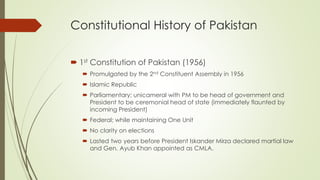
 1st Constitution of Pakistan (1956) 
 Promulgated by the 2nd Constituent Assembly in 1956 
 Islamic Republic 
 Parliamentary; unicameral with PM to be head of government and 
President to be ceremonial head of state (immediately flaunted by 
incoming President) 
 Federal; while maintaining One Unit 
 No clarity on elections 
 Lasted two years before President Iskander Mirza declared martial law 
and Gen. Ayub Khan appointed as CMLA.
Constitutional History of Pakistan 
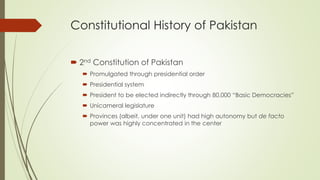
 2nd Constitution of Pakistan 
 Promulgated through presidential order 
 Presidential system 
 President to be elected indirectly through 80,000 “Basic Democracies” 
 Unicameral legislature 
 Provinces (albeit, under one unit) had high autonomy but de facto 
power was highly concentrated in the center
Constitutional History of Pakistan 
 3rd Constitution of Pakistan (1973) 
 Promulgated by elected assembly (West Pakistan) 
 Parliamentary 
 Bicameral legislature 
 Federal with 4 provinces 
 Responsibilities split with a number of them split between center and 
provinces: federal, provincial and concurrent List 
 Council of Common Interests 
 National Finance Commission
Federalism in Pakistan up to 2009 
 Provincial autonomy was undermined through the 
following: 
 One Unit successfully undermined the provincial autonomy of the four 
Western provinces, especially the smaller three 
 Military rule 
 Federal control over revenue generation and lopsided distribution 
through the NFC 
 Federal control over policymaking through the concurrent list 
 Capacity issues of provincial governments
Pakistan’s federalism transformed (2009 
– 2010) 
 Transition from 3rd Military era began with elections in 2008 
 Two major legislative victories in NFC award: (2009) and the 
Eighteenth Constitutional Amendment (2010) have 
transformed the policy landscape. 
 Greater share of provinces in state revenue 
 Abolishing of the Concurrent List 
 Devolution of major policy areas to provinces
The current discourse about federalism 
 The re-centralization demand 
 Devolution is failing due to: 
 Capacity issues at the provincial level 
 Policy divergence between the provinces is a threat to national coordination 
(in some more alarmist terms a threat to national cohesion) 
 Local government: Devolution interrupted? 
 Devolution did not go far enough and powers need to be devolved 
down to local government because: 
 Provincial politics are just as corrupt as national politics 
 Greater accountability can be achieved at the district level
The situation today 
 Capacity Problems at Provincial Level 
 Floods, Fake medicine incident, curriculum development 
 Issues of coordination and international liaison 
 Political fragmentation across provinces (each province 
has a different political party in power) in 2013
The situation today 
 At the same time public discourse has not caught up with the 
changed situation. 
 A recipe for center vs. province battles as well as for legal 
challenges 
 Increasing popularity of National Social Policy making 
Benazir Income Support Programme (BISP) 
 Current administration’s floating of a National Health 
Insurance scheme
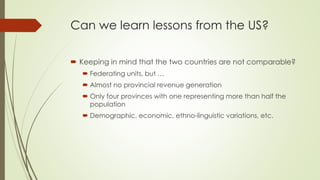
Can we learn lessons from the US? 
 Keeping in mind that the two countries are not comparable? 
 Federating units, but … 
 Almost no provincial revenue generation 
 Only four provinces with one representing more than half the 
population 
 Demographic, economic, ethno-linguistic variations, etc.
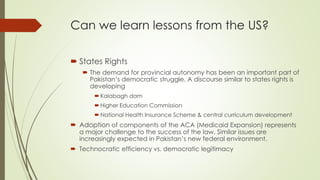
Can we learn lessons from the US? 
 States Rights 
 The demand for provincial autonomy has been an important part of 
Pakistan’s democratic struggle. A discourse similar to states rights is 
developing 
 Kalabagh dam 
 Higher Education Commission 
 National Health Insurance Scheme & central curriculum development 
 Adoption of components of the ACA (Medicaid Expansion) represents 
a major challenge to the success of the law. Similar issues are 
increasingly expected in Pakistan’s new federal environment. 
 Technocratic efficiency vs. democratic legitimacy
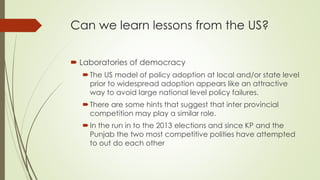
Can we learn lessons from the US? 
 Laboratories of democracy 
 The US model of policy adoption at local and/or state level 
prior to widespread adoption appears like an attractive 
way to avoid large national level policy failures. 
 There are some hints that suggest that inter provincial 
competition may play a similar role. 
 In the run in to the 2013 elections and since KP and the 
Punjab the two most competitive polities have attempted 
to out do each other
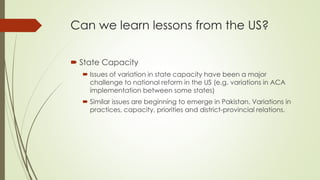
Can we learn lessons from the US? 
 State Capacity 
 Issues of variation in state capacity have been a major 
challenge to national reform in the US (e.g. variations in ACA 
implementation between some states) 
 Similar issues are beginning to emerge in Pakistan. Variations in 
practices, capacity, priorities and district-provincial relations.
Can we learn lessons from the US? 
 Accountability & the importance of local governance 
 10,000 democracies (Berkman) 
 Ideological opposition to ACA at the state level and practical 
buy-in at the local level 
 The debate over LG in Pakistan is an outstanding issue and is 
being battled over in each of the 4 provinces
Can we learn lessons from the US? 
 Regulatory frameworks & Inter state coordination 
Unlike the US most regulatory law exists at the federal level 
(insurance, banking, etc.) 
 There are major holes in the existing regulatory frameworks 
(e.g. there is almost no regulation of private schools and 
hospitals) 
Reciprocity between states/provinces (medical licenses, 
insurance coverage, etc.)
Can we learn lessons from the US? 
 Checks & Balances 
 At the federal level 
Senate able to block unpopular legislation 
Increased role of judiciary. 
Vertical 
Provinces better able to block federal over reach 
 Radical reforms become harder. Incrementalism and marginal 
changes become more likely. (e.g. Public Option under the ACA)
Preliminary Conclusions 
 As Pakistan’s federalism continues to evolve and the loci of policy 
making and implementation move away from Islamabad, it has 
become imperative to explore the policy framework establishing 
alternatives available to the country and its constituent provinces. 
 While it is true that no two countries are alike, it is still important to 
examine federal structures and policymaking within those structures 
to derive lessons for Pakistan. 
 There are lessons to be drawn from Brazil, Canada, Germany, India, 
Malaysia, the United States and Venezuela.
Preliminary Conclusions 
 The United States provides an interesting example for exploration 
 The Affordable Care Act (legislation and implementation) along 
with previous social sector reforms like SSA (1965), SCHIP (1997), 
NCLB (2001) and the MMA (2003) provides important lessons in how 
the large social sector reforms can be legislated and implemented 
within a federal system based on state autonomy. 
 Most respondents, however, argued that the challenges faced by 
the ACA legislation and implementation are more a function of the 
prevalent political culture/mood/zeitgeist as opposed to the 
specifics of American federalism. 
 A period of pessimism about American federalism.

Pakistan importing america’s_federalism

  • 1.
    Pakistan: Importing America’sFederalism? Asif Saeed Memon September 25, 2014 Atlantic Council
  • 2.
    Constitutional History ofPakistan  Dominion  Government of India Act (1935)  Constituent Assembly as legislature  CA dominated by Muslim League and increasingly perceived as unrepresentative  Loose federal structure including 5 provinces and some princely states until “One Unit” declared in 1954  De facto power becomes increasingly concentrated in the office of Governor General
  • 3.
    Constitutional History ofPakistan  1st Constitution of Pakistan (1956)  Promulgated by the 2nd Constituent Assembly in 1956  Islamic Republic  Parliamentary; unicameral with PM to be head of government and President to be ceremonial head of state (immediately flaunted by incoming President)  Federal; while maintaining One Unit  No clarity on elections  Lasted two years before President Iskander Mirza declared martial law and Gen. Ayub Khan appointed as CMLA.
  • 4.
    Constitutional History ofPakistan  2nd Constitution of Pakistan  Promulgated through presidential order  Presidential system  President to be elected indirectly through 80,000 “Basic Democracies”  Unicameral legislature  Provinces (albeit, under one unit) had high autonomy but de facto power was highly concentrated in the center
  • 5.
    Constitutional History ofPakistan  3rd Constitution of Pakistan (1973)  Promulgated by elected assembly (West Pakistan)  Parliamentary  Bicameral legislature  Federal with 4 provinces  Responsibilities split with a number of them split between center and provinces: federal, provincial and concurrent List  Council of Common Interests  National Finance Commission
  • 6.
    Federalism in Pakistanup to 2009  Provincial autonomy was undermined through the following:  One Unit successfully undermined the provincial autonomy of the four Western provinces, especially the smaller three  Military rule  Federal control over revenue generation and lopsided distribution through the NFC  Federal control over policymaking through the concurrent list  Capacity issues of provincial governments
  • 7.
    Pakistan’s federalism transformed(2009 – 2010)  Transition from 3rd Military era began with elections in 2008  Two major legislative victories in NFC award: (2009) and the Eighteenth Constitutional Amendment (2010) have transformed the policy landscape.  Greater share of provinces in state revenue  Abolishing of the Concurrent List  Devolution of major policy areas to provinces
  • 8.
    The current discourseabout federalism  The re-centralization demand  Devolution is failing due to:  Capacity issues at the provincial level  Policy divergence between the provinces is a threat to national coordination (in some more alarmist terms a threat to national cohesion)  Local government: Devolution interrupted?  Devolution did not go far enough and powers need to be devolved down to local government because:  Provincial politics are just as corrupt as national politics  Greater accountability can be achieved at the district level
  • 9.
    The situation today  Capacity Problems at Provincial Level  Floods, Fake medicine incident, curriculum development  Issues of coordination and international liaison  Political fragmentation across provinces (each province has a different political party in power) in 2013
  • 10.
    The situation today  At the same time public discourse has not caught up with the changed situation.  A recipe for center vs. province battles as well as for legal challenges  Increasing popularity of National Social Policy making Benazir Income Support Programme (BISP)  Current administration’s floating of a National Health Insurance scheme
  • 11.
    Can we learnlessons from the US?  Keeping in mind that the two countries are not comparable?  Federating units, but …  Almost no provincial revenue generation  Only four provinces with one representing more than half the population  Demographic, economic, ethno-linguistic variations, etc.
  • 12.
    Can we learnlessons from the US?  States Rights  The demand for provincial autonomy has been an important part of Pakistan’s democratic struggle. A discourse similar to states rights is developing  Kalabagh dam  Higher Education Commission  National Health Insurance Scheme & central curriculum development  Adoption of components of the ACA (Medicaid Expansion) represents a major challenge to the success of the law. Similar issues are increasingly expected in Pakistan’s new federal environment.  Technocratic efficiency vs. democratic legitimacy
  • 13.
    Can we learnlessons from the US?  Laboratories of democracy  The US model of policy adoption at local and/or state level prior to widespread adoption appears like an attractive way to avoid large national level policy failures.  There are some hints that suggest that inter provincial competition may play a similar role.  In the run in to the 2013 elections and since KP and the Punjab the two most competitive polities have attempted to out do each other
  • 14.
    Can we learnlessons from the US?  State Capacity  Issues of variation in state capacity have been a major challenge to national reform in the US (e.g. variations in ACA implementation between some states)  Similar issues are beginning to emerge in Pakistan. Variations in practices, capacity, priorities and district-provincial relations.
  • 15.
    Can we learnlessons from the US?  Accountability & the importance of local governance  10,000 democracies (Berkman)  Ideological opposition to ACA at the state level and practical buy-in at the local level  The debate over LG in Pakistan is an outstanding issue and is being battled over in each of the 4 provinces
  • 16.
    Can we learnlessons from the US?  Regulatory frameworks & Inter state coordination Unlike the US most regulatory law exists at the federal level (insurance, banking, etc.)  There are major holes in the existing regulatory frameworks (e.g. there is almost no regulation of private schools and hospitals) Reciprocity between states/provinces (medical licenses, insurance coverage, etc.)
  • 17.
    Can we learnlessons from the US?  Checks & Balances  At the federal level Senate able to block unpopular legislation Increased role of judiciary. Vertical Provinces better able to block federal over reach  Radical reforms become harder. Incrementalism and marginal changes become more likely. (e.g. Public Option under the ACA)
  • 18.
    Preliminary Conclusions As Pakistan’s federalism continues to evolve and the loci of policy making and implementation move away from Islamabad, it has become imperative to explore the policy framework establishing alternatives available to the country and its constituent provinces.  While it is true that no two countries are alike, it is still important to examine federal structures and policymaking within those structures to derive lessons for Pakistan.  There are lessons to be drawn from Brazil, Canada, Germany, India, Malaysia, the United States and Venezuela.
  • 19.
    Preliminary Conclusions The United States provides an interesting example for exploration  The Affordable Care Act (legislation and implementation) along with previous social sector reforms like SSA (1965), SCHIP (1997), NCLB (2001) and the MMA (2003) provides important lessons in how the large social sector reforms can be legislated and implemented within a federal system based on state autonomy.  Most respondents, however, argued that the challenges faced by the ACA legislation and implementation are more a function of the prevalent political culture/mood/zeitgeist as opposed to the specifics of American federalism.  A period of pessimism about American federalism.