Silberschatz, Galvin and Gagne ©2018
Operating System Concepts – 10th Edition
Page Replacement
Algorithms
10.2 Silberschatz, Galvin and Gagne ©2018
Operating System Concepts – 10th Edition
What Happens if There is no Free Frame?
 Issues and Policies:
 What if all frames are used up by process pages?
 What if there is a demand from the kernel, I/O buffers, etc.
 How much to allocate to each process (what is the min and max)?
 Page Replacement
 Find some page in memory, but not really in use, page it out
 If no frame is free, we find one that is not currently being used and free it
 Algorithm – terminate? swap out? replace the page?
 Performance – want an algorithm which will result in minimum number of page faults
 What if the same page may be brought into memory several times
 Prevent over-allocation of memory
 by modifying page-fault service routine to include page replacement
 Use modify (dirty) bit to reduce overhead of page transfers –
– only modified pages are written to disk
 Page replacement completes separation between logical memory and physical memory
– large virtual memory can be provided on a smaller physical memory
10.3 Silberschatz, Galvin and Gagne ©2018
Operating System Concepts – 10th Edition
Need For Page Replacement
10.4 Silberschatz, Galvin and Gagne ©2018
Operating System Concepts – 10th Edition
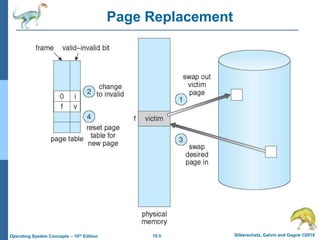
Basic Page Replacement
1. Find the location of the desired page on disk
2. Find a free frame:
 If there is a free frame, use it
 If there is no free frame, use a page replacement algorithm to select a
victim frame
 Write victim frame to disk if dirty
3. Bring the desired page into the (newly) free frame; update the page and
frame tables
4. Continue the process by restarting the instruction that caused the trap
 Note:
 Potentially 2 page transfers for page fault
 increasing EAT
10.5 Silberschatz, Galvin and Gagne ©2018
Operating System Concepts – 10th Edition
Page Replacement
10.6 Silberschatz, Galvin and Gagne ©2018
Operating System Concepts – 10th Edition
Page and Frame Replacement Algorithms
 Frame-Allocation Algorithm determines
 How many frames to give each process
 Which frames to replace
 Page-Replacement Algorithm
 Want lowest page-fault rate on both first access and re-access
 Evaluate algorithm by running it on a particular string of memory references
(reference string) and computing the number of page faults on that string
 String is just page numbers, not full addresses
 Repeated access to the same page does not cause a page fault
 Results depend on number of frames available
 In all our examples, the reference string of referenced page numbers is
7,0,1,2,0,3,0,4,2,3,0,3,0,3,2,1,2,0,1,7,0,1
10.7 Silberschatz, Galvin and Gagne ©2018
Operating System Concepts – 10th Edition
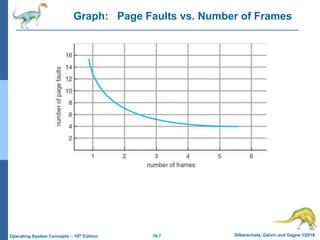
Graph: Page Faults vs. Number of Frames
10.8 Silberschatz, Galvin and Gagne ©2018
Operating System Concepts – 10th Edition
First-In-First-Out (FIFO) Algorithm
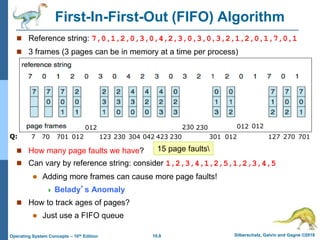
 Reference string: 7,0,1,2,0,3,0,4,2,3,0,3,0,3,2,1,2,0,1,7,0,1
 3 frames (3 pages can be in memory at a time per process)
 How many page faults we have?
 Can vary by reference string: consider 1,2,3,4,1,2,5,1,2,3,4,5
 Adding more frames can cause more page faults!
 Belady’s Anomaly
 How to track ages of pages?
 Just use a FIFO queue
15 page faults
7 70 701 012
012
123 230 304 042 423 230
230 230
301 012
012 012
127 270 701
Q:
10.9 Silberschatz, Galvin and Gagne ©2018
Operating System Concepts – 10th Edition
FIFO Illustrating Belady’s Anomaly
10.10 Silberschatz, Galvin and Gagne ©2018
Operating System Concepts – 10th Edition
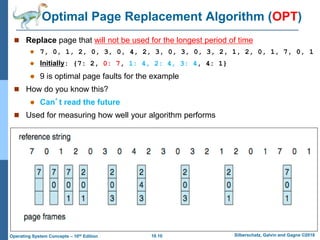
Optimal Page Replacement Algorithm (OPT)
 Replace page that will not be used for the longest period of time
 7, 0, 1, 2, 0, 3, 0, 4, 2, 3, 0, 3, 0, 3, 2, 1, 2, 0, 1, 7, 0, 1
 Initially: {7: 2, 0: 7, 1: 4, 2: 4, 3: 4, 4: 1}
 9 is optimal page faults for the example
 How do you know this?
 Can’t read the future
 Used for measuring how well your algorithm performs
10.11 Silberschatz, Galvin and Gagne ©2018
Operating System Concepts – 10th Edition
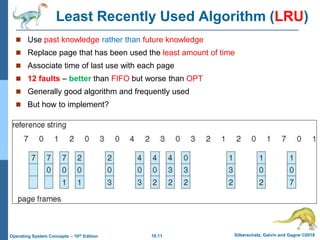
Least Recently Used Algorithm (LRU)
 Use past knowledge rather than future knowledge
 Replace page that has been used the least amount of time
 Associate time of last use with each page
 12 faults – better than FIFO but worse than OPT
 Generally good algorithm and frequently used
 But how to implement?
10.12 Silberschatz, Galvin and Gagne ©2018
Operating System Concepts – 10th Edition
LRU Algorithm (Cont.)
 Counter implementation
 Every page entry has a counter; every time page is referenced through this
entry, copy the clock into the counter
 When a page needs to be replaced, look at the counters to find smallest value
 Search through table needed (Bad)
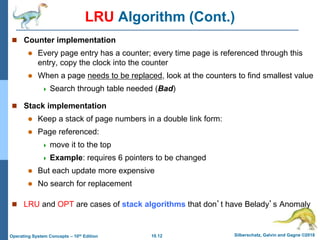
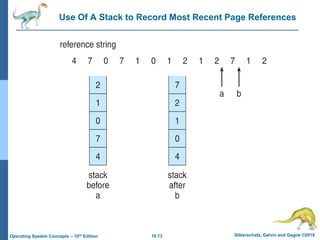
 Stack implementation
 Keep a stack of page numbers in a double link form:
 Page referenced:
 move it to the top
 Example: requires 6 pointers to be changed
 But each update more expensive
 No search for replacement
 LRU and OPT are cases of stack algorithms that don’t have Belady’s Anomaly
10.13 Silberschatz, Galvin and Gagne ©2018
Operating System Concepts – 10th Edition
Use Of A Stack to Record Most Recent Page References
10.14 Silberschatz, Galvin and Gagne ©2018
Operating System Concepts – 10th Edition
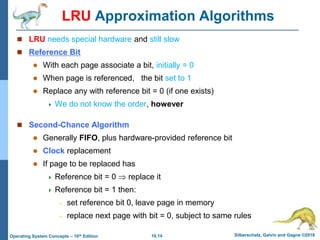
LRU Approximation Algorithms
 LRU needs special hardware and still slow
 Reference Bit
 With each page associate a bit, initially = 0
 When page is referenced, the bit set to 1
 Replace any with reference bit = 0 (if one exists)
 We do not know the order, however
 Second-Chance Algorithm
 Generally FIFO, plus hardware-provided reference bit
 Clock replacement
 If page to be replaced has
 Reference bit = 0  replace it
 Reference bit = 1 then:
– set reference bit 0, leave page in memory
– replace next page with bit = 0, subject to same rules
10.15 Silberschatz, Galvin and Gagne ©2018
Operating System Concepts – 10th Edition
Second-Chance (clock) Page-Replacement Algorithm
10.16 Silberschatz, Galvin and Gagne ©2018
Operating System Concepts – 10th Edition
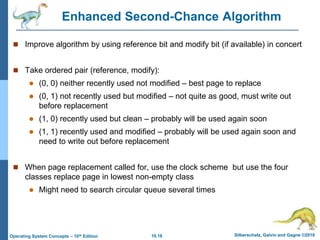
Enhanced Second-Chance Algorithm
 Improve algorithm by using reference bit and modify bit (if available) in concert
 Take ordered pair (reference, modify):
 (0, 0) neither recently used not modified – best page to replace
 (0, 1) not recently used but modified – not quite as good, must write out
before replacement
 (1, 0) recently used but clean – probably will be used again soon
 (1, 1) recently used and modified – probably will be used again soon and
need to write out before replacement
 When page replacement called for, use the clock scheme but use the four
classes replace page in lowest non-empty class
 Might need to search circular queue several times
10.17 Silberschatz, Galvin and Gagne ©2018
Operating System Concepts – 10th Edition
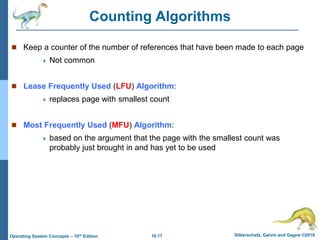
Counting Algorithms
 Keep a counter of the number of references that have been made to each page
 Not common
 Lease Frequently Used (LFU) Algorithm:
 replaces page with smallest count
 Most Frequently Used (MFU) Algorithm:
 based on the argument that the page with the smallest count was
probably just brought in and has yet to be used
10.18 Silberschatz, Galvin and Gagne ©2018
Operating System Concepts – 10th Edition
Page-Buffering Algorithms
 Keep a pool of free frames, always
 Then frame available when needed, not found at fault time
 Read page into free frame and select victim to evict and add to free pool
 When convenient, evict victim
 Possibly, keep list of modified pages
 When backing store otherwise idle, write pages there and set to non-dirty
 Possibly, keep free frame contents intact and note what is in them
 If referenced again before reused, no need to load contents again from
disk
 Generally useful to reduce penalty if wrong victim frame selected
10.19 Silberschatz, Galvin and Gagne ©2018
Operating System Concepts – 10th Edition
Applications and Page Replacement
 All of these algorithms have OS guessing about future page access
 Some applications have better knowledge – i.e. databases
 Memory intensive applications can cause double buffering
 OS keeps copy of page in memory as I/O buffer
 Application keeps page in memory for its own work
 Operating system can given direct access to the disk, getting out of the way
of the applications
 Raw disk mode
 Bypasses buffering, locking, etc.

Page Replacement Algorithms.pptx

  • 1.
    Silberschatz, Galvin andGagne ©2018 Operating System Concepts – 10th Edition Page Replacement Algorithms
  • 2.
    10.2 Silberschatz, Galvinand Gagne ©2018 Operating System Concepts – 10th Edition What Happens if There is no Free Frame?  Issues and Policies:  What if all frames are used up by process pages?  What if there is a demand from the kernel, I/O buffers, etc.  How much to allocate to each process (what is the min and max)?  Page Replacement  Find some page in memory, but not really in use, page it out  If no frame is free, we find one that is not currently being used and free it  Algorithm – terminate? swap out? replace the page?  Performance – want an algorithm which will result in minimum number of page faults  What if the same page may be brought into memory several times  Prevent over-allocation of memory  by modifying page-fault service routine to include page replacement  Use modify (dirty) bit to reduce overhead of page transfers – – only modified pages are written to disk  Page replacement completes separation between logical memory and physical memory – large virtual memory can be provided on a smaller physical memory
  • 3.
    10.3 Silberschatz, Galvinand Gagne ©2018 Operating System Concepts – 10th Edition Need For Page Replacement
  • 4.
    10.4 Silberschatz, Galvinand Gagne ©2018 Operating System Concepts – 10th Edition Basic Page Replacement 1. Find the location of the desired page on disk 2. Find a free frame:  If there is a free frame, use it  If there is no free frame, use a page replacement algorithm to select a victim frame  Write victim frame to disk if dirty 3. Bring the desired page into the (newly) free frame; update the page and frame tables 4. Continue the process by restarting the instruction that caused the trap  Note:  Potentially 2 page transfers for page fault  increasing EAT
  • 5.
    10.5 Silberschatz, Galvinand Gagne ©2018 Operating System Concepts – 10th Edition Page Replacement
  • 6.
    10.6 Silberschatz, Galvinand Gagne ©2018 Operating System Concepts – 10th Edition Page and Frame Replacement Algorithms  Frame-Allocation Algorithm determines  How many frames to give each process  Which frames to replace  Page-Replacement Algorithm  Want lowest page-fault rate on both first access and re-access  Evaluate algorithm by running it on a particular string of memory references (reference string) and computing the number of page faults on that string  String is just page numbers, not full addresses  Repeated access to the same page does not cause a page fault  Results depend on number of frames available  In all our examples, the reference string of referenced page numbers is 7,0,1,2,0,3,0,4,2,3,0,3,0,3,2,1,2,0,1,7,0,1
  • 7.
    10.7 Silberschatz, Galvinand Gagne ©2018 Operating System Concepts – 10th Edition Graph: Page Faults vs. Number of Frames
  • 8.
    10.8 Silberschatz, Galvinand Gagne ©2018 Operating System Concepts – 10th Edition First-In-First-Out (FIFO) Algorithm  Reference string: 7,0,1,2,0,3,0,4,2,3,0,3,0,3,2,1,2,0,1,7,0,1  3 frames (3 pages can be in memory at a time per process)  How many page faults we have?  Can vary by reference string: consider 1,2,3,4,1,2,5,1,2,3,4,5  Adding more frames can cause more page faults!  Belady’s Anomaly  How to track ages of pages?  Just use a FIFO queue 15 page faults 7 70 701 012 012 123 230 304 042 423 230 230 230 301 012 012 012 127 270 701 Q:
  • 9.
    10.9 Silberschatz, Galvinand Gagne ©2018 Operating System Concepts – 10th Edition FIFO Illustrating Belady’s Anomaly
  • 10.
    10.10 Silberschatz, Galvinand Gagne ©2018 Operating System Concepts – 10th Edition Optimal Page Replacement Algorithm (OPT)  Replace page that will not be used for the longest period of time  7, 0, 1, 2, 0, 3, 0, 4, 2, 3, 0, 3, 0, 3, 2, 1, 2, 0, 1, 7, 0, 1  Initially: {7: 2, 0: 7, 1: 4, 2: 4, 3: 4, 4: 1}  9 is optimal page faults for the example  How do you know this?  Can’t read the future  Used for measuring how well your algorithm performs
  • 11.
    10.11 Silberschatz, Galvinand Gagne ©2018 Operating System Concepts – 10th Edition Least Recently Used Algorithm (LRU)  Use past knowledge rather than future knowledge  Replace page that has been used the least amount of time  Associate time of last use with each page  12 faults – better than FIFO but worse than OPT  Generally good algorithm and frequently used  But how to implement?
  • 12.
    10.12 Silberschatz, Galvinand Gagne ©2018 Operating System Concepts – 10th Edition LRU Algorithm (Cont.)  Counter implementation  Every page entry has a counter; every time page is referenced through this entry, copy the clock into the counter  When a page needs to be replaced, look at the counters to find smallest value  Search through table needed (Bad)  Stack implementation  Keep a stack of page numbers in a double link form:  Page referenced:  move it to the top  Example: requires 6 pointers to be changed  But each update more expensive  No search for replacement  LRU and OPT are cases of stack algorithms that don’t have Belady’s Anomaly
  • 13.
    10.13 Silberschatz, Galvinand Gagne ©2018 Operating System Concepts – 10th Edition Use Of A Stack to Record Most Recent Page References
  • 14.
    10.14 Silberschatz, Galvinand Gagne ©2018 Operating System Concepts – 10th Edition LRU Approximation Algorithms  LRU needs special hardware and still slow  Reference Bit  With each page associate a bit, initially = 0  When page is referenced, the bit set to 1  Replace any with reference bit = 0 (if one exists)  We do not know the order, however  Second-Chance Algorithm  Generally FIFO, plus hardware-provided reference bit  Clock replacement  If page to be replaced has  Reference bit = 0  replace it  Reference bit = 1 then: – set reference bit 0, leave page in memory – replace next page with bit = 0, subject to same rules
  • 15.
    10.15 Silberschatz, Galvinand Gagne ©2018 Operating System Concepts – 10th Edition Second-Chance (clock) Page-Replacement Algorithm
  • 16.
    10.16 Silberschatz, Galvinand Gagne ©2018 Operating System Concepts – 10th Edition Enhanced Second-Chance Algorithm  Improve algorithm by using reference bit and modify bit (if available) in concert  Take ordered pair (reference, modify):  (0, 0) neither recently used not modified – best page to replace  (0, 1) not recently used but modified – not quite as good, must write out before replacement  (1, 0) recently used but clean – probably will be used again soon  (1, 1) recently used and modified – probably will be used again soon and need to write out before replacement  When page replacement called for, use the clock scheme but use the four classes replace page in lowest non-empty class  Might need to search circular queue several times
  • 17.
    10.17 Silberschatz, Galvinand Gagne ©2018 Operating System Concepts – 10th Edition Counting Algorithms  Keep a counter of the number of references that have been made to each page  Not common  Lease Frequently Used (LFU) Algorithm:  replaces page with smallest count  Most Frequently Used (MFU) Algorithm:  based on the argument that the page with the smallest count was probably just brought in and has yet to be used
  • 18.
    10.18 Silberschatz, Galvinand Gagne ©2018 Operating System Concepts – 10th Edition Page-Buffering Algorithms  Keep a pool of free frames, always  Then frame available when needed, not found at fault time  Read page into free frame and select victim to evict and add to free pool  When convenient, evict victim  Possibly, keep list of modified pages  When backing store otherwise idle, write pages there and set to non-dirty  Possibly, keep free frame contents intact and note what is in them  If referenced again before reused, no need to load contents again from disk  Generally useful to reduce penalty if wrong victim frame selected
  • 19.
    10.19 Silberschatz, Galvinand Gagne ©2018 Operating System Concepts – 10th Edition Applications and Page Replacement  All of these algorithms have OS guessing about future page access  Some applications have better knowledge – i.e. databases  Memory intensive applications can cause double buffering  OS keeps copy of page in memory as I/O buffer  Application keeps page in memory for its own work  Operating system can given direct access to the disk, getting out of the way of the applications  Raw disk mode  Bypasses buffering, locking, etc.