M. Tech Communication Systems 2022
Advanced Software Defined Radio Laboratory Page 60
M. Tech Communication Systems 2022
Advanced Software Defined Radio Laboratory Page 61
Lab 8 Frame Detection ad Frequency Offset Correction
Objective
 Implement a particular method for frequency offset correction, called the Moose algorithm, and a
method for frame detection based on correlation. Also study the performance of the frequency offset
correction and frame detection algorithms by embedding within the synchronization block of the
receiver
Requirements
 LabVIEW Software
 Modulation Toolkit
 Advanced signal processing Toolkit
 USRP 2922 (TX/RX)-Full Duplex
Theory
Up to this point we have assumed that a training sequence has been provided at both the transmitter and
receiver. Not all training sequences are created equal. Without a good training sequence, the estimation
techniques in the labs would perform poorly. This section discusses some desirable properties of training
sequences and introduces one family of sequences known as Barker codes. Many other sequences are used in
research literature and in commercial wireless systems as well (e.g., Frank sequences, Zadoff-Chu sequences, or
Gold sequences).
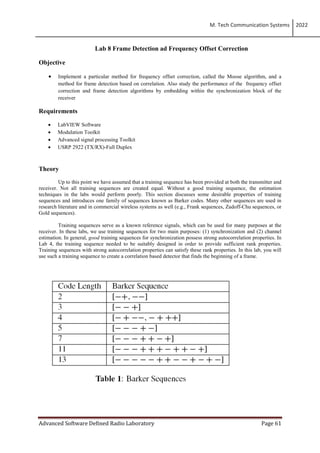
Training sequences serve as a known reference signals, which can be used for many purposes at the
receiver. In these labs, we use training sequences for two main purposes: (1) synchronization and (2) channel
estimation. In general, good training sequences for synchronization possess strong autocorrelation properties. In
Lab 4, the training sequence needed to be suitably designed in order to provide sufficient rank properties.
Training sequences with strong autocorrelation properties can satisfy these rank properties. In this lab, you will
use such a training sequence to create a correlation based detector that finds the beginning of a frame.
M. Tech Communication Systems 2022
Advanced Software Defined Radio Laboratory Page 62
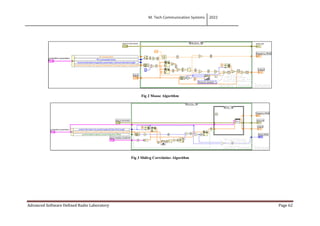
Fig 2 Moose Algorithm
Fig 3 Sliding Correlation Algorithm
M. Tech Communication Systems 2022
Advanced Software Defined Radio Laboratory Page 63
Procedure
Moose Algorithm
1. The training sequence's length is divided by 2 to obtain Nt.
2. The first half of the input's training sequence (from 0 to Nt-1) is extracted
and its complex conjugate is taken.
3. The second half of the input's training sequence (from Nt to 2Nt-1) is
extracted.
4. As part of the algorithm, the phase of the sum of the product of signals in and 3 is obtained here.
5. The frequency of the message is obtained rounding the division between the sample rate and the
oversample factor. T is the inverse of the frequency. Here 2*pi*T*Nt is calculated.
6. The estimated frequency offset is the quocient of the signals in 3 and 5.
7. Dividing the signal in 4 by Nt actually results in 2*pi*epsilon.
8. n is obtained as the sequence of integers from 0 to the length of the input
decremented. This is -2*pi*epsilon*n.
9. Creates complex signal with magnitude one and phase (8).
10. The frequency offset correction is obtained by multiplying the input by
the complex exponential (9).
Sliding correlation Algorithm
1. The input signal is extracted from the bundle
2. The signal is padded with an array of 0's created with the length of the zero padding.
3. 3. The training sequence is correlated with the the zero-padded input.
4. The squared magnitude of the correlation is taken.
5. The position of the maximum squared magnitude is found and subtracted by the length of the training
sequence in order to find the position of the start of the frame.
6. The length of the training sequence had to be decremented to compensate for the increase of one
element by the correlation algorithm.
7. The length of the zero padding is subtracted from the position of beginning of the frame, because this
was added at the beginning and should not be considered.
8. The input signal is cut to start from the frame offset calculated on (7).
9. The zero padding is subtracted again to take into account the effects of other blocks in the system.
10. When the frequency offset correction is turned off, the moose algorithm is used only to estimate the
frequency offset, but not to correct it, as its output goes unused.
11. When the frequency offset correction is turned on, Moose's output is connected to the output of this
block.
Questions
1. Set up your simulator according to the steps used for verifying your correlation based frame detector.
In particular, make sure that the control Correct Frequency Offset is set to FALSE. Set the noise power
of your channel to 5 dB. Also, use AWGN channel for this question instead of ISI. Describe what
happens to the error rate of your system when the estimate for the delay in the channel is off by more
than one symbol time (i.e., when dˆ _= d).
Note: You may need to modify your VIs to observe this effect, or you may guess the impact from the
structure of the frame detection equations.
2. Set up your simulator according to the steps used for verifying your implementation of the Moose
algorithm. Set the Correct Frequency Offset control to FALSE. Describe what happens to the received
constellation if you do not correct for the 201 Hz frequency offset.
3. Based on the system parameters described in the pre-lab, what are the range of frequency offsets that
you can estimate/correct using the Moose algorithm? Since the Moose algorithm cannot
M. Tech Communication Systems 2022
Advanced Software Defined Radio Laboratory Page 64
estimate/correct for arbitrary frequency offsets it is often considered to perform what is known as fine
frequency synchronization.
4. Discuss any problems you might have encountered and how you overcame these obstacles.
5. In this lab you observed how your code operates over a real wireless link. Answer the following
questions about your experience in lab.
a. Name three impairments in a real wireless system which impact the accuracy of the
correlation based detection method.
b. Under large frequency offsets, the correlation based detector “breaks”. What property of the
training sequence breaks down under large frequency offsets? Hint: You may need to consider
your answer to the question in Section 3.2.
c. In the self referenced frame synchronization method, is it still critical that the periodic training
sequence have good autocorrelation properties? If so, why?
Experiment
In this lab you will run your implementation of sliding correlator.vi over a real wireless link. Using your code
from the prior labs in conjunction with the new blocks you have created, you will complete the framework for
the transmitter and receiver blocks in lab as in previous labs. Insert your code into this framework as you did in
the pre-lab. Next, set up the following parameters in your system.
o TX sample rate = 4 MSamp/sec
o TX oversample factor = 20
o RX sample rate = 4 MSamp/sec
o RX oversample factor = 20
o Channel estimate length = 2
o Equalizer length = 4
o Capture time = 2 msec
Leave any unspecified parameters set to their default values. Also make sure that the Correct Frequency Offset
control on top rx is set to TRUE.You will now perform two experiments to explore frequency offsets and frame
detection over a real wireless link. Before you begin, estimate the order of magnitude of the frequency offset
between the transmitter and receiver of your system. Take note of this value as you may be asked about it later.
Inferences
 The performance of the sliding correlation algorithm is studied to comprehend the concept of Frame
detection ad Frequency offset correction.

Frame detection.pdf

  • 1.
    M. Tech CommunicationSystems 2022 Advanced Software Defined Radio Laboratory Page 60
  • 2.
    M. Tech CommunicationSystems 2022 Advanced Software Defined Radio Laboratory Page 61 Lab 8 Frame Detection ad Frequency Offset Correction Objective  Implement a particular method for frequency offset correction, called the Moose algorithm, and a method for frame detection based on correlation. Also study the performance of the frequency offset correction and frame detection algorithms by embedding within the synchronization block of the receiver Requirements  LabVIEW Software  Modulation Toolkit  Advanced signal processing Toolkit  USRP 2922 (TX/RX)-Full Duplex Theory Up to this point we have assumed that a training sequence has been provided at both the transmitter and receiver. Not all training sequences are created equal. Without a good training sequence, the estimation techniques in the labs would perform poorly. This section discusses some desirable properties of training sequences and introduces one family of sequences known as Barker codes. Many other sequences are used in research literature and in commercial wireless systems as well (e.g., Frank sequences, Zadoff-Chu sequences, or Gold sequences). Training sequences serve as a known reference signals, which can be used for many purposes at the receiver. In these labs, we use training sequences for two main purposes: (1) synchronization and (2) channel estimation. In general, good training sequences for synchronization possess strong autocorrelation properties. In Lab 4, the training sequence needed to be suitably designed in order to provide sufficient rank properties. Training sequences with strong autocorrelation properties can satisfy these rank properties. In this lab, you will use such a training sequence to create a correlation based detector that finds the beginning of a frame.
  • 3.
    M. Tech CommunicationSystems 2022 Advanced Software Defined Radio Laboratory Page 62 Fig 2 Moose Algorithm Fig 3 Sliding Correlation Algorithm
  • 4.
    M. Tech CommunicationSystems 2022 Advanced Software Defined Radio Laboratory Page 63 Procedure Moose Algorithm 1. The training sequence's length is divided by 2 to obtain Nt. 2. The first half of the input's training sequence (from 0 to Nt-1) is extracted and its complex conjugate is taken. 3. The second half of the input's training sequence (from Nt to 2Nt-1) is extracted. 4. As part of the algorithm, the phase of the sum of the product of signals in and 3 is obtained here. 5. The frequency of the message is obtained rounding the division between the sample rate and the oversample factor. T is the inverse of the frequency. Here 2*pi*T*Nt is calculated. 6. The estimated frequency offset is the quocient of the signals in 3 and 5. 7. Dividing the signal in 4 by Nt actually results in 2*pi*epsilon. 8. n is obtained as the sequence of integers from 0 to the length of the input decremented. This is -2*pi*epsilon*n. 9. Creates complex signal with magnitude one and phase (8). 10. The frequency offset correction is obtained by multiplying the input by the complex exponential (9). Sliding correlation Algorithm 1. The input signal is extracted from the bundle 2. The signal is padded with an array of 0's created with the length of the zero padding. 3. 3. The training sequence is correlated with the the zero-padded input. 4. The squared magnitude of the correlation is taken. 5. The position of the maximum squared magnitude is found and subtracted by the length of the training sequence in order to find the position of the start of the frame. 6. The length of the training sequence had to be decremented to compensate for the increase of one element by the correlation algorithm. 7. The length of the zero padding is subtracted from the position of beginning of the frame, because this was added at the beginning and should not be considered. 8. The input signal is cut to start from the frame offset calculated on (7). 9. The zero padding is subtracted again to take into account the effects of other blocks in the system. 10. When the frequency offset correction is turned off, the moose algorithm is used only to estimate the frequency offset, but not to correct it, as its output goes unused. 11. When the frequency offset correction is turned on, Moose's output is connected to the output of this block. Questions 1. Set up your simulator according to the steps used for verifying your correlation based frame detector. In particular, make sure that the control Correct Frequency Offset is set to FALSE. Set the noise power of your channel to 5 dB. Also, use AWGN channel for this question instead of ISI. Describe what happens to the error rate of your system when the estimate for the delay in the channel is off by more than one symbol time (i.e., when dˆ _= d). Note: You may need to modify your VIs to observe this effect, or you may guess the impact from the structure of the frame detection equations. 2. Set up your simulator according to the steps used for verifying your implementation of the Moose algorithm. Set the Correct Frequency Offset control to FALSE. Describe what happens to the received constellation if you do not correct for the 201 Hz frequency offset. 3. Based on the system parameters described in the pre-lab, what are the range of frequency offsets that you can estimate/correct using the Moose algorithm? Since the Moose algorithm cannot
  • 5.
    M. Tech CommunicationSystems 2022 Advanced Software Defined Radio Laboratory Page 64 estimate/correct for arbitrary frequency offsets it is often considered to perform what is known as fine frequency synchronization. 4. Discuss any problems you might have encountered and how you overcame these obstacles. 5. In this lab you observed how your code operates over a real wireless link. Answer the following questions about your experience in lab. a. Name three impairments in a real wireless system which impact the accuracy of the correlation based detection method. b. Under large frequency offsets, the correlation based detector “breaks”. What property of the training sequence breaks down under large frequency offsets? Hint: You may need to consider your answer to the question in Section 3.2. c. In the self referenced frame synchronization method, is it still critical that the periodic training sequence have good autocorrelation properties? If so, why? Experiment In this lab you will run your implementation of sliding correlator.vi over a real wireless link. Using your code from the prior labs in conjunction with the new blocks you have created, you will complete the framework for the transmitter and receiver blocks in lab as in previous labs. Insert your code into this framework as you did in the pre-lab. Next, set up the following parameters in your system. o TX sample rate = 4 MSamp/sec o TX oversample factor = 20 o RX sample rate = 4 MSamp/sec o RX oversample factor = 20 o Channel estimate length = 2 o Equalizer length = 4 o Capture time = 2 msec Leave any unspecified parameters set to their default values. Also make sure that the Correct Frequency Offset control on top rx is set to TRUE.You will now perform two experiments to explore frequency offsets and frame detection over a real wireless link. Before you begin, estimate the order of magnitude of the frequency offset between the transmitter and receiver of your system. Take note of this value as you may be asked about it later. Inferences  The performance of the sliding correlation algorithm is studied to comprehend the concept of Frame detection ad Frequency offset correction.