Silberschatz, Galvin and GagneOperating System Concepts – 8th
Edition,
Virtual Memory
9.2 Silberschatz, Galvin and GagneOperating System Concepts – 8th
Edition
Virtual Memory
Background
Demand Paging
Copy-on-Write
Page Replacement
Allocation of Frames
Thrashing
Memory-Mapped Files
Allocating Kernel Memory
Other Considerations
Operating-System Examples
9.3 Silberschatz, Galvin and GagneOperating System Concepts – 8th
Edition
Objectives
To describe the benefits of a virtual memory system
To explain the concepts of demand paging, page-replacement algorithms,
and allocation of page frames
To discuss the principle of the working-set model
9.4 Silberschatz, Galvin and GagneOperating System Concepts – 8th
Edition
Background
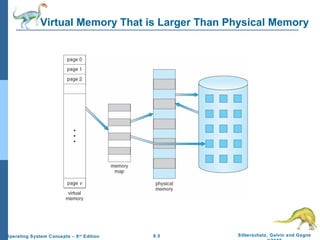
Virtual memory – separation of user logical memory from physical
memory.
Only part of the program needs to be in memory for execution
Logical address space can therefore be much larger than physical
address space
Allows address spaces to be shared by several processes
Allows for more efficient process creation
Virtual memory can be implemented via:
Demand paging
Demand segmentation
9.5 Silberschatz, Galvin and GagneOperating System Concepts – 8th
Edition
Virtual Memory That is Larger Than Physical Memory
⇒
9.6 Silberschatz, Galvin and GagneOperating System Concepts – 8th
Edition
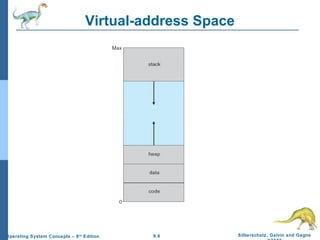
Virtual-address Space
9.7 Silberschatz, Galvin and GagneOperating System Concepts – 8th
Edition
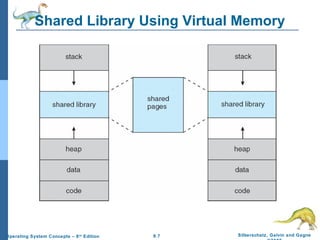
Shared Library Using Virtual Memory
9.8 Silberschatz, Galvin and GagneOperating System Concepts – 8th
Edition
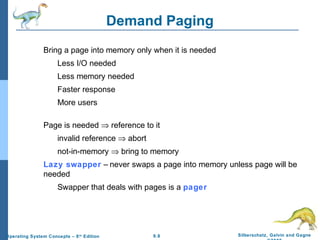
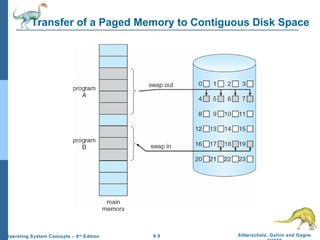
Demand Paging
Bring a page into memory only when it is needed
Less I/O needed
Less memory needed
Faster response
More users
Page is needed ⇒ reference to it
invalid reference ⇒ abort
not-in-memory ⇒ bring to memory
Lazy swapper – never swaps a page into memory unless page will be
needed
Swapper that deals with pages is a pager
9.9 Silberschatz, Galvin and GagneOperating System Concepts – 8th
Edition
Transfer of a Paged Memory to Contiguous Disk Space
9.10 Silberschatz, Galvin and GagneOperating System Concepts – 8th
Edition
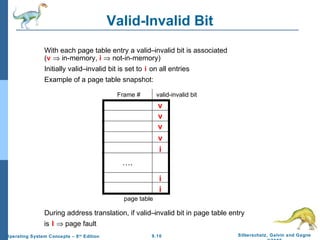
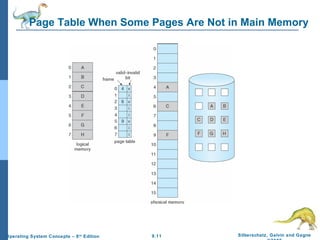
Valid-Invalid Bit
With each page table entry a valid–invalid bit is associated
(v ⇒ in-memory, i ⇒ not-in-memory)
Initially valid–invalid bit is set to i on all entries
Example of a page table snapshot:
During address translation, if valid–invalid bit in page table entry
is I ⇒ page fault
v
v
v
v
i
i
i
….
Frame # valid-invalid bit
page table
9.11 Silberschatz, Galvin and GagneOperating System Concepts – 8th
Edition
Page Table When Some Pages Are Not in Main Memory
9.12 Silberschatz, Galvin and GagneOperating System Concepts – 8th
Edition
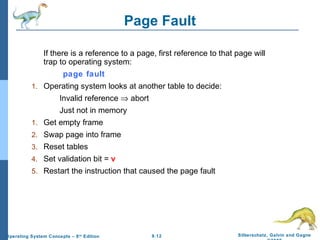
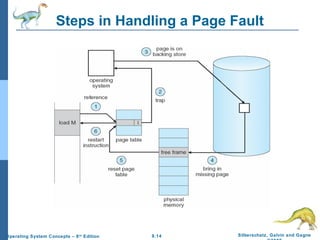
Page Fault
If there is a reference to a page, first reference to that page will
trap to operating system:
page fault
1. Operating system looks at another table to decide:
Invalid reference ⇒ abort
Just not in memory
1. Get empty frame
2. Swap page into frame
3. Reset tables
4. Set validation bit = v
5. Restart the instruction that caused the page fault
9.13 Silberschatz, Galvin and GagneOperating System Concepts – 8th
Edition
Page Fault (Cont.)
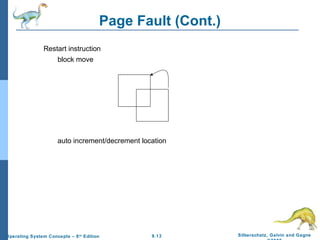
Restart instruction
block move
auto increment/decrement location
9.14 Silberschatz, Galvin and GagneOperating System Concepts – 8th
Edition
Steps in Handling a Page Fault
9.15 Silberschatz, Galvin and GagneOperating System Concepts – 8th
Edition
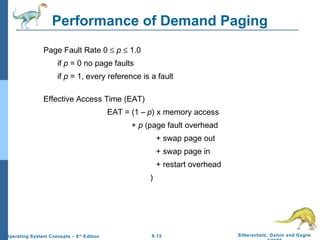
Performance of Demand Paging
Page Fault Rate 0 ≤ p ≤ 1.0
if p = 0 no page faults
if p = 1, every reference is a fault
Effective Access Time (EAT)
EAT = (1 – p) x memory access
+ p (page fault overhead
+ swap page out
+ swap page in
+ restart overhead
)
9.16 Silberschatz, Galvin and GagneOperating System Concepts – 8th
Edition
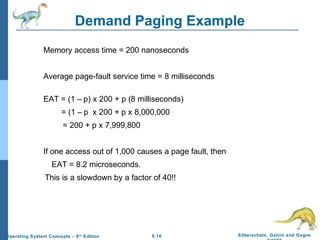
Demand Paging Example
Memory access time = 200 nanoseconds
Average page-fault service time = 8 milliseconds
EAT = (1 – p) x 200 + p (8 milliseconds)
= (1 – p x 200 + p x 8,000,000
= 200 + p x 7,999,800
If one access out of 1,000 causes a page fault, then
EAT = 8.2 microseconds.
This is a slowdown by a factor of 40!!
9.17 Silberschatz, Galvin and GagneOperating System Concepts – 8th
Edition
Process Creation
Virtual memory allows other benefits during process creation:
- Copy-on-Write
- Memory-Mapped Files (later)
9.18 Silberschatz, Galvin and GagneOperating System Concepts – 8th
Edition
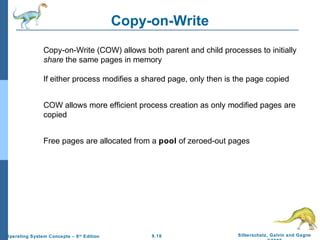
Copy-on-Write
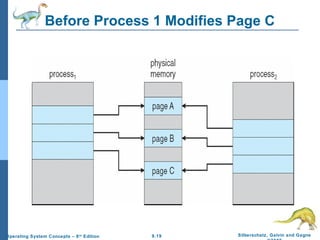
Copy-on-Write (COW) allows both parent and child processes to initially
share the same pages in memory
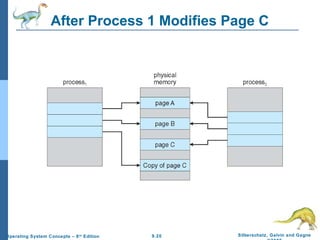
If either process modifies a shared page, only then is the page copied
COW allows more efficient process creation as only modified pages are
copied
Free pages are allocated from a pool of zeroed-out pages
9.19 Silberschatz, Galvin and GagneOperating System Concepts – 8th
Edition
Before Process 1 Modifies Page C
9.20 Silberschatz, Galvin and GagneOperating System Concepts – 8th
Edition
After Process 1 Modifies Page C
9.21 Silberschatz, Galvin and GagneOperating System Concepts – 8th
Edition
What happens if there is no free frame?
Page replacement – find some page in memory, but not
really in use, swap it out
algorithm
performance – want an algorithm which will result in
minimum number of page faults
Same page may be brought into memory several times
9.22 Silberschatz, Galvin and GagneOperating System Concepts – 8th
Edition
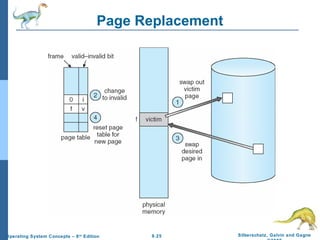
Page Replacement
Prevent over-allocation of memory by modifying page-fault service routine to
include page replacement
Use modify (dirty) bit to reduce overhead of page transfers – only
modified pages are written to disk
Page replacement completes separation between logical memory and
physical memory – large virtual memory can be provided on a smaller
physical memory
9.23 Silberschatz, Galvin and GagneOperating System Concepts – 8th
Edition
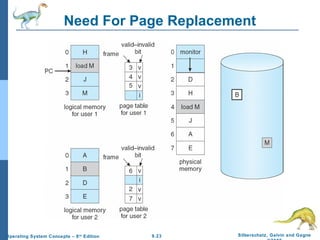
Need For Page Replacement
9.24 Silberschatz, Galvin and GagneOperating System Concepts – 8th
Edition
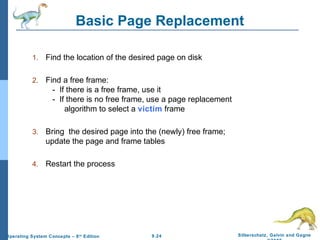
Basic Page Replacement
1. Find the location of the desired page on disk
2. Find a free frame:
- If there is a free frame, use it
- If there is no free frame, use a page replacement
algorithm to select a victim frame
3. Bring the desired page into the (newly) free frame;
update the page and frame tables
4. Restart the process
9.25 Silberschatz, Galvin and GagneOperating System Concepts – 8th
Edition
Page Replacement
9.26 Silberschatz, Galvin and GagneOperating System Concepts – 8th
Edition
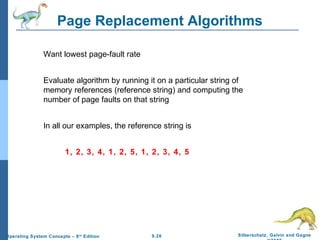
Page Replacement Algorithms
Want lowest page-fault rate
Evaluate algorithm by running it on a particular string of
memory references (reference string) and computing the
number of page faults on that string
In all our examples, the reference string is
1, 2, 3, 4, 1, 2, 5, 1, 2, 3, 4, 5
9.27 Silberschatz, Galvin and GagneOperating System Concepts – 8th
Edition
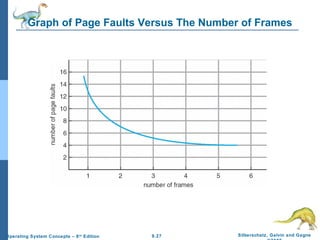
Graph of Page Faults Versus The Number of Frames
9.28 Silberschatz, Galvin and GagneOperating System Concepts – 8th
Edition
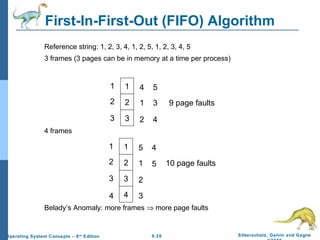
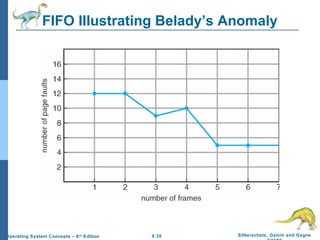
First-In-First-Out (FIFO) Algorithm
Reference string: 1, 2, 3, 4, 1, 2, 5, 1, 2, 3, 4, 5
3 frames (3 pages can be in memory at a time per process)
4 frames
Belady’s Anomaly: more frames ⇒ more page faults
1
2
3
1
2
3
4
1
2
5
3
4
9 page faults
1
2
3
1
2
3
5
1
2
4
5 10 page faults
44 3
9.29 Silberschatz, Galvin and GagneOperating System Concepts – 8th
Edition
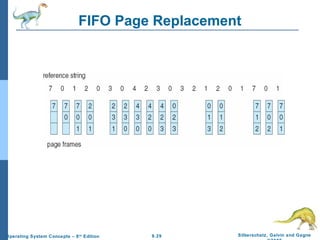
FIFO Page Replacement
9.30 Silberschatz, Galvin and GagneOperating System Concepts – 8th
Edition
FIFO Illustrating Belady’s Anomaly
9.31 Silberschatz, Galvin and GagneOperating System Concepts – 8th
Edition
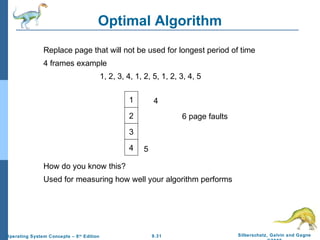
Optimal Algorithm
Replace page that will not be used for longest period of time
4 frames example
1, 2, 3, 4, 1, 2, 5, 1, 2, 3, 4, 5
How do you know this?
Used for measuring how well your algorithm performs
1
2
3
4
6 page faults
4 5
9.32 Silberschatz, Galvin and GagneOperating System Concepts – 8th
Edition
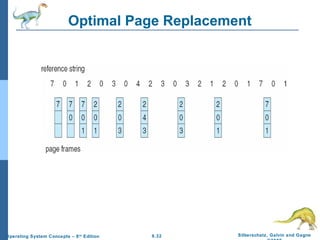
Optimal Page Replacement
9.33 Silberschatz, Galvin and GagneOperating System Concepts – 8th
Edition
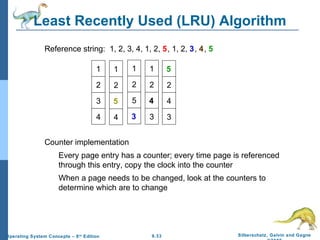
Least Recently Used (LRU) Algorithm
Reference string: 1, 2, 3, 4, 1, 2, 5, 1, 2, 3, 4, 5
Counter implementation
Every page entry has a counter; every time page is referenced
through this entry, copy the clock into the counter
When a page needs to be changed, look at the counters to
determine which are to change
5
2
4
3
1
2
3
4
1
2
5
4
1
2
5
3
1
2
4
3
9.34 Silberschatz, Galvin and GagneOperating System Concepts – 8th
Edition
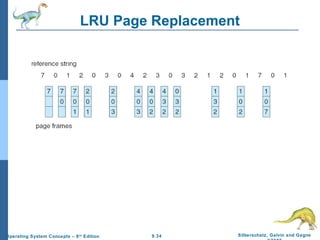
LRU Page Replacement
9.35 Silberschatz, Galvin and GagneOperating System Concepts – 8th
Edition
LRU Algorithm (Cont.)
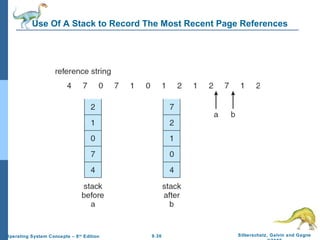
Stack implementation – keep a stack of page numbers in a double link form:
Page referenced:
 move it to the top
 requires 6 pointers to be changed
No search for replacement
9.36 Silberschatz, Galvin and GagneOperating System Concepts – 8th
Edition
Use Of A Stack to Record The Most Recent Page References
9.37 Silberschatz, Galvin and GagneOperating System Concepts – 8th
Edition
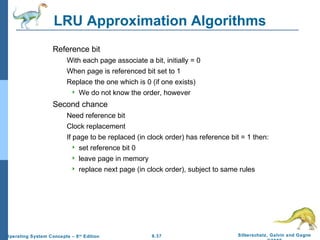
LRU Approximation Algorithms
Reference bit
With each page associate a bit, initially = 0
When page is referenced bit set to 1
Replace the one which is 0 (if one exists)
 We do not know the order, however
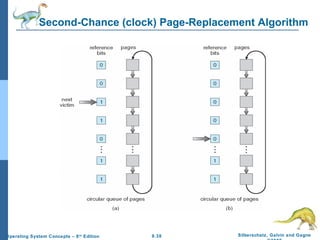
Second chance
Need reference bit
Clock replacement
If page to be replaced (in clock order) has reference bit = 1 then:
 set reference bit 0
 leave page in memory
 replace next page (in clock order), subject to same rules
9.38 Silberschatz, Galvin and GagneOperating System Concepts – 8th
Edition
Second-Chance (clock) Page-Replacement Algorithm
9.39 Silberschatz, Galvin and GagneOperating System Concepts – 8th
Edition
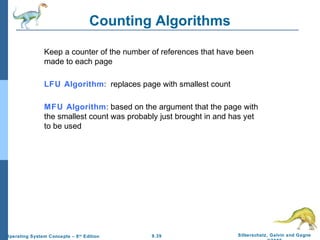
Counting Algorithms
Keep a counter of the number of references that have been
made to each page
LFU Algorithm: replaces page with smallest count
MFU Algorithm: based on the argument that the page with
the smallest count was probably just brought in and has yet
to be used
9.40 Silberschatz, Galvin and GagneOperating System Concepts – 8th
Edition
Allocation of Frames
Each process needs minimum number of pages
Example: IBM 370 – 6 pages to handle SS MOVE instruction:
instruction is 6 bytes, might span 2 pages
2 pages to handle from
2 pages to handle to
Two major allocation schemes
fixed allocation
priority allocation
9.41 Silberschatz, Galvin and GagneOperating System Concepts – 8th
Edition
Fixed Allocation
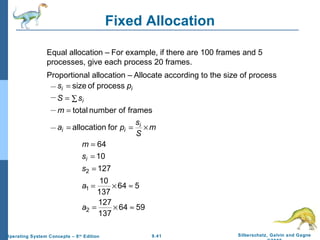
Equal allocation – For example, if there are 100 frames and 5
processes, give each process 20 frames.
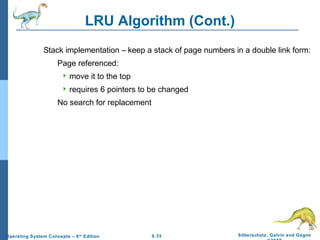
Proportional allocation – Allocate according to the size of process
m
S
s
pa
m
sS
ps
i
ii
i
ii
×==
=
∑=
=
forallocation
framesofnumbertotal
processofsize
5964
137
127
564
137
10
127
10
64
2
1
2
≈×=
≈×=
=
=
=
a
a
s
s
m
i
9.42 Silberschatz, Galvin and GagneOperating System Concepts – 8th
Edition
Priority Allocation
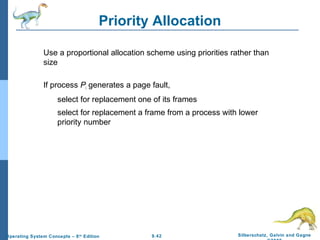
Use a proportional allocation scheme using priorities rather than
size
If process Pi generates a page fault,
select for replacement one of its frames
select for replacement a frame from a process with lower
priority number
9.43 Silberschatz, Galvin and GagneOperating System Concepts – 8th
Edition
Global vs. Local Allocation
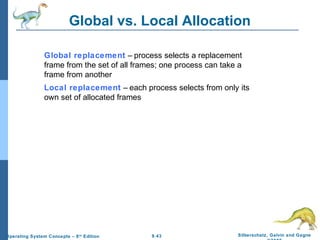
Global replacement – process selects a replacement
frame from the set of all frames; one process can take a
frame from another
Local replacement – each process selects from only its
own set of allocated frames
9.44 Silberschatz, Galvin and GagneOperating System Concepts – 8th
Edition
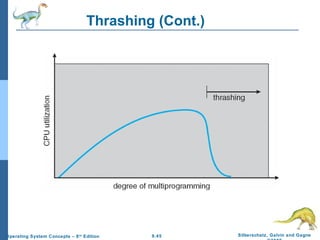
Thrashing
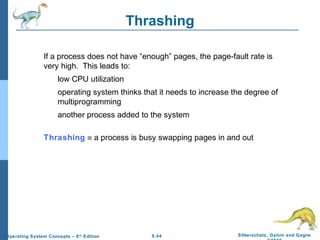
If a process does not have “enough” pages, the page-fault rate is
very high. This leads to:
low CPU utilization
operating system thinks that it needs to increase the degree of
multiprogramming
another process added to the system
Thrashing ≡ a process is busy swapping pages in and out
9.45 Silberschatz, Galvin and GagneOperating System Concepts – 8th
Edition
Thrashing (Cont.)
9.46 Silberschatz, Galvin and GagneOperating System Concepts – 8th
Edition
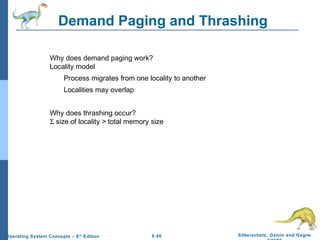
Demand Paging and Thrashing
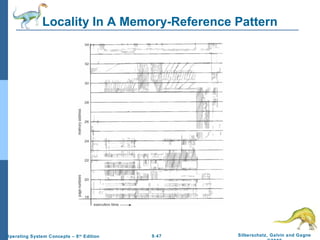
Why does demand paging work?
Locality model
Process migrates from one locality to another
Localities may overlap
Why does thrashing occur?
Σ size of locality > total memory size
9.47 Silberschatz, Galvin and GagneOperating System Concepts – 8th
Edition
Locality In A Memory-Reference Pattern
9.48 Silberschatz, Galvin and GagneOperating System Concepts – 8th
Edition
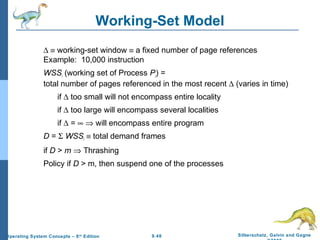
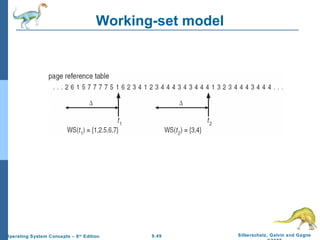
Working-Set Model
∆ ≡ working-set window ≡ a fixed number of page references
Example: 10,000 instruction
WSSi (working set of Process Pi) =
total number of pages referenced in the most recent ∆ (varies in time)
if ∆ too small will not encompass entire locality
if ∆ too large will encompass several localities
if ∆ = ∞ ⇒ will encompass entire program
D = Σ WSSi ≡ total demand frames
if D > m ⇒ Thrashing
Policy if D > m, then suspend one of the processes
9.49 Silberschatz, Galvin and GagneOperating System Concepts – 8th
Edition
Working-set model
9.50 Silberschatz, Galvin and GagneOperating System Concepts – 8th
Edition
Keeping Track of the Working Set
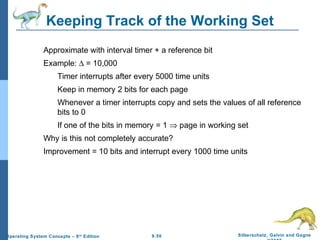
Approximate with interval timer + a reference bit
Example: ∆ = 10,000
Timer interrupts after every 5000 time units
Keep in memory 2 bits for each page
Whenever a timer interrupts copy and sets the values of all reference
bits to 0
If one of the bits in memory = 1 ⇒ page in working set
Why is this not completely accurate?
Improvement = 10 bits and interrupt every 1000 time units
9.51 Silberschatz, Galvin and GagneOperating System Concepts – 8th
Edition
Page-Fault Frequency Scheme
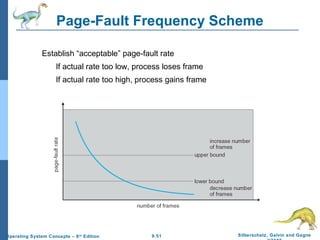
Establish “acceptable” page-fault rate
If actual rate too low, process loses frame
If actual rate too high, process gains frame
9.52 Silberschatz, Galvin and GagneOperating System Concepts – 8th
Edition
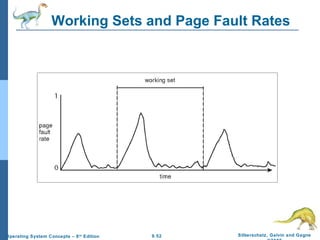
Working Sets and Page Fault Rates
9.53 Silberschatz, Galvin and GagneOperating System Concepts – 8th
Edition
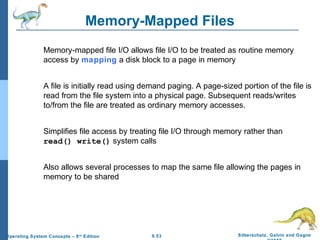
Memory-Mapped Files
Memory-mapped file I/O allows file I/O to be treated as routine memory
access by mapping a disk block to a page in memory
A file is initially read using demand paging. A page-sized portion of the file is
read from the file system into a physical page. Subsequent reads/writes
to/from the file are treated as ordinary memory accesses.
Simplifies file access by treating file I/O through memory rather than
read() write() system calls
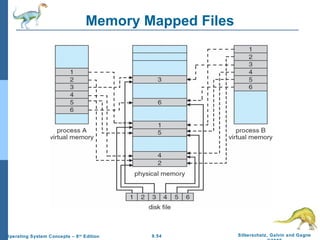
Also allows several processes to map the same file allowing the pages in
memory to be shared
9.54 Silberschatz, Galvin and GagneOperating System Concepts – 8th
Edition
Memory Mapped Files
9.55 Silberschatz, Galvin and GagneOperating System Concepts – 8th
Edition
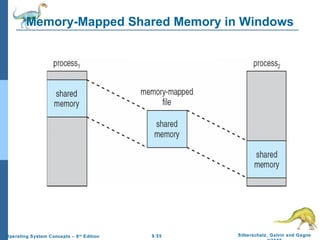
Memory-Mapped Shared Memory in Windows
9.56 Silberschatz, Galvin and GagneOperating System Concepts – 8th
Edition
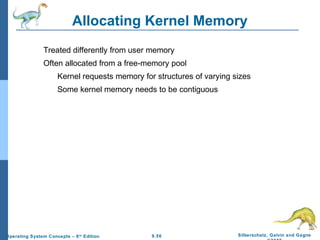
Allocating Kernel Memory
Treated differently from user memory
Often allocated from a free-memory pool
Kernel requests memory for structures of varying sizes
Some kernel memory needs to be contiguous
9.57 Silberschatz, Galvin and GagneOperating System Concepts – 8th
Edition
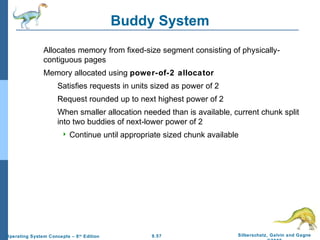
Buddy System
Allocates memory from fixed-size segment consisting of physically-
contiguous pages
Memory allocated using power-of-2 allocator
Satisfies requests in units sized as power of 2
Request rounded up to next highest power of 2
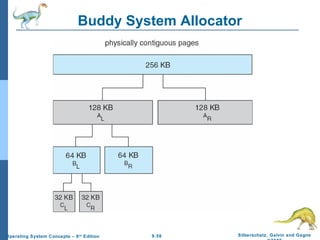
When smaller allocation needed than is available, current chunk split
into two buddies of next-lower power of 2
 Continue until appropriate sized chunk available
9.58 Silberschatz, Galvin and GagneOperating System Concepts – 8th
Edition
Buddy System Allocator
9.59 Silberschatz, Galvin and GagneOperating System Concepts – 8th
Edition
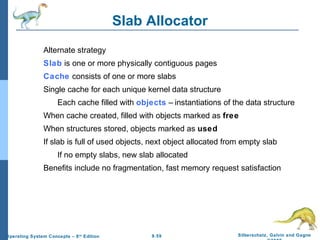
Slab Allocator
Alternate strategy
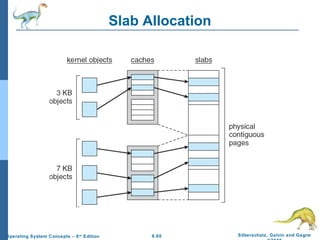
Slab is one or more physically contiguous pages
Cache consists of one or more slabs
Single cache for each unique kernel data structure
Each cache filled with objects – instantiations of the data structure
When cache created, filled with objects marked as free
When structures stored, objects marked as used
If slab is full of used objects, next object allocated from empty slab
If no empty slabs, new slab allocated
Benefits include no fragmentation, fast memory request satisfaction
9.60 Silberschatz, Galvin and GagneOperating System Concepts – 8th
Edition
Slab Allocation
9.61 Silberschatz, Galvin and GagneOperating System Concepts – 8th
Edition
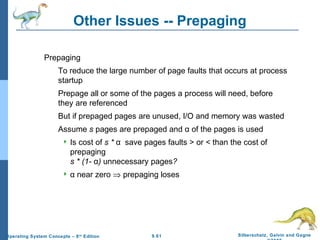
Other Issues -- Prepaging
Prepaging
To reduce the large number of page faults that occurs at process
startup
Prepage all or some of the pages a process will need, before
they are referenced
But if prepaged pages are unused, I/O and memory was wasted
Assume s pages are prepaged and α of the pages is used
 Is cost of s * α save pages faults > or < than the cost of
prepaging
s * (1- α) unnecessary pages?
 α near zero ⇒ prepaging loses
9.62 Silberschatz, Galvin and GagneOperating System Concepts – 8th
Edition
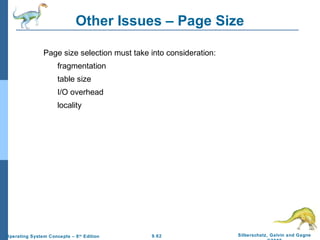
Other Issues – Page Size
Page size selection must take into consideration:
fragmentation
table size
I/O overhead
locality
9.63 Silberschatz, Galvin and GagneOperating System Concepts – 8th
Edition
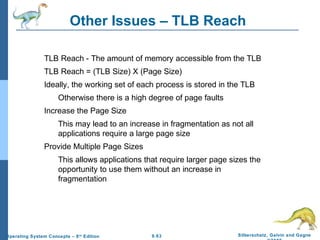
Other Issues – TLB Reach
TLB Reach - The amount of memory accessible from the TLB
TLB Reach = (TLB Size) X (Page Size)
Ideally, the working set of each process is stored in the TLB
Otherwise there is a high degree of page faults
Increase the Page Size
This may lead to an increase in fragmentation as not all
applications require a large page size
Provide Multiple Page Sizes
This allows applications that require larger page sizes the
opportunity to use them without an increase in
fragmentation
9.64 Silberschatz, Galvin and GagneOperating System Concepts – 8th
Edition
Other Issues – Program Structure
Program structure
Int[128,128] data;
Each row is stored in one page
Program 1
for (j = 0; j <128; j++)
for (i = 0; i < 128; i++)
data[i,j] = 0;
128 x 128 = 16,384 page faults
Program 2
for (i = 0; i < 128; i++)
for (j = 0; j < 128; j++)
data[i,j] = 0;
128 page faults
9.65 Silberschatz, Galvin and GagneOperating System Concepts – 8th
Edition
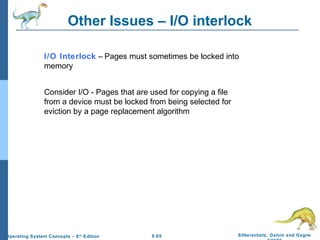
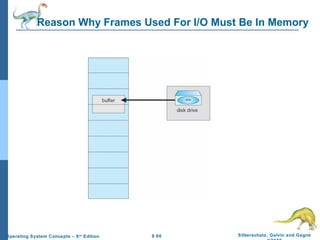
Other Issues – I/O interlock
I/O Interlock – Pages must sometimes be locked into
memory
Consider I/O - Pages that are used for copying a file
from a device must be locked from being selected for
eviction by a page replacement algorithm
9.66 Silberschatz, Galvin and GagneOperating System Concepts – 8th
Edition
Reason Why Frames Used For I/O Must Be In Memory
9.67 Silberschatz, Galvin and GagneOperating System Concepts – 8th
Edition
Operating System Examples
Windows XP
Solaris
9.68 Silberschatz, Galvin and GagneOperating System Concepts – 8th
Edition
Windows XP
Uses demand paging with clustering. Clustering brings in pages
surrounding the faulting page
Processes are assigned working set minimum and working set
maximum
Working set minimum is the minimum number of pages the process is
guaranteed to have in memory
A process may be assigned as many pages up to its working set maximum
When the amount of free memory in the system falls below a threshold,
automatic working set trimming is performed to restore the amount of
free memory
Working set trimming removes pages from processes that have pages in
excess of their working set minimum
9.69 Silberschatz, Galvin and GagneOperating System Concepts – 8th
Edition
Solaris
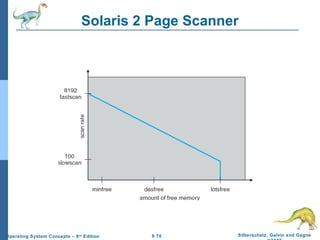
Maintains a list of free pages to assign faulting processes
Lotsfree – threshold parameter (amount of free memory) to begin paging
Desfree – threshold parameter to increasing paging
Minfree – threshold parameter to being swapping
Paging is performed by pageout process
Pageout scans pages using modified clock algorithm
Scanrate is the rate at which pages are scanned. This ranges from
slowscan to fastscan
Pageout is called more frequently depending upon the amount of free
memory available
9.70 Silberschatz, Galvin and GagneOperating System Concepts – 8th
Edition
Solaris 2 Page Scanner
Silberschatz, Galvin and GagneOperating System Concepts – 8th
Edition,
Thank you

Virtual memory

  • 1.
    Silberschatz, Galvin andGagneOperating System Concepts – 8th Edition, Virtual Memory
  • 2.
    9.2 Silberschatz, Galvinand GagneOperating System Concepts – 8th Edition Virtual Memory Background Demand Paging Copy-on-Write Page Replacement Allocation of Frames Thrashing Memory-Mapped Files Allocating Kernel Memory Other Considerations Operating-System Examples
  • 3.
    9.3 Silberschatz, Galvinand GagneOperating System Concepts – 8th Edition Objectives To describe the benefits of a virtual memory system To explain the concepts of demand paging, page-replacement algorithms, and allocation of page frames To discuss the principle of the working-set model
  • 4.
    9.4 Silberschatz, Galvinand GagneOperating System Concepts – 8th Edition Background Virtual memory – separation of user logical memory from physical memory. Only part of the program needs to be in memory for execution Logical address space can therefore be much larger than physical address space Allows address spaces to be shared by several processes Allows for more efficient process creation Virtual memory can be implemented via: Demand paging Demand segmentation
  • 5.
    9.5 Silberschatz, Galvinand GagneOperating System Concepts – 8th Edition Virtual Memory That is Larger Than Physical Memory ⇒
  • 6.
    9.6 Silberschatz, Galvinand GagneOperating System Concepts – 8th Edition Virtual-address Space
  • 7.
    9.7 Silberschatz, Galvinand GagneOperating System Concepts – 8th Edition Shared Library Using Virtual Memory
  • 8.
    9.8 Silberschatz, Galvinand GagneOperating System Concepts – 8th Edition Demand Paging Bring a page into memory only when it is needed Less I/O needed Less memory needed Faster response More users Page is needed ⇒ reference to it invalid reference ⇒ abort not-in-memory ⇒ bring to memory Lazy swapper – never swaps a page into memory unless page will be needed Swapper that deals with pages is a pager
  • 9.
    9.9 Silberschatz, Galvinand GagneOperating System Concepts – 8th Edition Transfer of a Paged Memory to Contiguous Disk Space
  • 10.
    9.10 Silberschatz, Galvinand GagneOperating System Concepts – 8th Edition Valid-Invalid Bit With each page table entry a valid–invalid bit is associated (v ⇒ in-memory, i ⇒ not-in-memory) Initially valid–invalid bit is set to i on all entries Example of a page table snapshot: During address translation, if valid–invalid bit in page table entry is I ⇒ page fault v v v v i i i …. Frame # valid-invalid bit page table
  • 11.
    9.11 Silberschatz, Galvinand GagneOperating System Concepts – 8th Edition Page Table When Some Pages Are Not in Main Memory
  • 12.
    9.12 Silberschatz, Galvinand GagneOperating System Concepts – 8th Edition Page Fault If there is a reference to a page, first reference to that page will trap to operating system: page fault 1. Operating system looks at another table to decide: Invalid reference ⇒ abort Just not in memory 1. Get empty frame 2. Swap page into frame 3. Reset tables 4. Set validation bit = v 5. Restart the instruction that caused the page fault
  • 13.
    9.13 Silberschatz, Galvinand GagneOperating System Concepts – 8th Edition Page Fault (Cont.) Restart instruction block move auto increment/decrement location
  • 14.
    9.14 Silberschatz, Galvinand GagneOperating System Concepts – 8th Edition Steps in Handling a Page Fault
  • 15.
    9.15 Silberschatz, Galvinand GagneOperating System Concepts – 8th Edition Performance of Demand Paging Page Fault Rate 0 ≤ p ≤ 1.0 if p = 0 no page faults if p = 1, every reference is a fault Effective Access Time (EAT) EAT = (1 – p) x memory access + p (page fault overhead + swap page out + swap page in + restart overhead )
  • 16.
    9.16 Silberschatz, Galvinand GagneOperating System Concepts – 8th Edition Demand Paging Example Memory access time = 200 nanoseconds Average page-fault service time = 8 milliseconds EAT = (1 – p) x 200 + p (8 milliseconds) = (1 – p x 200 + p x 8,000,000 = 200 + p x 7,999,800 If one access out of 1,000 causes a page fault, then EAT = 8.2 microseconds. This is a slowdown by a factor of 40!!
  • 17.
    9.17 Silberschatz, Galvinand GagneOperating System Concepts – 8th Edition Process Creation Virtual memory allows other benefits during process creation: - Copy-on-Write - Memory-Mapped Files (later)
  • 18.
    9.18 Silberschatz, Galvinand GagneOperating System Concepts – 8th Edition Copy-on-Write Copy-on-Write (COW) allows both parent and child processes to initially share the same pages in memory If either process modifies a shared page, only then is the page copied COW allows more efficient process creation as only modified pages are copied Free pages are allocated from a pool of zeroed-out pages
  • 19.
    9.19 Silberschatz, Galvinand GagneOperating System Concepts – 8th Edition Before Process 1 Modifies Page C
  • 20.
    9.20 Silberschatz, Galvinand GagneOperating System Concepts – 8th Edition After Process 1 Modifies Page C
  • 21.
    9.21 Silberschatz, Galvinand GagneOperating System Concepts – 8th Edition What happens if there is no free frame? Page replacement – find some page in memory, but not really in use, swap it out algorithm performance – want an algorithm which will result in minimum number of page faults Same page may be brought into memory several times
  • 22.
    9.22 Silberschatz, Galvinand GagneOperating System Concepts – 8th Edition Page Replacement Prevent over-allocation of memory by modifying page-fault service routine to include page replacement Use modify (dirty) bit to reduce overhead of page transfers – only modified pages are written to disk Page replacement completes separation between logical memory and physical memory – large virtual memory can be provided on a smaller physical memory
  • 23.
    9.23 Silberschatz, Galvinand GagneOperating System Concepts – 8th Edition Need For Page Replacement
  • 24.
    9.24 Silberschatz, Galvinand GagneOperating System Concepts – 8th Edition Basic Page Replacement 1. Find the location of the desired page on disk 2. Find a free frame: - If there is a free frame, use it - If there is no free frame, use a page replacement algorithm to select a victim frame 3. Bring the desired page into the (newly) free frame; update the page and frame tables 4. Restart the process
  • 25.
    9.25 Silberschatz, Galvinand GagneOperating System Concepts – 8th Edition Page Replacement
  • 26.
    9.26 Silberschatz, Galvinand GagneOperating System Concepts – 8th Edition Page Replacement Algorithms Want lowest page-fault rate Evaluate algorithm by running it on a particular string of memory references (reference string) and computing the number of page faults on that string In all our examples, the reference string is 1, 2, 3, 4, 1, 2, 5, 1, 2, 3, 4, 5
  • 27.
    9.27 Silberschatz, Galvinand GagneOperating System Concepts – 8th Edition Graph of Page Faults Versus The Number of Frames
  • 28.
    9.28 Silberschatz, Galvinand GagneOperating System Concepts – 8th Edition First-In-First-Out (FIFO) Algorithm Reference string: 1, 2, 3, 4, 1, 2, 5, 1, 2, 3, 4, 5 3 frames (3 pages can be in memory at a time per process) 4 frames Belady’s Anomaly: more frames ⇒ more page faults 1 2 3 1 2 3 4 1 2 5 3 4 9 page faults 1 2 3 1 2 3 5 1 2 4 5 10 page faults 44 3
  • 29.
    9.29 Silberschatz, Galvinand GagneOperating System Concepts – 8th Edition FIFO Page Replacement
  • 30.
    9.30 Silberschatz, Galvinand GagneOperating System Concepts – 8th Edition FIFO Illustrating Belady’s Anomaly
  • 31.
    9.31 Silberschatz, Galvinand GagneOperating System Concepts – 8th Edition Optimal Algorithm Replace page that will not be used for longest period of time 4 frames example 1, 2, 3, 4, 1, 2, 5, 1, 2, 3, 4, 5 How do you know this? Used for measuring how well your algorithm performs 1 2 3 4 6 page faults 4 5
  • 32.
    9.32 Silberschatz, Galvinand GagneOperating System Concepts – 8th Edition Optimal Page Replacement
  • 33.
    9.33 Silberschatz, Galvinand GagneOperating System Concepts – 8th Edition Least Recently Used (LRU) Algorithm Reference string: 1, 2, 3, 4, 1, 2, 5, 1, 2, 3, 4, 5 Counter implementation Every page entry has a counter; every time page is referenced through this entry, copy the clock into the counter When a page needs to be changed, look at the counters to determine which are to change 5 2 4 3 1 2 3 4 1 2 5 4 1 2 5 3 1 2 4 3
  • 34.
    9.34 Silberschatz, Galvinand GagneOperating System Concepts – 8th Edition LRU Page Replacement
  • 35.
    9.35 Silberschatz, Galvinand GagneOperating System Concepts – 8th Edition LRU Algorithm (Cont.) Stack implementation – keep a stack of page numbers in a double link form: Page referenced:  move it to the top  requires 6 pointers to be changed No search for replacement
  • 36.
    9.36 Silberschatz, Galvinand GagneOperating System Concepts – 8th Edition Use Of A Stack to Record The Most Recent Page References
  • 37.
    9.37 Silberschatz, Galvinand GagneOperating System Concepts – 8th Edition LRU Approximation Algorithms Reference bit With each page associate a bit, initially = 0 When page is referenced bit set to 1 Replace the one which is 0 (if one exists)  We do not know the order, however Second chance Need reference bit Clock replacement If page to be replaced (in clock order) has reference bit = 1 then:  set reference bit 0  leave page in memory  replace next page (in clock order), subject to same rules
  • 38.
    9.38 Silberschatz, Galvinand GagneOperating System Concepts – 8th Edition Second-Chance (clock) Page-Replacement Algorithm
  • 39.
    9.39 Silberschatz, Galvinand GagneOperating System Concepts – 8th Edition Counting Algorithms Keep a counter of the number of references that have been made to each page LFU Algorithm: replaces page with smallest count MFU Algorithm: based on the argument that the page with the smallest count was probably just brought in and has yet to be used
  • 40.
    9.40 Silberschatz, Galvinand GagneOperating System Concepts – 8th Edition Allocation of Frames Each process needs minimum number of pages Example: IBM 370 – 6 pages to handle SS MOVE instruction: instruction is 6 bytes, might span 2 pages 2 pages to handle from 2 pages to handle to Two major allocation schemes fixed allocation priority allocation
  • 41.
    9.41 Silberschatz, Galvinand GagneOperating System Concepts – 8th Edition Fixed Allocation Equal allocation – For example, if there are 100 frames and 5 processes, give each process 20 frames. Proportional allocation – Allocate according to the size of process m S s pa m sS ps i ii i ii ×== = ∑= = forallocation framesofnumbertotal processofsize 5964 137 127 564 137 10 127 10 64 2 1 2 ≈×= ≈×= = = = a a s s m i
  • 42.
    9.42 Silberschatz, Galvinand GagneOperating System Concepts – 8th Edition Priority Allocation Use a proportional allocation scheme using priorities rather than size If process Pi generates a page fault, select for replacement one of its frames select for replacement a frame from a process with lower priority number
  • 43.
    9.43 Silberschatz, Galvinand GagneOperating System Concepts – 8th Edition Global vs. Local Allocation Global replacement – process selects a replacement frame from the set of all frames; one process can take a frame from another Local replacement – each process selects from only its own set of allocated frames
  • 44.
    9.44 Silberschatz, Galvinand GagneOperating System Concepts – 8th Edition Thrashing If a process does not have “enough” pages, the page-fault rate is very high. This leads to: low CPU utilization operating system thinks that it needs to increase the degree of multiprogramming another process added to the system Thrashing ≡ a process is busy swapping pages in and out
  • 45.
    9.45 Silberschatz, Galvinand GagneOperating System Concepts – 8th Edition Thrashing (Cont.)
  • 46.
    9.46 Silberschatz, Galvinand GagneOperating System Concepts – 8th Edition Demand Paging and Thrashing Why does demand paging work? Locality model Process migrates from one locality to another Localities may overlap Why does thrashing occur? Σ size of locality > total memory size
  • 47.
    9.47 Silberschatz, Galvinand GagneOperating System Concepts – 8th Edition Locality In A Memory-Reference Pattern
  • 48.
    9.48 Silberschatz, Galvinand GagneOperating System Concepts – 8th Edition Working-Set Model ∆ ≡ working-set window ≡ a fixed number of page references Example: 10,000 instruction WSSi (working set of Process Pi) = total number of pages referenced in the most recent ∆ (varies in time) if ∆ too small will not encompass entire locality if ∆ too large will encompass several localities if ∆ = ∞ ⇒ will encompass entire program D = Σ WSSi ≡ total demand frames if D > m ⇒ Thrashing Policy if D > m, then suspend one of the processes
  • 49.
    9.49 Silberschatz, Galvinand GagneOperating System Concepts – 8th Edition Working-set model
  • 50.
    9.50 Silberschatz, Galvinand GagneOperating System Concepts – 8th Edition Keeping Track of the Working Set Approximate with interval timer + a reference bit Example: ∆ = 10,000 Timer interrupts after every 5000 time units Keep in memory 2 bits for each page Whenever a timer interrupts copy and sets the values of all reference bits to 0 If one of the bits in memory = 1 ⇒ page in working set Why is this not completely accurate? Improvement = 10 bits and interrupt every 1000 time units
  • 51.
    9.51 Silberschatz, Galvinand GagneOperating System Concepts – 8th Edition Page-Fault Frequency Scheme Establish “acceptable” page-fault rate If actual rate too low, process loses frame If actual rate too high, process gains frame
  • 52.
    9.52 Silberschatz, Galvinand GagneOperating System Concepts – 8th Edition Working Sets and Page Fault Rates
  • 53.
    9.53 Silberschatz, Galvinand GagneOperating System Concepts – 8th Edition Memory-Mapped Files Memory-mapped file I/O allows file I/O to be treated as routine memory access by mapping a disk block to a page in memory A file is initially read using demand paging. A page-sized portion of the file is read from the file system into a physical page. Subsequent reads/writes to/from the file are treated as ordinary memory accesses. Simplifies file access by treating file I/O through memory rather than read() write() system calls Also allows several processes to map the same file allowing the pages in memory to be shared
  • 54.
    9.54 Silberschatz, Galvinand GagneOperating System Concepts – 8th Edition Memory Mapped Files
  • 55.
    9.55 Silberschatz, Galvinand GagneOperating System Concepts – 8th Edition Memory-Mapped Shared Memory in Windows
  • 56.
    9.56 Silberschatz, Galvinand GagneOperating System Concepts – 8th Edition Allocating Kernel Memory Treated differently from user memory Often allocated from a free-memory pool Kernel requests memory for structures of varying sizes Some kernel memory needs to be contiguous
  • 57.
    9.57 Silberschatz, Galvinand GagneOperating System Concepts – 8th Edition Buddy System Allocates memory from fixed-size segment consisting of physically- contiguous pages Memory allocated using power-of-2 allocator Satisfies requests in units sized as power of 2 Request rounded up to next highest power of 2 When smaller allocation needed than is available, current chunk split into two buddies of next-lower power of 2  Continue until appropriate sized chunk available
  • 58.
    9.58 Silberschatz, Galvinand GagneOperating System Concepts – 8th Edition Buddy System Allocator
  • 59.
    9.59 Silberschatz, Galvinand GagneOperating System Concepts – 8th Edition Slab Allocator Alternate strategy Slab is one or more physically contiguous pages Cache consists of one or more slabs Single cache for each unique kernel data structure Each cache filled with objects – instantiations of the data structure When cache created, filled with objects marked as free When structures stored, objects marked as used If slab is full of used objects, next object allocated from empty slab If no empty slabs, new slab allocated Benefits include no fragmentation, fast memory request satisfaction
  • 60.
    9.60 Silberschatz, Galvinand GagneOperating System Concepts – 8th Edition Slab Allocation
  • 61.
    9.61 Silberschatz, Galvinand GagneOperating System Concepts – 8th Edition Other Issues -- Prepaging Prepaging To reduce the large number of page faults that occurs at process startup Prepage all or some of the pages a process will need, before they are referenced But if prepaged pages are unused, I/O and memory was wasted Assume s pages are prepaged and α of the pages is used  Is cost of s * α save pages faults > or < than the cost of prepaging s * (1- α) unnecessary pages?  α near zero ⇒ prepaging loses
  • 62.
    9.62 Silberschatz, Galvinand GagneOperating System Concepts – 8th Edition Other Issues – Page Size Page size selection must take into consideration: fragmentation table size I/O overhead locality
  • 63.
    9.63 Silberschatz, Galvinand GagneOperating System Concepts – 8th Edition Other Issues – TLB Reach TLB Reach - The amount of memory accessible from the TLB TLB Reach = (TLB Size) X (Page Size) Ideally, the working set of each process is stored in the TLB Otherwise there is a high degree of page faults Increase the Page Size This may lead to an increase in fragmentation as not all applications require a large page size Provide Multiple Page Sizes This allows applications that require larger page sizes the opportunity to use them without an increase in fragmentation
  • 64.
    9.64 Silberschatz, Galvinand GagneOperating System Concepts – 8th Edition Other Issues – Program Structure Program structure Int[128,128] data; Each row is stored in one page Program 1 for (j = 0; j <128; j++) for (i = 0; i < 128; i++) data[i,j] = 0; 128 x 128 = 16,384 page faults Program 2 for (i = 0; i < 128; i++) for (j = 0; j < 128; j++) data[i,j] = 0; 128 page faults
  • 65.
    9.65 Silberschatz, Galvinand GagneOperating System Concepts – 8th Edition Other Issues – I/O interlock I/O Interlock – Pages must sometimes be locked into memory Consider I/O - Pages that are used for copying a file from a device must be locked from being selected for eviction by a page replacement algorithm
  • 66.
    9.66 Silberschatz, Galvinand GagneOperating System Concepts – 8th Edition Reason Why Frames Used For I/O Must Be In Memory
  • 67.
    9.67 Silberschatz, Galvinand GagneOperating System Concepts – 8th Edition Operating System Examples Windows XP Solaris
  • 68.
    9.68 Silberschatz, Galvinand GagneOperating System Concepts – 8th Edition Windows XP Uses demand paging with clustering. Clustering brings in pages surrounding the faulting page Processes are assigned working set minimum and working set maximum Working set minimum is the minimum number of pages the process is guaranteed to have in memory A process may be assigned as many pages up to its working set maximum When the amount of free memory in the system falls below a threshold, automatic working set trimming is performed to restore the amount of free memory Working set trimming removes pages from processes that have pages in excess of their working set minimum
  • 69.
    9.69 Silberschatz, Galvinand GagneOperating System Concepts – 8th Edition Solaris Maintains a list of free pages to assign faulting processes Lotsfree – threshold parameter (amount of free memory) to begin paging Desfree – threshold parameter to increasing paging Minfree – threshold parameter to being swapping Paging is performed by pageout process Pageout scans pages using modified clock algorithm Scanrate is the rate at which pages are scanned. This ranges from slowscan to fastscan Pageout is called more frequently depending upon the amount of free memory available
  • 70.
    9.70 Silberschatz, Galvinand GagneOperating System Concepts – 8th Edition Solaris 2 Page Scanner
  • 71.
    Silberschatz, Galvin andGagneOperating System Concepts – 8th Edition, Thank you