Packaging and the Value Chain: The situation of Shelf Ready Packaging ? Olivier LABASSE  General manager ECR France - ECR Europe  Board member
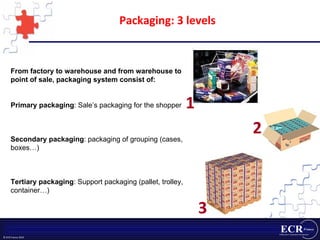
Packaging: 3 levels From factory to warehouse and from warehouse to  point of sale, packaging system consist of: Primary packaging : Sale’s packaging for the shopper Secondary packaging : packaging of grouping (cases, boxes…) Tertiary packaging : Support packaging (pallet, trolley, container…) 1 2 3
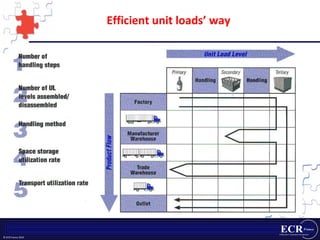
Efficient unit loads’ way
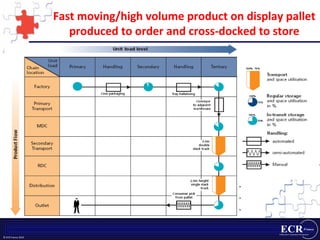
Fast moving/high volume product on display pallet produced to order and cross-docked to store
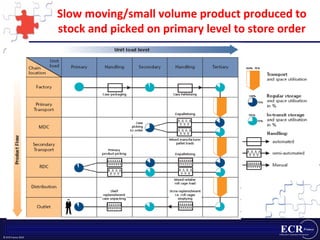
Slow moving/small volume product produced to stock and picked on primary level to store order
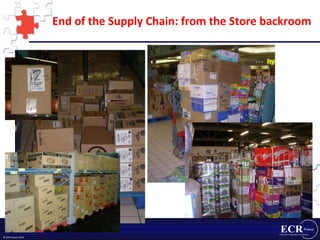
End of the Supply Chain: from the Store backroom
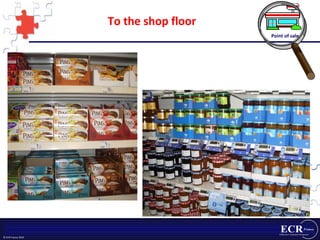
Point of sale To the shop floor
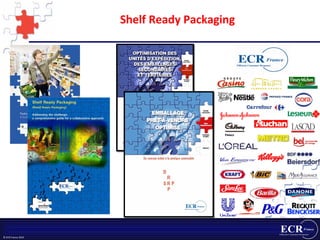
Shelf Ready Packaging:  definition and value judgement Shelf Ready Packaging (SRP) is the term used to refer to a product that comes in a ready merchandised unit which is easy to identify, easy to open, can easily be put onto the shelf and disposed of, allowing an optimisation of shelf replenishment and enhanced visibility. SRP cannot be considered as a standalone best practice, whose generalization would bring substantial and measurable benefits at the industry level. Its implementation should follow a case-by-case iterative, rather than systematic or dogmatic approach.
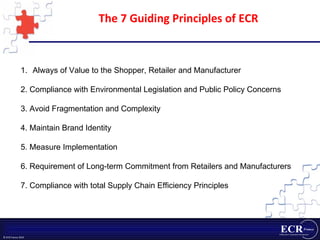
The 7 Guiding Principles of ECR Always of Value to the Shopper, Retailer and Manufacturer 2. Compliance with Environmental Legislation and Public Policy Concerns 3. Avoid Fragmentation and Complexity 4. Maintain Brand Identity 5. Measure Implementation 6. Requirement of Long-term Commitment from Retailers and Manufacturers 7. Compliance with total Supply Chain Efficiency Principles
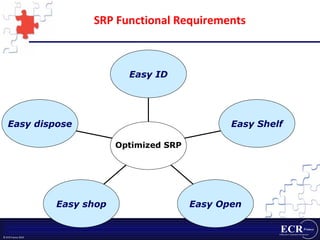
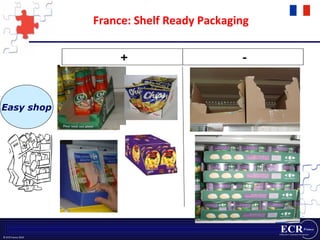
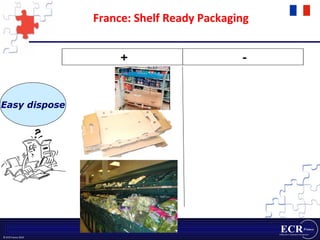
SRP Functional Requirements Easy dispose Easy shop Easy Open Easy Shelf Easy ID Optimized SRP
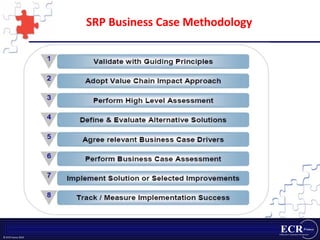
SRP Business Case Methodology
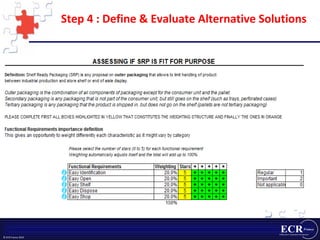
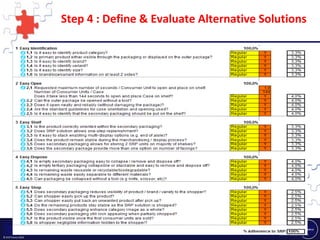
Step 4 : Define & Evaluate Alternative Solutions
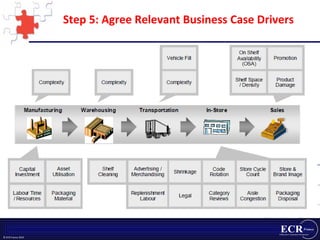
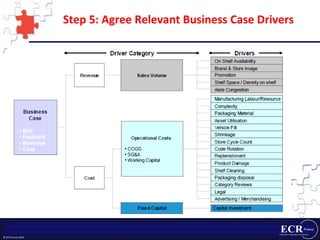
Step 5: Agree Relevant Business Case Drivers
Shelf Ready Packaging
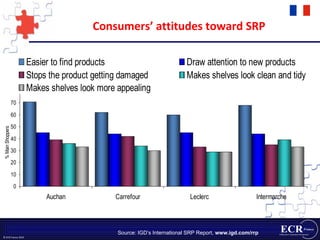
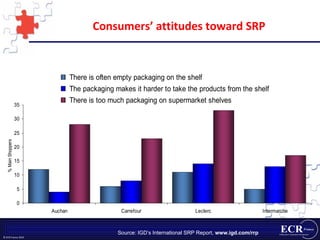
Consumers’ attitudes toward SRP Source: IGD’s International SRP Report,  www.igd.com/rrp
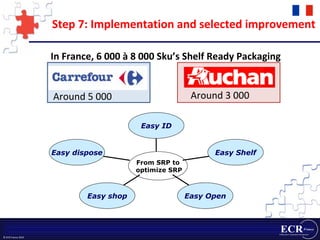
Step 7: Implementation and selected improvement In  France, 6 000 à 8 000 Sku’s Shelf Ready Packaging Around 5 000  Around 3 000  Easy dispose Easy shop Easy Open Easy Shelf Easy ID From SRP to optimize SRP
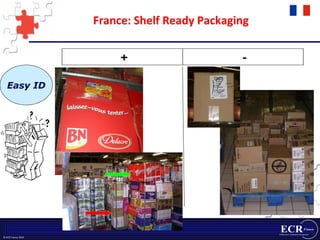
France: Shelf Ready Packaging Easy ID
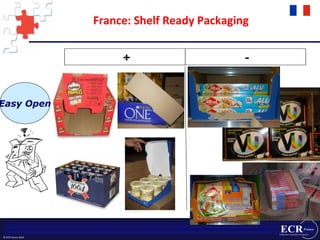
France: Shelf Ready Packaging Easy Open
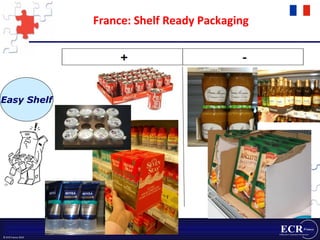
France: Shelf Ready Packaging Easy Shelf
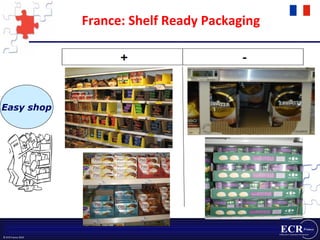
France: Shelf Ready Packaging Easy shop
France: Shelf Ready Packaging Easy dispose
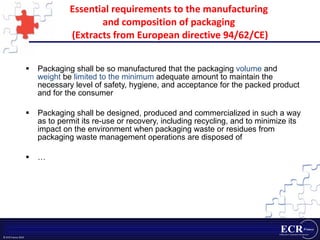
Essential requirements to the manufacturing  and composition of packaging  (Extracts from European directive 94/62/CE) Packaging shall be so manufactured that the packaging  volume  and  weight  be  limited to the minimum  adequate amount to maintain the necessary level of safety, hygiene, and acceptance for the packed product and for the consumer Packaging shall be designed, produced and commercialized in such a way as to permit its re-use or recovery, including recycling, and to minimize its impact on the environment when packaging waste or residues from packaging waste management operations are disposed of …
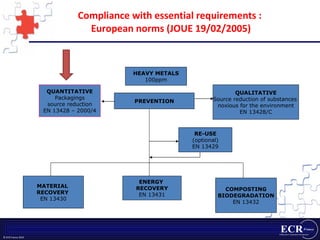
Compliance with essential requirements :  European norms (JOUE 19/02/2005) PREVENTION QUANTITATIVE Packagings source reduction EN 13428 – 2000/4 RE-USE (optional) EN 13429 MATERIAL  RECOVERY   EN 13430 ENERGY  RECOVERY EN 13431 COMPOSTING BIODEGRADATION EN 13432 HEAVY METALS 100ppm QUALITATIVE Source reduction of substances  noxious for the environment EN 13428/C
The European definition of packaging waste prevention « The reduction of the quantity & of the harmfulness for the environment of: Materials & substances contained in packaging and packaging waste Packaging and packaging waste at  production process  level and at the  marketing, distribution, utilization  and elimination stages. » This definition covers the whole life cycle of the product-packaging mix Source : European Directive 94/62/EC, 3d article
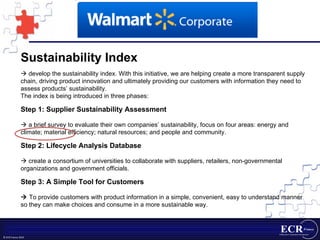
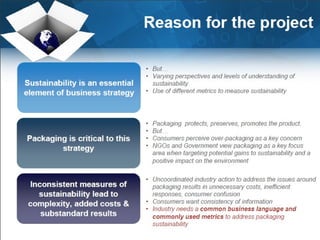
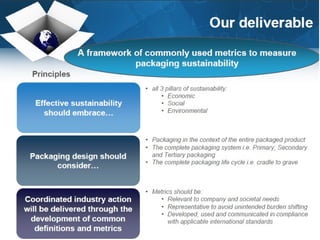
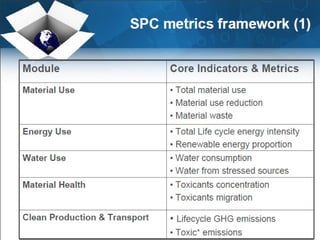
Sustainability Index    develop the sustainability index. With this initiative, we are helping create a more transparent supply chain, driving product innovation and ultimately providing our customers with information they need to assess products’ sustainability. The index is being introduced in three phases: Step 1: Supplier Sustainability Assessment    a brief survey to evaluate their own companies’ sustainability, focus on four areas: energy and climate; material efficiency; natural resources; and people and community. Step 2: Lifecycle Analysis Database    create a consortium of universities to collaborate with suppliers, retailers, non-governmental organizations and government officials. Step 3: A Simple Tool for Customers    To provide customers with product information in a simple, convenient, easy to understand manner so they can make choices and consume in a more sustainable way.


Thank you for your attention, any questions ?

Packagingandthevaluechain ol

  • 1.
    Packaging and theValue Chain: The situation of Shelf Ready Packaging ? Olivier LABASSE General manager ECR France - ECR Europe Board member
  • 2.
    Packaging: 3 levelsFrom factory to warehouse and from warehouse to point of sale, packaging system consist of: Primary packaging : Sale’s packaging for the shopper Secondary packaging : packaging of grouping (cases, boxes…) Tertiary packaging : Support packaging (pallet, trolley, container…) 1 2 3
  • 3.
  • 4.
    Fast moving/high volumeproduct on display pallet produced to order and cross-docked to store
  • 5.
    Slow moving/small volumeproduct produced to stock and picked on primary level to store order
  • 6.
    End of theSupply Chain: from the Store backroom
  • 7.
    Point of saleTo the shop floor
  • 8.
    Shelf Ready Packaging: definition and value judgement Shelf Ready Packaging (SRP) is the term used to refer to a product that comes in a ready merchandised unit which is easy to identify, easy to open, can easily be put onto the shelf and disposed of, allowing an optimisation of shelf replenishment and enhanced visibility. SRP cannot be considered as a standalone best practice, whose generalization would bring substantial and measurable benefits at the industry level. Its implementation should follow a case-by-case iterative, rather than systematic or dogmatic approach.
  • 9.
    The 7 GuidingPrinciples of ECR Always of Value to the Shopper, Retailer and Manufacturer 2. Compliance with Environmental Legislation and Public Policy Concerns 3. Avoid Fragmentation and Complexity 4. Maintain Brand Identity 5. Measure Implementation 6. Requirement of Long-term Commitment from Retailers and Manufacturers 7. Compliance with total Supply Chain Efficiency Principles
  • 10.
    SRP Functional RequirementsEasy dispose Easy shop Easy Open Easy Shelf Easy ID Optimized SRP
  • 11.
    SRP Business CaseMethodology
  • 12.
    Step 4 :Define & Evaluate Alternative Solutions
  • 13.
    Step 4 :Define & Evaluate Alternative Solutions
  • 14.
    Step 5: AgreeRelevant Business Case Drivers
  • 15.
    Step 5: AgreeRelevant Business Case Drivers
  • 16.
  • 17.
    Consumers’ attitudes towardSRP Source: IGD’s International SRP Report, www.igd.com/rrp
  • 18.
    Consumers’ attitudes towardSRP Source: IGD’s International SRP Report, www.igd.com/rrp
  • 19.
    Step 7: Implementationand selected improvement In France, 6 000 à 8 000 Sku’s Shelf Ready Packaging Around 5 000 Around 3 000 Easy dispose Easy shop Easy Open Easy Shelf Easy ID From SRP to optimize SRP
  • 20.
    France: Shelf ReadyPackaging Easy ID
  • 21.
    France: Shelf ReadyPackaging Easy Open
  • 22.
    France: Shelf ReadyPackaging Easy Shelf
  • 23.
    France: Shelf ReadyPackaging Easy shop
  • 24.
    France: Shelf ReadyPackaging Easy shop
  • 25.
    France: Shelf ReadyPackaging Easy dispose
  • 26.
    Essential requirements tothe manufacturing and composition of packaging (Extracts from European directive 94/62/CE) Packaging shall be so manufactured that the packaging volume and weight be limited to the minimum adequate amount to maintain the necessary level of safety, hygiene, and acceptance for the packed product and for the consumer Packaging shall be designed, produced and commercialized in such a way as to permit its re-use or recovery, including recycling, and to minimize its impact on the environment when packaging waste or residues from packaging waste management operations are disposed of …
  • 27.
    Compliance with essentialrequirements : European norms (JOUE 19/02/2005) PREVENTION QUANTITATIVE Packagings source reduction EN 13428 – 2000/4 RE-USE (optional) EN 13429 MATERIAL RECOVERY EN 13430 ENERGY RECOVERY EN 13431 COMPOSTING BIODEGRADATION EN 13432 HEAVY METALS 100ppm QUALITATIVE Source reduction of substances noxious for the environment EN 13428/C
  • 28.
    The European definitionof packaging waste prevention « The reduction of the quantity & of the harmfulness for the environment of: Materials & substances contained in packaging and packaging waste Packaging and packaging waste at production process level and at the marketing, distribution, utilization and elimination stages. » This definition covers the whole life cycle of the product-packaging mix Source : European Directive 94/62/EC, 3d article
  • 29.
    Sustainability Index  develop the sustainability index. With this initiative, we are helping create a more transparent supply chain, driving product innovation and ultimately providing our customers with information they need to assess products’ sustainability. The index is being introduced in three phases: Step 1: Supplier Sustainability Assessment  a brief survey to evaluate their own companies’ sustainability, focus on four areas: energy and climate; material efficiency; natural resources; and people and community. Step 2: Lifecycle Analysis Database  create a consortium of universities to collaborate with suppliers, retailers, non-governmental organizations and government officials. Step 3: A Simple Tool for Customers  To provide customers with product information in a simple, convenient, easy to understand manner so they can make choices and consume in a more sustainable way.
  • 30.
  • 31.
  • 32.
  • 33.
  • 34.
  • 35.
  • 36.
  • 37.
    Thank you foryour attention, any questions ?