Sustainex Packaging Workshop
Robert Duncan
Senior Environmental Consultant
Northern Ireland Science Park, Belfast
028 90 78 73 78
Workshop agenda
•  Packaging in your business
•  How packaging impacts on your business
and the environment
•  Eco-design principles/ considerations
•  Principles in practice/ opportunities
•  Barriers and solutions
•  Q&A session
Exercises throughout – think about YOUR
business
What exactly is resource
efficiency?
•  It is about sustainable management and use
of resources throughout their life cycle -
from extraction, transport, transformation, consumption
to the disposal of waste.
•  It means producing more value with less
material and consuming differently, to limit the risks
linked with scarcity and for less environmental
impacts, within our planet’s natural limits.
And how does this relate to
packaging?
•  Considering eco-design principles
•  Optimising packaging use
•  Selecting more sustainable materials
•  Reducing packaging waste
•  Complying with packaging Regulations
=> Cost savings for your organisation.
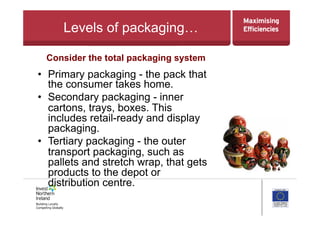
Levels of packaging…
Consider the total packaging system
•  Primary packaging - the pack that
the consumer takes home.
•  Secondary packaging - inner
cartons, trays, boxes. This
includes retail-ready and display
packaging.
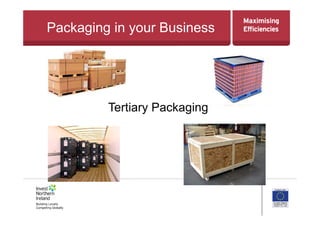
•  Tertiary packaging - the outer
transport packaging, such as
pallets and stretch wrap, that gets
products to the depot or
distribution centre.
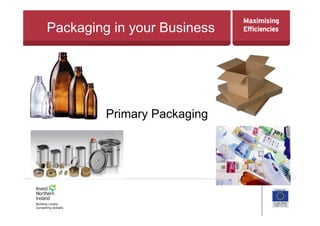
Packaging in your Business
Primary Packaging
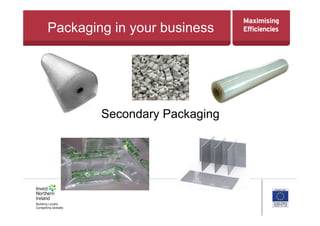
Packaging in your business
Secondary Packaging
Packaging in your Business
Tertiary Packaging
Packaging in your business
60 SECOND EXERCISE
List what types and where packaging exists
in your business
Packaging efficiency drivers
Cost Savings
•  Less material (weight/volume) costs less
•  Reduced product loss/damage costs.
•  Reduced incoming supplier packaging
results in reduced waste management
costs.
Packaging efficiency drivers
Supply Chain Pressures
•  Customers are requesting more efficient/
sustainable/green/recyclable packaging
methods which business needs to adapt to
cost effectively
•  Show your commitment to sustainability
and adapting to customer’s needs
Packaging efficiency drivers
Legislation
•  Improved packaging efficiency, tracking and reporting of
packaging consumption reduces legislative costs and
liability
– Producer responsibility obligations (packaging waste)
Regulations
– Packaging (Essential Requirements) Regulations
Non-compliance?...
A stationery supplier was taken to court and fined because goods
ordered through its website arrived in boxes which were only 7%,
19% and 29% full.
Packaging efficiency drivers
Marketing
•  Increase your company’s competitiveness
in the marketplace
•  Supporting your green credentials
(ISO14001, Carbon Footprinting etc.)
•  Good PR stories
Packaging efficiency drivers
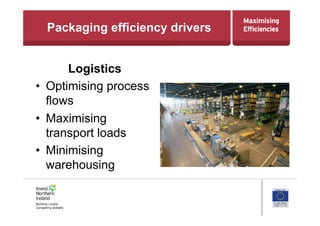
Logistics
•  Optimising process
flows
•  Maximising
transport loads
•  Minimising
warehousing
Packaging efficiency drivers
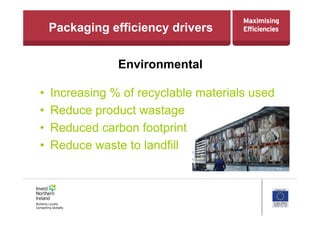
Environmental
•  Increasing % of recyclable materials used
•  Reduce product wastage
•  Reduced carbon footprint
•  Reduce waste to landfill
How packaging impacts your
business and the environment
60 SECOND EXERCISE
List your business drivers for and against
improving packaging efficiency
(choose specific examples)
Packaging eco-design
principles
•  Design for Minimisation
•  Design for Reuse
•  Design for Recycling
•  Design for composting
These principles will be
relevant to you as;
•  A customer
•  A supplier
•  An end-user
•  A packer
•  A filler
•  A distributor
Fit for Purpose?...
Remember why you use packaging…
•  Ensure product arrives in good condition
•  Protect the contents from hazards
•  Easy to open
•  Easy to carry
•  Attractive to consumers
Design for Minimisation
•  Essentially we are talking about…
– Reduce packaging volume
– Reduce packaging weight
… to the minimum required to achieve
functional requirements (Fit for purpose).
Minimisation Considerations
•  Could a change in product or packaging design
allow a reduction in the size or weight of the
packaging while maintaining its capacity?
•  Could less material be used by modifying the
volume sold, e.g. more sales units per box,
larger portions, bulk or even loose?
•  Could you reduce packaging by changing the
physical nature of the contents or by using an
alternative material?
Minimisation Considerations
•  Are additional materials such as intermediate
layers, shrink wrap, adhesives and tapes all
necessary?
•  Could the distribution system be modified in a
way that would reduce energy consumption or
the amount of packaging needed?
•  Could certain components be strengthened or
weakened to reduce overall material use?
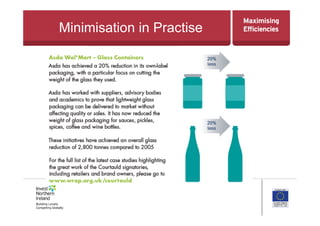
Minimisation in Practise
Minimisation in Practice
Booker – U.K.’s leading food wholesaler
•  Worked with supplier to reduce thickness of stretch wrap from
17µm to 7µm whilst keeping the wrapping technique the same.
•  A reduction in average film usage per
pallet from 303g to 125g
•  A reduction in annual film consumption
from 315t to 130t
•  Carbon emission reductions of 500t/yr
•  Greater than 50% saving in film cost
•  Improved load consolidation
• • 
Minimisation in Practise
Other minimisation opportunities
•  Review light-weighting of all packaging
(e.g. glass, plastic, cans, cartons etc.)
•  Reducing corrugated cardboard thickness
•  Removing unnecessary virgin layers,
inserts or replacing with (otherwise)
packaging waste.
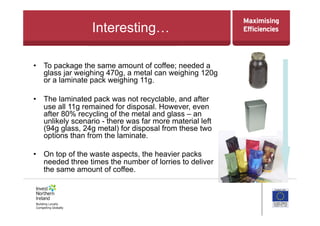
Interesting…
•  To package the same amount of coffee; needed a
glass jar weighing 470g, a metal can weighing 120g
or a laminate pack weighing 11g.
•  The laminated pack was not recyclable, and after
use all 11g remained for disposal. However, even
after 80% recycling of the metal and glass – an
unlikely scenario - there was far more material left
(94g glass, 24g metal) for disposal from these two
options than from the laminate.
•  On top of the waste aspects, the heavier packs
needed three times the number of lorries to deliver
the same amount of coffee.
Minimisation Opportunities
60 SECOND EXERCISE
List what packaging minimisation
opportunities may exist in YOUR business
Design for Reuse
•  Essentially we are talking about…
– design to minimise lifecycle impacts, e.g. by
maximising return rates.
– design for ‘closed loop’ reuse in preference to
an alternative use.
… without compromising functional
requirements (Fit for purpose!).
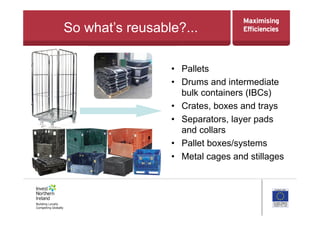
So what’s reusable?...
•  Pallets
•  Drums and intermediate
bulk containers (IBCs)
•  Crates, boxes and trays
•  Separators, layer pads
and collars
•  Pallet boxes/systems
•  Metal cages and stillages
Reuse Considerations
•  Ensure that the packaging is designed for and
is robust enough for re-use.
•  Check that your business partners will also
treat the packaging as re-usable and will return
it as appropriate, or that collection
arrangements are in place to enable private
end-users to return it.
•  Additional storage space will likely be required.
Reuse Considerations
•  Ensure that facilities for cleaning, repair or
reconditioning are available if this is necessary
before the packaging can be re-used.
•  Obtain written confirmation from your supplier
that the packaging is capable of re-use, and
confirmation from your customers that they
intend to place the packaging into a re-use
circuit.
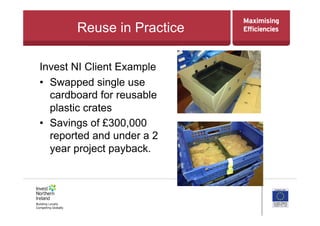
Reuse in Practice
Invest NI Client Example
•  Swapped single use
cardboard for reusable
plastic crates
•  Savings of £300,000
reported and under a 2
year project payback.
Reuse in Practice
Invest NI Client Example
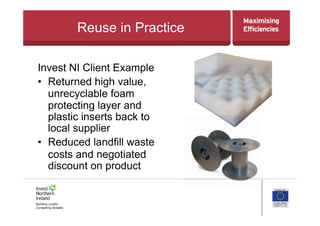
•  Returned high value,
unrecyclable foam
protecting layer and
plastic inserts back to
local supplier
•  Reduced landfill waste
costs and negotiated
discount on product
Reuse in Practice
Other reuse opportunities
•  Reusing incoming supplier packaging (e.g. boxes,
crates etc.) for outgoing product dispatch
•  Reusing incoming supplier packaging for internal
movement of product
•  Store and reuse bubble wrap, air pockets etc.
•  Engage frequent suppliers/customers to swap multiple
deliveries of single use packaging with one combined
reusable packaging container
•  Return secondary and tertiary packaging to supplier
Reuse Opportunities
60 SECOND EXERCISE
List what packaging reuse opportunities may
exist in YOUR business
Design for Recycling
•  Essentially we are talking about…
– specifying a material with an existing and widespread
system for recovery
– if possible using only one material, if not using
materials which are easy for you/the consumer to
separate or do not contaminate recycling systems
– Using the maximum amount of recycled content that’s
physically possible (preferably post-consumer).
… without compromising functional requirements (Fit for
purpose!).
Recycling Considerations
•  Try to avoid materials, combinations of
materials or designs of packaging that might
create problems in collecting, sorting or
recycling.
•  Minimise the use of substances or materials
that might create technical, environmental or
health problems in the recycling process or in
the disposal of recycling residues.
Recycling Considerations
•  Construct your packaging so that the end-user can easily
separate any components that should not go into the
recycling process (‘design for disassembly’).
•  Can you have a policy for ‘recyclable’ single use
packaging only?
•  Minimise the use of substances or materials that might
have a negative influence on the quality of the recycled
material. For example, do you need a colour tint on your
plastic bottle or could you achieve the same effect with
an eye-catching label?
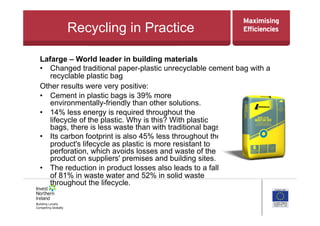
Recycling in Practice
Other results were very positive:
•  Cement in plastic bags is 39% more
environmentally-friendly than other solutions.
•  14% less energy is required throughout the
lifecycle of the plastic. Why is this? With plastic
bags, there is less waste than with traditional bags.
•  Its carbon footprint is also 45% less throughout the
product's lifecycle as plastic is more resistant to
perforation, which avoids losses and waste of the
product on suppliers' premises and building sites.
•  The reduction in product losses also leads to a fall
of 81% in waste water and 52% in solid waste
throughout the lifecycle.
Lafarge – World leader in building materials
•  Changed traditional paper-plastic unrecyclable cement bag with a
recyclable plastic bag
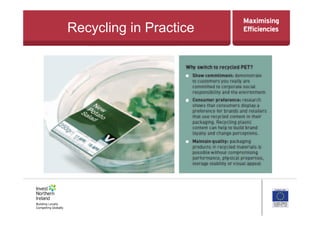
Recycling in Practice
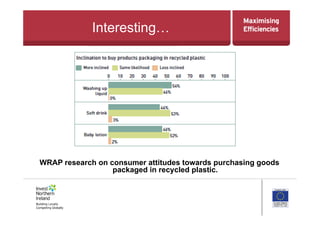
Interesting…
WRAP research on consumer attitudes towards purchasing goods
packaged in recycled plastic.
Design for Composting
•  Essentially we are talking about…
– specifying compostable rather than oxo-
degradable materials
– ensuring that a system is available for
collection and processing.
… without compromising functional
requirements (Fit for purpose!).
Composting Considerations
•  Will your compostable packaging be
lighter or heavier than the packaging it
replaces?
•  Will the use of biopolymers adversely
affect the contents of your packaging?
•  Clear and conspicuous labelling is
essential to prevent it ending up in landfill!
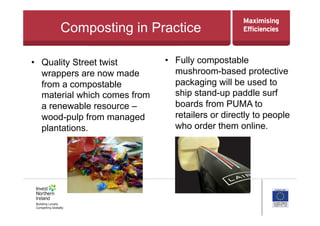
Composting in Practice
•  Quality Street twist
wrappers are now made
from a compostable
material which comes from
a renewable resource –
wood-pulp from managed
plantations.
•  Fully compostable
mushroom-based protective
packaging will be used to
ship stand-up paddle surf
boards from PUMA to
retailers or directly to people
who order them online.
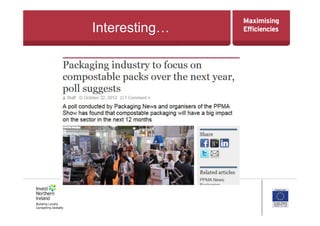
Interesting…
Recycling and Composting
Opportunities
60 SECOND EXERCISE
List what packaging recycling and
composting opportunities may exist in
YOUR business
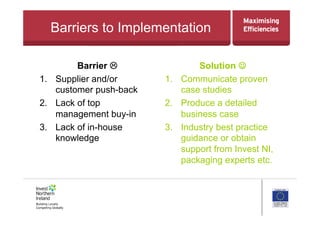
Barriers to Implementation
Barrier 
1.  Supplier and/or
customer push-back
2.  Lack of top
management buy-in
3.  Lack of in-house
knowledge
Solution 
1.  Communicate proven
case studies
2.  Produce a detailed
business case
3.  Industry best practice
guidance or obtain
support from Invest NI,
packaging experts etc.
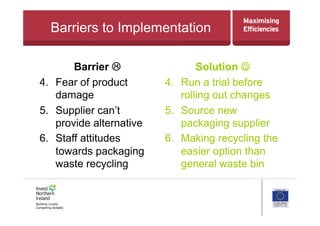
Barriers to Implementation
Barrier 
4.  Fear of product
damage
5.  Supplier can’t
provide alternative
6.  Staff attitudes
towards packaging
waste recycling
Solution 
4.  Run a trial before
rolling out changes
5.  Source new
packaging supplier
6.  Making recycling the
easier option than
general waste bin
Want to learn more?...
•  Envirowise PackGuide: A guide to
packaging eco-design - GG908
•  NI Business Info Packaging
www.nibusinessinfo.co.uk/content/types-
reusable-packaging
•  Industry Council for Packaging and the
Environment - www.incpen.org
Questions?
Thank you for your time today.
1-to-1 discussions available after the
session, just ask!
Or
Get in touch:
 duncan@mabbett.eu
 fiona.walker@investni.com

Sustainex 2013 - Packaging Design Regulations Robert Duncan (PDF)

  • 1.
    Sustainex Packaging Workshop RobertDuncan Senior Environmental Consultant Northern Ireland Science Park, Belfast 028 90 78 73 78
  • 2.
    Workshop agenda •  Packagingin your business •  How packaging impacts on your business and the environment •  Eco-design principles/ considerations •  Principles in practice/ opportunities •  Barriers and solutions •  Q&A session Exercises throughout – think about YOUR business
  • 3.
    What exactly isresource efficiency? •  It is about sustainable management and use of resources throughout their life cycle - from extraction, transport, transformation, consumption to the disposal of waste. •  It means producing more value with less material and consuming differently, to limit the risks linked with scarcity and for less environmental impacts, within our planet’s natural limits.
  • 4.
    And how doesthis relate to packaging? •  Considering eco-design principles •  Optimising packaging use •  Selecting more sustainable materials •  Reducing packaging waste •  Complying with packaging Regulations => Cost savings for your organisation.
  • 5.
    Levels of packaging… Considerthe total packaging system •  Primary packaging - the pack that the consumer takes home. •  Secondary packaging - inner cartons, trays, boxes. This includes retail-ready and display packaging. •  Tertiary packaging - the outer transport packaging, such as pallets and stretch wrap, that gets products to the depot or distribution centre.
  • 6.
    Packaging in yourBusiness Primary Packaging
  • 7.
    Packaging in yourbusiness Secondary Packaging
  • 8.
    Packaging in yourBusiness Tertiary Packaging
  • 9.
    Packaging in yourbusiness 60 SECOND EXERCISE List what types and where packaging exists in your business
  • 10.
    Packaging efficiency drivers CostSavings •  Less material (weight/volume) costs less •  Reduced product loss/damage costs. •  Reduced incoming supplier packaging results in reduced waste management costs.
  • 11.
    Packaging efficiency drivers SupplyChain Pressures •  Customers are requesting more efficient/ sustainable/green/recyclable packaging methods which business needs to adapt to cost effectively •  Show your commitment to sustainability and adapting to customer’s needs
  • 12.
    Packaging efficiency drivers Legislation • Improved packaging efficiency, tracking and reporting of packaging consumption reduces legislative costs and liability – Producer responsibility obligations (packaging waste) Regulations – Packaging (Essential Requirements) Regulations Non-compliance?... A stationery supplier was taken to court and fined because goods ordered through its website arrived in boxes which were only 7%, 19% and 29% full.
  • 13.
    Packaging efficiency drivers Marketing • Increase your company’s competitiveness in the marketplace •  Supporting your green credentials (ISO14001, Carbon Footprinting etc.) •  Good PR stories
  • 14.
    Packaging efficiency drivers Logistics • Optimising process flows •  Maximising transport loads •  Minimising warehousing
  • 15.
    Packaging efficiency drivers Environmental • Increasing % of recyclable materials used •  Reduce product wastage •  Reduced carbon footprint •  Reduce waste to landfill
  • 16.
    How packaging impactsyour business and the environment 60 SECOND EXERCISE List your business drivers for and against improving packaging efficiency (choose specific examples)
  • 17.
    Packaging eco-design principles •  Designfor Minimisation •  Design for Reuse •  Design for Recycling •  Design for composting These principles will be relevant to you as; •  A customer •  A supplier •  An end-user •  A packer •  A filler •  A distributor
  • 18.
    Fit for Purpose?... Rememberwhy you use packaging… •  Ensure product arrives in good condition •  Protect the contents from hazards •  Easy to open •  Easy to carry •  Attractive to consumers
  • 19.
    Design for Minimisation • Essentially we are talking about… – Reduce packaging volume – Reduce packaging weight … to the minimum required to achieve functional requirements (Fit for purpose).
  • 20.
    Minimisation Considerations •  Coulda change in product or packaging design allow a reduction in the size or weight of the packaging while maintaining its capacity? •  Could less material be used by modifying the volume sold, e.g. more sales units per box, larger portions, bulk or even loose? •  Could you reduce packaging by changing the physical nature of the contents or by using an alternative material?
  • 21.
    Minimisation Considerations •  Areadditional materials such as intermediate layers, shrink wrap, adhesives and tapes all necessary? •  Could the distribution system be modified in a way that would reduce energy consumption or the amount of packaging needed? •  Could certain components be strengthened or weakened to reduce overall material use?
  • 22.
  • 23.
    Minimisation in Practice Booker– U.K.’s leading food wholesaler •  Worked with supplier to reduce thickness of stretch wrap from 17µm to 7µm whilst keeping the wrapping technique the same. •  A reduction in average film usage per pallet from 303g to 125g •  A reduction in annual film consumption from 315t to 130t •  Carbon emission reductions of 500t/yr •  Greater than 50% saving in film cost •  Improved load consolidation • • 
  • 24.
    Minimisation in Practise Otherminimisation opportunities •  Review light-weighting of all packaging (e.g. glass, plastic, cans, cartons etc.) •  Reducing corrugated cardboard thickness •  Removing unnecessary virgin layers, inserts or replacing with (otherwise) packaging waste.
  • 25.
    Interesting… •  To packagethe same amount of coffee; needed a glass jar weighing 470g, a metal can weighing 120g or a laminate pack weighing 11g. •  The laminated pack was not recyclable, and after use all 11g remained for disposal. However, even after 80% recycling of the metal and glass – an unlikely scenario - there was far more material left (94g glass, 24g metal) for disposal from these two options than from the laminate. •  On top of the waste aspects, the heavier packs needed three times the number of lorries to deliver the same amount of coffee.
  • 26.
    Minimisation Opportunities 60 SECONDEXERCISE List what packaging minimisation opportunities may exist in YOUR business
  • 27.
    Design for Reuse • Essentially we are talking about… – design to minimise lifecycle impacts, e.g. by maximising return rates. – design for ‘closed loop’ reuse in preference to an alternative use. … without compromising functional requirements (Fit for purpose!).
  • 28.
    So what’s reusable?... • Pallets •  Drums and intermediate bulk containers (IBCs) •  Crates, boxes and trays •  Separators, layer pads and collars •  Pallet boxes/systems •  Metal cages and stillages
  • 29.
    Reuse Considerations •  Ensurethat the packaging is designed for and is robust enough for re-use. •  Check that your business partners will also treat the packaging as re-usable and will return it as appropriate, or that collection arrangements are in place to enable private end-users to return it. •  Additional storage space will likely be required.
  • 30.
    Reuse Considerations •  Ensurethat facilities for cleaning, repair or reconditioning are available if this is necessary before the packaging can be re-used. •  Obtain written confirmation from your supplier that the packaging is capable of re-use, and confirmation from your customers that they intend to place the packaging into a re-use circuit.
  • 31.
    Reuse in Practice InvestNI Client Example •  Swapped single use cardboard for reusable plastic crates •  Savings of £300,000 reported and under a 2 year project payback.
  • 32.
    Reuse in Practice InvestNI Client Example •  Returned high value, unrecyclable foam protecting layer and plastic inserts back to local supplier •  Reduced landfill waste costs and negotiated discount on product
  • 33.
    Reuse in Practice Otherreuse opportunities •  Reusing incoming supplier packaging (e.g. boxes, crates etc.) for outgoing product dispatch •  Reusing incoming supplier packaging for internal movement of product •  Store and reuse bubble wrap, air pockets etc. •  Engage frequent suppliers/customers to swap multiple deliveries of single use packaging with one combined reusable packaging container •  Return secondary and tertiary packaging to supplier
  • 34.
    Reuse Opportunities 60 SECONDEXERCISE List what packaging reuse opportunities may exist in YOUR business
  • 35.
    Design for Recycling • Essentially we are talking about… – specifying a material with an existing and widespread system for recovery – if possible using only one material, if not using materials which are easy for you/the consumer to separate or do not contaminate recycling systems – Using the maximum amount of recycled content that’s physically possible (preferably post-consumer). … without compromising functional requirements (Fit for purpose!).
  • 36.
    Recycling Considerations •  Tryto avoid materials, combinations of materials or designs of packaging that might create problems in collecting, sorting or recycling. •  Minimise the use of substances or materials that might create technical, environmental or health problems in the recycling process or in the disposal of recycling residues.
  • 37.
    Recycling Considerations •  Constructyour packaging so that the end-user can easily separate any components that should not go into the recycling process (‘design for disassembly’). •  Can you have a policy for ‘recyclable’ single use packaging only? •  Minimise the use of substances or materials that might have a negative influence on the quality of the recycled material. For example, do you need a colour tint on your plastic bottle or could you achieve the same effect with an eye-catching label?
  • 38.
    Recycling in Practice Otherresults were very positive: •  Cement in plastic bags is 39% more environmentally-friendly than other solutions. •  14% less energy is required throughout the lifecycle of the plastic. Why is this? With plastic bags, there is less waste than with traditional bags. •  Its carbon footprint is also 45% less throughout the product's lifecycle as plastic is more resistant to perforation, which avoids losses and waste of the product on suppliers' premises and building sites. •  The reduction in product losses also leads to a fall of 81% in waste water and 52% in solid waste throughout the lifecycle. Lafarge – World leader in building materials •  Changed traditional paper-plastic unrecyclable cement bag with a recyclable plastic bag
  • 39.
  • 40.
    Interesting… WRAP research onconsumer attitudes towards purchasing goods packaged in recycled plastic.
  • 41.
    Design for Composting • Essentially we are talking about… – specifying compostable rather than oxo- degradable materials – ensuring that a system is available for collection and processing. … without compromising functional requirements (Fit for purpose!).
  • 42.
    Composting Considerations •  Willyour compostable packaging be lighter or heavier than the packaging it replaces? •  Will the use of biopolymers adversely affect the contents of your packaging? •  Clear and conspicuous labelling is essential to prevent it ending up in landfill!
  • 43.
    Composting in Practice • Quality Street twist wrappers are now made from a compostable material which comes from a renewable resource – wood-pulp from managed plantations. •  Fully compostable mushroom-based protective packaging will be used to ship stand-up paddle surf boards from PUMA to retailers or directly to people who order them online.
  • 44.
  • 45.
    Recycling and Composting Opportunities 60SECOND EXERCISE List what packaging recycling and composting opportunities may exist in YOUR business
  • 46.
    Barriers to Implementation Barrier 1.  Supplier and/or customer push-back 2.  Lack of top management buy-in 3.  Lack of in-house knowledge Solution  1.  Communicate proven case studies 2.  Produce a detailed business case 3.  Industry best practice guidance or obtain support from Invest NI, packaging experts etc.
  • 47.
    Barriers to Implementation Barrier 4.  Fear of product damage 5.  Supplier can’t provide alternative 6.  Staff attitudes towards packaging waste recycling Solution  4.  Run a trial before rolling out changes 5.  Source new packaging supplier 6.  Making recycling the easier option than general waste bin
  • 48.
    Want to learnmore?... •  Envirowise PackGuide: A guide to packaging eco-design - GG908 •  NI Business Info Packaging www.nibusinessinfo.co.uk/content/types- reusable-packaging •  Industry Council for Packaging and the Environment - www.incpen.org
  • 49.
    Questions? Thank you foryour time today. 1-to-1 discussions available after the session, just ask! Or Get in touch:  duncan@mabbett.eu  fiona.walker@investni.com