CoPPAC Presentation
October 13th, 2015
2014 – The New PAC
The vital partner and catalyst for
the packaging value chain
Formally Launched April 2014
2014 – The New PAC
In 2014, PAC connected >3000 people
PAC 48 Tours, Seminars, Social & Education
13 Facility tours, 300+ attendees.
3 Seminars, 200+ attendees.
6 Social activities, 500+ attendees.
2 Summit/Symposium, 700+ attendees.
10 Webinars, 1000+ attendees.
14 In-class courses, 180+ attendees.
Network
Throughout Life
PAC educates industry
8 in-class courses
In April 2014, PAC NEXT launched
The Ultimate Packaging Optimization Course
“Got me excited to really dive into our company’s plan and develop a strong strategy”
– Joanna Caners, Home Depot
15 on-line courses
PAC can customize courses & present in-house
On-Line Courses
6
VISION
A World Without Packaging Waste
PURPOSE
To facilitate the convergence of ideas and identify
sustainable solutions that lead to zero packaging waste
GOAL
To minimize recovery system cost while maximizing
recycling rates and the value of recovered materials
Launched August 3, 2011
Launched December 5, 2013
VISION
A Catalyst for Food Waste Packaging Solutions
GOAL
To maximize the reduction of food waste through
prevention and extension of shelf life utilizing
sustainable packaging solutions
INDUSTRY TRENDS & DRIVERS
Circular Economy
Curbside collection & recovery costs ca. $1billion / yr
10
(1) Canada Wide Action Plan for EPR 2009
(2) Estimate – US GDP 10x Canada GDP
A $2billion(1) - 20billion(2) opportunity?
Value of pkg materials that go to landfill > $1.1 billion / yr
11
Circular Economy & Life Cycle Thinking
12
Packaging that can be easily separated into Re-
usable or Recyclable or Renewable materials
Packaging that can be readily
dis-assembled into biological
and technical nutrients
Circular Economy & Life Cycle Thinking
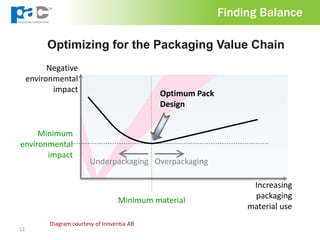
Optimizing for the Packaging Value Chain
13
Negative
environmental
impact
Increasing
packaging
material use
Minimum material
OverpackagingUnderpackaging
Optimum Pack
Design
Minimum
environmental
impact
Diagram courtesy of Innventia AB
Finding Balance
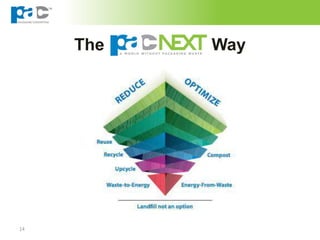
The Way
14
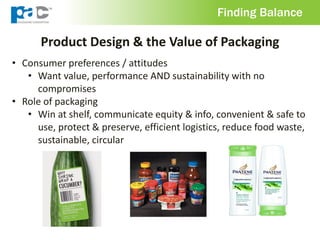
• Consumer preferences / attitudes
• Want value, performance AND sustainability with no
compromises
• Role of packaging
• Win at shelf, communicate equity & info, convenient & safe to
use, protect & preserve, efficient logistics, reduce food waste,
sustainable, circular
Product Design & the Value of Packaging
Finding Balance
Designs That Work in MRFs
• What is a MRF?
– MRF stands for Material Recovery Facility
– MRFs receive collected materials for recycling where it is sorted
and baled for processing based on available end markets
– It is important that the materials which
come out of the MRF are clean, properly
sorted and relatively free of impurities
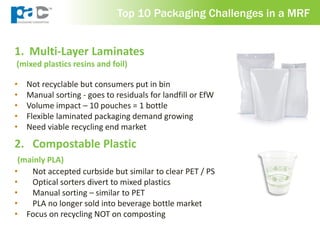
1. Multi-Layer Laminates
(mixed plastics resins and foil)
• Not recyclable but consumers put in bin
• Manual sorting - goes to residuals for landfill or EfW
• Volume impact – 10 pouches = 1 bottle
• Flexible laminated packaging demand growing
• Need viable recycling end market
17
Top 10 Packaging Challenges in a MRF
2. Compostable Plastic
(mainly PLA)
• Not accepted curbside but similar to clear PET / PS
• Optical sorters divert to mixed plastics
• Manual sorting – similar to PET
• PLA no longer sold into beverage bottle market
• Focus on recycling NOT on composting
3. Black Plastic Containers
• Variable acceptance curbside
• Manual sorting to mixed plastics
(Optical sorters not effective)
• Other colors preferred or additives – easier to sort
18
4. Full Shrink Wrap Label
• Accepted curbside
• Full labels can confuse optical sorters
• APR Design for Recyclability guidelines
- Label floats in water
- Ink does not stain rPET
- Partial label preferred
Top 10 Packaging Challenges in a MRF
5. Hot Beverage Polycoated Cups
• Variable acceptance curbside
• Keep lid separate from cup – rinsed / clean
• Manually sorting to polycoated containers (high
value) or mixed paper stream (lower value)
• Optical sorters for fibers – then manual sort
19
6. Metallized Tubes
• Not accepted curbside but consumers put in bins
• Ends up in residuals going to landfill or efw
• Enval developing technology to separate foil / plastic
Top 10 Packaging Challenges in a MRF
7. Single-Serve Hot Beverage Pods
• Not accepted curbside but consumers put in bin
• Small – contaminates glass stream
• Design for dis-assembly, recyclable plastics and
compostable plastics
20
8. Colored Opaque PET
• Accepted curbside but contaminates
clear PET
• Requires manual sorting to mixed plastics
• Clear PET preferred
Top 10 Packaging Challenges in a MRF
9. Non-PET Clamshells
• Similar to clear PET
• Optical sorters send to mixed plastics
• APR guidelines – use labels, inks & adhesives that
can be easily removed
21
10. Cardboard Tray with Plastic Film
• Requires manual separation of materials otherwise
plastic & board goes to landfill
• Municipality P&E programs – separate materials or
avoid mixed materials
Top 10 Packaging Challenges in a MRF
- One of most
popular articles
of past months
- More than 2,000
Page Views
- Keep building
this momentum
Packaging Innovation Gateway
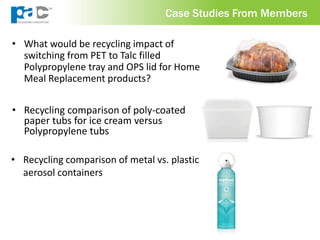
• What would be recycling impact of
switching from PET to Talc filled
Polypropylene tray and OPS lid for Home
Meal Replacement products?
Case Studies From Members
• Recycling comparison of poly-coated
paper tubs for ice cream versus
Polypropylene tubs
• Recycling comparison of metal vs. plastic
aerosol containers
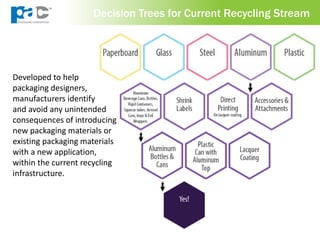
Decision Trees for Current Recycling Stream
Developed to help
packaging designers,
manufacturers identify
and avoid any unintended
consequences of introducing
new packaging materials or
existing packaging materials
with a new application,
within the current recycling
infrastructure.
Food Security
26
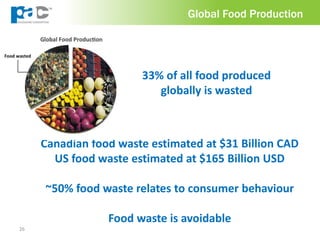
Canadian food waste estimated at $31 Billion CAD
US food waste estimated at $165 Billion USD
~50% food waste relates to consumer behaviour
Food waste is avoidable
Global Food Production
33% of all food produced
globally is wasted
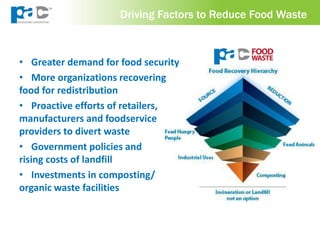
Driving Factors to Reduce Food Waste
• Greater demand for food security
• More organizations recovering
food for redistribution
• Proactive efforts of retailers,
manufacturers and foodservice
providers to divert waste
• Government policies and
rising costs of landfill
• Investments in composting/
organic waste facilities
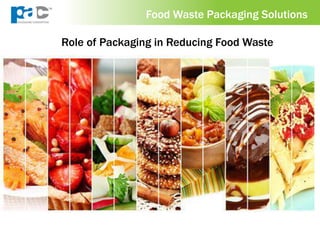
Food Waste Packaging Solutions
Role of Packaging in Reducing Food Waste
29
Consumer Beliefs vs. Behaviours
Harris Poll 2014 commissioned by Sealed Air
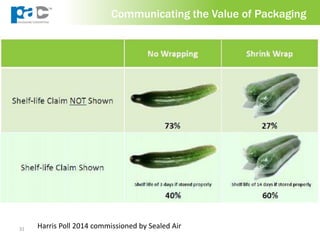
30 Harris Poll 2014 commissioned by Sealed Air
Consumer Beliefs vs. Behaviours
31 Harris Poll 2014 commissioned by Sealed Air
Communicating the Value of Packaging
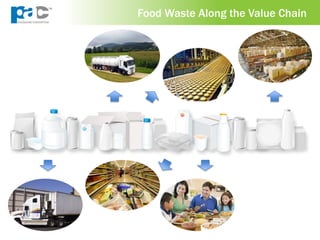
Food Waste Along the Value Chain
Consumer
Raw material
transportation
Manufacturing/
processing
Warehousing/
storage
Finished goods
transportation
Point of purchase –
Retail or Food Service Post-consumer
Product source – Farm
9%
1-2%
1-2%
18%
51%
17%
1-2%
Food Waste Along the Value Chain
Key functions of packaging to tackle food waste
PROTECT PRODUCT
EXTEND SHELF LIFE
PROMOTE BEHAVIOUR CHANGE
Food Waste Packaging Solutions
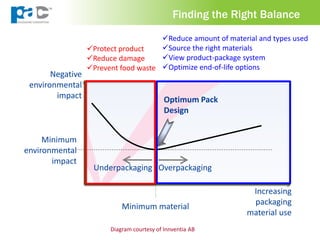
Negative
environmental
impact
Increasing
packaging
material use
Minimum material
OverpackagingUnderpackaging
Optimum Pack
Design
Minimum
environmental
impact
Diagram courtesy of Innventia AB
Protect product
Reduce damage
Prevent food waste
Reduce amount of material and types used
Source the right materials
View product-package system
Optimize end-of-life options
Finding the Right Balance
Source: RMIT, 2013
Finding the Right Balance
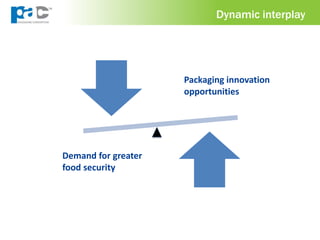
Packaging innovation
opportunities
Demand for greater
food security
Dynamic interplay
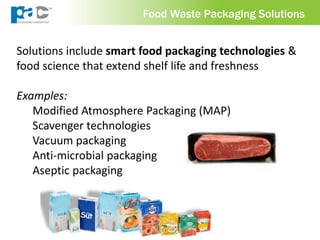
Solutions include smart food packaging technologies &
food science that extend shelf life and freshness
Examples:
Modified Atmosphere Packaging (MAP)
Scavenger technologies
Vacuum packaging
Anti-microbial packaging
Aseptic packaging
Food Waste Packaging Solutions
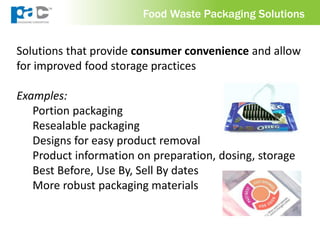
Solutions that provide consumer convenience and allow
for improved food storage practices
Examples:
Portion packaging
Resealable packaging
Designs for easy product removal
Product information on preparation, dosing, storage
Best Before, Use By, Sell By dates
More robust packaging materials
Food Waste Packaging Solutions
Project Highlights
• PAC FOOD WASTE's three inaugural projects
explore the relationships between smart,
innovative packaging and causes of food waste
along the food value chain.
o Food Waste Reduction Case Studies
o Who’s Who of Packaging and Food Waste
Initiatives
o Single-Serve Coffee Life Cycle Assessment
Consumer
Raw material
transportation
Manufacturing/
processing
Warehousing/
storage
Finished goods
transportation
Point of purchase –
Retail or Food Service
Food Waste Packaging Case Studies
INNOVATION AREAS
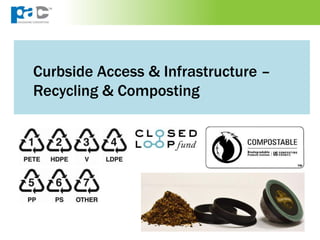
Curbside Access & Infrastructure –
Recycling & Composting
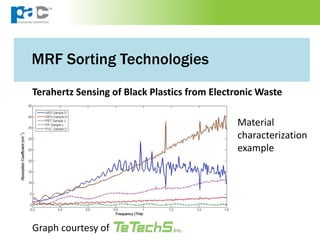
Terahertz Sensing of Black Plastics from Electronic Waste
Graph courtesy of
Material
characterization
example
MRF Sorting Technologies
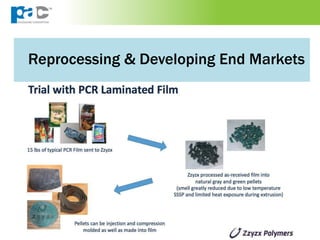
Reprocessing & Developing End Markets
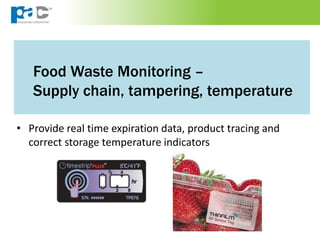
Food Waste Monitoring –
Supply chain, tampering, temperature
• Provide real time expiration data, product tracing and
correct storage temperature indicators
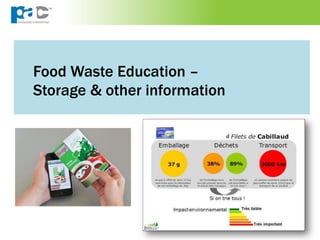
Food Waste Education –
Storage & other information
Innovation & Design
PAC Global Leadership Awards
Awards Gala – April 22, 2015
First North American Sustainable Packaging
Awards launched in 2008.
First North American Food Waste Packaging
Awards launched in 2015.
Brand Marketing fastest growing category.
Competition open to all!
Packaging Competitions
Global Competitions
51
Sustainable Packaging Award Winners 2015
Food Waste Awards 2015
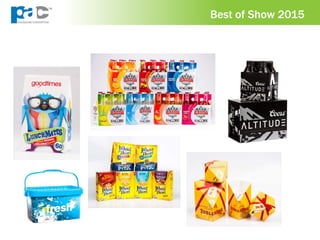
Best of Show 2015
Best of Show 2015
55
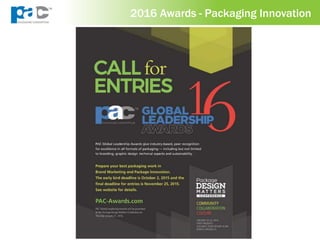
2016 Awards - Packaging Innovation
PAC Website
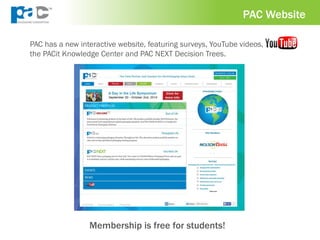
PAC has a new interactive website, featuring surveys, YouTube videos,
the PACit Knowledge Center and PAC NEXT Decision Trees.
PAC Website
Membership is free for students!
Thank you!
Contact:
Rachel Morier, BTech, MES
Program Manager, Packaging & Food Waste
416.727.3512
rmorier@pac.ca
Learn more at pac.ca!

Sustainable Solutions for Packaging 2015

  • 1.
  • 2.
    2014 – TheNew PAC The vital partner and catalyst for the packaging value chain Formally Launched April 2014 2014 – The New PAC
  • 3.
    In 2014, PACconnected >3000 people PAC 48 Tours, Seminars, Social & Education 13 Facility tours, 300+ attendees. 3 Seminars, 200+ attendees. 6 Social activities, 500+ attendees. 2 Summit/Symposium, 700+ attendees. 10 Webinars, 1000+ attendees. 14 In-class courses, 180+ attendees. Network
  • 4.
    Throughout Life PAC educatesindustry 8 in-class courses In April 2014, PAC NEXT launched The Ultimate Packaging Optimization Course “Got me excited to really dive into our company’s plan and develop a strong strategy” – Joanna Caners, Home Depot 15 on-line courses PAC can customize courses & present in-house
  • 5.
  • 6.
    6 VISION A World WithoutPackaging Waste PURPOSE To facilitate the convergence of ideas and identify sustainable solutions that lead to zero packaging waste GOAL To minimize recovery system cost while maximizing recycling rates and the value of recovered materials Launched August 3, 2011
  • 7.
    Launched December 5,2013 VISION A Catalyst for Food Waste Packaging Solutions GOAL To maximize the reduction of food waste through prevention and extension of shelf life utilizing sustainable packaging solutions
  • 8.
  • 9.
  • 10.
    Curbside collection &recovery costs ca. $1billion / yr 10 (1) Canada Wide Action Plan for EPR 2009 (2) Estimate – US GDP 10x Canada GDP A $2billion(1) - 20billion(2) opportunity? Value of pkg materials that go to landfill > $1.1 billion / yr
  • 11.
    11 Circular Economy &Life Cycle Thinking
  • 12.
    12 Packaging that canbe easily separated into Re- usable or Recyclable or Renewable materials Packaging that can be readily dis-assembled into biological and technical nutrients Circular Economy & Life Cycle Thinking
  • 13.
    Optimizing for thePackaging Value Chain 13 Negative environmental impact Increasing packaging material use Minimum material OverpackagingUnderpackaging Optimum Pack Design Minimum environmental impact Diagram courtesy of Innventia AB Finding Balance
  • 14.
  • 15.
    • Consumer preferences/ attitudes • Want value, performance AND sustainability with no compromises • Role of packaging • Win at shelf, communicate equity & info, convenient & safe to use, protect & preserve, efficient logistics, reduce food waste, sustainable, circular Product Design & the Value of Packaging Finding Balance
  • 16.
    Designs That Workin MRFs • What is a MRF? – MRF stands for Material Recovery Facility – MRFs receive collected materials for recycling where it is sorted and baled for processing based on available end markets – It is important that the materials which come out of the MRF are clean, properly sorted and relatively free of impurities
  • 17.
    1. Multi-Layer Laminates (mixedplastics resins and foil) • Not recyclable but consumers put in bin • Manual sorting - goes to residuals for landfill or EfW • Volume impact – 10 pouches = 1 bottle • Flexible laminated packaging demand growing • Need viable recycling end market 17 Top 10 Packaging Challenges in a MRF 2. Compostable Plastic (mainly PLA) • Not accepted curbside but similar to clear PET / PS • Optical sorters divert to mixed plastics • Manual sorting – similar to PET • PLA no longer sold into beverage bottle market • Focus on recycling NOT on composting
  • 18.
    3. Black PlasticContainers • Variable acceptance curbside • Manual sorting to mixed plastics (Optical sorters not effective) • Other colors preferred or additives – easier to sort 18 4. Full Shrink Wrap Label • Accepted curbside • Full labels can confuse optical sorters • APR Design for Recyclability guidelines - Label floats in water - Ink does not stain rPET - Partial label preferred Top 10 Packaging Challenges in a MRF
  • 19.
    5. Hot BeveragePolycoated Cups • Variable acceptance curbside • Keep lid separate from cup – rinsed / clean • Manually sorting to polycoated containers (high value) or mixed paper stream (lower value) • Optical sorters for fibers – then manual sort 19 6. Metallized Tubes • Not accepted curbside but consumers put in bins • Ends up in residuals going to landfill or efw • Enval developing technology to separate foil / plastic Top 10 Packaging Challenges in a MRF
  • 20.
    7. Single-Serve HotBeverage Pods • Not accepted curbside but consumers put in bin • Small – contaminates glass stream • Design for dis-assembly, recyclable plastics and compostable plastics 20 8. Colored Opaque PET • Accepted curbside but contaminates clear PET • Requires manual sorting to mixed plastics • Clear PET preferred Top 10 Packaging Challenges in a MRF
  • 21.
    9. Non-PET Clamshells •Similar to clear PET • Optical sorters send to mixed plastics • APR guidelines – use labels, inks & adhesives that can be easily removed 21 10. Cardboard Tray with Plastic Film • Requires manual separation of materials otherwise plastic & board goes to landfill • Municipality P&E programs – separate materials or avoid mixed materials Top 10 Packaging Challenges in a MRF
  • 22.
    - One ofmost popular articles of past months - More than 2,000 Page Views - Keep building this momentum Packaging Innovation Gateway
  • 23.
    • What wouldbe recycling impact of switching from PET to Talc filled Polypropylene tray and OPS lid for Home Meal Replacement products? Case Studies From Members • Recycling comparison of poly-coated paper tubs for ice cream versus Polypropylene tubs • Recycling comparison of metal vs. plastic aerosol containers
  • 24.
    Decision Trees forCurrent Recycling Stream Developed to help packaging designers, manufacturers identify and avoid any unintended consequences of introducing new packaging materials or existing packaging materials with a new application, within the current recycling infrastructure.
  • 25.
  • 26.
    26 Canadian food wasteestimated at $31 Billion CAD US food waste estimated at $165 Billion USD ~50% food waste relates to consumer behaviour Food waste is avoidable Global Food Production 33% of all food produced globally is wasted
  • 27.
    Driving Factors toReduce Food Waste • Greater demand for food security • More organizations recovering food for redistribution • Proactive efforts of retailers, manufacturers and foodservice providers to divert waste • Government policies and rising costs of landfill • Investments in composting/ organic waste facilities
  • 28.
    Food Waste PackagingSolutions Role of Packaging in Reducing Food Waste
  • 29.
    29 Consumer Beliefs vs.Behaviours Harris Poll 2014 commissioned by Sealed Air
  • 30.
    30 Harris Poll2014 commissioned by Sealed Air Consumer Beliefs vs. Behaviours
  • 31.
    31 Harris Poll2014 commissioned by Sealed Air Communicating the Value of Packaging
  • 32.
    Food Waste Alongthe Value Chain Consumer Raw material transportation Manufacturing/ processing Warehousing/ storage Finished goods transportation Point of purchase – Retail or Food Service Post-consumer Product source – Farm 9% 1-2% 1-2% 18% 51% 17% 1-2%
  • 33.
    Food Waste Alongthe Value Chain
  • 34.
    Key functions ofpackaging to tackle food waste PROTECT PRODUCT EXTEND SHELF LIFE PROMOTE BEHAVIOUR CHANGE Food Waste Packaging Solutions
  • 35.
    Negative environmental impact Increasing packaging material use Minimum material OverpackagingUnderpackaging OptimumPack Design Minimum environmental impact Diagram courtesy of Innventia AB Protect product Reduce damage Prevent food waste Reduce amount of material and types used Source the right materials View product-package system Optimize end-of-life options Finding the Right Balance
  • 36.
    Source: RMIT, 2013 Findingthe Right Balance
  • 37.
    Packaging innovation opportunities Demand forgreater food security Dynamic interplay
  • 38.
    Solutions include smartfood packaging technologies & food science that extend shelf life and freshness Examples: Modified Atmosphere Packaging (MAP) Scavenger technologies Vacuum packaging Anti-microbial packaging Aseptic packaging Food Waste Packaging Solutions
  • 39.
    Solutions that provideconsumer convenience and allow for improved food storage practices Examples: Portion packaging Resealable packaging Designs for easy product removal Product information on preparation, dosing, storage Best Before, Use By, Sell By dates More robust packaging materials Food Waste Packaging Solutions
  • 40.
    Project Highlights • PACFOOD WASTE's three inaugural projects explore the relationships between smart, innovative packaging and causes of food waste along the food value chain. o Food Waste Reduction Case Studies o Who’s Who of Packaging and Food Waste Initiatives o Single-Serve Coffee Life Cycle Assessment
  • 41.
  • 42.
  • 43.
    Curbside Access &Infrastructure – Recycling & Composting
  • 44.
    Terahertz Sensing ofBlack Plastics from Electronic Waste Graph courtesy of Material characterization example MRF Sorting Technologies
  • 45.
  • 46.
    Food Waste Monitoring– Supply chain, tampering, temperature • Provide real time expiration data, product tracing and correct storage temperature indicators
  • 47.
    Food Waste Education– Storage & other information
  • 49.
  • 50.
    PAC Global LeadershipAwards Awards Gala – April 22, 2015 First North American Sustainable Packaging Awards launched in 2008. First North American Food Waste Packaging Awards launched in 2015. Brand Marketing fastest growing category. Competition open to all! Packaging Competitions Global Competitions
  • 51.
  • 52.
  • 53.
  • 54.
  • 55.
    55 2016 Awards -Packaging Innovation
  • 56.
    PAC Website PAC hasa new interactive website, featuring surveys, YouTube videos, the PACit Knowledge Center and PAC NEXT Decision Trees. PAC Website Membership is free for students!
  • 57.
    Thank you! Contact: Rachel Morier,BTech, MES Program Manager, Packaging & Food Waste 416.727.3512 rmorier@pac.ca Learn more at pac.ca!