Dr Roya Khalil
roya.khalil@gmail.com
23rd May 2013
Global Trends in Food Packaging
Use of packaging is not new but the packaging technology is an ever evolving art
Packaging Terminology
Packaging is defined in the regulations as "all products made of any materials of any nature to be used for
the containment, protection, handling, delivery and preservation of goods from the producer to the user
or consumer”.
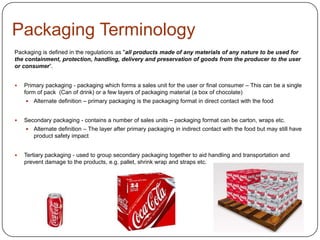
 Primary packaging - packaging which forms a sales unit for the user or final consumer – This can be a single
form of pack (Can of drink) or a few layers of packaging material (a box of chocolate)
 Alternate definition – primary packaging is the packaging format in direct contact with the food
 Secondary packaging - contains a number of sales units – packaging format can be carton, wraps etc.
 Alternate definition – The layer after primary packaging in indirect contact with the food but may still have
product safety impact
 Tertiary packaging - used to group secondary packaging together to aid handling and transportation and
prevent damage to the products, e.g. pallet, shrink wrap and straps etc.
Evolving role of food packaging
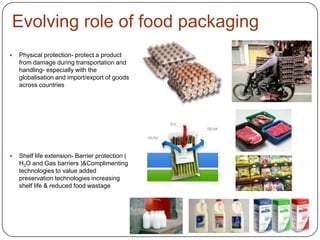
 Physical protection- protect a product
from damage during transportation and
handling- especially with the
globalisation and import/export of goods
across countries
 Shelf life extension- Barrier protection (
H2O and Gas barriers )&Complimenting
technologies to value added
preservation technologies increasing
shelf life & reduced food wastage
Evolving role of food packaging contd…
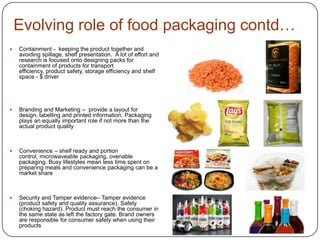
 Containment - keeping the product together and
avoiding spillage, shelf presentation. A lot of effort and
research is focused onto designing packs for
containment of products for transport
efficiency, product safety, storage efficiency and shelf
space - $ driver
 Branding and Marketing – provide a layout for
design, labelling and printed information. Packaging
plays an equally important role if not more than the
actual product quality
 Convenience – shelf ready and portion
control, microwaveable packaging, ovenable
packaging. Busy lifestyles mean less time spent on
preparing meals and convenience packaging can be a
market share
 Security and Tamper evidence– Tamper evidence
(product safety and quality assurance), Safety
(choking hazard). Product must reach the consumer in
the same state as left the factory gate. Brand owners
are responsible for consumer safety when using their
products
Global Packaging 1999-2009
https://www.smitherspira.com/global-packaging-industry-expected-to-reach-820-billion-by-2016.aspx
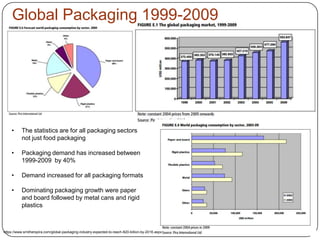
• The statistics are for all packaging sectors
not just food packaging
• Packaging demand has increased between
1999-2009 by 40%
• Demand increased for all packaging formats
• Dominating packaging growth were paper
and board followed by metal cans and rigid
plastics
Global Packaging 2010-2016
Source :https://www.smitherspira.com/global-packaging-industry-expected-to-reach-820-billion-by-2016.aspx
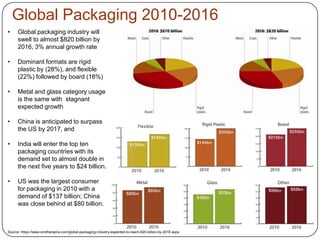
• Global packaging industry will
swell to almost $820 billion by
2016, 3% annual growth rate
• Dominant formats are rigid
plastic by (28%), and flexible
(22%) followed by board (18%)
• Metal and glass category usage
is the same with stagnant
expected growth
• China is anticipated to surpass
the US by 2017, and
• India will enter the top ten
packaging countries with its
demand set to almost double in
the next five years to $24 billion.
• US was the largest consumer
for packaging in 2010 with a
demand of $137 billion; China
was close behind at $80 billion.
Global Packaging Trends
Key areas
Functional Packaging
 Smart/Active/ Intelligent Packaging
 Retail Ready Packaging
 Convenient Packaging
 Accessible Packaging – easy open, better grip, clear labling etc
 Food safe – direct and indirect contact
Sustainable Packaging
 Bioplastics
 3 Rs
Key drivers
 Legislation & guidelines
 Innovative technologies in materials and processes
 Change in life style
 Economy- cost saving
 Consumer influence and awareness
Smart Packaging
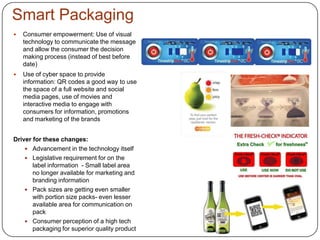
 Consumer empowerment: Use of visual
technology to communicate the message
and allow the consumer the decision
making process (instead of best before
date)
 Use of cyber space to provide
information: QR codes a good way to use
the space of a full website and social
media pages, use of movies and
interactive media to engage with
consumers for information, promotions
and marketing of the brands
Driver for these changes:
 Advancement in the technology itself
 Legislative requirement for on the
label information - Small label area
no longer available for marketing and
branding information
 Pack sizes are getting even smaller
with portion size packs- even lesser
available area for communication on
pack
 Consumer perception of a high tech
packaging for superior quality product
Retail Ready Packaging
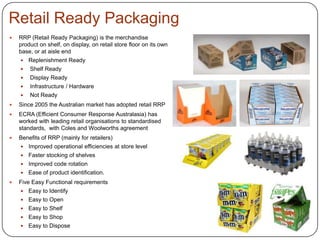
 RRP (Retail Ready Packaging) is the merchandise
product on shelf, on display, on retail store floor on its own
base, or at aisle end
 Replenishment Ready
 Shelf Ready
 Display Ready
 Infrastructure / Hardware
 Not Ready
 Since 2005 the Australian market has adopted retail RRP
 ECRA (Efficient Consumer Response Australasia) has
worked with leading retail organisations to standardised
standards, with Coles and Woolworths agreement
 Benefits of RRP (mainly for retailers)
 Improved operational efficiencies at store level
 Faster stocking of shelves
 Improved code rotation
 Ease of product identification.
 Five Easy Functional requirements
 Easy to Identify
 Easy to Open
 Easy to Shelf
 Easy to Shop
 Easy to Dispose
Convenient Packaging
Provide convenience:
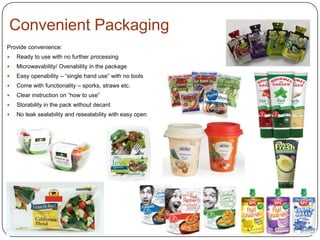
 Ready to use with no further processing
 Microwavability/ Ovenability in the package
 Easy openability – “single hand use” with no tools
 Come with functionality – sporks, straws etc.
 Clear instruction on “how to use”
 Storability in the pack without decant
 No leak sealability and resealability with easy open
Accessible Packaging
 3.85million Australians affected by Arthritis- major cause of disability and chronic pain in
Australia,
 By 2050, 7 million people is expected to suffer from arthritis as population ages
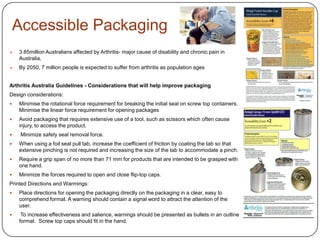
Arthritis Australia Guidelines - Considerations that will help improve packaging
Design considerations:
 Minimise the rotational force requirement for breaking the initial seal on screw top containers.
Minimise the linear force requirement for opening packages
 Avoid packaging that requires extensive use of a tool, such as scissors which often cause
injury, to access the product.
 Minimize safety seal removal force.
 When using a foil seal pull tab, increase the coefficient of friction by coating the tab so that
extensive pinching is not required and increasing the size of the tab to accommodate a pinch.
 Require a grip span of no more than 71 mm for products that are intended to be grasped with
one hand.
 Minimize the forces required to open and close flip-top caps.
Printed Directions and Warmings:
 Place directions for opening the packaging directly on the packaging in a clear, easy to
comprehend format. A warning should contain a signal word to attract the attention of the
user.
 To increase effectiveness and salience, warnings should be presented as bullets in an outline
format. Screw top caps should fit in the hand.
Sustainable Packaging
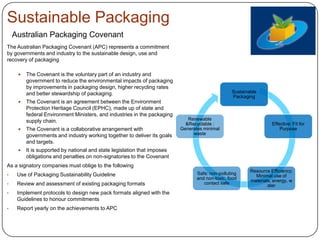
The Australian Packaging Covenant (APC) represents a commitment
by governments and industry to the sustainable design, use and
recovery of packaging
 The Covenant is the voluntary part of an industry and
government to reduce the environmental impacts of packaging
by improvements in packaging design, higher recycling rates
and better stewardship of packaging.
 The Covenant is an agreement between the Environment
Protection Heritage Council (EPHC), made up of state and
federal Environment Ministers, and industries in the packaging
supply chain.
 The Covenant is a collaborative arrangement with
governments and industry working together to deliver its goals
and targets.
 It is supported by national and state legislation that imposes
obligations and penalties on non-signatories to the Covenant
As a signatory companies must oblige to the following
• Use of Packaging Sustainability Guideline
• Review and assessment of existing packaging formats
• Implement protocols to design new pack formats aligned with the
Guidelines to honour commitments
• Report yearly on the achievements to APC
Sustainable
Packaging
Effective: Fit for
Purpose
Resource Efficiency:
Minimal use of
materials, energy, w
ater
Safe: non-polluting
and non-toxic, food
contact safe
Renewable
&Recyclable :
Generates minimal
waste
Australian Packaging Covenant
Bioplastics
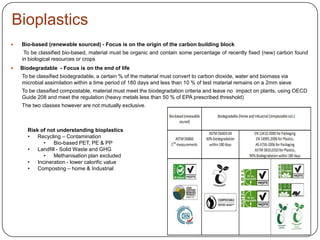
Risk of not understanding bioplastics
• Recycling – Contamination
• Bio-based PET, PE & PP
• Landfill - Solid Waste and GHG
• Methanisation plan excluded
• Incineration - lower calorific value
• Composting – home & Industrial
 Bio-based (renewable sourced) - Focus is on the origin of the carbon building block
To be classified bio-based, material must be organic and contain some percentage of recently fixed (new) carbon found
in biological resources or crops
 Biodegradable - Focus is on the end of life
To be classified biodegradable, a certain % of the material must convert to carbon dioxide, water and biomass via
microbial assimilation within a time period of 180 days and less than 10 % of test material remains on a 2mm sieve
To be classified compostable, material must meet the biodegradation criteria and leave no impact on plants, using OECD
Guide 208 and meet the regulation (heavy metals less than 50 % of EPA prescribed threshold)
The two classes however are not mutually exclusive.
Bioplastics
3 R – Reduce, Recycle & Reuse
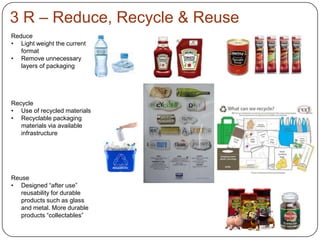
Reduce
• Light weight the current
format
• Remove unnecessary
layers of packaging
Recycle
• Use of recycled materials
• Recyclable packaging
materials via available
infrastructure
Reuse
• Designed “after use”
reusability for durable
products such as glass
and metal. More durable
products “collectables”
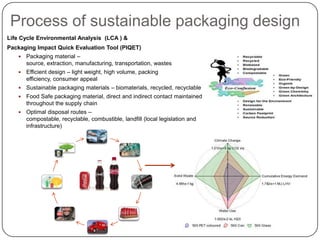
Life Cycle Environmental Analysis (LCA ) &
Packaging Impact Quick Evaluation Tool (PIQET)
 Packaging material –
source, extraction, manufacturing, transportation, wastes
 Efficient design – light weight, high volume, packing
efficiency, consumer appeal
 Sustainable packaging materials – biomaterials, recycled, recyclable
 Food Safe packaging material, direct and indirect contact maintained
throughout the supply chain
 Optimal disposal routes –
compostable, recyclable, combustible, landfill (local legislation and
infrastructure)
Process of sustainable packaging design
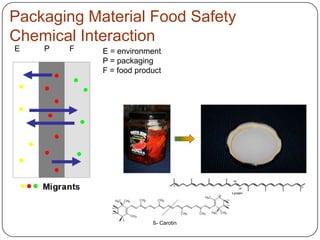
Packaging Material Food Safety
Chemical Interaction
ß- Carotin
E = environment
P = packaging
F = food product
E P F
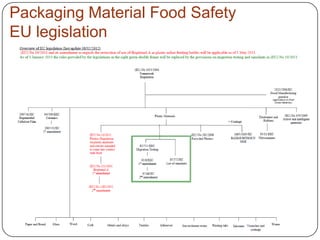
Packaging Material Food Safety
EU legislation
Packaging Material Food Safety
Australia
The packaging materials chosen to protect and transport food must comply with existing regulation, such as the
Materials and Articles in Contact with Food Regulations (EU Regulation 1935/2004) and equivalent FDA
requirements in the USA.
Material specific requirements must also be taken into position, Packaging and Food Safety
consideration, especially for plastics: 2002/72/EU and its 5 amendments and FDA CFR 21 specify the exact
amounts and types of additives that can be used to manufacture the plastics, each one having been tested and
approved for food use.
Australian Standards
 In Australia, manufacturers are required by the Food Standards Code to ensure food packaging materials are
safe and meet the requirements of the relevant Australian Standard.
 Standard 1.4.3 – Articles and Materials in Contact with Food, deals with food contact materials in general terms
but does not specify individual packaging materials for food contact or how they should be produced or used.
 The Standard also refers to the Australian Standard for Plastic Materials for Food Contact Use, AS 2070-
1999. This Standard provides a guide to industry about the production of plastic materials for food contact use.
 AS 2070-1999, in turn, refers to regulations of the US and European Economic Community directives for the
manufacture and use of plastics. Various state and territory food acts also make reference to food packaging
safety.
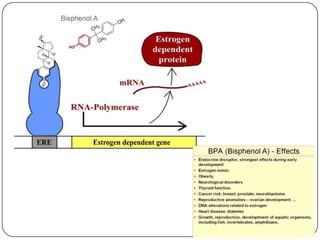
 Some known chemicals that can migrate from packaging into food products are phthalates, perfluorinated
compounds, semicarbazide, acrylonitrile or vinyl chloride and Bisphenol A (BPA)
 FSANZ – Food Safety Australia and New Zealand conduct regular surveys on different food categories to
ensure packaging products do not use chemicals that can pose food safety hazards
Any new packaging formats must undergo a rigorous product safety analysis.
Summary
 Global Packaging use increase to $820b by 2016
 Increase expected in flexible and rigid plastics and
board packaging
 Emerging economies dominating the industry
 Key trends in packaging
 Smart packaging
 Convenient packaging
 Retail ready packaging
 Sustainable packaging
 Food safe packaging
 http://thepackaginginsider.com/coca-cola-aluminum-bottles/
 http://www.foodproductiondaily.com/Supply-Chain/Importance-of-packaging
 http://columbinelabel.com/blog/7-uses-for-qr-codes-on-product-label-and-packaging/
 http://blog.euromonitor.com/2013/02/flexibles-become-leading-packaging-format-for-dog-and-cat-
food-in-2013.html
 http://www.prnewswire.com/news-releases/global-packaging-survey-2013---changes-in-demand-
for-packaging-types-trends-and-preferences-181829411.html
 http://www.packworld.com/trends-and-issues/oee-amp-lean-manufacturing/top-9-packaging-
trends-2013
 https://www.smitherspira.com/global-packaging-industry-expected-to-reach-820-billion-by-
2016.aspx
 http://en.european-bioplastics.org/
 http://greensborough.vic.edu.au/going-red-to-go-green/
 http://www.arthritisaustralia.com.au/index.php/arthritis-information.html
 Nestle's Approach to Packaging Design Aims to Make Its Products Easier to Enjoy -
Dexigner http://www.dexigner.com/news/24578#ixzz2PqrlMPtA
 http://www.ecraustralasia.org.au/storage/publications/Retail%20Ready%20Packaging%20Toolkit
%202013.pdf
 http://www.foodstandards.gov.au/scienceandeducation/factsheets/factsheets/chemicalsinfoodpac
ka5514.cfm
 http://www.worldpackaging.org/uploads/paperpublished/7_pdf.pdf
References
Questions??
Email: roya.khalil@gmail.com

Slide share packaging trends 2013 roya khalil

  • 1.
    Dr Roya Khalil roya.khalil@gmail.com 23rdMay 2013 Global Trends in Food Packaging
  • 2.
    Use of packagingis not new but the packaging technology is an ever evolving art
  • 3.
    Packaging Terminology Packaging isdefined in the regulations as "all products made of any materials of any nature to be used for the containment, protection, handling, delivery and preservation of goods from the producer to the user or consumer”.  Primary packaging - packaging which forms a sales unit for the user or final consumer – This can be a single form of pack (Can of drink) or a few layers of packaging material (a box of chocolate)  Alternate definition – primary packaging is the packaging format in direct contact with the food  Secondary packaging - contains a number of sales units – packaging format can be carton, wraps etc.  Alternate definition – The layer after primary packaging in indirect contact with the food but may still have product safety impact  Tertiary packaging - used to group secondary packaging together to aid handling and transportation and prevent damage to the products, e.g. pallet, shrink wrap and straps etc.
  • 4.
    Evolving role offood packaging  Physical protection- protect a product from damage during transportation and handling- especially with the globalisation and import/export of goods across countries  Shelf life extension- Barrier protection ( H2O and Gas barriers )&Complimenting technologies to value added preservation technologies increasing shelf life & reduced food wastage
  • 5.
    Evolving role offood packaging contd…  Containment - keeping the product together and avoiding spillage, shelf presentation. A lot of effort and research is focused onto designing packs for containment of products for transport efficiency, product safety, storage efficiency and shelf space - $ driver  Branding and Marketing – provide a layout for design, labelling and printed information. Packaging plays an equally important role if not more than the actual product quality  Convenience – shelf ready and portion control, microwaveable packaging, ovenable packaging. Busy lifestyles mean less time spent on preparing meals and convenience packaging can be a market share  Security and Tamper evidence– Tamper evidence (product safety and quality assurance), Safety (choking hazard). Product must reach the consumer in the same state as left the factory gate. Brand owners are responsible for consumer safety when using their products
  • 6.
    Global Packaging 1999-2009 https://www.smitherspira.com/global-packaging-industry-expected-to-reach-820-billion-by-2016.aspx •The statistics are for all packaging sectors not just food packaging • Packaging demand has increased between 1999-2009 by 40% • Demand increased for all packaging formats • Dominating packaging growth were paper and board followed by metal cans and rigid plastics
  • 7.
    Global Packaging 2010-2016 Source:https://www.smitherspira.com/global-packaging-industry-expected-to-reach-820-billion-by-2016.aspx • Global packaging industry will swell to almost $820 billion by 2016, 3% annual growth rate • Dominant formats are rigid plastic by (28%), and flexible (22%) followed by board (18%) • Metal and glass category usage is the same with stagnant expected growth • China is anticipated to surpass the US by 2017, and • India will enter the top ten packaging countries with its demand set to almost double in the next five years to $24 billion. • US was the largest consumer for packaging in 2010 with a demand of $137 billion; China was close behind at $80 billion.
  • 8.
    Global Packaging Trends Keyareas Functional Packaging  Smart/Active/ Intelligent Packaging  Retail Ready Packaging  Convenient Packaging  Accessible Packaging – easy open, better grip, clear labling etc  Food safe – direct and indirect contact Sustainable Packaging  Bioplastics  3 Rs Key drivers  Legislation & guidelines  Innovative technologies in materials and processes  Change in life style  Economy- cost saving  Consumer influence and awareness
  • 9.
    Smart Packaging  Consumerempowerment: Use of visual technology to communicate the message and allow the consumer the decision making process (instead of best before date)  Use of cyber space to provide information: QR codes a good way to use the space of a full website and social media pages, use of movies and interactive media to engage with consumers for information, promotions and marketing of the brands Driver for these changes:  Advancement in the technology itself  Legislative requirement for on the label information - Small label area no longer available for marketing and branding information  Pack sizes are getting even smaller with portion size packs- even lesser available area for communication on pack  Consumer perception of a high tech packaging for superior quality product
  • 10.
    Retail Ready Packaging RRP (Retail Ready Packaging) is the merchandise product on shelf, on display, on retail store floor on its own base, or at aisle end  Replenishment Ready  Shelf Ready  Display Ready  Infrastructure / Hardware  Not Ready  Since 2005 the Australian market has adopted retail RRP  ECRA (Efficient Consumer Response Australasia) has worked with leading retail organisations to standardised standards, with Coles and Woolworths agreement  Benefits of RRP (mainly for retailers)  Improved operational efficiencies at store level  Faster stocking of shelves  Improved code rotation  Ease of product identification.  Five Easy Functional requirements  Easy to Identify  Easy to Open  Easy to Shelf  Easy to Shop  Easy to Dispose
  • 11.
    Convenient Packaging Provide convenience: Ready to use with no further processing  Microwavability/ Ovenability in the package  Easy openability – “single hand use” with no tools  Come with functionality – sporks, straws etc.  Clear instruction on “how to use”  Storability in the pack without decant  No leak sealability and resealability with easy open
  • 12.
    Accessible Packaging  3.85millionAustralians affected by Arthritis- major cause of disability and chronic pain in Australia,  By 2050, 7 million people is expected to suffer from arthritis as population ages Arthritis Australia Guidelines - Considerations that will help improve packaging Design considerations:  Minimise the rotational force requirement for breaking the initial seal on screw top containers. Minimise the linear force requirement for opening packages  Avoid packaging that requires extensive use of a tool, such as scissors which often cause injury, to access the product.  Minimize safety seal removal force.  When using a foil seal pull tab, increase the coefficient of friction by coating the tab so that extensive pinching is not required and increasing the size of the tab to accommodate a pinch.  Require a grip span of no more than 71 mm for products that are intended to be grasped with one hand.  Minimize the forces required to open and close flip-top caps. Printed Directions and Warmings:  Place directions for opening the packaging directly on the packaging in a clear, easy to comprehend format. A warning should contain a signal word to attract the attention of the user.  To increase effectiveness and salience, warnings should be presented as bullets in an outline format. Screw top caps should fit in the hand.
  • 13.
    Sustainable Packaging The AustralianPackaging Covenant (APC) represents a commitment by governments and industry to the sustainable design, use and recovery of packaging  The Covenant is the voluntary part of an industry and government to reduce the environmental impacts of packaging by improvements in packaging design, higher recycling rates and better stewardship of packaging.  The Covenant is an agreement between the Environment Protection Heritage Council (EPHC), made up of state and federal Environment Ministers, and industries in the packaging supply chain.  The Covenant is a collaborative arrangement with governments and industry working together to deliver its goals and targets.  It is supported by national and state legislation that imposes obligations and penalties on non-signatories to the Covenant As a signatory companies must oblige to the following • Use of Packaging Sustainability Guideline • Review and assessment of existing packaging formats • Implement protocols to design new pack formats aligned with the Guidelines to honour commitments • Report yearly on the achievements to APC Sustainable Packaging Effective: Fit for Purpose Resource Efficiency: Minimal use of materials, energy, w ater Safe: non-polluting and non-toxic, food contact safe Renewable &Recyclable : Generates minimal waste Australian Packaging Covenant
  • 14.
    Bioplastics Risk of notunderstanding bioplastics • Recycling – Contamination • Bio-based PET, PE & PP • Landfill - Solid Waste and GHG • Methanisation plan excluded • Incineration - lower calorific value • Composting – home & Industrial  Bio-based (renewable sourced) - Focus is on the origin of the carbon building block To be classified bio-based, material must be organic and contain some percentage of recently fixed (new) carbon found in biological resources or crops  Biodegradable - Focus is on the end of life To be classified biodegradable, a certain % of the material must convert to carbon dioxide, water and biomass via microbial assimilation within a time period of 180 days and less than 10 % of test material remains on a 2mm sieve To be classified compostable, material must meet the biodegradation criteria and leave no impact on plants, using OECD Guide 208 and meet the regulation (heavy metals less than 50 % of EPA prescribed threshold) The two classes however are not mutually exclusive.
  • 15.
  • 16.
    3 R –Reduce, Recycle & Reuse Reduce • Light weight the current format • Remove unnecessary layers of packaging Recycle • Use of recycled materials • Recyclable packaging materials via available infrastructure Reuse • Designed “after use” reusability for durable products such as glass and metal. More durable products “collectables”
  • 17.
    Life Cycle EnvironmentalAnalysis (LCA ) & Packaging Impact Quick Evaluation Tool (PIQET)  Packaging material – source, extraction, manufacturing, transportation, wastes  Efficient design – light weight, high volume, packing efficiency, consumer appeal  Sustainable packaging materials – biomaterials, recycled, recyclable  Food Safe packaging material, direct and indirect contact maintained throughout the supply chain  Optimal disposal routes – compostable, recyclable, combustible, landfill (local legislation and infrastructure) Process of sustainable packaging design
  • 18.
    Packaging Material FoodSafety Chemical Interaction ß- Carotin E = environment P = packaging F = food product E P F
  • 20.
    Packaging Material FoodSafety EU legislation
  • 21.
    Packaging Material FoodSafety Australia The packaging materials chosen to protect and transport food must comply with existing regulation, such as the Materials and Articles in Contact with Food Regulations (EU Regulation 1935/2004) and equivalent FDA requirements in the USA. Material specific requirements must also be taken into position, Packaging and Food Safety consideration, especially for plastics: 2002/72/EU and its 5 amendments and FDA CFR 21 specify the exact amounts and types of additives that can be used to manufacture the plastics, each one having been tested and approved for food use. Australian Standards  In Australia, manufacturers are required by the Food Standards Code to ensure food packaging materials are safe and meet the requirements of the relevant Australian Standard.  Standard 1.4.3 – Articles and Materials in Contact with Food, deals with food contact materials in general terms but does not specify individual packaging materials for food contact or how they should be produced or used.  The Standard also refers to the Australian Standard for Plastic Materials for Food Contact Use, AS 2070- 1999. This Standard provides a guide to industry about the production of plastic materials for food contact use.  AS 2070-1999, in turn, refers to regulations of the US and European Economic Community directives for the manufacture and use of plastics. Various state and territory food acts also make reference to food packaging safety.  Some known chemicals that can migrate from packaging into food products are phthalates, perfluorinated compounds, semicarbazide, acrylonitrile or vinyl chloride and Bisphenol A (BPA)  FSANZ – Food Safety Australia and New Zealand conduct regular surveys on different food categories to ensure packaging products do not use chemicals that can pose food safety hazards Any new packaging formats must undergo a rigorous product safety analysis.
  • 22.
    Summary  Global Packaginguse increase to $820b by 2016  Increase expected in flexible and rigid plastics and board packaging  Emerging economies dominating the industry  Key trends in packaging  Smart packaging  Convenient packaging  Retail ready packaging  Sustainable packaging  Food safe packaging
  • 23.
     http://thepackaginginsider.com/coca-cola-aluminum-bottles/  http://www.foodproductiondaily.com/Supply-Chain/Importance-of-packaging http://columbinelabel.com/blog/7-uses-for-qr-codes-on-product-label-and-packaging/  http://blog.euromonitor.com/2013/02/flexibles-become-leading-packaging-format-for-dog-and-cat- food-in-2013.html  http://www.prnewswire.com/news-releases/global-packaging-survey-2013---changes-in-demand- for-packaging-types-trends-and-preferences-181829411.html  http://www.packworld.com/trends-and-issues/oee-amp-lean-manufacturing/top-9-packaging- trends-2013  https://www.smitherspira.com/global-packaging-industry-expected-to-reach-820-billion-by- 2016.aspx  http://en.european-bioplastics.org/  http://greensborough.vic.edu.au/going-red-to-go-green/  http://www.arthritisaustralia.com.au/index.php/arthritis-information.html  Nestle's Approach to Packaging Design Aims to Make Its Products Easier to Enjoy - Dexigner http://www.dexigner.com/news/24578#ixzz2PqrlMPtA  http://www.ecraustralasia.org.au/storage/publications/Retail%20Ready%20Packaging%20Toolkit %202013.pdf  http://www.foodstandards.gov.au/scienceandeducation/factsheets/factsheets/chemicalsinfoodpac ka5514.cfm  http://www.worldpackaging.org/uploads/paperpublished/7_pdf.pdf References
  • 24.

Editor's Notes

  • #8 Leatherhead UK, 25 January 2012. The global packaging industry will swell to almost $820 billion by 2016 predicts SmithersPira in a new market forecast. Driven mainly by increasing demand for packaging in emerging and transitional economies, a 3% per annum growth rate will focus on board products and rigid plastics, with $40 billion and $33 billion in cumulative predicted growth respectively to 2016.More specifically, robust growth in demand for rigid plastic packaging, especially in sectors like drinks, cosmetics, toiletries, and household and personal care products, is stimulating packaging consumption. Similarly, flexible plastic packaging materials are receiving a boost from sectors like perishable foods, healthcare, convenience foods and various industrial markets. Corrugated board consumption is being egged on by the processed food sector and a number of non-food applications including personal and household care, chemicals, electrical goods and others. At the same time, folding carton consumption is benefiting from the growth found in healthcare products, electrical goods, and frozen and chilled foods, among others.According to the SmithersPira, the US was the largest consumer for packaging in 2010 with a demand of $137 billion; China was close behind at $80 billion. China is anticipated to surpass the US by 2017, and India will enter the top ten packaging countries with its demand set to almost double in the next five years to $24 billion.Technological developments in packaging are seeing an upswing in the consumption of bio-polymers in both rigid and flexible applications, improved value adding in products with functional and barrier coatings, as well as enhanced graphics, resource reduction by way of continuous lightweighting across all materials, and other developments.Board products account for the biggest sector of the packaging market, totaling some $210 billion in 2010 and maintaining their leading position into 2016 when the sector will be worth $40 billion more at nearly $250 billion.Rigid plastic is the second largest slice of the whole, at over 21% or $144 billion in 2010, expanding to over $200 billion by 2016, while the flexible packaging market will increase from $130 billion in 2010 to over $163 billion by 2016.The consumption of metal packaging represented over 15% of the 2010 market but will be losing market share to competing products, especially rigid plastic, to enjoy only 14% of the 2016 market, while demand for glass containers is also anticipated to slow down over the medium term, increasing from some $45 billion in 2010 to around $53 billion by 2016.What is the current market landscape and what is changing?Survey results show that 79% of packaging industry manufacturer respondents expect the demand for 'flexible packaging' to increase, while 68% expect an increase in demand for 'paper and board packaging'.What are the key drivers behind recent market changes?In total, the top three drivers that influence changes in the packaging industry include 'cost cutting measures', 'compliance and regulations', and 'environmental issues'.10. Clean machine design helps drive OEM growth and meet new regulations.9. Digital printing continues to make advances and becomes a reality.8. Sustainable packaging and waste to value propositions get more clarity and harmonization.7. Interactive and intelligent packaging becomes more real and gets commercialized.6. Flexible packaging growing in new markets and categories globally.5. Companies ramp up new processes to look at risk and anticipatory issues and get in front of the next BPA.4. Digital media and package design: Social media and zero moment of truth will offer big opportunities for packaging going forward.3. Packaging enabled innovation and growth: More companies targeting a percentage of their growth driven by packaging.2. Consumer insight for packaging: Companies recognize the importance of consumer insights for packaging and how it can vary, and expect more data from suppliers.”
  • #10 Use of visual technology to communicate the message and allow the consumer the decision making process (instead of best before date)Small labels area for information communication specially on small packs – QR codes a good way to use the space of a full website, use of movies and interactive media to attract consumers. Bring them to your social media pages, use of social media and internet.Advancement in the technology itself to allow selective barrier for breathing fresh produce.
  • #11 Having common industry-agreed standards and design principles which are then used by the whole industry is essential to broad scale implementation. In a market Australia’s size, it makes no sense to have SKU proliferation as a direct result of minor packaging differences between competing retail organisations. ECRA has worked with leading retail organisations to deliver a more streamlined toolkit that goes some ways to addressing this issue. The cost of implementing SFP formats typically sits with the supplier, whilst the immediate in-store benefit of increased speed of replenishment sits with the retailer. As an industry we need to consider the broader benefits and understand how we can maximise their advantages. These include: improved operational efficiencies at store level faster stocking of shelves improved code rotation ease of product identification.
  • #13 Nestle launched an Accessibility Benchmarking Scale last year with Arthritis Australia. The scale allows packaging designers to predict how many people can use their packaging.Arthritis Australia Guidelines - Considerations that will help improve packaging Minimise the rotational force requirement for breaking the initial seal on screw top containers. Rotational forces greater than 10lb-in/1.8 kilos-cm often exceed the functional capabilities of the frail, elderly and those living with arthritis. Minimise the linear force requirement for opening packages. Try to avoid exceeding 5lb/2.3 kilos of liner force. Avoid packaging that requires extensive use of a tool, such as scissors which often cause injury, to access the product. Minimize safety seal removal force. Use either an easy to puncture seal that does not require the use of a tool. The force required pulling or puncturing the safety seal should not exceed 5.0 pounds/2.3 kilos. (5) When using a foil seal pull tab, increase the coefficient of friction by coating the tab so that extensive pinching is not required and increasing the size of the tab to accommodate a pinch. (6) Place directions for opening the packaging directly on the packaging in a clear, easy to comprehend format. A warning should contain a signal word to attract the attention of the user. (7) To increase effectiveness and salience, warnings should be presented as bullets in an outline format. (8) Screw top caps should fit in the hand. Their removal should require no more than ¼ turn for each angular movement, and no more than two angular movements should be required. Use steep rather than gradual threading to prevent over tightening of the cap. (9) Require a grip span of no more than 71 mm for products that are intended to be grasped with one hand. (10) Require no more than 3.3 pounds/1.5 kilos to push in a push tab. (11) Minimize the forces required to open and close flip-top caps. The forces required to flip the cap open and closed should not exceed 5.0 pounds/2.3 kilos.
  • #22 The packaging materials chosen to protect and transport food must comply with existing regulation, such as the Materials and Articles in Contact with Food Regulations (EU Regulation 1935/2004) and equivalent FDA requirements in the USA. Material specific requirements must also be taken into position, Packaging and Food Safety consideration, especially for plastics: 2002/72/EU and its 5 amendments and FDA CFR 21 specify the exact amounts and types of additives that can be used to manufacture the plastics, each one having been tested and approved for food use.