ROYAL COMMISSION MEDICAL CENTER
                    YANBU AL SINAIYAH


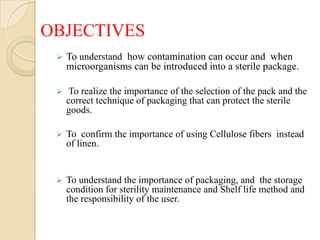
            STERILITY MAINTENANCE
            SHELF LIFE MANAGEMENT


PRESENTED BY :
                 HATHROUBI MUNEER
                 RCMC CSSD OFFICER
OBJECTIVES
    To understand how contamination can occur and when
     microorganisms can be introduced into a sterile package.

     To realize the importance of the selection of the pack and the
     correct technique of packaging that can protect the sterile
     goods.

    To confirm the importance of using Cellulose fibers instead
     of linen.


    To understand the importance of packaging, and the storage
     condition for sterility maintenance and Shelf life method and
     the responsibility of the user.
HISTORY

    The SMITHSONIAN INSTITUTE has flasks
     that were sterilized in 1863 by LOUIS
     PASTEUR; these flasks are still sterile after
     more than 140 years.
DEFINITION
   Shelf life is the period of time during which a sterile item is
    considered safe to use.

   Shelf life is considered to be event –related not time related. That
    is while the probability of contamination increases with time, it
    is more influenced by handling and storage methods.
   Sterile items that are protected from the environment have been
    proven to remain sterile indefinitely.

   Shelf life is not matter of sterility maintenance. Many products
    from outside manufacturers carry out expiration dates that relate
    to product and packaging degradation, not to product sterility per
    se.

   It is important that sterile items be properly stored so that the
    packaging is not compromised.
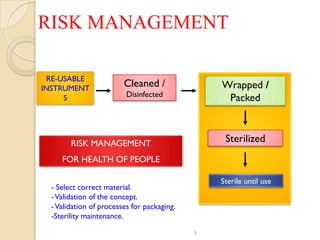
RISK MANAGEMENT

 RE-USABLE
INSTRUMENT
                         Cleaned /               Wrapped /
                          Disinfected
     S                                            Packed


        RISK MANAGEMENT                           Sterilized
     FOR HEALTH OF PEOPLE

                                                 Sterile until use
  - Select correct material.
  - Validation of the concept.
  - Validation of processes for packaging.
  -Sterility maintenance.
                                             5
TOPICS


   1- MATERIAL REQUIREMENT

   2- PACKAGING SYSTEM DESIGN
    REQUIREMENTS

   3- PROCESSES VALIDATION

   4- STERILITY MAITENANCE SHELF
    LIFE
Topics

   1- MATERIAL REQUIREMENT

   2- PACKAGING SYSTEM DESIGN
    REQUIREMENTS

   3- PROCESSES VALIDATION

   4- STERILITY MAITENANCE SHELF
    LIFE
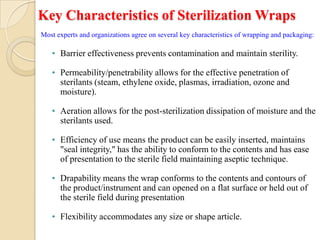
Key Characteristics of Sterilization Wraps
Most experts and organizations agree on several key characteristics of wrapping and packaging:

   • Barrier effectiveness prevents contamination and maintain sterility.

   • Permeability/penetrability allows for the effective penetration of
     sterilants (steam, ethylene oxide, plasmas, irradiation, ozone and
     moisture).

   • Aeration allows for the post-sterilization dissipation of moisture and the
     sterilants used.

   • Efficiency of use means the product can be easily inserted, maintains
     "seal integrity," has the ability to conform to the contents and has ease
     of presentation to the sterile field maintaining aseptic technique.

   • Drapability means the wrap conforms to the contents and contours of
     the product/instrument and can opened on a flat surface or held out of
     the sterile field during presentation

   • Flexibility accommodates any size or shape article.
Key Characteristics of Sterilization Wraps
  • Durable package integrity means the wrap resists punctures, tears and
    abrasions. Conforms to measurement standards for tensile
    strength, porosity and moisture vapor transmission rates.
  • Toxin free means non-toxic and non-fast dyes prevent adverse physical
    reaction of handler or change/coloration of the contents or wrapper.
  • Odor free characteristics prevent any allergic reactions from inhalation
    of chemical processes used in manufacturing or laundering.
  • Lint free/minimal linting means the wrap is devoid of or contains
    minimal linting properties (Gelbo Lint INDA Standard testing method
    160-1-92) .
  • Cost effectiveness ensures the wrap is economical, saves time and
    reduces waste without compromising aseptic technique.
  • Content verification means the ability to identify the internal contents
    of the product produced visually or by labeling.
How to consider the choice of
packaging?
   Question:
    How to be sure that the medical device placed in the wrap packaging is still
      sterile when introduced in operating room ?

   Problematic:
    There is no destructive and routine test able to determine if the barrier
      integrity of the pack is still valid

   Answer:
    Compliance to EN ISO 11607 part 1 & 2
      Part 1 : Requirements for material and Packaging System Design
      Part 2 : Validation requirements of processes for packaging

       3 requested conditions:
          1- Have the adequate material
          2- Have a validated packaging system design
          3- Follow a protocol from packaging to operating room with regular
          check of the integrity of the packaging
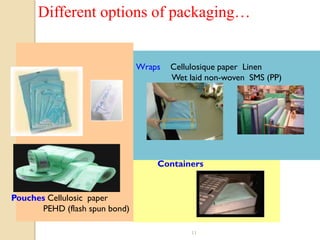
Different options of packaging…


                               Wraps   Cellulosique paper Linen
                                       Wet laid non-woven SMS (PP)


                                   Containers


Pouches Cellulosic paper
      PEHD (flash spun bond)

                                            11
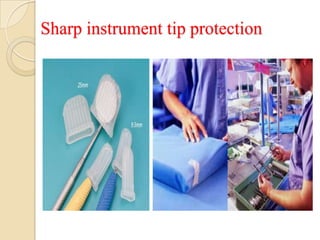
Sharp instrument tip protection
Topics
     1- MATERIAL REQUIREMENT

     2- PACKAGING SYSTEM DESIGN
      REQUIREMENTS

     3- PROCESSES VALIDATION

     4- STERILITY MAITENANCE SHELF
      LIFE
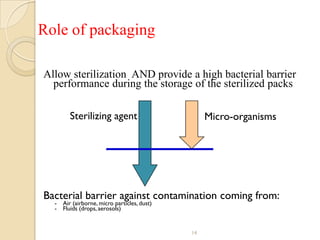
Role of packaging

Allow sterilization AND provide a high bacterial barrier
  performance during the storage of the sterilized packs

        Sterilizing agent                          Micro-organisms

                        ____________

Bacterial barrier against contamination coming from:
  -   Air (airborne, micro particles, dust)
  -   Fluids (drops, aerosols)


                                              14
Microbial barrier
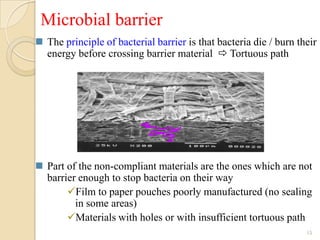
 The principle of bacterial barrier is that bacteria die / burn their
  energy before crossing barrier material  Tortuous path


 Part of the non-compliant materials are the ones which are not
  barrier enough to stop bacteria on their way
       Film to paper pouches poorly manufactured (no sealing
         in some areas)
       Materials with holes or with insufficient tortuous path
                                                                   15
Microbial barrier : Focus on linen
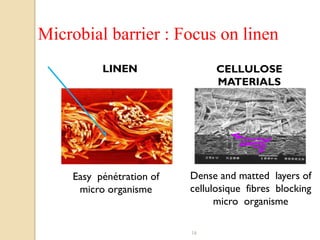
          LINEN                 CELLULOSE
                                MATERIALS


    Easy pénétration of   Dense and matted layers of
     micro organisme      cellulosique fibres blocking
                                micro organisme

                          16
Microbial barrier : Focus on linen
                                                 CELLULOSE
         LINEN
                                                 MATERIALS


                               Water
                               drop


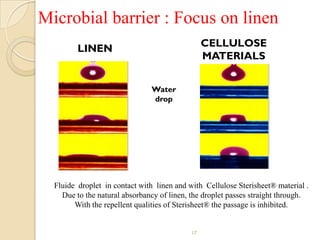
  Fluide droplet in contact with linen and with Cellulose Sterisheet® material .
    Due to the natural absorbancy of linen, the droplet passes straight through.
        With the repellent qualities of Sterisheet® the passage is inhibited.


                                            17
Microbial barrier : Focus on linen
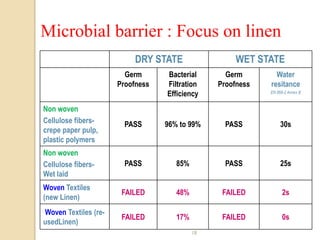
                           DRY STATE                 WET STATE
                        Germ      Bacterial       Germ        Water
                      Proofness   Filtration    Proofness   resitance
                                  Efficiency                EN 868-2 Annex B


Non woven
Cellulose fibers-       PASS      96% to 99%      PASS           30s
crepe paper pulp,
plastic polymers
Non woven
Cellulose fibers-       PASS         85%          PASS           25s
Wet laid
Woven Textiles
                       FAILED        48%         FAILED           2s
(new Linen)
Woven Textiles (re-
                       FAILED        17%         FAILED           0s
usedLinen)
                                           18
How to validate that the design of your
packaging system is adapted ?
 :Validation of the packaging system design by real test & good practices

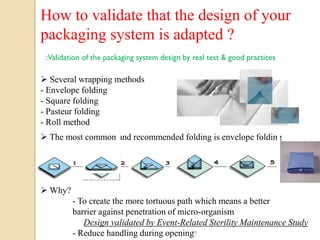
 Several wrapping methods
- Envelope folding
- Square folding
- Pasteur folding
- Roll method
 The most common and recommended folding is envelope folding


 Why?
         - To create the more tortuous path which means a better
         barrier against penetration of micro-organism
            Design validated by Event-Related Sterility Maintenance Study
         - Reduce handling during opening  19
How to validate that the design of your
    packaging system is adapted ?
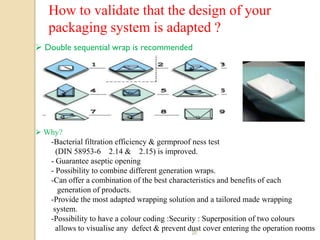
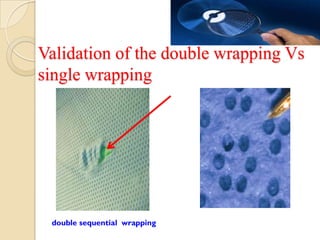
 Double sequential wrap is recommended


 Why?
   -Bacterial filtration efficiency & germproof ness test
     (DIN 58953-6 2.14 & 2.15) is improved.
   - Guarantee aseptic opening
   - Possibility to combine different generation wraps.
   -Can offer a combination of the best characteristics and benefits of each
      generation of products.
   -Provide the most adapted wrapping solution and a tailored made wrapping
    system.
   -Possibility to have a colour coding :Security : Superposition of two colours
     allows to visualise any defect & prevent dust cover entering the operation rooms
                                                20
Validation of the double wrapping Vs
single wrapping


 double sequential wrapping
Validation of the double wrapping Vs single
                   wrapping
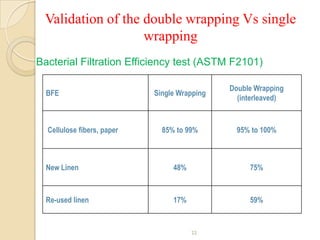
Bacterial Filtration Efficiency test (ASTM F2101)

                                              Double Wrapping
  BFE                       Single Wrapping
                                                (interleaved)


  Cellulose fibers, paper     85% to 99%        95% to 100%


  New Linen                      48%               75%


  Re-used linen                  17%               59%


                                       22
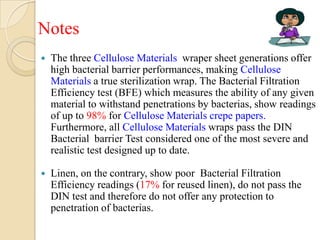
Notes
   The three Cellulose Materials wraper sheet generations offer
    high bacterial barrier performances, making Cellulose
    Materials a true sterilization wrap. The Bacterial Filtration
    Efficiency test (BFE) which measures the ability of any given
    material to withstand penetrations by bacterias, show readings
    of up to 98% for Cellulose Materials crepe papers.
    Furthermore, all Cellulose Materials wraps pass the DIN
    Bacterial barrier Test considered one of the most severe and
    realistic test designed up to date.

   Linen, on the contrary, show poor Bacterial Filtration
    Efficiency readings (17% for reused linen), do not pass the
    DIN test and therefore do not offer any protection to
    penetration of bacterias.
Topics

     1- MATERIAL REQUIREMENT

     2- PACKAGING SYSTEM DESIGN
      REQUIREMENTS

     3- PROCESSES VALIDATION

     4- STERILITY MAITENANCE SHELF
      LIFE
How to validate that the design of your
packaging system is adapted ?
Validation of the packaging system design by real test & good practices

     Efficiency of sterilization :
        Steam penetration testing thru activating sterilization indicators
     Integrity of the packege / Maintenance of sterility integrity over time :

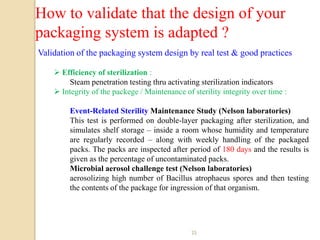
         Event-Related Sterility Maintenance Study (Nelson laboratories)
         This test is performed on double-layer packaging after sterilization, and
         simulates shelf storage – inside a room whose humidity and temperature
         are regularly recorded – along with weekly handling of the packaged
         packs. The packs are inspected after period of 180 days and the results is
         given as the percentage of uncontaminated packs.
         Microbial aerosol challenge test (Nelson laboratories)
         aerosolizing high number of Bacillus atrophaeus spores and then testing
         the contents of the package for ingression of that organism.


                                                25
Validation of the maintenance of sterility
                     over time
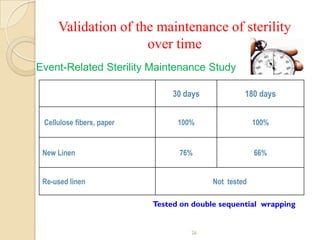
Event-Related Sterility Maintenance Study

                                30 days            180 days


 Cellulose fibers, paper         100%                  100%


 New Linen                       76%                   66%


 Re-used linen                            Not tested

                           Tested on double sequential wrapping


                                    26
Topics

     1- MATERIAL REQUIREMENT

     2- PACKAGING SYSTEM DESIGN
      REQUIREMENTS

     3- PROCESSES VALIDATION

     4- STERILITY MAITENANCE SHELF
      LIFE
GUIDELINE FOR PACKAGIN
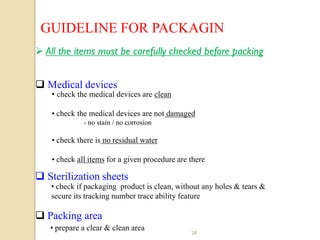
 All the items must be carefully checked before packing


 Medical devices
    • check the medical devices are clean

    • check the medical devices are not damaged
              - no stain / no corrosion

    • check there is no residual water

    • check all items for a given procedure are there

 Sterilization sheets
   • check if packaging product is clean, without any holes & tears &
   secure its tracking number trace ability feature

 Packing area
   • prepare a clear & clean area
                                                28
PROTOCOL FOR VALIDATION OF
PACKAGING PROCESS
Condition A written protocol and visual aids for each step:
1- Packing preparation
2- Sterilization (Loading)
3- Transportation
4- Storage
5- Opening
Only a visual inspection, will guarantee the integrity of the
packaging
At the end of each stage, a visual inspection must be
performed thru a documented quality system including
records, training & qualifying any actor of the chain
 Following guideline is based on these 3 conditions and the
    results of in situ testing, experience & good practices

                                  29
Topics

     1- MATERIAL REQUIREMENT

     2- PACKAGING SYSTEM DESIGN
      REQUIREMENTS

     3- PROCESSES VALIDATION

     4- STERILITY MAITENANCE SHELF
      LIFE
STERILITY MAITENANCE SHELF
LIFE
   Shelf life refers to the period of time any disinfected or
    sterilized item is safe to use.

   The time an item remains safe for use is more event-related
    than time-related.(Actual sterility may be indefinite
    depending on the package materials, the item itself and the
    handling and storage).

   Some manufactured items have a label claim of “Sterility
    guaranteed unless packaged is punctured or broken.” This
    labeling claims indefinite shelf life under the condition of
    proper handling and storage.
ROTATION OF THE STOCK
   Rotation of stock entails a system of adding
    newer sterilized items to an inventory to
    enable the use of the oldest first to prevent
    stale dating. When we go to the supermarket
    we always do the opposite: we look for and
    select the items that are freshest. In
    contrast, in dispensing we should select the
    oldest dated sterile items and use them first.
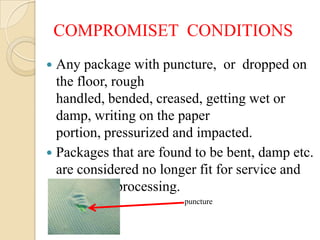
COMPROMISET CONDITIONS
 Any package with puncture, or dropped on
  the floor, rough
  handled, bended, creased, getting wet or
  damp, writing on the paper
  portion, pressurized and impacted.
 Packages that are found to be bent, damp etc.
  are considered no longer fit for service and
  require re-processing.
                        puncture
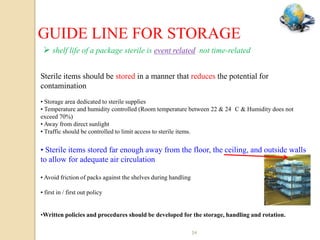
GUIDE LINE FOR STORAGE
  shelf life of a package sterile is event related not time-related

Sterile items should be stored in a manner that reduces the potential for
contamination
• Storage area dedicated to sterile supplies
• Temperature and humidity controlled (Room temperature between 22 & 24 C & Humidity does not
exceed 70%)
• Away from direct sunlight
• Traffic should be controlled to limit access to sterile items.


• Sterile items stored far enough away from the floor, the ceiling, and outside walls
to allow for adequate air circulation

• Avoid friction of packs against the shelves during handling

• first in / first out policy


•Written policies and procedures should be developed for the storage, handling and rotation.

                                                                34
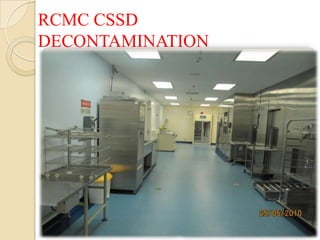
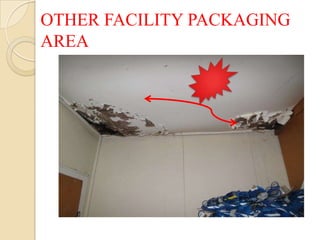
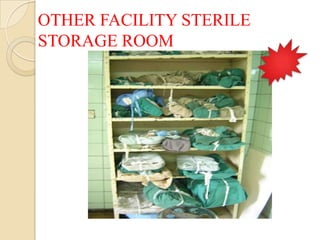
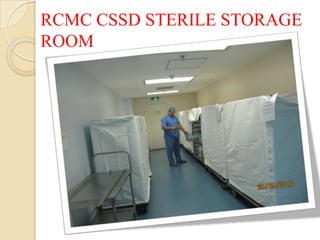
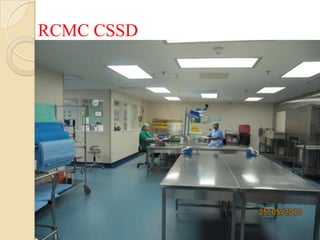
WHERE ARE WE ?
 COMPARISON BETWEEN OUR RCMC
  CSSD & OTHER FACILITY CSSD
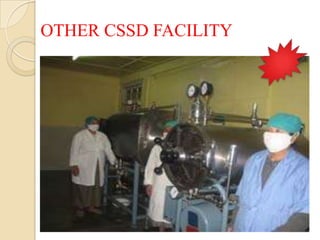
OTHER CSSD FACILITY
RCMC CSSD
RCMC CSSD
OTHER FACILITY
DECOTAMINATION AREA
RCMC CSSD
DECONTAMINATION
OTHER FACILITY CSSD
PROCESSING AREA
OUR PROCESSING AREA
OTHER FACILITY PACKAGING
AREA
PACKAGING AREA
OTHER FACILITY STERILE
STORAGE ROOM
RCMC CSSD STERILE STORAGE
ROOM
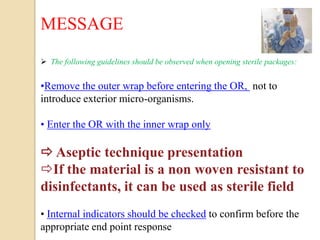
MESSAGE
 The following guidelines should be observed when opening sterile packages:


•Remove the outer wrap before entering the OR, not to
introduce exterior micro-organisms.

• Enter the OR with the inner wrap only

 Aseptic technique presentation
If the material is a non woven resistant to
disinfectants, it can be used as sterile field
• Internal indicators should be checked to confirm before the
appropriate end point response
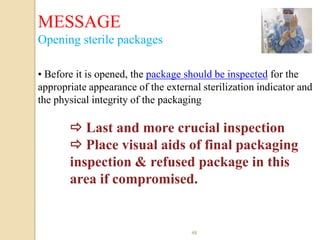
MESSAGE
Opening sterile packages

• Before it is opened, the package should be inspected for the
appropriate appearance of the external sterilization indicator and
the physical integrity of the packaging

        Last and more crucial inspection
        Place visual aids of final packaging
       inspection & refused package in this
       area if compromised.


                                    48
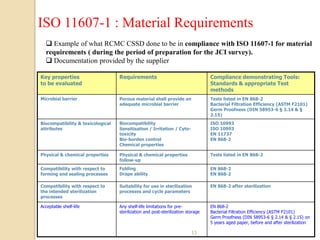
ISO 11607-1 : Material Requirements
   Example of what RCMC CSSD done to be in compliance with ISO 11607-1 for material
  requirements ( during the period of preparation for the JCI survey).
   Documentation provided by the supplier

Key properties                     Requirements                                   Compliance demonstrating Tools:
to be evaluated                                                                   Standards & appropriate Test
                                                                                  methods
Microbial barrier                  Porous material shall provide an               Tests listed in EN 868-2
                                   adequate microbial barrier                     Bacterial Filtration Efficiency (ASTM F2101)
                                                                                  Germ Proofness (DIN 58953-6 § 2.14 & §
                                                                                  2.15)
Biocompatibility & toxicological   Biocompatibility                               ISO 10993
attributes                         Sensitisation / Irritation / Cyto-             ISO 10993
                                   toxicity                                       EN 11737
                                   Bio-burden control                             EN 868-2
                                   Chemical properties

Physical & chemical properties     Physical & chemical properties                 Tests listed in EN 868-2
                                   follow-up
Compatibility with respect to      Folding                                        EN 868-2
forming and sealing processes      Drape ability                                  EN 868-2

Compatibility with respect to      Suitability for use in sterilization           EN 868-2 after sterilization
the intended sterilization         processes and cycle parameters
processes

Acceptable shelf-life              Any shelf-life limitations for pre-            EN 868-2
                                   sterilization and post-sterilization storage   Bacterial Filtration Efficiency (ASTM F2101)
                                                                                  Germ Proofness (DIN 58953-6 § 2.14 & § 2.15) on
                                                                                  5 years aged paper, before and after sterilization

                                                                          53
What can be done against nosocomial
diseases?
     Good practices:
      - Hand washing
      - PPE (gloves, gowns..)
      - Medical and surgical equipment care:
        - Cleaning
        - Disinfection
        - Packaging
        - Sterilization of reusable medical devices
        - Traceability
      - Preference of single use devices
      - Good sterilization method.
      - Good storage technique.

Sterility Maintenance Shelf life Management

  • 1.
    ROYAL COMMISSION MEDICALCENTER YANBU AL SINAIYAH STERILITY MAINTENANCE SHELF LIFE MANAGEMENT PRESENTED BY : HATHROUBI MUNEER RCMC CSSD OFFICER
  • 2.
    OBJECTIVES  To understand how contamination can occur and when microorganisms can be introduced into a sterile package.  To realize the importance of the selection of the pack and the correct technique of packaging that can protect the sterile goods.  To confirm the importance of using Cellulose fibers instead of linen.  To understand the importance of packaging, and the storage condition for sterility maintenance and Shelf life method and the responsibility of the user.
  • 3.
    HISTORY  The SMITHSONIAN INSTITUTE has flasks that were sterilized in 1863 by LOUIS PASTEUR; these flasks are still sterile after more than 140 years.
  • 4.
    DEFINITION  Shelf life is the period of time during which a sterile item is considered safe to use.  Shelf life is considered to be event –related not time related. That is while the probability of contamination increases with time, it is more influenced by handling and storage methods.  Sterile items that are protected from the environment have been proven to remain sterile indefinitely.  Shelf life is not matter of sterility maintenance. Many products from outside manufacturers carry out expiration dates that relate to product and packaging degradation, not to product sterility per se.  It is important that sterile items be properly stored so that the packaging is not compromised.
  • 5.
    RISK MANAGEMENT RE-USABLE INSTRUMENT Cleaned / Wrapped / Disinfected S Packed RISK MANAGEMENT Sterilized FOR HEALTH OF PEOPLE Sterile until use - Select correct material. - Validation of the concept. - Validation of processes for packaging. -Sterility maintenance. 5
  • 6.
    TOPICS  1- MATERIAL REQUIREMENT  2- PACKAGING SYSTEM DESIGN REQUIREMENTS  3- PROCESSES VALIDATION  4- STERILITY MAITENANCE SHELF LIFE
  • 7.
    Topics  1- MATERIAL REQUIREMENT  2- PACKAGING SYSTEM DESIGN REQUIREMENTS  3- PROCESSES VALIDATION  4- STERILITY MAITENANCE SHELF LIFE
  • 8.
    Key Characteristics ofSterilization Wraps Most experts and organizations agree on several key characteristics of wrapping and packaging: • Barrier effectiveness prevents contamination and maintain sterility. • Permeability/penetrability allows for the effective penetration of sterilants (steam, ethylene oxide, plasmas, irradiation, ozone and moisture). • Aeration allows for the post-sterilization dissipation of moisture and the sterilants used. • Efficiency of use means the product can be easily inserted, maintains "seal integrity," has the ability to conform to the contents and has ease of presentation to the sterile field maintaining aseptic technique. • Drapability means the wrap conforms to the contents and contours of the product/instrument and can opened on a flat surface or held out of the sterile field during presentation • Flexibility accommodates any size or shape article.
  • 9.
    Key Characteristics ofSterilization Wraps • Durable package integrity means the wrap resists punctures, tears and abrasions. Conforms to measurement standards for tensile strength, porosity and moisture vapor transmission rates. • Toxin free means non-toxic and non-fast dyes prevent adverse physical reaction of handler or change/coloration of the contents or wrapper. • Odor free characteristics prevent any allergic reactions from inhalation of chemical processes used in manufacturing or laundering. • Lint free/minimal linting means the wrap is devoid of or contains minimal linting properties (Gelbo Lint INDA Standard testing method 160-1-92) . • Cost effectiveness ensures the wrap is economical, saves time and reduces waste without compromising aseptic technique. • Content verification means the ability to identify the internal contents of the product produced visually or by labeling.
  • 10.
    How to considerthe choice of packaging?  Question: How to be sure that the medical device placed in the wrap packaging is still sterile when introduced in operating room ?  Problematic: There is no destructive and routine test able to determine if the barrier integrity of the pack is still valid  Answer: Compliance to EN ISO 11607 part 1 & 2 Part 1 : Requirements for material and Packaging System Design Part 2 : Validation requirements of processes for packaging 3 requested conditions: 1- Have the adequate material 2- Have a validated packaging system design 3- Follow a protocol from packaging to operating room with regular check of the integrity of the packaging
  • 11.
    Different options ofpackaging… Wraps Cellulosique paper Linen Wet laid non-woven SMS (PP) Containers Pouches Cellulosic paper PEHD (flash spun bond) 11
  • 12.
  • 13.
    Topics  1- MATERIAL REQUIREMENT  2- PACKAGING SYSTEM DESIGN REQUIREMENTS  3- PROCESSES VALIDATION  4- STERILITY MAITENANCE SHELF LIFE
  • 14.
    Role of packaging Allowsterilization AND provide a high bacterial barrier performance during the storage of the sterilized packs Sterilizing agent Micro-organisms ____________ Bacterial barrier against contamination coming from: - Air (airborne, micro particles, dust) - Fluids (drops, aerosols) 14
  • 15.
    Microbial barrier  Theprinciple of bacterial barrier is that bacteria die / burn their energy before crossing barrier material  Tortuous path  Part of the non-compliant materials are the ones which are not barrier enough to stop bacteria on their way Film to paper pouches poorly manufactured (no sealing in some areas) Materials with holes or with insufficient tortuous path 15
  • 16.
    Microbial barrier :Focus on linen LINEN CELLULOSE MATERIALS Easy pénétration of Dense and matted layers of micro organisme cellulosique fibres blocking micro organisme 16
  • 17.
    Microbial barrier :Focus on linen CELLULOSE LINEN MATERIALS Water drop Fluide droplet in contact with linen and with Cellulose Sterisheet® material . Due to the natural absorbancy of linen, the droplet passes straight through. With the repellent qualities of Sterisheet® the passage is inhibited. 17
  • 18.
    Microbial barrier :Focus on linen DRY STATE WET STATE Germ Bacterial Germ Water Proofness Filtration Proofness resitance Efficiency EN 868-2 Annex B Non woven Cellulose fibers- PASS 96% to 99% PASS 30s crepe paper pulp, plastic polymers Non woven Cellulose fibers- PASS 85% PASS 25s Wet laid Woven Textiles FAILED 48% FAILED 2s (new Linen) Woven Textiles (re- FAILED 17% FAILED 0s usedLinen) 18
  • 19.
    How to validatethat the design of your packaging system is adapted ? :Validation of the packaging system design by real test & good practices  Several wrapping methods - Envelope folding - Square folding - Pasteur folding - Roll method  The most common and recommended folding is envelope folding  Why? - To create the more tortuous path which means a better barrier against penetration of micro-organism Design validated by Event-Related Sterility Maintenance Study - Reduce handling during opening 19
  • 20.
    How to validatethat the design of your packaging system is adapted ?  Double sequential wrap is recommended  Why? -Bacterial filtration efficiency & germproof ness test (DIN 58953-6 2.14 & 2.15) is improved. - Guarantee aseptic opening - Possibility to combine different generation wraps. -Can offer a combination of the best characteristics and benefits of each generation of products. -Provide the most adapted wrapping solution and a tailored made wrapping system. -Possibility to have a colour coding :Security : Superposition of two colours allows to visualise any defect & prevent dust cover entering the operation rooms 20
  • 21.
    Validation of thedouble wrapping Vs single wrapping double sequential wrapping
  • 22.
    Validation of thedouble wrapping Vs single wrapping Bacterial Filtration Efficiency test (ASTM F2101) Double Wrapping BFE Single Wrapping (interleaved) Cellulose fibers, paper 85% to 99% 95% to 100% New Linen 48% 75% Re-used linen 17% 59% 22
  • 23.
    Notes  The three Cellulose Materials wraper sheet generations offer high bacterial barrier performances, making Cellulose Materials a true sterilization wrap. The Bacterial Filtration Efficiency test (BFE) which measures the ability of any given material to withstand penetrations by bacterias, show readings of up to 98% for Cellulose Materials crepe papers. Furthermore, all Cellulose Materials wraps pass the DIN Bacterial barrier Test considered one of the most severe and realistic test designed up to date.  Linen, on the contrary, show poor Bacterial Filtration Efficiency readings (17% for reused linen), do not pass the DIN test and therefore do not offer any protection to penetration of bacterias.
  • 24.
    Topics  1- MATERIAL REQUIREMENT  2- PACKAGING SYSTEM DESIGN REQUIREMENTS  3- PROCESSES VALIDATION  4- STERILITY MAITENANCE SHELF LIFE
  • 25.
    How to validatethat the design of your packaging system is adapted ? Validation of the packaging system design by real test & good practices  Efficiency of sterilization : Steam penetration testing thru activating sterilization indicators  Integrity of the packege / Maintenance of sterility integrity over time : Event-Related Sterility Maintenance Study (Nelson laboratories) This test is performed on double-layer packaging after sterilization, and simulates shelf storage – inside a room whose humidity and temperature are regularly recorded – along with weekly handling of the packaged packs. The packs are inspected after period of 180 days and the results is given as the percentage of uncontaminated packs. Microbial aerosol challenge test (Nelson laboratories) aerosolizing high number of Bacillus atrophaeus spores and then testing the contents of the package for ingression of that organism. 25
  • 26.
    Validation of themaintenance of sterility over time Event-Related Sterility Maintenance Study 30 days 180 days Cellulose fibers, paper 100% 100% New Linen 76% 66% Re-used linen Not tested Tested on double sequential wrapping 26
  • 27.
    Topics  1- MATERIAL REQUIREMENT  2- PACKAGING SYSTEM DESIGN REQUIREMENTS  3- PROCESSES VALIDATION  4- STERILITY MAITENANCE SHELF LIFE
  • 28.
    GUIDELINE FOR PACKAGIN All the items must be carefully checked before packing  Medical devices • check the medical devices are clean • check the medical devices are not damaged - no stain / no corrosion • check there is no residual water • check all items for a given procedure are there  Sterilization sheets • check if packaging product is clean, without any holes & tears & secure its tracking number trace ability feature  Packing area • prepare a clear & clean area 28
  • 29.
    PROTOCOL FOR VALIDATIONOF PACKAGING PROCESS Condition A written protocol and visual aids for each step: 1- Packing preparation 2- Sterilization (Loading) 3- Transportation 4- Storage 5- Opening Only a visual inspection, will guarantee the integrity of the packaging At the end of each stage, a visual inspection must be performed thru a documented quality system including records, training & qualifying any actor of the chain Following guideline is based on these 3 conditions and the results of in situ testing, experience & good practices 29
  • 30.
    Topics  1- MATERIAL REQUIREMENT  2- PACKAGING SYSTEM DESIGN REQUIREMENTS  3- PROCESSES VALIDATION  4- STERILITY MAITENANCE SHELF LIFE
  • 31.
    STERILITY MAITENANCE SHELF LIFE  Shelf life refers to the period of time any disinfected or sterilized item is safe to use.  The time an item remains safe for use is more event-related than time-related.(Actual sterility may be indefinite depending on the package materials, the item itself and the handling and storage).  Some manufactured items have a label claim of “Sterility guaranteed unless packaged is punctured or broken.” This labeling claims indefinite shelf life under the condition of proper handling and storage.
  • 32.
    ROTATION OF THESTOCK  Rotation of stock entails a system of adding newer sterilized items to an inventory to enable the use of the oldest first to prevent stale dating. When we go to the supermarket we always do the opposite: we look for and select the items that are freshest. In contrast, in dispensing we should select the oldest dated sterile items and use them first.
  • 33.
    COMPROMISET CONDITIONS  Anypackage with puncture, or dropped on the floor, rough handled, bended, creased, getting wet or damp, writing on the paper portion, pressurized and impacted.  Packages that are found to be bent, damp etc. are considered no longer fit for service and require re-processing. puncture
  • 34.
    GUIDE LINE FORSTORAGE  shelf life of a package sterile is event related not time-related Sterile items should be stored in a manner that reduces the potential for contamination • Storage area dedicated to sterile supplies • Temperature and humidity controlled (Room temperature between 22 & 24 C & Humidity does not exceed 70%) • Away from direct sunlight • Traffic should be controlled to limit access to sterile items. • Sterile items stored far enough away from the floor, the ceiling, and outside walls to allow for adequate air circulation • Avoid friction of packs against the shelves during handling • first in / first out policy •Written policies and procedures should be developed for the storage, handling and rotation. 34
  • 35.
    WHERE ARE WE? COMPARISON BETWEEN OUR RCMC CSSD & OTHER FACILITY CSSD
  • 36.
  • 37.
  • 38.
  • 39.
  • 40.
  • 41.
  • 42.
  • 43.
  • 44.
  • 45.
  • 46.
    RCMC CSSD STERILESTORAGE ROOM
  • 47.
    MESSAGE  The followingguidelines should be observed when opening sterile packages: •Remove the outer wrap before entering the OR, not to introduce exterior micro-organisms. • Enter the OR with the inner wrap only  Aseptic technique presentation If the material is a non woven resistant to disinfectants, it can be used as sterile field • Internal indicators should be checked to confirm before the appropriate end point response
  • 48.
    MESSAGE Opening sterile packages •Before it is opened, the package should be inspected for the appropriate appearance of the external sterilization indicator and the physical integrity of the packaging  Last and more crucial inspection  Place visual aids of final packaging inspection & refused package in this area if compromised. 48
  • 53.
    ISO 11607-1 :Material Requirements  Example of what RCMC CSSD done to be in compliance with ISO 11607-1 for material requirements ( during the period of preparation for the JCI survey).  Documentation provided by the supplier Key properties Requirements Compliance demonstrating Tools: to be evaluated Standards & appropriate Test methods Microbial barrier Porous material shall provide an Tests listed in EN 868-2 adequate microbial barrier Bacterial Filtration Efficiency (ASTM F2101) Germ Proofness (DIN 58953-6 § 2.14 & § 2.15) Biocompatibility & toxicological Biocompatibility ISO 10993 attributes Sensitisation / Irritation / Cyto- ISO 10993 toxicity EN 11737 Bio-burden control EN 868-2 Chemical properties Physical & chemical properties Physical & chemical properties Tests listed in EN 868-2 follow-up Compatibility with respect to Folding EN 868-2 forming and sealing processes Drape ability EN 868-2 Compatibility with respect to Suitability for use in sterilization EN 868-2 after sterilization the intended sterilization processes and cycle parameters processes Acceptable shelf-life Any shelf-life limitations for pre- EN 868-2 sterilization and post-sterilization storage Bacterial Filtration Efficiency (ASTM F2101) Germ Proofness (DIN 58953-6 § 2.14 & § 2.15) on 5 years aged paper, before and after sterilization 53
  • 54.
    What can bedone against nosocomial diseases?  Good practices: - Hand washing - PPE (gloves, gowns..) - Medical and surgical equipment care: - Cleaning - Disinfection - Packaging - Sterilization of reusable medical devices - Traceability - Preference of single use devices - Good sterilization method. - Good storage technique.