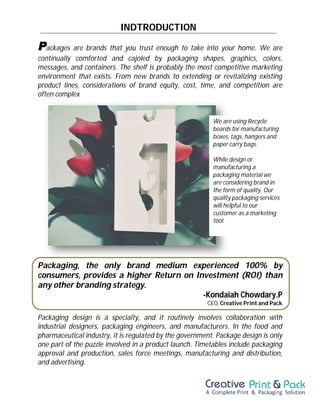
Packages are brands that you trust enough to take into your home. We are
continually comforted and cajoled by packaging shapes, graphics, colors,
messages, and containers. The shelf is probably the most competitive marketing
environment that exists. From new brands to extending or revitalizing existing
product lines, considerations of brand equity, cost, time, and competition are
often complex
.
Packaging, the only brand medium experienced 100% by
consumers, provides a higher Return on Investment (ROI) than
any other branding strategy.
-Kondaiah Chowdary.P
CEO, Creative Print and Pack
Packaging design is a specialty, and it routinely involves collaboration with
industrial designers, packaging engineers, and manufacturers. In the food and
pharmaceutical industry, it is regulated by the government. Package design is only
one part of the puzzle involved in a product launch. Timetables include packaging
approval and production, sales force meetings, manufacturing and distribution,
and advertising.
We are using Recycle
boards for manufacturing
boxes, tags, hangers and
paper carry bags.
While design or
manufacturing a
packaging material we
are considering brand in
the form of quality. Our
quality packaging services
will helpful to our
customer as a marketing
tool.
INDTRODUCTION
PACKAGING DESIGN PROCESS
Clarify goals + Positioning
 Establish goals and define
problem.
 Brand equity
 Competition
 Existing brands in product line
 Price point
 Target consumer
 Product benefit
Conduct audits + identify expert
team
 Competitive (category)
 Retail (point of sale)
 Brand (internal, existing
product line)
 Packaging designer
 Packaging engineer
 Packaging manufacturers
 Industrial designers
 Regulatory legal department
Conduct research as needed
 Understand brand equity.
 Determine brand standards.
 Examine brand architecture.
 Clarify target consumer.
 Confirm need for product does
product benefit resonate?
 Confirm language how should
benefit be expressed?
Research legal requirements
 Brand and corporate standards
 Product-specific
 Net weight
 Drug facts
 Nutrition facts
 Ingredients
 Warnings
 Claims
Research functional criteria
 Product stability
 Tamper or theft resistance
 Shelf footprint
 Durability
 Usage
 Packability
 Fillability
THiNK
BR’AND’iNG
PACK’AGE’iNG
PACKAGING BASICS
 The shelf is the most competitive marketing
environment in existence.
 Good design sells. It is a competitive
advantage.
 Positioning relative to the competition and
to the other members of the product line is
critical for developing a packaging strategy.
 A disciplined, coherent approach leads to a
unified, powerful brand presence.
 Structure and graphics can be developed
concurrently. It is a chicken-and-egg debate.
 Brand extensions are always a strategic
tug-of-war between differentiation and
coherence within a product line.
 Consider the entire life cycle of the package
and its relationship to the product: source, print,
assemble, pack, preserve, ship, display, purchase,
use, recycle/dispose.
 Devise timetables involving packaging
approval and production, sales force meetings, product sell in to
stores, manufacturing, and distribution.
 Developing a new structure takes a long time and is very
expensive, but it offers a unique competitive advantage.
Determine printing specifications
 Method: Offset, Digital
 Application: Paper
Board/PET/PP Boxes, Paper
Hang Tags, Paper Bags,
Barcode Stickers.
 Other: 6 colours, UV Printing,
Hot Foil Stamping
Determine structural design
 Design new structure or use
stock?
 Choose forms (e.g., Carton,
Cardboard, Corrugated, Rigid,
PET and PP Boxes).
 Choose possible materials,
substrates, or finishes.
 Source stock and get samples.
Finalize copy + content
 Product name
 Benefit copy
 Product Facts
 Ingredients
 Net contents
 Claims and Warnings
 Distributed by
 Manufactured in
 Universal Product Code
Design + prototype
 Start with face panels
(2D renderings).
 Get prototypes made.
 Narrow option(s).
 Design rest of package.
 Simulate reality: use actual
structure/substrate with
contents.
Evaluate solution + manage production
 In a retail/competitive environment
 As a member of the product line
 Consumer testing
 Finalize files.
 Oversee production.
Packaging Basics

Packaging Basics

  • 3.
    Packages are brandsthat you trust enough to take into your home. We are continually comforted and cajoled by packaging shapes, graphics, colors, messages, and containers. The shelf is probably the most competitive marketing environment that exists. From new brands to extending or revitalizing existing product lines, considerations of brand equity, cost, time, and competition are often complex . Packaging, the only brand medium experienced 100% by consumers, provides a higher Return on Investment (ROI) than any other branding strategy. -Kondaiah Chowdary.P CEO, Creative Print and Pack Packaging design is a specialty, and it routinely involves collaboration with industrial designers, packaging engineers, and manufacturers. In the food and pharmaceutical industry, it is regulated by the government. Package design is only one part of the puzzle involved in a product launch. Timetables include packaging approval and production, sales force meetings, manufacturing and distribution, and advertising. We are using Recycle boards for manufacturing boxes, tags, hangers and paper carry bags. While design or manufacturing a packaging material we are considering brand in the form of quality. Our quality packaging services will helpful to our customer as a marketing tool. INDTRODUCTION
  • 4.
    PACKAGING DESIGN PROCESS Clarifygoals + Positioning  Establish goals and define problem.  Brand equity  Competition  Existing brands in product line  Price point  Target consumer  Product benefit Conduct audits + identify expert team  Competitive (category)  Retail (point of sale)  Brand (internal, existing product line)  Packaging designer  Packaging engineer  Packaging manufacturers  Industrial designers  Regulatory legal department Conduct research as needed  Understand brand equity.  Determine brand standards.  Examine brand architecture.  Clarify target consumer.  Confirm need for product does product benefit resonate?  Confirm language how should benefit be expressed? Research legal requirements  Brand and corporate standards  Product-specific  Net weight  Drug facts  Nutrition facts  Ingredients  Warnings  Claims
  • 5.
    Research functional criteria Product stability  Tamper or theft resistance  Shelf footprint  Durability  Usage  Packability  Fillability THiNK BR’AND’iNG PACK’AGE’iNG
  • 6.
    PACKAGING BASICS  Theshelf is the most competitive marketing environment in existence.  Good design sells. It is a competitive advantage.  Positioning relative to the competition and to the other members of the product line is critical for developing a packaging strategy.  A disciplined, coherent approach leads to a unified, powerful brand presence.  Structure and graphics can be developed concurrently. It is a chicken-and-egg debate.  Brand extensions are always a strategic tug-of-war between differentiation and coherence within a product line.  Consider the entire life cycle of the package and its relationship to the product: source, print, assemble, pack, preserve, ship, display, purchase, use, recycle/dispose.  Devise timetables involving packaging approval and production, sales force meetings, product sell in to stores, manufacturing, and distribution.  Developing a new structure takes a long time and is very expensive, but it offers a unique competitive advantage.
  • 7.
    Determine printing specifications Method: Offset, Digital  Application: Paper Board/PET/PP Boxes, Paper Hang Tags, Paper Bags, Barcode Stickers.  Other: 6 colours, UV Printing, Hot Foil Stamping Determine structural design  Design new structure or use stock?  Choose forms (e.g., Carton, Cardboard, Corrugated, Rigid, PET and PP Boxes).  Choose possible materials, substrates, or finishes.  Source stock and get samples. Finalize copy + content  Product name  Benefit copy  Product Facts  Ingredients  Net contents  Claims and Warnings  Distributed by  Manufactured in  Universal Product Code Design + prototype  Start with face panels (2D renderings).  Get prototypes made.  Narrow option(s).  Design rest of package.  Simulate reality: use actual structure/substrate with contents. Evaluate solution + manage production  In a retail/competitive environment  As a member of the product line  Consumer testing  Finalize files.  Oversee production.