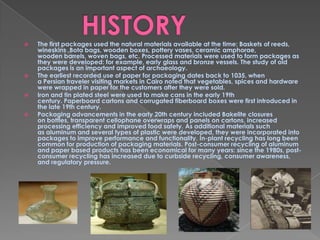
   The first packages used the natural materials available at the time: Baskets of reeds,
    wineskins ,Bota bags, wooden boxes, pottery vases, ceramic amphorae,
    wooden barrels, woven bags, etc. Processed materials were used to form packages as
    they were developed: for example, early glass and bronze vessels. The study of old
    packages is an important aspect of archaeology.
   The earliest recorded use of paper for packaging dates back to 1035, when
    a Persian traveler visiting markets in Cairo noted that vegetables, spices and hardware
    were wrapped in paper for the customers after they were sold.
   Iron and tin plated steel were used to make cans in the early 19th
    century. Paperboard cartons and corrugated fiberboard boxes were first introduced in
    the late 19th century.
   Packaging advancements in the early 20th century included Bakelite closures
    on bottles, transparent cellophane overwraps and panels on cartons, increased
    processing efficiency and improved food safety. As additional materials such
    as aluminum and several types of plastic were developed, they were incorporated into
    packages to improve performance and functionality. In-plant recycling has long been
    common for production of packaging materials. Post-consumer recycling of aluminum
    and paper based products has been economical for many years: since the 1980s, post-
    consumer recycling has increased due to curbside recycling, consumer awareness,
    and regulatory pressure.
   Physical protection – The objects enclosed in the package may require protection from,
    among other things, mechanical shock, vibration, electrostatic discharge,
    compression, temperature,[ etc.
   Barrier protection – A barrier from oxygen, water vapor, dust, etc., is often
    required. Permeation is a critical factor in design. Some packages
    contain desiccants or Oxygen absorbers to help extend shelf life. Modified
    atmospheres [or controlled atmospheres are also maintained in some food packages.
    Keeping the contents clean, fresh, sterile and safe for the intended shelf life is a primary
    function.
   Containment or agglomeration – Small objects are typically grouped together in one
    package for reasons of efficiency. For example, a single box of 1000 pencils requires
    less physical handling than 1000 single pencils. Liquids, powders, and granular
    materials need containment.

   A single-serving shampoo packet
   Security – Packaging can play an important role in reducing the security risks of
    shipment. Packages can be made with
   Convenience – Packages can have features that add convenience in distribution,
    handling, stacking, display, sale, opening, reclosing, use, dispensing, and reuse.
   Package design and development are often thought of as an integral part of
    the new product development process. Alternatively, development of a package (or
    component) can be a separate process, but must be linked closely with the product
    to be packaged. Package design starts with the identification of all the
    requirements: structural design, marketing, shelf life, quality assurance, logistics,
    legal, regulatory, graphic design, end-use, environmental, etc.
   An example of how package design is affected by other factors is the relationship
    to logistics . When the distribution system includes individual shipments by a small
    parcel carrier, the sortation , handling, and mixed stacking make severe demands
    on the strength and protective ability of the transport package.. A package
    designed for one mode of shipment may not be suited for another.
sustainable packaging:
 Package development involves considerations for sustainability,
 environmental responsibility, and
 applicable environmental and recycling regulations. It may involve a life
 cycle assessment[16][17] which considers the material and energy inputs and
 outputs to the package, the packaged product (contents), the packaging
 process, the logistics system, waste management, etc. It is necessary to know
 the relevant regulatory requirements for point of manufacture, sale, and use.
The traditional “three R’s” of reduce, reuse, and recycle are part of a waste
 hierarchy which may be considered in product and package development.


              Waste hierarchy
A choice of packaging machinery includes: technical capabilities, labor
    requirements, worker safety, maintainability, serviceability ,reliability, ability to
    integrate into the packaging line, capital cost , floor space , flexibility (change-
    over, materials, etc.), energy usage, quality of outgoing packages, qualifications
    (for food, pharmaceuticals, etc.), throughput, efficiency, productivity ,ergonomics
    , return on investment, etc.
Packaging machinery can be:
   purchased as standard, off-the-shelf
   purchased custom-made or custom-tailored to specific operations
   manufactured or modified by in-house engineers and maintenance staff.
   Accumulating and Collating Machines
   Blister packs, skin packs and Vacuum Packaging Machines
   Bottle caps equipment, Over-Capping, Lidding, Closing, Seaming and Sealing Machines
   Box, Case and Tray Forming, Packing, Unpacking, Closing and Sealing Machines
   Cartoning machines
   Cleaning, Sterilizing, Cooling and Drying Machines
   Coding, Printing, Marking, Stamping, and Imprinting Machines
   Converting Machines
   Conveyor belts, Accumulating and Related Machines
   Feeding, Orienting, Placing and Related Machines
   Filling Machines: Handling dry, powered, solid, liquid, gas, or viscous products
   Inspecting: visual, sound, metal detecting, etc
   Label dispenser
   Orienting, Unscrambling Machines
   Package Filling and Closing Machines
   Palletizing, Depalletizing, Unit load assembly
   Product Identification: labeling, marking, etc.
   Weighing Machines: Check weigher, multihead weigher
   Wrapping machines: Stretch wrapping, Shrink wrap, Banding
Bakery goods shrink wrapped by                               High speed conveyor with
shrink film, heat sealer and heat                            bar code scanner for sorting
    tunnel on roller conveyer                                transport packages.


                                Robotics used to palletize
Automatic stretch wrapping      bread                           Equipment for
machine                                                         thermoforming packages at
                                                                NASA
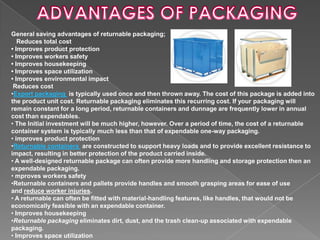
General saving advantages of returnable packaging;
   Reduces total cost
• Improves product protection
• Improves workers safety
• Improves housekeeping
• Improves space utilization
• Improves environmental impact
 Reduces cost
•Export packaging is typically used once and then thrown away. The cost of this package is added into
the product unit cost. Returnable packaging eliminates this recurring cost. If your packaging will
remain constant for a long period, returnable containers and dunnage are frequently lower in annual
cost than expendables.
• The Initial investment will be much higher, however. Over a period of time, the cost of a returnable
container system is typically much less than that of expendable one-way packaging.
• improves product protection
•Returnable containers are constructed to support heavy loads and to provide excellent resistance to
impact, resulting in better protection of the product carried inside.
• A well-designed returnable package can often provide more handling and storage protection then an
expendable packaging.
• mproves workers safety
•Returnable containers and pallets provide handles and smooth grasping areas for ease of use
and reduce worker injuries.
• A returnable can often be fitted with material-handling features, like handles, that would not be
economically feasible with an expendable container.
• Improves housekeeping
•Returnable packaging eliminates dirt, dust, and the trash clean-up associated with expendable
packaging.
• Improves space utilization
An example;
1 returnable with a lifetime of 100 turns replaces 100 expendable containers.
Weight for the expendable; 25 kg
Weight for the returnable; 40 kg


 T                      otal packaging material weight saving would be;


100 x 25 – 1 x 40 =2,460 Kg !!!

Important note : The principal driving force since the 1980s has been pressure from environmental sources .
General disadvantages of returnable packaging;
• Large capital expense or high Initial Investment
• Increased transportation expense, mainly for the returns
• Cost for tracking and accounting and sometimes cleaning
• Storage space for empties

•Large capital expense
Initial cost is probably the largest deterrent to the wide use of returnables. Savings over time have to be
significant to justify the capital expense. On the other hand, by the experience we have had, Pay-Off-
time for the Investments are normally <1 year, which means the Investment is quickly covered.

•Increased transportation expense
Returnables have to be returned and the return trip is usually not free. The cost must be factored in. Our
experience shows that the return cost is normally dominating over other costs. The degree of
“collapsibility” or “nestability” of containers and dunnage is of key importance and increases with
shipping distance.

•Cost for tracking and accounting
Because returnable packaging is relatively expensive, it´s important that they don´t get lost in the return
system. A loss rate of 10% losses per trip will give the result of complete system loss in just 10 cycles (10%
loss x 10 cycles results in 100% loss). On top of this cleaning might sometimes be an issue.
• Storage space for empties
It typically takes more space to store empty returnable packaging than to store expendable packaging
due to strength and design.

Packaging

  • 2.
    The first packages used the natural materials available at the time: Baskets of reeds, wineskins ,Bota bags, wooden boxes, pottery vases, ceramic amphorae, wooden barrels, woven bags, etc. Processed materials were used to form packages as they were developed: for example, early glass and bronze vessels. The study of old packages is an important aspect of archaeology.  The earliest recorded use of paper for packaging dates back to 1035, when a Persian traveler visiting markets in Cairo noted that vegetables, spices and hardware were wrapped in paper for the customers after they were sold.  Iron and tin plated steel were used to make cans in the early 19th century. Paperboard cartons and corrugated fiberboard boxes were first introduced in the late 19th century.  Packaging advancements in the early 20th century included Bakelite closures on bottles, transparent cellophane overwraps and panels on cartons, increased processing efficiency and improved food safety. As additional materials such as aluminum and several types of plastic were developed, they were incorporated into packages to improve performance and functionality. In-plant recycling has long been common for production of packaging materials. Post-consumer recycling of aluminum and paper based products has been economical for many years: since the 1980s, post- consumer recycling has increased due to curbside recycling, consumer awareness, and regulatory pressure.
  • 3.
    Physical protection – The objects enclosed in the package may require protection from, among other things, mechanical shock, vibration, electrostatic discharge, compression, temperature,[ etc.  Barrier protection – A barrier from oxygen, water vapor, dust, etc., is often required. Permeation is a critical factor in design. Some packages contain desiccants or Oxygen absorbers to help extend shelf life. Modified atmospheres [or controlled atmospheres are also maintained in some food packages. Keeping the contents clean, fresh, sterile and safe for the intended shelf life is a primary function.  Containment or agglomeration – Small objects are typically grouped together in one package for reasons of efficiency. For example, a single box of 1000 pencils requires less physical handling than 1000 single pencils. Liquids, powders, and granular materials need containment.  A single-serving shampoo packet  Security – Packaging can play an important role in reducing the security risks of shipment. Packages can be made with  Convenience – Packages can have features that add convenience in distribution, handling, stacking, display, sale, opening, reclosing, use, dispensing, and reuse.
  • 5.
    Package design and development are often thought of as an integral part of the new product development process. Alternatively, development of a package (or component) can be a separate process, but must be linked closely with the product to be packaged. Package design starts with the identification of all the requirements: structural design, marketing, shelf life, quality assurance, logistics, legal, regulatory, graphic design, end-use, environmental, etc.  An example of how package design is affected by other factors is the relationship to logistics . When the distribution system includes individual shipments by a small parcel carrier, the sortation , handling, and mixed stacking make severe demands on the strength and protective ability of the transport package.. A package designed for one mode of shipment may not be suited for another.
  • 6.
    sustainable packaging: Packagedevelopment involves considerations for sustainability, environmental responsibility, and applicable environmental and recycling regulations. It may involve a life cycle assessment[16][17] which considers the material and energy inputs and outputs to the package, the packaged product (contents), the packaging process, the logistics system, waste management, etc. It is necessary to know the relevant regulatory requirements for point of manufacture, sale, and use. The traditional “three R’s” of reduce, reuse, and recycle are part of a waste hierarchy which may be considered in product and package development. Waste hierarchy
  • 7.
    A choice ofpackaging machinery includes: technical capabilities, labor requirements, worker safety, maintainability, serviceability ,reliability, ability to integrate into the packaging line, capital cost , floor space , flexibility (change- over, materials, etc.), energy usage, quality of outgoing packages, qualifications (for food, pharmaceuticals, etc.), throughput, efficiency, productivity ,ergonomics , return on investment, etc. Packaging machinery can be:  purchased as standard, off-the-shelf  purchased custom-made or custom-tailored to specific operations  manufactured or modified by in-house engineers and maintenance staff.
  • 8.
    Accumulating and Collating Machines  Blister packs, skin packs and Vacuum Packaging Machines  Bottle caps equipment, Over-Capping, Lidding, Closing, Seaming and Sealing Machines  Box, Case and Tray Forming, Packing, Unpacking, Closing and Sealing Machines  Cartoning machines  Cleaning, Sterilizing, Cooling and Drying Machines  Coding, Printing, Marking, Stamping, and Imprinting Machines  Converting Machines  Conveyor belts, Accumulating and Related Machines  Feeding, Orienting, Placing and Related Machines  Filling Machines: Handling dry, powered, solid, liquid, gas, or viscous products  Inspecting: visual, sound, metal detecting, etc  Label dispenser  Orienting, Unscrambling Machines  Package Filling and Closing Machines  Palletizing, Depalletizing, Unit load assembly  Product Identification: labeling, marking, etc.  Weighing Machines: Check weigher, multihead weigher  Wrapping machines: Stretch wrapping, Shrink wrap, Banding
  • 9.
    Bakery goods shrinkwrapped by High speed conveyor with shrink film, heat sealer and heat bar code scanner for sorting tunnel on roller conveyer transport packages. Robotics used to palletize Automatic stretch wrapping bread Equipment for machine thermoforming packages at NASA
  • 10.
    General saving advantagesof returnable packaging; Reduces total cost • Improves product protection • Improves workers safety • Improves housekeeping • Improves space utilization • Improves environmental impact Reduces cost •Export packaging is typically used once and then thrown away. The cost of this package is added into the product unit cost. Returnable packaging eliminates this recurring cost. If your packaging will remain constant for a long period, returnable containers and dunnage are frequently lower in annual cost than expendables. • The Initial investment will be much higher, however. Over a period of time, the cost of a returnable container system is typically much less than that of expendable one-way packaging. • improves product protection •Returnable containers are constructed to support heavy loads and to provide excellent resistance to impact, resulting in better protection of the product carried inside. • A well-designed returnable package can often provide more handling and storage protection then an expendable packaging. • mproves workers safety •Returnable containers and pallets provide handles and smooth grasping areas for ease of use and reduce worker injuries. • A returnable can often be fitted with material-handling features, like handles, that would not be economically feasible with an expendable container. • Improves housekeeping •Returnable packaging eliminates dirt, dust, and the trash clean-up associated with expendable packaging. • Improves space utilization
  • 11.
    An example; 1 returnablewith a lifetime of 100 turns replaces 100 expendable containers. Weight for the expendable; 25 kg Weight for the returnable; 40 kg T otal packaging material weight saving would be; 100 x 25 – 1 x 40 =2,460 Kg !!! Important note : The principal driving force since the 1980s has been pressure from environmental sources .
  • 12.
    General disadvantages ofreturnable packaging; • Large capital expense or high Initial Investment • Increased transportation expense, mainly for the returns • Cost for tracking and accounting and sometimes cleaning • Storage space for empties •Large capital expense Initial cost is probably the largest deterrent to the wide use of returnables. Savings over time have to be significant to justify the capital expense. On the other hand, by the experience we have had, Pay-Off- time for the Investments are normally <1 year, which means the Investment is quickly covered. •Increased transportation expense Returnables have to be returned and the return trip is usually not free. The cost must be factored in. Our experience shows that the return cost is normally dominating over other costs. The degree of “collapsibility” or “nestability” of containers and dunnage is of key importance and increases with shipping distance. •Cost for tracking and accounting Because returnable packaging is relatively expensive, it´s important that they don´t get lost in the return system. A loss rate of 10% losses per trip will give the result of complete system loss in just 10 cycles (10% loss x 10 cycles results in 100% loss). On top of this cleaning might sometimes be an issue. • Storage space for empties It typically takes more space to store empty returnable packaging than to store expendable packaging due to strength and design.