Presented by-
Adya Tiwari
Ph.D. previous
(Department of TAD)
Presented To-
Dr. Sudha Babel
PACKAGING
 Packaging is an important concern for consumers,
particularly those who are interested in converting to
environmentally-friendly buying behaviors.
 Eco-friendly packaging is a recent phenomenon, it is
already a large and rapidly growing trend.
 Innovative techniques and various measures of
textile cleaner production”(CP) which ensures
textile processing is “eco-friendly”, “cost effective”
and “sustainable business”.
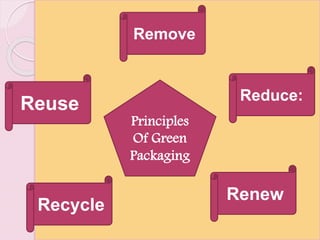
Recycle
Renew
Reuse
Remove
Reduce:
Principles
Of Green
Packaging
Components of a Package
Aesthetic Component
Size and shape
Material
Color
Text
Functional Component
Structural Design
Brand Advertisement
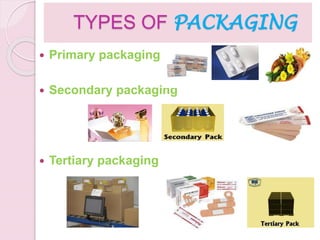
TYPES OF PACKAGING
 Primary packaging
 Secondary packaging
 Tertiary packaging
1. Tissues Paper Packaging
Other Types OF PACKAGING
2. Vacuum
Packaging
3. Ecological
Packaging
5. Green
Packaging
6. Sustainable
Packaging
Goal of sustainable packaging
In general, the broad goals of
sustainable packaging are:
 Functional – product protection, safety,
regulatory compliance, etc.
 Cost effective – if it is too expensive, it
is unlikely to be used
 Support long-term human and
ecological health
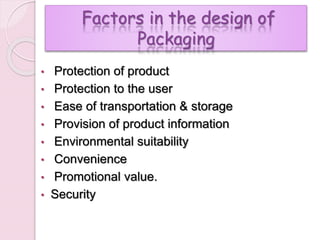
Factors in the design of
Packaging
• Protection of product
• Protection to the user
• Ease of transportation & storage
• Provision of product information
• Environmental suitability
• Convenience
• Promotional value.
• Security
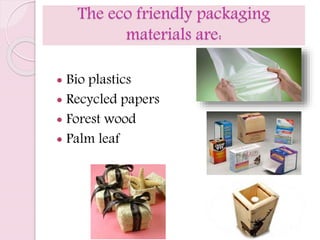
The eco friendly packaging
materials are:
 Bio plastics
 Recycled papers
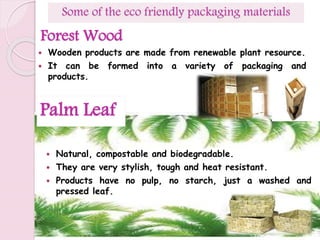
 Forest wood
 Palm leaf
Recycled packaging materials:
 Corrugated cartons
 Glass
 Steel
 Paper board
 Bubble wrap
 Corn starch
 Some recyclable plastics
Natural packaging materials:
Coconut husk
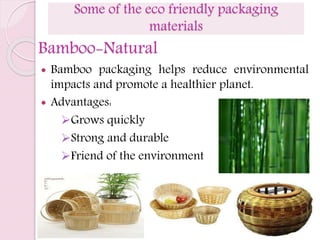
Bamboo
Some of the eco friendly packaging
materials are:
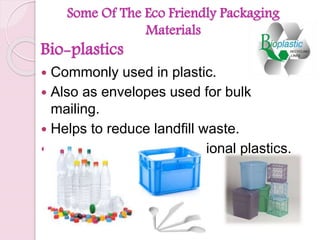
Bio-plastics
 Commonly used in plastic.
 Also as envelopes used for bulk
mailing.
 Helps to reduce landfill waste.
 Good alternative to traditional plastics.
Some Of The Eco Friendly Packaging
Materials
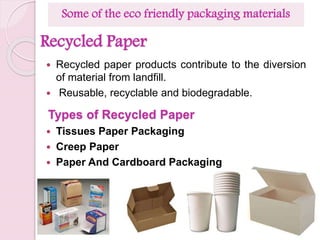
Recycled Paper
 Recycled paper products contribute to the diversion
of material from landfill.
 Reusable, recyclable and biodegradable.
Some of the eco friendly packaging materials
 Tissues Paper Packaging
 Creep Paper
 Paper And Cardboard Packaging
Types of Recycled Paper
Palm Leaf
 Natural, compostable and biodegradable.
 They are very stylish, tough and heat resistant.
 Products have no pulp, no starch, just a washed and
pressed leaf.
Some of the eco friendly packaging materials
 Wooden products are made from renewable plant resource.
 It can be formed into a variety of packaging and
products.
Forest Wood
Corn starch
Some of the eco friendly packaging
materials
 Items made from corn starch are biodegradable.
 Corn starch packaging biodegrades and has a
limited negative impact on the environment.
Green wrap
 Eco friendly biodegradable paper protective
packaging material made from recycled material.
 It looks great and cost effective
Bamboo-Natural
 Bamboo packaging helps reduce environmental
impacts and promote a healthier planet.
 Advantages:
Grows quickly
Strong and durable
Friend of the environment
Some of the eco friendly packaging
materials
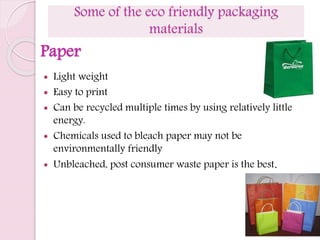
Paper
 Light weight
 Easy to print
 Can be recycled multiple times by using relatively little
energy.
 Chemicals used to bleach paper may not be
environmentally friendly
 Unbleached, post consumer waste paper is the best.
Some of the eco friendly packaging
materials
Benefit Of Eco-friendly
Packaging
While helping the environment is one benefit of eco-
friendly packaging, packing products using fewer and
more sustainable materials reaps additional rewards:
 Saving money. Reducing excess packaging results in
lighter and smaller shipments that cost less to
transport.
 Maintaining business. Switching to green materials
can help meet or anticipate customer demands for
eco-friendly suppliers.
 Attracting consumers. Many shoppers will choose
an environmentally friendly product over a
conventional package.
Related Studies
 McHugh in 2004 gave the example that her
packaging could be used to flavor the product
inside such as a “steak wrapped in carrot film”,
“hams enveloped in apple wraps”
 A global leader in 2005 he introduced in his
innovation, The calculator has allowed for Kraft to
reduce Oscar Mayer Deli Creations paperboard
packaging by 30%. This design will reduce an
estimated 1.2 million pounds of paperboard waste
annually.
 The Ajinomoto Group introduced its unique “Aji-na-
Eco”1 mark in autumn 2010 to show the eco-
friendliness of its product packages.
 Anthony King announced in 2011, the development of the world’s
first plant-based PET plastic bottle, which will in the future use
non-food sources such as orange peel. Coca-Cola and Heinz
have also recently launched bio-plastic bottles in Europe.
 Along with PLA labels, in fiscal 2012, Ajinomoto Co., also plans to
use eco-friendly plastic for the cap of the AJIPANDAR jar (75 g) of
the umami seasoning AJI-NO-MOTOR. The plastic for that
purpose contained biomass polyethylene made from sugarcane.
This step will enable packaging that is completely environmental
friendly.
 ITC, since long, has been associated with quality. In 2002, they
introduced their packaged; the package was of great importance to
ensure long shelf life for the products which were made
without any preservatives.
Related Studies
 Iyer has introduced in 2006 that Radio frequency identification
(RFID) is being incorporated into thin-film electronics to monitor
the conditions inside of a package in real time. the study of
kinetics, as well as providing an excellent inventory and quality
control database to reduce waste of packaging.
 This article looks at some of the basic types of reusable
packaging used in industry. Reusable packaging plays a key role
within the recycling industry itself, while in terms of helping
companies achieve waste reduction targets such as Zero Landfill
initiatives within the context of more broad Zero Waste programs,
reusable transport packaging is playing an increasingly important
role. Some of the common types of reusable packaging include:
 Reusable pallets
 Reusable handheld containers
 Reusable dunnage.
Related Studies
Polyolefin (HDPE/PP) woven sacks are versatile
packing materials used extensively in the packing
of cement, fertilizers, thermo plastic raw materials, food
grains, sugar etc.
 PP/HDPE printed sandwich bags are made by
sandwiching PP and HDPE. They have a very good
appearance and are used for packaging costlier
products like pesticides, seeds, wheat flour, high-
end chemicals, etc.
Recent Textiles Packaging
 Monsoon Sheds
Recent eco friendly textiles packaging
materials
Cotton Canvas Tarpaulins
HDPE Tarpaulins
(High density poly ethylene)
Conclusion
Innovations in eco-friendly packing have
come in many forms ranging from simply
removing source material to the
development of complex nano-
composites. As consumers and industry
become more aware of the current
environmental conditions, they embrace
the concept of moral responsibility
superseding convenience and
conventional profitability.
Presentation on eco friendly packaging materials

Presentation on eco friendly packaging materials

  • 1.
    Presented by- Adya Tiwari Ph.D.previous (Department of TAD) Presented To- Dr. Sudha Babel
  • 2.
    PACKAGING  Packaging isan important concern for consumers, particularly those who are interested in converting to environmentally-friendly buying behaviors.  Eco-friendly packaging is a recent phenomenon, it is already a large and rapidly growing trend.  Innovative techniques and various measures of textile cleaner production”(CP) which ensures textile processing is “eco-friendly”, “cost effective” and “sustainable business”.
  • 3.
  • 4.
    Components of aPackage Aesthetic Component Size and shape Material Color Text Functional Component Structural Design Brand Advertisement
  • 5.
    TYPES OF PACKAGING Primary packaging  Secondary packaging  Tertiary packaging
  • 6.
    1. Tissues PaperPackaging Other Types OF PACKAGING 2. Vacuum Packaging 3. Ecological Packaging 5. Green Packaging 6. Sustainable Packaging
  • 7.
    Goal of sustainablepackaging In general, the broad goals of sustainable packaging are:  Functional – product protection, safety, regulatory compliance, etc.  Cost effective – if it is too expensive, it is unlikely to be used  Support long-term human and ecological health
  • 8.
    Factors in thedesign of Packaging • Protection of product • Protection to the user • Ease of transportation & storage • Provision of product information • Environmental suitability • Convenience • Promotional value. • Security
  • 9.
    The eco friendlypackaging materials are:  Bio plastics  Recycled papers  Forest wood  Palm leaf
  • 10.
    Recycled packaging materials: Corrugated cartons  Glass  Steel  Paper board  Bubble wrap  Corn starch  Some recyclable plastics Natural packaging materials: Coconut husk Bamboo Some of the eco friendly packaging materials are:
  • 11.
    Bio-plastics  Commonly usedin plastic.  Also as envelopes used for bulk mailing.  Helps to reduce landfill waste.  Good alternative to traditional plastics. Some Of The Eco Friendly Packaging Materials
  • 12.
    Recycled Paper  Recycledpaper products contribute to the diversion of material from landfill.  Reusable, recyclable and biodegradable. Some of the eco friendly packaging materials  Tissues Paper Packaging  Creep Paper  Paper And Cardboard Packaging Types of Recycled Paper
  • 13.
    Palm Leaf  Natural,compostable and biodegradable.  They are very stylish, tough and heat resistant.  Products have no pulp, no starch, just a washed and pressed leaf. Some of the eco friendly packaging materials  Wooden products are made from renewable plant resource.  It can be formed into a variety of packaging and products. Forest Wood
  • 14.
    Corn starch Some ofthe eco friendly packaging materials  Items made from corn starch are biodegradable.  Corn starch packaging biodegrades and has a limited negative impact on the environment. Green wrap  Eco friendly biodegradable paper protective packaging material made from recycled material.  It looks great and cost effective
  • 15.
    Bamboo-Natural  Bamboo packaginghelps reduce environmental impacts and promote a healthier planet.  Advantages: Grows quickly Strong and durable Friend of the environment Some of the eco friendly packaging materials
  • 16.
    Paper  Light weight Easy to print  Can be recycled multiple times by using relatively little energy.  Chemicals used to bleach paper may not be environmentally friendly  Unbleached, post consumer waste paper is the best. Some of the eco friendly packaging materials
  • 17.
    Benefit Of Eco-friendly Packaging Whilehelping the environment is one benefit of eco- friendly packaging, packing products using fewer and more sustainable materials reaps additional rewards:  Saving money. Reducing excess packaging results in lighter and smaller shipments that cost less to transport.  Maintaining business. Switching to green materials can help meet or anticipate customer demands for eco-friendly suppliers.  Attracting consumers. Many shoppers will choose an environmentally friendly product over a conventional package.
  • 18.
    Related Studies  McHughin 2004 gave the example that her packaging could be used to flavor the product inside such as a “steak wrapped in carrot film”, “hams enveloped in apple wraps”  A global leader in 2005 he introduced in his innovation, The calculator has allowed for Kraft to reduce Oscar Mayer Deli Creations paperboard packaging by 30%. This design will reduce an estimated 1.2 million pounds of paperboard waste annually.  The Ajinomoto Group introduced its unique “Aji-na- Eco”1 mark in autumn 2010 to show the eco- friendliness of its product packages.
  • 19.
     Anthony Kingannounced in 2011, the development of the world’s first plant-based PET plastic bottle, which will in the future use non-food sources such as orange peel. Coca-Cola and Heinz have also recently launched bio-plastic bottles in Europe.  Along with PLA labels, in fiscal 2012, Ajinomoto Co., also plans to use eco-friendly plastic for the cap of the AJIPANDAR jar (75 g) of the umami seasoning AJI-NO-MOTOR. The plastic for that purpose contained biomass polyethylene made from sugarcane. This step will enable packaging that is completely environmental friendly.  ITC, since long, has been associated with quality. In 2002, they introduced their packaged; the package was of great importance to ensure long shelf life for the products which were made without any preservatives. Related Studies
  • 20.
     Iyer hasintroduced in 2006 that Radio frequency identification (RFID) is being incorporated into thin-film electronics to monitor the conditions inside of a package in real time. the study of kinetics, as well as providing an excellent inventory and quality control database to reduce waste of packaging.  This article looks at some of the basic types of reusable packaging used in industry. Reusable packaging plays a key role within the recycling industry itself, while in terms of helping companies achieve waste reduction targets such as Zero Landfill initiatives within the context of more broad Zero Waste programs, reusable transport packaging is playing an increasingly important role. Some of the common types of reusable packaging include:  Reusable pallets  Reusable handheld containers  Reusable dunnage. Related Studies
  • 21.
    Polyolefin (HDPE/PP) wovensacks are versatile packing materials used extensively in the packing of cement, fertilizers, thermo plastic raw materials, food grains, sugar etc.  PP/HDPE printed sandwich bags are made by sandwiching PP and HDPE. They have a very good appearance and are used for packaging costlier products like pesticides, seeds, wheat flour, high- end chemicals, etc. Recent Textiles Packaging
  • 22.
     Monsoon Sheds Recenteco friendly textiles packaging materials Cotton Canvas Tarpaulins HDPE Tarpaulins (High density poly ethylene)
  • 23.
    Conclusion Innovations in eco-friendlypacking have come in many forms ranging from simply removing source material to the development of complex nano- composites. As consumers and industry become more aware of the current environmental conditions, they embrace the concept of moral responsibility superseding convenience and conventional profitability.