
Indications for pacing
In
Special conditions
Dr. Ahmed Taha Hussein
M.Sc.Cardiology
Electrophysiology specialist
Assistant lecturer
Zagazig university
Updates of the guidelines
Specific conditions
▪ Acute myocardial infarction
▪ Pacing after cardiac surgery,transcatheter aortic
valve implantation,and heart transplantation.
▪ Pacing and cardiac resynchronization therapy in
children and in congenital heart disease.
▪ Pacing in hypertrophic cardiomyopathy.
▪ Pacing in rare diseases.
▪ Pacing in pregnancy.
▪ Pacing for first-degree atrioventricular block
(haemodynamic).
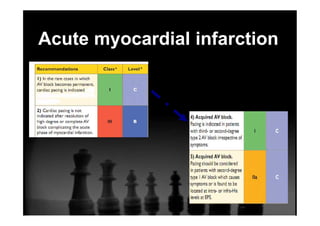
Acute myocardial infarction
▪ Incidence 3.2% after PCI and thrombolytics.
▪ AWMI associated high degree AV block is
always below Hiss bundle , while IWMI usually
above Hiss bundle .
▪ Usually resolve spontaneously within 2-7 days.
▪ 9% need Permenant pacing later on.
▪ Newely developed Intraventricular condcution
defect usually associated with high mortality due
extensive myonecrosis ... CRT criteria.
Acute myocardial infarction
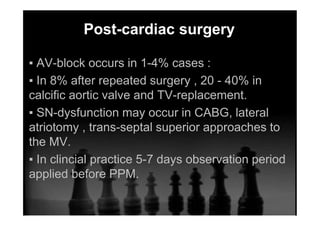
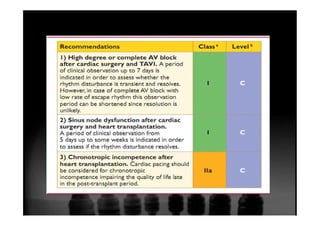
Post-cardiac surgery
▪ AV-block occurs in 1-4% cases :
▪ In 8% after repeated surgery , 20 - 40% in
calcific aortic valve and TV-replacement.
▪ SN-dysfunction may occur in CABG, lateral
atriotomy , trans-septal superior approaches to
the MV.
▪ In clincial practice 5-7 days observation period
applied before PPM.
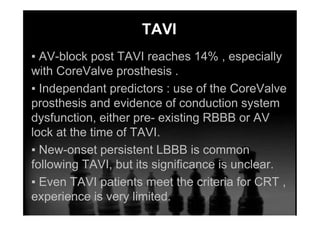
TAVI
▪ AV-block post TAVI reaches 14% , especially
with CoreValve prosthesis .
▪ Independant predictors : use of the CoreValve
prosthesis and evidence of conduction system
dysfunction, either pre- existing RBBB or AV
lock at the time of TAVI.
▪ New-onset persistent LBBB is common
following TAVI, but its significance is unclear.
▪ Even TAVI patients meet the criteria for CRT ,
experience is very limited.
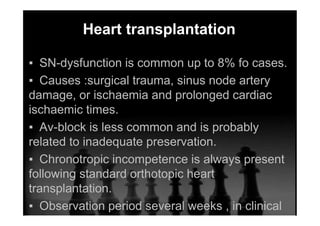
Heart transplantation
▪ SN-dysfunction is common up to 8% fo cases.
▪ Causes :surgical trauma, sinus node artery
damage, or ischaemia and prolonged cardiac
ischaemic times.
▪ Av-block is less common and is probably
related to inadequate preservation.
▪ Chronotropic incompetence is always present
following standard orthotopic heart
transplantation.
▪ Observation period several weeks , in clinical
consensus 3 weeks .
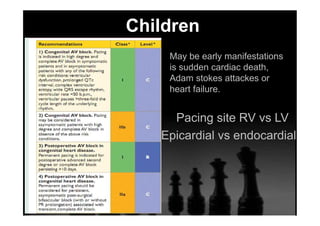
Children
May be early manifestations
is sudden cardiac death,
Adam stokes attackes or
heart failure.
Pacing site RV vs LV
Epicardial vs endocardial
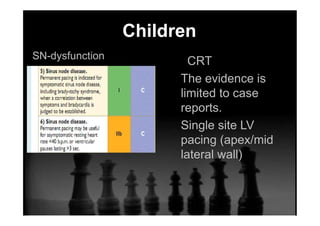
Children
SN-dysfunction
CRT
The evidence is
limited to case
reports.
Single site LV
pacing (apex/mid
lateral wall)
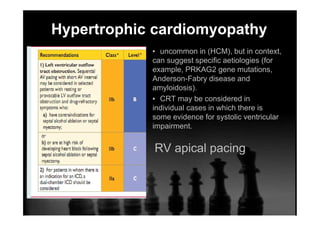
Hypertrophic cardiomyopathy
▪ uncommon in (HCM), but in context,
can suggest specific aetiologies (for
example, PRKAG2 gene mutations,
Anderson-Fabry disease and
amyloidosis).
▪ CRT may be considered in
individual cases in which there is
some evidence for systolic ventricular
impairment.
RV apical pacing
Rare diseases
LQT- syndromes
ICD (with active pacing) is preferable in patients with
symptoms unresponsive
to ß-blocker therapy or pause-dependent ventricular
arrhythmia according to current ICD guidelines.
Muscular dystrophies
Emery-Dreifuss MD
once bradycardia appeared , but thromboebolism are
not preventable by pacing.
athy and mitochondrial diseases , pacing with ICD
back-up is the recommended Other types of
desmopapproach.
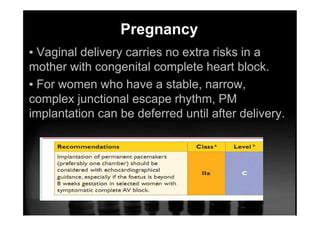
Pregnancy
▪ Vaginal delivery carries no extra risks in a
mother with congenital complete heart block.
▪ For women who have a stable, narrow,
complex junctional escape rhythm, PM
implantation can be deferred until after delivery.
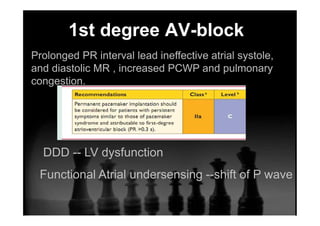
1st degree AV-block
Prolonged PR interval lead ineffective atrial systole,
and diastolic MR , increased PCWP and pulmonary
congestion.
DDD -- LV dysfunction
Functional Atrial undersensing --shift of P wave
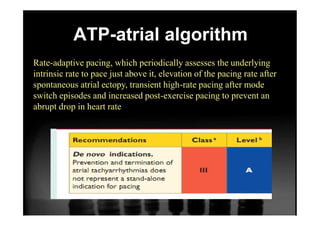
ATP-atrial algorithm
Rate-adaptive pacing, which periodically assesses the underlying
intrinsic rate to pace just above it, elevation of the pacing rate after
spontaneous atrial ectopy, transient high-rate pacing after mode
switch episodes and increased post-exercise pacing to prevent an
abrupt drop in heart rate.
Thank you

Pacing in special conditions 2013 guidelines

  • 1.
    Indications for pacing In Specialconditions Dr. Ahmed Taha Hussein M.Sc.Cardiology Electrophysiology specialist Assistant lecturer Zagazig university
  • 2.
    Updates of theguidelines
  • 3.
    Specific conditions ▪ Acutemyocardial infarction ▪ Pacing after cardiac surgery,transcatheter aortic valve implantation,and heart transplantation. ▪ Pacing and cardiac resynchronization therapy in children and in congenital heart disease. ▪ Pacing in hypertrophic cardiomyopathy. ▪ Pacing in rare diseases. ▪ Pacing in pregnancy. ▪ Pacing for first-degree atrioventricular block (haemodynamic).
  • 4.
    Acute myocardial infarction ▪Incidence 3.2% after PCI and thrombolytics. ▪ AWMI associated high degree AV block is always below Hiss bundle , while IWMI usually above Hiss bundle . ▪ Usually resolve spontaneously within 2-7 days. ▪ 9% need Permenant pacing later on. ▪ Newely developed Intraventricular condcution defect usually associated with high mortality due extensive myonecrosis ... CRT criteria.
  • 5.
  • 6.
    Post-cardiac surgery ▪ AV-blockoccurs in 1-4% cases : ▪ In 8% after repeated surgery , 20 - 40% in calcific aortic valve and TV-replacement. ▪ SN-dysfunction may occur in CABG, lateral atriotomy , trans-septal superior approaches to the MV. ▪ In clincial practice 5-7 days observation period applied before PPM.
  • 7.
    TAVI ▪ AV-block postTAVI reaches 14% , especially with CoreValve prosthesis . ▪ Independant predictors : use of the CoreValve prosthesis and evidence of conduction system dysfunction, either pre- existing RBBB or AV lock at the time of TAVI. ▪ New-onset persistent LBBB is common following TAVI, but its significance is unclear. ▪ Even TAVI patients meet the criteria for CRT , experience is very limited.
  • 8.
    Heart transplantation ▪ SN-dysfunctionis common up to 8% fo cases. ▪ Causes :surgical trauma, sinus node artery damage, or ischaemia and prolonged cardiac ischaemic times. ▪ Av-block is less common and is probably related to inadequate preservation. ▪ Chronotropic incompetence is always present following standard orthotopic heart transplantation. ▪ Observation period several weeks , in clinical consensus 3 weeks .
  • 10.
    Children May be earlymanifestations is sudden cardiac death, Adam stokes attackes or heart failure. Pacing site RV vs LV Epicardial vs endocardial
  • 11.
    Children SN-dysfunction CRT The evidence is limitedto case reports. Single site LV pacing (apex/mid lateral wall)
  • 12.
    Hypertrophic cardiomyopathy ▪ uncommonin (HCM), but in context, can suggest specific aetiologies (for example, PRKAG2 gene mutations, Anderson-Fabry disease and amyloidosis). ▪ CRT may be considered in individual cases in which there is some evidence for systolic ventricular impairment. RV apical pacing
  • 13.
    Rare diseases LQT- syndromes ICD(with active pacing) is preferable in patients with symptoms unresponsive to ß-blocker therapy or pause-dependent ventricular arrhythmia according to current ICD guidelines. Muscular dystrophies Emery-Dreifuss MD once bradycardia appeared , but thromboebolism are not preventable by pacing. athy and mitochondrial diseases , pacing with ICD back-up is the recommended Other types of desmopapproach.
  • 14.
    Pregnancy ▪ Vaginal deliverycarries no extra risks in a mother with congenital complete heart block. ▪ For women who have a stable, narrow, complex junctional escape rhythm, PM implantation can be deferred until after delivery.
  • 15.
    1st degree AV-block ProlongedPR interval lead ineffective atrial systole, and diastolic MR , increased PCWP and pulmonary congestion. DDD -- LV dysfunction Functional Atrial undersensing --shift of P wave
  • 16.
    ATP-atrial algorithm Rate-adaptive pacing,which periodically assesses the underlying intrinsic rate to pace just above it, elevation of the pacing rate after spontaneous atrial ectopy, transient high-rate pacing after mode switch episodes and increased post-exercise pacing to prevent an abrupt drop in heart rate.
  • 17.