

Ahmed Taha Abdelwahed, MD
Lecturer of Cardiology
Department of Cardiology, Faculty of Medicine,
Zagazig University, Egypt;
Heart Center, Department of Cardiology, Tampere University Hospital,
and School of Medicine, University of Tampere, Finland
Mono vs.
Combination therapy for
initial treatment of
Hypertension
Consultant of Cardiology
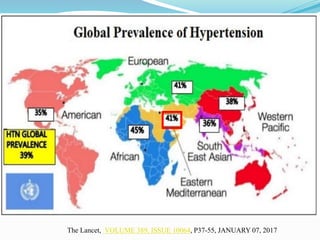
The Lancet, VOLUME 389, ISSUE 10064, P37-55, JANUARY 07, 2017
Introduction
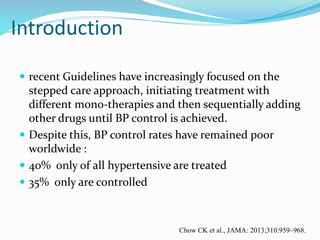
 recent Guidelines have increasingly focused on the
stepped care approach, initiating treatment with
different mono-therapies and then sequentially adding
other drugs until BP control is achieved.
 Despite this, BP control rates have remained poor
worldwide :
 40% only of all hypertensive are treated
 35% only are controlled
Chow CK et al., JAMA: 2013;310:959–968.
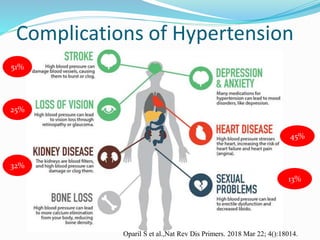
Complications of Hypertension
51%
25%
32%
45%
13%
Oparil S et al.,Nat Rev Dis Primers. 2018 Mar 22; 4():18014.
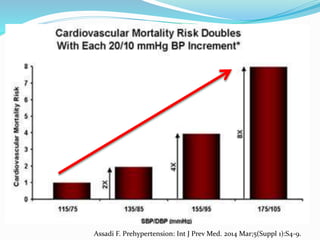
Assadi F. Prehypertension: Int J Prev Med. 2014 Mar;5(Suppl 1):S4-9.
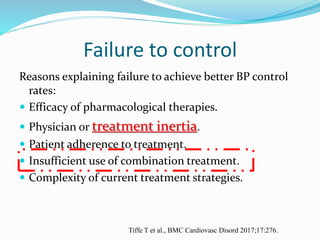
Failure to control
Reasons explaining failure to achieve better BP control
rates:
 Efficacy of pharmacological therapies.
 Physician or treatment inertia.
 Patient adherence to treatment.
 Insufficient use of combination treatment.
 Complexity of current treatment strategies.
Tiffe T et al., BMC Cardiovasc Disord 2017;17:276.
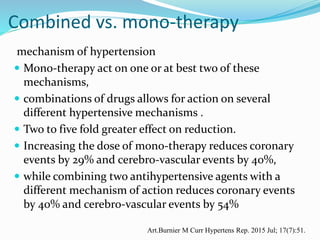
Combined vs. mono-therapy
mechanism of hypertension
 Mono-therapy act on one or at best two of these
mechanisms,
 combinations of drugs allows for action on several
different hypertensive mechanisms .
 Two to five fold greater effect on reduction.
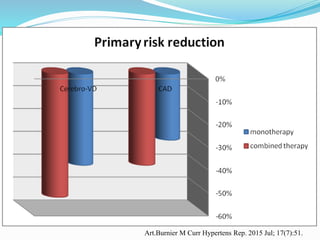
 Increasing the dose of mono-therapy reduces coronary
events by 29% and cerebro-vascular events by 40%,
 while combining two antihypertensive agents with a
different mechanism of action reduces coronary events
by 40% and cerebro-vascular events by 54%
Art.Burnier M Curr Hypertens Rep. 2015 Jul; 17(7):51.
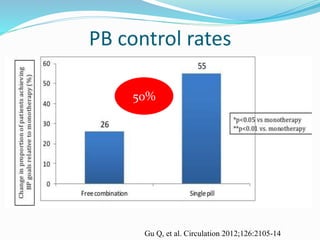
PB control rates
50%
Gu Q, et al. Circulation 2012;126:2105-14
Advantages of the combination
Reduction in adverse effects:
 RASIs prevent pretibial edema induced by calcium
channel blockers
 RASIs counteract the release of renin caused by
natriuretics
 RASIs block the release of aldosterone induced by
natriuretics and the resulting hypokalemia
 Several physiopathological mechanisms of increased
blood pressure are blocked
 Greater protection to target organs
 Faster control of blood pressure
Oparil S et al.,Nat Rev Dis Primers. 2018 Mar 22; 4():18014.
Combinations may have some effects that are
independent of their antihypertensive action:
 Anti-inflammatory
 Metabolic
 Anticounter regulation:
 Diuretics counteract the retention of water produced
by vasodilators
 RASIs compensate for renin release by diuretics
Combination Therapy
Is Superior to
Sequential Mono-
therapy for the Initial
Treatment of
Hypertension
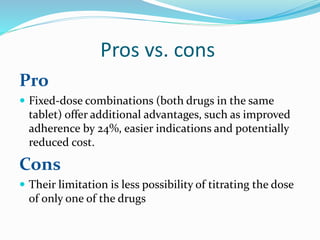
Pros vs. cons
Pro
 Fixed-dose combinations (both drugs in the same
tablet) offer additional advantages, such as improved
adherence by 24%, easier indications and potentially
reduced cost.
Cons
 Their limitation is less possibility of titrating the dose
of only one of the drugs
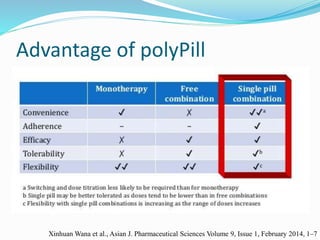
Advantage of polyPill
Xinhuan Wana et al., Asian J. Pharmaceutical Sciences Volume 9, Issue 1, February 2014, 1–7
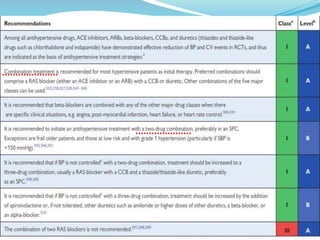
Recommendation
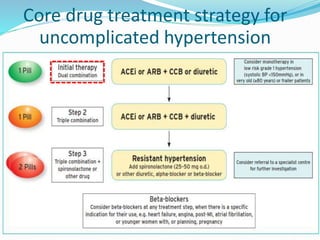
Core drug treatment strategy for
uncomplicated hypertension
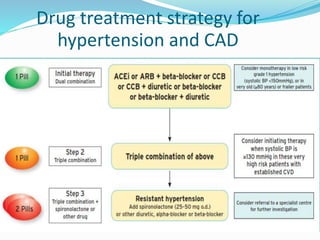
Drug treatment strategy for
hypertension and CAD
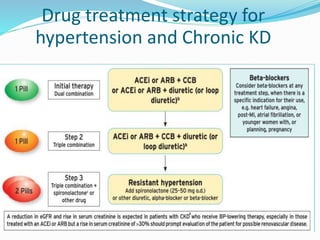
Drug treatment strategy for
hypertension and Chronic KD
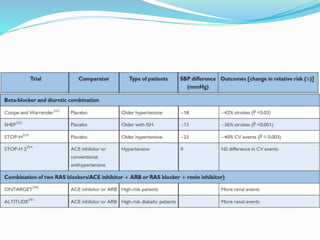
Major trials of conbination vs mono therapy/ Placebo
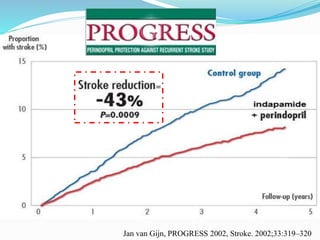
Jan van Gijn, PROGRESS 2002, Stroke. 2002;33:319–320
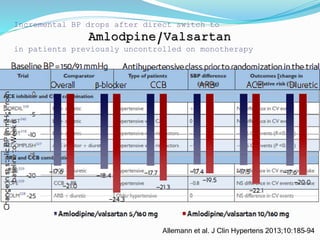
Incremental BP drops after direct switch to
Amlodpine/Valsartan
in patients previously uncontrolled on monotherapy
Allemann et al. J Clin Hypertens 2013;10:185–94
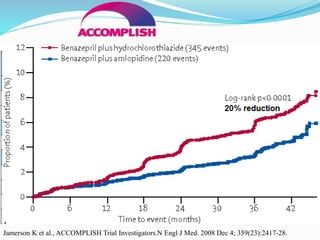
Jamerson K et al., ACCOMPLISH Trial Investigators.N Engl J Med. 2008 Dec 4; 359(23):2417-28.
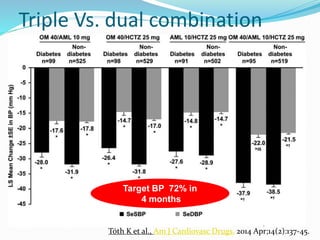
Triple Vs. dual combination
Tóth K et al., Am J Cardiovasc Drugs. 2014 Apr;14(2):137-45.
Target BP 72% in
4 months
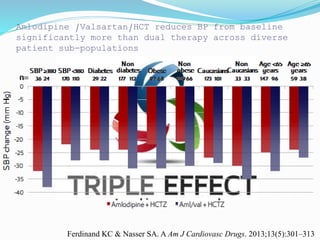
Amlodipine /Valsartan/HCT reduces BP from baseline
significantly more than dual therapy across diverse
patient sub-populations
Ferdinand KC & Nasser SA. A Am J Cardiovasc Drugs. 2013;13(5):301–313
 Although no RCT has compared major CV outcomes
between initial combination therapy and mono-therapy
 observational evidence suggests that the time taken to
achieve BP control is an important determinant of clinical
outcomes, especially in higher risk patients, with a
shorter time to control associated with
lower risk.
Take home message
 Initial combined anti-hypertensive therapy is
recommended and with earlier and better
control and better outcomes.
 it is not just the hemodynamics but in addition
there are metabolic, anti-inflammatory and
pleotropic effects.
 Gives patient more compliance and adherence to
medication
 Cost-effective
 Individualize the treatment
The Heart

mono-therapy vs. combination therapy in hypertension

  • 1.
    Ahmed Taha Abdelwahed,MD Lecturer of Cardiology Department of Cardiology, Faculty of Medicine, Zagazig University, Egypt; Heart Center, Department of Cardiology, Tampere University Hospital, and School of Medicine, University of Tampere, Finland Mono vs. Combination therapy for initial treatment of Hypertension Consultant of Cardiology
  • 2.
    The Lancet, VOLUME389, ISSUE 10064, P37-55, JANUARY 07, 2017
  • 3.
    Introduction  recent Guidelineshave increasingly focused on the stepped care approach, initiating treatment with different mono-therapies and then sequentially adding other drugs until BP control is achieved.  Despite this, BP control rates have remained poor worldwide :  40% only of all hypertensive are treated  35% only are controlled Chow CK et al., JAMA: 2013;310:959–968.
  • 4.
    Complications of Hypertension 51% 25% 32% 45% 13% OparilS et al.,Nat Rev Dis Primers. 2018 Mar 22; 4():18014.
  • 5.
    Assadi F. Prehypertension:Int J Prev Med. 2014 Mar;5(Suppl 1):S4-9.
  • 6.
    Failure to control Reasonsexplaining failure to achieve better BP control rates:  Efficacy of pharmacological therapies.  Physician or treatment inertia.  Patient adherence to treatment.  Insufficient use of combination treatment.  Complexity of current treatment strategies. Tiffe T et al., BMC Cardiovasc Disord 2017;17:276.
  • 7.
    Combined vs. mono-therapy mechanismof hypertension  Mono-therapy act on one or at best two of these mechanisms,  combinations of drugs allows for action on several different hypertensive mechanisms .  Two to five fold greater effect on reduction.  Increasing the dose of mono-therapy reduces coronary events by 29% and cerebro-vascular events by 40%,  while combining two antihypertensive agents with a different mechanism of action reduces coronary events by 40% and cerebro-vascular events by 54% Art.Burnier M Curr Hypertens Rep. 2015 Jul; 17(7):51.
  • 8.
    Art.Burnier M CurrHypertens Rep. 2015 Jul; 17(7):51.
  • 9.
    PB control rates 50% GuQ, et al. Circulation 2012;126:2105-14
  • 10.
    Advantages of thecombination Reduction in adverse effects:  RASIs prevent pretibial edema induced by calcium channel blockers  RASIs counteract the release of renin caused by natriuretics  RASIs block the release of aldosterone induced by natriuretics and the resulting hypokalemia  Several physiopathological mechanisms of increased blood pressure are blocked  Greater protection to target organs  Faster control of blood pressure Oparil S et al.,Nat Rev Dis Primers. 2018 Mar 22; 4():18014.
  • 11.
    Combinations may havesome effects that are independent of their antihypertensive action:  Anti-inflammatory  Metabolic  Anticounter regulation:  Diuretics counteract the retention of water produced by vasodilators  RASIs compensate for renin release by diuretics
  • 12.
    Combination Therapy Is Superiorto Sequential Mono- therapy for the Initial Treatment of Hypertension
  • 13.
    Pros vs. cons Pro Fixed-dose combinations (both drugs in the same tablet) offer additional advantages, such as improved adherence by 24%, easier indications and potentially reduced cost. Cons  Their limitation is less possibility of titrating the dose of only one of the drugs
  • 14.
    Advantage of polyPill XinhuanWana et al., Asian J. Pharmaceutical Sciences Volume 9, Issue 1, February 2014, 1–7
  • 15.
  • 16.
    Core drug treatmentstrategy for uncomplicated hypertension
  • 17.
    Drug treatment strategyfor hypertension and CAD
  • 18.
    Drug treatment strategyfor hypertension and Chronic KD
  • 20.
    Major trials ofconbination vs mono therapy/ Placebo
  • 21.
    Jan van Gijn,PROGRESS 2002, Stroke. 2002;33:319–320
  • 23.
    Incremental BP dropsafter direct switch to Amlodpine/Valsartan in patients previously uncontrolled on monotherapy Allemann et al. J Clin Hypertens 2013;10:185–94
  • 24.
    Jamerson K etal., ACCOMPLISH Trial Investigators.N Engl J Med. 2008 Dec 4; 359(23):2417-28.
  • 25.
    Triple Vs. dualcombination Tóth K et al., Am J Cardiovasc Drugs. 2014 Apr;14(2):137-45. Target BP 72% in 4 months
  • 26.
    Amlodipine /Valsartan/HCT reducesBP from baseline significantly more than dual therapy across diverse patient sub-populations Ferdinand KC & Nasser SA. A Am J Cardiovasc Drugs. 2013;13(5):301–313
  • 27.
     Although noRCT has compared major CV outcomes between initial combination therapy and mono-therapy  observational evidence suggests that the time taken to achieve BP control is an important determinant of clinical outcomes, especially in higher risk patients, with a shorter time to control associated with lower risk.
  • 28.
    Take home message Initial combined anti-hypertensive therapy is recommended and with earlier and better control and better outcomes.  it is not just the hemodynamics but in addition there are metabolic, anti-inflammatory and pleotropic effects.  Gives patient more compliance and adherence to medication  Cost-effective  Individualize the treatment
  • 30.