


The role of Clopidogrel
in
Atherosclerosis Vascular
Disease
Ahmed Taha Abdelwahed, MD, EHRA-Certified
Lecturer of Cardiology
Department of Cardiology, Faculty of Medicine,
Zagazig University, Egypt;
Heart Center, Department of Cardiology, Tampere University Hospital, and School of
Medicine, Tampere University- Finland
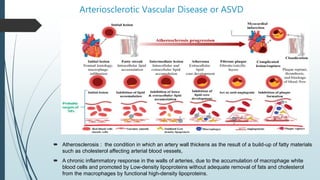
Arteriosclerotic Vascular Disease or ASVD
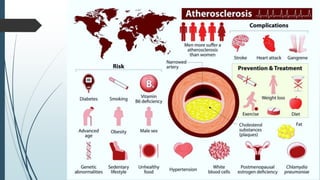
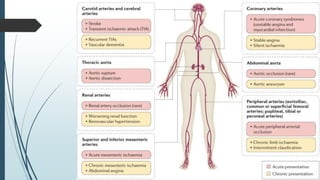
 Atherosclerosis : the condition in which an artery wall thickens as the result of a build-up of fatty materials
such as cholesterol affecting arterial blood vessels,
 A chronic inflammatory response in the walls of arteries, due to the accumulation of macrophage white
blood cells and promoted by Low-density lipoproteins without adequate removal of fats and cholesterol
from the macrophages by functional high-density lipoproteins.
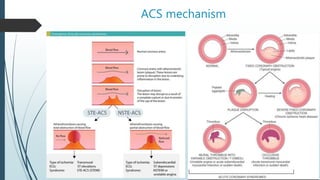
ACS mechanism
Background
1. Antiplatelet therapy has remained the cornerstone of treatment for patients with
ACS :” Platelet adhesion, activation, and aggregation after plaque rupture or
erosion are the major determinants of arterial thrombosis leading to ACS”
2. Anti-platelet therapy is vital
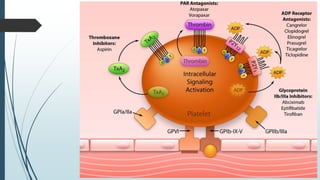
3. Multiple platelet-signaling pathways are involved in thrombus formation and are
potential targets for therapies.
4. Dual antiplatelet therapy with a combination of aspirin and either P2Y12-receptor
inhibitors should be the treatment of choice in patients with ACS.
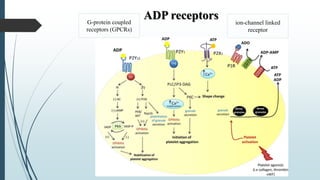
ADP receptors
G-protein coupled
receptors (GPCRs)
ion-channel linked
receptor
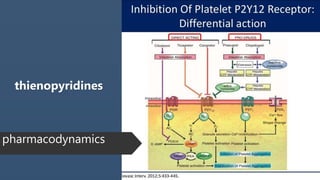
pharmacodynamics
thienopyridines
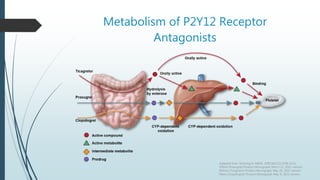
Metabolism of P2Y12 Receptor
Antagonists
Adapted from: Schomig A. NEJM. 2009;361(11):1108-1111.
Effient (Prasugrel) Product Monograph March 11, 2011 version.
Brilinta (Ticagrelor) Product Monograph May 26, 2011 version.
Plavix (Clopidogrel) Product Monograph May 9, 2011 version.
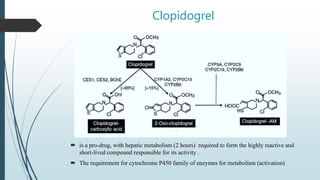
Clopidogrel
 is a pro-drug, with hepatic metabolism (2 hours) required to form the highly reactive and
short-lived compound responsible for its activity .
 The requirement for cytochrome P450 family of enzymes for metabolism (activation)
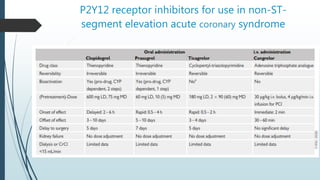
P2Y12 receptor inhibitors for use in non-ST-
segment elevation acute coronary syndrome
Evidence based data
Clinical trials
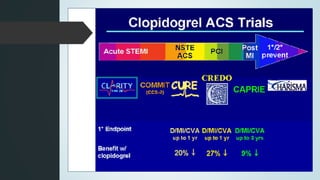
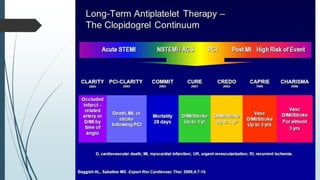
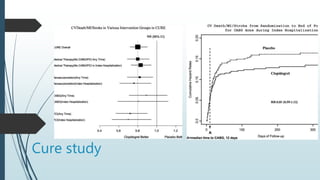
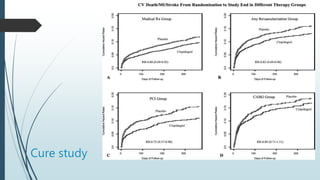
CURE study
The Clopidogrel in Unstable Angina to
Prevent Recurrent Events
Clinical trials
Cure study
Cure study
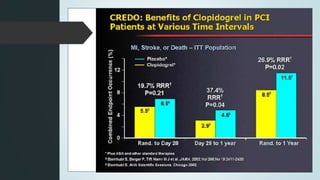
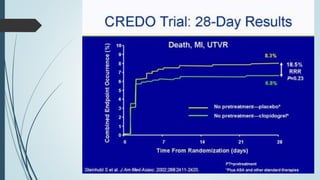
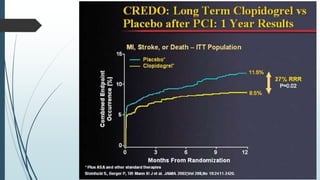
CREDO study
Clopidogrel for Reduction of Events During
Observation
Clinical trials
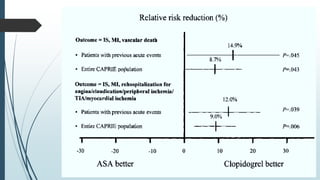
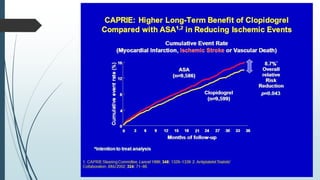
CAPRIE study
Clopidogrel versus aspirin in patients at
risk of ischemic events
Clinical trials
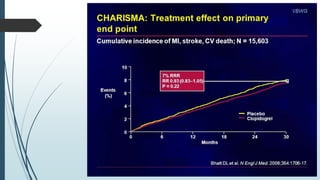
CHARISMA study
The Clopidogrel for High Atherothrombotic
Risk and Ischemic Stabilization,
Management, and Avoidance
Clinical trials
TALOS AMI study
TicAgrelor Versus CLOpidogrel in
Stabilized Patients With Acute Myocardial
Infarction
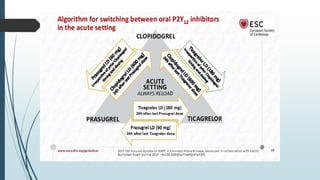
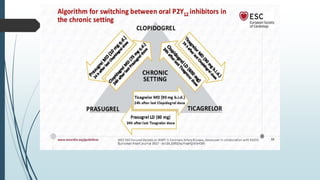
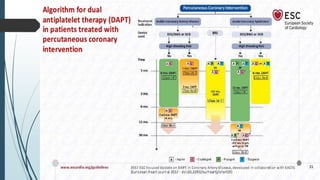
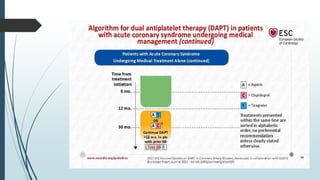
De-escalation of DAPT therapy
What’s new in 2021
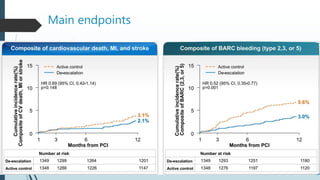
Main endpoints
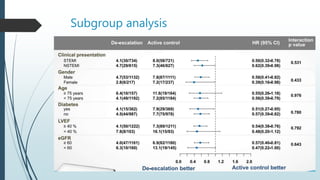
Subgroup analysis
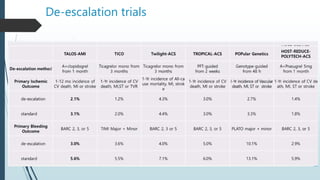
De-escalation trials
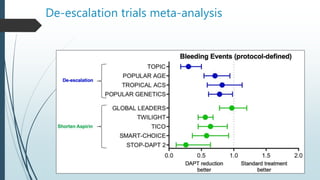
De-escalation trials meta-analysis
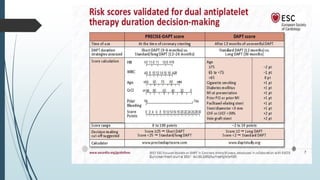
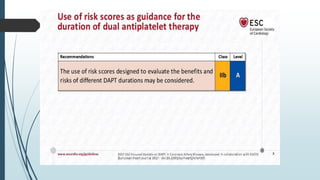
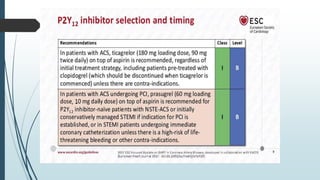
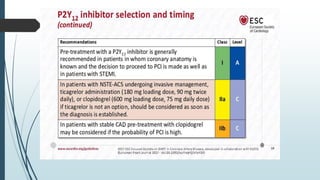
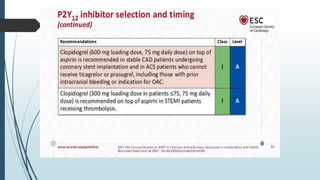
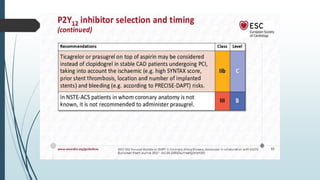
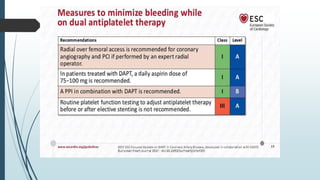
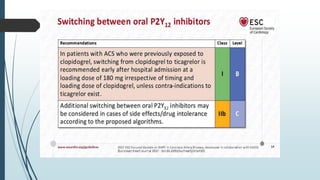
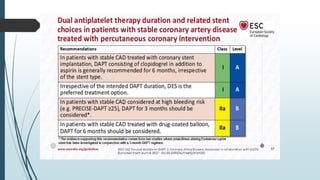
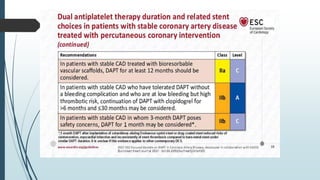
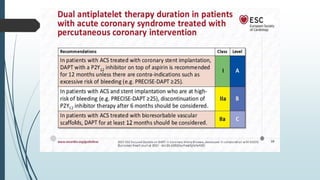
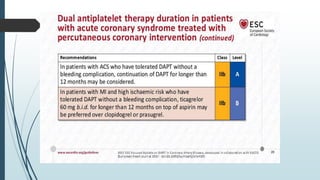
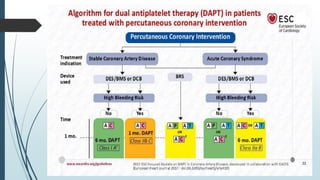
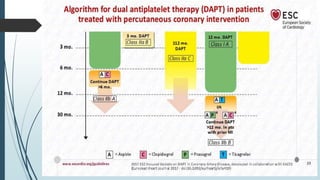
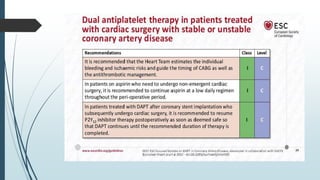
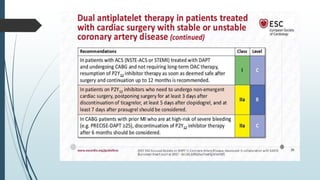
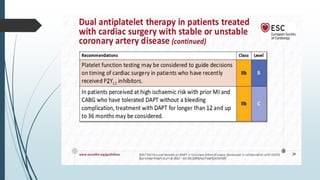
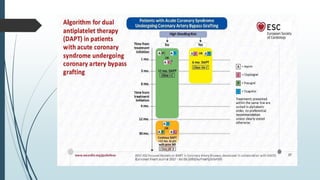
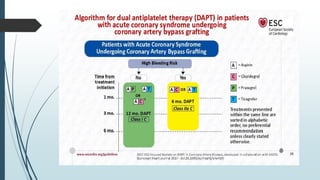
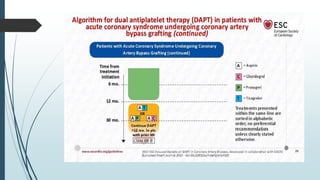
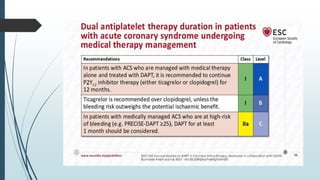
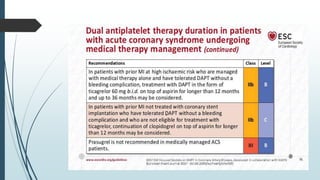
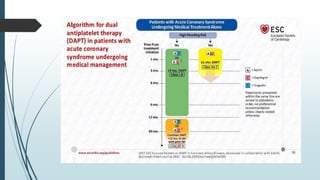
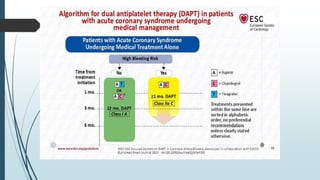
Guidelines
From trials to guidelines
Conclusion
 Prasugrel and ticagrelor is more efficacious in preventing ischemic events in patients
with ACS undergoing PCI, but with increased bleeding complications.
 Dual antiplatelet treatment has only been efficacious in ACS and post-PCI patients.
 Newer thienopyridines did not show advantages over and above those of ticlopidine or
clopidogrel as to reduction of stroke.
 De-escalation of Dual Antiplatelet Therapy Appears Safe and Effective, either
from ticagrelor or prasugrel to Clopidogrel.
 genotype-guided DAPT de-escalation may be favored. Moreover, clopidogrel may be
considered the first choice of antiplatelet therapy in elderly patients with ACS.
 patients with stroke or very high-risk TIA, intensive DAPT with aspirin plus clopidogrel
should be administered for 21–28 days after the acute event, followed by less intensive
treatment for up to 90 days, to minimize the risk of bleeding complications; clopidogrel
is potentially more effective than aspirin as antiplatelet monotherapy.
 In patients with symptomatic PAD, or those who have undergone peripheral
revascularization, clopidogrel is the preferred agent
clopidogrel (old is gold)

clopidogrel (old is gold)

  • 1.
    The role ofClopidogrel in Atherosclerosis Vascular Disease Ahmed Taha Abdelwahed, MD, EHRA-Certified Lecturer of Cardiology Department of Cardiology, Faculty of Medicine, Zagazig University, Egypt; Heart Center, Department of Cardiology, Tampere University Hospital, and School of Medicine, Tampere University- Finland
  • 2.
    Arteriosclerotic Vascular Diseaseor ASVD  Atherosclerosis : the condition in which an artery wall thickens as the result of a build-up of fatty materials such as cholesterol affecting arterial blood vessels,  A chronic inflammatory response in the walls of arteries, due to the accumulation of macrophage white blood cells and promoted by Low-density lipoproteins without adequate removal of fats and cholesterol from the macrophages by functional high-density lipoproteins.
  • 5.
  • 6.
    Background 1. Antiplatelet therapyhas remained the cornerstone of treatment for patients with ACS :” Platelet adhesion, activation, and aggregation after plaque rupture or erosion are the major determinants of arterial thrombosis leading to ACS” 2. Anti-platelet therapy is vital 3. Multiple platelet-signaling pathways are involved in thrombus formation and are potential targets for therapies. 4. Dual antiplatelet therapy with a combination of aspirin and either P2Y12-receptor inhibitors should be the treatment of choice in patients with ACS.
  • 7.
    ADP receptors G-protein coupled receptors(GPCRs) ion-channel linked receptor
  • 9.
  • 10.
    Metabolism of P2Y12Receptor Antagonists Adapted from: Schomig A. NEJM. 2009;361(11):1108-1111. Effient (Prasugrel) Product Monograph March 11, 2011 version. Brilinta (Ticagrelor) Product Monograph May 26, 2011 version. Plavix (Clopidogrel) Product Monograph May 9, 2011 version.
  • 11.
    Clopidogrel  is apro-drug, with hepatic metabolism (2 hours) required to form the highly reactive and short-lived compound responsible for its activity .  The requirement for cytochrome P450 family of enzymes for metabolism (activation)
  • 12.
    P2Y12 receptor inhibitorsfor use in non-ST- segment elevation acute coronary syndrome
  • 13.
  • 17.
    CURE study The Clopidogrelin Unstable Angina to Prevent Recurrent Events Clinical trials
  • 18.
  • 19.
  • 20.
    CREDO study Clopidogrel forReduction of Events During Observation Clinical trials
  • 24.
    CAPRIE study Clopidogrel versusaspirin in patients at risk of ischemic events Clinical trials
  • 27.
    CHARISMA study The Clopidogrelfor High Atherothrombotic Risk and Ischemic Stabilization, Management, and Avoidance Clinical trials
  • 29.
    TALOS AMI study TicAgrelorVersus CLOpidogrel in Stabilized Patients With Acute Myocardial Infarction De-escalation of DAPT therapy What’s new in 2021
  • 30.
  • 31.
  • 32.
  • 33.
  • 34.
  • 63.
    Conclusion  Prasugrel andticagrelor is more efficacious in preventing ischemic events in patients with ACS undergoing PCI, but with increased bleeding complications.  Dual antiplatelet treatment has only been efficacious in ACS and post-PCI patients.  Newer thienopyridines did not show advantages over and above those of ticlopidine or clopidogrel as to reduction of stroke.  De-escalation of Dual Antiplatelet Therapy Appears Safe and Effective, either from ticagrelor or prasugrel to Clopidogrel.  genotype-guided DAPT de-escalation may be favored. Moreover, clopidogrel may be considered the first choice of antiplatelet therapy in elderly patients with ACS.  patients with stroke or very high-risk TIA, intensive DAPT with aspirin plus clopidogrel should be administered for 21–28 days after the acute event, followed by less intensive treatment for up to 90 days, to minimize the risk of bleeding complications; clopidogrel is potentially more effective than aspirin as antiplatelet monotherapy.  In patients with symptomatic PAD, or those who have undergone peripheral revascularization, clopidogrel is the preferred agent