
Effective Financial Management Best Business Practices for a Profitable and Sustainable Business Presented by Advisors On Target
What we will cover today… Getting Your Business “On Target” for Success 3 Key Financial Indicators of Business Health Key Metrics –  Other Important Financial Data Profit Improvement Strategies Creating a Budget to Achieve your Plan
On the road to becoming an ON TARGET Painting Contractor…
Financial Management Best Practice Guide Accounting system is fully & accurately functioning Controls are in place to ensure accuracy Financial Monitoring is being used effectively as a business tool Key Metrics are being used to keep your finger on the financial pulse of your business Owner reviews Financial Data and Metrics at least monthly if not weekly An adequate credit line is in place  Company is profitable, solvent and able to finance its growth and reward stakeholders
Rewards of being “On Target” Grow the business Become more profitable & be able to reward shareholders and key employees Achieve your business goals Make timely changes to your strategy Reduce risk in tough economic times Improve quality of life both personally and professionally
Effective Financial Management Key Financial Data For Business Survival
3 Key Financial Indicators  Of Your Business’ State Of Health Business is about making money To do this, it must simultaneously increase three things: Net profit margin – Operating profit margin Cash flow Return on investment (ROI)
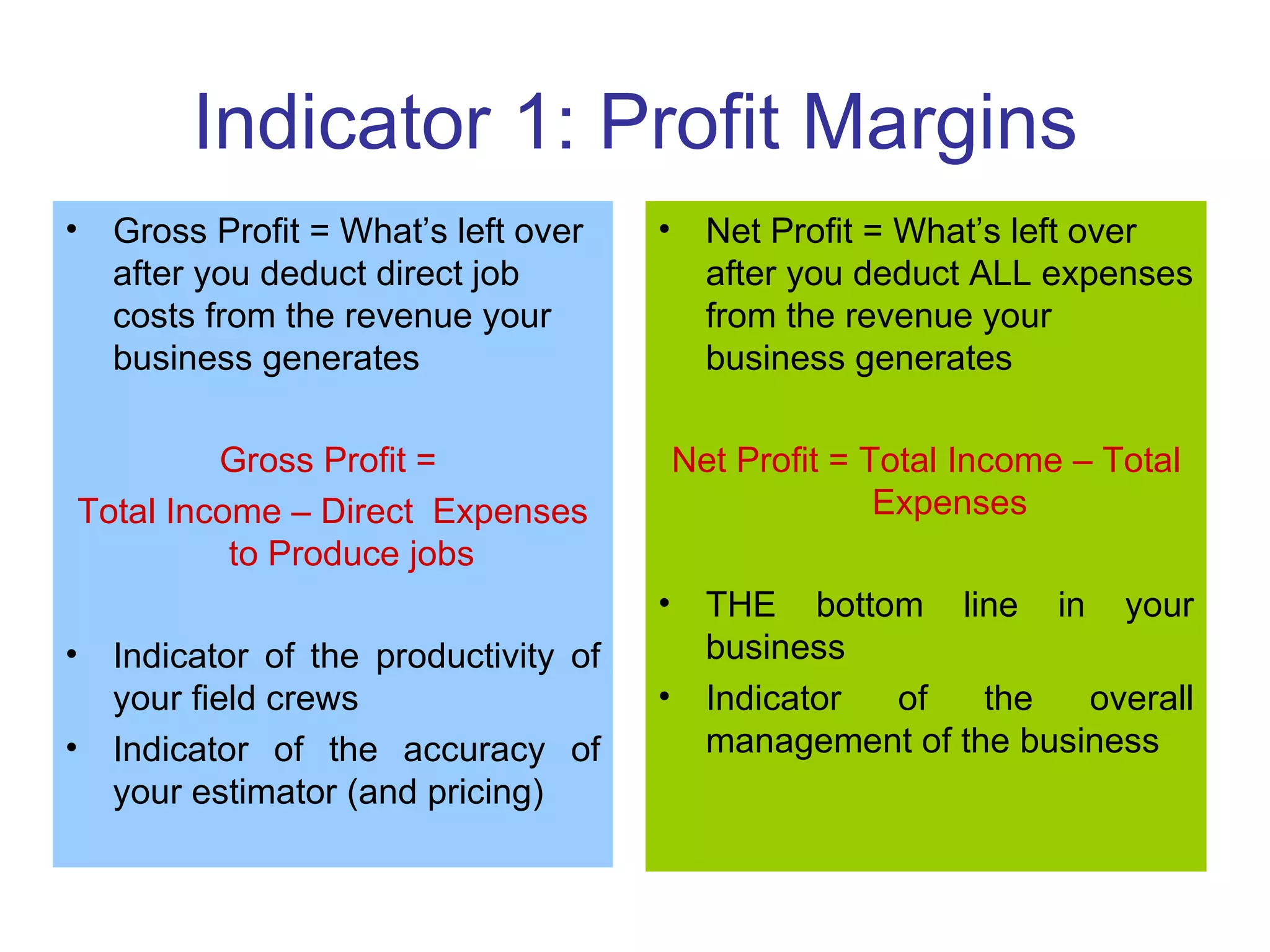
Indicator 1: Profit Margins Net Profit = What’s left over after you deduct ALL expenses from the revenue your business generates Net Profit = Total Income – Total Expenses THE bottom line in your business Indicator of the overall management of the business Gross Profit = What’s left over after you deduct direct job costs from the revenue your business generates Gross Profit =  Total Income – Direct  Expenses to Produce jobs  Indicator of the productivity of your field crews  Indicator of the accuracy of your estimator (and pricing)
How To Calculate Profit Margins Gross Profit Margin (GP%) is profit derived from work produced divided by Gross Revenue Gross Profit Margin = (Gross Profit/Revenue)% Net Profit Margin (NP%) is after-tax net profit divided by Gross Revenue Net Profit Margin = (Net Profit/Revenue)%
Improving The Gross Profit Margin To improve the Gross profit margin you need to work on the drivers: Production / service delivery processes Material Costs Labor Costs Customer relations Team Skills and Development  Pricing & Estimating
What else affects Direct Labor Costs? Productivity of Personnel Ability of the company to keep work in the pipeline Region – availability of qualified labor Effectiveness of operating systems in the business Job Process Systems Fully supplied crews/trucks Training/Management
Improving The Net Profit Margin To improve the Net profit margin you also need to manage the following: Administrative operating processes Variable Costs  Overhead Costs Customer relations Administrative Team Skills and Development  Marketing Activities and Costs
BEST PRACTICE GUIDE : Gross Profit % Gross Profit Margin = (Gross Profit/Revenue)% Higher is better 50% is goal  45% is industry average* * Residential and Commercial Contractors under $10MM, depends on mix of work, and use of subcontractors
BEST PRACTICE GUIDE :  Net Operating Profit %** Net Operating Profit Margin = (Net  Operating Profit/Revenue)% Higher is better 15% is goal (25% BEFORE Owner’s Compensation)  5% is industry average* *Residential and Commercial Contractors under $10MM ** There is a distinction between Net Profit and Net Operating Profit, which is Profit before taxes, and “other” income & expenses not related to operations of the business
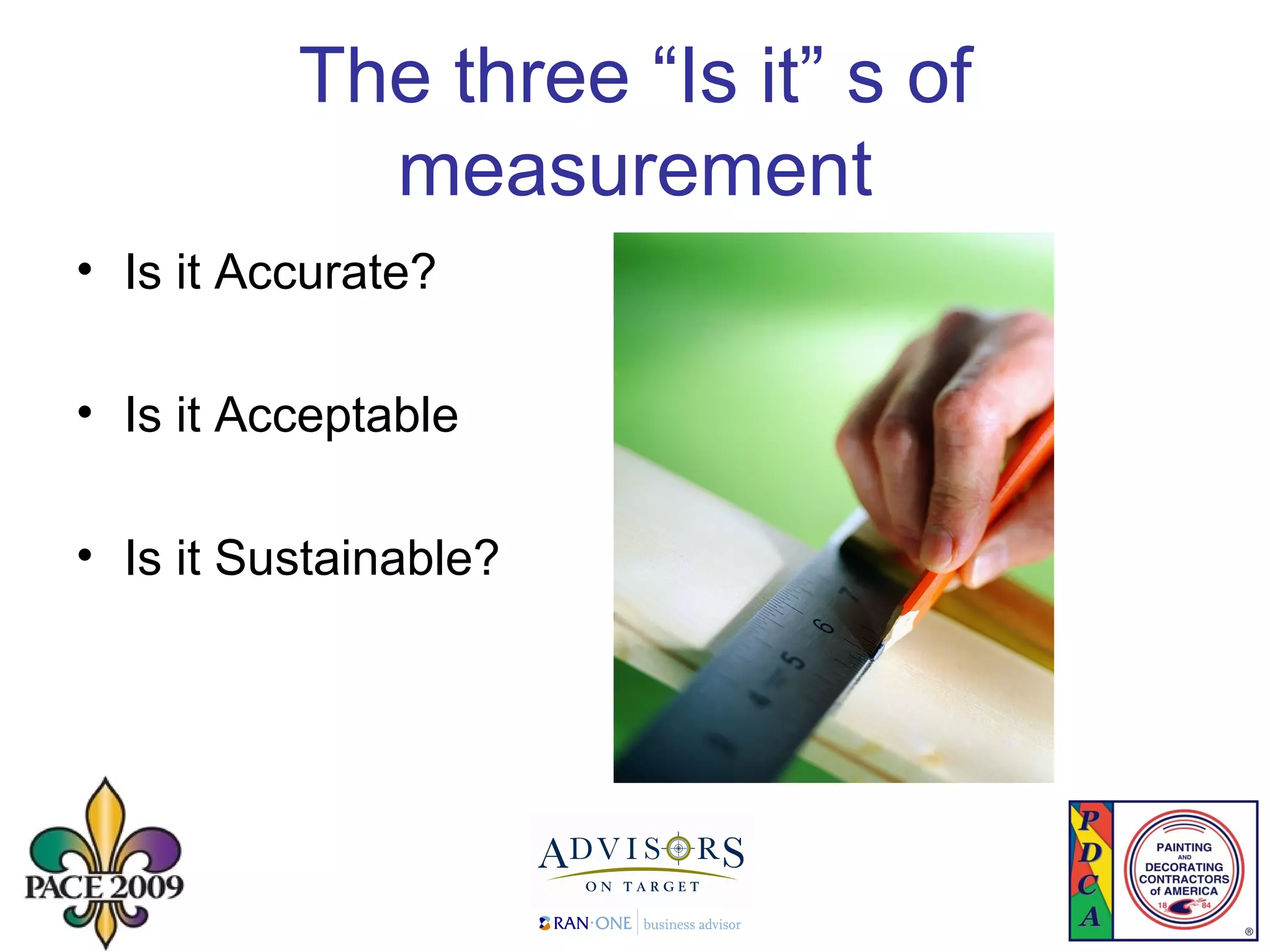
The three “Is it” s of measurement Is it Accurate? Is it Acceptable Is it Sustainable?
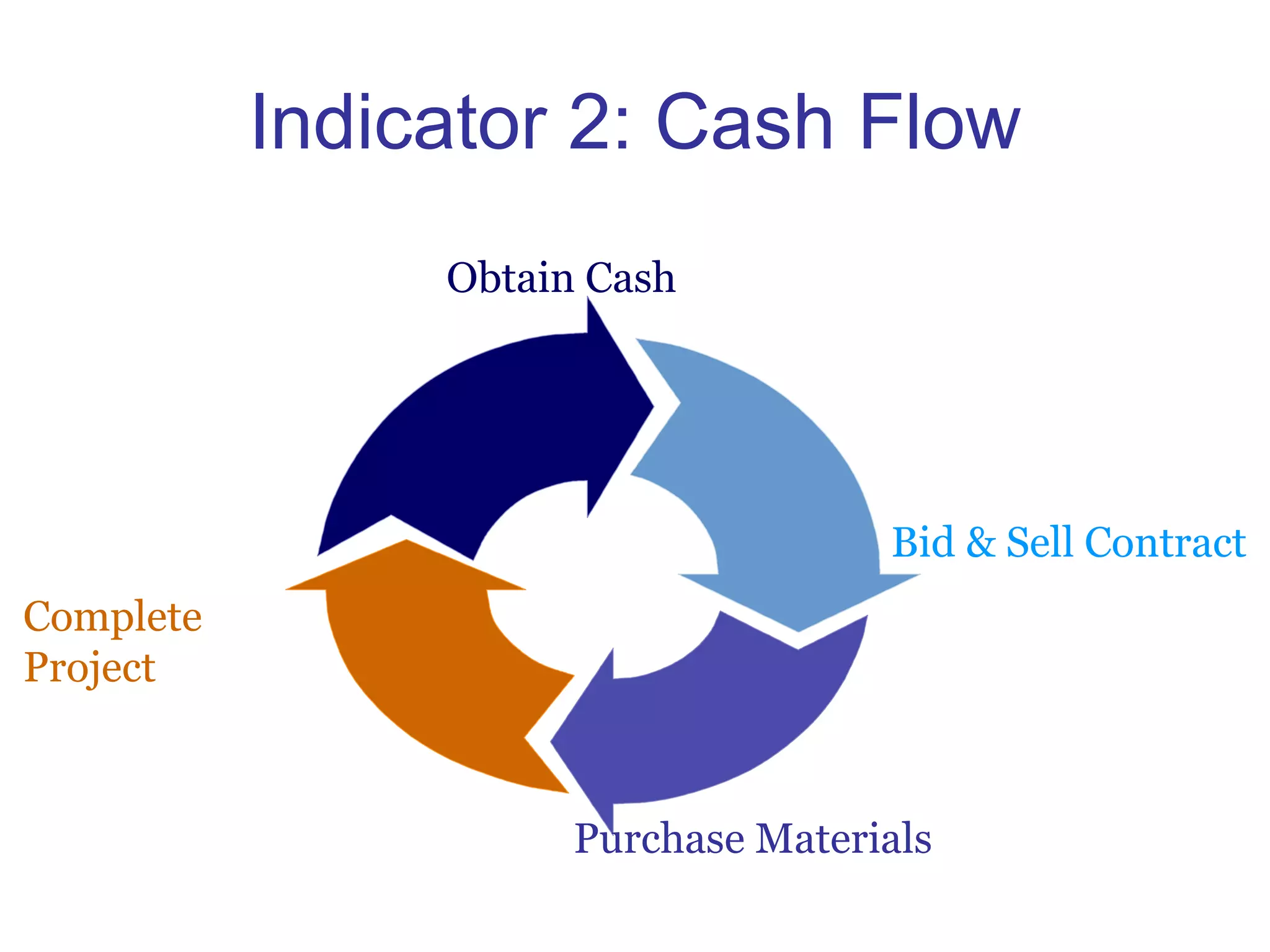
Indicator 2: Cash Flow Obtain Cash Purchase Materials Bid & Sell Contract Complete Project
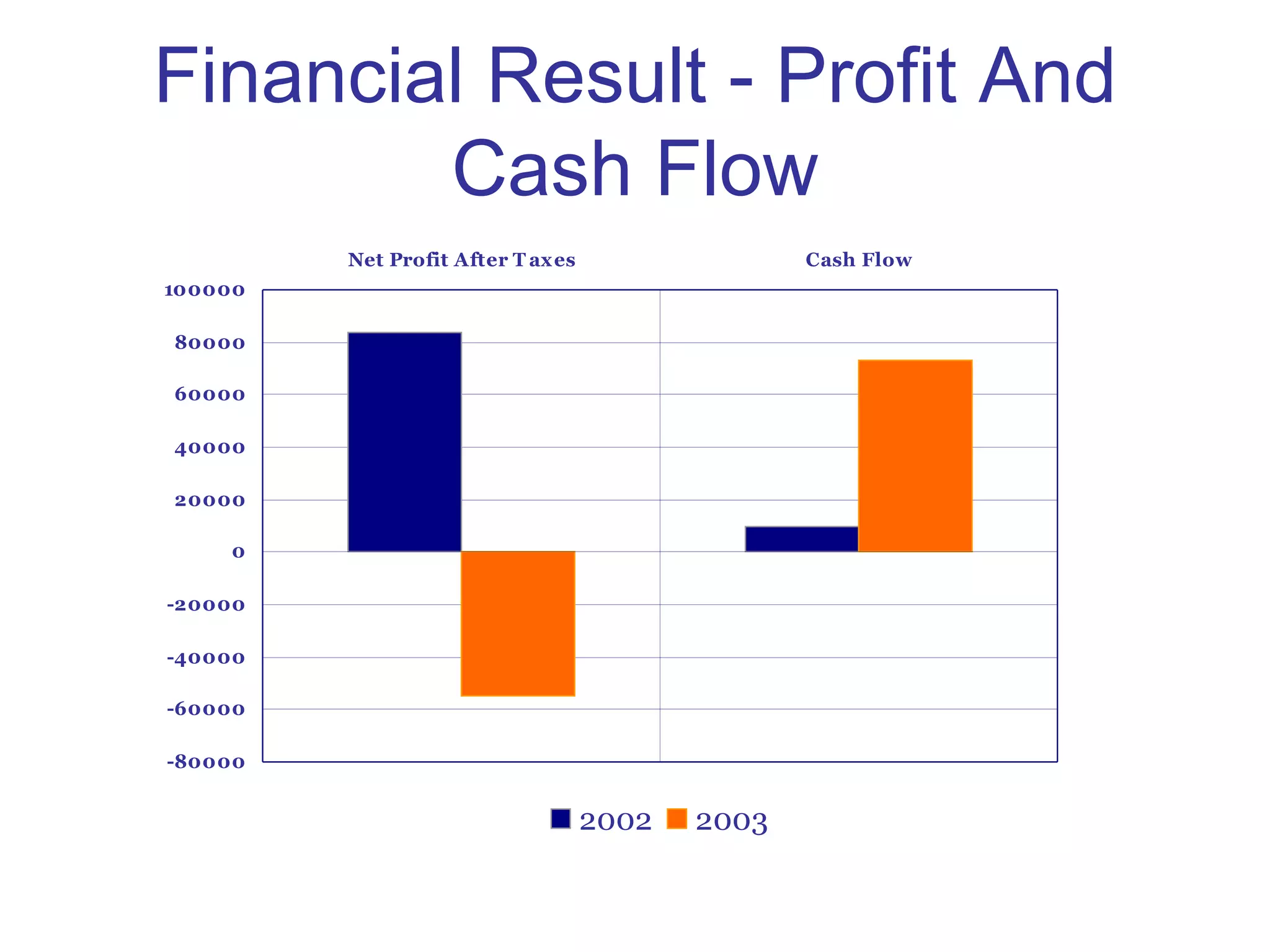
Improving Cash Flow Cash Flow Cycle   Cash Flow vs. Profit Long Term Strategies
Financial Result - Profit And Cash Flow
BEST PRACTICE GUIDE :  Cash Flow Prepare a Cash Flow Projection Manage Your Spending on a monthly, if not weekly basis Invoice Promptly Develop a systematized approach to receivables and collections  Obtain a line of credit
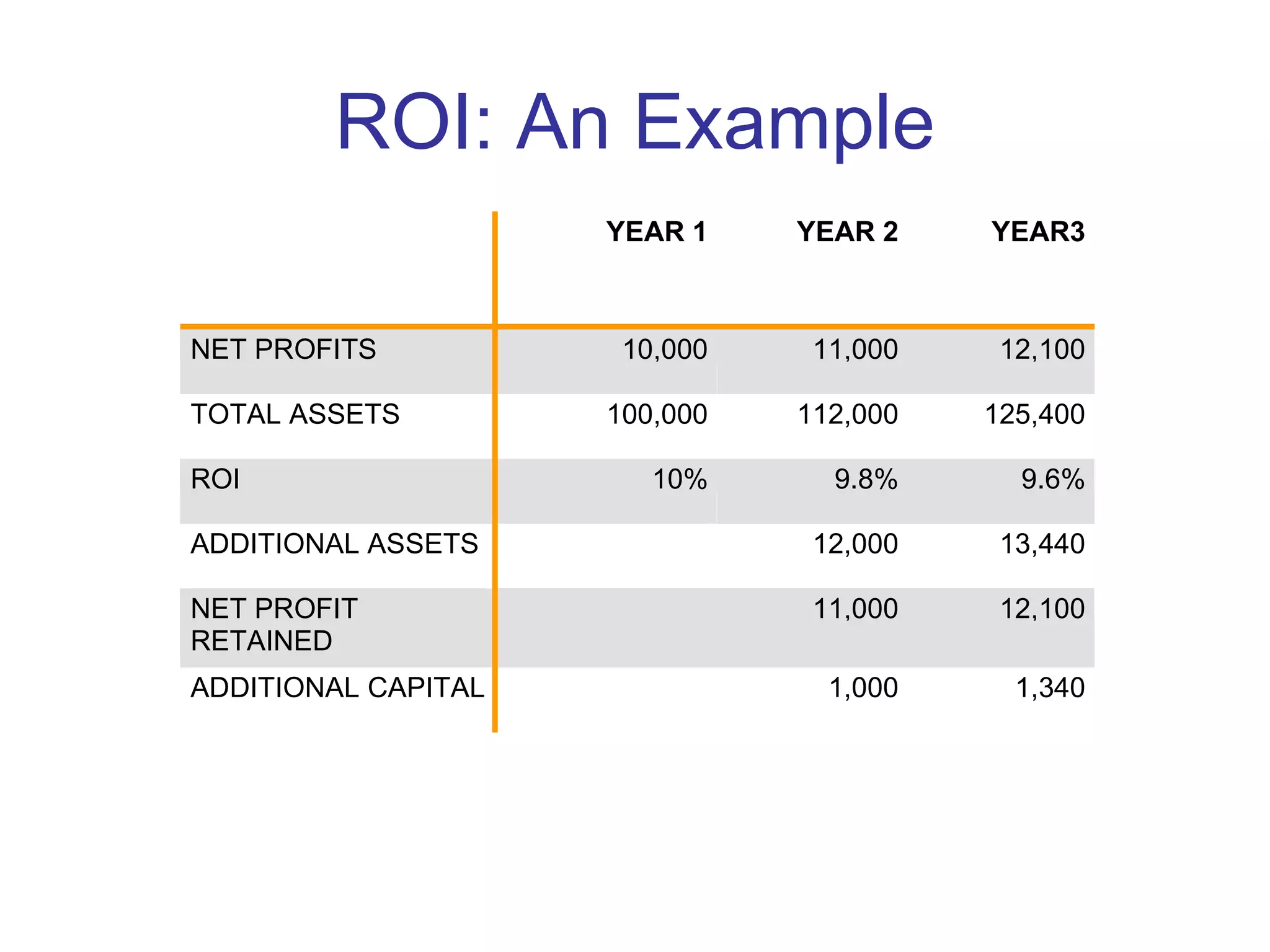
Indicator 3: Return On Investment Return On Investment is net profit expressed as a percentage of the value of the total assets you have tied up in the business ROI = (NP/TA)% ROI is a profitability ratio – it is the true measure of the financial productivity of a business
ROI: An Example
BEST PRACTICE GUIDE : ROI Return on Investment = (Net Profit/Total Assets)% Higher is better Should be at least 10% 25% or higher is a goal
Key Metrics: Other Important Financial Data to Watch  Liquidity Debt Collections  Break Even
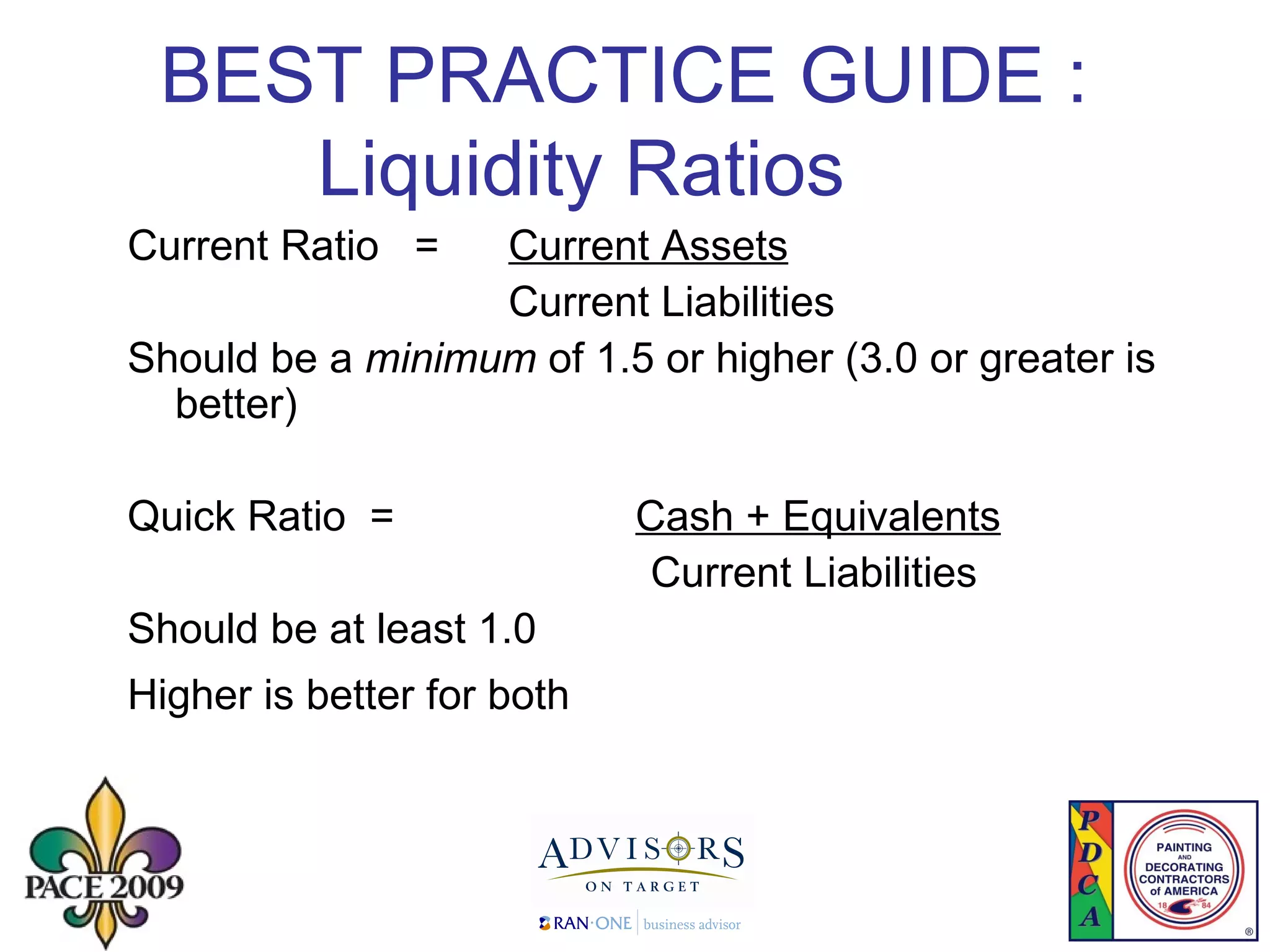
BEST PRACTICE GUIDE :  Liquidity Ratios Current Ratio  =  Current Assets Current Liabilities Should be a  minimum  of 1.5 or higher (3.0 or greater is better) Quick Ratio  =  Cash + Equivalents   Current Liabilities  Should be at least 1.0 Higher is better for both
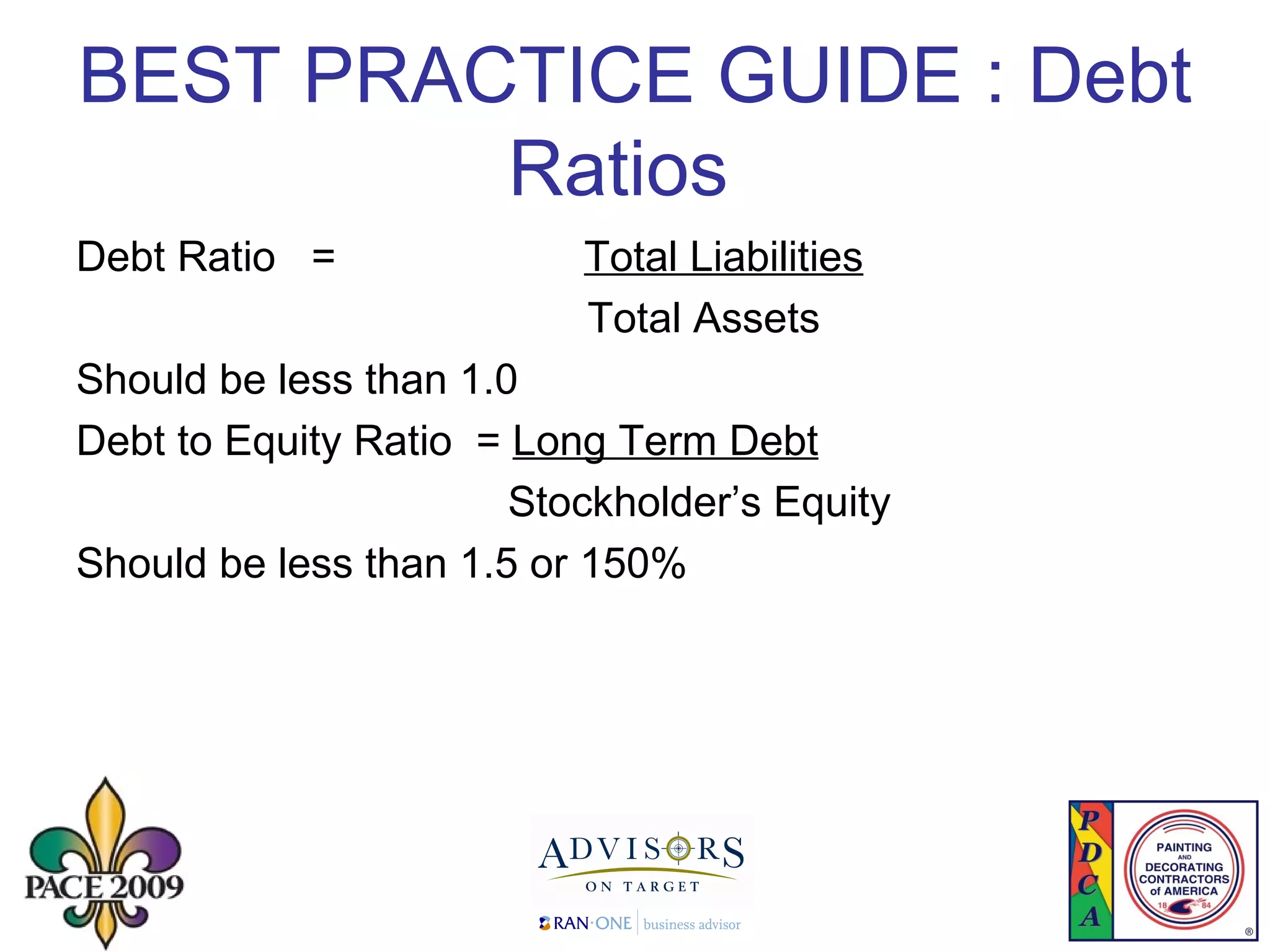
BEST PRACTICE GUIDE : Debt Ratios Debt Ratio  =    Total Liabilities   Total Assets Should be less than 1.0 Debt to Equity Ratio  =  Long Term Debt   Stockholder’s Equity  Should be less than 1.5 or 150%
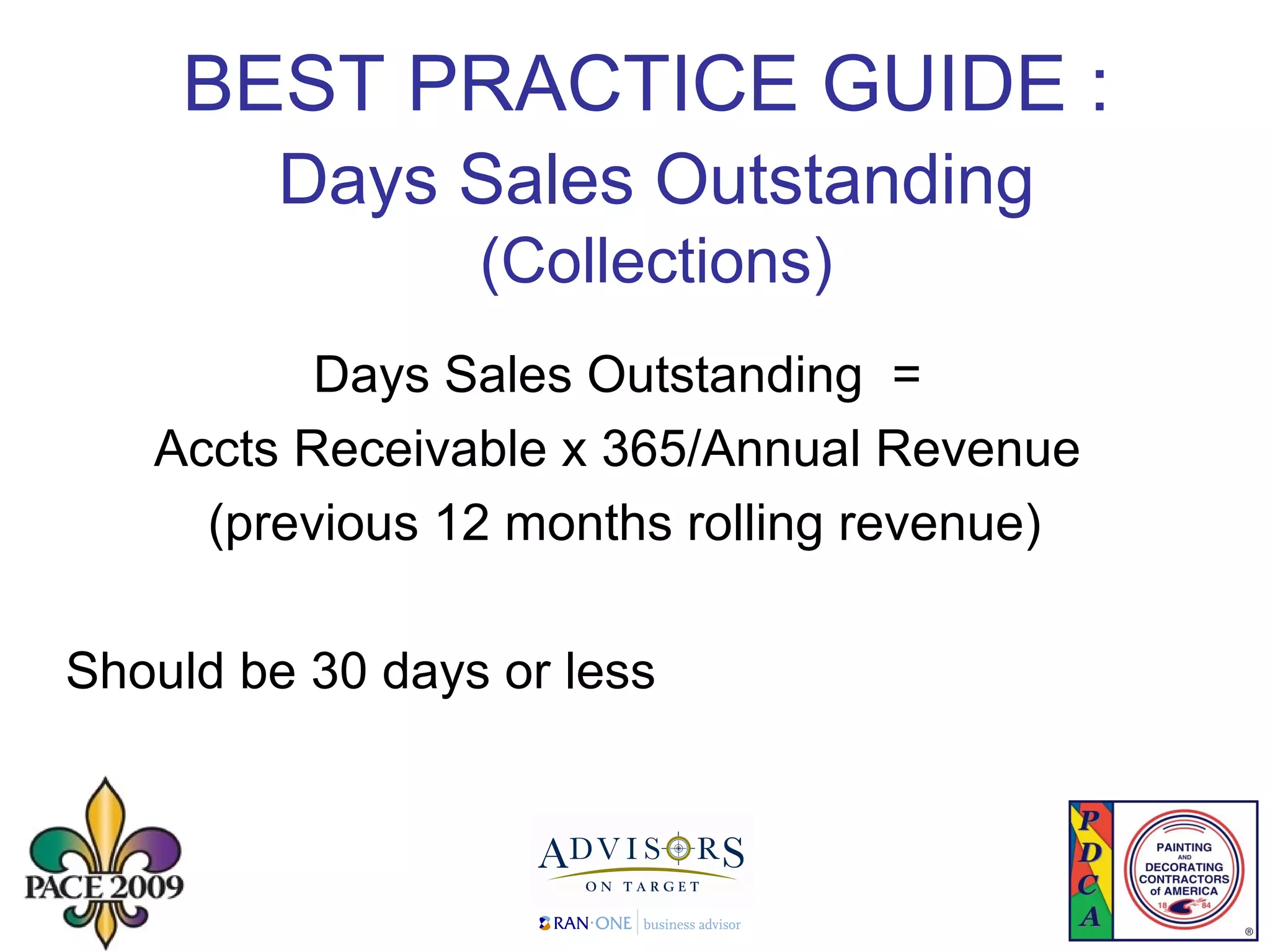
BEST PRACTICE GUIDE :   Days Sales Outstanding   (Collections) Days Sales Outstanding  =  Accts Receivable x 365/Annual Revenue  (previous 12 months rolling revenue) Should be 30 days or less
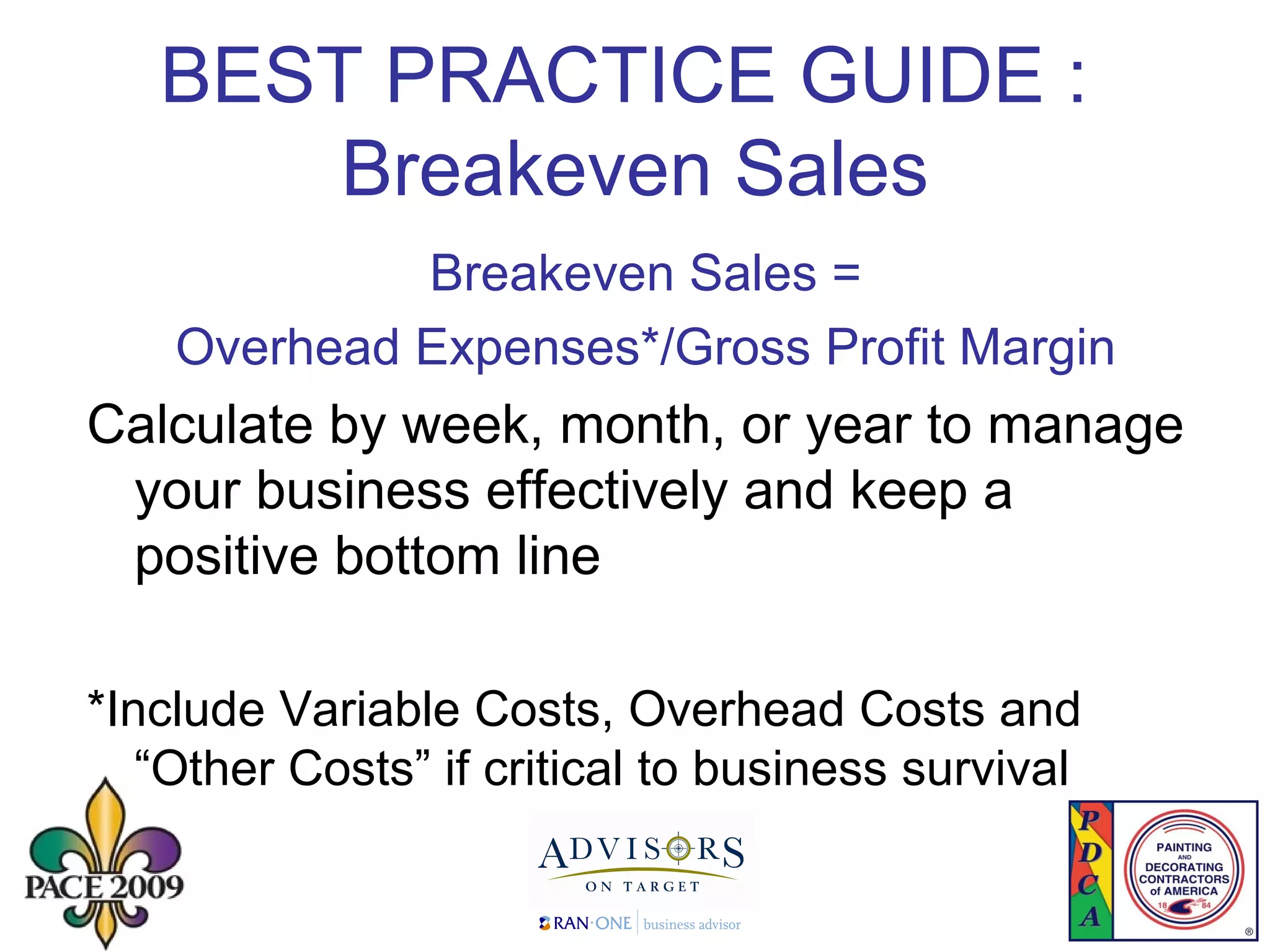
BEST PRACTICE GUIDE :  Breakeven Sales Breakeven Sales = Overhead Expenses*/Gross Profit Margin Calculate by week, month, or year to manage your business effectively and keep a positive bottom line *Include Variable Costs, Overhead Costs and “Other Costs” if critical to business survival
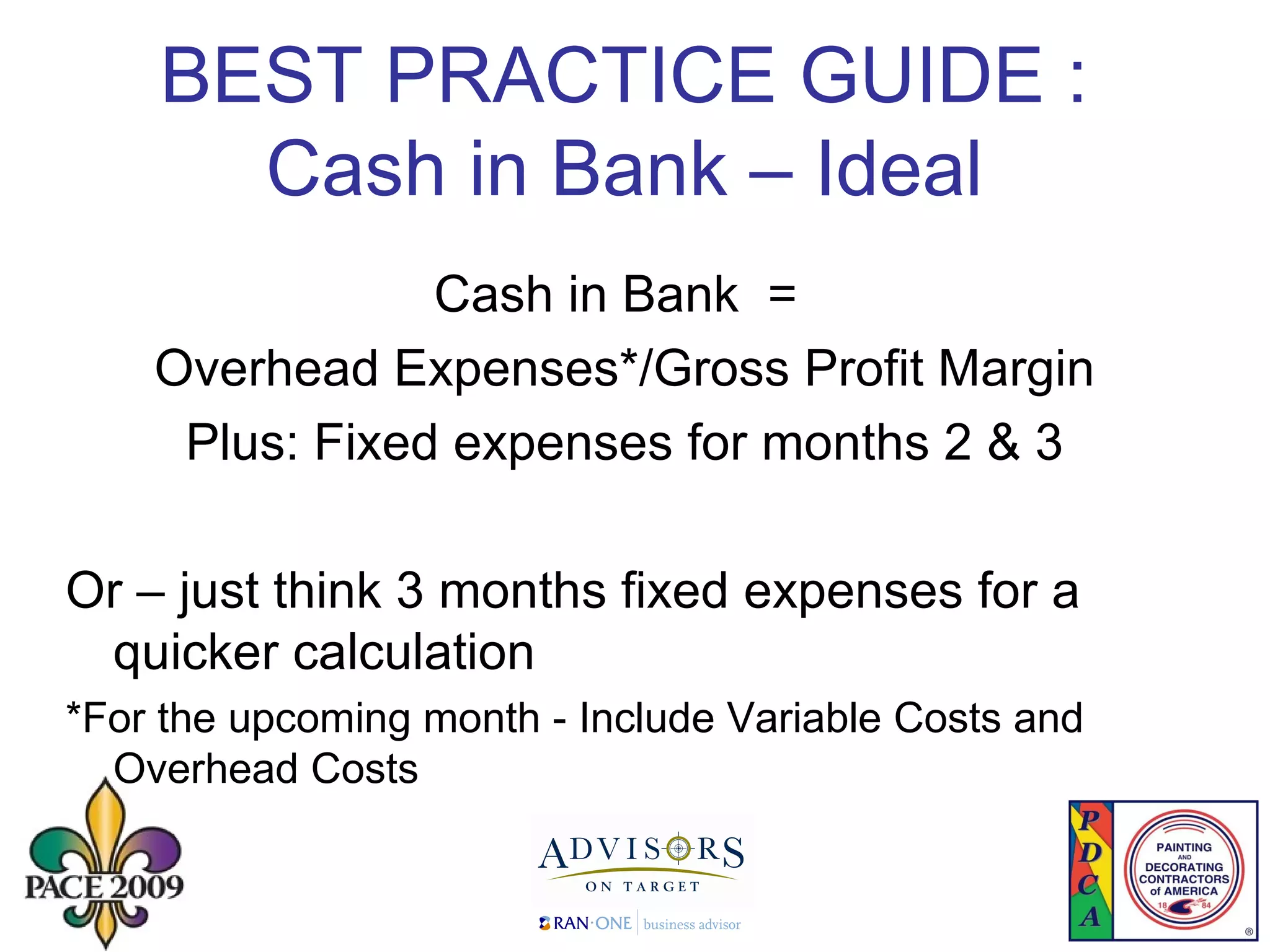
BEST PRACTICE GUIDE :  Cash in Bank – Ideal  Cash in Bank  = Overhead Expenses*/Gross Profit Margin Plus: Fixed expenses for months 2 & 3 Or – just think 3 months fixed expenses for a quicker calculation *For the upcoming month - Include Variable Costs and Overhead Costs
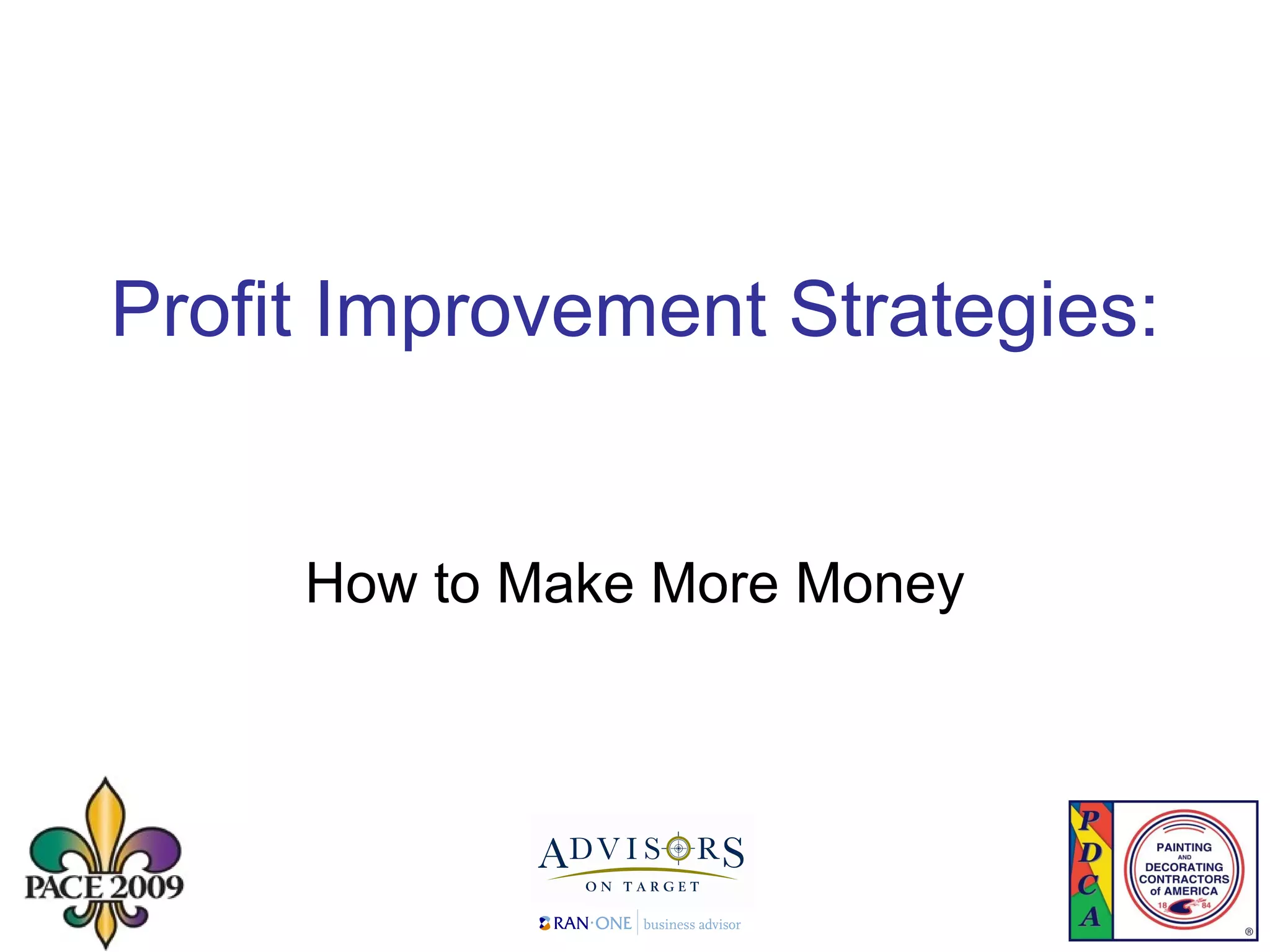
Profit Improvement Strategies:  How to Make More Money
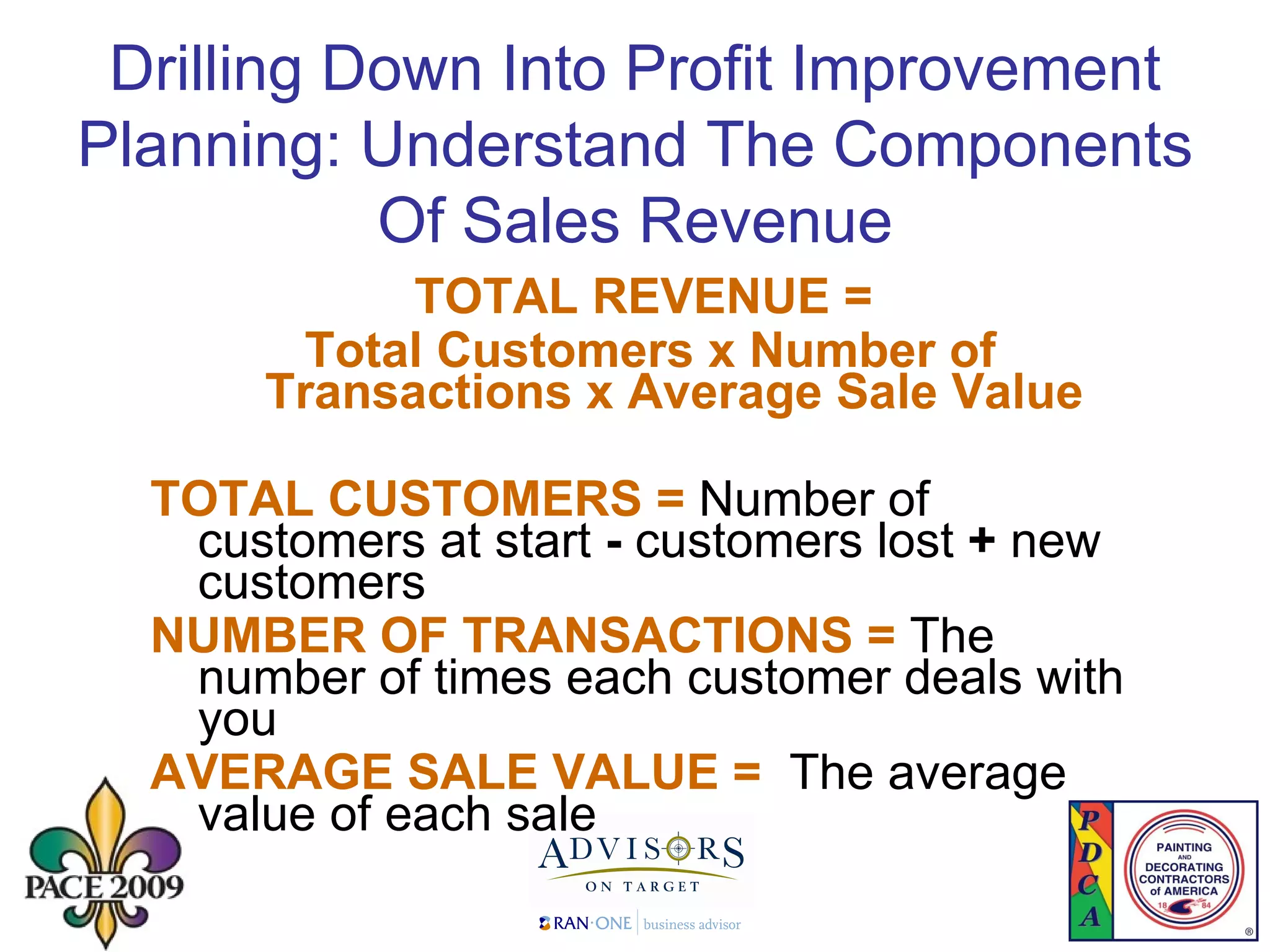
Drilling Down Into Profit Improvement Planning: Understand The Components Of Sales Revenue TOTAL REVENUE =  Total Customers x Number of Transactions x Average Sale Value TOTAL CUSTOMERS =  Number of customers at start  -   customers lost  +  new customers NUMBER OF TRANSACTIONS =  The number of times each customer deals with you AVERAGE SALE VALUE =  The average value of each sale
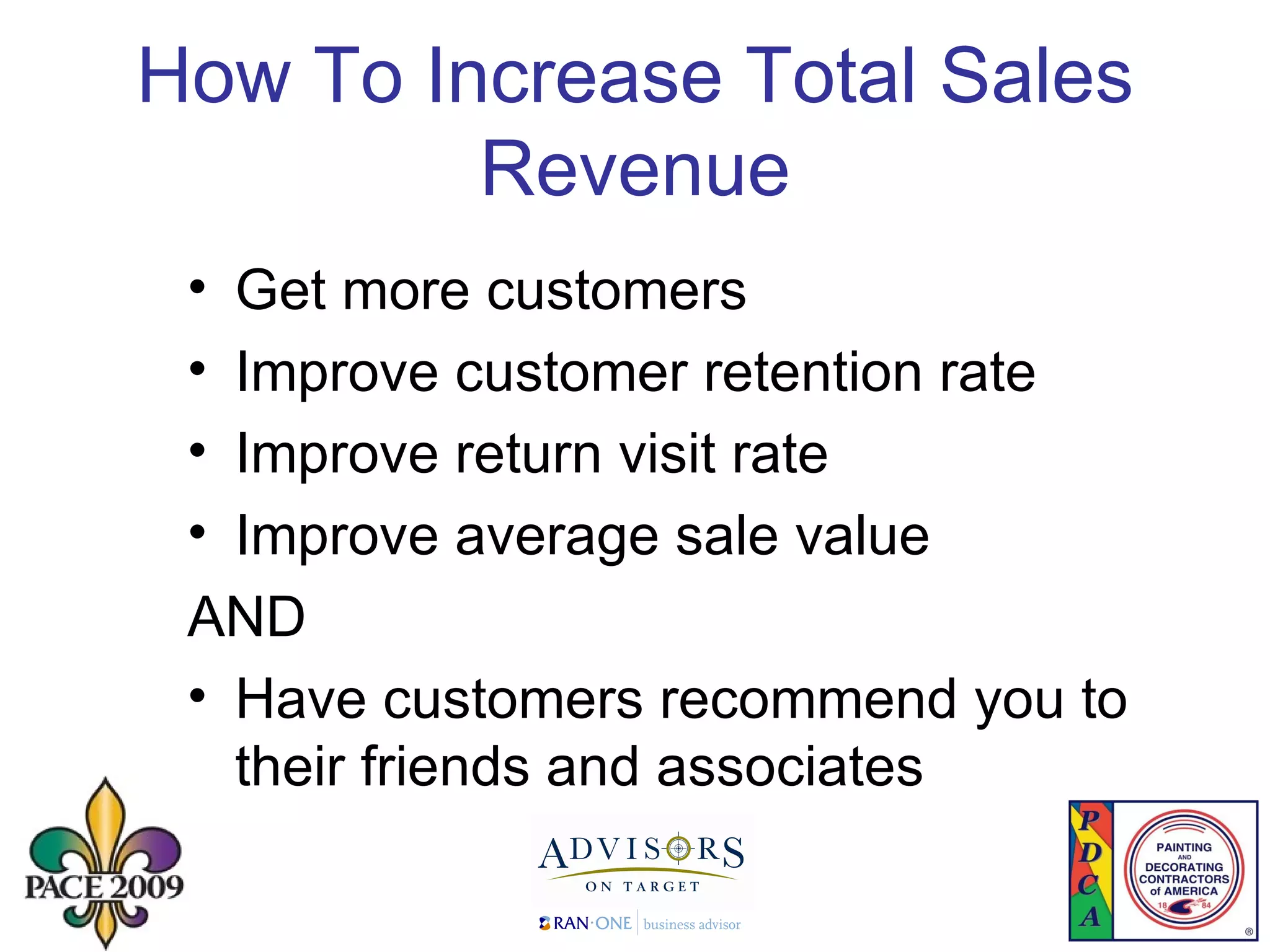
How To Increase Total Sales Revenue Get more customers Improve customer retention rate  Improve return visit rate Improve average sale value AND Have customers recommend you to their friends and associates
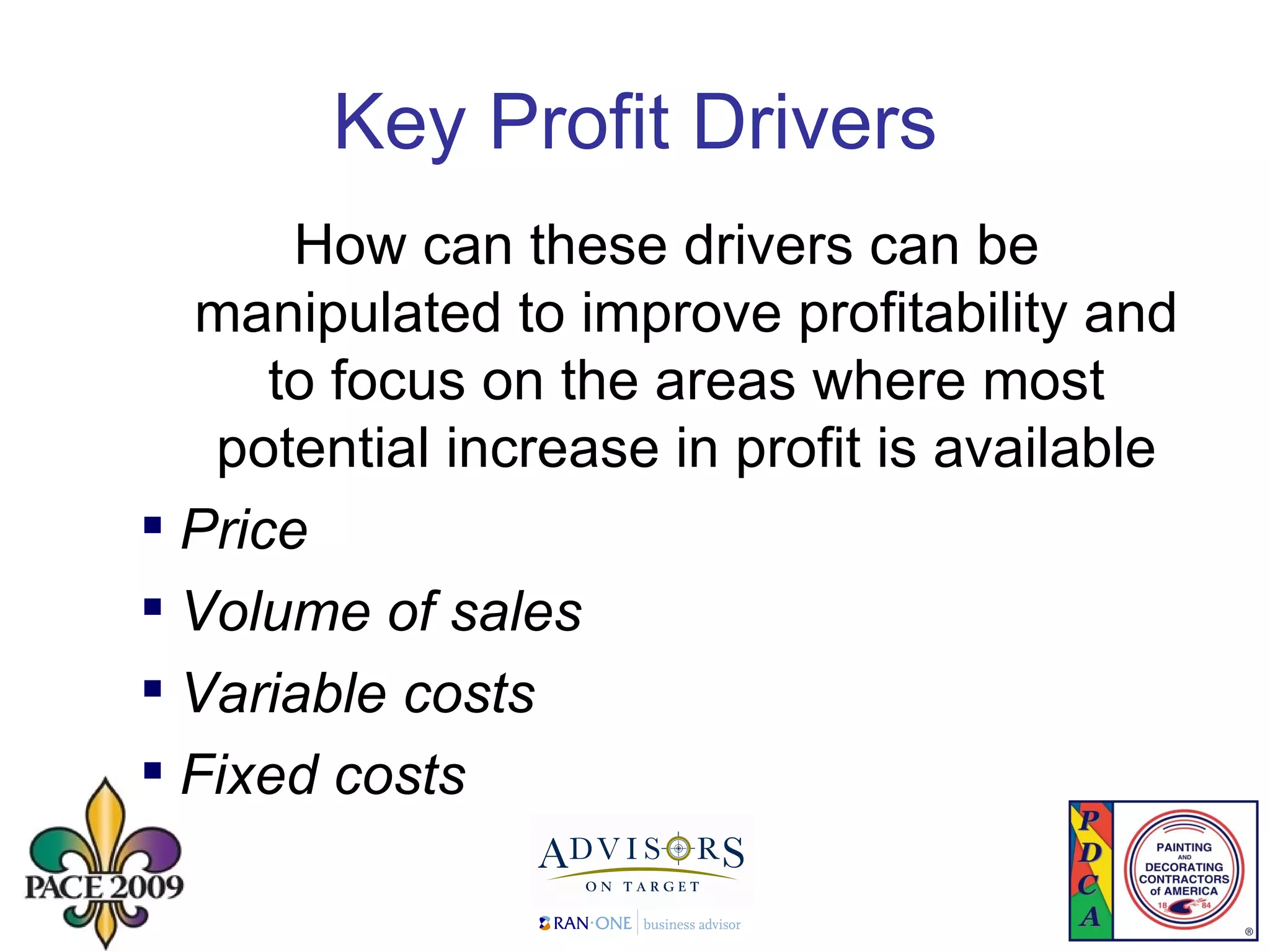
Key Profit Drivers How can these drivers can be manipulated to improve profitability and to focus on the areas where most potential increase in profit is available Price Volume of sales Variable costs Fixed costs
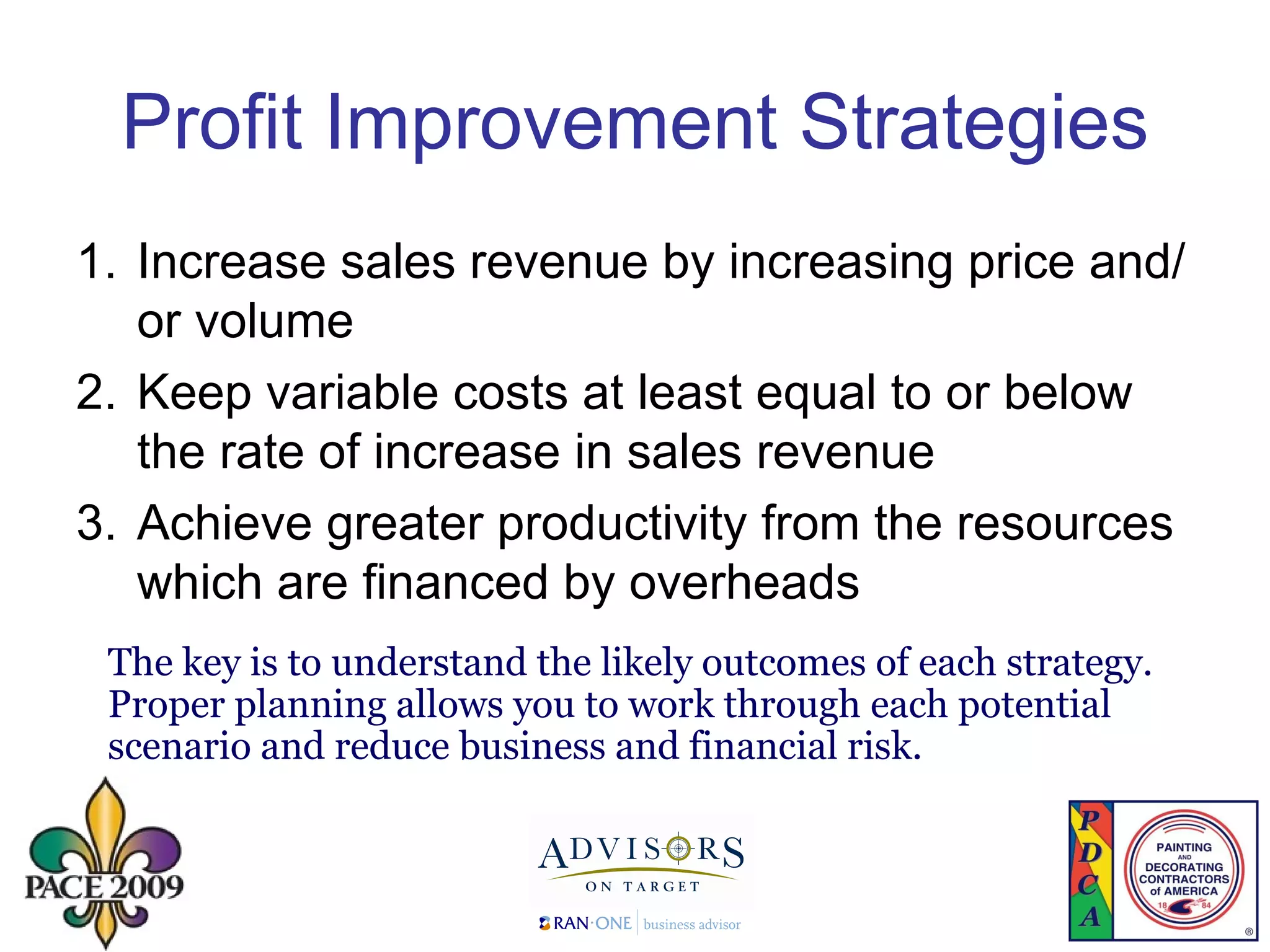
Profit Improvement Strategies Increase sales revenue by increasing price and/or volume Keep variable costs at least equal to or below the rate of increase in sales revenue Achieve greater productivity from the resources which are financed by overheads The key is to understand the likely outcomes of each strategy. Proper planning allows you to work through each potential scenario and reduce business and financial risk.
Here’s What You Need To Do Increase sales revenue by increasing price and/or volume Keep variable costs down (equal or below the rate of increase in revenue) Achieve greater productivity from resources which are financed through overhead Ensure that tight control is exercised over assets SO THAT Cash flow increases simultaneously with the increase in net profit
Create a Budget to achieve your Profit Plan
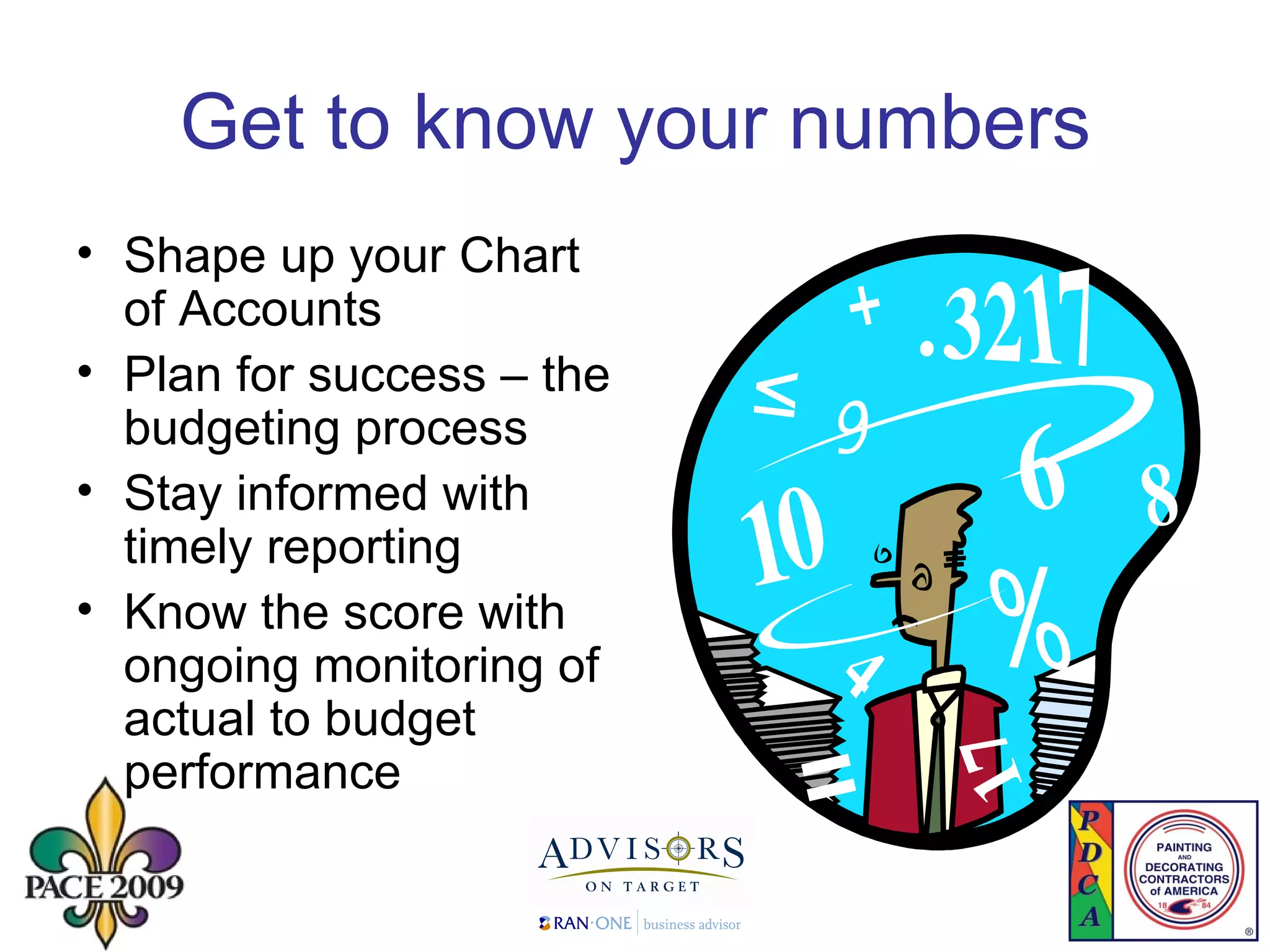
Get to know your numbers Shape up your Chart of Accounts Plan for success – the budgeting process Stay informed with timely reporting Know the score with ongoing monitoring of actual to budget performance
The Budgeting Process Start with last year’s year to date information  Base your current profit plan on your business plan objectives Project labor cost and hours Ensure budgeted hours will meet revenue targets Review marketing plan & adjust costs according Update expenses based on foreseen changes
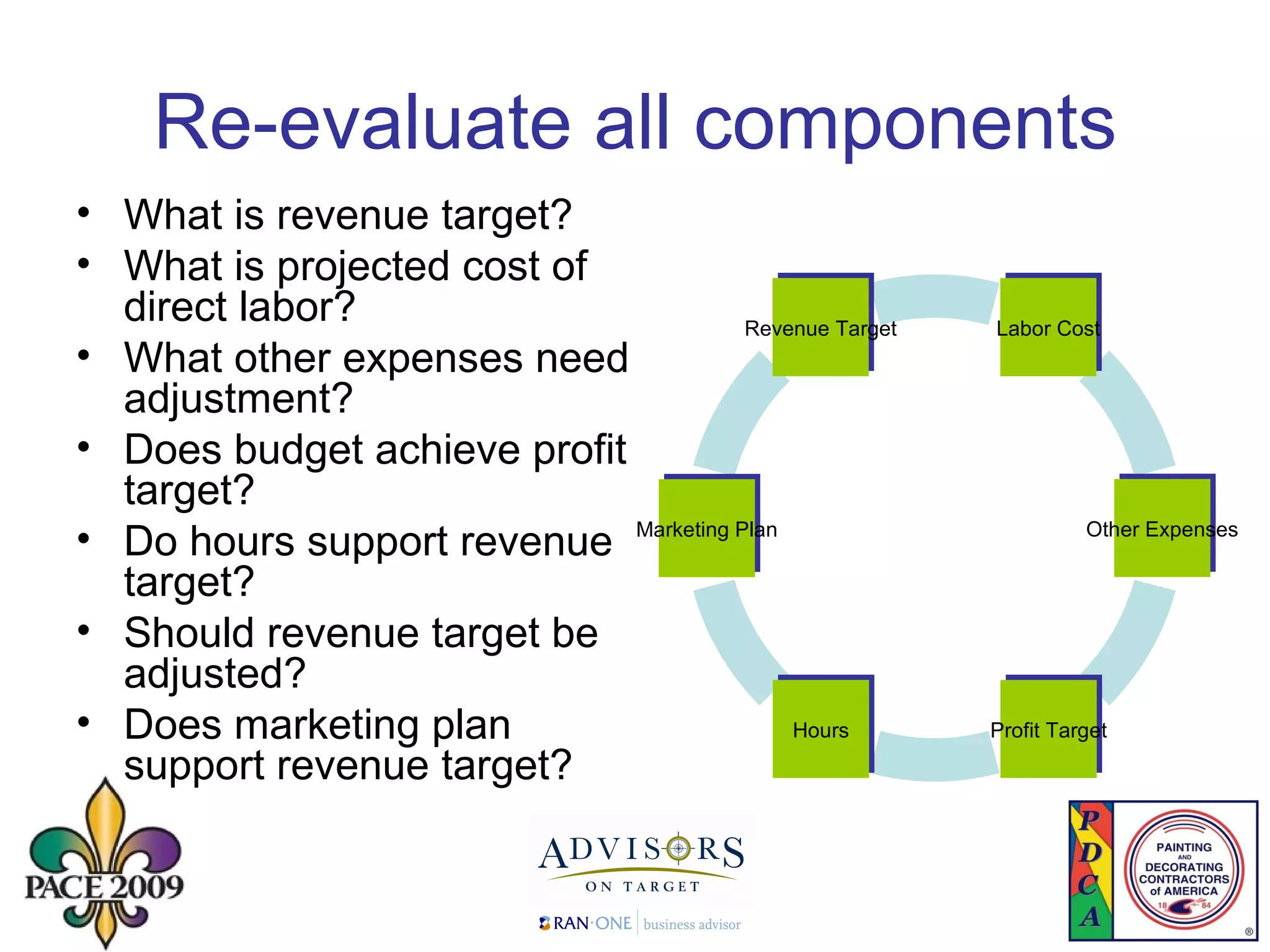
Re-evaluate all components What is revenue target? What is projected cost of direct labor? What other expenses need adjustment? Does budget achieve profit target? Do hours support revenue target? Should revenue target be adjusted? Does marketing plan support revenue target? Revenue Target Marketing Plan Hours Labor Cost Profit Target Other Expenses
Monitor your Progress Incorporate Budget into QuickBooks Monitor Monthly & YTD Progress  Make management decisions to achieve plan (or revise the plan, if necessary) Identify Action Steps for upcoming month
Monitor Monthly*:  Review & Analyze  Profit Margins Costs Cash Flow Liquidity  Debt Collections Break Even  Compare Actual to Budget Performance Job Costing Realization Marketing & Sales Data  Compare to plan What’s working?
Thank you for attending!  See us at the Trade Show  Booth # 924 Contact Information Linnea Blair Tel 619.291.3700 Email  [email_address] www.AdvisorsOnTarget.com

Pace 2009 Effective Financial Management

  • 1.
    Effective Financial ManagementBest Business Practices for a Profitable and Sustainable Business Presented by Advisors On Target
  • 2.
    What we willcover today… Getting Your Business “On Target” for Success 3 Key Financial Indicators of Business Health Key Metrics – Other Important Financial Data Profit Improvement Strategies Creating a Budget to Achieve your Plan
  • 3.
    On the roadto becoming an ON TARGET Painting Contractor…
  • 4.
    Financial Management BestPractice Guide Accounting system is fully & accurately functioning Controls are in place to ensure accuracy Financial Monitoring is being used effectively as a business tool Key Metrics are being used to keep your finger on the financial pulse of your business Owner reviews Financial Data and Metrics at least monthly if not weekly An adequate credit line is in place Company is profitable, solvent and able to finance its growth and reward stakeholders
  • 5.
    Rewards of being“On Target” Grow the business Become more profitable & be able to reward shareholders and key employees Achieve your business goals Make timely changes to your strategy Reduce risk in tough economic times Improve quality of life both personally and professionally
  • 6.
    Effective Financial ManagementKey Financial Data For Business Survival
  • 7.
    3 Key FinancialIndicators Of Your Business’ State Of Health Business is about making money To do this, it must simultaneously increase three things: Net profit margin – Operating profit margin Cash flow Return on investment (ROI)
  • 8.
    Indicator 1: ProfitMargins Net Profit = What’s left over after you deduct ALL expenses from the revenue your business generates Net Profit = Total Income – Total Expenses THE bottom line in your business Indicator of the overall management of the business Gross Profit = What’s left over after you deduct direct job costs from the revenue your business generates Gross Profit = Total Income – Direct Expenses to Produce jobs Indicator of the productivity of your field crews Indicator of the accuracy of your estimator (and pricing)
  • 9.
    How To CalculateProfit Margins Gross Profit Margin (GP%) is profit derived from work produced divided by Gross Revenue Gross Profit Margin = (Gross Profit/Revenue)% Net Profit Margin (NP%) is after-tax net profit divided by Gross Revenue Net Profit Margin = (Net Profit/Revenue)%
  • 10.
    Improving The GrossProfit Margin To improve the Gross profit margin you need to work on the drivers: Production / service delivery processes Material Costs Labor Costs Customer relations Team Skills and Development Pricing & Estimating
  • 11.
    What else affectsDirect Labor Costs? Productivity of Personnel Ability of the company to keep work in the pipeline Region – availability of qualified labor Effectiveness of operating systems in the business Job Process Systems Fully supplied crews/trucks Training/Management
  • 12.
    Improving The NetProfit Margin To improve the Net profit margin you also need to manage the following: Administrative operating processes Variable Costs Overhead Costs Customer relations Administrative Team Skills and Development Marketing Activities and Costs
  • 13.
    BEST PRACTICE GUIDE: Gross Profit % Gross Profit Margin = (Gross Profit/Revenue)% Higher is better 50% is goal 45% is industry average* * Residential and Commercial Contractors under $10MM, depends on mix of work, and use of subcontractors
  • 14.
    BEST PRACTICE GUIDE: Net Operating Profit %** Net Operating Profit Margin = (Net Operating Profit/Revenue)% Higher is better 15% is goal (25% BEFORE Owner’s Compensation) 5% is industry average* *Residential and Commercial Contractors under $10MM ** There is a distinction between Net Profit and Net Operating Profit, which is Profit before taxes, and “other” income & expenses not related to operations of the business
  • 15.
    The three “Isit” s of measurement Is it Accurate? Is it Acceptable Is it Sustainable?
  • 16.
    Indicator 2: CashFlow Obtain Cash Purchase Materials Bid & Sell Contract Complete Project
  • 17.
    Improving Cash FlowCash Flow Cycle Cash Flow vs. Profit Long Term Strategies
  • 18.
    Financial Result -Profit And Cash Flow
  • 19.
    BEST PRACTICE GUIDE: Cash Flow Prepare a Cash Flow Projection Manage Your Spending on a monthly, if not weekly basis Invoice Promptly Develop a systematized approach to receivables and collections Obtain a line of credit
  • 20.
    Indicator 3: ReturnOn Investment Return On Investment is net profit expressed as a percentage of the value of the total assets you have tied up in the business ROI = (NP/TA)% ROI is a profitability ratio – it is the true measure of the financial productivity of a business
  • 21.
  • 22.
    BEST PRACTICE GUIDE: ROI Return on Investment = (Net Profit/Total Assets)% Higher is better Should be at least 10% 25% or higher is a goal
  • 23.
    Key Metrics: OtherImportant Financial Data to Watch Liquidity Debt Collections Break Even
  • 24.
    BEST PRACTICE GUIDE: Liquidity Ratios Current Ratio = Current Assets Current Liabilities Should be a minimum of 1.5 or higher (3.0 or greater is better) Quick Ratio = Cash + Equivalents Current Liabilities Should be at least 1.0 Higher is better for both
  • 25.
    BEST PRACTICE GUIDE: Debt Ratios Debt Ratio = Total Liabilities Total Assets Should be less than 1.0 Debt to Equity Ratio = Long Term Debt Stockholder’s Equity Should be less than 1.5 or 150%
  • 26.
    BEST PRACTICE GUIDE: Days Sales Outstanding (Collections) Days Sales Outstanding = Accts Receivable x 365/Annual Revenue (previous 12 months rolling revenue) Should be 30 days or less
  • 27.
    BEST PRACTICE GUIDE: Breakeven Sales Breakeven Sales = Overhead Expenses*/Gross Profit Margin Calculate by week, month, or year to manage your business effectively and keep a positive bottom line *Include Variable Costs, Overhead Costs and “Other Costs” if critical to business survival
  • 28.
    BEST PRACTICE GUIDE: Cash in Bank – Ideal Cash in Bank = Overhead Expenses*/Gross Profit Margin Plus: Fixed expenses for months 2 & 3 Or – just think 3 months fixed expenses for a quicker calculation *For the upcoming month - Include Variable Costs and Overhead Costs
  • 29.
    Profit Improvement Strategies: How to Make More Money
  • 30.
    Drilling Down IntoProfit Improvement Planning: Understand The Components Of Sales Revenue TOTAL REVENUE = Total Customers x Number of Transactions x Average Sale Value TOTAL CUSTOMERS = Number of customers at start - customers lost + new customers NUMBER OF TRANSACTIONS = The number of times each customer deals with you AVERAGE SALE VALUE = The average value of each sale
  • 31.
    How To IncreaseTotal Sales Revenue Get more customers Improve customer retention rate Improve return visit rate Improve average sale value AND Have customers recommend you to their friends and associates
  • 32.
    Key Profit DriversHow can these drivers can be manipulated to improve profitability and to focus on the areas where most potential increase in profit is available Price Volume of sales Variable costs Fixed costs
  • 33.
    Profit Improvement StrategiesIncrease sales revenue by increasing price and/or volume Keep variable costs at least equal to or below the rate of increase in sales revenue Achieve greater productivity from the resources which are financed by overheads The key is to understand the likely outcomes of each strategy. Proper planning allows you to work through each potential scenario and reduce business and financial risk.
  • 34.
    Here’s What YouNeed To Do Increase sales revenue by increasing price and/or volume Keep variable costs down (equal or below the rate of increase in revenue) Achieve greater productivity from resources which are financed through overhead Ensure that tight control is exercised over assets SO THAT Cash flow increases simultaneously with the increase in net profit
  • 35.
    Create a Budgetto achieve your Profit Plan
  • 36.
    Get to knowyour numbers Shape up your Chart of Accounts Plan for success – the budgeting process Stay informed with timely reporting Know the score with ongoing monitoring of actual to budget performance
  • 37.
    The Budgeting ProcessStart with last year’s year to date information Base your current profit plan on your business plan objectives Project labor cost and hours Ensure budgeted hours will meet revenue targets Review marketing plan & adjust costs according Update expenses based on foreseen changes
  • 38.
    Re-evaluate all componentsWhat is revenue target? What is projected cost of direct labor? What other expenses need adjustment? Does budget achieve profit target? Do hours support revenue target? Should revenue target be adjusted? Does marketing plan support revenue target? Revenue Target Marketing Plan Hours Labor Cost Profit Target Other Expenses
  • 39.
    Monitor your ProgressIncorporate Budget into QuickBooks Monitor Monthly & YTD Progress Make management decisions to achieve plan (or revise the plan, if necessary) Identify Action Steps for upcoming month
  • 40.
    Monitor Monthly*: Review & Analyze Profit Margins Costs Cash Flow Liquidity Debt Collections Break Even Compare Actual to Budget Performance Job Costing Realization Marketing & Sales Data Compare to plan What’s working?
  • 41.
    Thank you forattending! See us at the Trade Show Booth # 924 Contact Information Linnea Blair Tel 619.291.3700 Email [email_address] www.AdvisorsOnTarget.com