FINANCIAL PROJECTIONS
 AREA48
 July 16, 2013
 Sam Buffington, CPA
◦ sambuff@cox.net
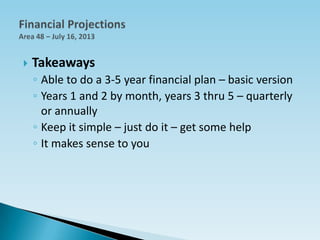
 Takeaways
◦ Able to do a 3-5 year financial plan – basic version
◦ Years 1 and 2 by month, years 3 thru 5 – quarterly
or annually
◦ Keep it simple – just do it – get some help
◦ It makes sense to you
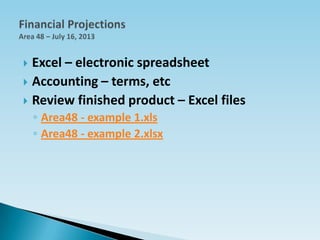
 Excel – electronic spreadsheet
 Accounting – terms, etc
 Review finished product – Excel files
◦ Area48 - example 1.xls
◦ Area48 - example 2.xlsx
 Why do we do projections / forecasts?
◦ Need to know where we are headed
 Long term – one year
 Short term – 6-8 weeks for cash forecast
◦ Need to know how much money we need
 “capital required”
 “burn rate”
 Where are we spending our money (investment)?
◦ It’s important part of business administration –
fundamental
 Why do we do projections / forecasts?
◦ Must do – startup, early stage, mature businesses
◦ Flows with the record-keeping requirement
 Where have we been – historical financial statements
 Required to do – no choice
 Where are we now – current financial statements
 Where will we be in the future
◦ Helpful (necessary) for valuation of your business
 Terminology
◦ Budget
◦ Forecast (projections)
◦ Plan (model)
 Terminology
◦ Budget
 Fixed – doesn’t change
 One year period
 Measurement tool for management – expected
by:
 Board
 Investors
 Bank
 Etc.
 Terminology
◦ Forecasts
 Most current best estimate
 Moving periods –
 “rolling 12 months”
 one year or multi year
 Monthly – quarterly – annually
 Must have to manage resources, cash, etc.
 Terminology
◦ Plans
 Business plan
 All encompassing
 Development, sales and marketing, operations,
financial
 Financial plan
 Part of the “Business Plan”
 Accounting Terminology
◦ Accrual basis – use this
◦ Cash basis
◦ Revenues (sales)
◦ Cost of sales ( cost of goods – COG’s)
◦ Gross margin (gross profit)
◦ Operating expenses
◦ Operating income (EBITDA)
 Accounting Terminology
◦ Other income and expense
 Interest – depreciation - taxes
◦ Net income (bottom line)
 Accounting Terminology
◦ Financial statements
 Balance sheet - point in time
 Income statement – period of time
 Statement of cash flows – period of time
 Format for forecasting /budgeting
◦ Use “income statement” format
◦ Periods across the top (columns)
 Monthly – quarterly - annual
◦ Items down the side (rows)
◦ Use electronic spreadsheet – Excel
◦ This is standard format - do not vary
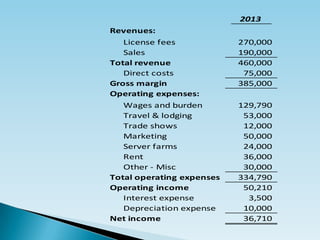
2013
Revenues:
License fees 270,000
Sales 190,000
Total revenue 460,000
Direct costs 75,000
Gross margin 385,000
Operating expenses:
Wages and burden 129,790
Travel & lodging 53,000
Trade shows 12,000
Marketing 50,000
Server farms 24,000
Rent 36,000
Other - Misc 30,000
Total operating expenses 334,790
Operating income 50,210
Interest expense 3,500
Depreciation expense 10,000
Net income 36,710
Line items to forecast
 Revenues
◦ What we sell, when, for how much (to who?)
 Cost of revenues
◦ Tied directly to what we sold
◦ “direct costs” – can be goods, services, wages
Line items to forecast
Operating Expenses
 Think through where you are going to spend your
money to operate your business
 Look at other income statements, forecasts, etc.
Line items to forecast
Operating Expenses
 People costs - salaries and wages – yourself
◦ Remember “payroll burden” – payroll taxes
◦ Benefits?
◦ Commissions?
 Rent
 Insurance
 Professional fees
 Marketing
Line items to forecast
Operating Expenses
 T&E
 Office supplies
 IT costs
 Communications

Financial Projections

  • 1.
    FINANCIAL PROJECTIONS  AREA48 July 16, 2013  Sam Buffington, CPA ◦ sambuff@cox.net
  • 2.
     Takeaways ◦ Ableto do a 3-5 year financial plan – basic version ◦ Years 1 and 2 by month, years 3 thru 5 – quarterly or annually ◦ Keep it simple – just do it – get some help ◦ It makes sense to you
  • 3.
     Excel –electronic spreadsheet  Accounting – terms, etc  Review finished product – Excel files ◦ Area48 - example 1.xls ◦ Area48 - example 2.xlsx
  • 4.
     Why dowe do projections / forecasts? ◦ Need to know where we are headed  Long term – one year  Short term – 6-8 weeks for cash forecast ◦ Need to know how much money we need  “capital required”  “burn rate”  Where are we spending our money (investment)? ◦ It’s important part of business administration – fundamental
  • 5.
     Why dowe do projections / forecasts? ◦ Must do – startup, early stage, mature businesses ◦ Flows with the record-keeping requirement  Where have we been – historical financial statements  Required to do – no choice  Where are we now – current financial statements  Where will we be in the future ◦ Helpful (necessary) for valuation of your business
  • 6.
     Terminology ◦ Budget ◦Forecast (projections) ◦ Plan (model)
  • 7.
     Terminology ◦ Budget Fixed – doesn’t change  One year period  Measurement tool for management – expected by:  Board  Investors  Bank  Etc.
  • 8.
     Terminology ◦ Forecasts Most current best estimate  Moving periods –  “rolling 12 months”  one year or multi year  Monthly – quarterly – annually  Must have to manage resources, cash, etc.
  • 9.
     Terminology ◦ Plans Business plan  All encompassing  Development, sales and marketing, operations, financial  Financial plan  Part of the “Business Plan”
  • 10.
     Accounting Terminology ◦Accrual basis – use this ◦ Cash basis ◦ Revenues (sales) ◦ Cost of sales ( cost of goods – COG’s) ◦ Gross margin (gross profit) ◦ Operating expenses ◦ Operating income (EBITDA)
  • 11.
     Accounting Terminology ◦Other income and expense  Interest – depreciation - taxes ◦ Net income (bottom line)
  • 12.
     Accounting Terminology ◦Financial statements  Balance sheet - point in time  Income statement – period of time  Statement of cash flows – period of time
  • 13.
     Format forforecasting /budgeting ◦ Use “income statement” format ◦ Periods across the top (columns)  Monthly – quarterly - annual ◦ Items down the side (rows) ◦ Use electronic spreadsheet – Excel ◦ This is standard format - do not vary
  • 14.
    2013 Revenues: License fees 270,000 Sales190,000 Total revenue 460,000 Direct costs 75,000 Gross margin 385,000 Operating expenses: Wages and burden 129,790 Travel & lodging 53,000 Trade shows 12,000 Marketing 50,000 Server farms 24,000 Rent 36,000 Other - Misc 30,000 Total operating expenses 334,790 Operating income 50,210 Interest expense 3,500 Depreciation expense 10,000 Net income 36,710
  • 15.
    Line items toforecast  Revenues ◦ What we sell, when, for how much (to who?)  Cost of revenues ◦ Tied directly to what we sold ◦ “direct costs” – can be goods, services, wages
  • 16.
    Line items toforecast Operating Expenses  Think through where you are going to spend your money to operate your business  Look at other income statements, forecasts, etc.
  • 17.
    Line items toforecast Operating Expenses  People costs - salaries and wages – yourself ◦ Remember “payroll burden” – payroll taxes ◦ Benefits? ◦ Commissions?  Rent  Insurance  Professional fees  Marketing
  • 18.
    Line items toforecast Operating Expenses  T&E  Office supplies  IT costs  Communications