Vital Sales & Marketing Metrics
Read me..

 Today, we have abundant data, better information, fair knowledge and
 poor insight. Encountering wisdom is a rare occurrence!
 The data is out there on our spreadsheets, databases and hard disks.

 Here are 20 simple effective metrics for a Sales /Brand manager.
 It is not all these metrics, probably an ideal combination of one or two of
 these metrics for a given business problem can show a direction - The
 right direction.
 The wisdom is finding out the combination. I leave the choice to you.
 Lastly, as some one aptly puts it,

        A collection of data is not information.
        A collection of information is not knowledge.
        A collection of knowledge is not wisdom.
        A collection of wisdom is not truth.
Metric


     A metric is a system of related measures that
      facilitates the quantification of some particular
      characteristic

     Remember ,
     What gets measured , gets done.
     If you cannot measure it, You cannot manage it
Few definitions in brief

  Segment and Category makes a Market


 Segment : People with similar needs
 Made up of people or organizations sharing one or
  more characteristics that cause them to demand
  similar product and/or services
 Category : Inter changeable brands or service
   A category is a group or set of things that have similar
   characteristics. Similar and competing products (or
   services) all fall into the same brand category.
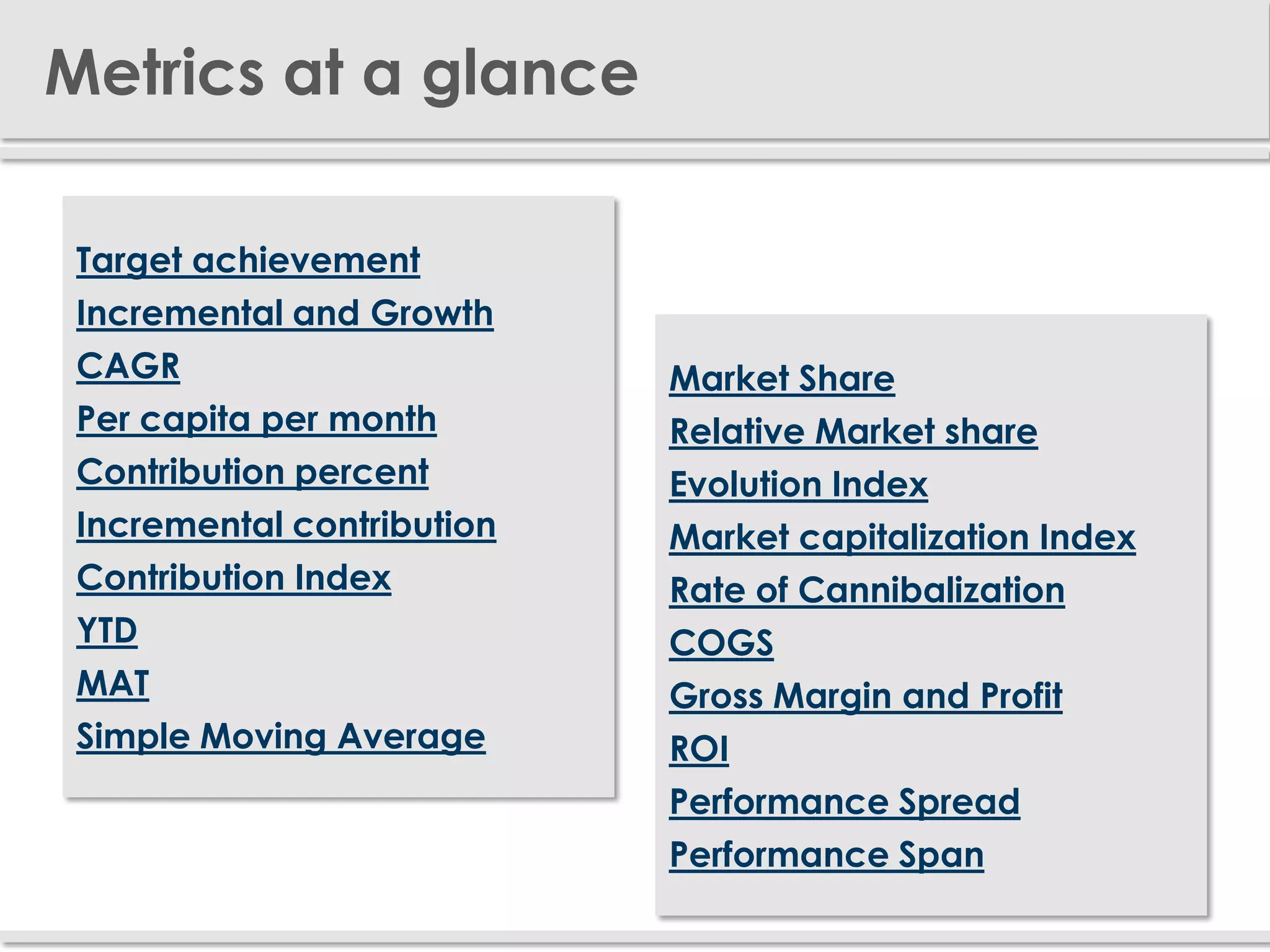
Metrics at a glance

 Target achievement
 Incremental and Growth
 CAGR                       Market Share
 Per capita per month       Relative Market share
 Contribution percent       Evolution Index
 Incremental contribution   Market capitalization Index
 Contribution Index         Rate of Cannibalization
 YTD                        COGS
 MAT                        Gross Margin and Profit
 Simple Moving Average      ROI
                            Performance Spread
                            Performance Span
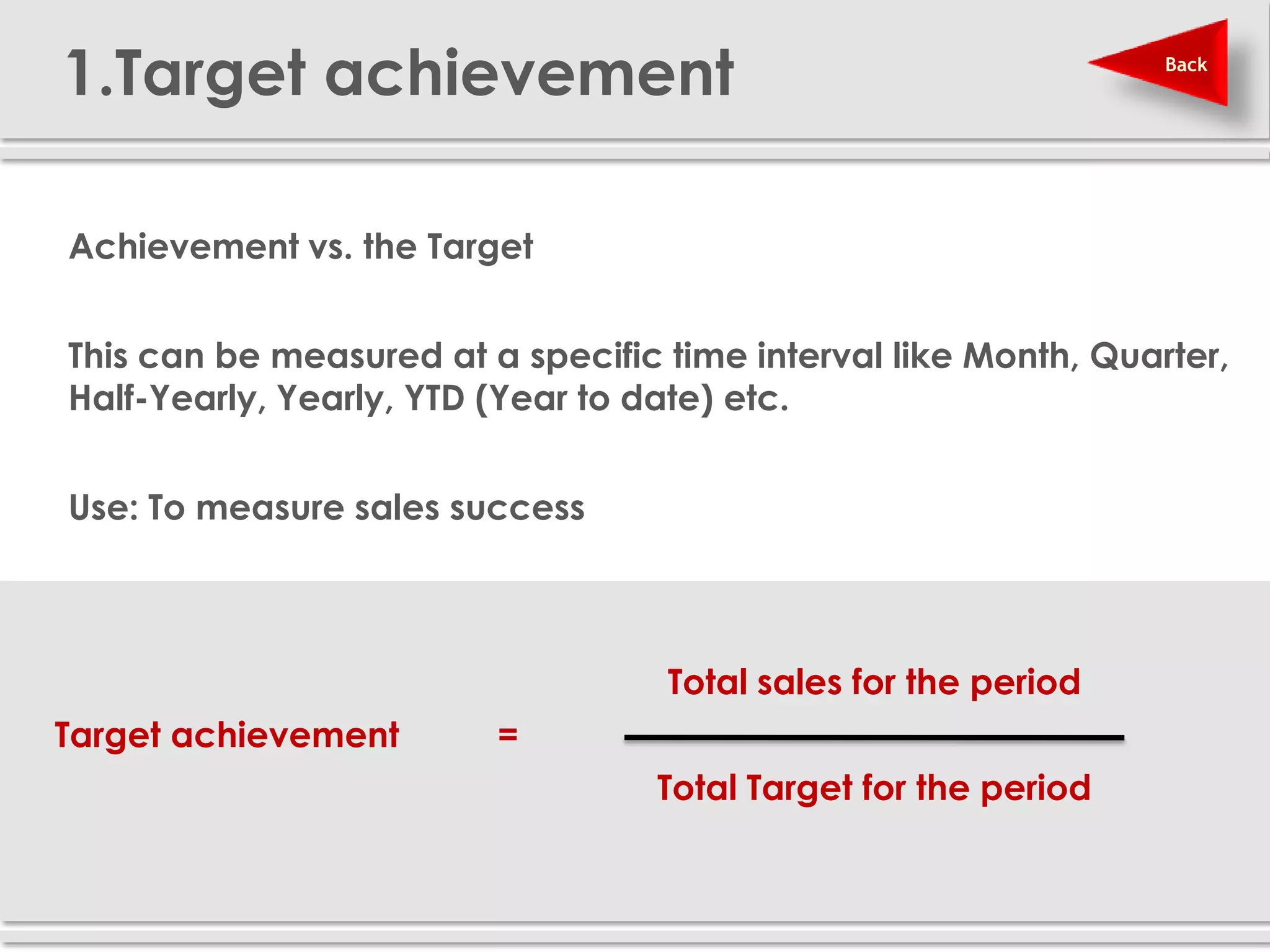
1.Target achievement                                             Back


Achievement vs. the Target


This can be measured at a specific time interval like Month, Quarter,
Half-Yearly, Yearly, YTD (Year to date) etc.


Use: To measure sales success


                                   Total sales for the period
Target achievement       =
                                   Total Target for the period
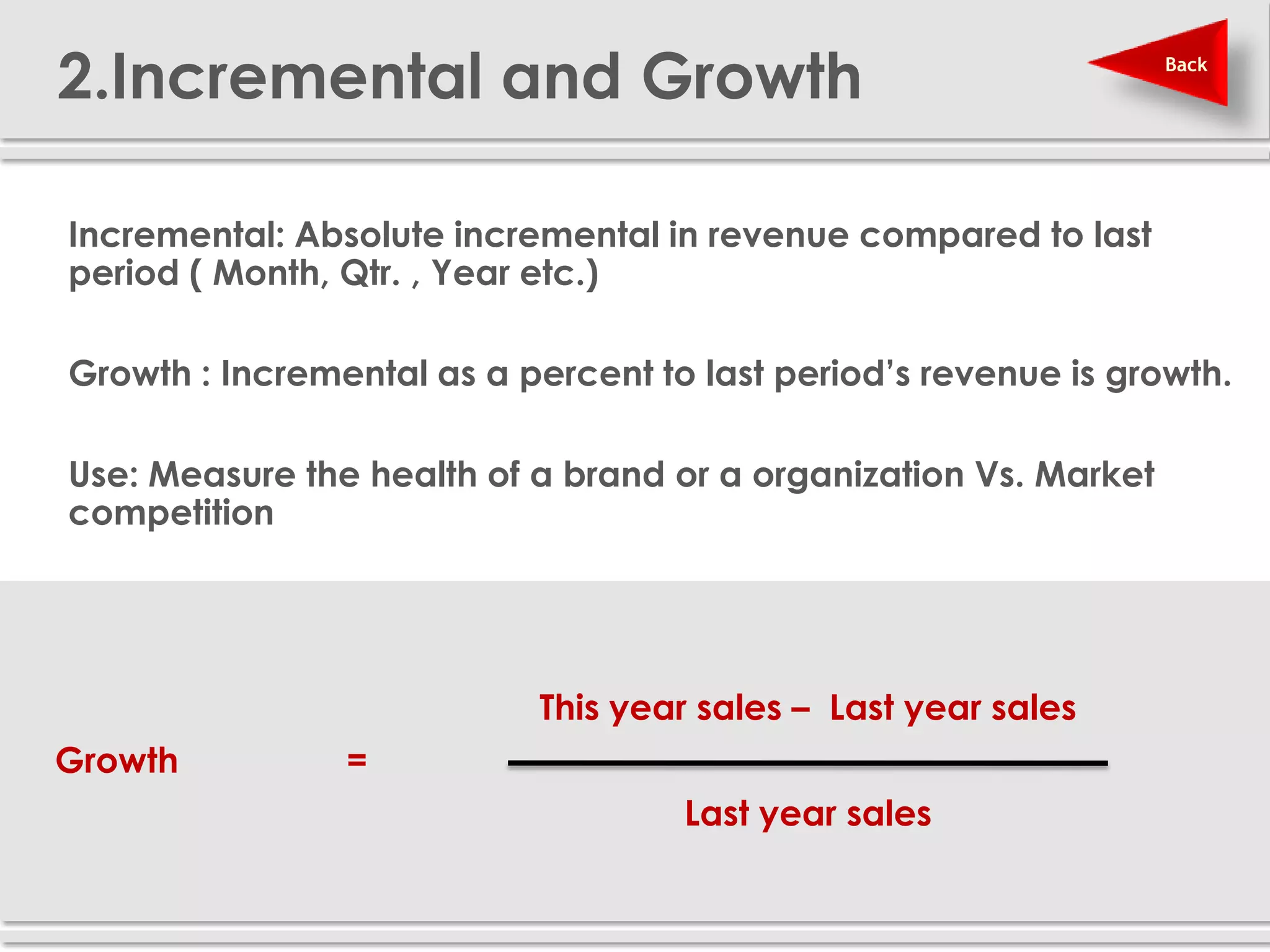
2.Incremental and Growth                                          Back


Incremental: Absolute incremental in revenue compared to last
period ( Month, Qtr. , Year etc.)

Growth : Incremental as a percent to last period’s revenue is growth.

Use: Measure the health of a brand or a organization Vs. Market
competition


                           This year sales – Last year sales
Growth          =
                                    Last year sales
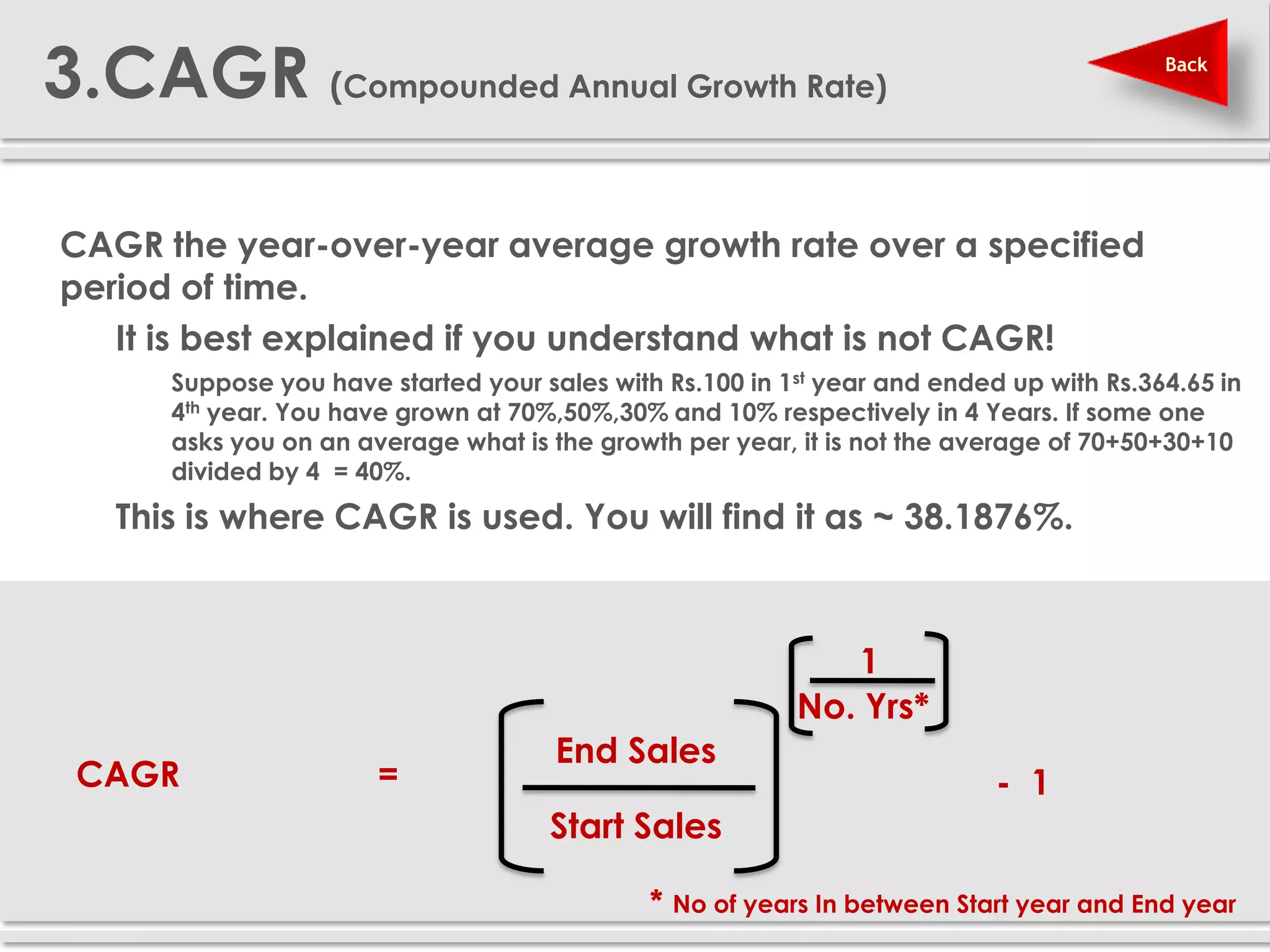
3.CAGR (Compounded Annual Growth Rate)                                                    Back


 CAGR the year-over-year average growth rate over a specified
  period of time.
    It is best explained if you understand what is not CAGR!
       Suppose you have started your sales with Rs.100 in 1st year and ended up with Rs.364.65 in
        4th year. You have grown at 70%,50%,30% and 10% respectively in 4 Years. If some one
        asks you on an average what is the growth per year, it is not the average of 70+50+30+10
        divided by 4 = 40%.
    This is where CAGR is used. You will find it as ~ 38.1876%.


                                                               1
                                                            No. Yrs*
                                        End Sales
   CAGR                  =                                                   - 1
                                        Start Sales

                                                * No of years In between Start year and End year
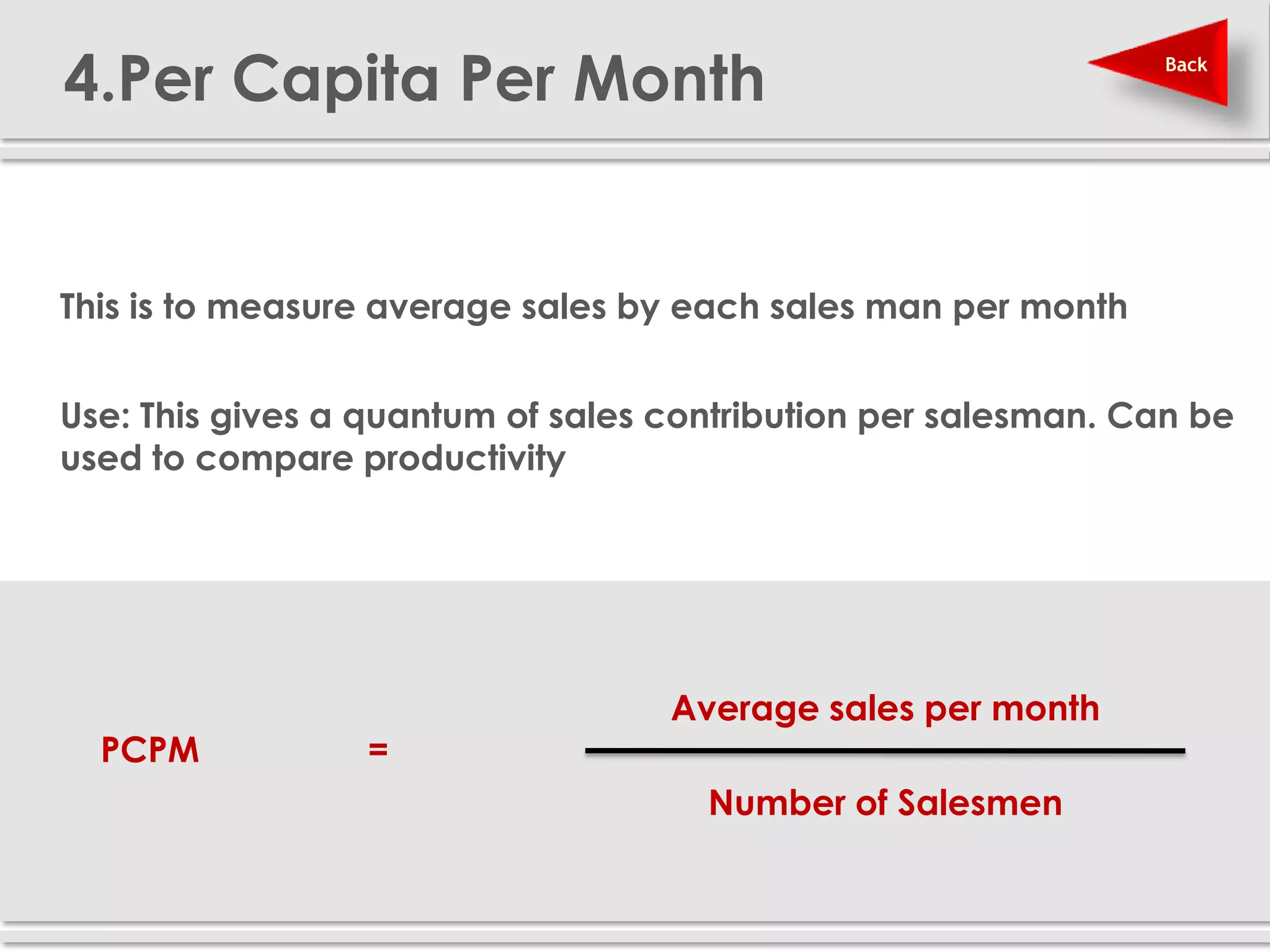
4.Per Capita Per Month                                          Back


 This is to measure average sales by each sales man per month


 Use: This gives a quantum of sales contribution per salesman. Can be
  used to compare productivity


                                     Average sales per month
     PCPM           =
                                       Number of Salesmen
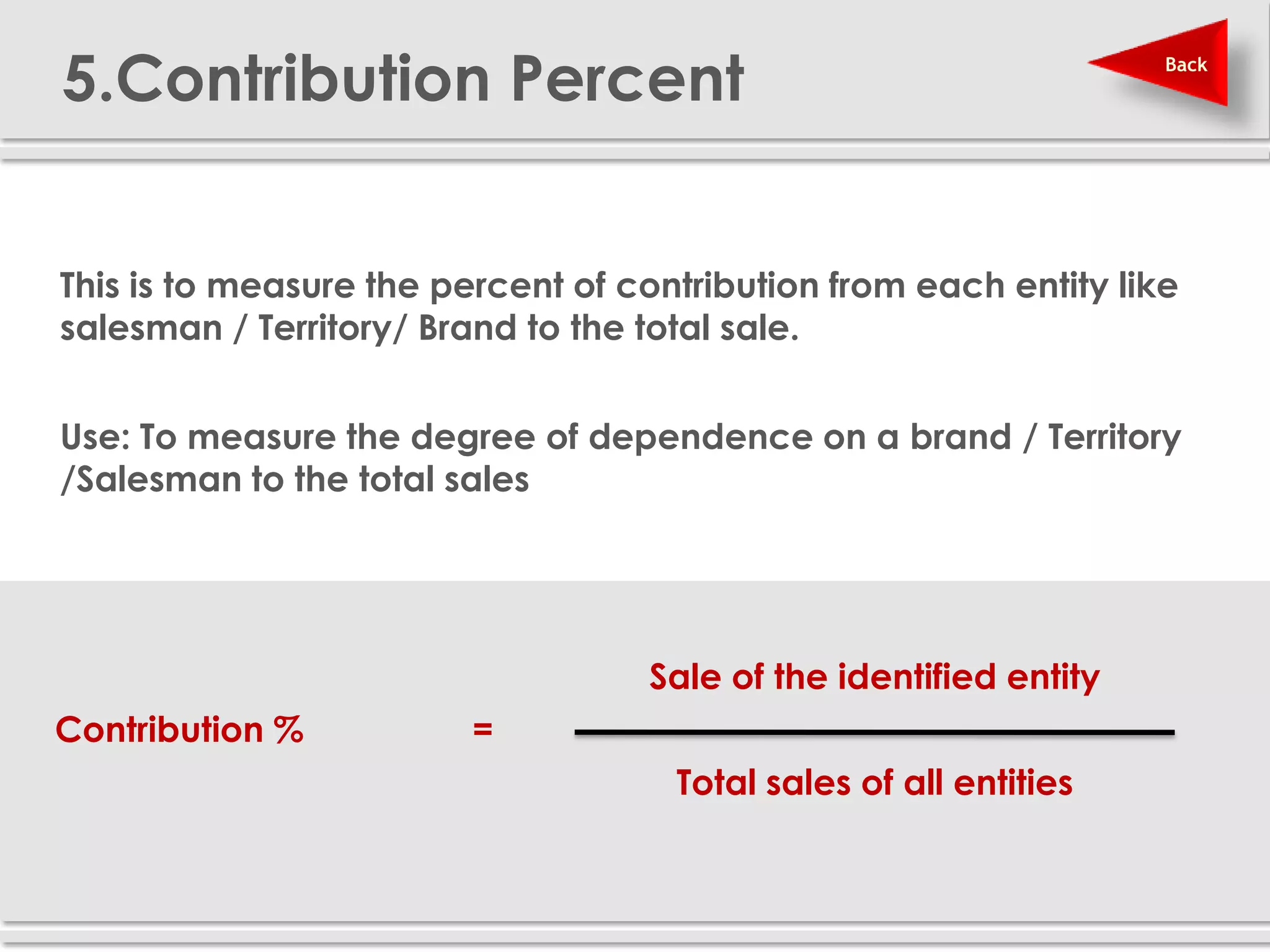
5.Contribution Percent                                              Back


 This is to measure the percent of contribution from each entity like
  salesman / Territory/ Brand to the total sale.


 Use: To measure the degree of dependence on a brand / Territory
  /Salesman to the total sales


                                      Sale of the identified entity
  Contribution %           =
                                       Total sales of all entities
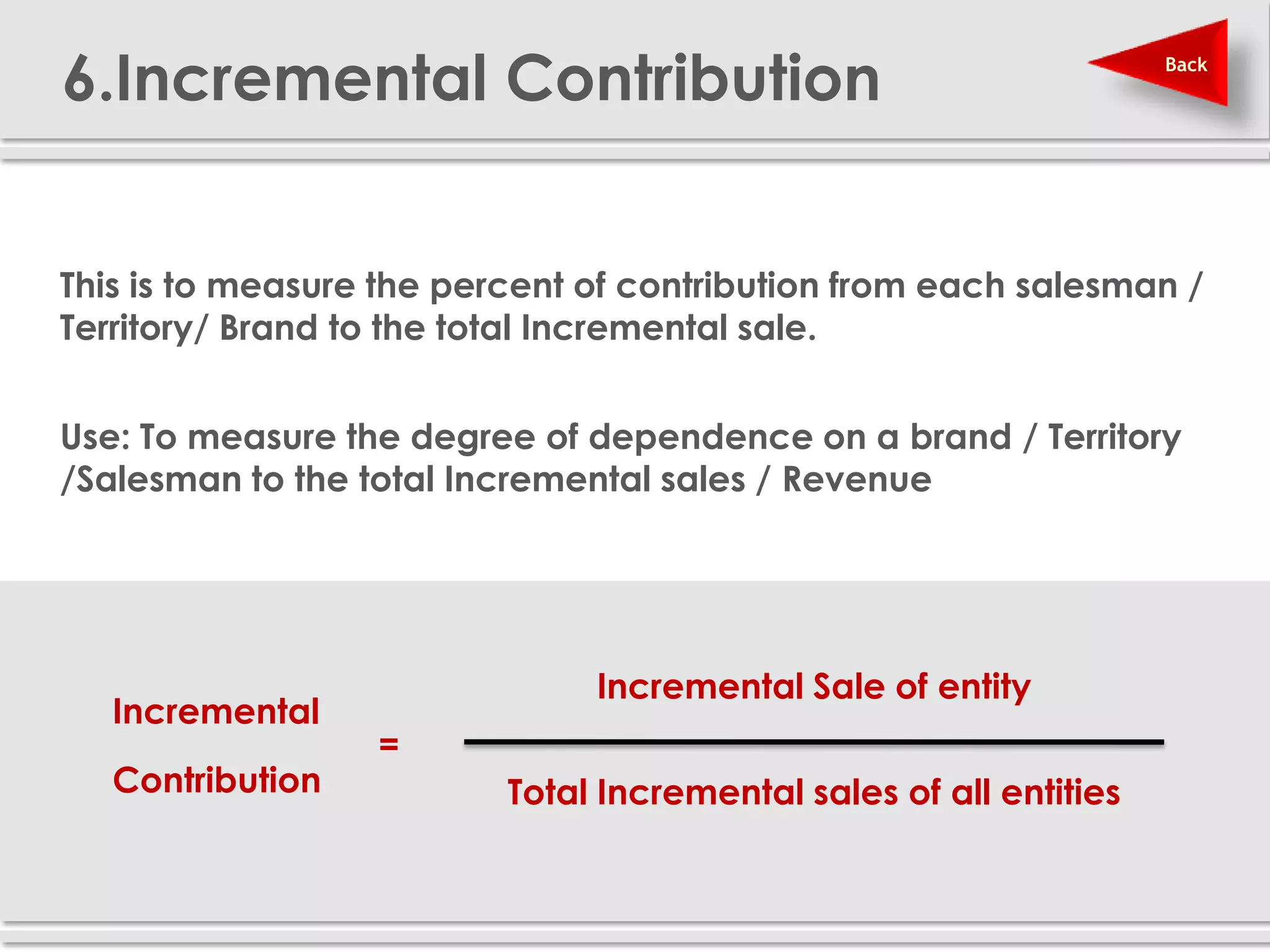
6.Incremental Contribution                                          Back


 This is to measure the percent of contribution from each salesman /
  Territory/ Brand to the total Incremental sale.


 Use: To measure the degree of dependence on a brand / Territory
  /Salesman to the total Incremental sales / Revenue


                                 Incremental Sale of entity
     Incremental
                     =
     Contribution           Total Incremental sales of all entities
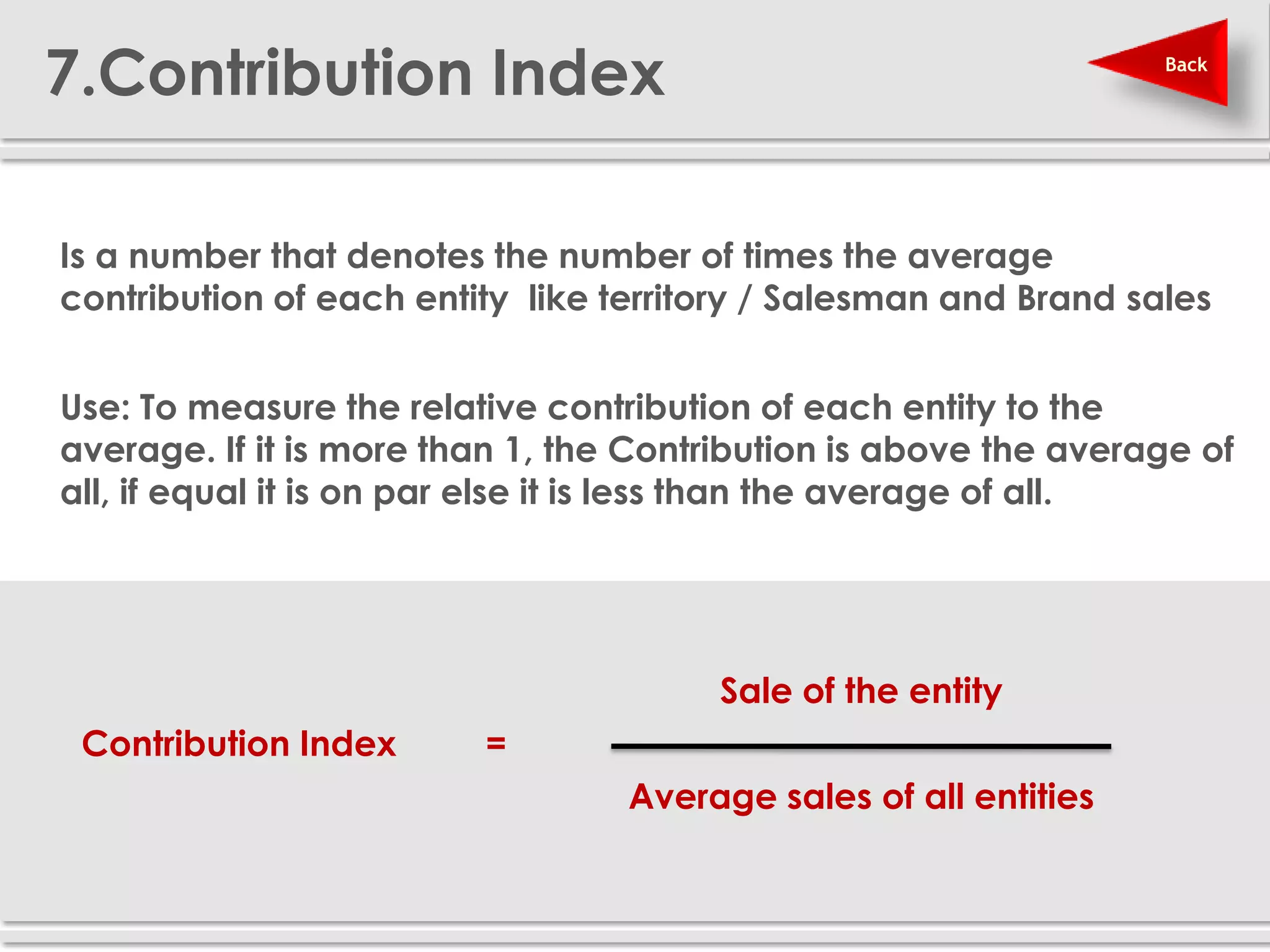
7.Contribution Index                                               Back


 Is a number that denotes the number of times the average
  contribution of each entity like territory / Salesman and Brand sales


 Use: To measure the relative contribution of each entity to the
  average. If it is more than 1, the Contribution is above the average of
  all, if equal it is on par else it is less than the average of all.


                                          Sale of the entity
    Contribution Index      =
                                    Average sales of all entities
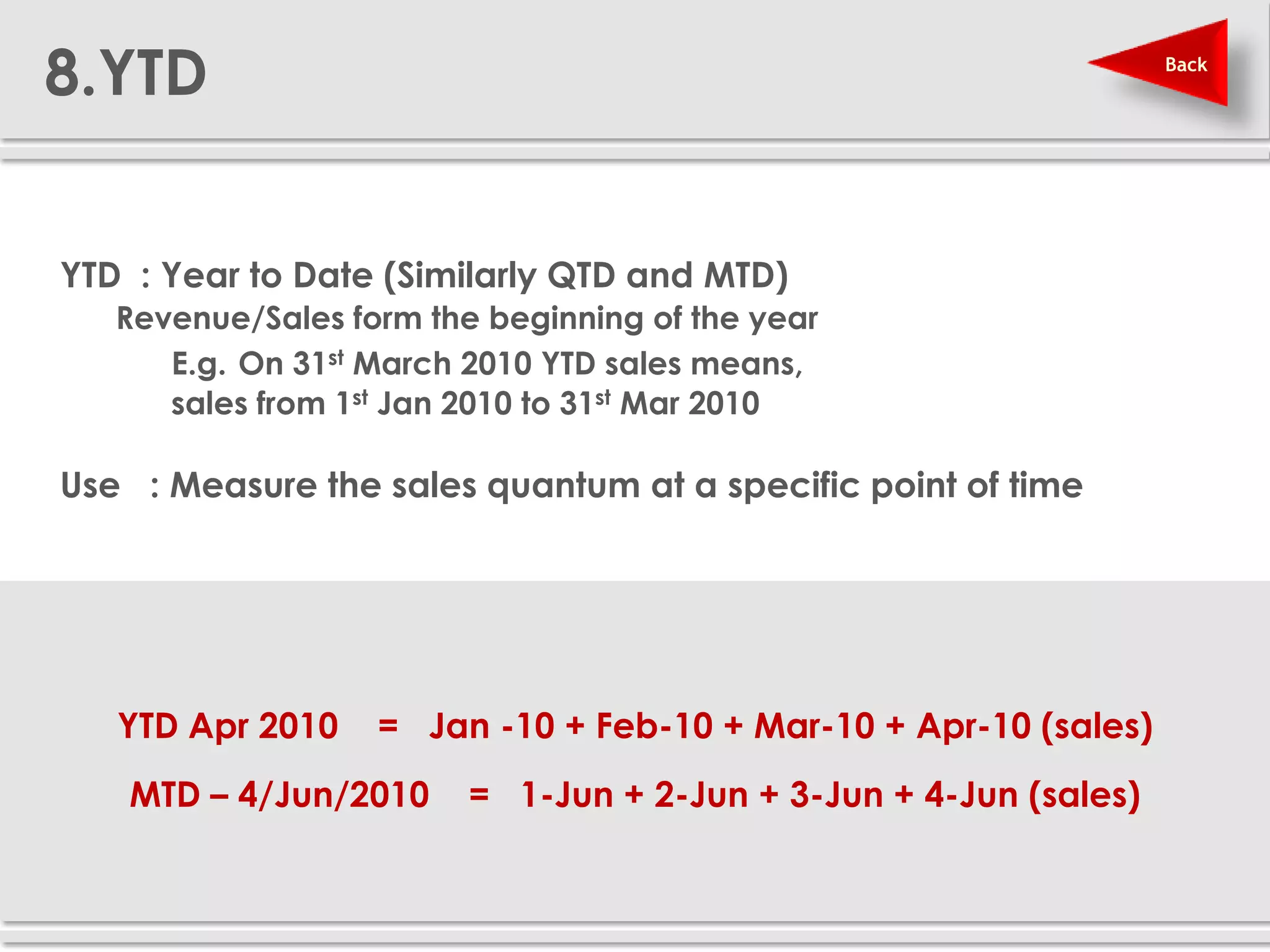
8.YTD                                                               Back


 YTD : Year to Date (Similarly QTD and MTD)
    Revenue/Sales form the beginning of the year
       E.g. On 31st March 2010 YTD sales means,
        sales from 1st Jan 2010 to 31st Mar 2010

 Use : Measure the sales quantum at a specific point of time


     YTD Apr 2010    = Jan -10 + Feb-10 + Mar-10 + Apr-10 (sales)
      MTD – 4/Jun/2010     = 1-Jun + 2-Jun + 3-Jun + 4-Jun (sales)
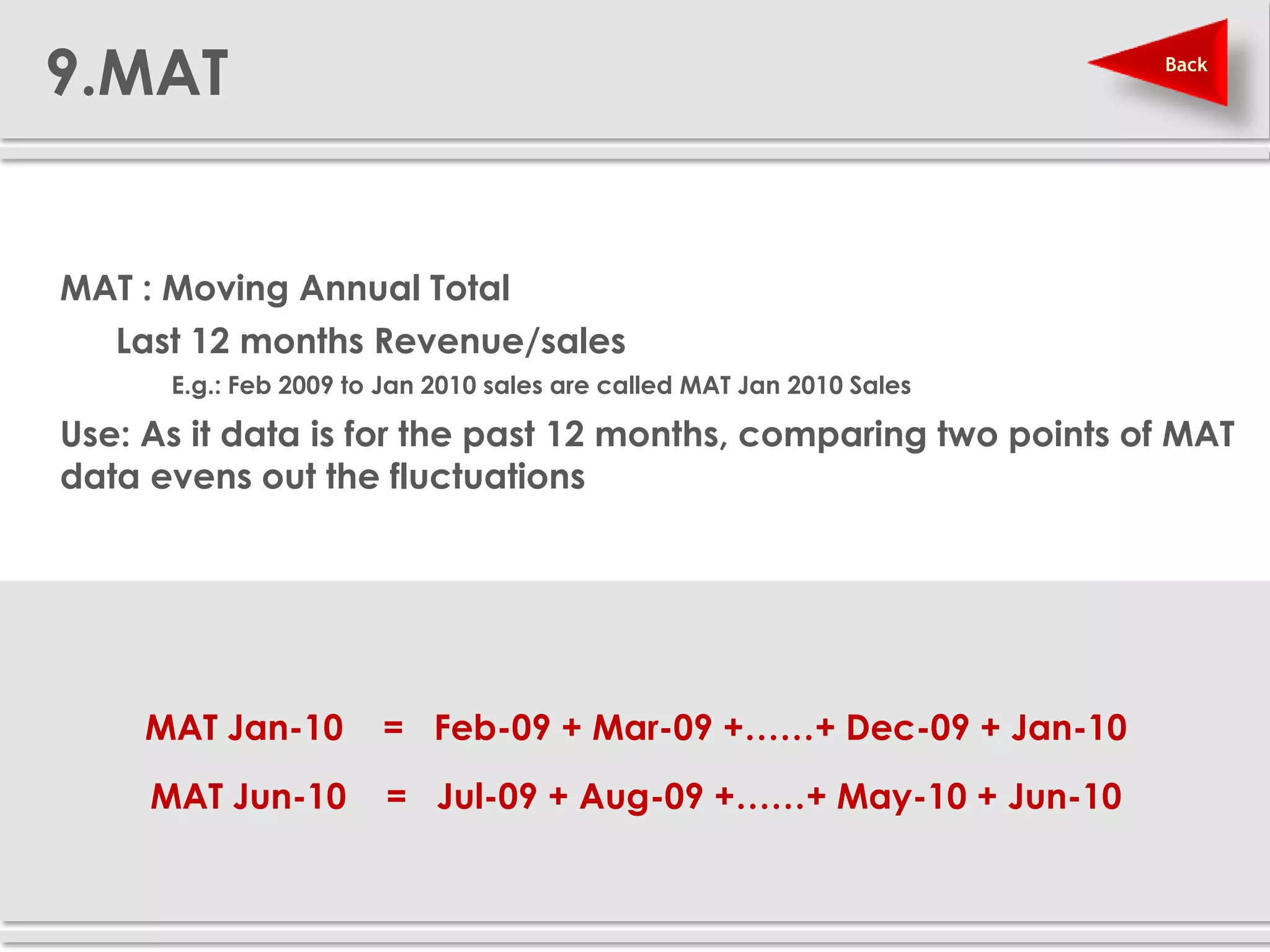
9.MAT                                                                    Back


 MAT : Moving Annual Total
    Last 12 months Revenue/sales
        E.g.: Feb 2009 to Jan 2010 sales are called MAT Jan 2010 Sales

 Use: As it data is for the past 12 months, comparing two points of MAT
  data evens out the fluctuations


       MAT Jan-10          = Feb-09 + Mar-09 +……+ Dec-09 + Jan-10
        MAT Jun-10         = Jul-09 + Aug-09 +……+ May-10 + Jun-10
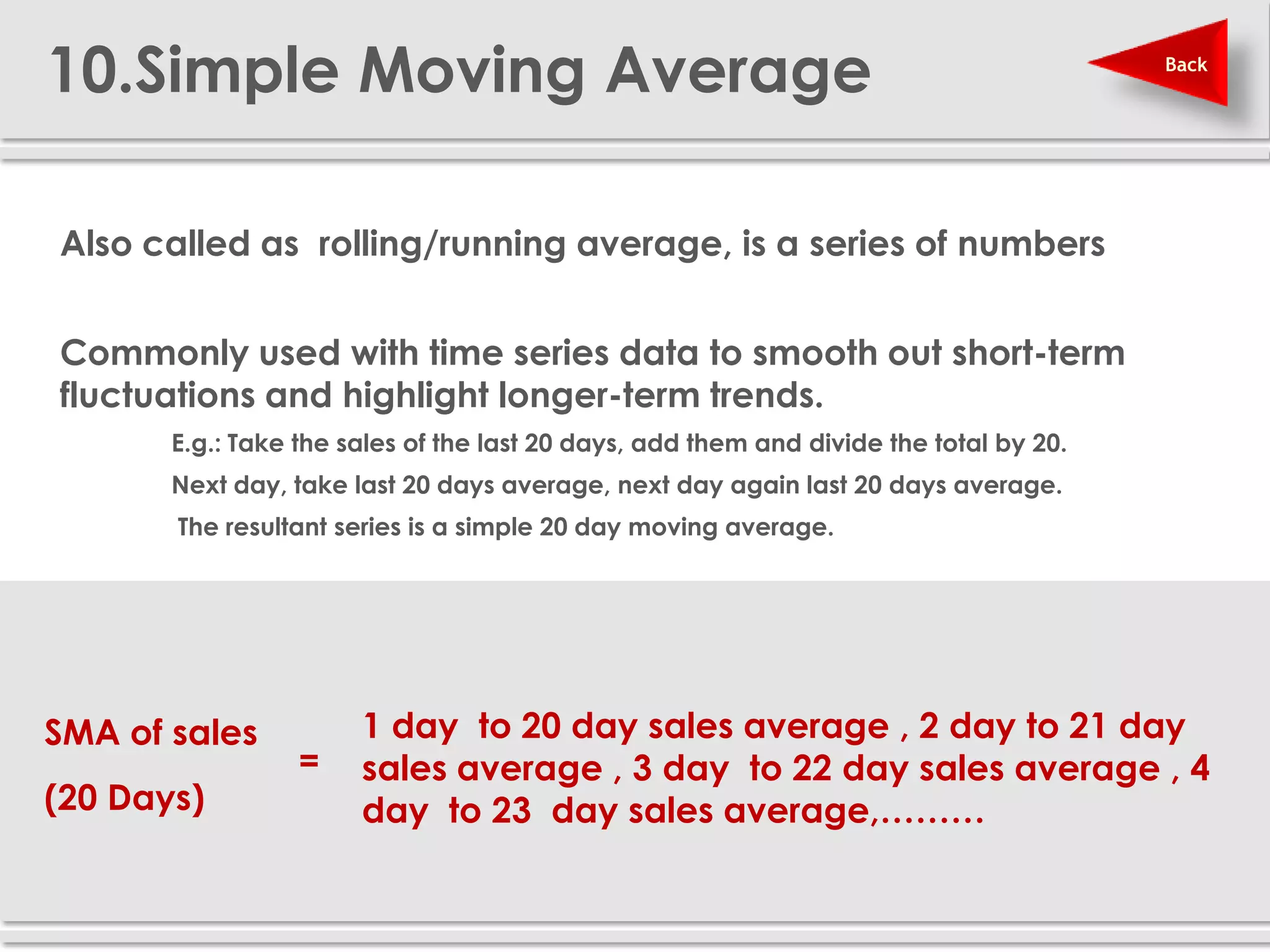
10.Simple Moving Average                                                                 Back


 Also called as rolling/running average, is a series of numbers


 Commonly used with time series data to smooth out short-term
  fluctuations and highlight longer-term trends.
        E.g.: Take the sales of the last 20 days, add them and divide the total by 20.
        Next day, take last 20 days average, next day again last 20 days average.
          The resultant series is a simple 20 day moving average.


 SMA of sales             1 day to 20 day sales average , 2 day to 21 day
                     =    sales average , 3 day to 22 day sales average , 4
 (20 Days)                day to 23 day sales average,………
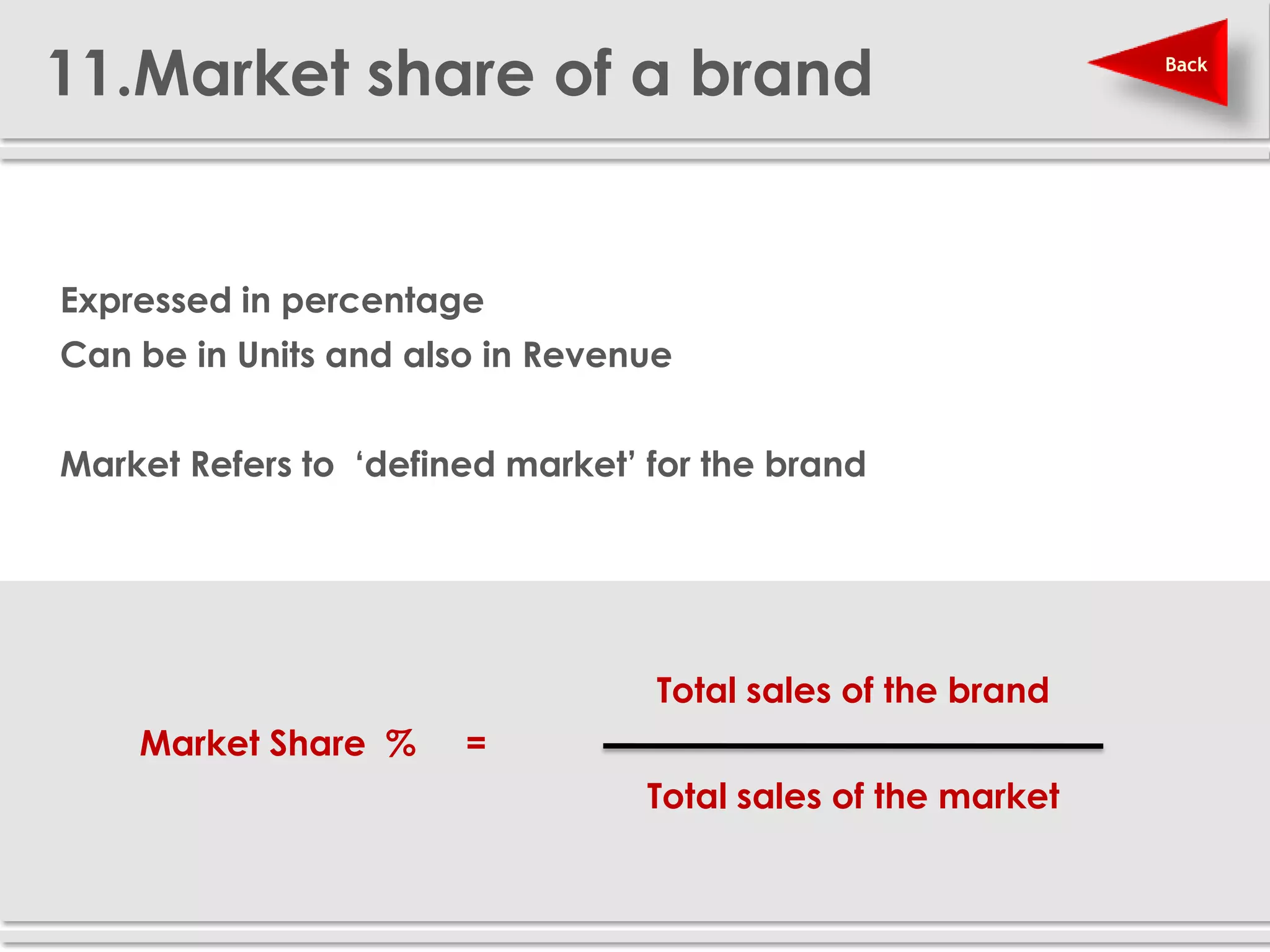
11.Market share of a brand                                     Back


 Expressed in percentage
 Can be in Units and also in Revenue


 Market Refers to ‘defined market’ for the brand


                                    Total sales of the brand
       Market Share %    =
                                    Total sales of the market
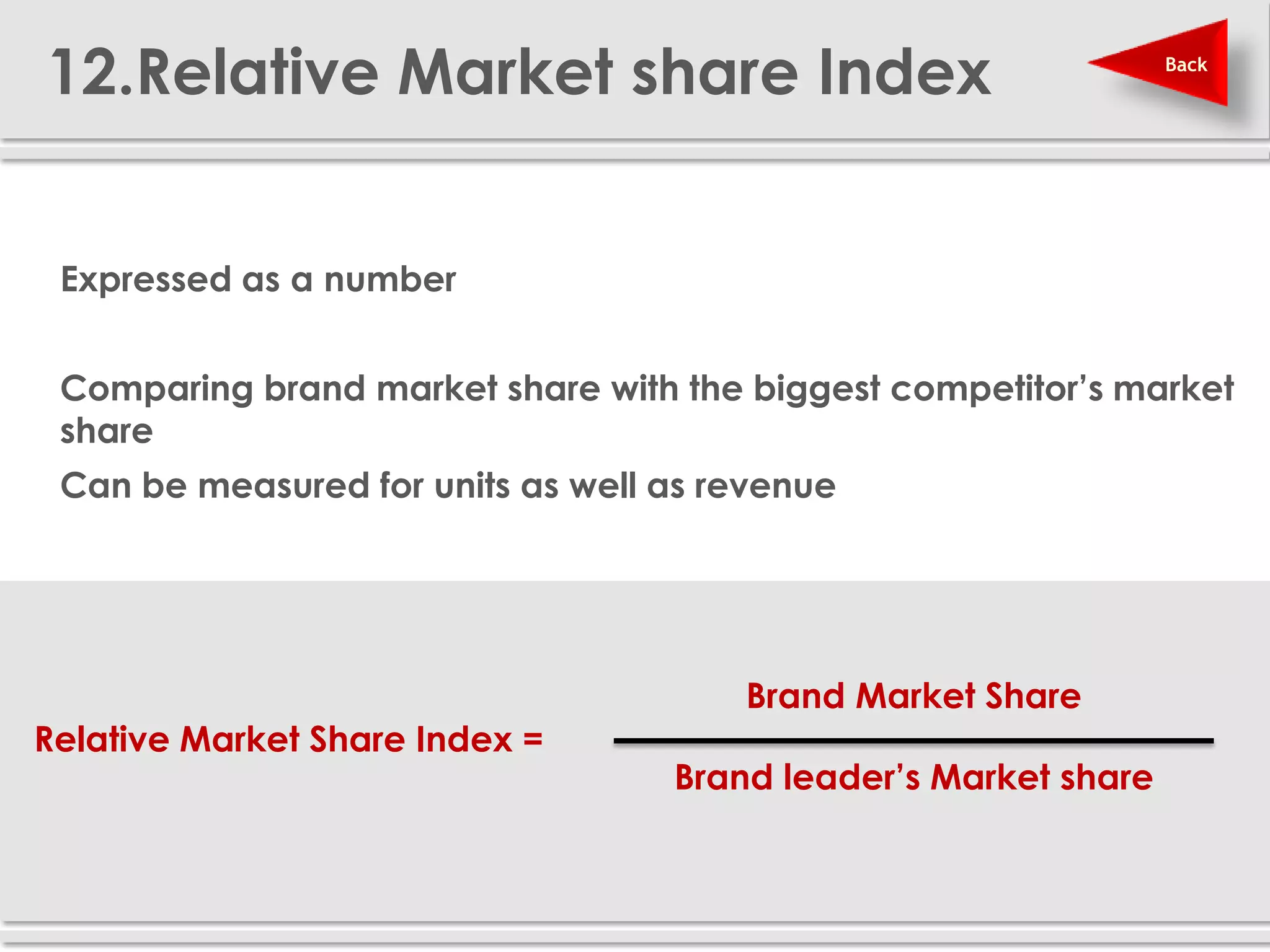
12.Relative Market share Index                                   Back


 Expressed as a number


 Comparing brand market share with the biggest competitor’s market
  share
 Can be measured for units as well as revenue


                                        Brand Market Share
 Relative Market Share Index =
                                    Brand leader’s Market share
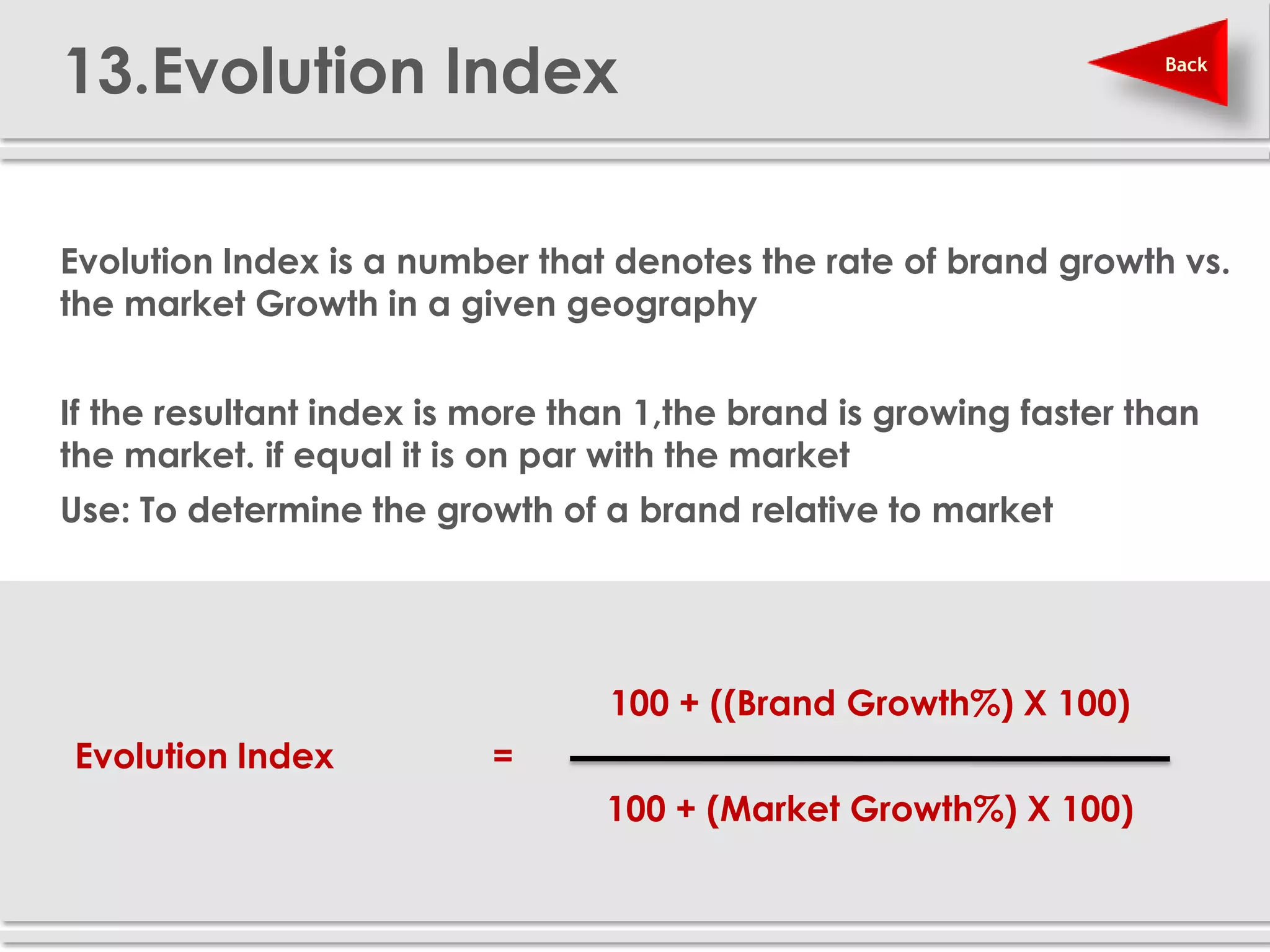
13.Evolution Index                                                 Back


 Evolution Index is a number that denotes the rate of brand growth vs.
  the market Growth in a given geography


 If the resultant index is more than 1,the brand is growing faster than
  the market. if equal it is on par with the market
 Use: To determine the growth of a brand relative to market


                                    100 + ((Brand Growth%) X 100)
   Evolution Index           =
                                    100 + (Market Growth%) X 100)
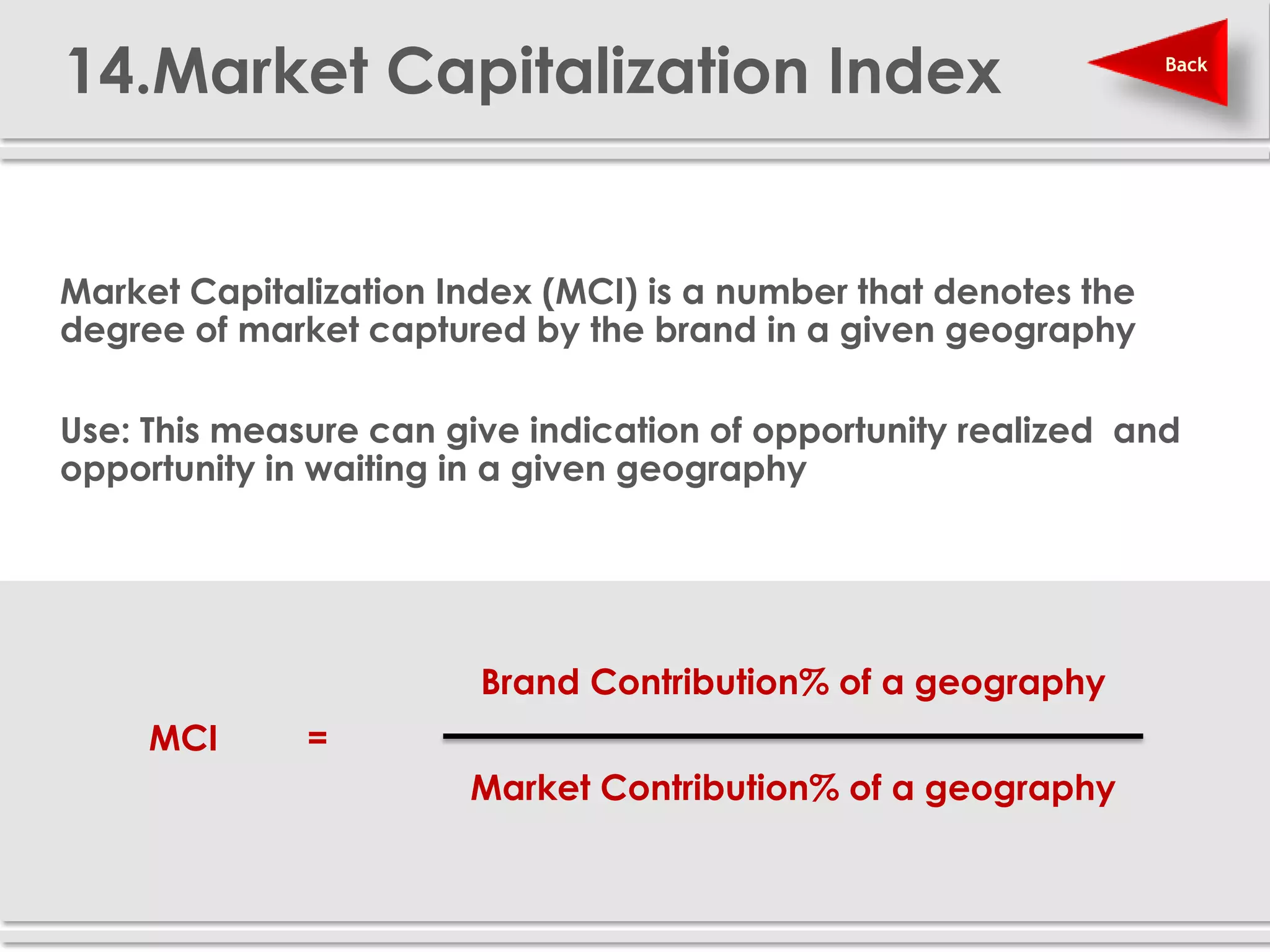
14.Market Capitalization Index                                   Back


 Market Capitalization Index (MCI) is a number that denotes the
  degree of market captured by the brand in a given geography

 Use: This measure can give indication of opportunity realized and
  opportunity in waiting in a given geography


                          Brand Contribution% of a geography
       MCI      =
                          Market Contribution% of a geography
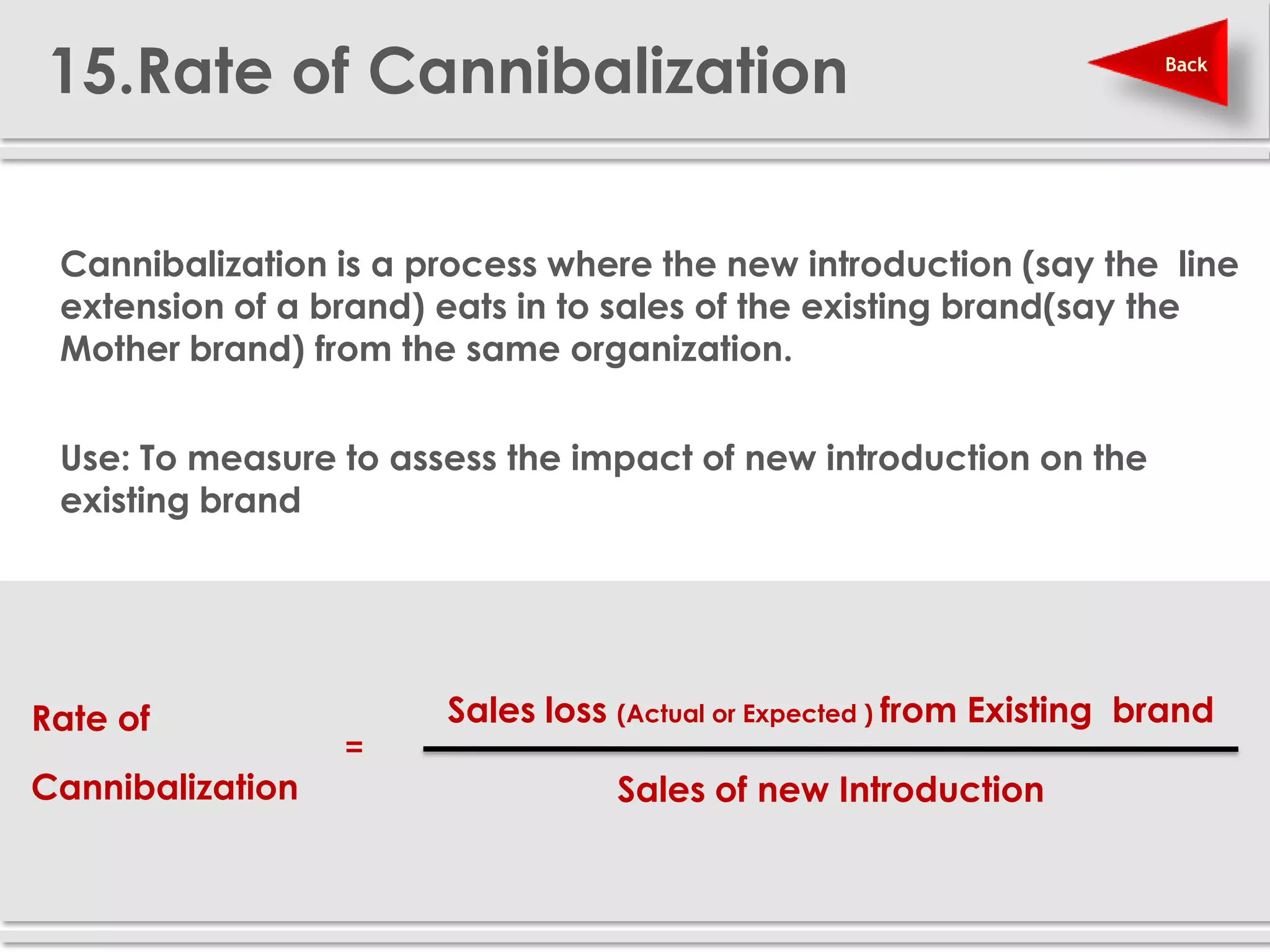
15.Rate of Cannibalization                                              Back


 Cannibalization is a process where the new introduction (say the line
  extension of a brand) eats in to sales of the existing brand(say the
  Mother brand) from the same organization.


 Use: To measure to assess the impact of new introduction on the
  existing brand


 Rate of                 Sales loss (Actual or Expected ) from Existing brand
                   =
 Cannibalization                    Sales of new Introduction
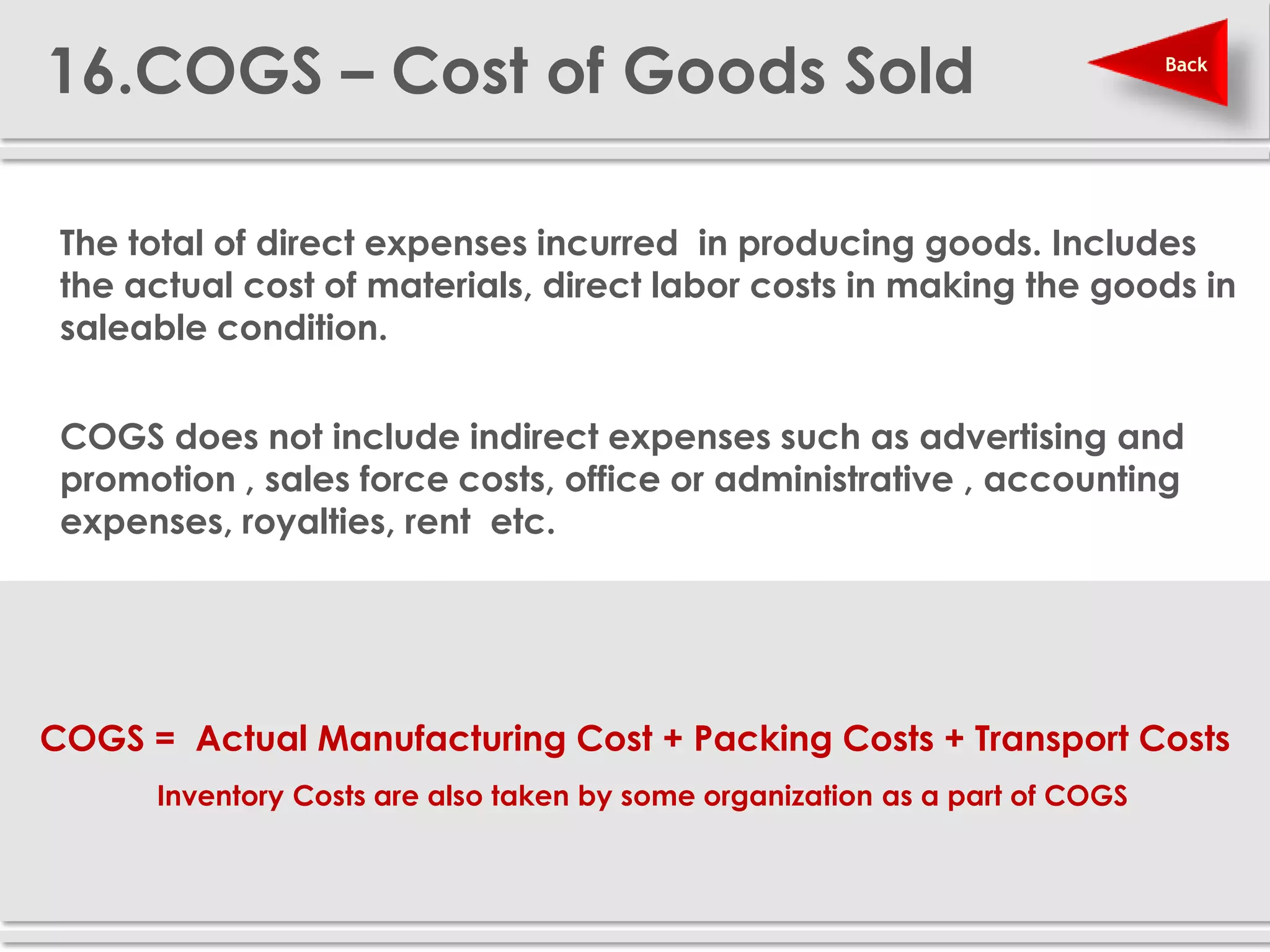
16.COGS – Cost of Goods Sold                                                  Back


 The total of direct expenses incurred in producing goods. Includes
  the actual cost of materials, direct labor costs in making the goods in
  saleable condition.

 COGS does not include indirect expenses such as advertising and
  promotion , sales force costs, office or administrative , accounting
  expenses, royalties, rent etc.


    COGS = Actual Manufacturing Cost + Packing Costs + Transport Costs
          Inventory Costs are also taken by some organization as a part of COGS
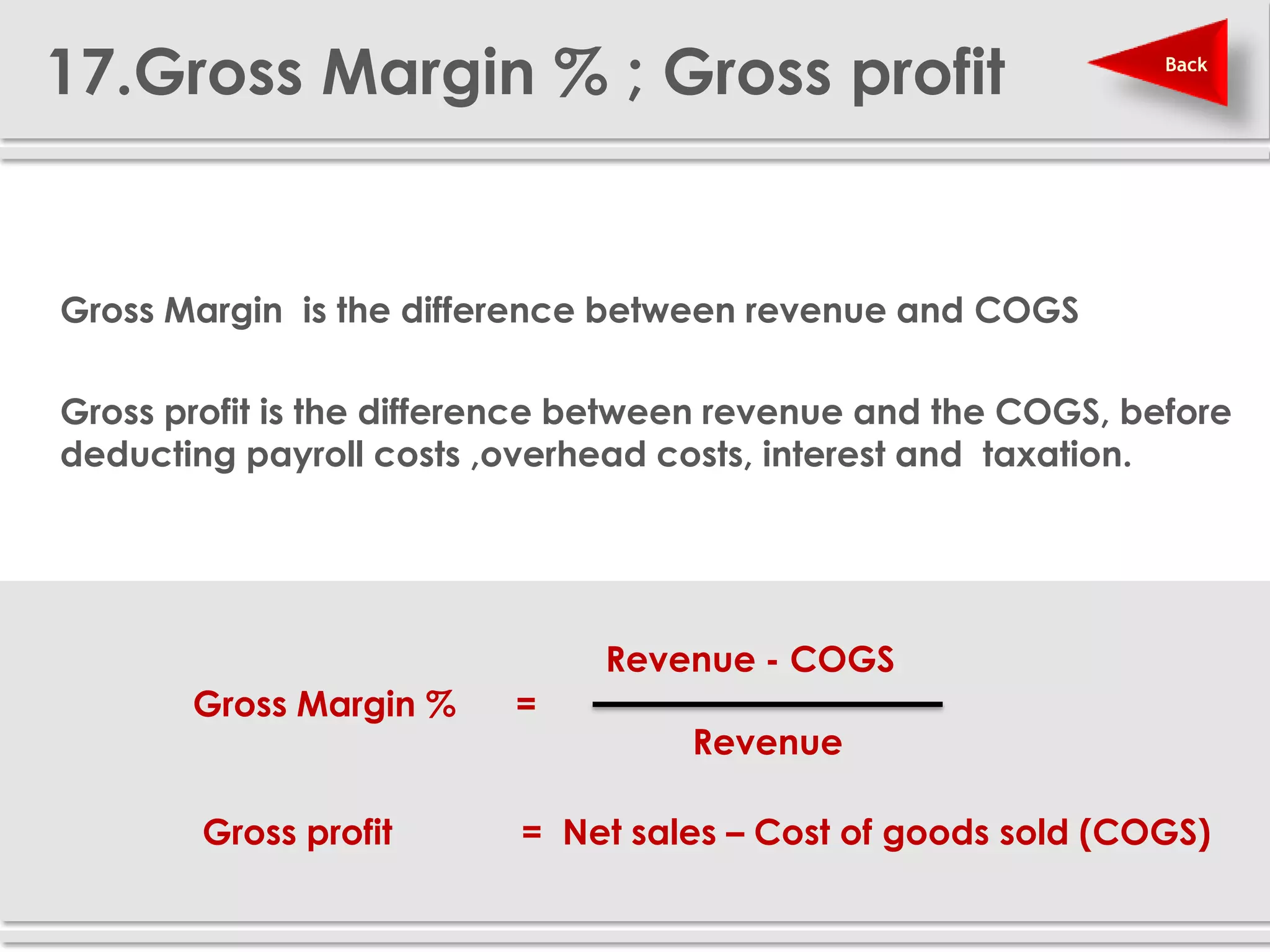
17.Gross Margin % ; Gross profit                                Back


 Gross Margin is the difference between revenue and COGS

 Gross profit is the difference between revenue and the COGS, before
  deducting payroll costs ,overhead costs, interest and taxation.


                                 Revenue - COGS
          Gross Margin %    =
                                      Revenue

          Gross profit      = Net sales – Cost of goods sold (COGS)
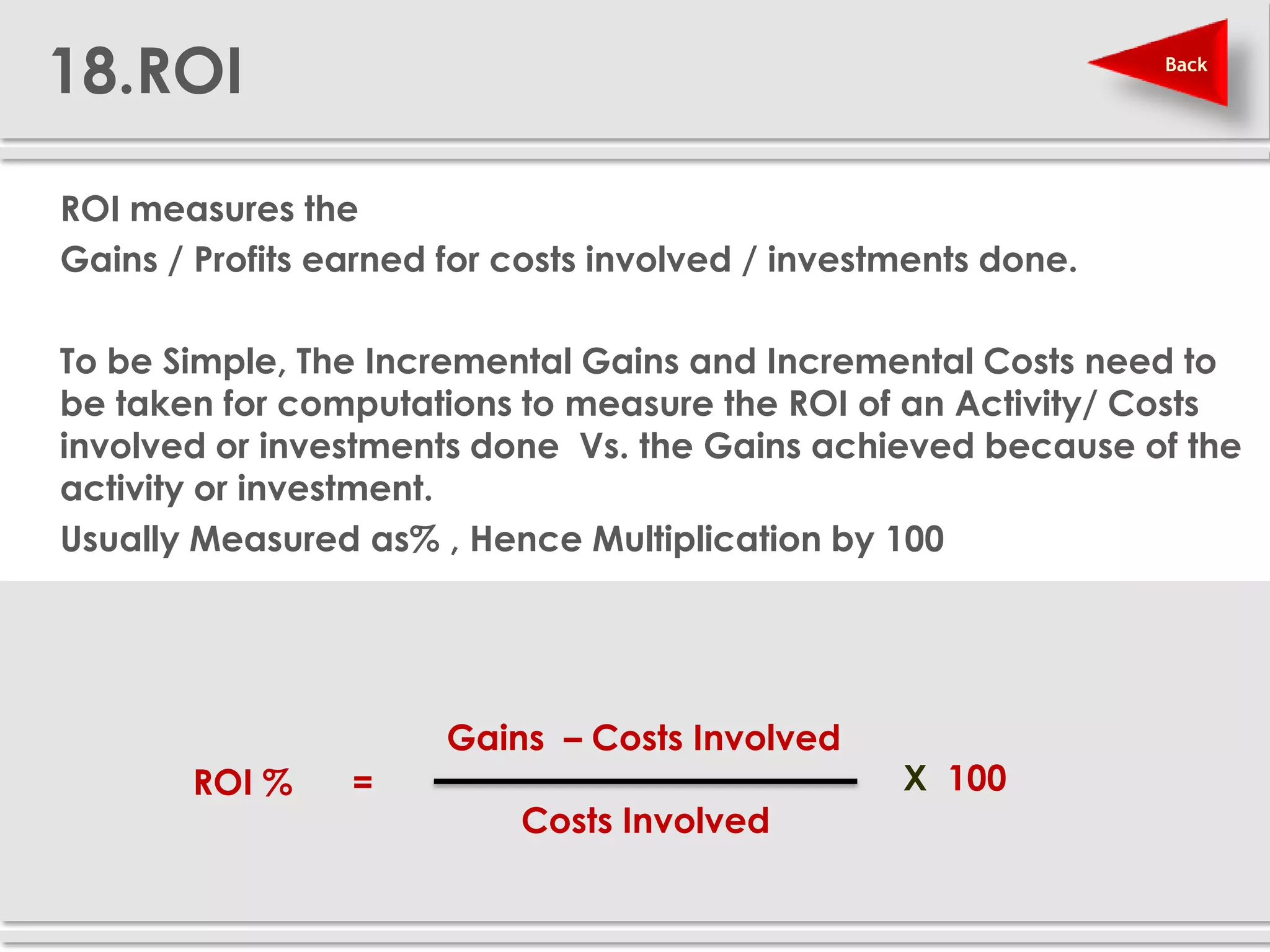
18.ROI                                                          Back


 ROI measures the
 Gains / Profits earned for costs involved / investments done.

 To be Simple, The Incremental Gains and Incremental Costs need to
  be taken for computations to measure the ROI of an Activity/ Costs
  involved or investments done Vs. the Gains achieved because of the
  activity or investment.
 Usually Measured as% , Hence Multiplication by 100


                         Gains – Costs Involved
          ROI %     =                               X 100
                              Costs Involved
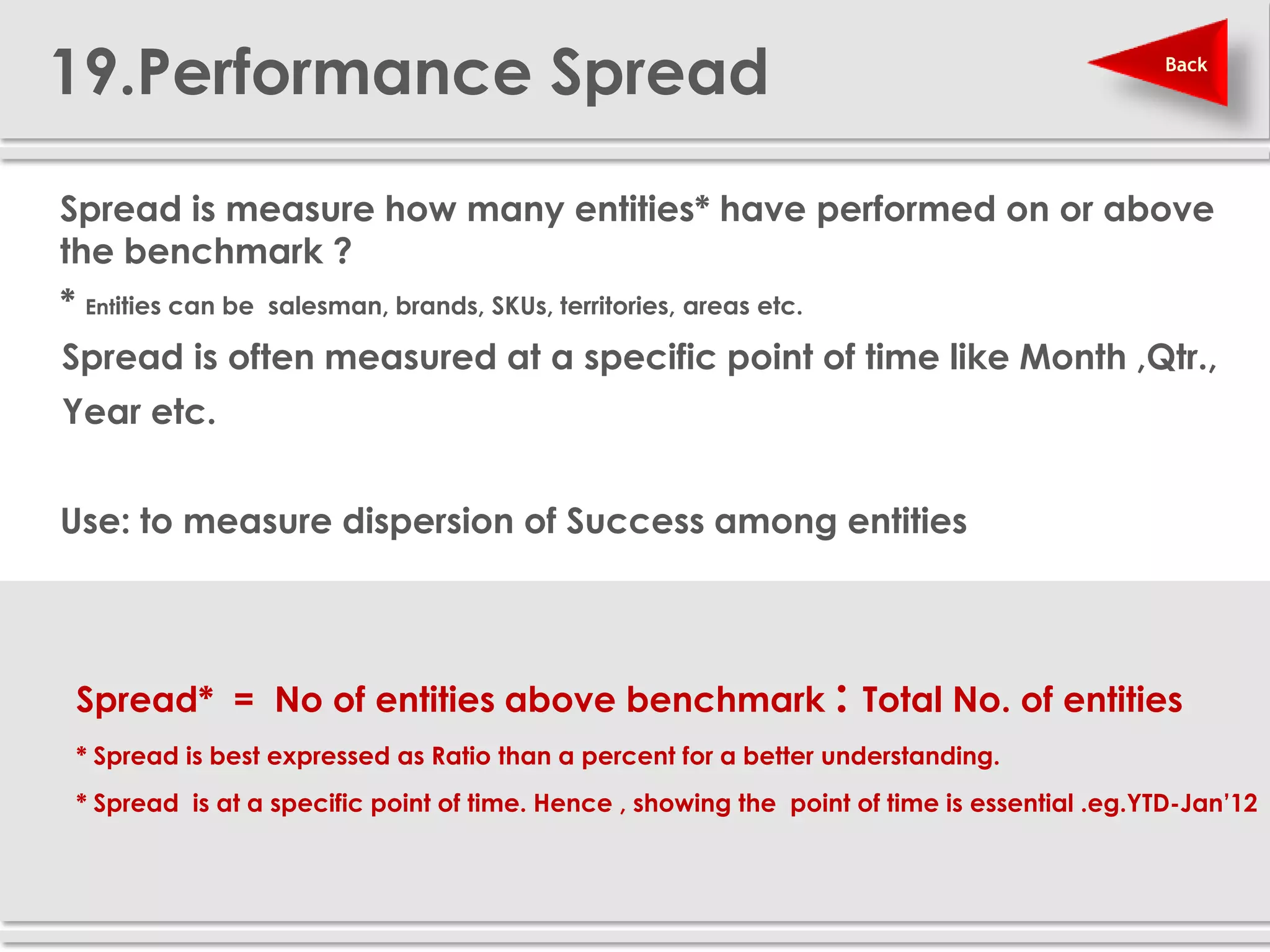
19.Performance Spread                                                                           Back


 Spread is measure how many entities* have performed on or above
  the benchmark ?
  * Entities can be salesman, brands, SKUs, territories, areas etc.
  Spread is often measured at a specific point of time like Month ,Qtr.,
  Year etc.


 Use: to measure dispersion of Success among entities


   Spread* = No of entities above benchmark : Total No. of entities
   * Spread is best expressed as Ratio than a percent for a better understanding.
   * Spread is at a specific point of time. Hence , showing the point of time is essential .eg.YTD-Jan’12
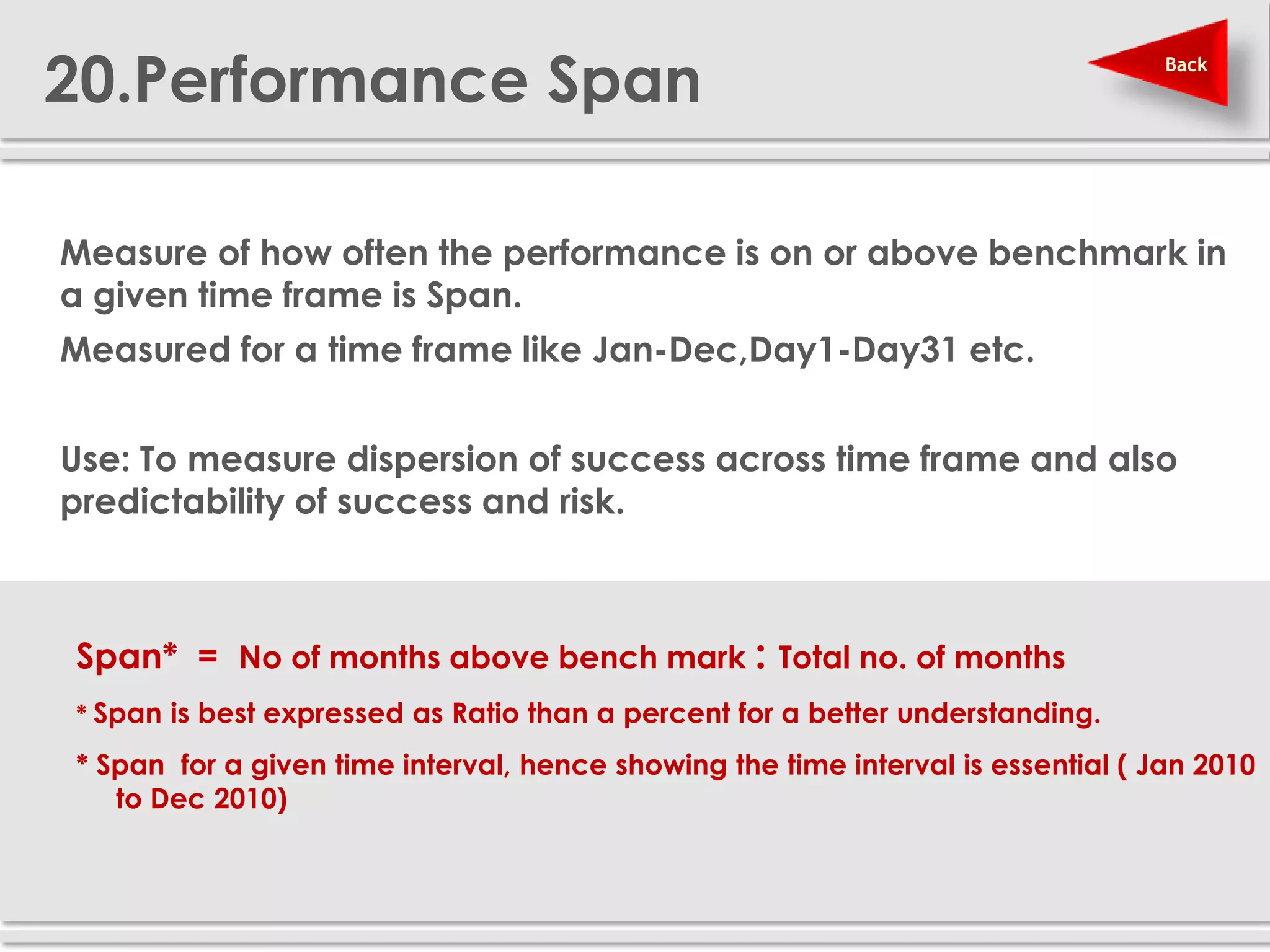
20.Performance Span                                                                 Back


 Measure of how often the performance is on or above benchmark in
  a given time frame is Span.
 Measured for a time frame like Jan-Dec,Day1-Day31 etc.


 Use: To measure dispersion of success across time frame and also
  predictability of success and risk.


   Span* = No of months above bench mark : Total no. of months
   * Span is best expressed as Ratio than a percent for a better understanding.

   * Span for a given time interval, hence showing the time interval is essential ( Jan 2010
      to Dec 2010)
20 Vital Sales and Marketing Metrics

20 Vital Sales and Marketing Metrics

  • 1.
    Vital Sales &Marketing Metrics
  • 2.
    Read me.. Today,we have abundant data, better information, fair knowledge and poor insight. Encountering wisdom is a rare occurrence! The data is out there on our spreadsheets, databases and hard disks. Here are 20 simple effective metrics for a Sales /Brand manager. It is not all these metrics, probably an ideal combination of one or two of these metrics for a given business problem can show a direction - The right direction. The wisdom is finding out the combination. I leave the choice to you. Lastly, as some one aptly puts it, A collection of data is not information. A collection of information is not knowledge. A collection of knowledge is not wisdom. A collection of wisdom is not truth.
  • 3.
    Metric  A metric is a system of related measures that facilitates the quantification of some particular characteristic  Remember ,  What gets measured , gets done.  If you cannot measure it, You cannot manage it
  • 4.
    Few definitions inbrief Segment and Category makes a Market  Segment : People with similar needs  Made up of people or organizations sharing one or more characteristics that cause them to demand similar product and/or services  Category : Inter changeable brands or service A category is a group or set of things that have similar characteristics. Similar and competing products (or services) all fall into the same brand category.
  • 5.
    Metrics at aglance Target achievement Incremental and Growth CAGR Market Share Per capita per month Relative Market share Contribution percent Evolution Index Incremental contribution Market capitalization Index Contribution Index Rate of Cannibalization YTD COGS MAT Gross Margin and Profit Simple Moving Average ROI Performance Spread Performance Span
  • 6.
    1.Target achievement Back Achievement vs. the Target This can be measured at a specific time interval like Month, Quarter, Half-Yearly, Yearly, YTD (Year to date) etc. Use: To measure sales success Total sales for the period Target achievement = Total Target for the period
  • 7.
    2.Incremental and Growth Back Incremental: Absolute incremental in revenue compared to last period ( Month, Qtr. , Year etc.) Growth : Incremental as a percent to last period’s revenue is growth. Use: Measure the health of a brand or a organization Vs. Market competition This year sales – Last year sales Growth = Last year sales
  • 8.
    3.CAGR (Compounded AnnualGrowth Rate) Back  CAGR the year-over-year average growth rate over a specified period of time.  It is best explained if you understand what is not CAGR!  Suppose you have started your sales with Rs.100 in 1st year and ended up with Rs.364.65 in 4th year. You have grown at 70%,50%,30% and 10% respectively in 4 Years. If some one asks you on an average what is the growth per year, it is not the average of 70+50+30+10 divided by 4 = 40%.  This is where CAGR is used. You will find it as ~ 38.1876%. 1 No. Yrs* End Sales CAGR = - 1 Start Sales * No of years In between Start year and End year
  • 9.
    4.Per Capita PerMonth Back  This is to measure average sales by each sales man per month  Use: This gives a quantum of sales contribution per salesman. Can be used to compare productivity Average sales per month PCPM = Number of Salesmen
  • 10.
    5.Contribution Percent Back  This is to measure the percent of contribution from each entity like salesman / Territory/ Brand to the total sale.  Use: To measure the degree of dependence on a brand / Territory /Salesman to the total sales Sale of the identified entity Contribution % = Total sales of all entities
  • 11.
    6.Incremental Contribution Back  This is to measure the percent of contribution from each salesman / Territory/ Brand to the total Incremental sale.  Use: To measure the degree of dependence on a brand / Territory /Salesman to the total Incremental sales / Revenue Incremental Sale of entity Incremental = Contribution Total Incremental sales of all entities
  • 12.
    7.Contribution Index Back  Is a number that denotes the number of times the average contribution of each entity like territory / Salesman and Brand sales  Use: To measure the relative contribution of each entity to the average. If it is more than 1, the Contribution is above the average of all, if equal it is on par else it is less than the average of all. Sale of the entity Contribution Index = Average sales of all entities
  • 13.
    8.YTD Back  YTD : Year to Date (Similarly QTD and MTD)  Revenue/Sales form the beginning of the year  E.g. On 31st March 2010 YTD sales means, sales from 1st Jan 2010 to 31st Mar 2010  Use : Measure the sales quantum at a specific point of time YTD Apr 2010 = Jan -10 + Feb-10 + Mar-10 + Apr-10 (sales) MTD – 4/Jun/2010 = 1-Jun + 2-Jun + 3-Jun + 4-Jun (sales)
  • 14.
    9.MAT Back  MAT : Moving Annual Total  Last 12 months Revenue/sales  E.g.: Feb 2009 to Jan 2010 sales are called MAT Jan 2010 Sales  Use: As it data is for the past 12 months, comparing two points of MAT data evens out the fluctuations MAT Jan-10 = Feb-09 + Mar-09 +……+ Dec-09 + Jan-10 MAT Jun-10 = Jul-09 + Aug-09 +……+ May-10 + Jun-10
  • 15.
    10.Simple Moving Average Back  Also called as rolling/running average, is a series of numbers  Commonly used with time series data to smooth out short-term fluctuations and highlight longer-term trends.  E.g.: Take the sales of the last 20 days, add them and divide the total by 20.  Next day, take last 20 days average, next day again last 20 days average.  The resultant series is a simple 20 day moving average. SMA of sales 1 day to 20 day sales average , 2 day to 21 day = sales average , 3 day to 22 day sales average , 4 (20 Days) day to 23 day sales average,………
  • 16.
    11.Market share ofa brand Back  Expressed in percentage  Can be in Units and also in Revenue  Market Refers to ‘defined market’ for the brand Total sales of the brand Market Share % = Total sales of the market
  • 17.
    12.Relative Market shareIndex Back  Expressed as a number  Comparing brand market share with the biggest competitor’s market share  Can be measured for units as well as revenue Brand Market Share Relative Market Share Index = Brand leader’s Market share
  • 18.
    13.Evolution Index Back  Evolution Index is a number that denotes the rate of brand growth vs. the market Growth in a given geography  If the resultant index is more than 1,the brand is growing faster than the market. if equal it is on par with the market  Use: To determine the growth of a brand relative to market 100 + ((Brand Growth%) X 100) Evolution Index = 100 + (Market Growth%) X 100)
  • 19.
    14.Market Capitalization Index Back  Market Capitalization Index (MCI) is a number that denotes the degree of market captured by the brand in a given geography  Use: This measure can give indication of opportunity realized and opportunity in waiting in a given geography Brand Contribution% of a geography MCI = Market Contribution% of a geography
  • 20.
    15.Rate of Cannibalization Back  Cannibalization is a process where the new introduction (say the line extension of a brand) eats in to sales of the existing brand(say the Mother brand) from the same organization.  Use: To measure to assess the impact of new introduction on the existing brand Rate of Sales loss (Actual or Expected ) from Existing brand = Cannibalization Sales of new Introduction
  • 21.
    16.COGS – Costof Goods Sold Back  The total of direct expenses incurred in producing goods. Includes the actual cost of materials, direct labor costs in making the goods in saleable condition.   COGS does not include indirect expenses such as advertising and promotion , sales force costs, office or administrative , accounting expenses, royalties, rent etc. COGS = Actual Manufacturing Cost + Packing Costs + Transport Costs Inventory Costs are also taken by some organization as a part of COGS
  • 22.
    17.Gross Margin %; Gross profit Back  Gross Margin is the difference between revenue and COGS  Gross profit is the difference between revenue and the COGS, before deducting payroll costs ,overhead costs, interest and taxation. Revenue - COGS Gross Margin % = Revenue Gross profit = Net sales – Cost of goods sold (COGS)
  • 23.
    18.ROI Back  ROI measures the  Gains / Profits earned for costs involved / investments done.  To be Simple, The Incremental Gains and Incremental Costs need to be taken for computations to measure the ROI of an Activity/ Costs involved or investments done Vs. the Gains achieved because of the activity or investment.  Usually Measured as% , Hence Multiplication by 100 Gains – Costs Involved ROI % = X 100 Costs Involved
  • 24.
    19.Performance Spread Back  Spread is measure how many entities* have performed on or above the benchmark ? * Entities can be salesman, brands, SKUs, territories, areas etc. Spread is often measured at a specific point of time like Month ,Qtr., Year etc.  Use: to measure dispersion of Success among entities Spread* = No of entities above benchmark : Total No. of entities * Spread is best expressed as Ratio than a percent for a better understanding. * Spread is at a specific point of time. Hence , showing the point of time is essential .eg.YTD-Jan’12
  • 25.
    20.Performance Span Back  Measure of how often the performance is on or above benchmark in a given time frame is Span.  Measured for a time frame like Jan-Dec,Day1-Day31 etc.  Use: To measure dispersion of success across time frame and also predictability of success and risk. Span* = No of months above bench mark : Total no. of months * Span is best expressed as Ratio than a percent for a better understanding. * Span for a given time interval, hence showing the time interval is essential ( Jan 2010 to Dec 2010)