P1TOPIC 1 -VISIBLE LIGHT ANDTHE SOLAR SYSTEM
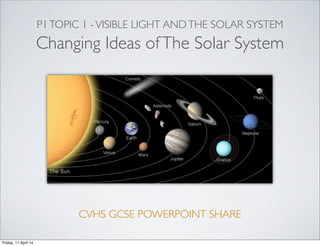
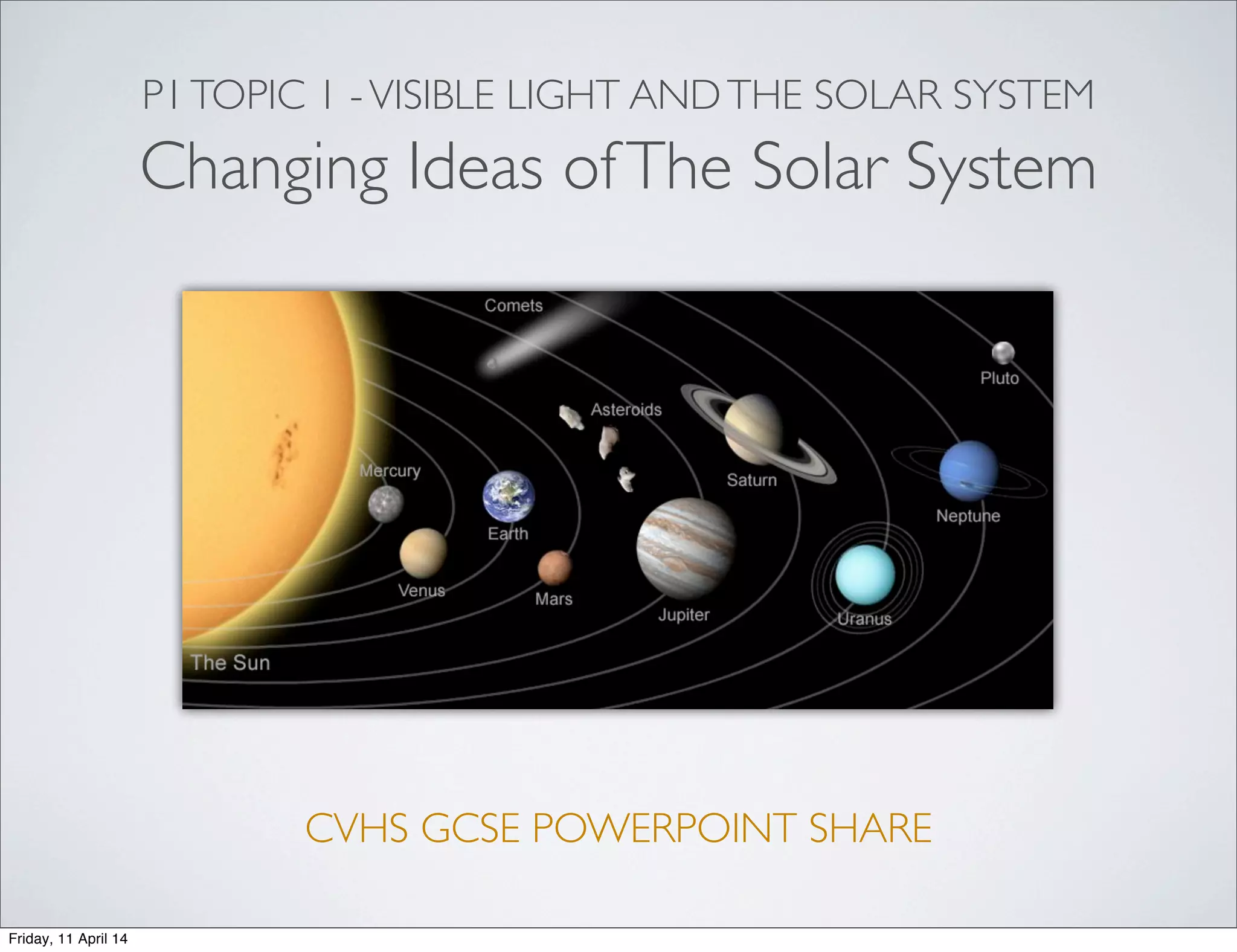
Changing Ideas ofThe Solar System
CVHS GCSE POWERPOINT SHARE
Friday, 11 April 14
Geocentric Model
Ancient Greek astronomers believed that the earth was at
the centre of the universe.
They believed that everything (sun, moon, planets and
stars) all orbited the earth in perfect circles.
The geocentric model was accepted up until the 1500s.
Copernicus published a book in
1543, which introduced the
Heliocentric model of the universe.
Friday, 11 April 14
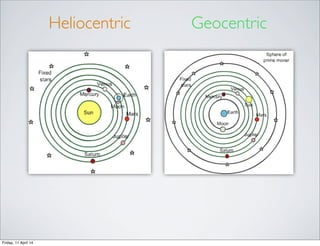
Heliocentric Geocentric
Friday, 11 April 14
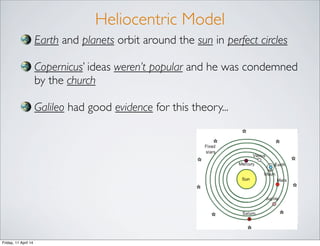
Heliocentric Model
Earth and planets orbit around the sun in perfect circles
Copernicus’ ideas weren’t popular and he was condemned
by the church
Galileo had good evidence for this theory...
Friday, 11 April 14
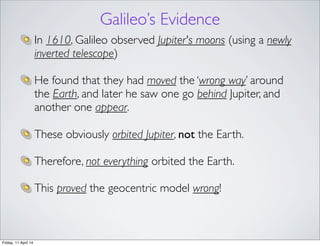
Galileo’s Evidence
In 1610, Galileo observed Jupiter's moons (using a newly
inverted telescope)
He found that they had moved the ‘wrong way’ around
the Earth, and later he saw one go behind Jupiter, and
another one appear.
These obviously orbited Jupiter, not the Earth.
Therefore, not everything orbited the Earth.
This proved the geocentric model wrong!
Friday, 11 April 14
Questions
When was the Heliocentric model first introduced, and
by who? (2)
Describe the geocentric model of the universe (3)
Compare the differences of the Geocentric and
Heliocentric models of the universe (2)
Friday, 11 April 14
Modern Day
Planets orbit the sun.
Elliptical orbits, rather than perfectly circular.
Discovery of new planets, such as uranus, with the
technology advances in telescopes.
Friday, 11 April 14
Questions
What do we know about orbits in the modern day (2)
Explain how ideas about the solar system have changed
from the time of the ancient greeks up until the modern
day (6)
Friday, 11 April 14

P1 topic 1 - Changing Ideas About The Solar System

  • 1.
    P1TOPIC 1 -VISIBLELIGHT ANDTHE SOLAR SYSTEM Changing Ideas ofThe Solar System CVHS GCSE POWERPOINT SHARE Friday, 11 April 14
  • 2.
    Geocentric Model Ancient Greekastronomers believed that the earth was at the centre of the universe. They believed that everything (sun, moon, planets and stars) all orbited the earth in perfect circles. The geocentric model was accepted up until the 1500s. Copernicus published a book in 1543, which introduced the Heliocentric model of the universe. Friday, 11 April 14
  • 3.
  • 4.
    Heliocentric Model Earth andplanets orbit around the sun in perfect circles Copernicus’ ideas weren’t popular and he was condemned by the church Galileo had good evidence for this theory... Friday, 11 April 14
  • 5.
    Galileo’s Evidence In 1610,Galileo observed Jupiter's moons (using a newly inverted telescope) He found that they had moved the ‘wrong way’ around the Earth, and later he saw one go behind Jupiter, and another one appear. These obviously orbited Jupiter, not the Earth. Therefore, not everything orbited the Earth. This proved the geocentric model wrong! Friday, 11 April 14
  • 6.
    Questions When was theHeliocentric model first introduced, and by who? (2) Describe the geocentric model of the universe (3) Compare the differences of the Geocentric and Heliocentric models of the universe (2) Friday, 11 April 14
  • 7.
    Modern Day Planets orbitthe sun. Elliptical orbits, rather than perfectly circular. Discovery of new planets, such as uranus, with the technology advances in telescopes. Friday, 11 April 14
  • 8.
    Questions What do weknow about orbits in the modern day (2) Explain how ideas about the solar system have changed from the time of the ancient greeks up until the modern day (6) Friday, 11 April 14