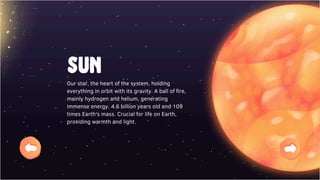
Sun
Our star, theheart of the system, holding
everything in orbit with its gravity. A ball of fire,
mainly hydrogen and helium, generating
immense energy. 4.6 billion years old and 109
times Earth's mass. Crucial for life on Earth,
providing warmth and light.
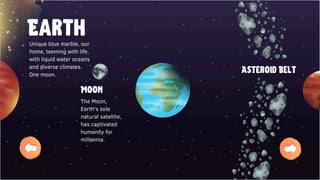
Earth
Moon
Asteroid Belt
Unique bluemarble, our
home, teeming with life,
with liquid water oceans
and diverse climates.
One moon.
The Moon,
Earth's sole
natural satellite,
has captivated
humanity for
millennia.
6.
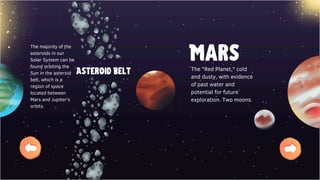
Mars
The "Red Planet,"cold
and dusty, with evidence
of past water and
potential for future
exploration. Two moons.
The majority of the
asteroids in our
Solar System can be
found orbiting the
Sun in the asteroid
belt, which is a
region of space
located between
Mars and Jupiter's
orbits.
Asteroid Belt
7.
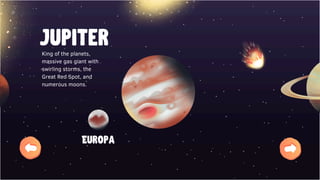
Jupıter
Europa
King of theplanets,
massive gas giant with
swirling storms, the
Great Red Spot, and
numerous moons.
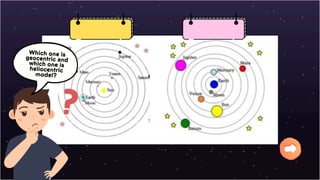
GEOCENTRIC
MODEL
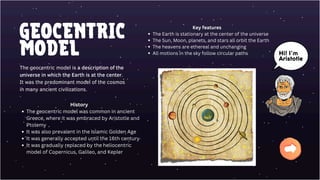
The geocentric modelis a description of the
universe in which the Earth is at the center.
It was the predominant model of the cosmos
in many ancient civilizations.
Key features
The Earth is stationary at the center of the universe
The Sun, Moon, planets, and stars all orbit the Earth
The heavens are ethereal and unchanging
All motions in the sky follow circular paths
History
The geocentric model was common in ancient
Greece, where it was embraced by Aristotle and
Ptolemy
It was also prevalent in the Islamic Golden Age
It was generally accepted until the 16th century
It was gradually replaced by the heliocentric
model of Copernicus, Galileo, and Kepler
Hi! I’m
Aristotle
12.
helioCENTRIC
MODEL
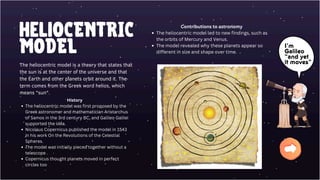
The heliocentric modelis a theory that states that
the sun is at the center of the universe and that
the Earth and other planets orbit around it. The
term comes from the Greek word helios, which
means "sun".
Contributions to astronomy
The heliocentric model led to new findings, such as
the orbits of Mercury and Venus.
The model revealed why these planets appear so
different in size and shape over time.
History
The heliocentric model was first proposed by the
Greek astronomer and mathematician Aristarchus
of Samos in the 3rd century BC, and Galileo Galilei
supported the idea.
Nicolaus Copernicus published the model in 1543
in his work On the Revolutions of the Celestial
Spheres.
The model was initially pieced together without a
telescope .
Copernicus thought planets moved in perfect
circles too
I’m
Galileo
“and yet
it moves”