Singapore
Katerina Karpova
Thomas Volpe
Nicole Sireci
Jessica Bascone
Rich Guido
Description of Organization
• History
• Created in 1993
• CEO Steve Ellis
• Established in Colorado
• Early Growth
• 16 Locations within 5
years
• 1,600 Locations within 20
years
• $350 Million in
investments by 1998
• Current Situation
• 17 Franchise Locations
• Forecasted 11-125 Growth Rate
• Current revenue- 4.1$ Billion
Strategic Goals and Objectives
● Receiving approval from the Singaporean government
● Finding a strong partner in Singapore
● Maintaining a unique all-American image
● Promoting the brand online as a fast-casual, exotic
venue
● Improving Chipotle revenues by 15%
Company Analysis
• Product Line:
• Fresh, organic, customizable food
• Emphasis on locally grown
• Burritos, tacos, salads, bloody
mary’s
• Current Operations:
• Food with integrity at a cheap
price
• Fast-casual pioneer
• Managerial know-how from
McDonald’s
• Few foreign locations (Canada,
UK)
Legal and Political
● Very stable political system
● Current President: Tony Tan Keng Yam (2011-
Present)
○Serves for 6 years, elected by the people
○The president and parliament make up the
legislature
○Second to the prime minister
● Current Prime Minister: Lee Hsien Loong (2004-
Present)
● Political Party: People’s Action Party (PAP)
Legal and Political Cont’
● Reinforces a strong power distance
● Masquerades as a democratic republic
● PM Lee Hsien Loong took over after his father
○ Policies:
● Regional economic integration
● Signing free trade agreements
● Eradicate “overprotective nanny-state” image
● Enhance freedom of expression
● Growing discontent among segments of the electorate
Cultural Analysis
(Cultural Elements)
Geert Hofstede’s Dimensions:
● Power Distance:
○ Very High
● Individualism:
○ Very Low
● Masculinity:
○ Middle Ground
● Uncertainty Avoidance:
○ Very Low
● Long-Term Orientation:
○ Very High
Norms & Ethical Considerations
Corporate Norms:
● Be punctual
● Dress modestly
● Avoid being excessively emotional, raising your voice, or showing anger in public
● Do not eat with your left hand
● Understand different food customs
● In public:
○ No smoking
○ Recreational drug use
○ Chewing gum
○ Jay Walking
○ Littering
● Avoid discussing religion or politics
● Only ethical issue: insider trading
Commercial Analysis
Market Analysis:
● American food is trendy
● Several American chains have major success
○ McDonald’s, KFC, Tony Roma’s
● Promotions are key
○ Despicable Me, Hello Kitty
● Superior distribution sets business apart, not concept
● To succeed:
○ Maintain American image
○ Attain local partner
○ Take advantage of distribution expertise
○ Offer a promotion
Industry Analysis
● Singapore’s economy is slowing down
● Food service remains stable in growth
● High competition
● Strong food culture
● Chained food service expected to see an
upswing
● Outlet expansion provides opportunity
● Growing access to social media access
Competitive Analysis
● Singapore’s population continues to go up
● Fast food isn’t growing as quickly as fast casual
● Average consumer has more disposable income ($)
● Food industry is extremely competitive
○ Yet, there is more opportunity (outlet expansion)
● Chained outlets overpower individual sites
● Chipotle stands out from the rest
● Not in direct competition with other fast-food outlets
Financial and Economic
● Number one country for ease of doing business
● Economic development fund offers financial assistance
○ Helps new entrepreneurs
● Both sectors have seen consistent growth since 1990
● Lack of government interference
● Consumers willing to try new things
○ Increased disposable income
● One of the “five dragons”
● Western-oriented
● Moving towards regional economic integration
● Forward-looking economic policies
Entry Mode: Foreign Direct Investment
● Locations serve as wholly owned subsidiaries
● Avoiding store locations becoming franchises
● Creating joint ventures with countries in the region
● Teaming up with suppliers who are familiar with the
area
Strategic Pattern
• Current Strategic Plans
• Natural Products
• High Quality Food
Sources
• Interactive Quiz
Questioning
• Consumer Targeting Tactics
• Incentivize Suppliers
• Referral Discounts
• “Discount Cards”
Organizational Structure
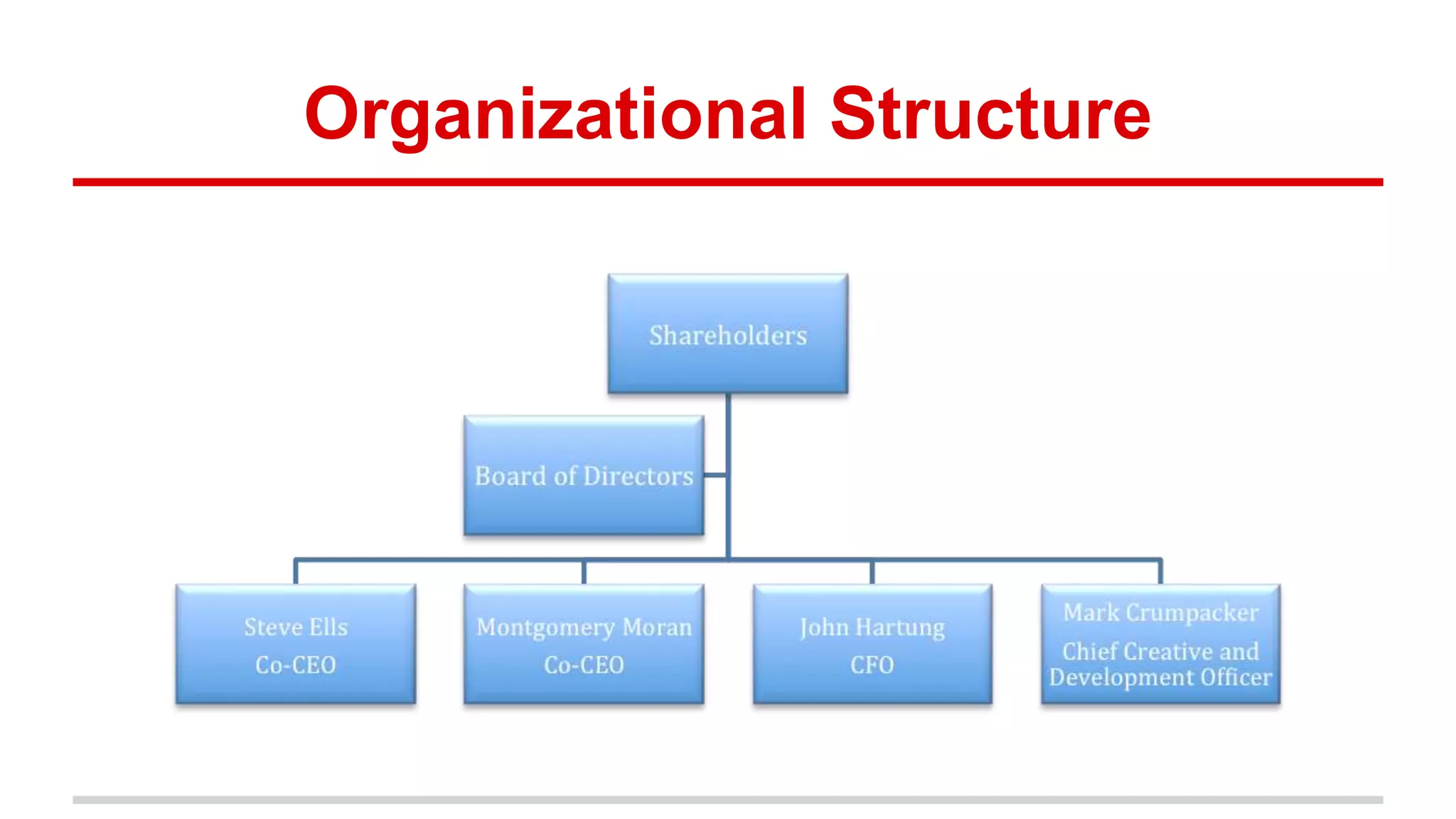
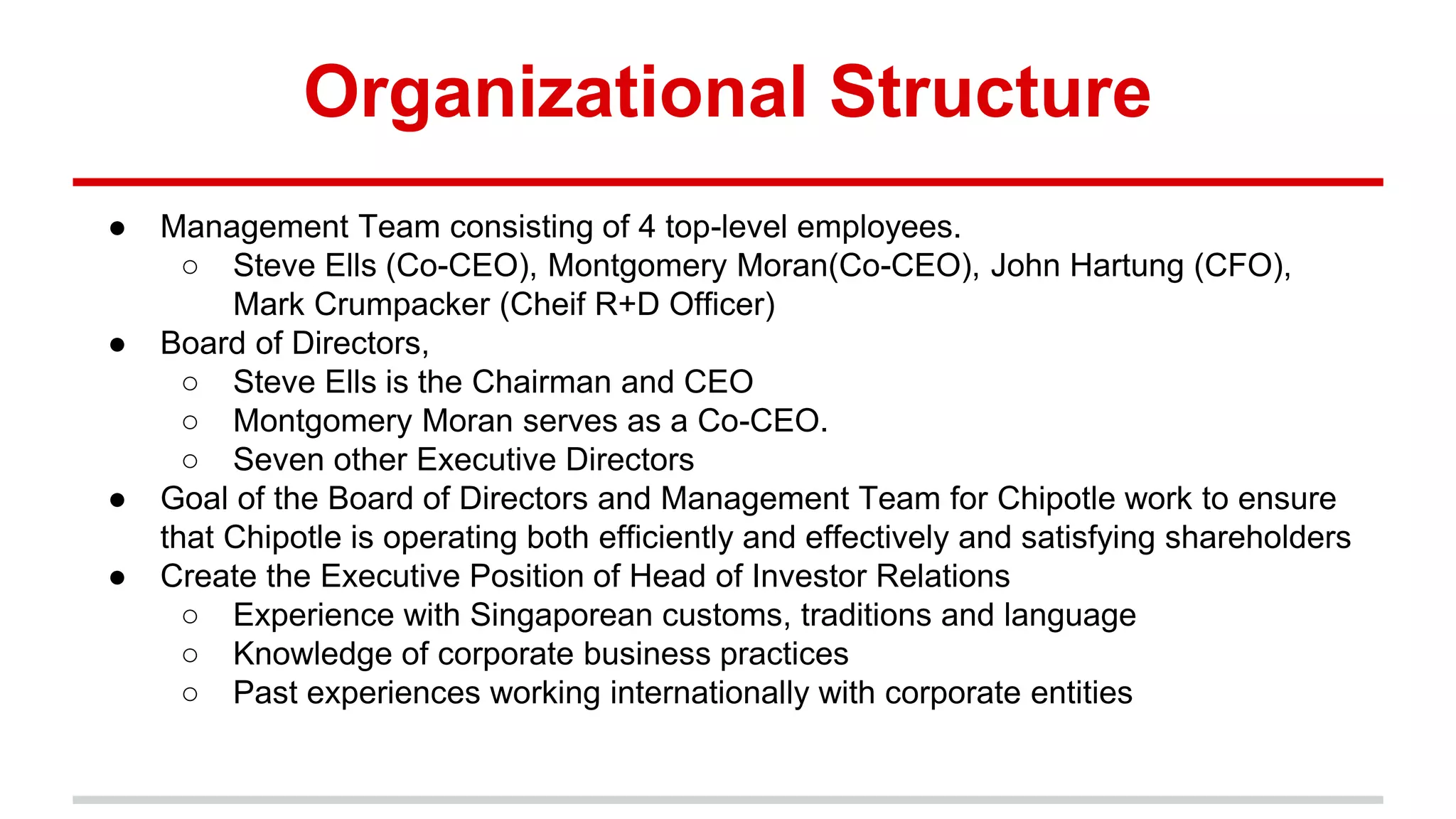
● Management Team consisting of 4 top-level employees.
○ Steve Ells (Co-CEO), Montgomery Moran(Co-CEO), John Hartung (CFO),
Mark Crumpacker (Cheif R+D Officer)
● Board of Directors,
○ Steve Ells is the Chairman and CEO
○ Montgomery Moran serves as a Co-CEO.
○ Seven other Executive Directors
● Goal of the Board of Directors and Management Team for Chipotle work to ensure
that Chipotle is operating both efficiently and effectively and satisfying shareholders
● Create the Executive Position of Head of Investor Relations
○ Experience with Singaporean customs, traditions and language
○ Knowledge of corporate business practices
○ Past experiences working internationally with corporate entities
Timeline
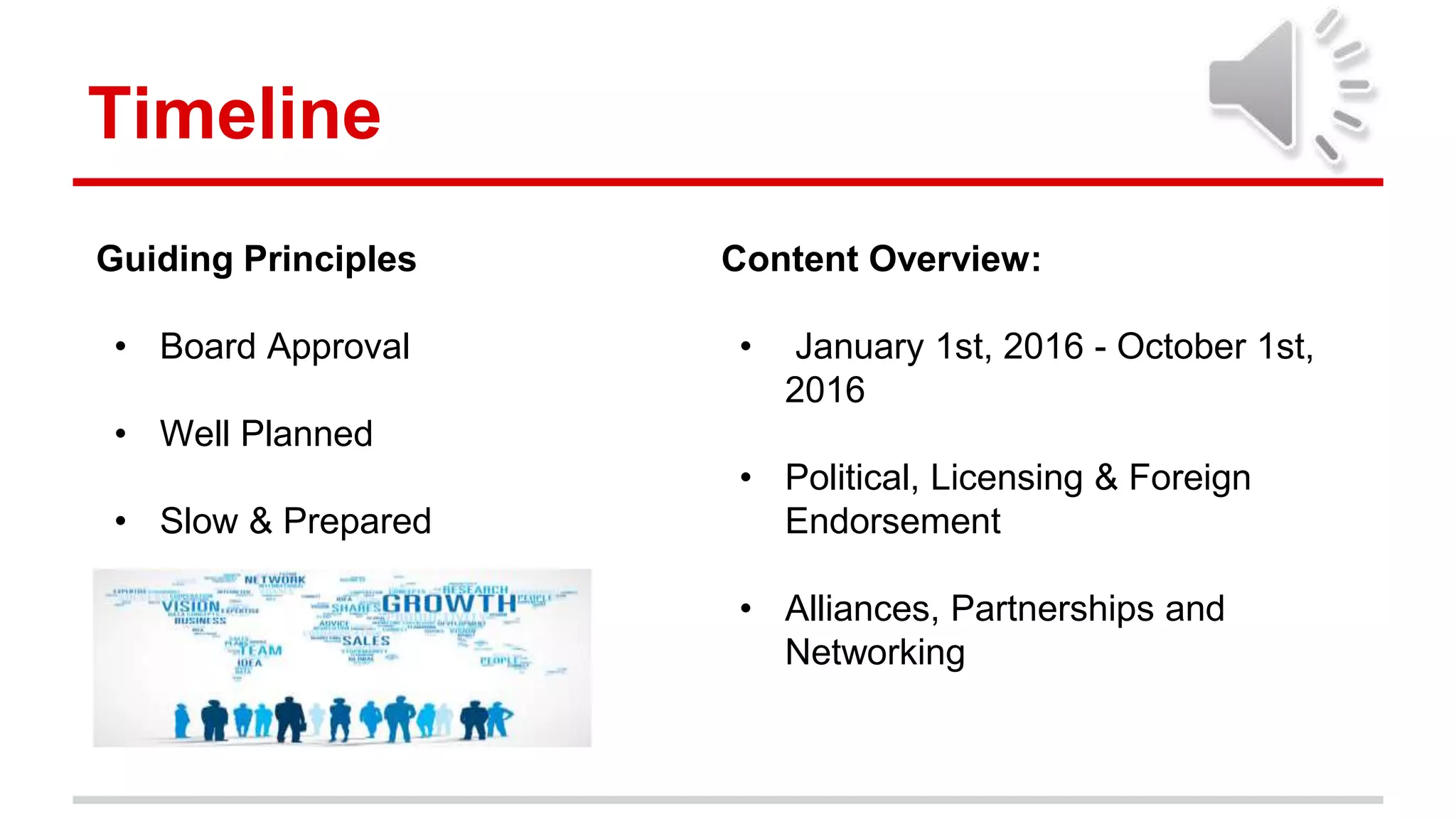
Guiding Principles
• Board Approval
• Well Planned
• Slow & Prepared
Content Overview:
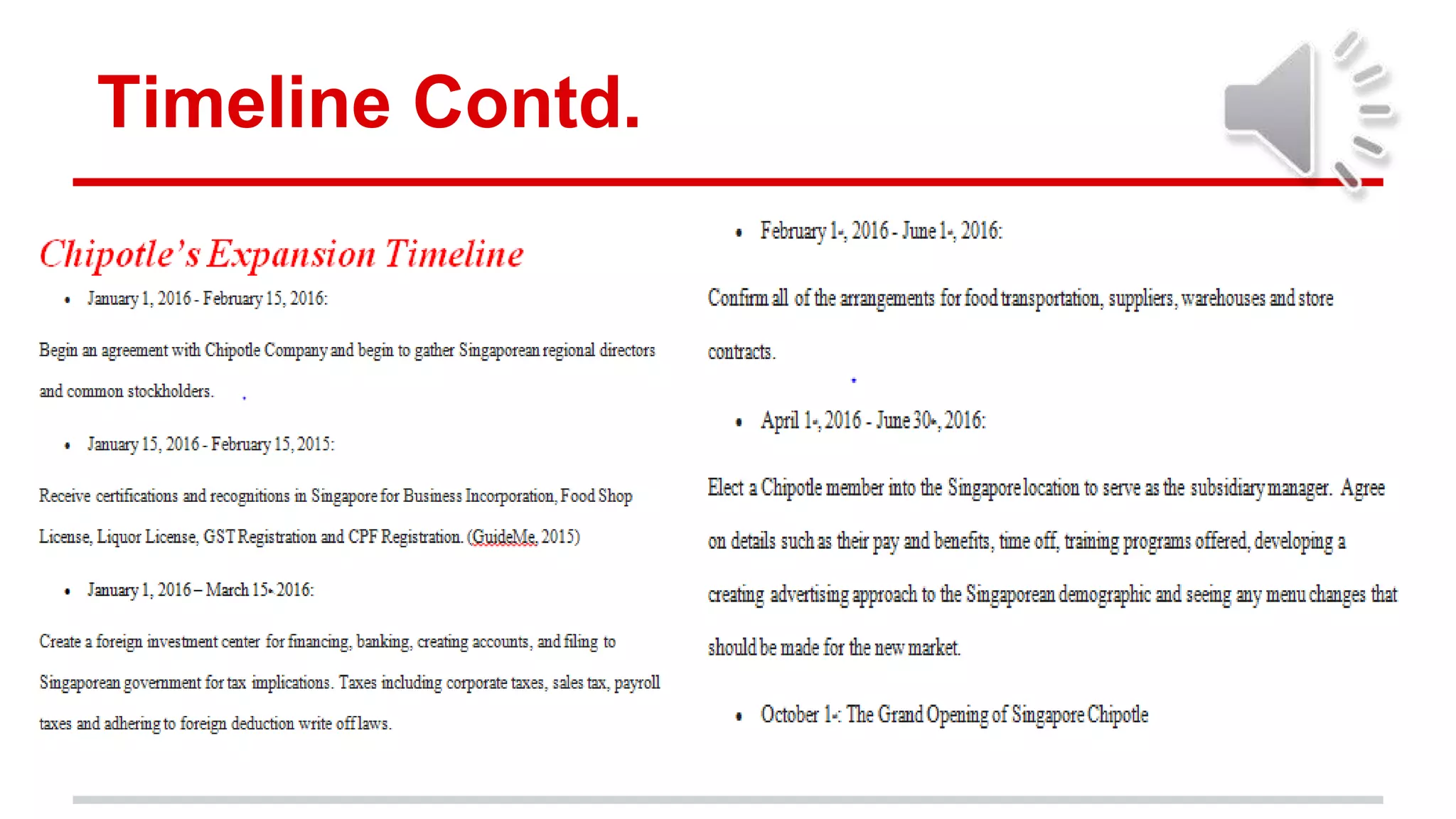
• January 1st, 2016 - October 1st,
2016
• Political, Licensing & Foreign
Endorsement
• Alliances, Partnerships and
Networking
Timeline Contd.
Financing
Financial Instruments:
• Cash & Short Term
Investments
• Debt Issuance
• Liquidity Insurance Plan
Cost Allocations & Budgeting:
• Small Store Locations
• Stable 10 yr Singapore Govt. Note
(2.48%)
• Low Credit Utilization
Human Resources System
Challenges:
• Consumer Norms &
Expectations
• Working Conditions &
Regulations
• Balancing Foreign & Domestic
Employees
Strategic Implementations:
• Hiring in advanced
Singaporean talent
• Diversifying workforce at all
layers of management
• Multinational Training:
• Ethics, Values & Morals
Marketing Approach
• TV Advertisements
• 33% of all commercials are for
food
• 38% “healthy” commercial
• Mobile Messaging Marketing
• 150/100 citizens
• Brand Recognition
• Press releases, blogs, social
media, commercials
• Social Media
• Highest ranked social media
users in the world
• Facebook, Twitter, Public
Forums
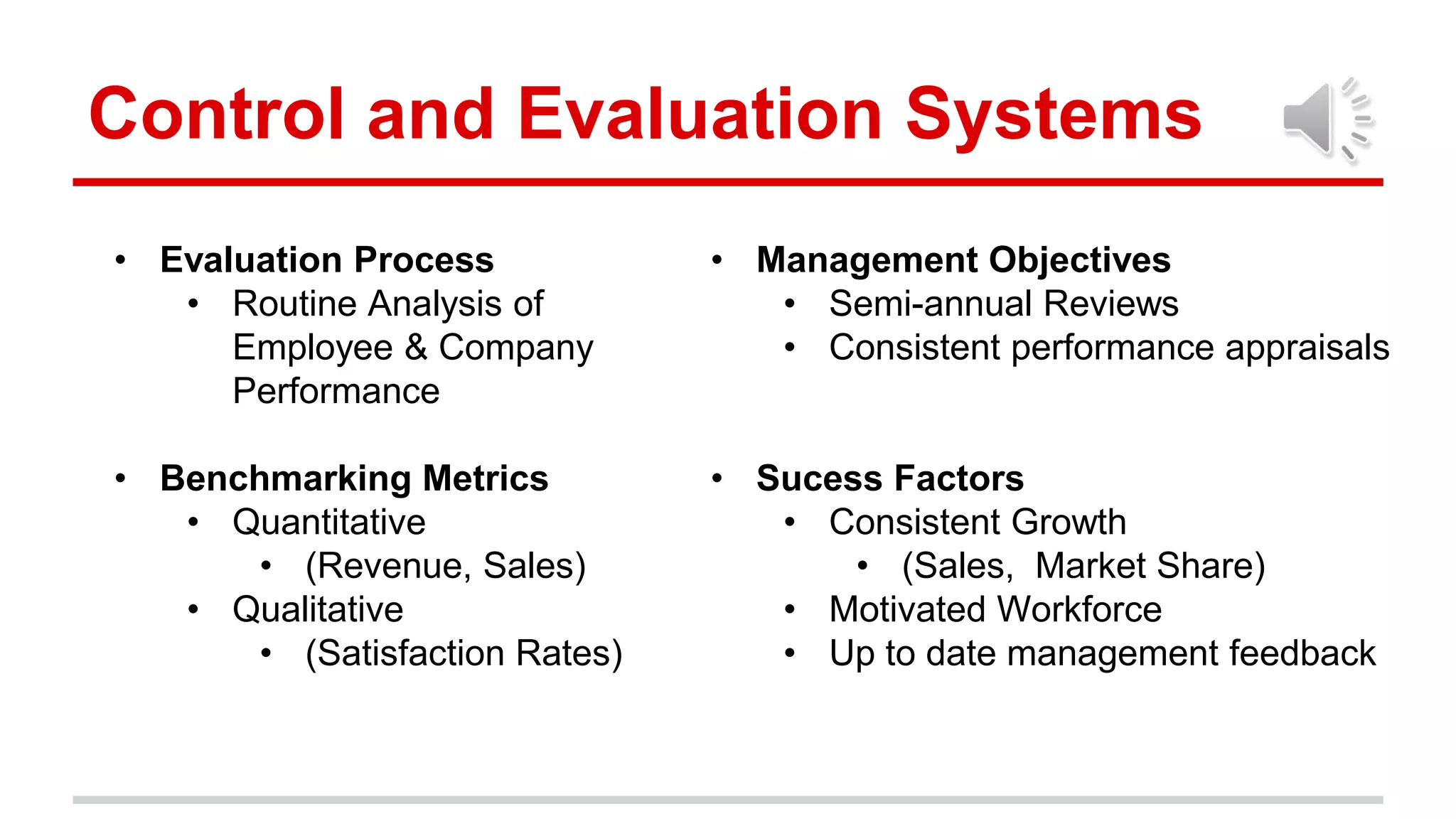
• Evaluation Process
• Routine Analysis of
Employee & Company
Performance
• Benchmarking Metrics
• Quantitative
• (Revenue, Sales)
• Qualitative
• (Satisfaction Rates)
Control and Evaluation Systems
• Management Objectives
• Semi-annual Reviews
• Consistent performance appraisals
• Sucess Factors
• Consistent Growth
• (Sales, Market Share)
• Motivated Workforce
• Up to date management feedback
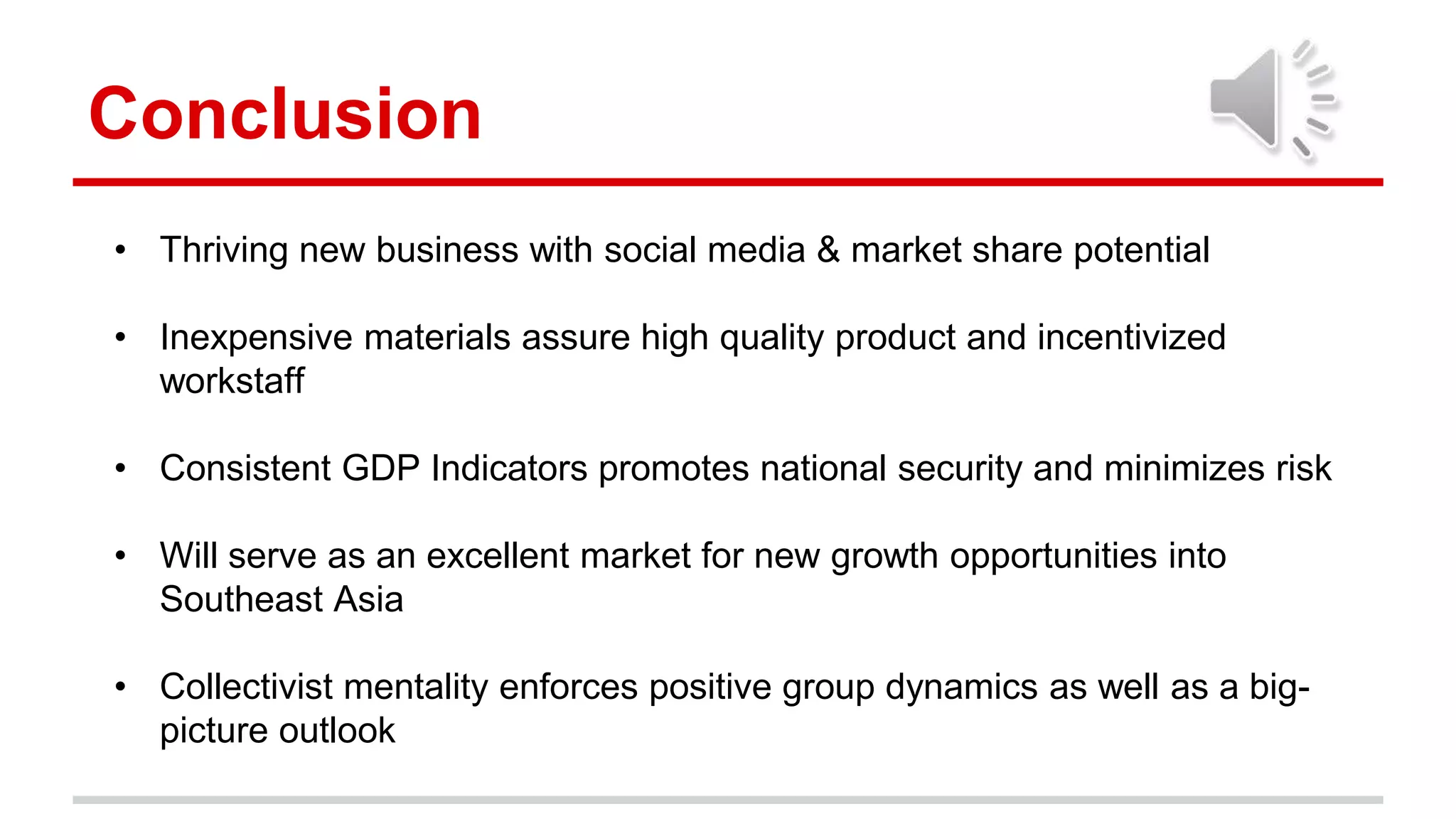
Conclusion
• Thriving new business with social media & market share potential
• Inexpensive materials assure high quality product and incentivized
workstaff
• Consistent GDP Indicators promotes national security and minimizes risk
• Will serve as an excellent market for new growth opportunities into
Southeast Asia
• Collectivist mentality enforces positive group dynamics as well as a big-
picture outlook

Chipotle presentation (1)

  • 1.
    Singapore Katerina Karpova Thomas Volpe NicoleSireci Jessica Bascone Rich Guido
  • 2.
    Description of Organization •History • Created in 1993 • CEO Steve Ellis • Established in Colorado • Early Growth • 16 Locations within 5 years • 1,600 Locations within 20 years • $350 Million in investments by 1998 • Current Situation • 17 Franchise Locations • Forecasted 11-125 Growth Rate • Current revenue- 4.1$ Billion
  • 3.
    Strategic Goals andObjectives ● Receiving approval from the Singaporean government ● Finding a strong partner in Singapore ● Maintaining a unique all-American image ● Promoting the brand online as a fast-casual, exotic venue ● Improving Chipotle revenues by 15%
  • 4.
    Company Analysis • ProductLine: • Fresh, organic, customizable food • Emphasis on locally grown • Burritos, tacos, salads, bloody mary’s • Current Operations: • Food with integrity at a cheap price • Fast-casual pioneer • Managerial know-how from McDonald’s • Few foreign locations (Canada, UK)
  • 5.
    Legal and Political ●Very stable political system ● Current President: Tony Tan Keng Yam (2011- Present) ○Serves for 6 years, elected by the people ○The president and parliament make up the legislature ○Second to the prime minister ● Current Prime Minister: Lee Hsien Loong (2004- Present) ● Political Party: People’s Action Party (PAP)
  • 6.
    Legal and PoliticalCont’ ● Reinforces a strong power distance ● Masquerades as a democratic republic ● PM Lee Hsien Loong took over after his father ○ Policies: ● Regional economic integration ● Signing free trade agreements ● Eradicate “overprotective nanny-state” image ● Enhance freedom of expression ● Growing discontent among segments of the electorate
  • 7.
    Cultural Analysis (Cultural Elements) GeertHofstede’s Dimensions: ● Power Distance: ○ Very High ● Individualism: ○ Very Low ● Masculinity: ○ Middle Ground ● Uncertainty Avoidance: ○ Very Low ● Long-Term Orientation: ○ Very High
  • 8.
    Norms & EthicalConsiderations Corporate Norms: ● Be punctual ● Dress modestly ● Avoid being excessively emotional, raising your voice, or showing anger in public ● Do not eat with your left hand ● Understand different food customs ● In public: ○ No smoking ○ Recreational drug use ○ Chewing gum ○ Jay Walking ○ Littering ● Avoid discussing religion or politics ● Only ethical issue: insider trading
  • 9.
    Commercial Analysis Market Analysis: ●American food is trendy ● Several American chains have major success ○ McDonald’s, KFC, Tony Roma’s ● Promotions are key ○ Despicable Me, Hello Kitty ● Superior distribution sets business apart, not concept ● To succeed: ○ Maintain American image ○ Attain local partner ○ Take advantage of distribution expertise ○ Offer a promotion
  • 10.
    Industry Analysis ● Singapore’seconomy is slowing down ● Food service remains stable in growth ● High competition ● Strong food culture ● Chained food service expected to see an upswing ● Outlet expansion provides opportunity ● Growing access to social media access
  • 11.
    Competitive Analysis ● Singapore’spopulation continues to go up ● Fast food isn’t growing as quickly as fast casual ● Average consumer has more disposable income ($) ● Food industry is extremely competitive ○ Yet, there is more opportunity (outlet expansion) ● Chained outlets overpower individual sites ● Chipotle stands out from the rest ● Not in direct competition with other fast-food outlets
  • 12.
    Financial and Economic ●Number one country for ease of doing business ● Economic development fund offers financial assistance ○ Helps new entrepreneurs ● Both sectors have seen consistent growth since 1990 ● Lack of government interference ● Consumers willing to try new things ○ Increased disposable income ● One of the “five dragons” ● Western-oriented ● Moving towards regional economic integration ● Forward-looking economic policies
  • 13.
    Entry Mode: ForeignDirect Investment ● Locations serve as wholly owned subsidiaries ● Avoiding store locations becoming franchises ● Creating joint ventures with countries in the region ● Teaming up with suppliers who are familiar with the area
  • 14.
    Strategic Pattern • CurrentStrategic Plans • Natural Products • High Quality Food Sources • Interactive Quiz Questioning • Consumer Targeting Tactics • Incentivize Suppliers • Referral Discounts • “Discount Cards”
  • 15.
  • 16.
    Organizational Structure ● ManagementTeam consisting of 4 top-level employees. ○ Steve Ells (Co-CEO), Montgomery Moran(Co-CEO), John Hartung (CFO), Mark Crumpacker (Cheif R+D Officer) ● Board of Directors, ○ Steve Ells is the Chairman and CEO ○ Montgomery Moran serves as a Co-CEO. ○ Seven other Executive Directors ● Goal of the Board of Directors and Management Team for Chipotle work to ensure that Chipotle is operating both efficiently and effectively and satisfying shareholders ● Create the Executive Position of Head of Investor Relations ○ Experience with Singaporean customs, traditions and language ○ Knowledge of corporate business practices ○ Past experiences working internationally with corporate entities
  • 17.
    Timeline Guiding Principles • BoardApproval • Well Planned • Slow & Prepared Content Overview: • January 1st, 2016 - October 1st, 2016 • Political, Licensing & Foreign Endorsement • Alliances, Partnerships and Networking
  • 18.
  • 19.
    Financing Financial Instruments: • Cash& Short Term Investments • Debt Issuance • Liquidity Insurance Plan Cost Allocations & Budgeting: • Small Store Locations • Stable 10 yr Singapore Govt. Note (2.48%) • Low Credit Utilization
  • 20.
    Human Resources System Challenges: •Consumer Norms & Expectations • Working Conditions & Regulations • Balancing Foreign & Domestic Employees Strategic Implementations: • Hiring in advanced Singaporean talent • Diversifying workforce at all layers of management • Multinational Training: • Ethics, Values & Morals
  • 21.
    Marketing Approach • TVAdvertisements • 33% of all commercials are for food • 38% “healthy” commercial • Mobile Messaging Marketing • 150/100 citizens • Brand Recognition • Press releases, blogs, social media, commercials • Social Media • Highest ranked social media users in the world • Facebook, Twitter, Public Forums
  • 22.
    • Evaluation Process •Routine Analysis of Employee & Company Performance • Benchmarking Metrics • Quantitative • (Revenue, Sales) • Qualitative • (Satisfaction Rates) Control and Evaluation Systems • Management Objectives • Semi-annual Reviews • Consistent performance appraisals • Sucess Factors • Consistent Growth • (Sales, Market Share) • Motivated Workforce • Up to date management feedback
  • 23.
    Conclusion • Thriving newbusiness with social media & market share potential • Inexpensive materials assure high quality product and incentivized workstaff • Consistent GDP Indicators promotes national security and minimizes risk • Will serve as an excellent market for new growth opportunities into Southeast Asia • Collectivist mentality enforces positive group dynamics as well as a big- picture outlook