Social Networking Analysis: uncovering the secrets of information flow for our information architecture Maria Horrigan Principal Consultant OZIA October 09
Slideshare and blogswww.slideshare.com/murphwww.barocks.comZenagile.wordpress.com@miahorri#OZIA09 , #SNA
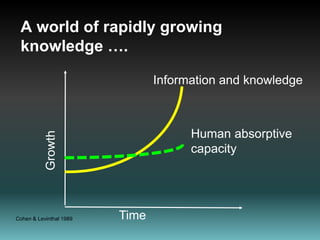
Information and knowledgeHuman absorptive capacityGrowthTimeCohen & Levinthal 1989A world of rapidly growing knowledge ….
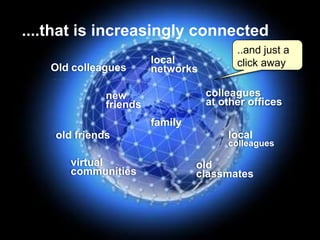
....that is increasingly connected..and just a click awaylocalnetworksOld colleaguescolleaguesat other officesnew friendsfamilylocalcolleaguesold friendsvirtualcommunitiesold classmates
Case study Context: (very political, high profile project)Started with waterfall analysis (2 years)No idea what the end solution would be likeLots of information, but in people’s headsMultiple stakeholders across multiple silosInformation flows between individuals and groups not well knownExternal industry pressure for project to occurHow could we leverage the network for the benefit of the project?
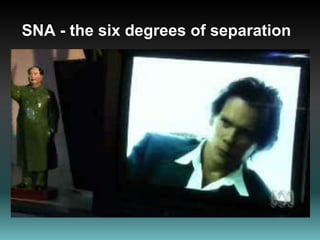
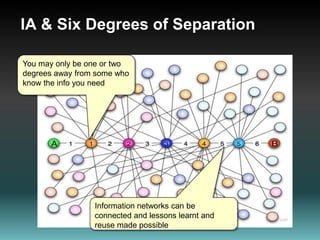
SNA - the six degrees of separation
Social Networking Analysis (SNA)Helped us explore questions such as:How does information flow into the network?Where does the information flow?Who is involved and why?What are they saying?What do they know?How do they interact?Strength of relationships & interactions ?Are there emergent sub-groups?
What we didAdopted an agile approachBroke down huge project puzzle into smaller business issues to solvePartnered IA+BAs to lead three streams of activities (IA had visualisation of all the different parts of the puzzle)Used SNA in each stream to uncover the information needs of the usersUsed “skinny” documentationto convey to stakeholders the key features of the system, its processes and the flow of information
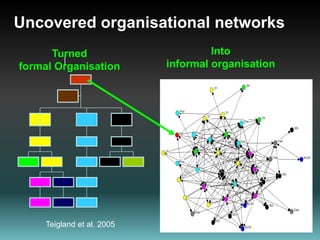
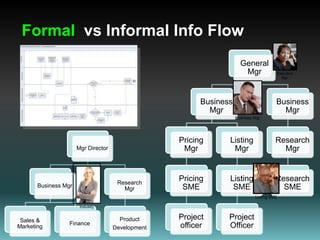
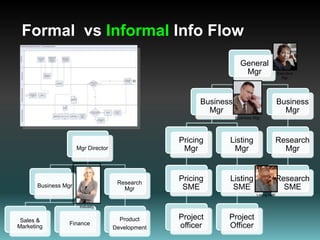
Intoinformal organisationTurnedformal OrganisationUncovered organisational networks Teigland et al. 2005
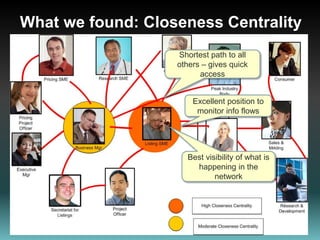
Centrality : revealing network structure Very centralized network - one or a few very central ‘nodes’. If removed, network quickly fragments and fails  Less centralized network - resilient. Many nodes can fail yet allow remaining nodes to still reach each other Boundary Spanners - connect their group to others. Innovators as have access to ideas and information in other clusters Periphery of a network -may connect to networks not currently mapped. Important sources of fresh information
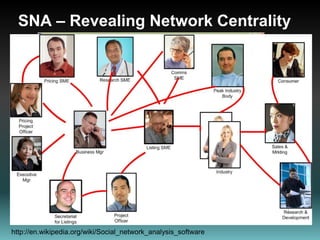
SNA – Revealing Network Centralityhttp://en.wikipedia.org/wiki/Social_network_analysis_software
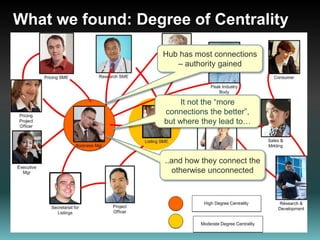
What we found: Degree of CentralityHub has most connections – authority gainedIt not the “more connections the better”, but where they lead to…..and how they connect the otherwise unconnected
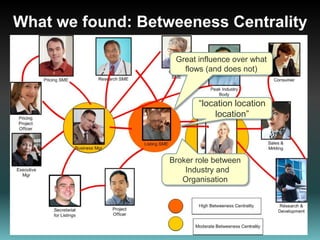
What we found: Betweeness Centrality Great influence over what flows (and does not)“location location location”Broker role between   Industry and Organisation
 What we found: Closeness Centrality Shortest path to all others – gives quick accessExcellent position to monitor info flowsBest visibility of what is happening in the network
Formal  vs Informal Info Flow
Formalvs Informal Info Flow
Formal  vsInformal Info Flow
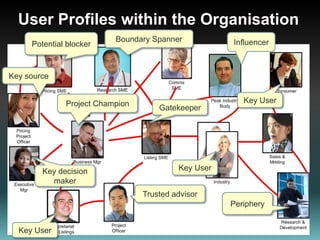
User Profiles within the OrganisationBoundary SpannerPotential blockerInfluencerKey sourceKey UserProject ChampionGatekeeperKey UserKey decision makerTrusted advisorPeripheryKey User
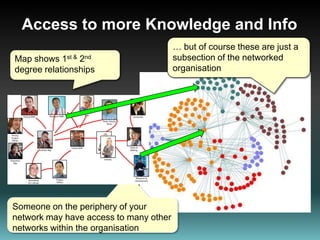
Access to more Knowledge and Info… but of course these are just a subsection of the networked organisationMap shows 1st & 2nd degree relationships Someone on the periphery of your network may have access to many other networks within the organisation
Leveraged CentralityUnderstood who might be “blockers” or “gatekeepers”  of information and contentFound people to go to in order to elicit information  Minimised re-work & unnecessary consultation – meeting fatigueQuickly identified who might know the answer, communicate with them, understand their lessons learned, improve likely success Knew who and how to communicate key messages  through use of targeted IA tools
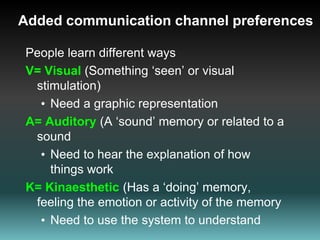
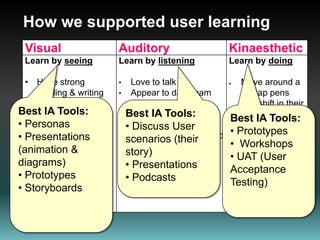
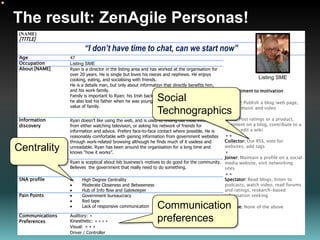
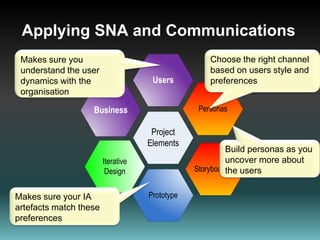
Captured SNA in personasStarted off with ‘skinny’ view of users gained thru workshopsAdded to personas as info uncovered thru SNA – place in the network, information preferences, types, communication styles & channelsBuilt up personas as we went in our agile project iterations, rather than all-at-once
From skinny to zen personasAs our project knowledge evolved, we added to our understanding of users:Their information preferencesTheir expectationsTheir capabilitiesTheir information needsTheir social network profiles (Forrester’s Technographics)Documented as ‘ZenAgile’ personas
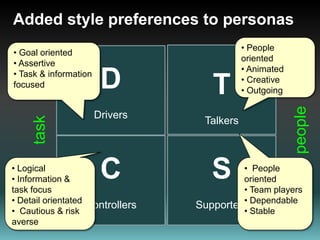
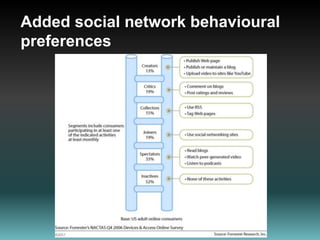
Added style preferences to personas People oriented
 Animated
 Creative
 Outgoing
 Goal oriented
 Assertive
 Task & information focusedTTalkersDDriverstaskpeopleSSupportersCControllers Logical
 Information & task focus
 Detail orientated
  Cautious & risk averse
  People oriented

Oz!a 2009 sna v0.2

  • 1.
    Social Networking Analysis:uncovering the secrets of information flow for our information architecture Maria Horrigan Principal Consultant OZIA October 09
  • 2.
  • 3.
    Information and knowledgeHumanabsorptive capacityGrowthTimeCohen & Levinthal 1989A world of rapidly growing knowledge ….
  • 4.
    ....that is increasinglyconnected..and just a click awaylocalnetworksOld colleaguescolleaguesat other officesnew friendsfamilylocalcolleaguesold friendsvirtualcommunitiesold classmates
  • 5.
    Case study Context:(very political, high profile project)Started with waterfall analysis (2 years)No idea what the end solution would be likeLots of information, but in people’s headsMultiple stakeholders across multiple silosInformation flows between individuals and groups not well knownExternal industry pressure for project to occurHow could we leverage the network for the benefit of the project?
  • 6.
    SNA - thesix degrees of separation
  • 7.
    Social Networking Analysis(SNA)Helped us explore questions such as:How does information flow into the network?Where does the information flow?Who is involved and why?What are they saying?What do they know?How do they interact?Strength of relationships & interactions ?Are there emergent sub-groups?
  • 8.
    What we didAdoptedan agile approachBroke down huge project puzzle into smaller business issues to solvePartnered IA+BAs to lead three streams of activities (IA had visualisation of all the different parts of the puzzle)Used SNA in each stream to uncover the information needs of the usersUsed “skinny” documentationto convey to stakeholders the key features of the system, its processes and the flow of information
  • 9.
    Intoinformal organisationTurnedformal OrganisationUncoveredorganisational networks Teigland et al. 2005
  • 10.
    Centrality : revealingnetwork structure Very centralized network - one or a few very central ‘nodes’. If removed, network quickly fragments and fails Less centralized network - resilient. Many nodes can fail yet allow remaining nodes to still reach each other Boundary Spanners - connect their group to others. Innovators as have access to ideas and information in other clusters Periphery of a network -may connect to networks not currently mapped. Important sources of fresh information
  • 11.
    SNA – RevealingNetwork Centralityhttp://en.wikipedia.org/wiki/Social_network_analysis_software
  • 12.
    What we found:Degree of CentralityHub has most connections – authority gainedIt not the “more connections the better”, but where they lead to…..and how they connect the otherwise unconnected
  • 13.
    What we found:Betweeness Centrality Great influence over what flows (and does not)“location location location”Broker role between Industry and Organisation
  • 14.
    What wefound: Closeness Centrality Shortest path to all others – gives quick accessExcellent position to monitor info flowsBest visibility of what is happening in the network
  • 15.
    Formal vsInformal Info Flow
  • 16.
  • 17.
  • 18.
    User Profiles withinthe OrganisationBoundary SpannerPotential blockerInfluencerKey sourceKey UserProject ChampionGatekeeperKey UserKey decision makerTrusted advisorPeripheryKey User
  • 19.
    Access to moreKnowledge and Info… but of course these are just a subsection of the networked organisationMap shows 1st & 2nd degree relationships Someone on the periphery of your network may have access to many other networks within the organisation
  • 20.
    Leveraged CentralityUnderstood whomight be “blockers” or “gatekeepers” of information and contentFound people to go to in order to elicit information Minimised re-work & unnecessary consultation – meeting fatigueQuickly identified who might know the answer, communicate with them, understand their lessons learned, improve likely success Knew who and how to communicate key messages through use of targeted IA tools
  • 21.
    Captured SNA inpersonasStarted off with ‘skinny’ view of users gained thru workshopsAdded to personas as info uncovered thru SNA – place in the network, information preferences, types, communication styles & channelsBuilt up personas as we went in our agile project iterations, rather than all-at-once
  • 22.
    From skinny tozen personasAs our project knowledge evolved, we added to our understanding of users:Their information preferencesTheir expectationsTheir capabilitiesTheir information needsTheir social network profiles (Forrester’s Technographics)Documented as ‘ZenAgile’ personas
  • 23.
    Added style preferencesto personas People oriented
  • 24.
  • 25.
  • 26.
  • 27.
  • 28.
  • 29.
    Task &information focusedTTalkersDDriverstaskpeopleSSupportersCControllers Logical
  • 30.
    Information &task focus
  • 31.
  • 32.
    Cautious& risk averse
  • 33.
    Peopleoriented