Communication and Connectedness in Business Analysis Maria Horrigan Principal Consultant BA World Sept 2009
Slideshare and blogswww.slideshare.com/murphwww.barocks.comZenagile.wordpress.com@miahorri# BAWorld09 , #SNA
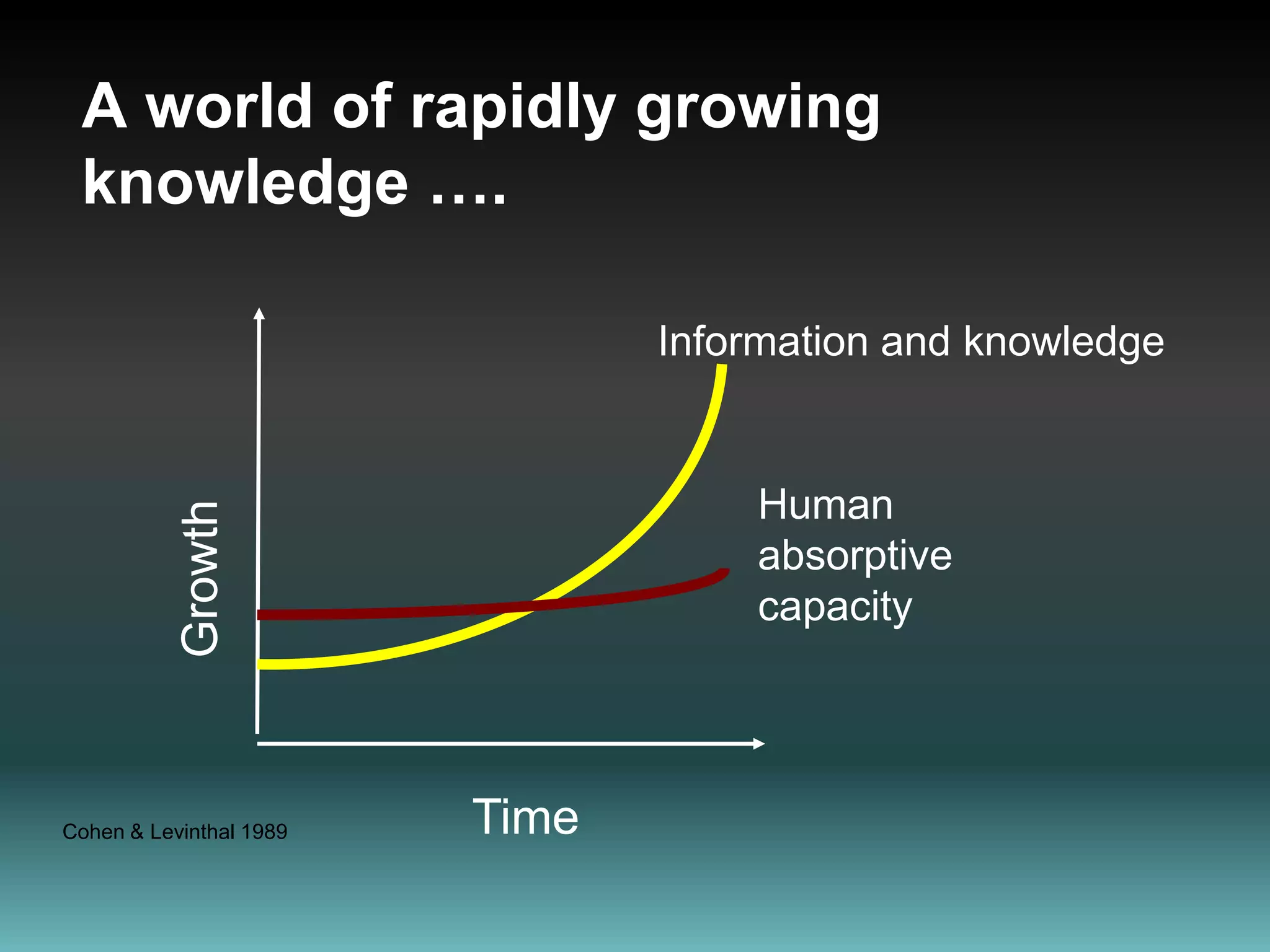
Information and knowledgeHuman absorptive capacityGrowthTimeCohen & Levinthal 1989A world of rapidly growing knowledge ….
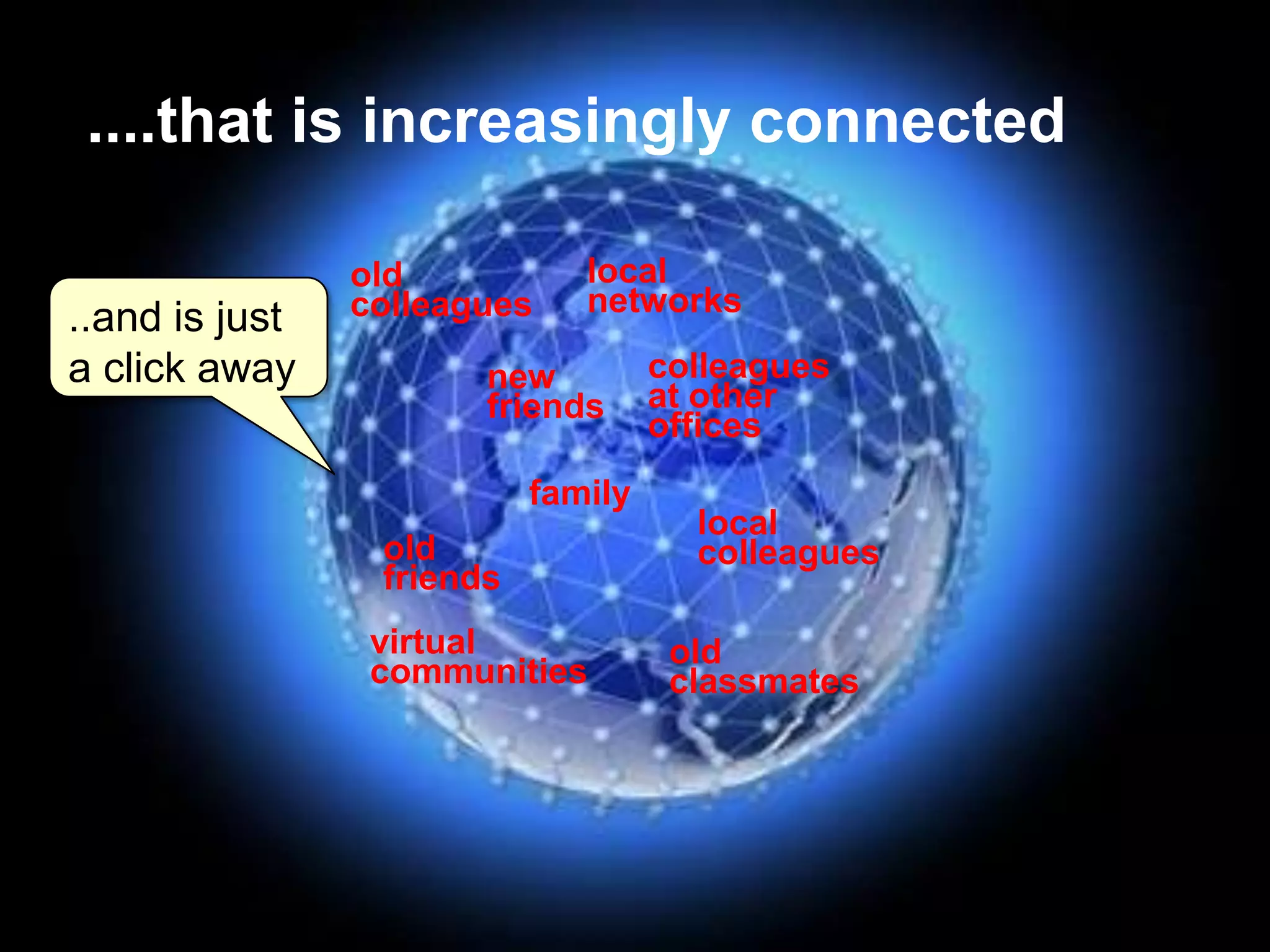
....that is increasingly connectedlocalnetworksoldcolleagues..and is just a click awaycolleaguesat other officesnew friendsfamilylocalcolleaguesold friendsvirtualcommunities old classmates
Modern IT Application ProjectsPeople demand to be heardPeople expect to be involvedPeople’s expectations of how good systems are is based on their experience of modern internet ..that means the Google World - Gmail, Google Search, Facebook, Flickr and YouTube of the  “Nintendo” generation
What does their expectation mean?Project success  hinges on communicating with people:To understand what they wantTo set expectations about what the project will actually deliver (and what it won’t)To show them how the project will help them in their workTo uncover what they need . . .
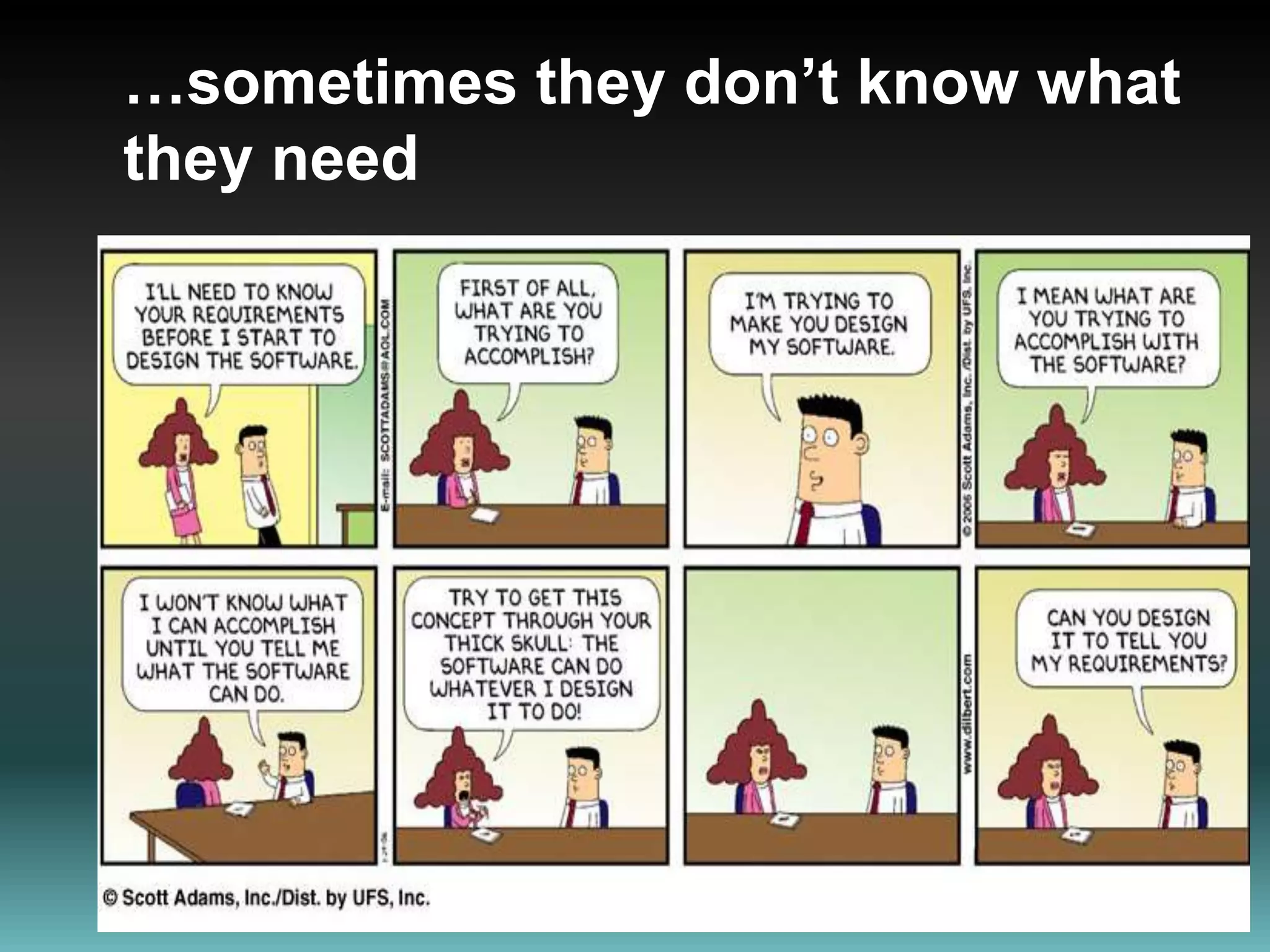
…sometimes they don’t know what they need
What’s their requirement of you?Knowing how to talk to people & get the info you need to write requirementsEffectively negotiating with important stakeholdersGetting the right messages to the right people at the right timeAn understanding of both the ‘big picture’ and the detail Understand the context & the situation
Role of  Business Analyst  is key!The Communicator The TranslatorThe Juggler of technology and people’s needsThe one between the rock and a hard placeThe Connector (bridge)
How do we do all this Communications Stuff Effectively?Analysethe stakeholders needs and wants, how they are connected and whyUnderstand how they communicate, their preference and styleLearnthe project in the context of people’s work and how this fits into the wider organisational context
analyse stakeholdersTheir needs and wants, their connections to others
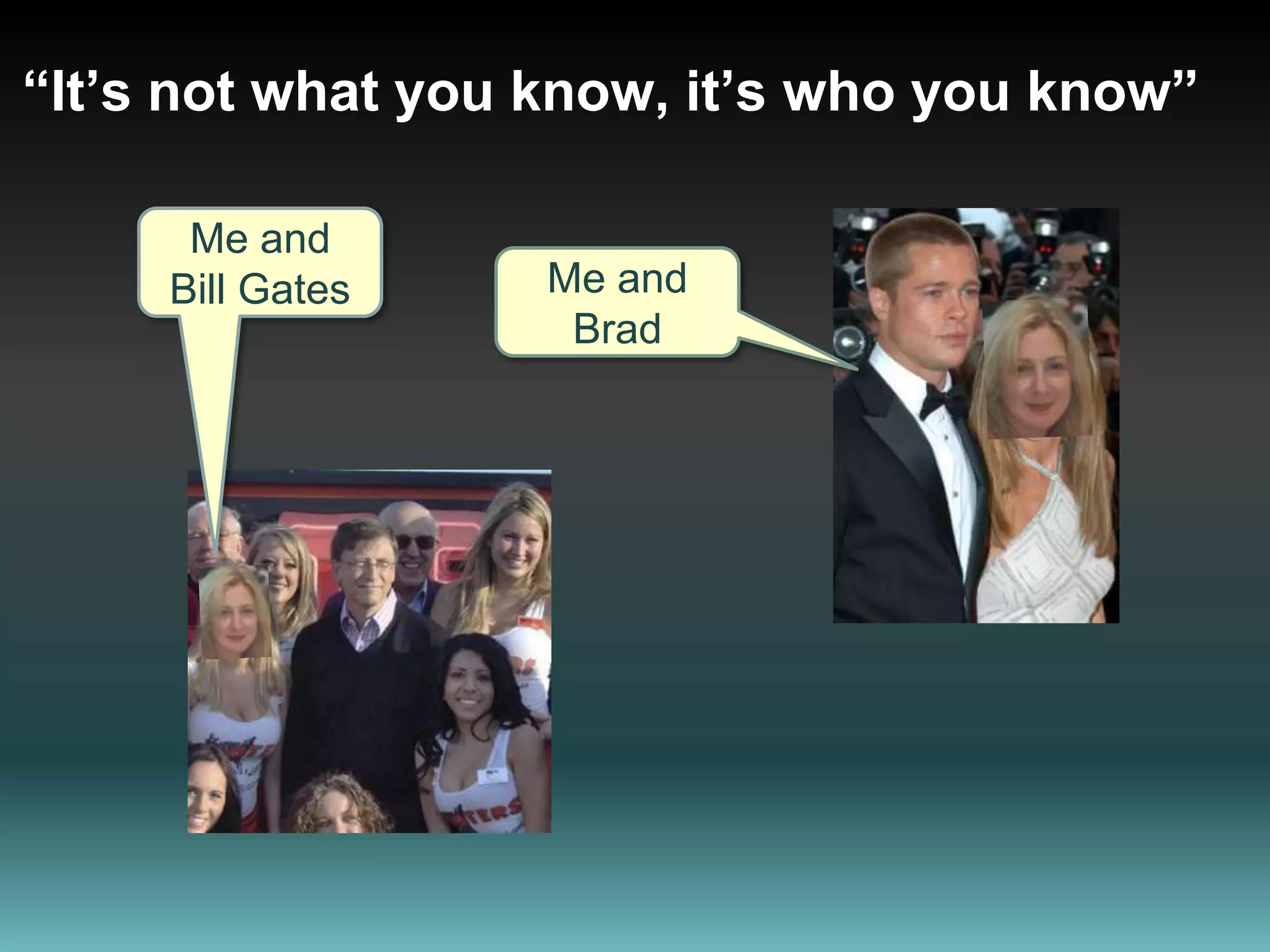
“It’s not what you know, it’s who you know”Me and Bill GatesMe and Brad
Analysing “who is who in the zoo”Who to talk toWho has influenceWho knows the business needs What drives & motivates people’s work  behaviour How to talk to them  How to tailor the communication to these different people
Multiplicity of networks                   official vs. unofficialAdvice - Who do you go to for advice? Who goes to you for advice?Collaboration - Who do you collaborate with?How do you collaborate (social media)Trust - Who do you trust?Who is your friend?Conflict - Who is a blocker or gatekeeper?
Social Networking AnalysisMathematical, graphical, theoretical understanding of the social worldMapping, understanding, analysing and measuring interactions across a network of people, groups, organisations, computers, and websitesUncovers networks and their structures Identifies flows of information & knowledgeFosters knowledge sharing
Understanding Social Networks the location of actors in the networkthe various roles and groupings in a network Gives insight into:who are the connectors, experts, leaders, bridges, isolates, the core or hub?where are the clusters and who is in them?who is on the periphery?
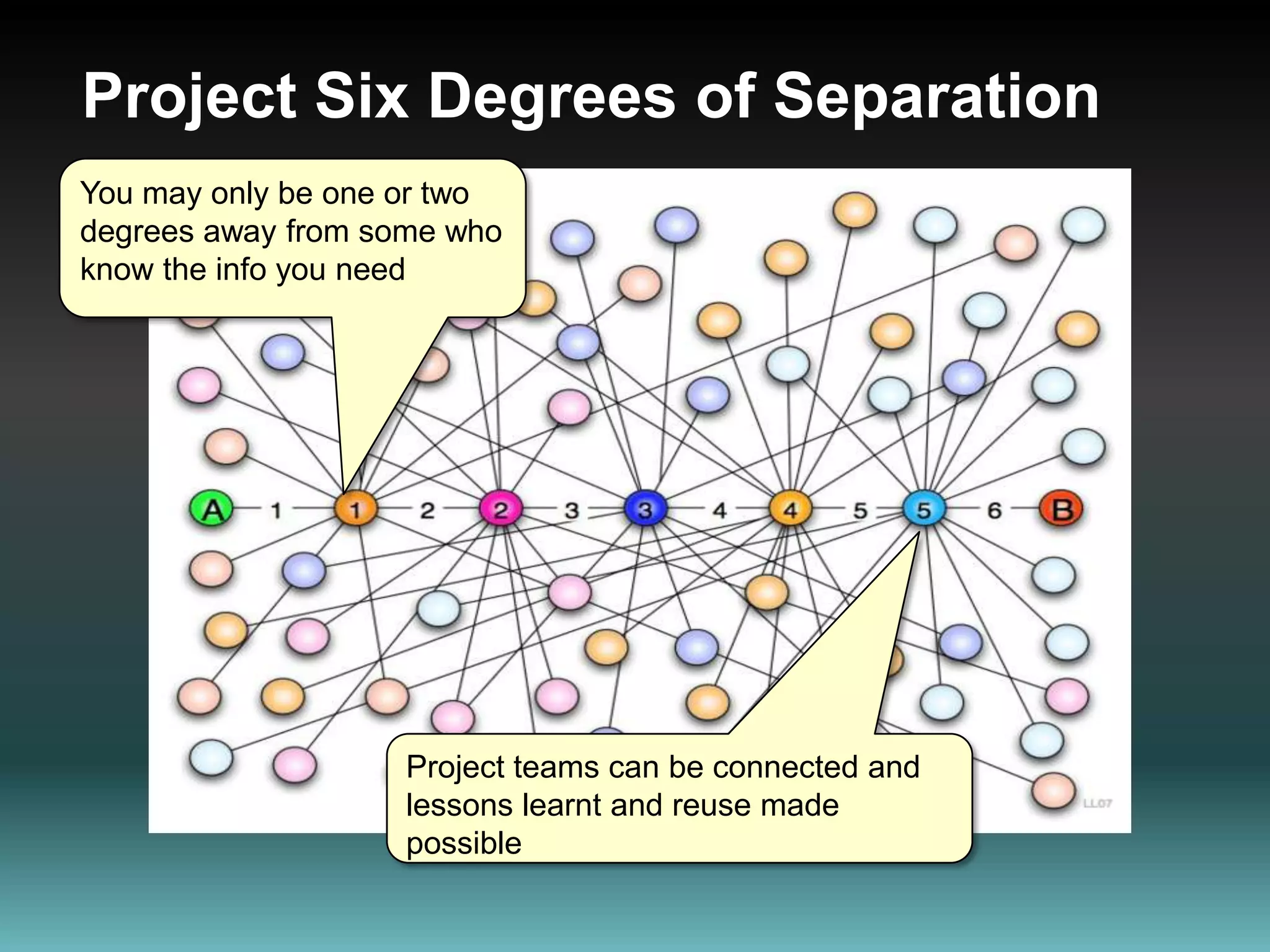
Six Degrees of Separation
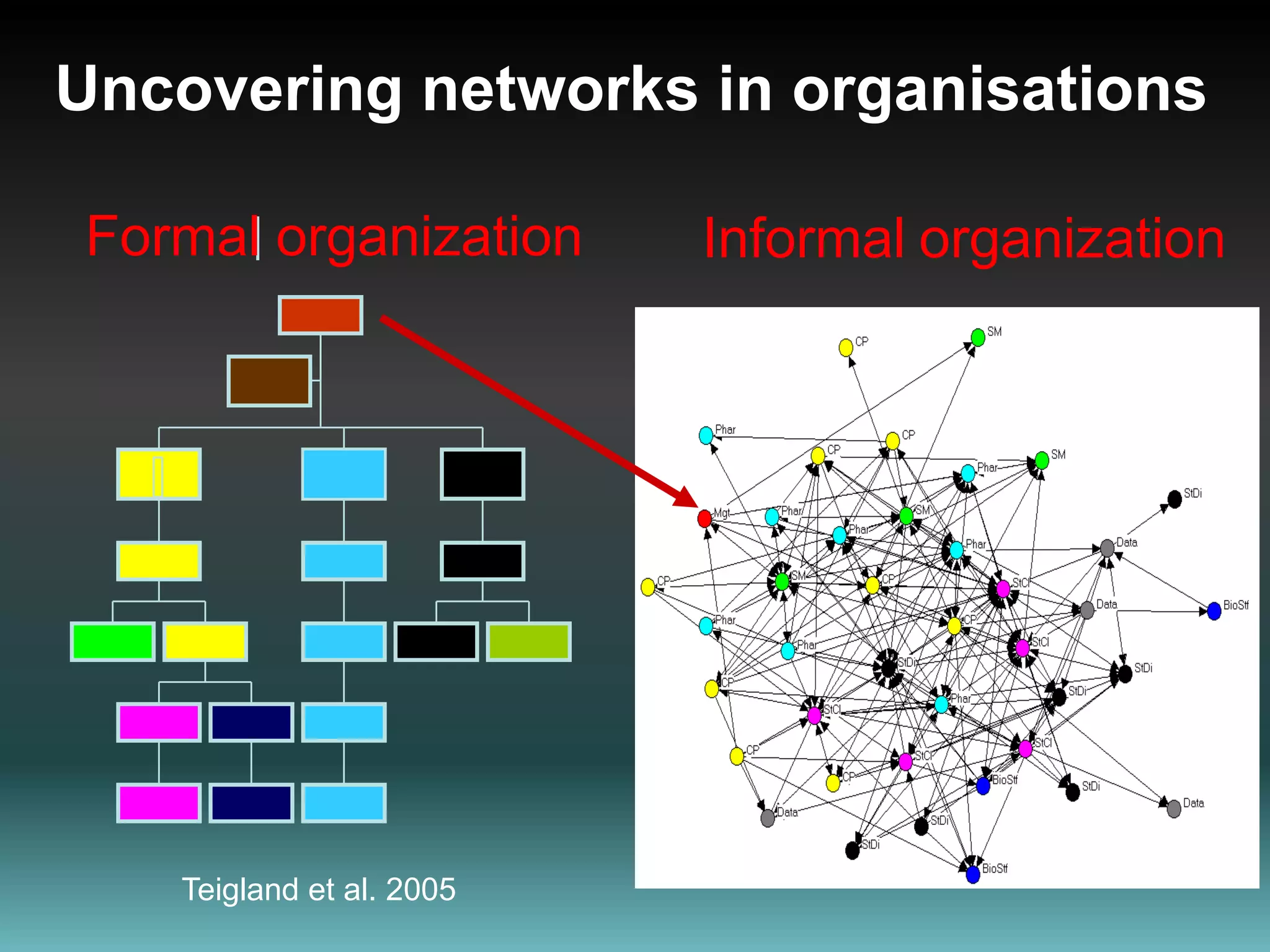
Formal organizationInformalorganizationUncovering networks in organisationsTeigland et al. 2005
Centrality : revealing network structure Very centralized network  dominated by one or a few very central nodes, if removed, network fragments & fails  Less centralized network resilient in the face of attacks, many nodes can fail yet allow remaining to still reach each other Boundary Spanners connect their group to others, positioned to be innovators as have access to ideas/info in other clusters Periphery of a network may connect to networks not currently mapped, important sources for fresh information
Dimensions to effective use of a  Network Knowledge - Knowing what someone knowsAccess - Gaining timely access to that personEngagement - Creating viable knowledge through cognitive engagementSafety - Learning from a safe relationshipCross, Parker and Borgatti,  2002
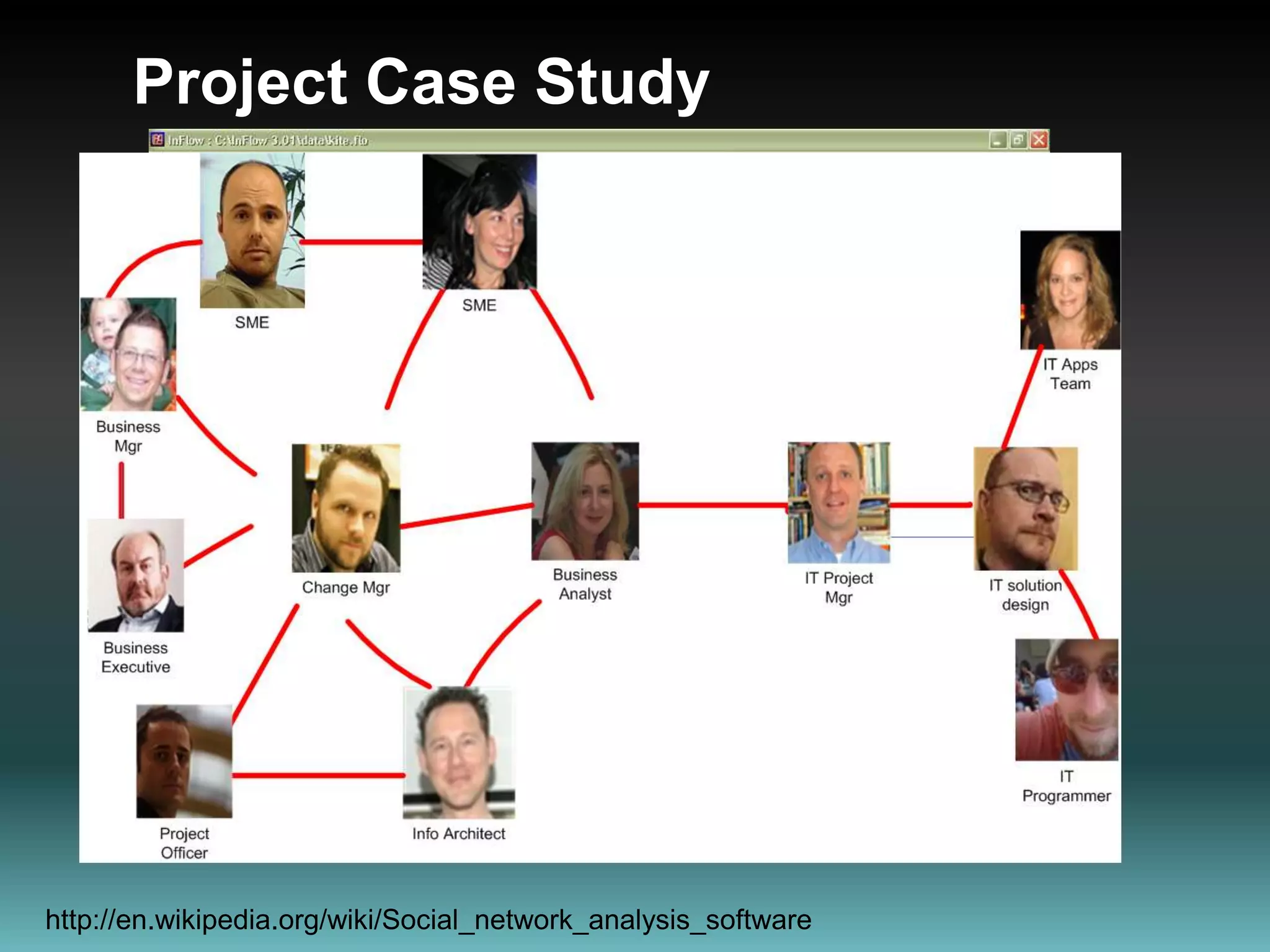
Use of SNA to model users’ network and map the relationships between people, groups, organisations and information.Case Study
Context - New System to support  assessment of applications for fundingStarted with waterfall analysis (2 years of gathering requirements)No idea what the end solution would be like (very political, high profile project)Processes not well documentedLarge organisational change projectExternal industry pressure for it to happen
Problem to be solvedMultiple stakeholders across silosInformation flows between individuals and groups not well knownLimited documentation of information and processes (in people’s heads)Terminology and Language issues
What we didDesign team adopted an agile approachPartnered BAs with IA to lead three streams of activities SNA of key players (needed to know the information needs of these key users)Needed “skinny” documentation to quickly convey understanding to stakeholders of the key features of the system and its processes and the flow of information
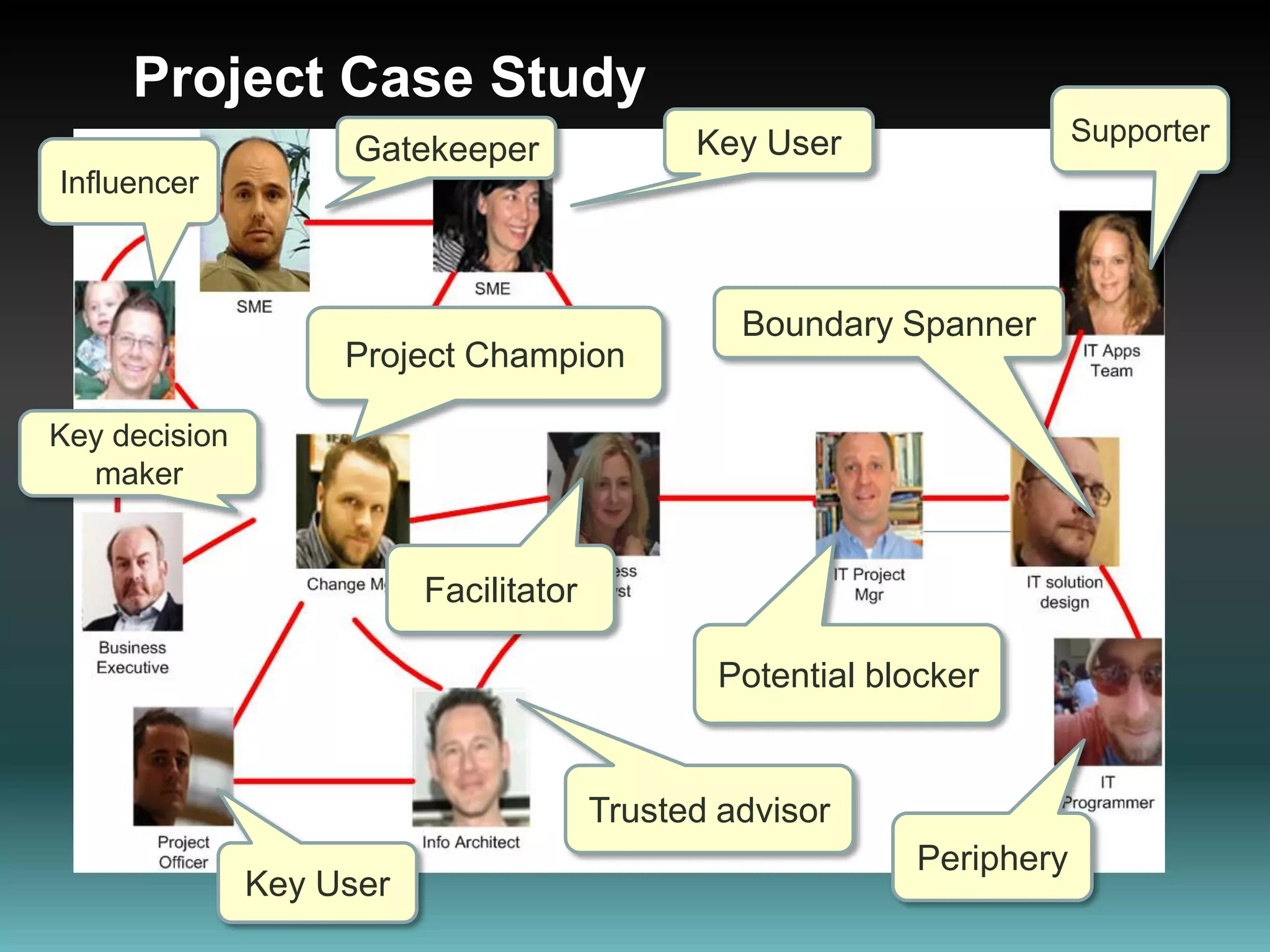
Project Case Studyhttp://en.wikipedia.org/wiki/Social_network_analysis_software
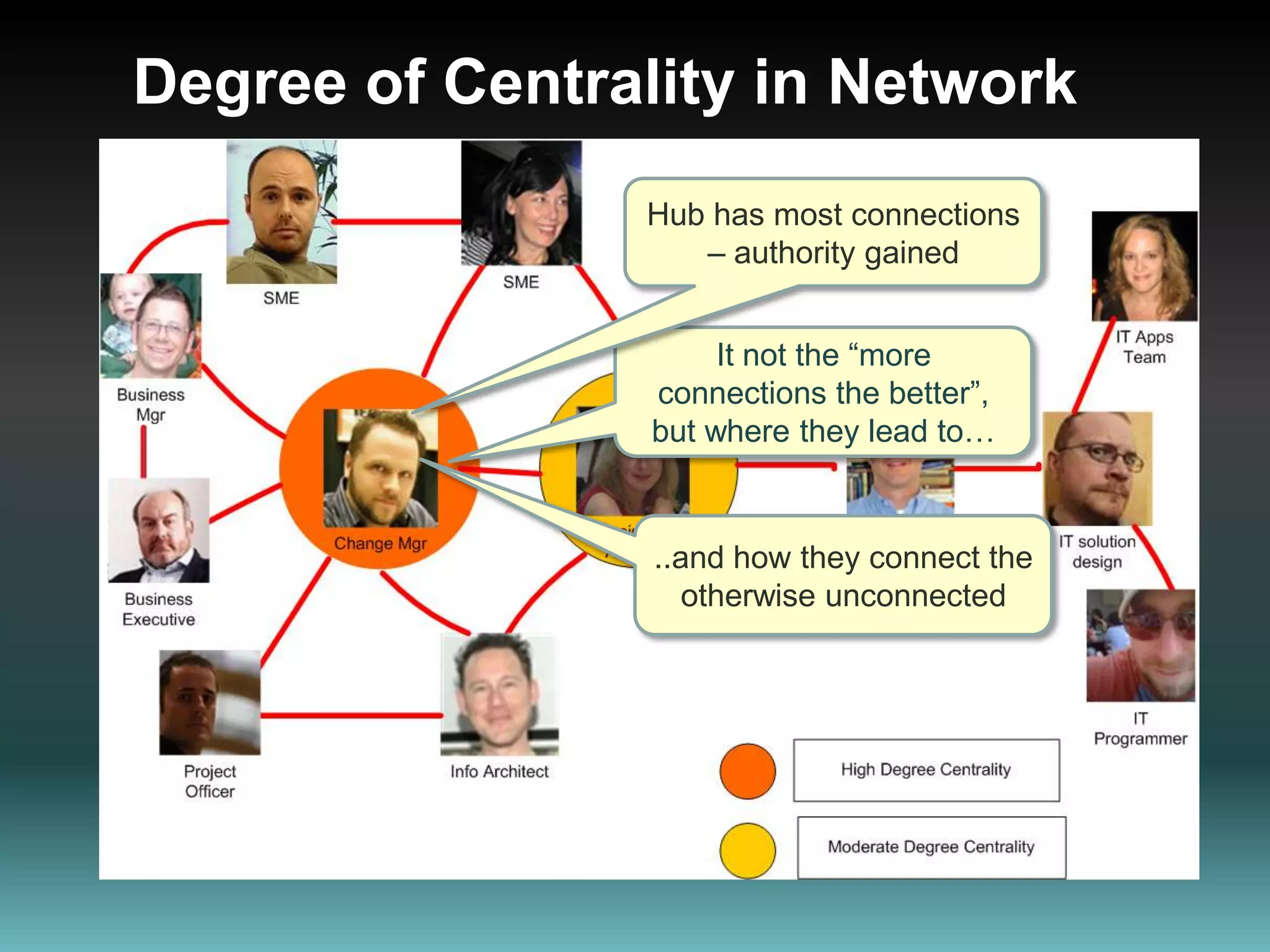
Degree of Centrality in NetworkHub has most connections – authority gainedIt not the “more connections the better”, but where they lead to…..and how they connect the otherwise unconnected
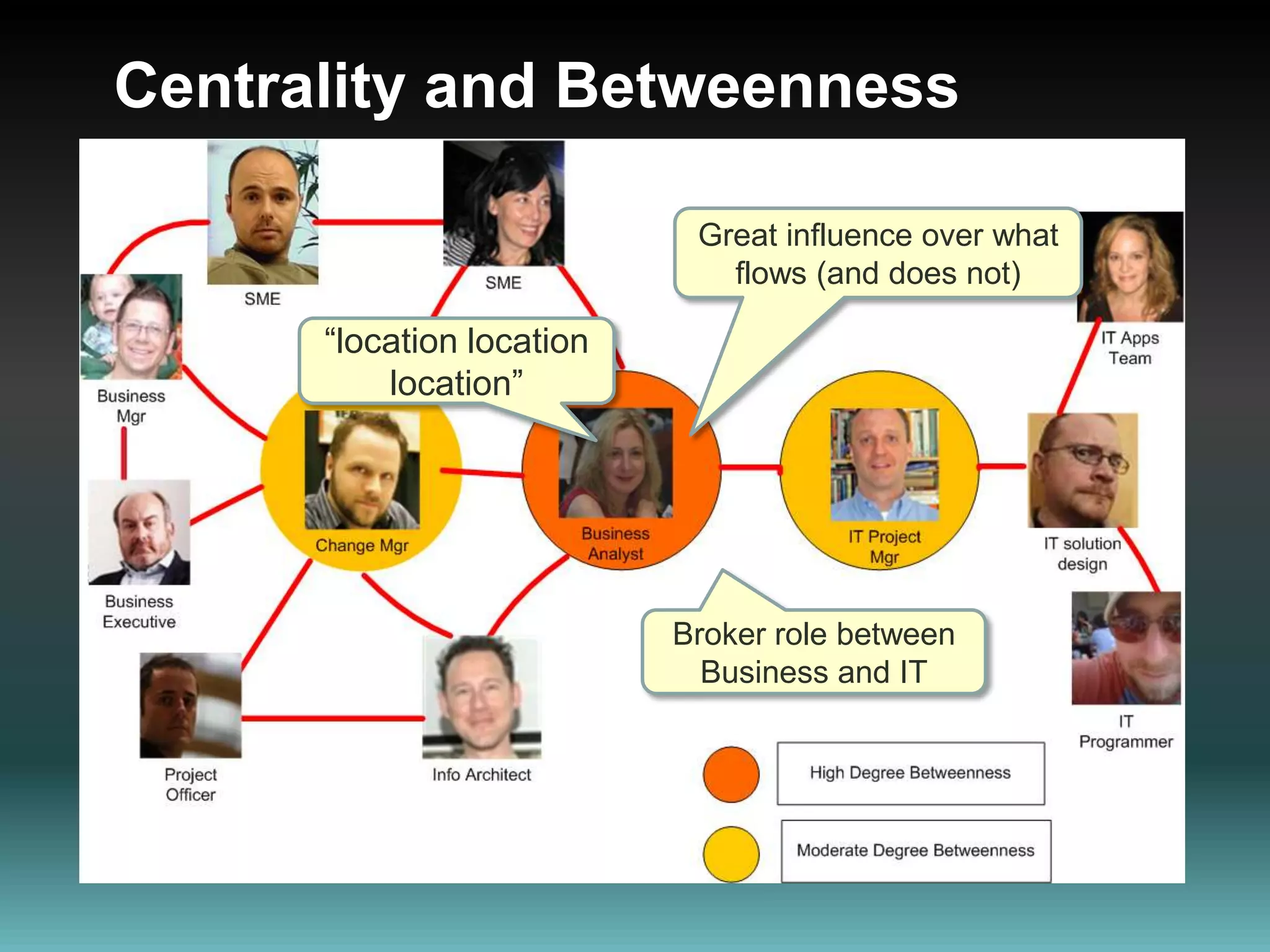
Centrality and BetweennessGreat influence over what flows (and does not)“location location location”Broker role between Business and IT
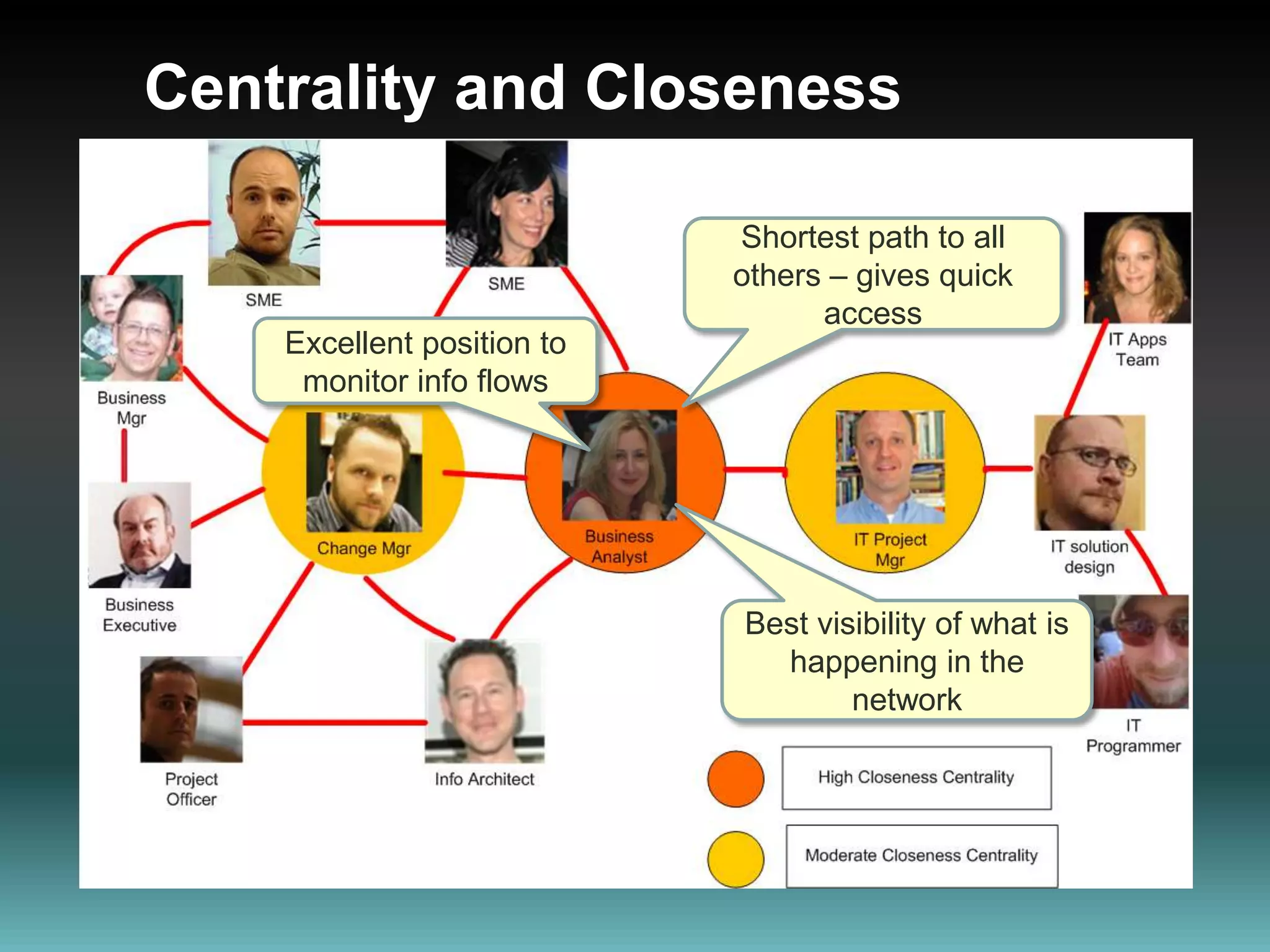
Centrality and ClosenessShortest path to all others – gives quick accessExcellent position to monitor info flowsBest visibility of what is happening in the network
Project Case StudySupporterKey UserGatekeeperInfluencerBoundary SpannerProject ChampionKey decision makerFacilitatorPotential blockerTrusted advisorPeripheryKey User
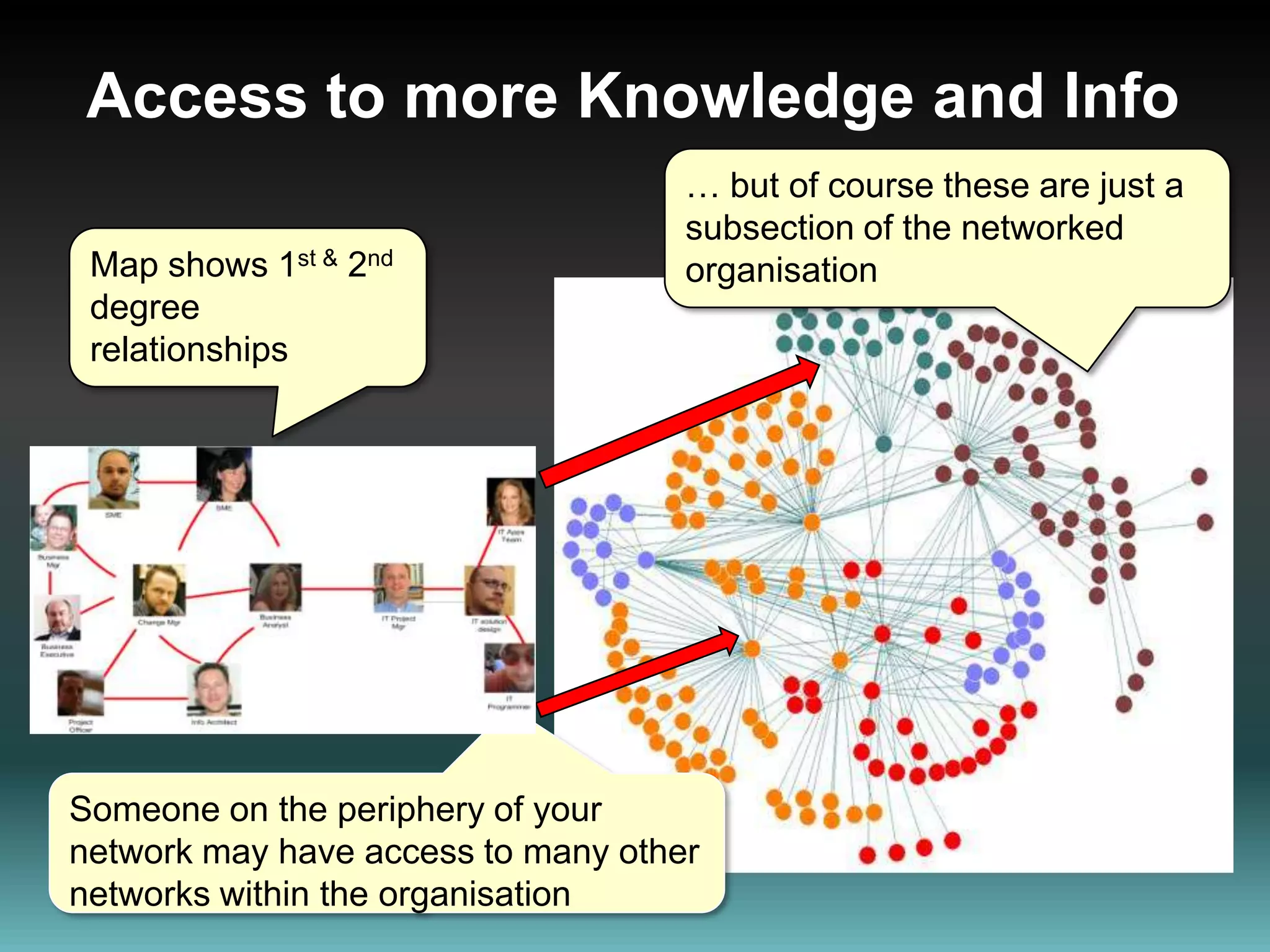
Access to more Knowledge and Info… but of course these are just a subsection of the networked organisationMap shows 1st & 2nd degree relationships Someone on the periphery of your network may have access to many other networks within the organisation
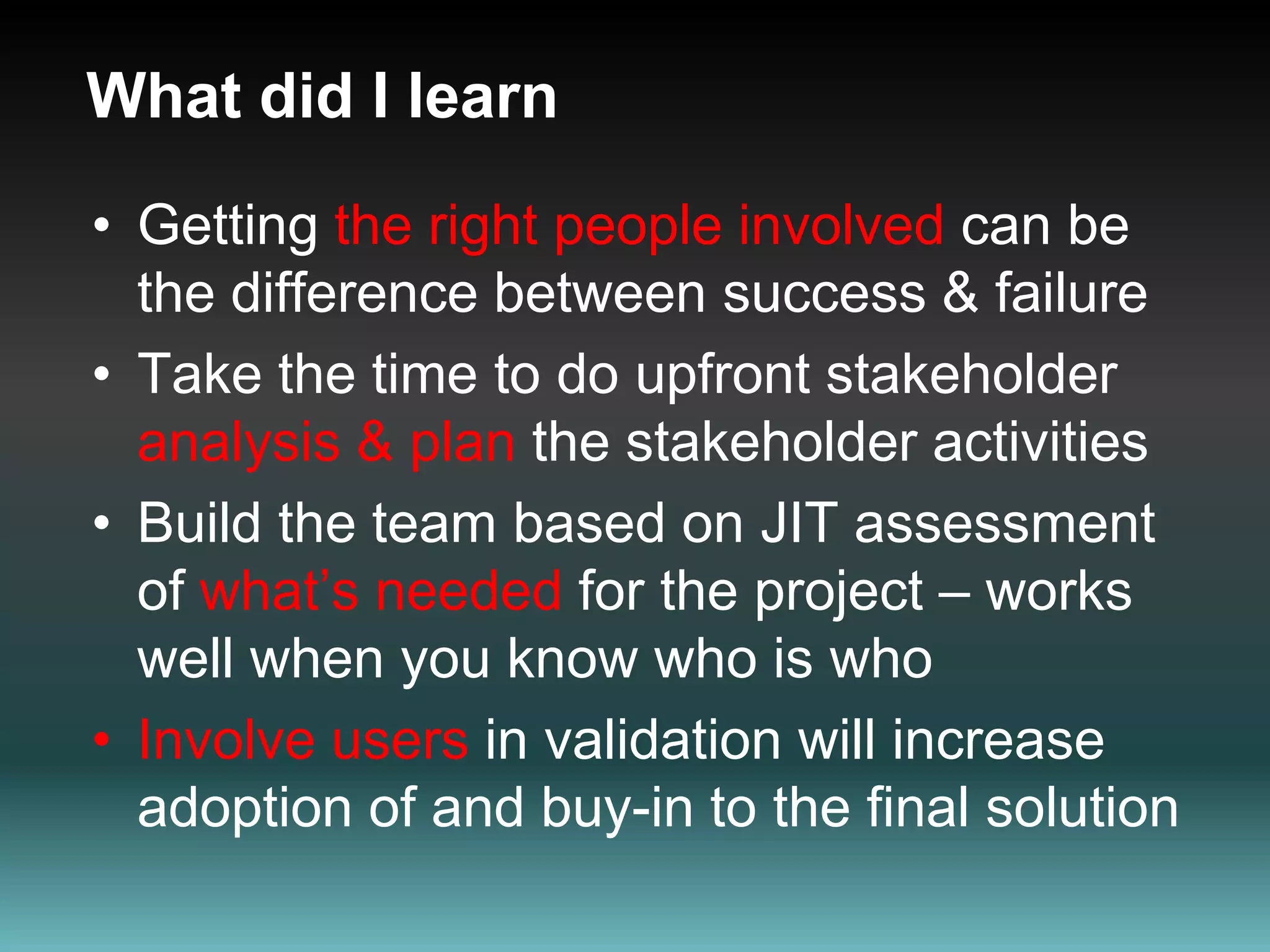
What did I learnGetting the right people involved can be the difference between success & failureTake the time to do upfront stakeholder analysis & plan the stakeholder activities Build the team based on JIT assessment of what’s needed for the project – works well when you know who is who Involve users in validation will increase adoption of and buy-in to the final solution
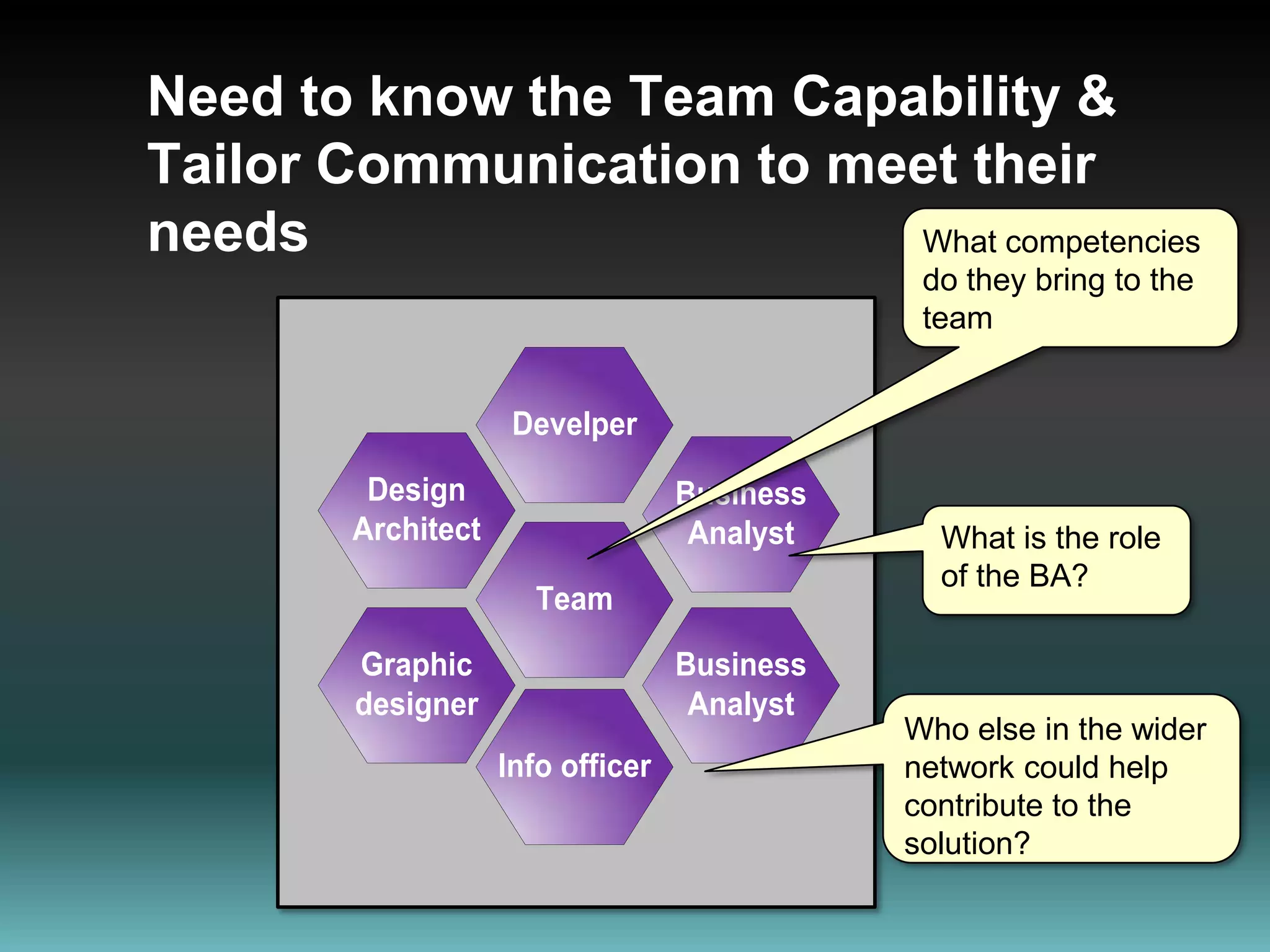
Need to know the Team Capability & Tailor Communication to meet their needsWhat competencies do they bring to the teamWhat is the role of the BA?Who else in the wider network could help contribute to the solution?
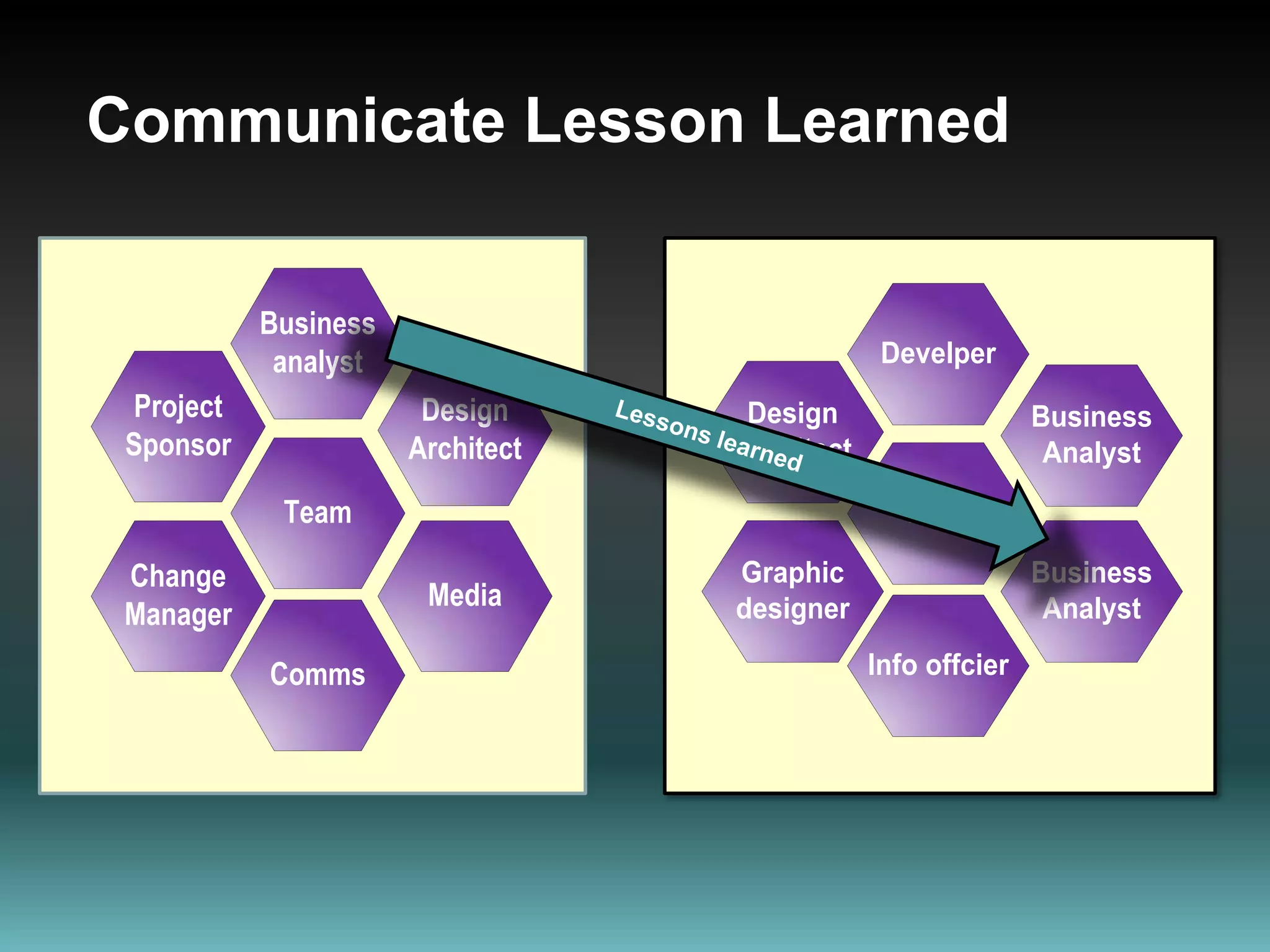
Communicate Lesson LearnedLessons learned
Project Six Degrees of SeparationYou may only be one or two degrees away from some who know the info you needProject teams can be connected and lessons learnt and reuse made possible
Leveraging CentralityLeverage project champions Understand who might be “blockers” or “gatekeepers” Find the “go to people” to elicit infoDon’t reinvent the wheelCommunicate - understand their lessons learnt to improve likelihood of success Know who to communicate key messages
Now we know who, we need to know how…..How they communicate, their preference for style & communication channelsUnderstanding stakeholders
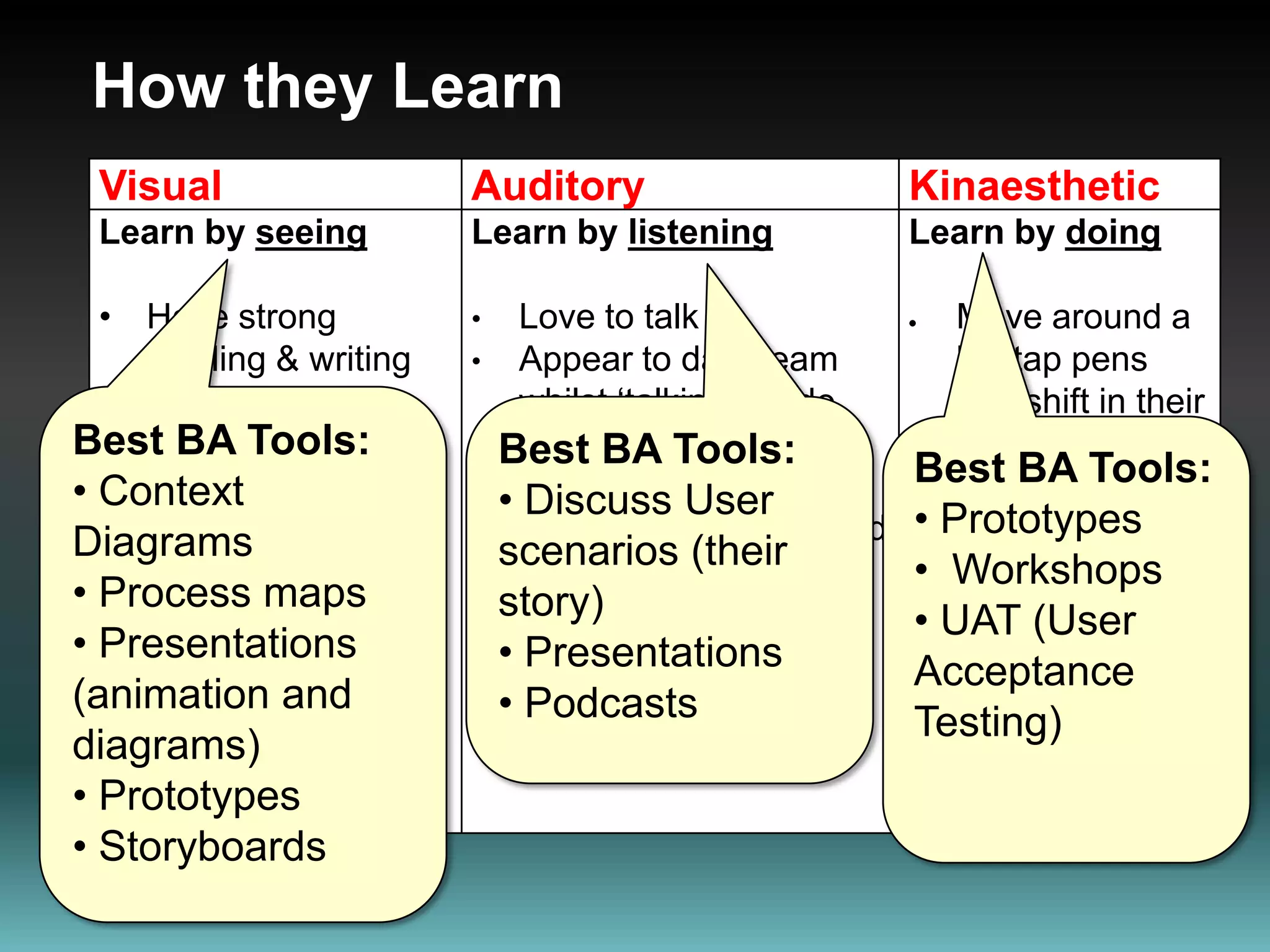
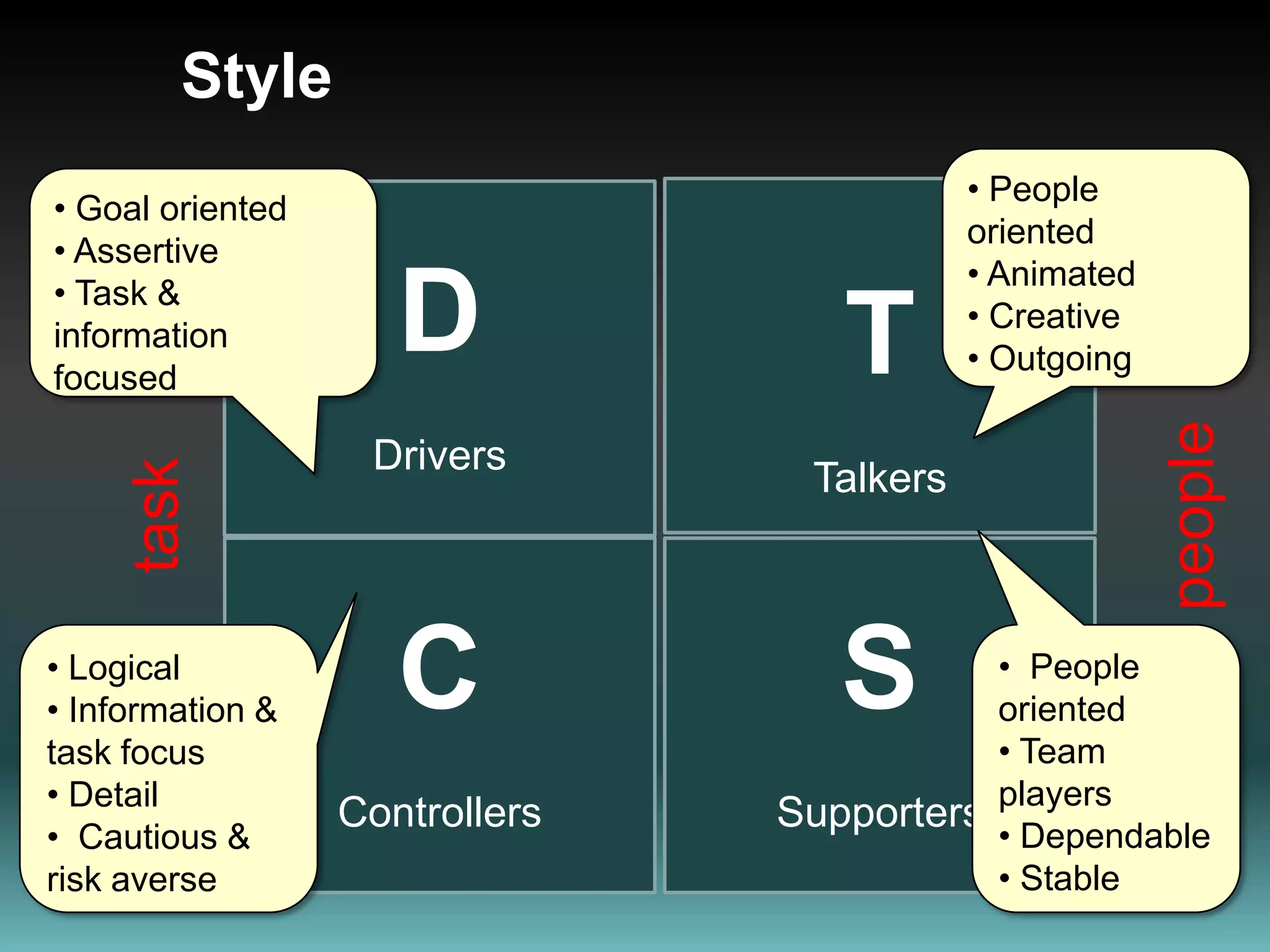
Understanding ‘how’ to CommunicateStyle preferencePerson’s orientation towards process vs. results Need for recognition vs. need for securityCommunication Channels preferenceVisual, Auditory, Kinaesthetic What type of medium for the message How best to document and display the information
Style People oriented
 Animated
 Creative
 Outgoing
 Goal oriented
 Assertive
 Task & information focusedTTalkersDDriverstaskpeopleSSupportersCControllers Logical
 Information & task focus
 Detail
  Cautious & risk averse
  People oriented
 Team players
 Dependable
 StableKnow your own style & preferenceStakeholders may have a very different style to me “Driver”/“Controller” – analytical & results focused, need to bring people along rather than trying to push too hardUse the strengths of your style & adapt  to the different stakeholders on a projectNo particular style is better than anotherContextual and situational so be flexible
Communication ChannelsPeople learn different waysV= Visual (Something ‘seen’ or visual stimulation)Need a graphic representation A= Auditory (A ‘sound’ memory or related to a soundNeed to hear the explanation of how things workK= Kinaesthetic (Has a ‘doing’ memory, feeling the emotion or activity of the memoryNeed to use the system to understand
ActivityWrite 5 words or phrases that relate to the words: Beach and OceanPlace a V, an A, or a K against each:V=visual (Something ‘seen’ or had visual stimulation) e.g. See the blue sky, see children playing in the waterA=Auditory (A ‘sound’ memory or related to a sound e.g. Hear the waves against the shoreK=Kinaesthetic (Has a ‘doing’ memory & you thought of yourself feeling the emotion) e.g. Feel the sun and the sand, the taste of salt
How to support learning in users
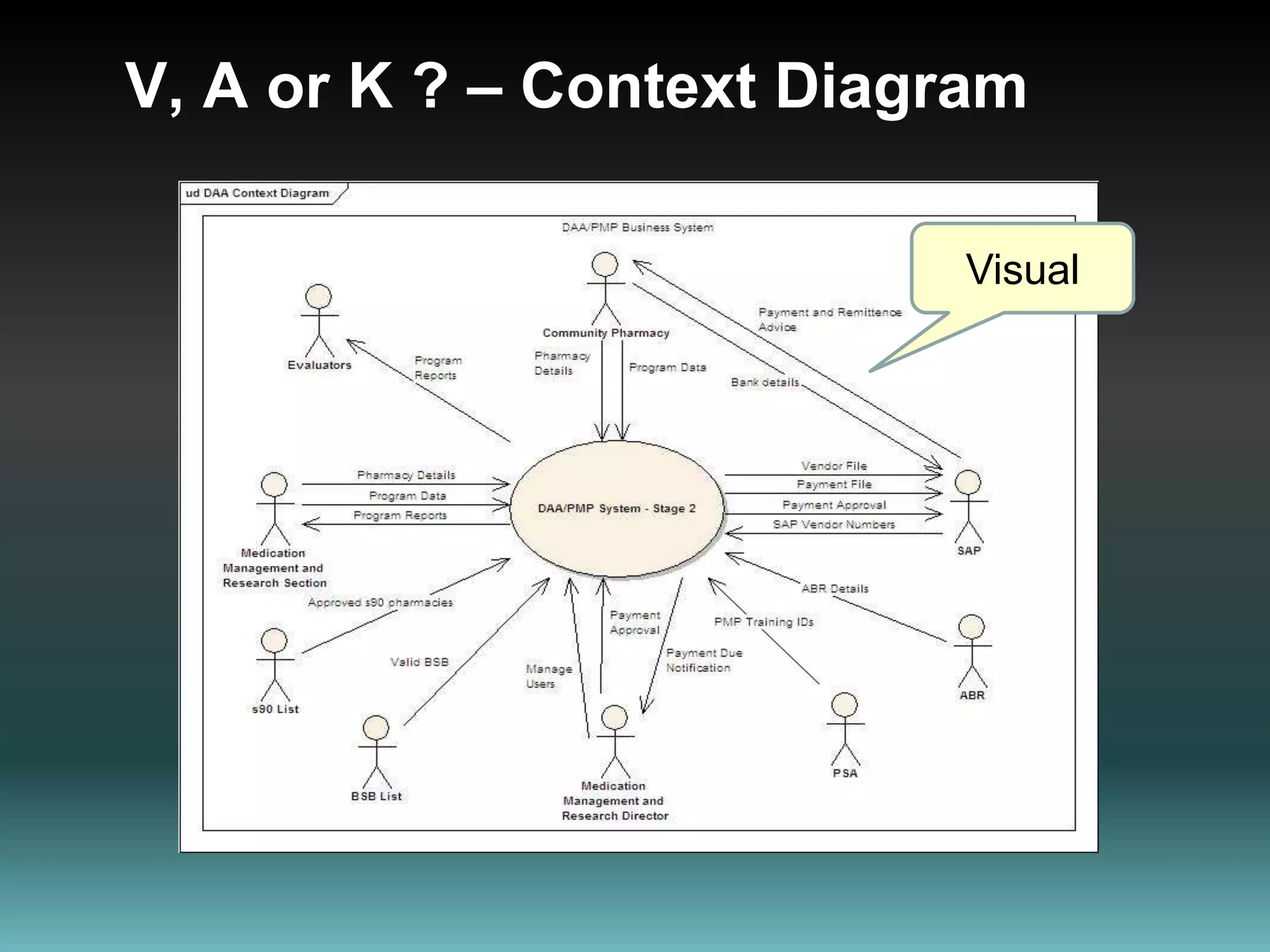
V, A or K ? – Context DiagramVisual
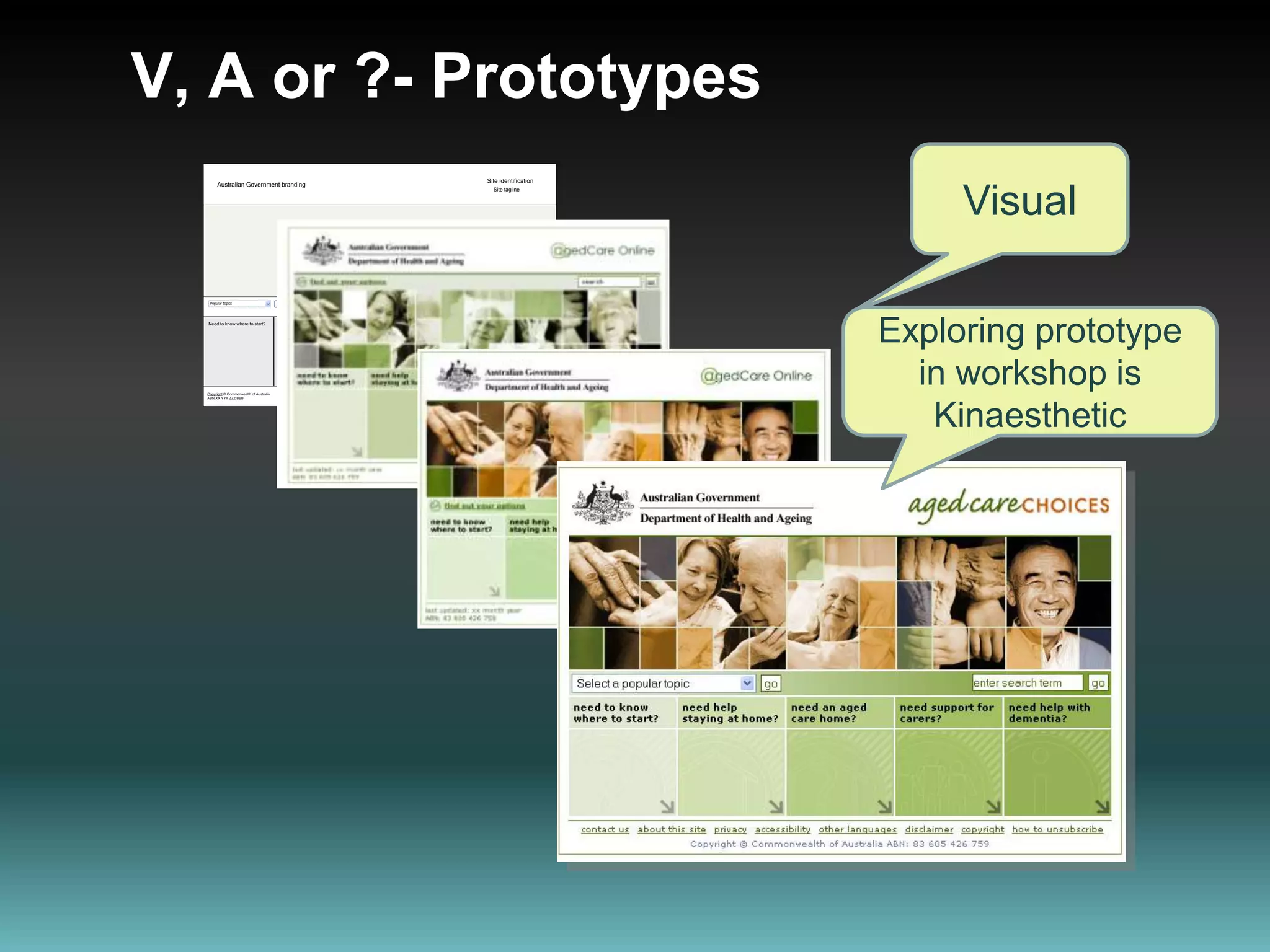
V, A or ?- PrototypesVisualExploring prototype in workshop is Kinaesthetic
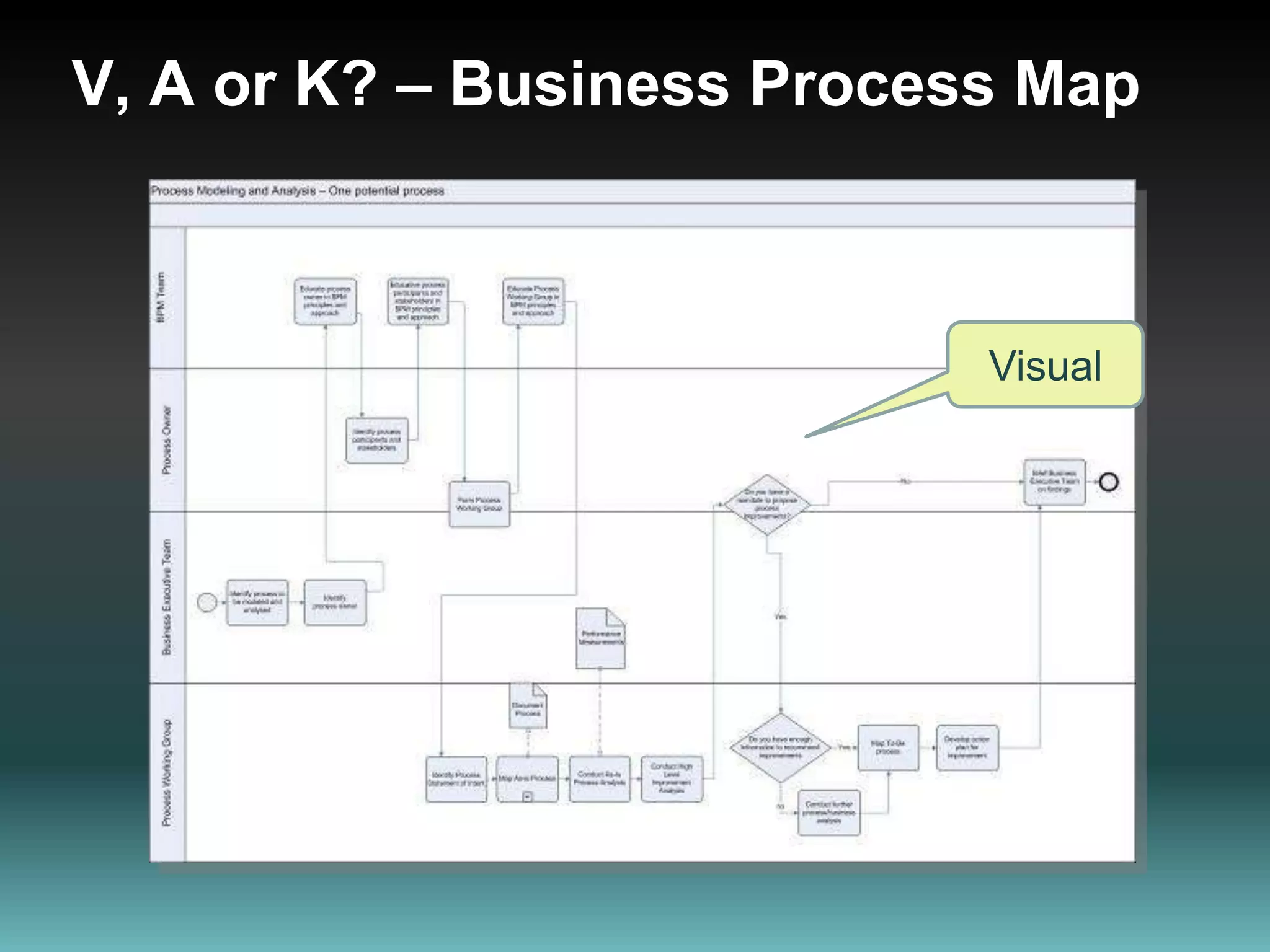
V, A or K? – Business Process MapVisual
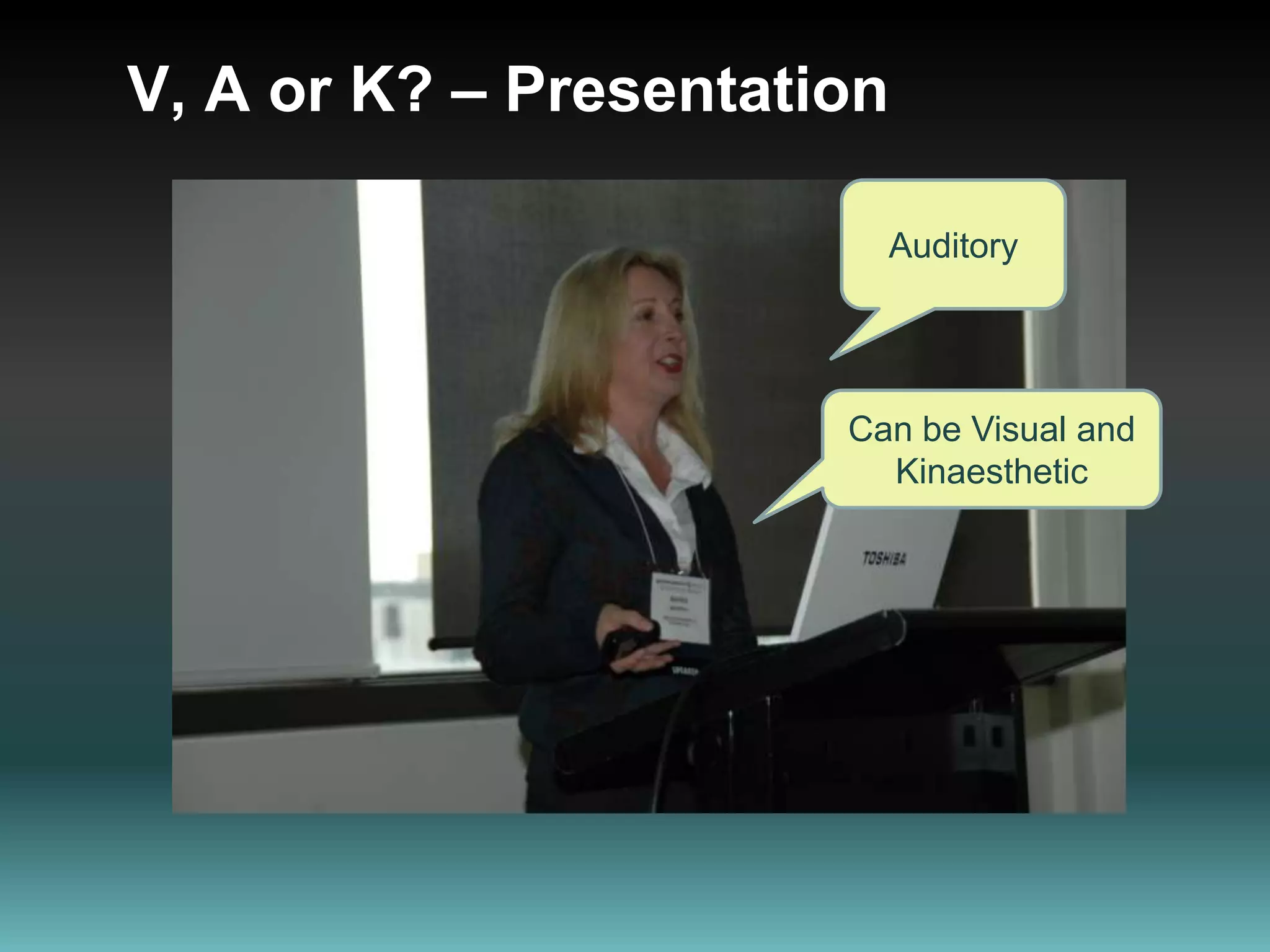
V, A or K? – PresentationAuditoryCan be Visual and Kinaesthetic
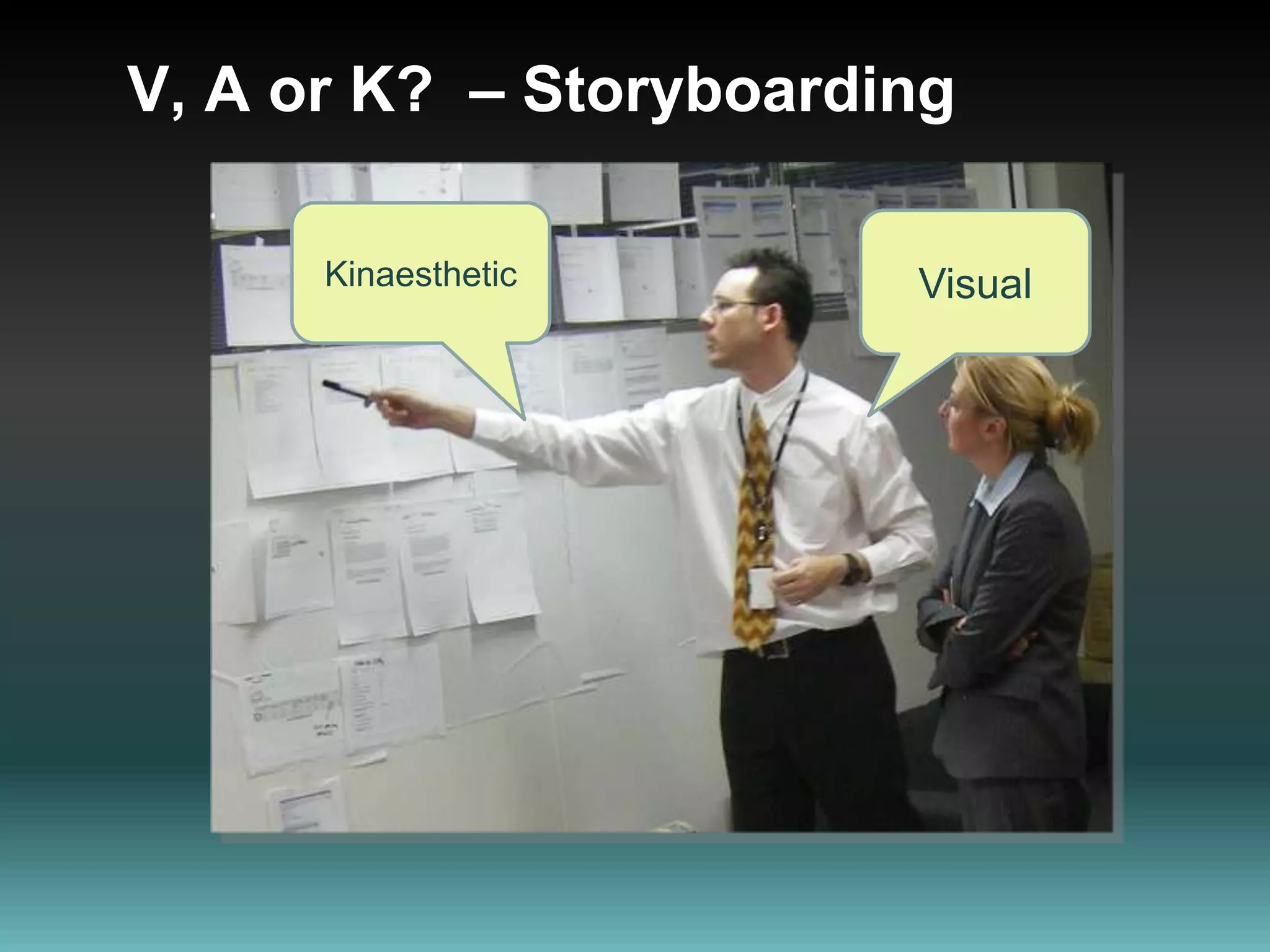
V, A or K?  – StoryboardingKinaestheticVisual
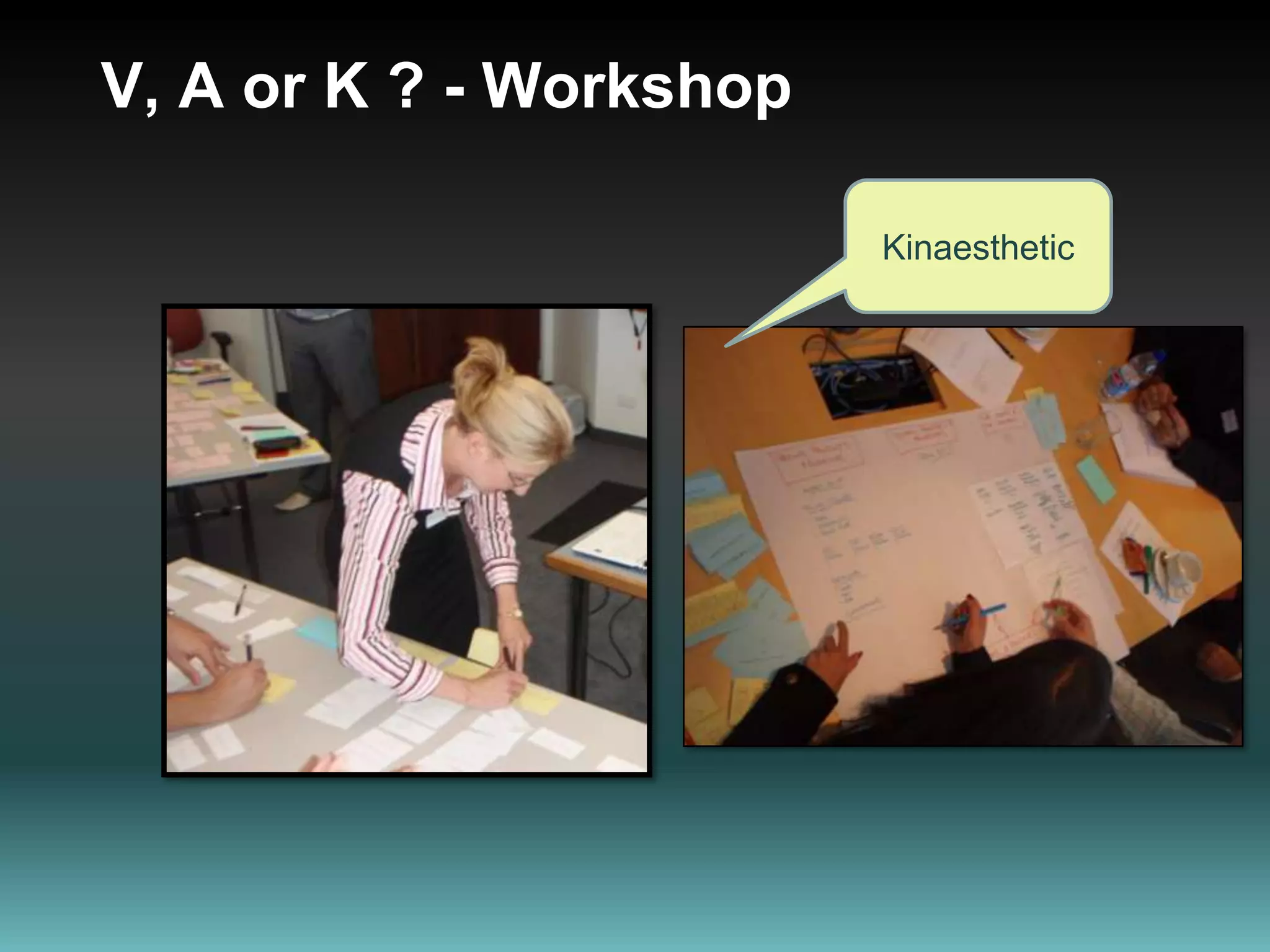
V, A or K ? - WorkshopKinaesthetic
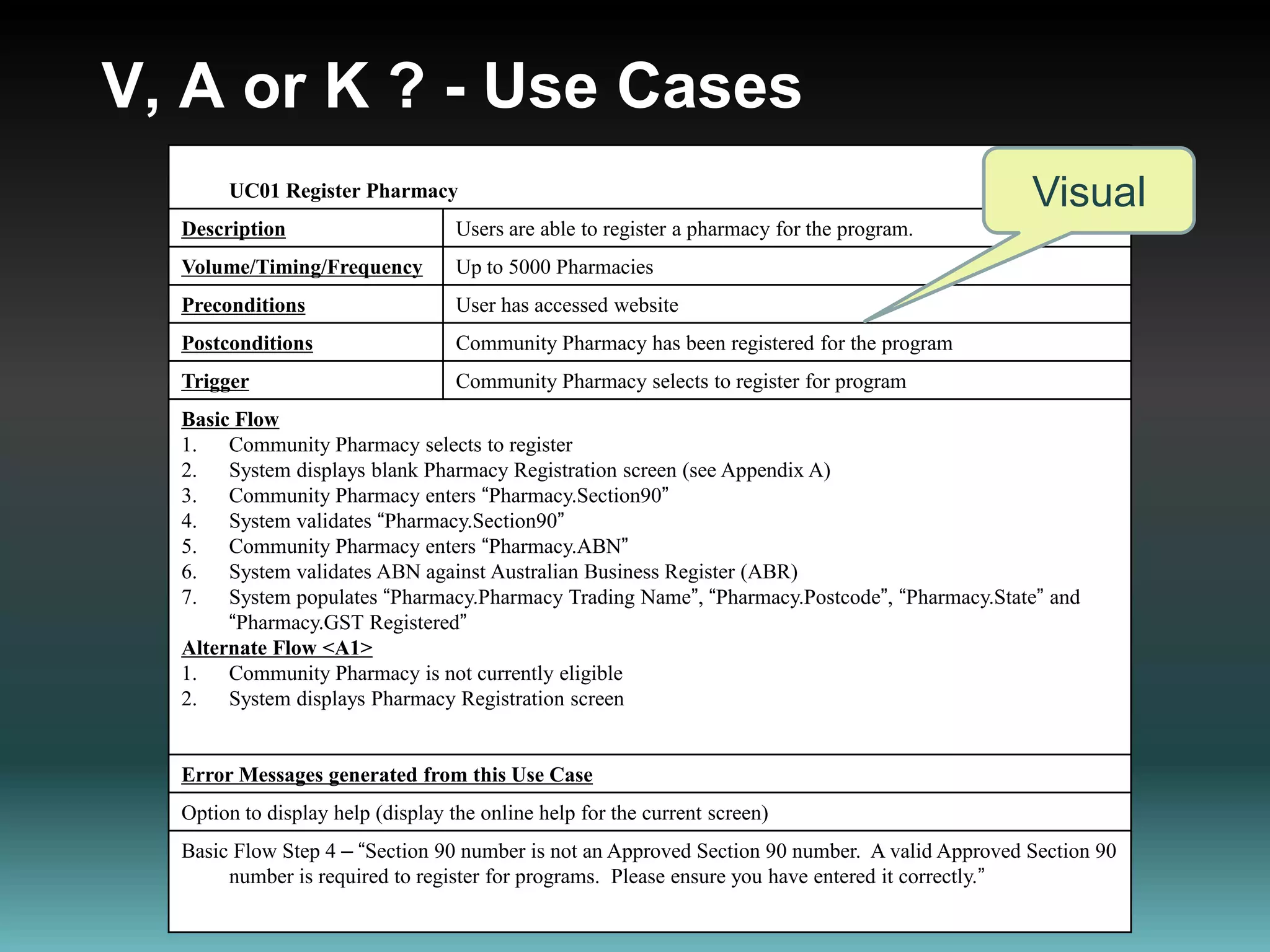
V, A or K ? - Use CasesVisual

Final communication and connectedness v3

  • 1.
    Communication and Connectednessin Business Analysis Maria Horrigan Principal Consultant BA World Sept 2009
  • 2.
  • 3.
    Information and knowledgeHumanabsorptive capacityGrowthTimeCohen & Levinthal 1989A world of rapidly growing knowledge ….
  • 4.
    ....that is increasinglyconnectedlocalnetworksoldcolleagues..and is just a click awaycolleaguesat other officesnew friendsfamilylocalcolleaguesold friendsvirtualcommunities old classmates
  • 5.
    Modern IT ApplicationProjectsPeople demand to be heardPeople expect to be involvedPeople’s expectations of how good systems are is based on their experience of modern internet ..that means the Google World - Gmail, Google Search, Facebook, Flickr and YouTube of the “Nintendo” generation
  • 6.
    What does theirexpectation mean?Project success hinges on communicating with people:To understand what they wantTo set expectations about what the project will actually deliver (and what it won’t)To show them how the project will help them in their workTo uncover what they need . . .
  • 7.
    …sometimes they don’tknow what they need
  • 8.
    What’s their requirementof you?Knowing how to talk to people & get the info you need to write requirementsEffectively negotiating with important stakeholdersGetting the right messages to the right people at the right timeAn understanding of both the ‘big picture’ and the detail Understand the context & the situation
  • 9.
    Role of Business Analyst is key!The Communicator The TranslatorThe Juggler of technology and people’s needsThe one between the rock and a hard placeThe Connector (bridge)
  • 10.
    How do wedo all this Communications Stuff Effectively?Analysethe stakeholders needs and wants, how they are connected and whyUnderstand how they communicate, their preference and styleLearnthe project in the context of people’s work and how this fits into the wider organisational context
  • 11.
    analyse stakeholdersTheir needsand wants, their connections to others
  • 12.
    “It’s not whatyou know, it’s who you know”Me and Bill GatesMe and Brad
  • 13.
    Analysing “who iswho in the zoo”Who to talk toWho has influenceWho knows the business needs What drives & motivates people’s work behaviour How to talk to them How to tailor the communication to these different people
  • 14.
    Multiplicity of networks official vs. unofficialAdvice - Who do you go to for advice? Who goes to you for advice?Collaboration - Who do you collaborate with?How do you collaborate (social media)Trust - Who do you trust?Who is your friend?Conflict - Who is a blocker or gatekeeper?
  • 15.
    Social Networking AnalysisMathematical,graphical, theoretical understanding of the social worldMapping, understanding, analysing and measuring interactions across a network of people, groups, organisations, computers, and websitesUncovers networks and their structures Identifies flows of information & knowledgeFosters knowledge sharing
  • 16.
    Understanding Social Networksthe location of actors in the networkthe various roles and groupings in a network Gives insight into:who are the connectors, experts, leaders, bridges, isolates, the core or hub?where are the clusters and who is in them?who is on the periphery?
  • 17.
    Six Degrees ofSeparation
  • 18.
  • 19.
    Centrality : revealingnetwork structure Very centralized network dominated by one or a few very central nodes, if removed, network fragments & fails Less centralized network resilient in the face of attacks, many nodes can fail yet allow remaining to still reach each other Boundary Spanners connect their group to others, positioned to be innovators as have access to ideas/info in other clusters Periphery of a network may connect to networks not currently mapped, important sources for fresh information
  • 20.
    Dimensions to effectiveuse of a Network Knowledge - Knowing what someone knowsAccess - Gaining timely access to that personEngagement - Creating viable knowledge through cognitive engagementSafety - Learning from a safe relationshipCross, Parker and Borgatti, 2002
  • 21.
    Use of SNAto model users’ network and map the relationships between people, groups, organisations and information.Case Study
  • 22.
    Context - NewSystem to support assessment of applications for fundingStarted with waterfall analysis (2 years of gathering requirements)No idea what the end solution would be like (very political, high profile project)Processes not well documentedLarge organisational change projectExternal industry pressure for it to happen
  • 23.
    Problem to besolvedMultiple stakeholders across silosInformation flows between individuals and groups not well knownLimited documentation of information and processes (in people’s heads)Terminology and Language issues
  • 24.
    What we didDesignteam adopted an agile approachPartnered BAs with IA to lead three streams of activities SNA of key players (needed to know the information needs of these key users)Needed “skinny” documentation to quickly convey understanding to stakeholders of the key features of the system and its processes and the flow of information
  • 25.
  • 26.
    Degree of Centralityin NetworkHub has most connections – authority gainedIt not the “more connections the better”, but where they lead to…..and how they connect the otherwise unconnected
  • 27.
    Centrality and BetweennessGreatinfluence over what flows (and does not)“location location location”Broker role between Business and IT
  • 28.
    Centrality and ClosenessShortestpath to all others – gives quick accessExcellent position to monitor info flowsBest visibility of what is happening in the network
  • 29.
    Project Case StudySupporterKeyUserGatekeeperInfluencerBoundary SpannerProject ChampionKey decision makerFacilitatorPotential blockerTrusted advisorPeripheryKey User
  • 30.
    Access to moreKnowledge and Info… but of course these are just a subsection of the networked organisationMap shows 1st & 2nd degree relationships Someone on the periphery of your network may have access to many other networks within the organisation
  • 31.
    What did IlearnGetting the right people involved can be the difference between success & failureTake the time to do upfront stakeholder analysis & plan the stakeholder activities Build the team based on JIT assessment of what’s needed for the project – works well when you know who is who Involve users in validation will increase adoption of and buy-in to the final solution
  • 32.
    Need to knowthe Team Capability & Tailor Communication to meet their needsWhat competencies do they bring to the teamWhat is the role of the BA?Who else in the wider network could help contribute to the solution?
  • 33.
  • 34.
    Project Six Degreesof SeparationYou may only be one or two degrees away from some who know the info you needProject teams can be connected and lessons learnt and reuse made possible
  • 35.
    Leveraging CentralityLeverage projectchampions Understand who might be “blockers” or “gatekeepers” Find the “go to people” to elicit infoDon’t reinvent the wheelCommunicate - understand their lessons learnt to improve likelihood of success Know who to communicate key messages
  • 36.
    Now we knowwho, we need to know how…..How they communicate, their preference for style & communication channelsUnderstanding stakeholders
  • 37.
    Understanding ‘how’ toCommunicateStyle preferencePerson’s orientation towards process vs. results Need for recognition vs. need for securityCommunication Channels preferenceVisual, Auditory, Kinaesthetic What type of medium for the message How best to document and display the information
  • 38.
  • 39.
  • 40.
  • 41.
  • 42.
  • 43.
  • 44.
    Task &information focusedTTalkersDDriverstaskpeopleSSupportersCControllers Logical
  • 45.
    Information &task focus
  • 46.
  • 47.
    Cautious& risk averse
  • 48.
    Peopleoriented
  • 49.
  • 50.
  • 51.
    StableKnow yourown style & preferenceStakeholders may have a very different style to me “Driver”/“Controller” – analytical & results focused, need to bring people along rather than trying to push too hardUse the strengths of your style & adapt to the different stakeholders on a projectNo particular style is better than anotherContextual and situational so be flexible
  • 52.
    Communication ChannelsPeople learndifferent waysV= Visual (Something ‘seen’ or visual stimulation)Need a graphic representation A= Auditory (A ‘sound’ memory or related to a soundNeed to hear the explanation of how things workK= Kinaesthetic (Has a ‘doing’ memory, feeling the emotion or activity of the memoryNeed to use the system to understand
  • 53.
    ActivityWrite 5 wordsor phrases that relate to the words: Beach and OceanPlace a V, an A, or a K against each:V=visual (Something ‘seen’ or had visual stimulation) e.g. See the blue sky, see children playing in the waterA=Auditory (A ‘sound’ memory or related to a sound e.g. Hear the waves against the shoreK=Kinaesthetic (Has a ‘doing’ memory & you thought of yourself feeling the emotion) e.g. Feel the sun and the sand, the taste of salt
  • 54.
    How to supportlearning in users
  • 55.
    V, A orK ? – Context DiagramVisual
  • 56.
    V, A or?- PrototypesVisualExploring prototype in workshop is Kinaesthetic
  • 57.
    V, A orK? – Business Process MapVisual
  • 58.
    V, A orK? – PresentationAuditoryCan be Visual and Kinaesthetic
  • 59.
    V, A orK? – StoryboardingKinaestheticVisual
  • 60.
    V, A orK ? - WorkshopKinaesthetic
  • 61.
    V, A orK ? - Use CasesVisual
  • 62.
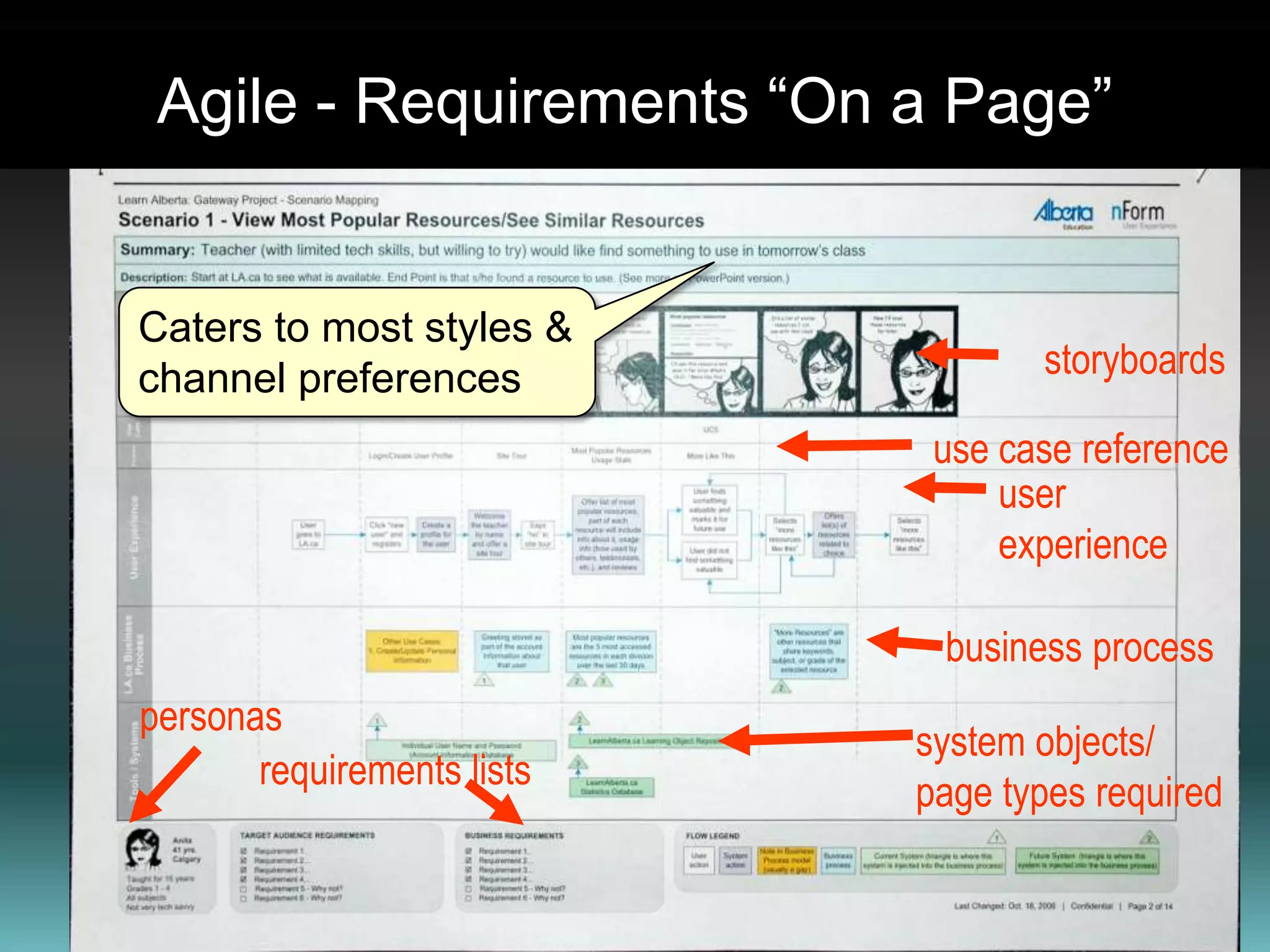
    storyboardsuse case referenceuserexperiencebusiness processpersonassystem objects/page types requiredrequirements listsAgile - Requirements “On a Page”Caters to most styles & channel preferences
  • 63.
    How they LearnBestBA Tools: Context Diagrams
  • 64.
  • 65.
  • 66.
  • 67.
    StoryboardsBest BATools: Discuss User scenarios (their story)
  • 68.
  • 69.
    PodcastsBest BATools: Prototypes
  • 70.
  • 71.
    UAT (UserAcceptance Testing)Know the project in the context of people’s work and how this fits into the wider organisational contextLearn the Context
  • 72.
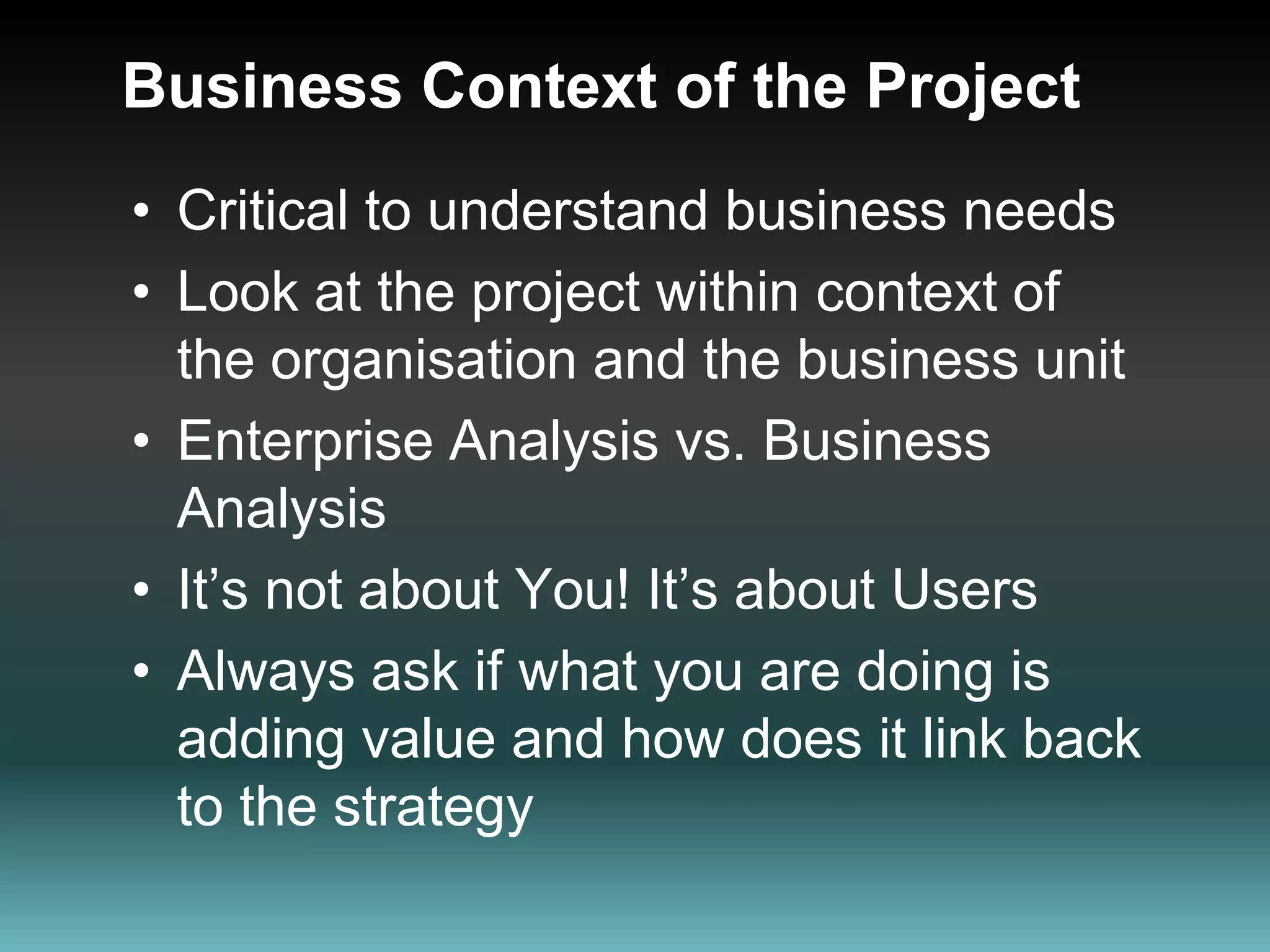
    Business Context ofthe ProjectCritical to understand business needsLook at the project within context of the organisation and the business unitEnterprise Analysis vs. Business AnalysisIt’s not about You! It’s about UsersAlways ask if what you are doing is adding value and how does it link back to the strategy
  • 73.
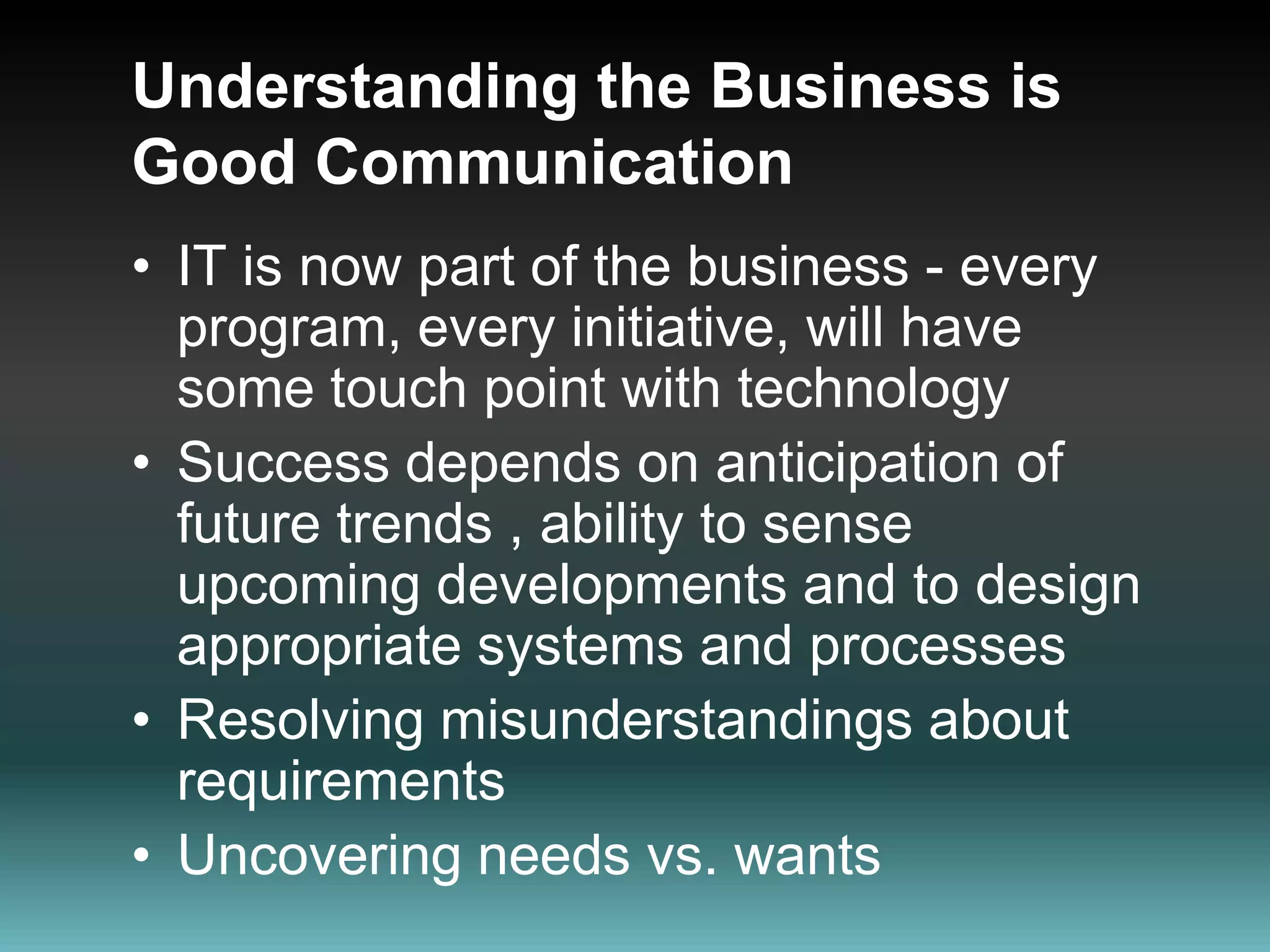
    Understanding the Businessis Good CommunicationIT is now part of the business - every program, every initiative, will have some touch point with technologySuccess depends on anticipation of future trends , ability to sense upcoming developments and to design appropriate systems and processes Resolving misunderstandings about requirements Uncovering needs vs. wants
  • 74.
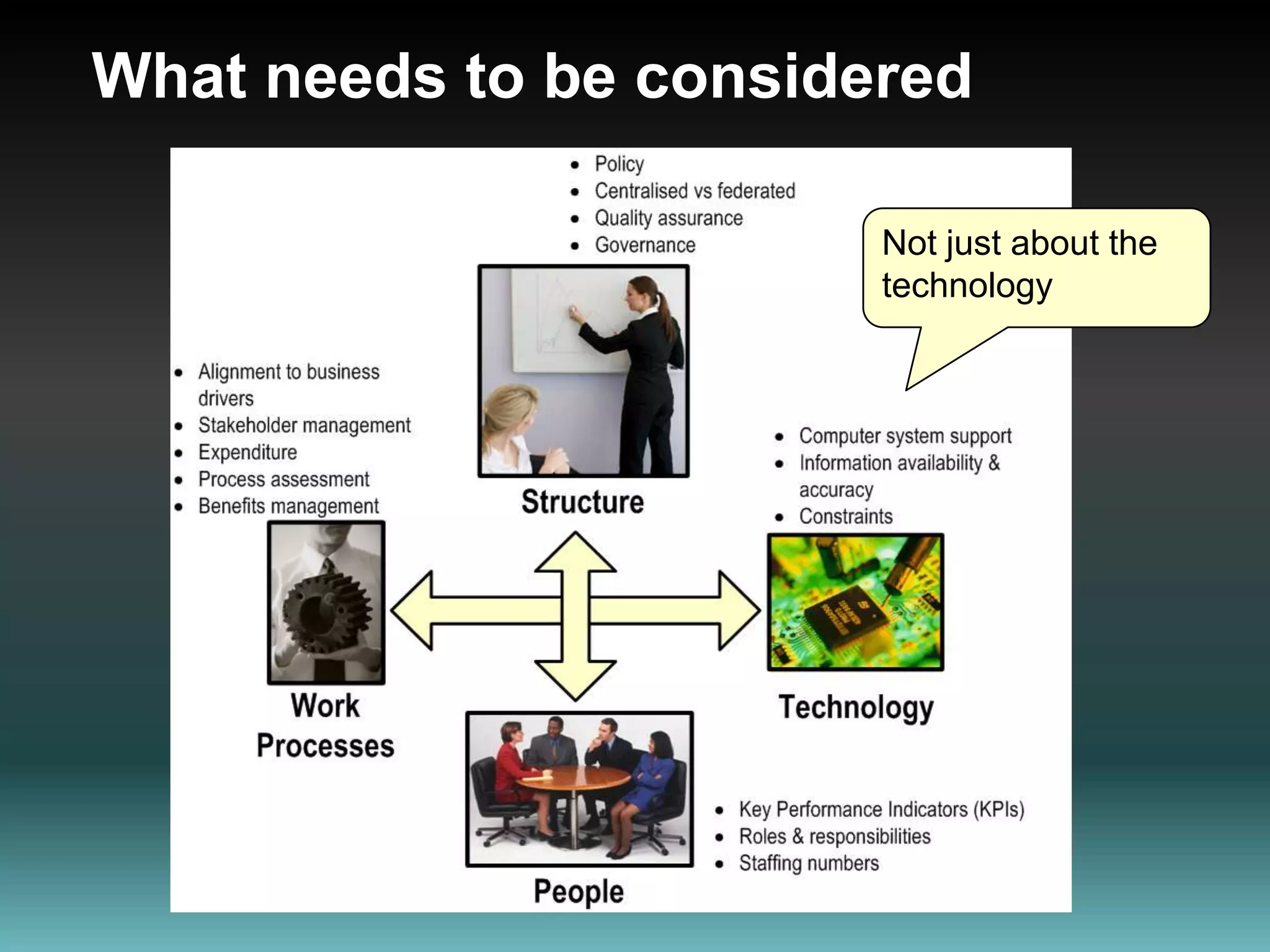
    What needs tobe consideredNot just about the technology
  • 75.
  • 76.
  • 77.
    Take Home messagesProjectscan be more successful if:You take the time to analyse the people, relationships, connections between themYou understand communication preferences will vary amongst stakeholdersAre flexible and adapt your style and channel to you audienceCommunicate as have a key role as translator to bridge the gap between technology and the work people need to do Get the right people working on the solution
  • 78.
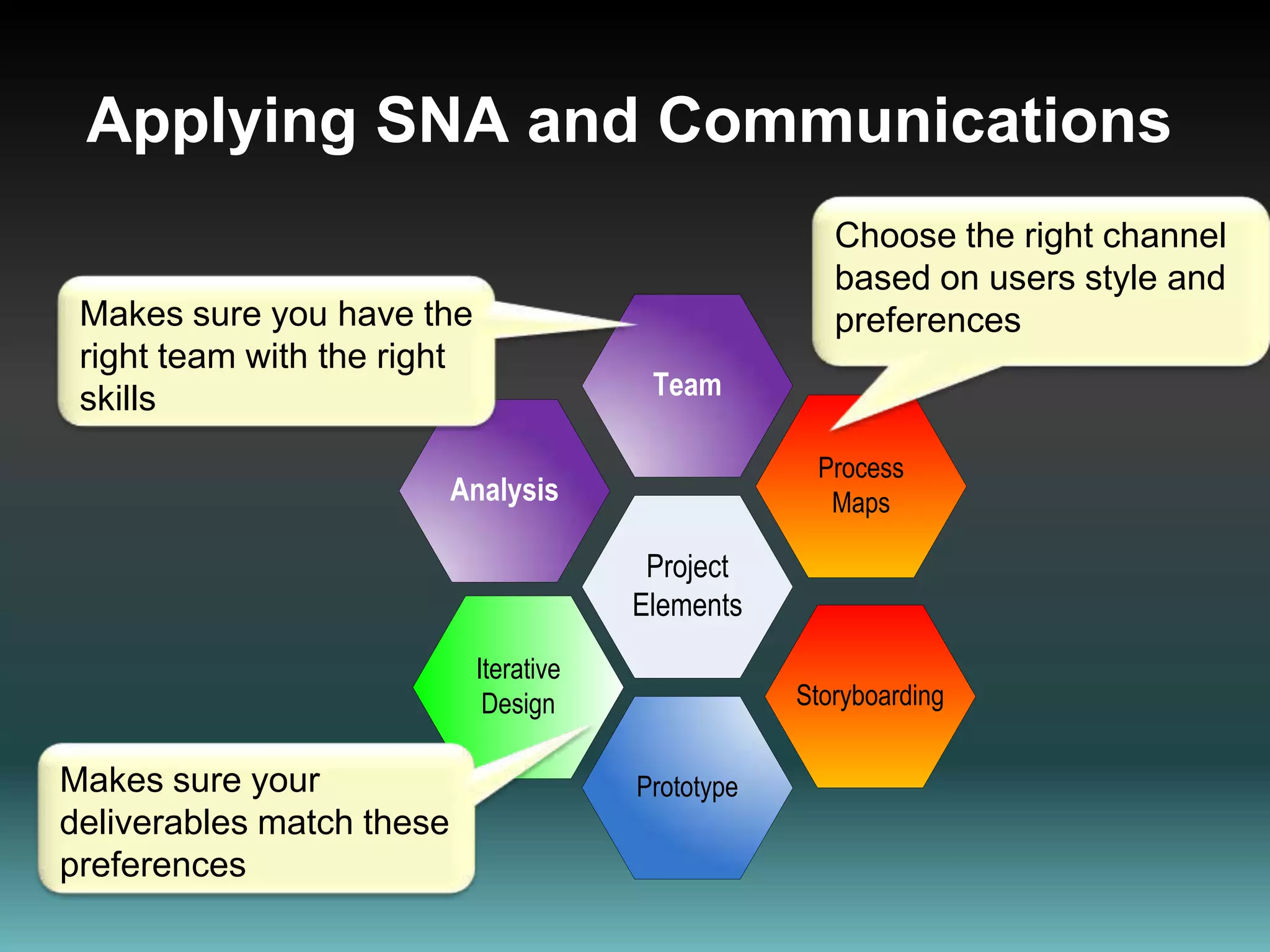
    Applying SNA andCommunicationsChoose the right channel based on users style and preferencesMakes sure you have the right team with the right skillsMakes sure your deliverables match these preferences
  • 79.
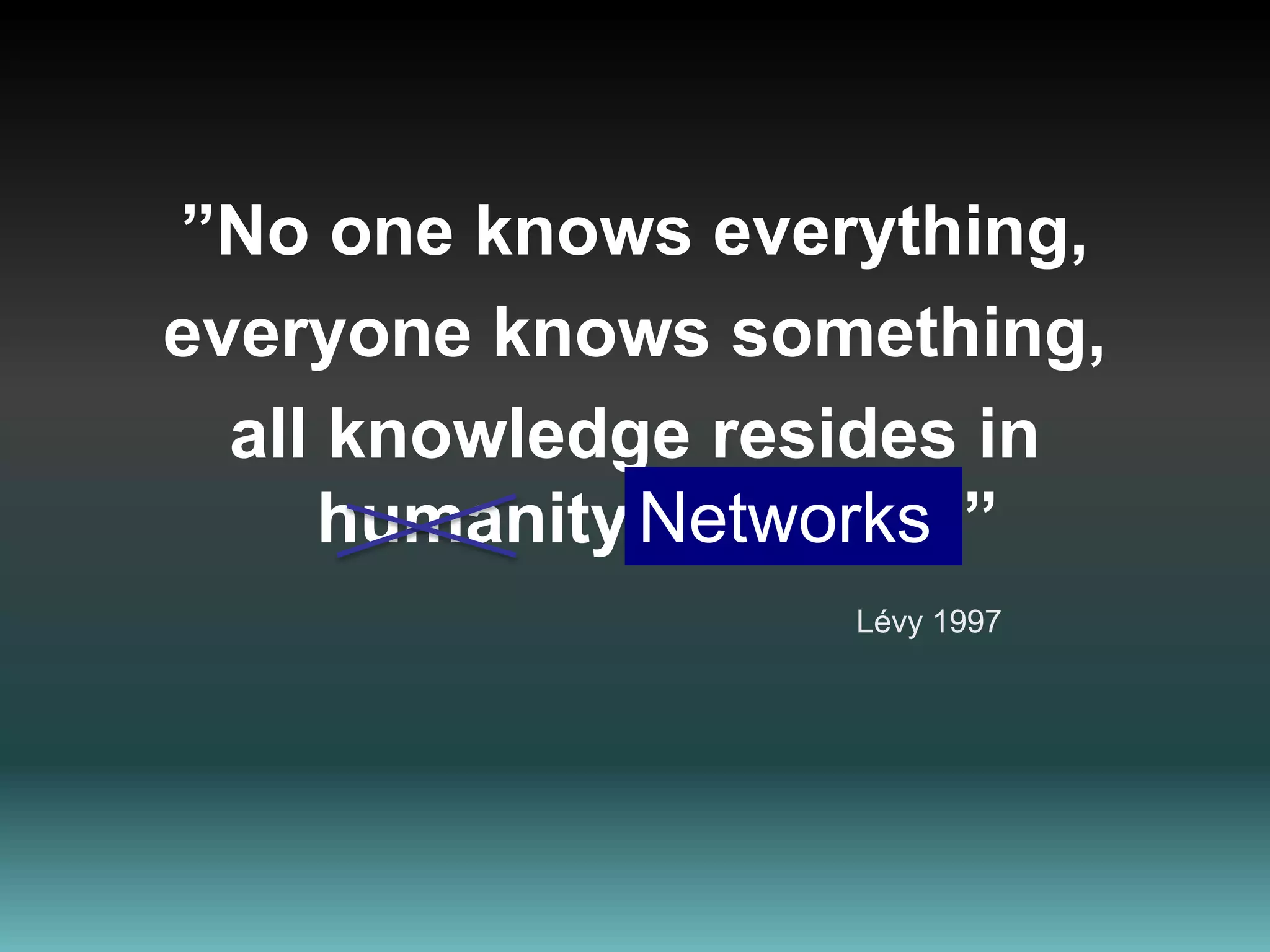
    ”No one knowseverything, everyone knows something, all knowledge resides in humanity ”Networks Lévy 1997
  • 80.
    Fin.Maria Horrigan Principal ConsultantEmail:Maria.horrigan@oakton.com.auBlog: www.barocks.com zenagile.worpress.comSlideshare:www.slideshare.com/murphTwitter: @miahorri

Editor's Notes