DATE: 06/03/2014
LIPID
OXIDATION
Causes & Prevention
Sadanand Patel
Presentation Pattern
 Rancidity(brief), Types
 Hydrolytic rancidity(brief)
 Oxidative rancidity and ways and outline
 Photo-oxidation(detail)
 Auto-oxidation(detail)
 Feasibility of reactions: Pro-oxidants
 Comparison b/w Photo and Auto-oxidation
 Hydroperoxides decomposition(brief)
 Factors affecting Lipoxidation(detail)
 Anti-oxidant, types and mechanism(detail)
 Measurement of Oxidative rancidity(brief)
 Fat oxidation characteristic curve and induction period
 General information
 Quick history of Lipoxidation
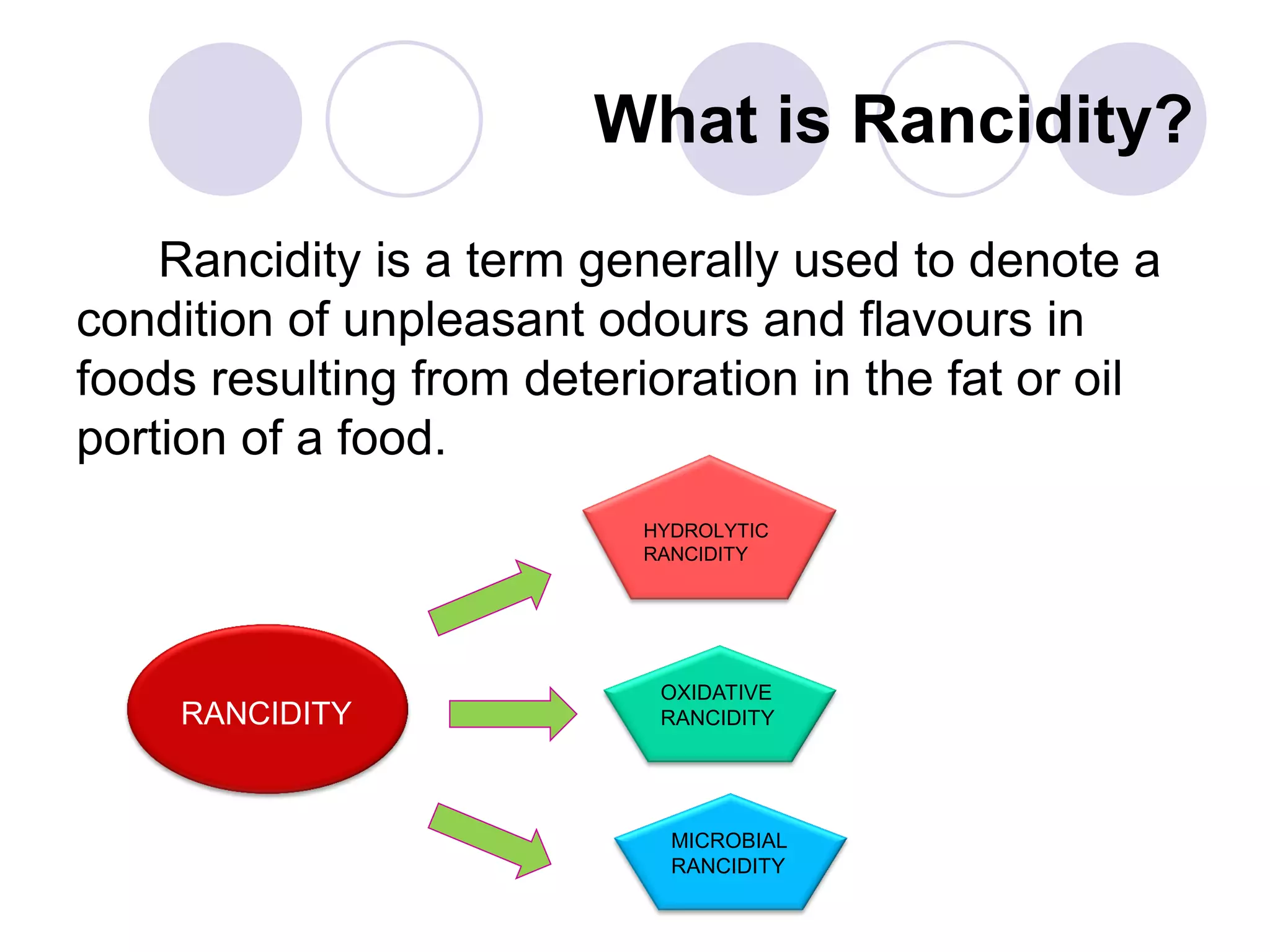
What is Rancidity?
Rancidity is a term generally used to denote a
condition of unpleasant odours and flavours in
foods resulting from deterioration in the fat or oil
portion of a food.
RANCIDITY
HYDROLYTIC
RANCIDITY
OXIDATIVE
RANCIDITY
MICROBIAL
RANCIDITY
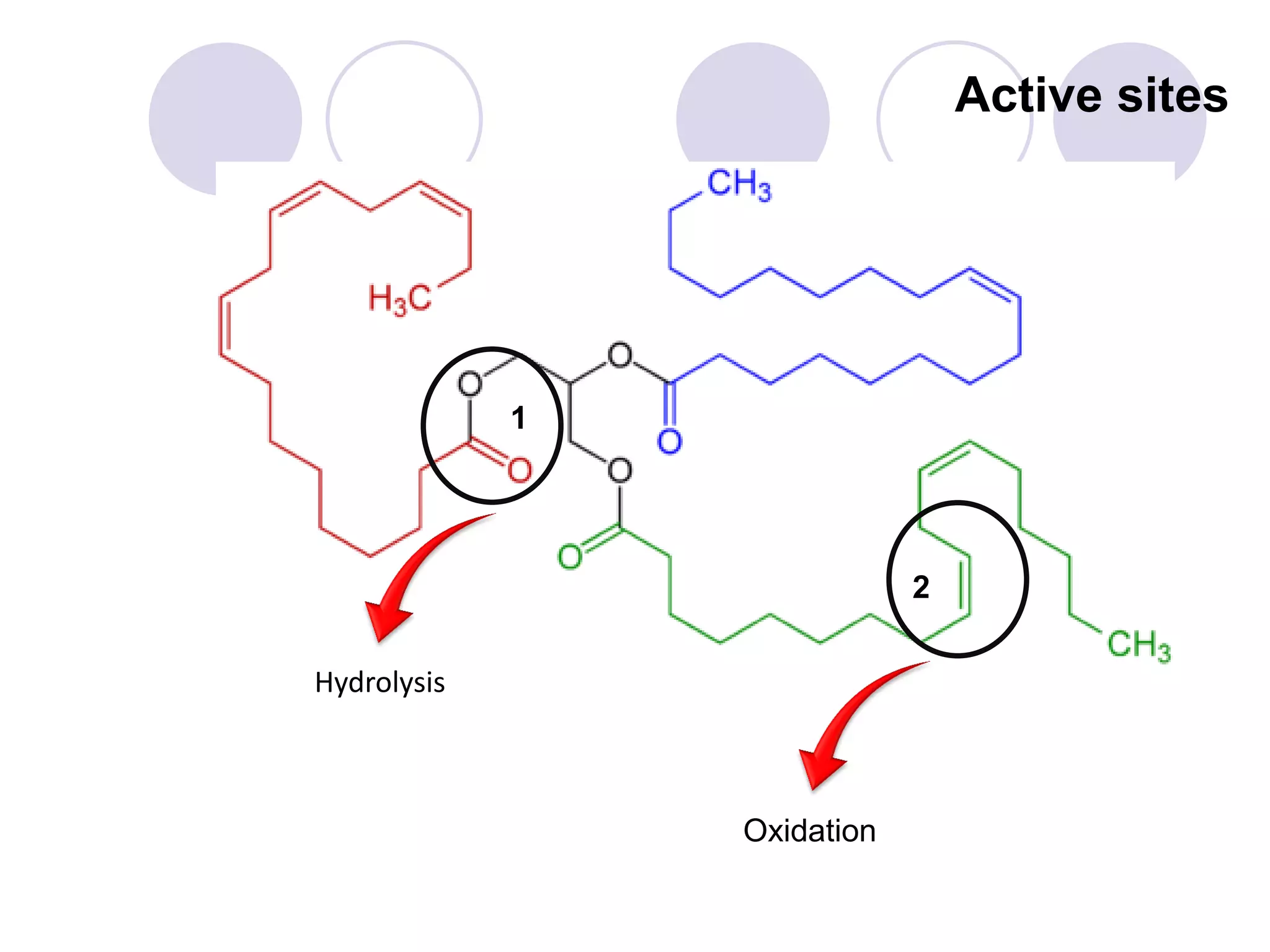
Active sites
Oxidation
Hydrolysis
1
2
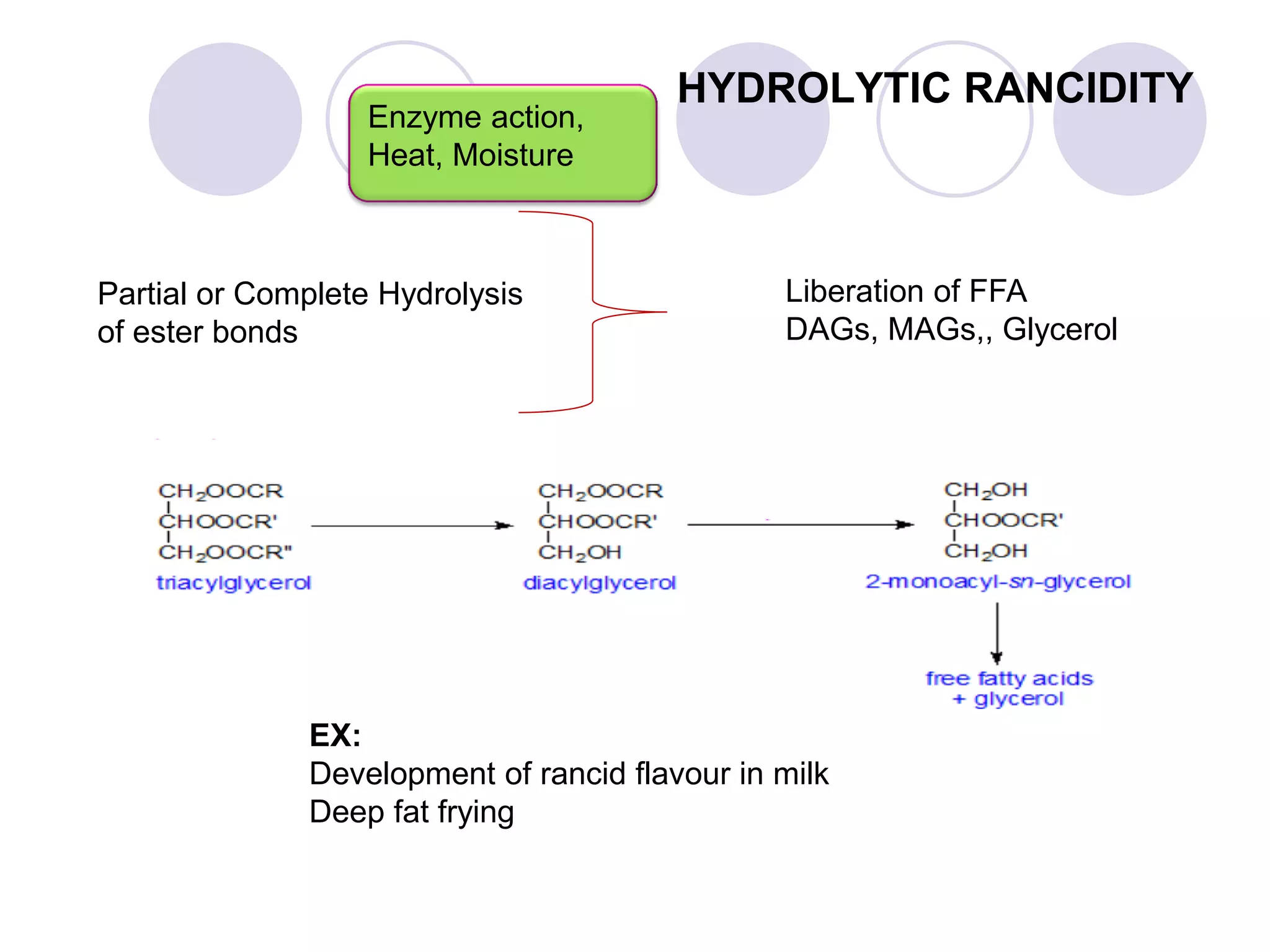
HYDROLYTIC RANCIDITY
Partial or Complete Hydrolysis
of ester bonds
Liberation of FFA
DAGs, MAGs,, Glycerol
EX:
Development of rancid flavour in milk
Deep fat frying
Enzyme action,
Heat, Moisture
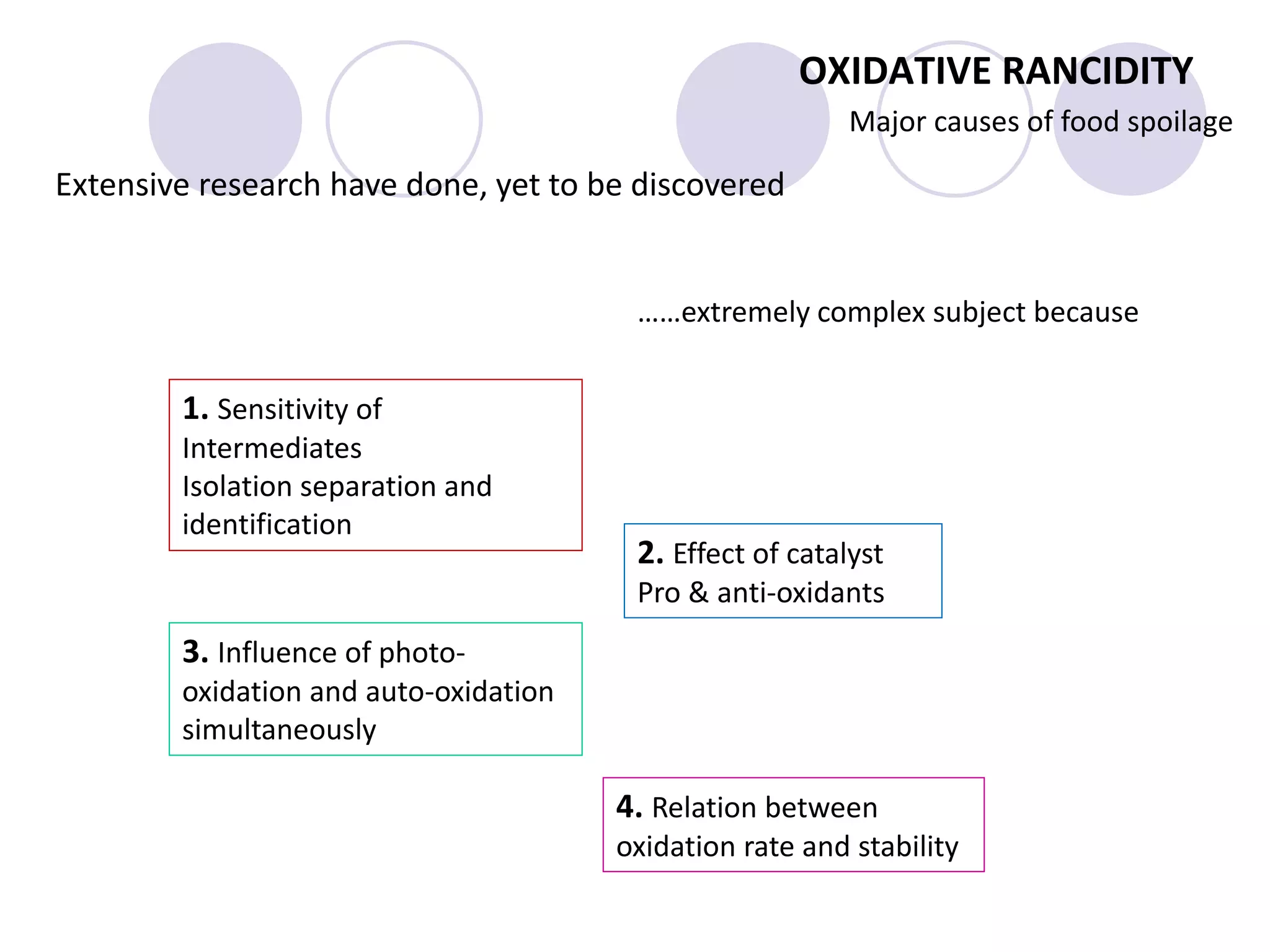
OXIDATIVE RANCIDITY
Major causes of food spoilage
Extensive research have done, yet to be discovered
……extremely complex subject because
1. Sensitivity of
Intermediates
Isolation separation and
identification
2. Effect of catalyst
Pro & anti-oxidants
3. Influence of photo-
oxidation and auto-oxidation
simultaneously
4. Relation between
oxidation rate and stability
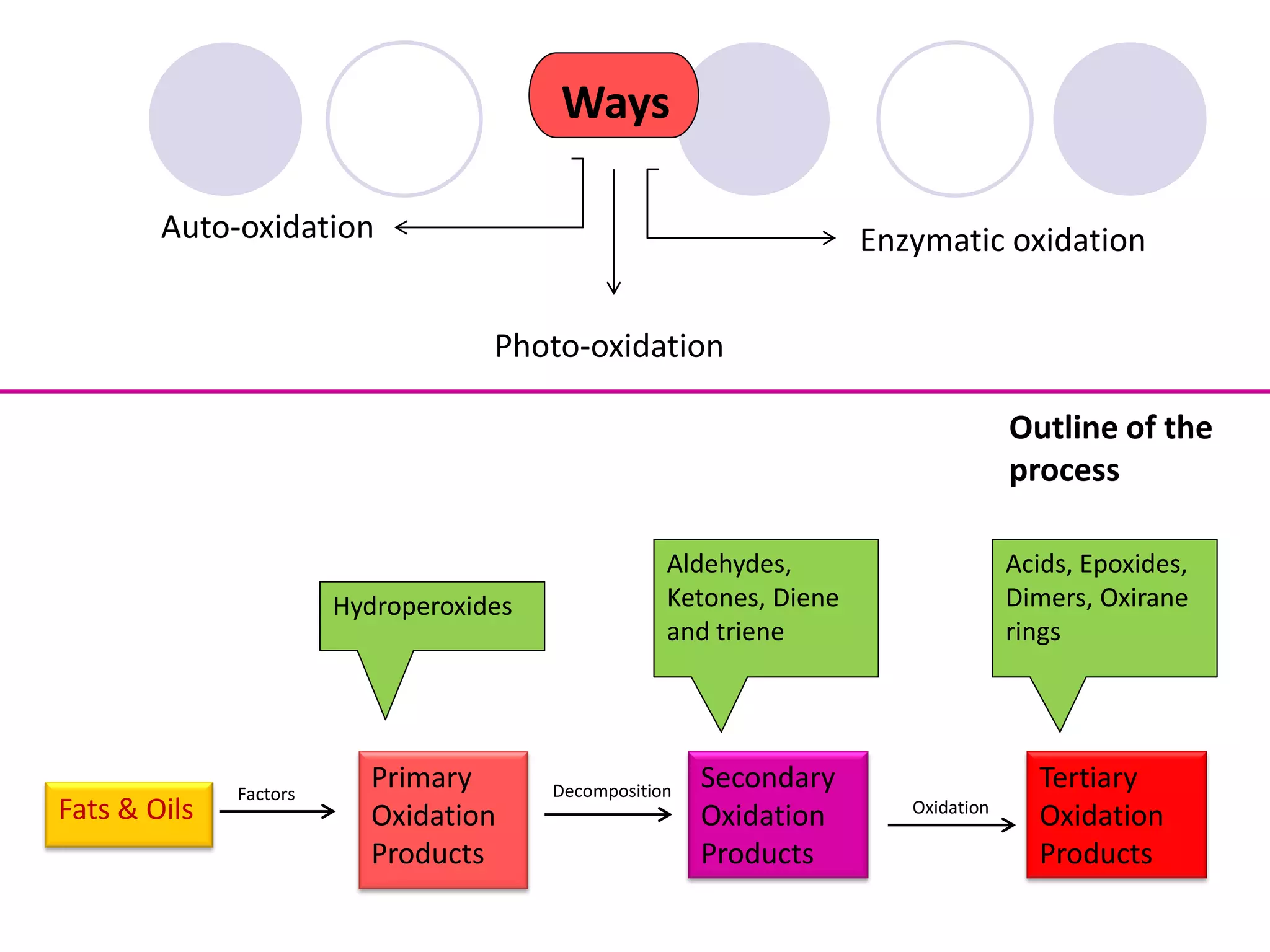
Photo-oxidation
Enzymatic oxidationAuto-oxidation
Ways
Fats & Oils
Primary
Oxidation
Products
Secondary
Oxidation
Products
Tertiary
Oxidation
Products
Factors Decomposition
Oxidation
Hydroperoxides
Aldehydes,
Ketones, Diene
and triene
Acids, Epoxides,
Dimers, Oxirane
rings
Outline of the
process
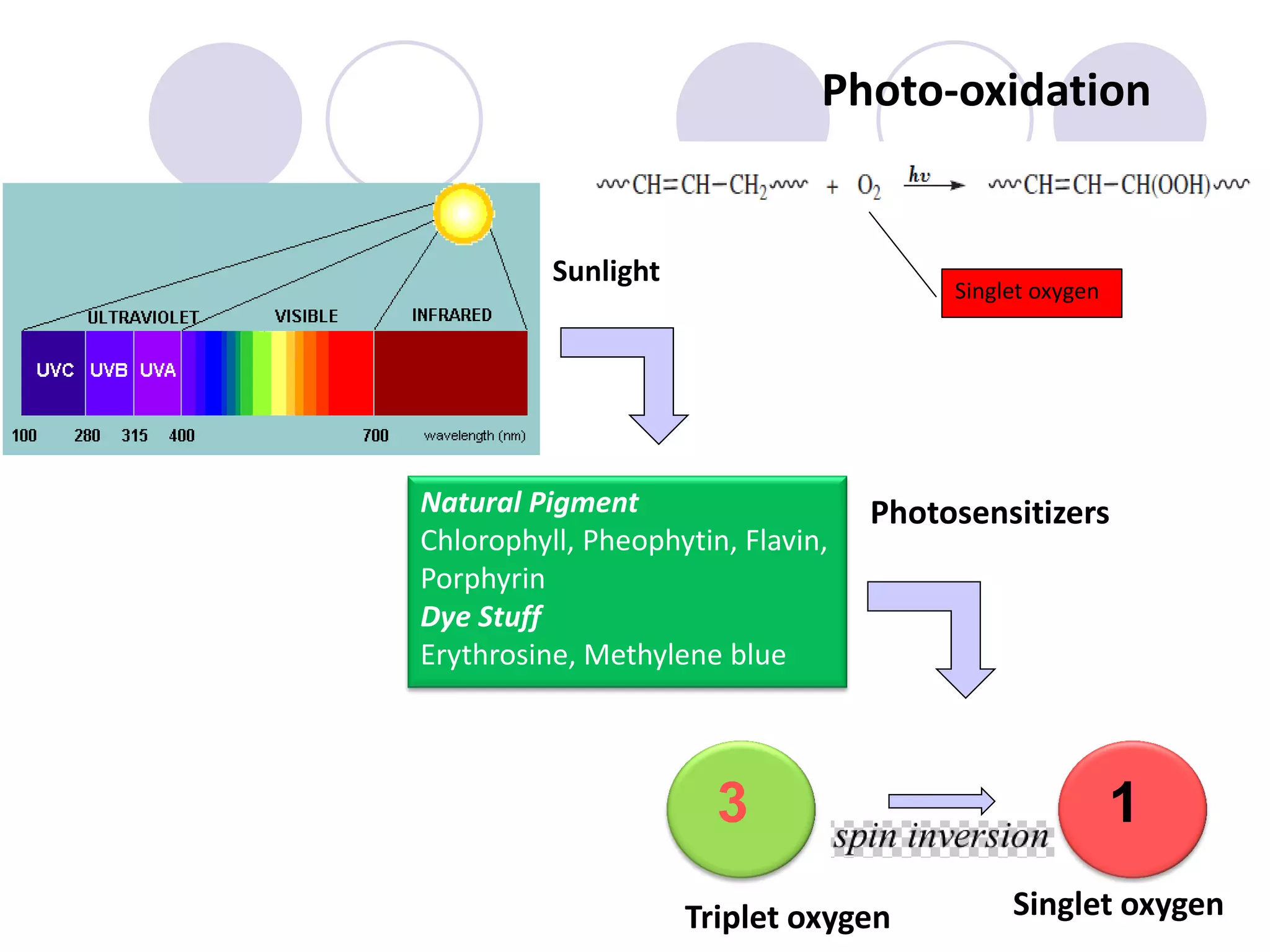
Photo-oxidation
Sunlight
Photosensitizers
Singlet oxygen
Natural Pigment
Chlorophyll, Pheophytin, Flavin,
Porphyrin
Dye Stuff
Erythrosine, Methylene blue
13
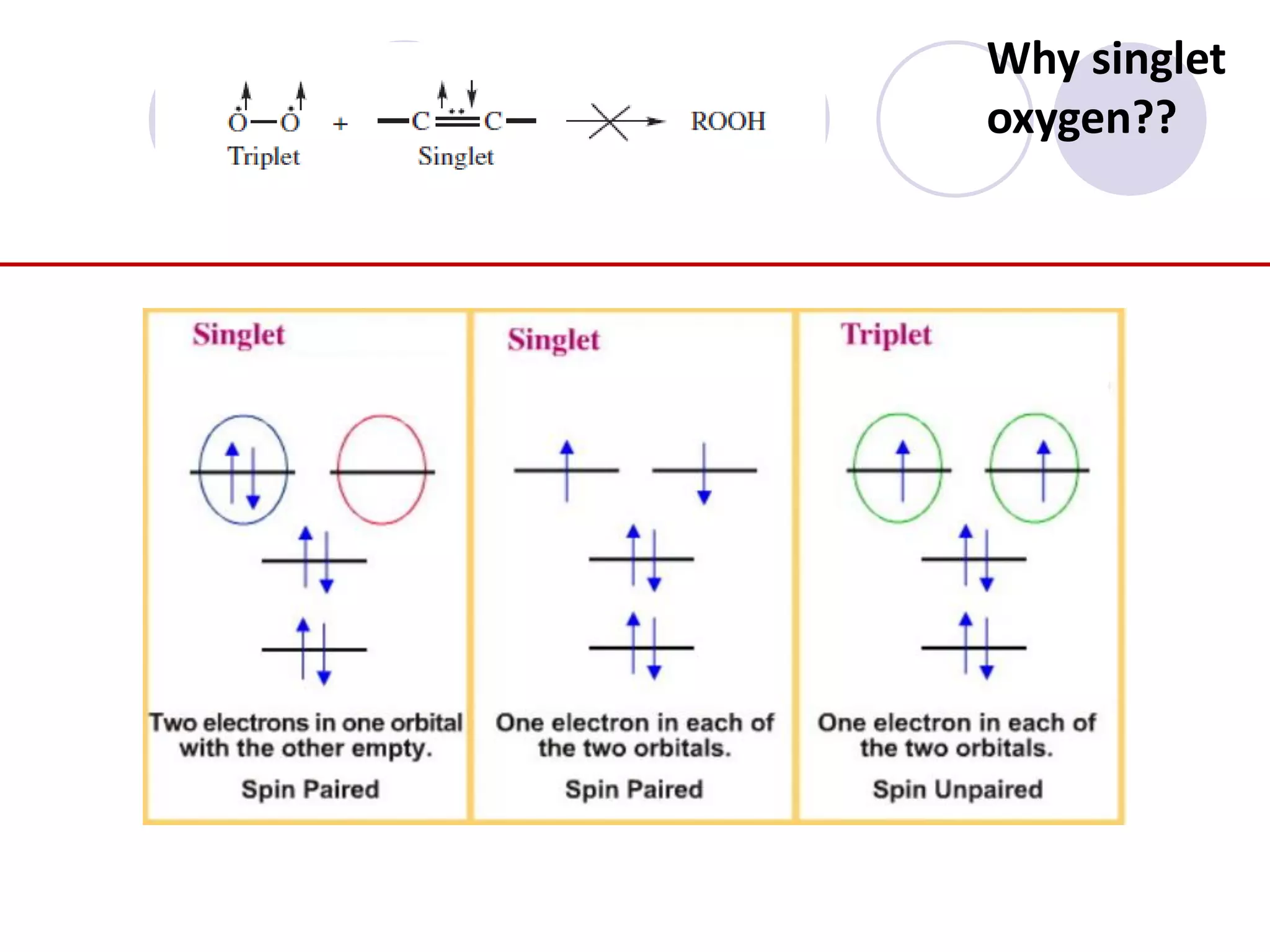
Triplet oxygen
Singlet oxygen
Why singlet
oxygen??
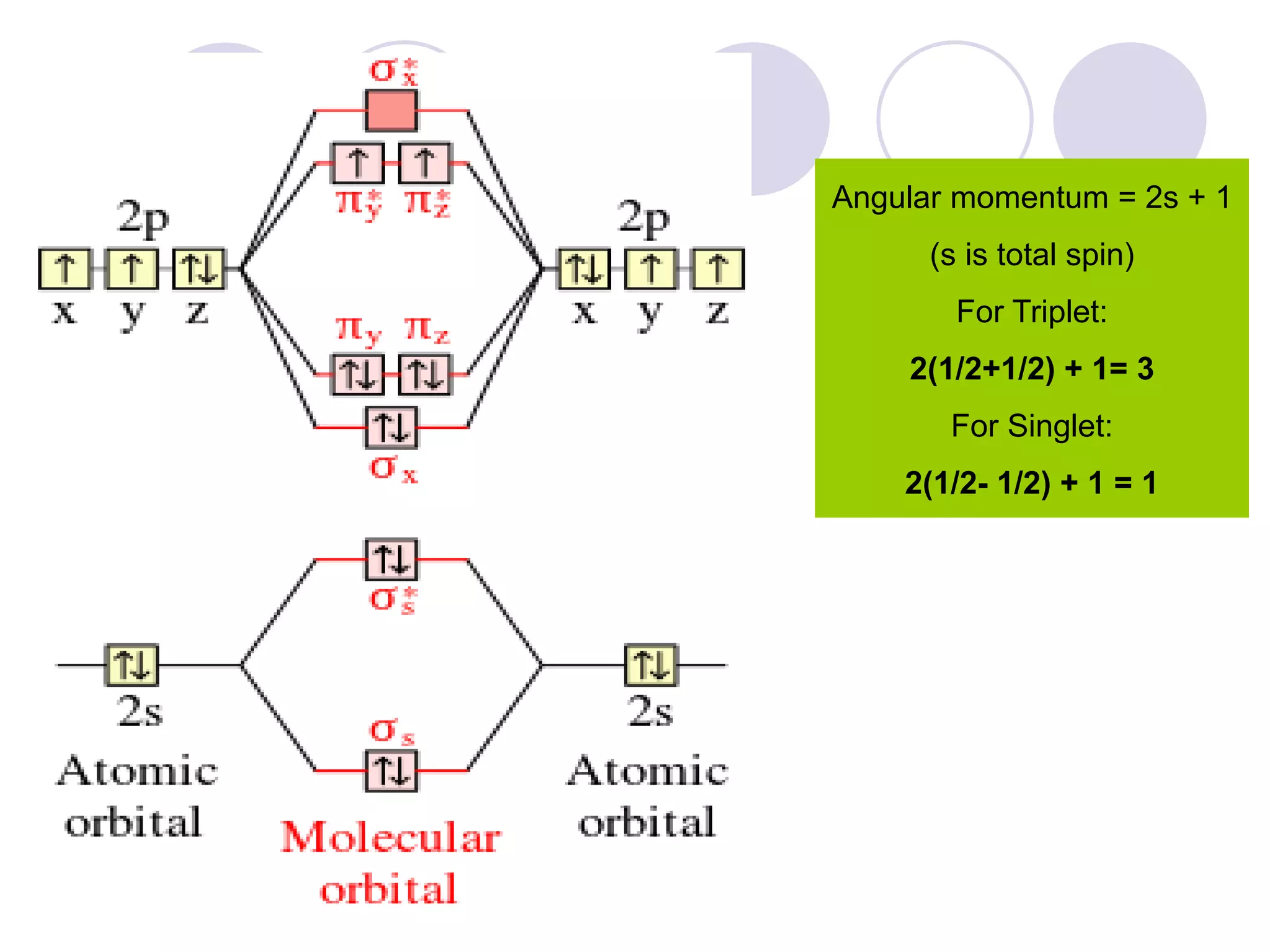
Angular momentum = 2s + 1
(s is total spin)
For Triplet:
2(1/2+1/2) + 1= 3
For Singlet:
2(1/2- 1/2) + 1 = 1
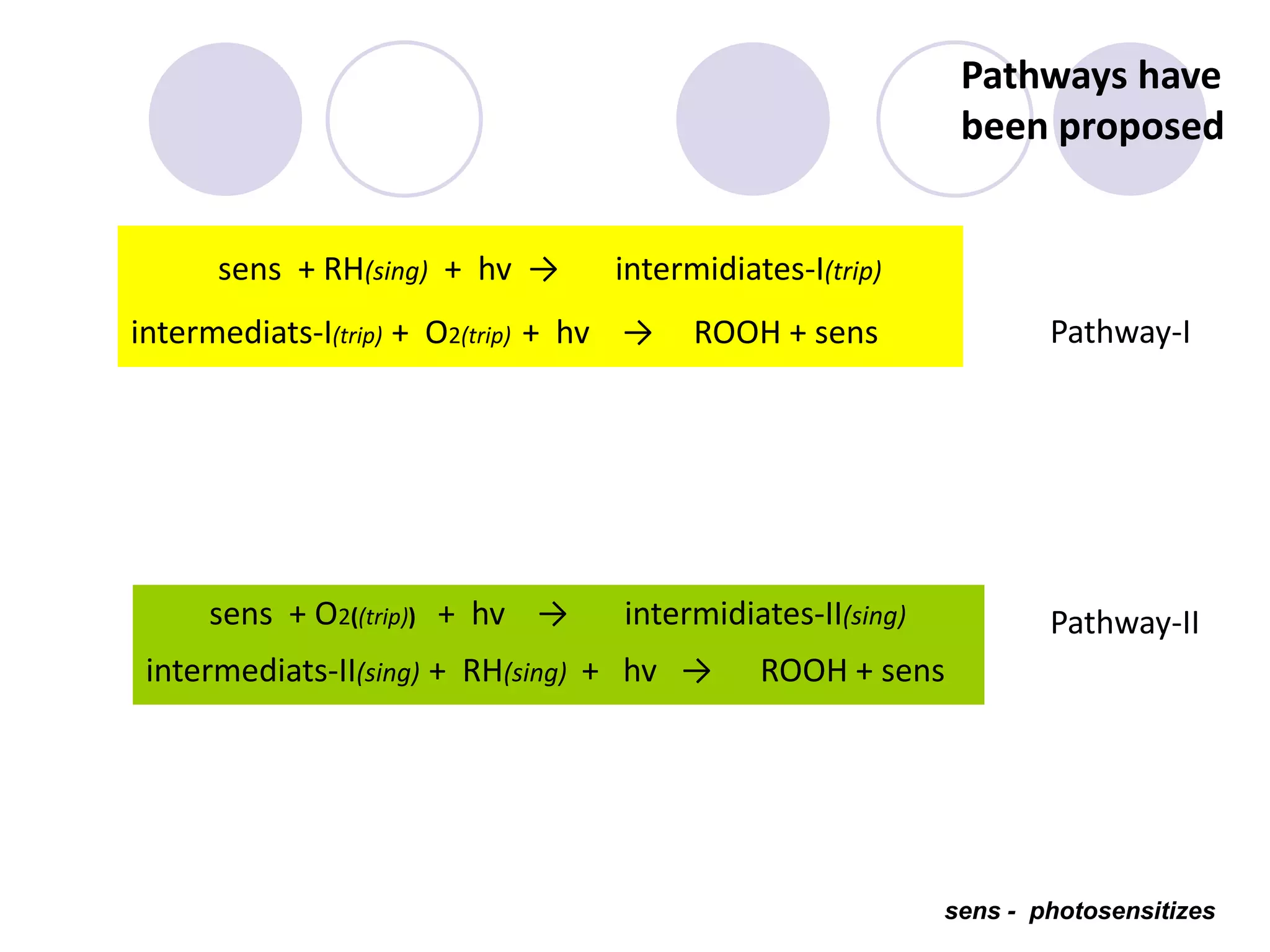
sens + RH(sing) + hv → intermidiates-I(trip)
intermediats-I(trip) + O2(trip) + hv → ROOH + sens
sens + O2((trip)) + hv → intermidiates-II(sing)
intermediats-II(sing) + RH(sing) + hv → ROOH + sens
Pathways have
been proposed
Pathway-I
Pathway-II
sens - photosensitizes
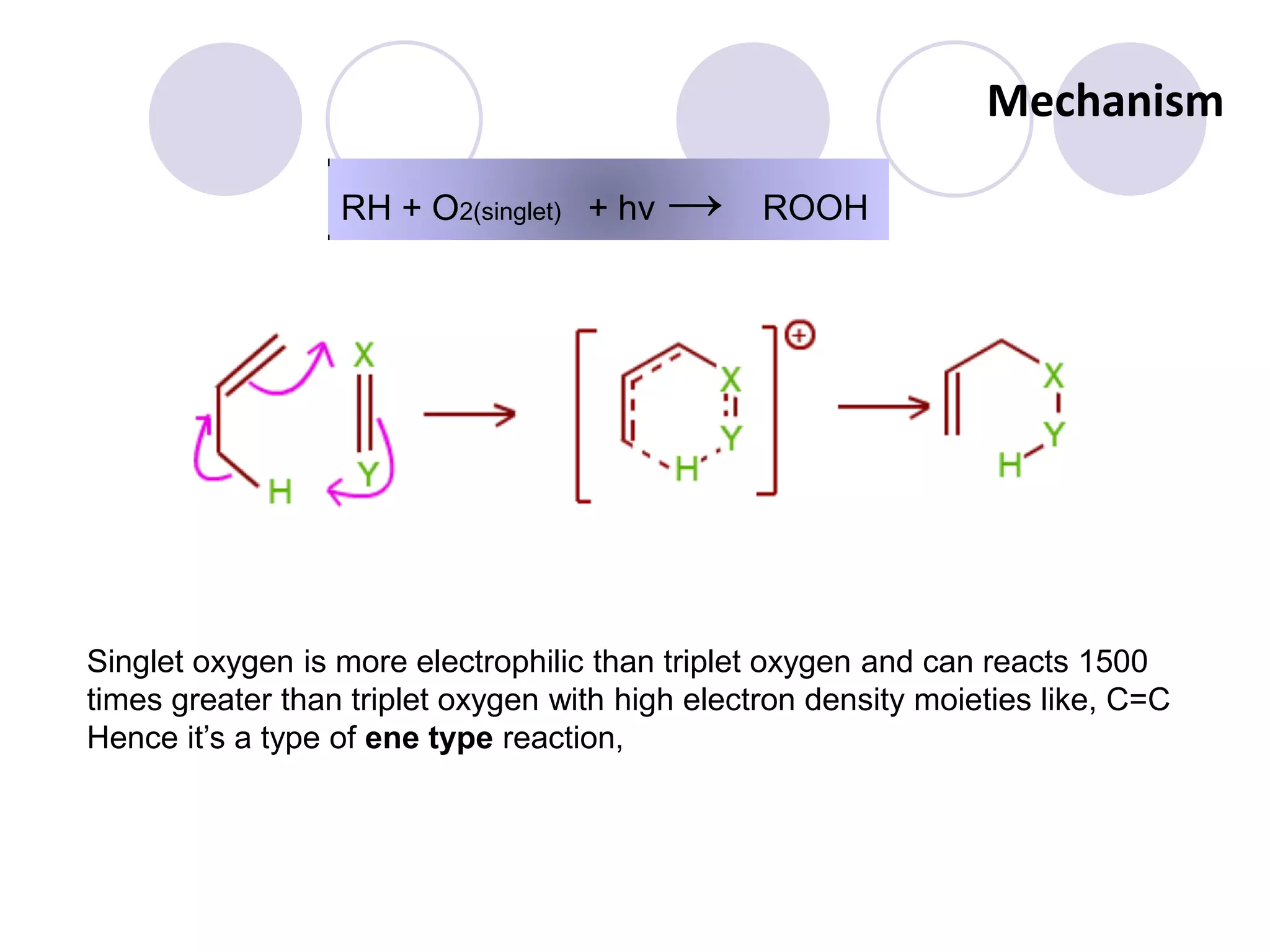
Mechanism
RH + O2(singlet) + hv → ROOH
Singlet oxygen is more electrophilic than triplet oxygen and can reacts 1500
times greater than triplet oxygen with high electron density moieties like, C=C
Hence it’s a type of ene type reaction,
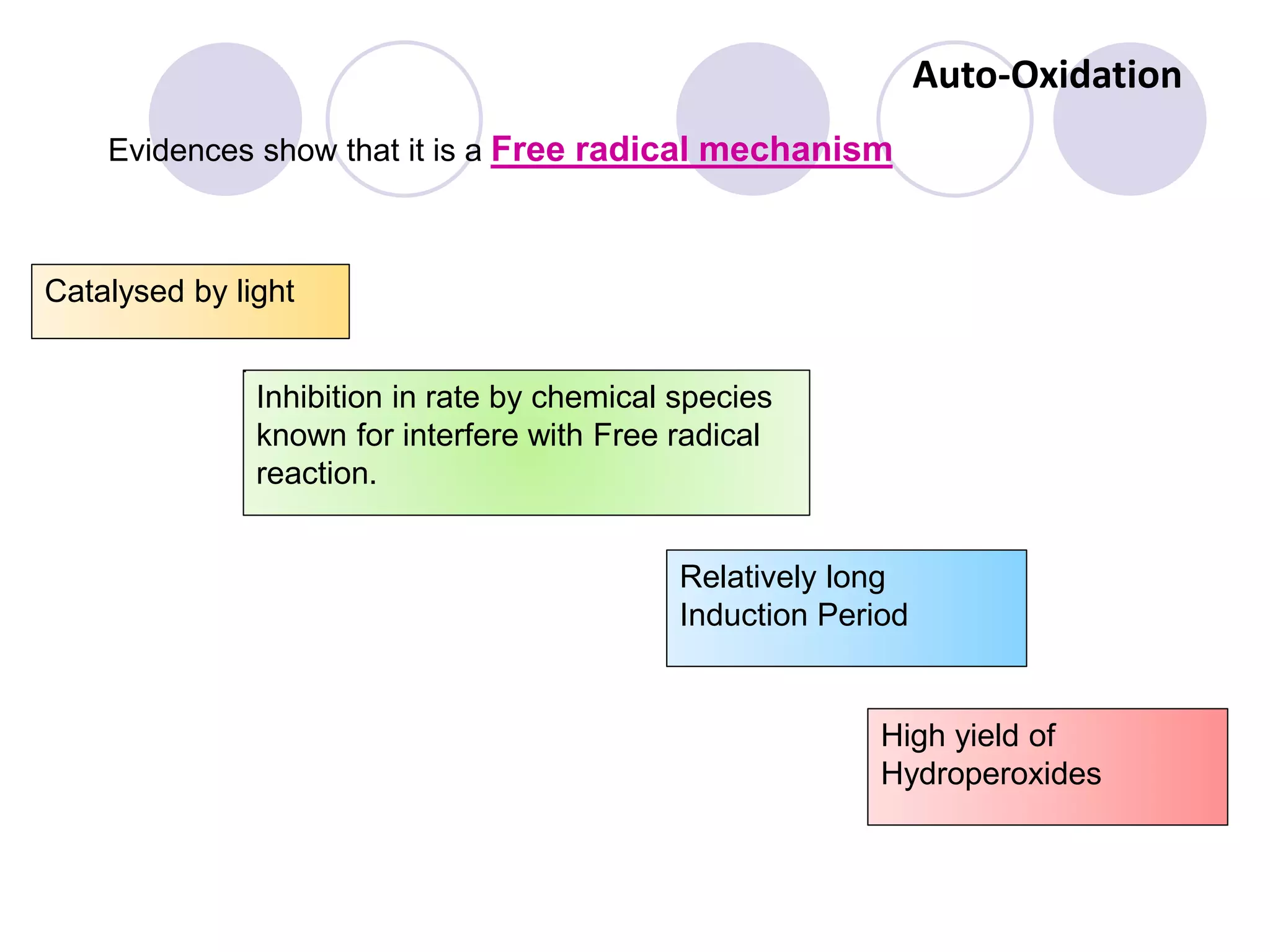
Evidences show that it is a Free radical mechanism
Inhibition in rate by chemical species
known for interfere with Free radical
reaction.
Catalysed by light
High yield of
Hydroperoxides
Relatively long
Induction Period
Auto-Oxidation
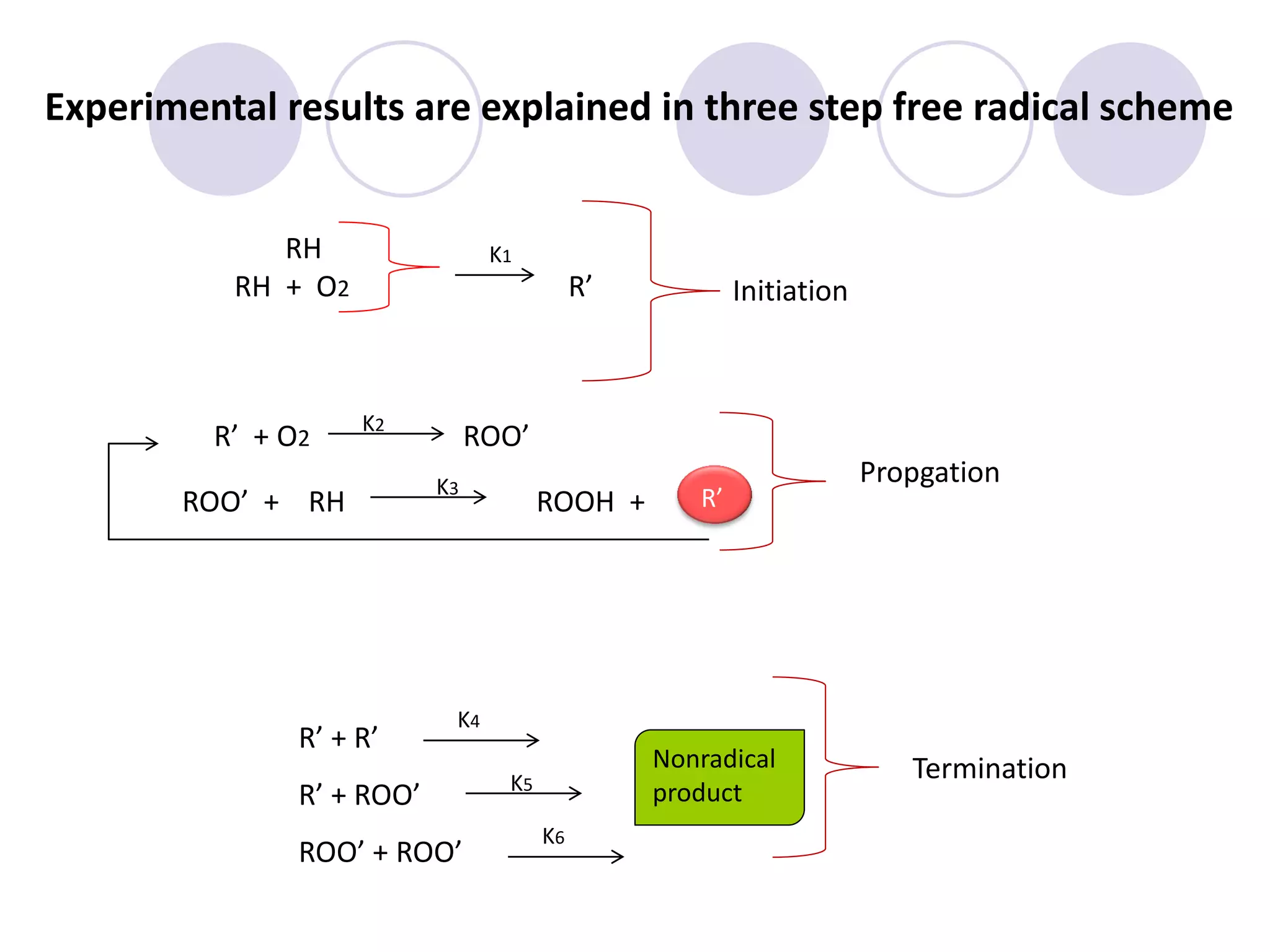
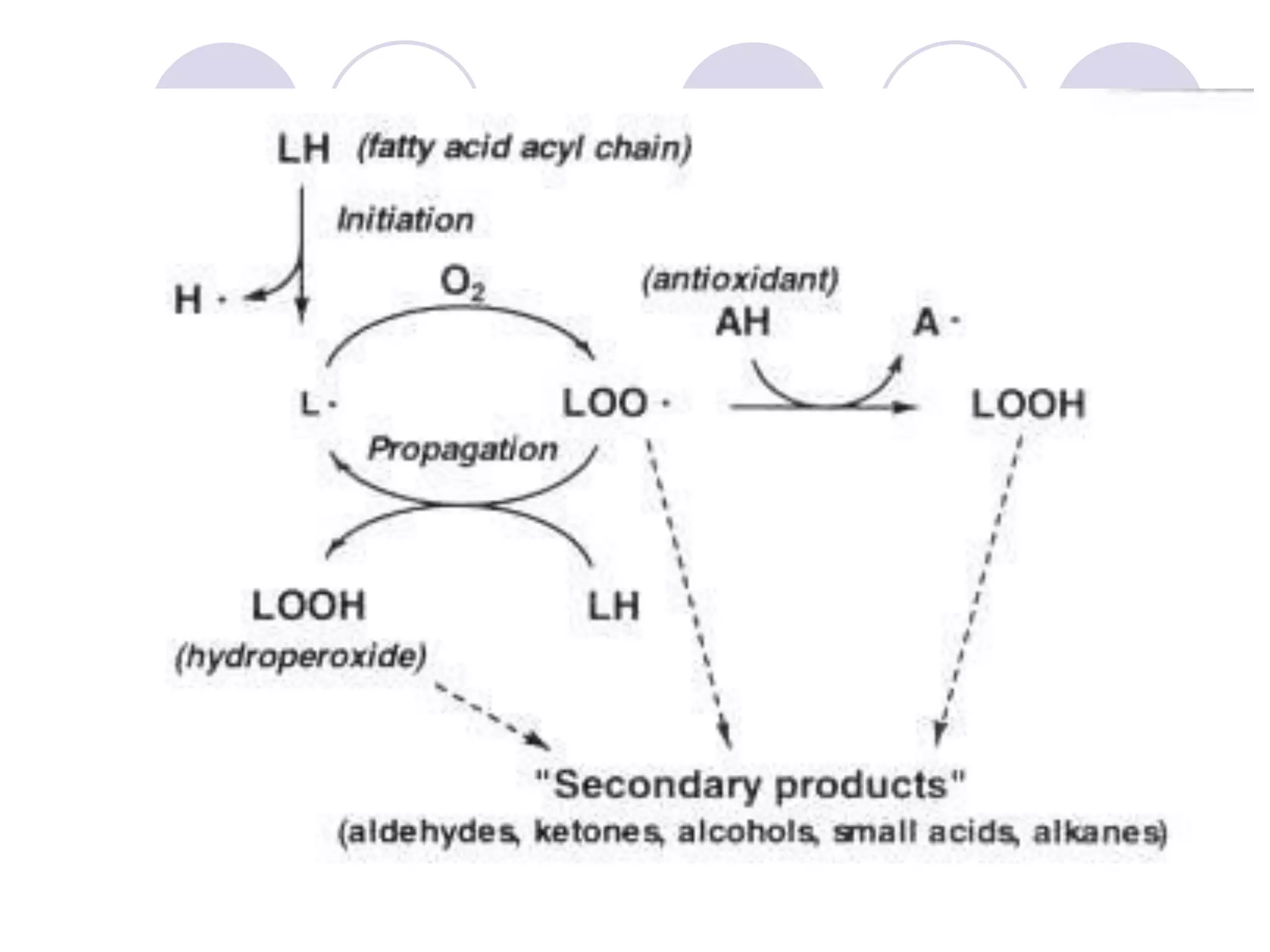
Experimental results are explained in three step free radical scheme
RH
RH + O2 R’
R’ + O2 ROO’
ROO’ + RH ROOH +
R’ + R’
R’ + ROO’
ROO’ + ROO’
K1
K2
K3
K4
K5
K6
Initiation
Propgation
Termination
R’
Nonradical
product
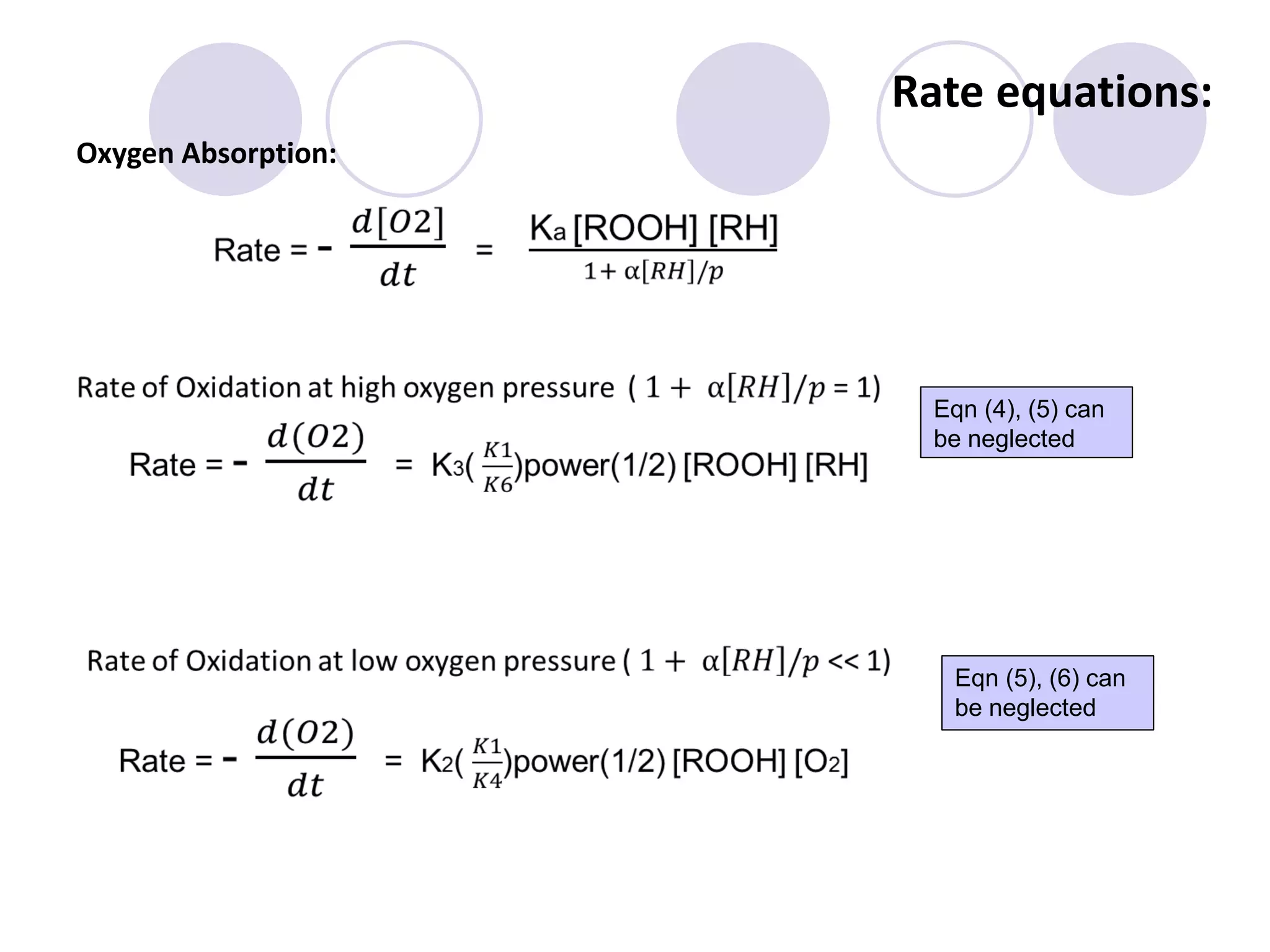
Rate equations:
Oxygen Absorption:
Eqn (4), (5) can
be neglected
Eqn (5), (6) can
be neglected
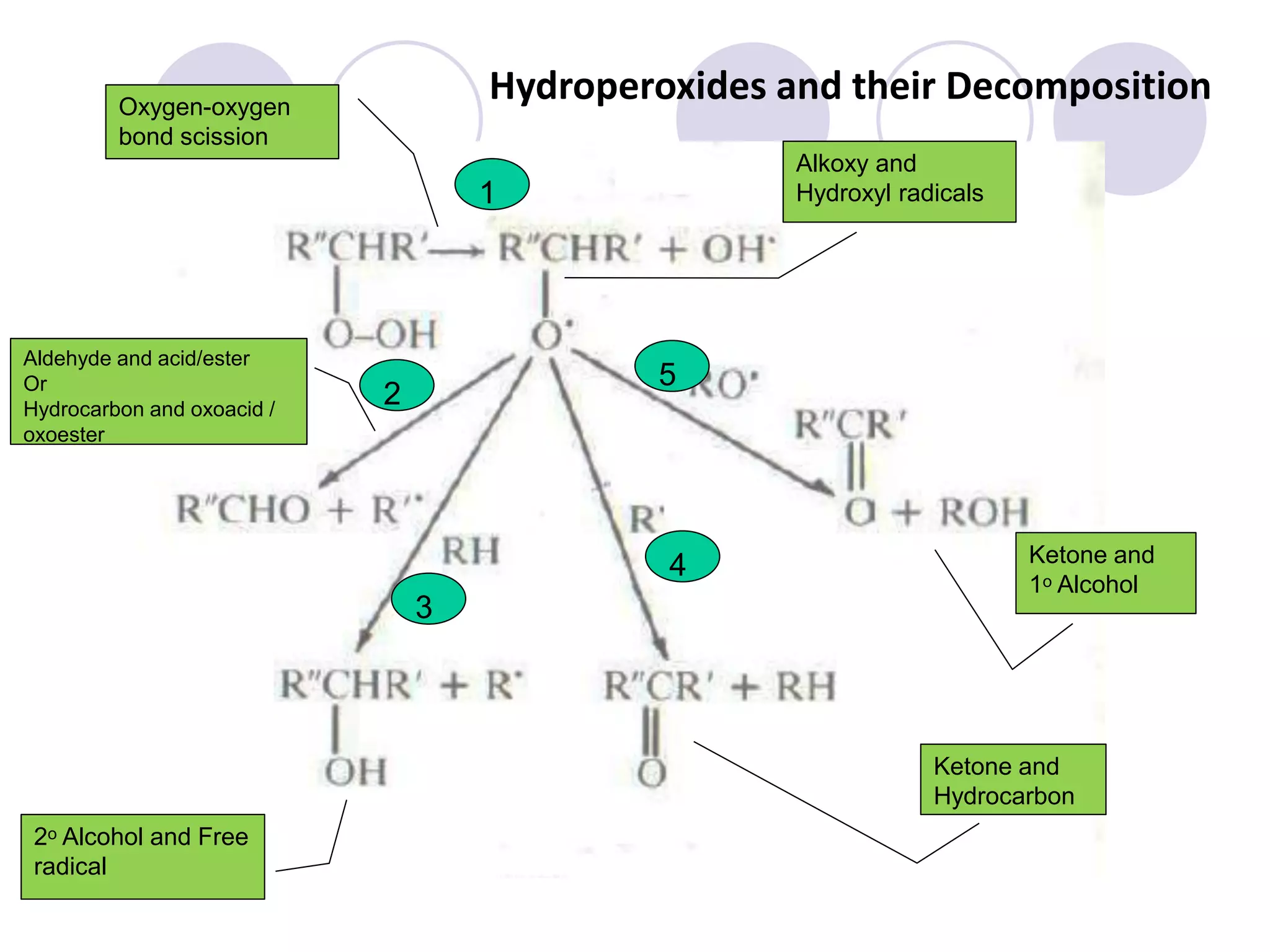
Hydroperoxides and their DecompositionOxygen-oxygen
bond scission
Alkoxy and
Hydroxyl radicals
Aldehyde and acid/ester
Or
Hydrocarbon and oxoacid /
oxoester
1
5
4
3
2
Ketone and
1ᵒ Alcohol
2ᵒ Alcohol and Free
radical
Ketone and
Hydrocarbon
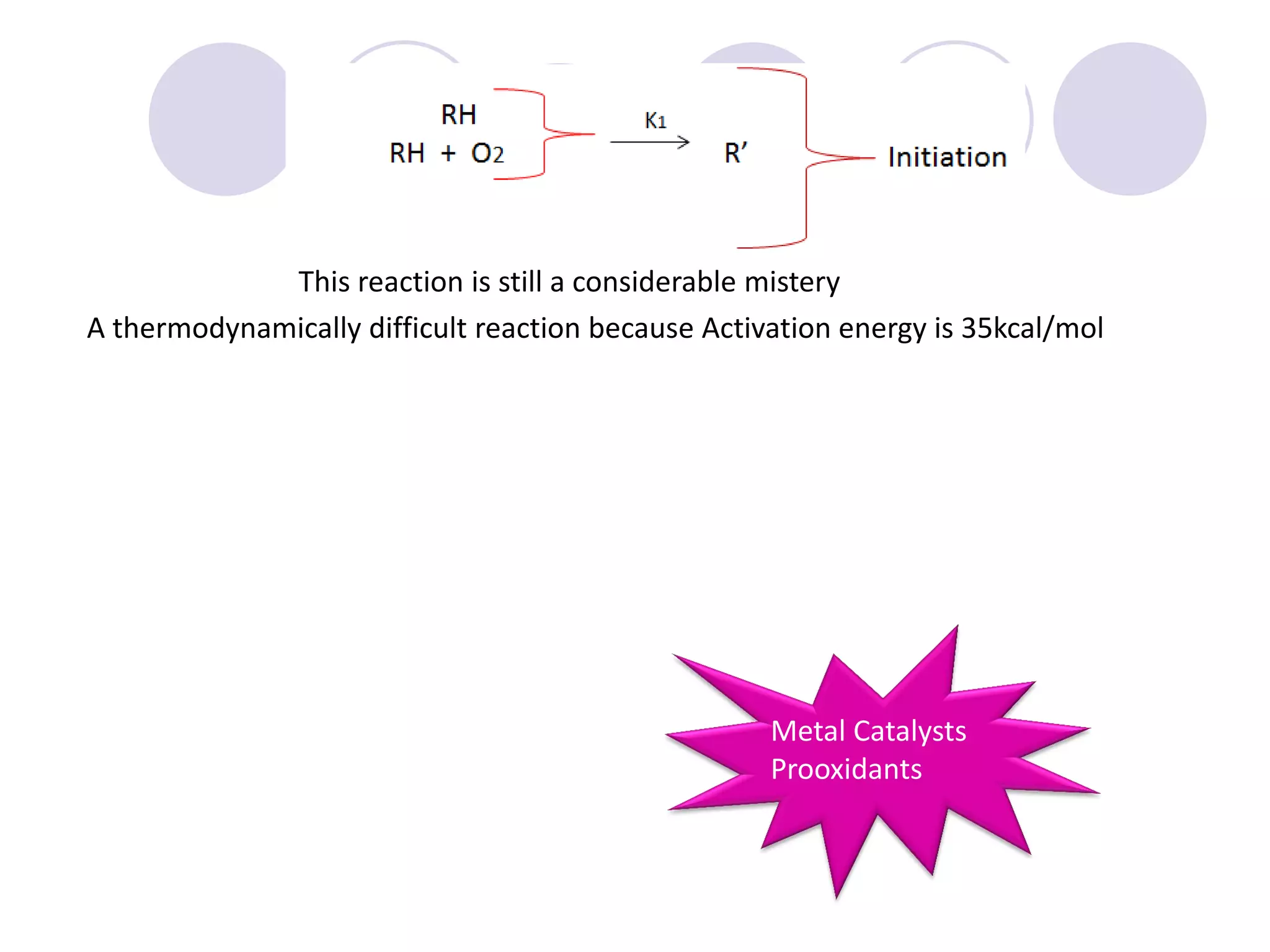
A thermodynamically difficult reaction because Activation energy is 35kcal/mol
Metal Catalysts
Prooxidants
This reaction is still a considerable mistery
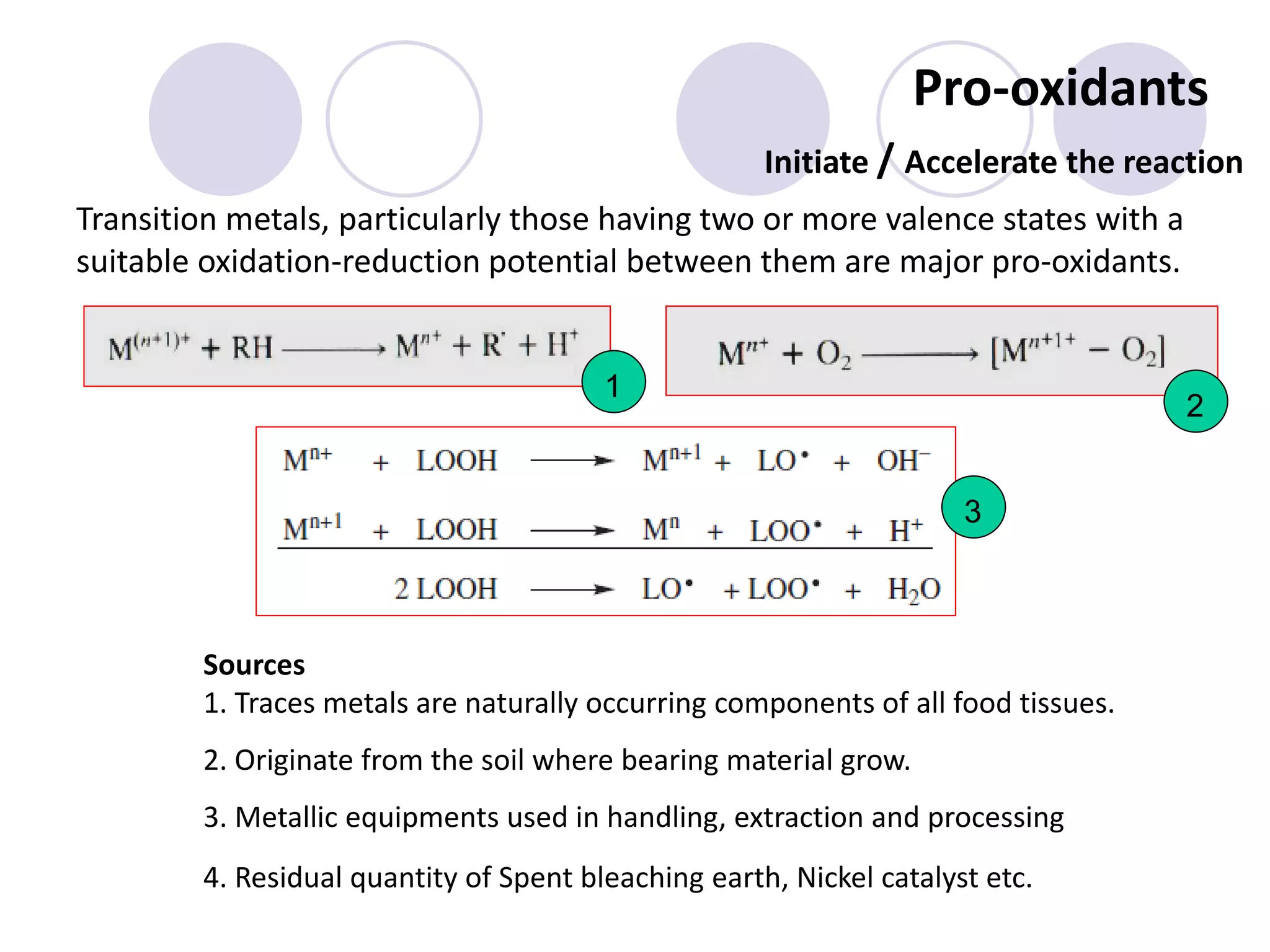
Pro-oxidants
Transition metals, particularly those having two or more valence states with a
suitable oxidation-reduction potential between them are major pro-oxidants.
Initiate / Accelerate the reaction
Sources
1. Traces metals are naturally occurring components of all food tissues.
2. Originate from the soil where bearing material grow.
3. Metallic equipments used in handling, extraction and processing
4. Residual quantity of Spent bleaching earth, Nickel catalyst etc.
1
3
2
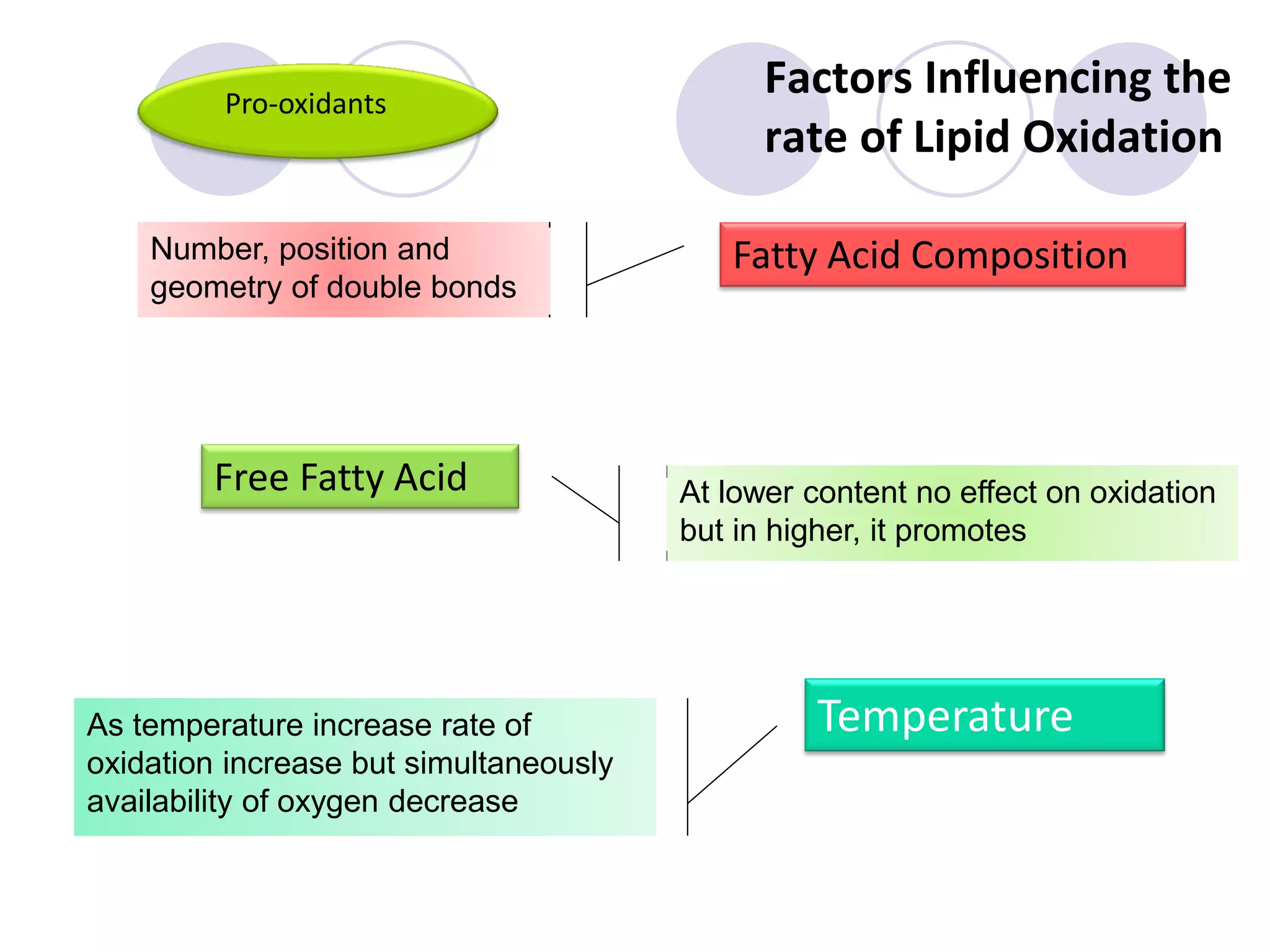
Factors Influencing the
rate of Lipid Oxidation
Fatty Acid Composition
Free Fatty Acid
Temperature
At lower content no effect on oxidation
but in higher, it promotes
Number, position and
geometry of double bonds
As temperature increase rate of
oxidation increase but simultaneously
availability of oxygen decrease
Pro-oxidants
Surface Area
Oxygen Concentration
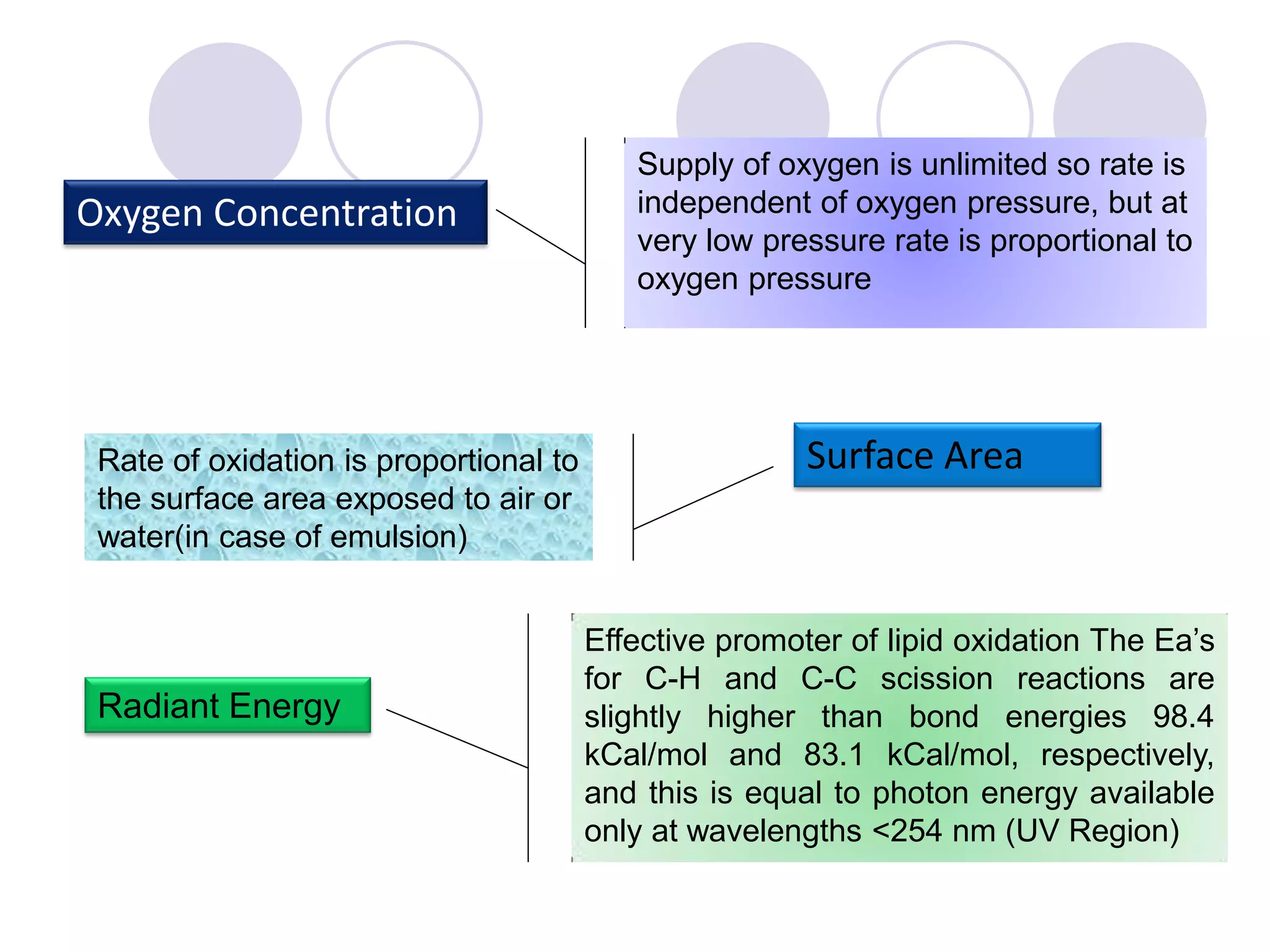
Rate of oxidation is proportional to
the surface area exposed to air or
water(in case of emulsion)
Supply of oxygen is unlimited so rate is
independent of oxygen pressure, but at
very low pressure rate is proportional to
oxygen pressure
Effective promoter of lipid oxidation The Ea’s
for C-H and C-C scission reactions are
slightly higher than bond energies 98.4
kCal/mol and 83.1 kCal/mol, respectively,
and this is equal to photon energy available
only at wavelengths <254 nm (UV Region)
Radiant Energy
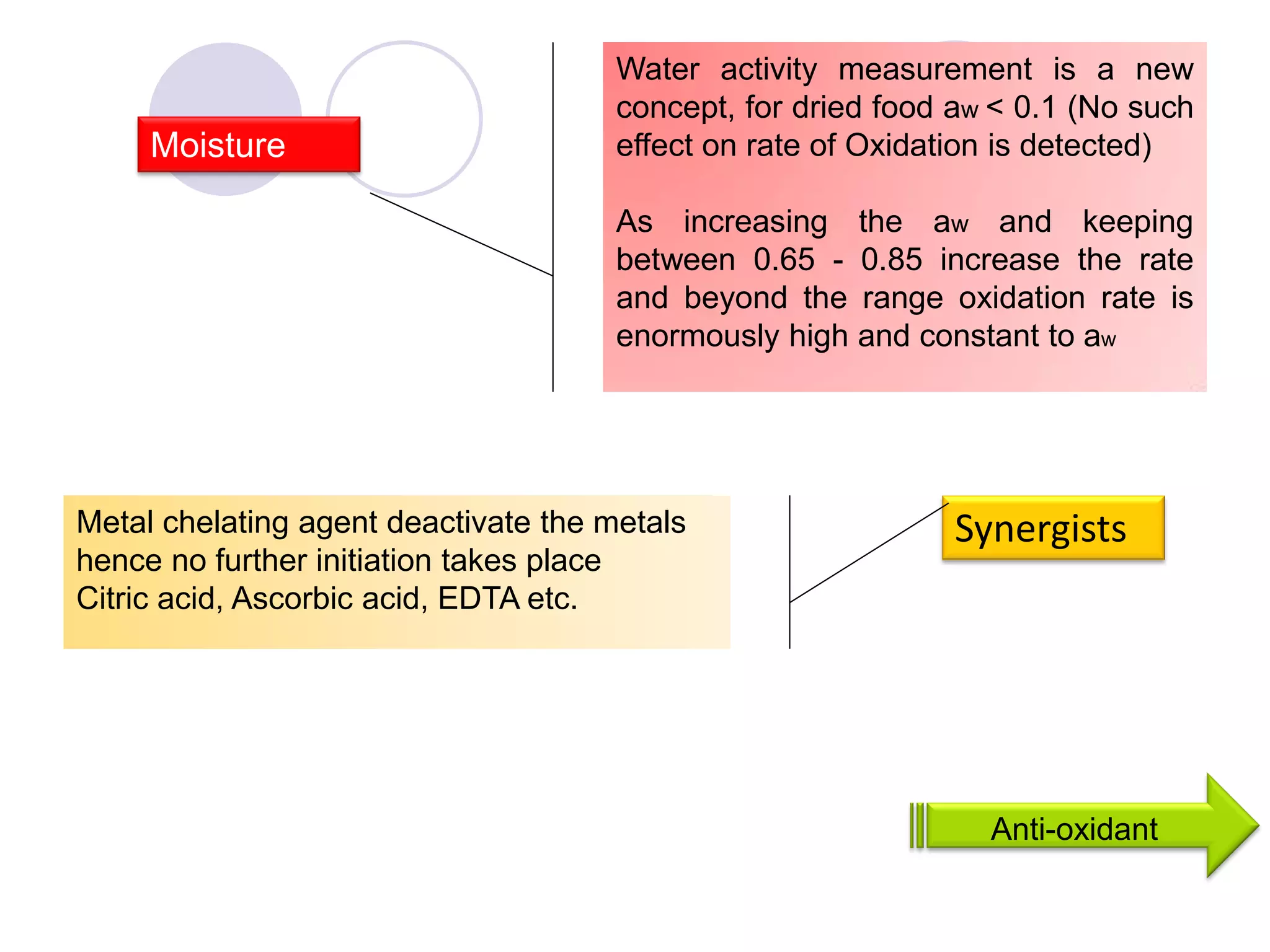
Synergists
Moisture
Metal chelating agent deactivate the metals
hence no further initiation takes place
Citric acid, Ascorbic acid, EDTA etc.
Water activity measurement is a new
concept, for dried food aw < 0.1 (No such
effect on rate of Oxidation is detected)
As increasing the aw and keeping
between 0.65 - 0.85 increase the rate
and beyond the range oxidation rate is
enormously high and constant to aw
Anti-oxidant
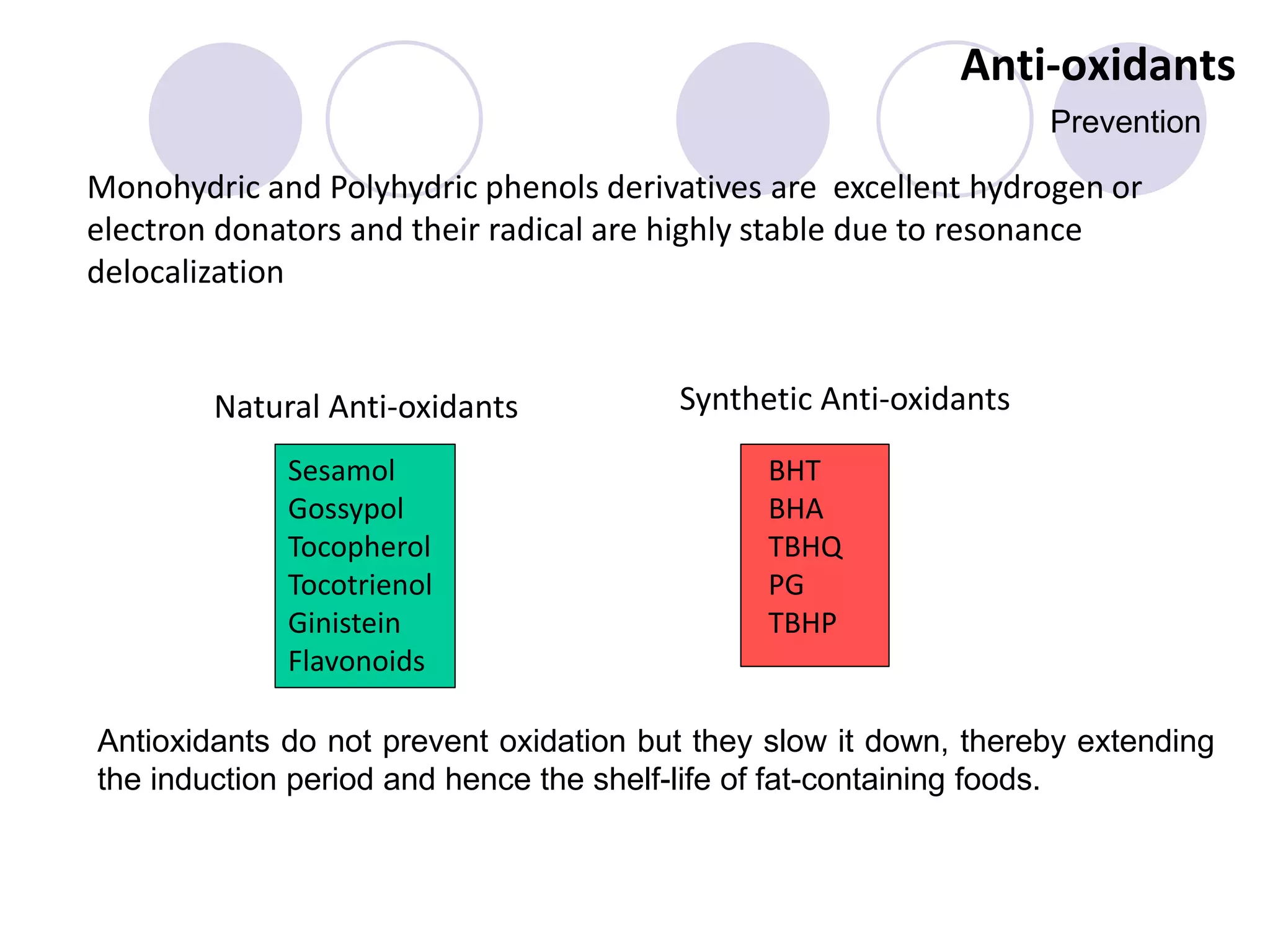
Anti-oxidants
Monohydric and Polyhydric phenols derivatives are excellent hydrogen or
electron donators and their radical are highly stable due to resonance
delocalization
Natural Anti-oxidants Synthetic Anti-oxidants
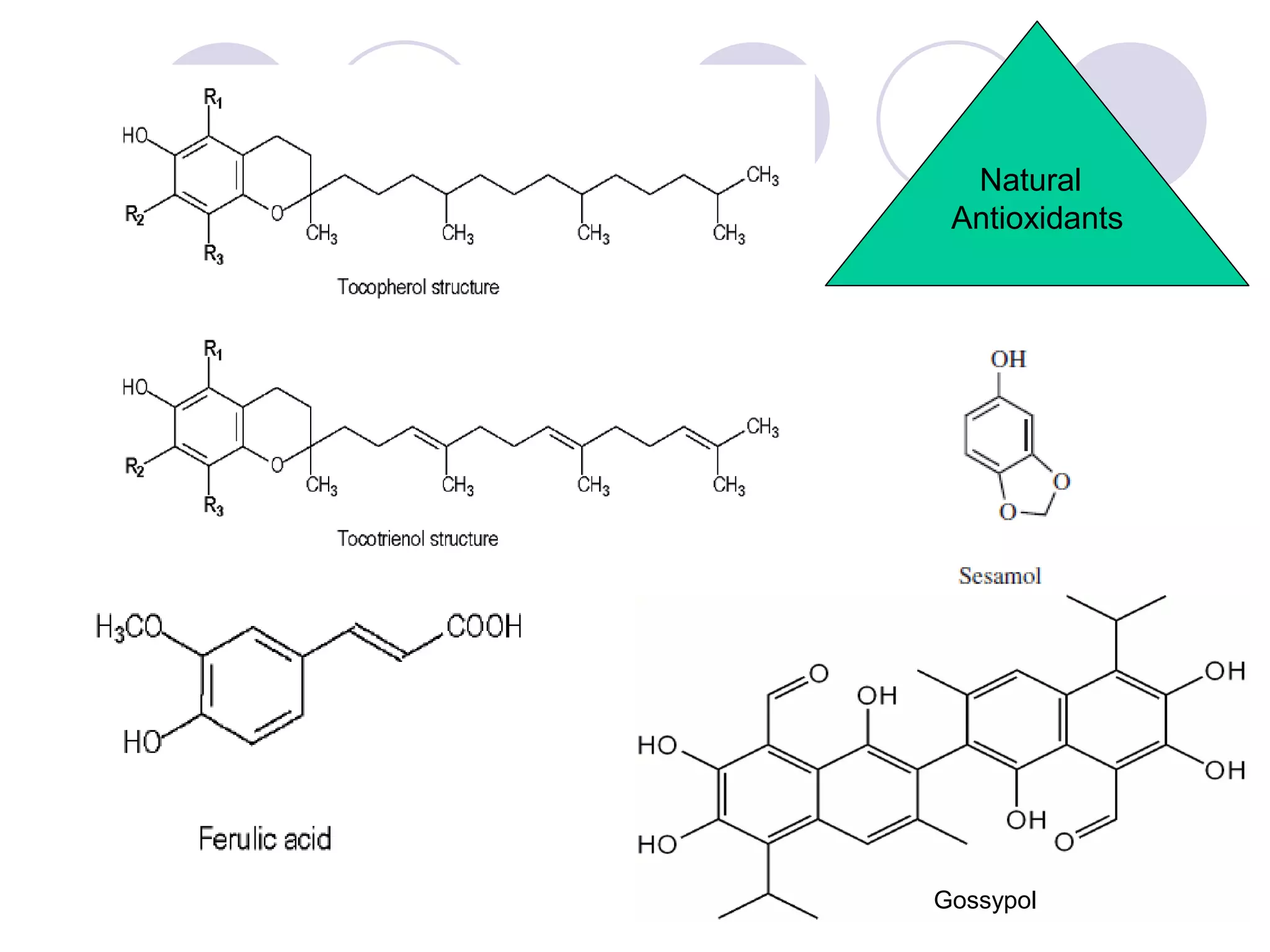
Sesamol
Gossypol
Tocopherol
Tocotrienol
Ginistein
Flavonoids
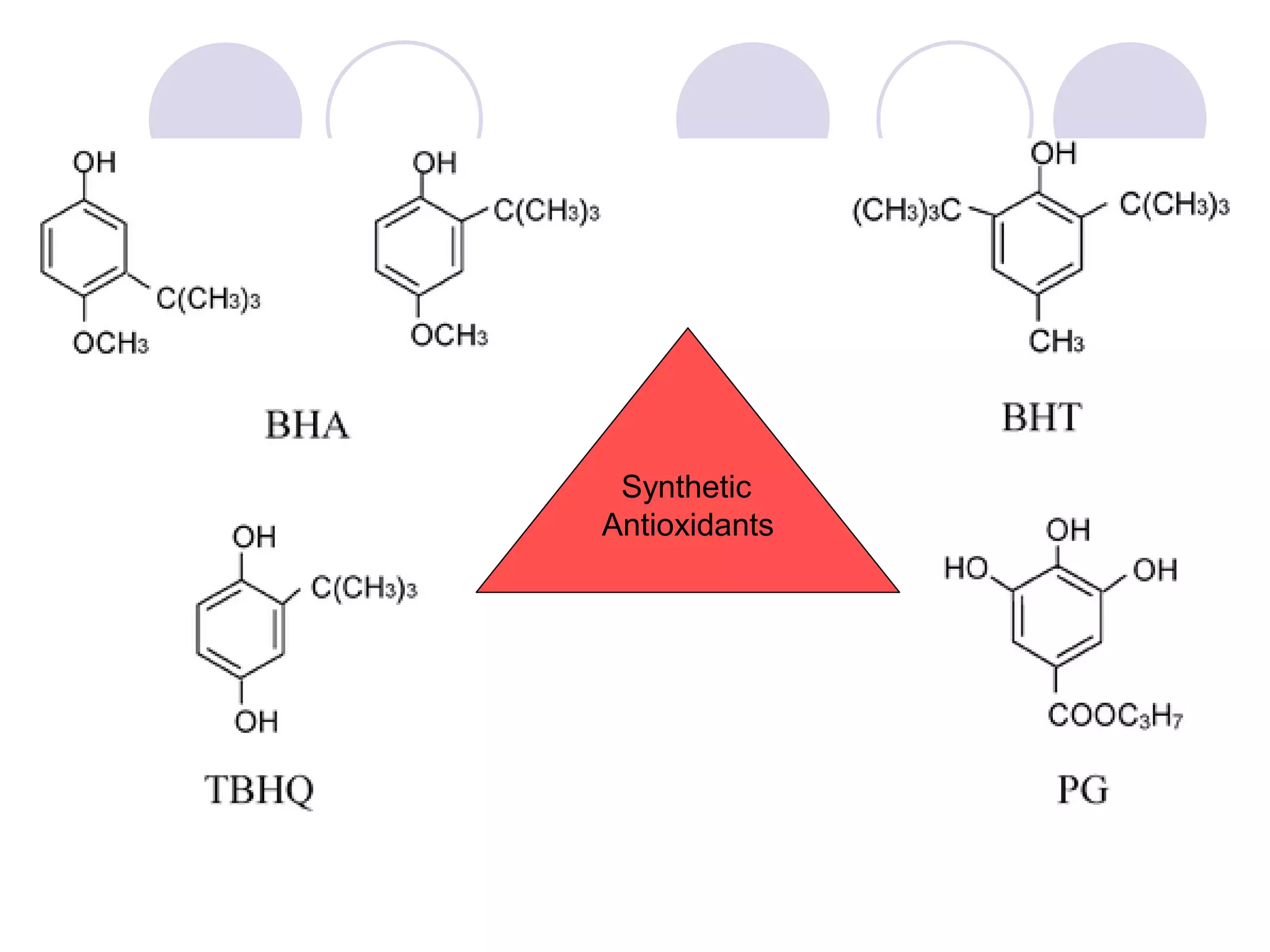
BHT
BHA
TBHQ
PG
TBHP
Antioxidants do not prevent oxidation but they slow it down, thereby extending
the induction period and hence the shelf-life of fat-containing foods.
Prevention
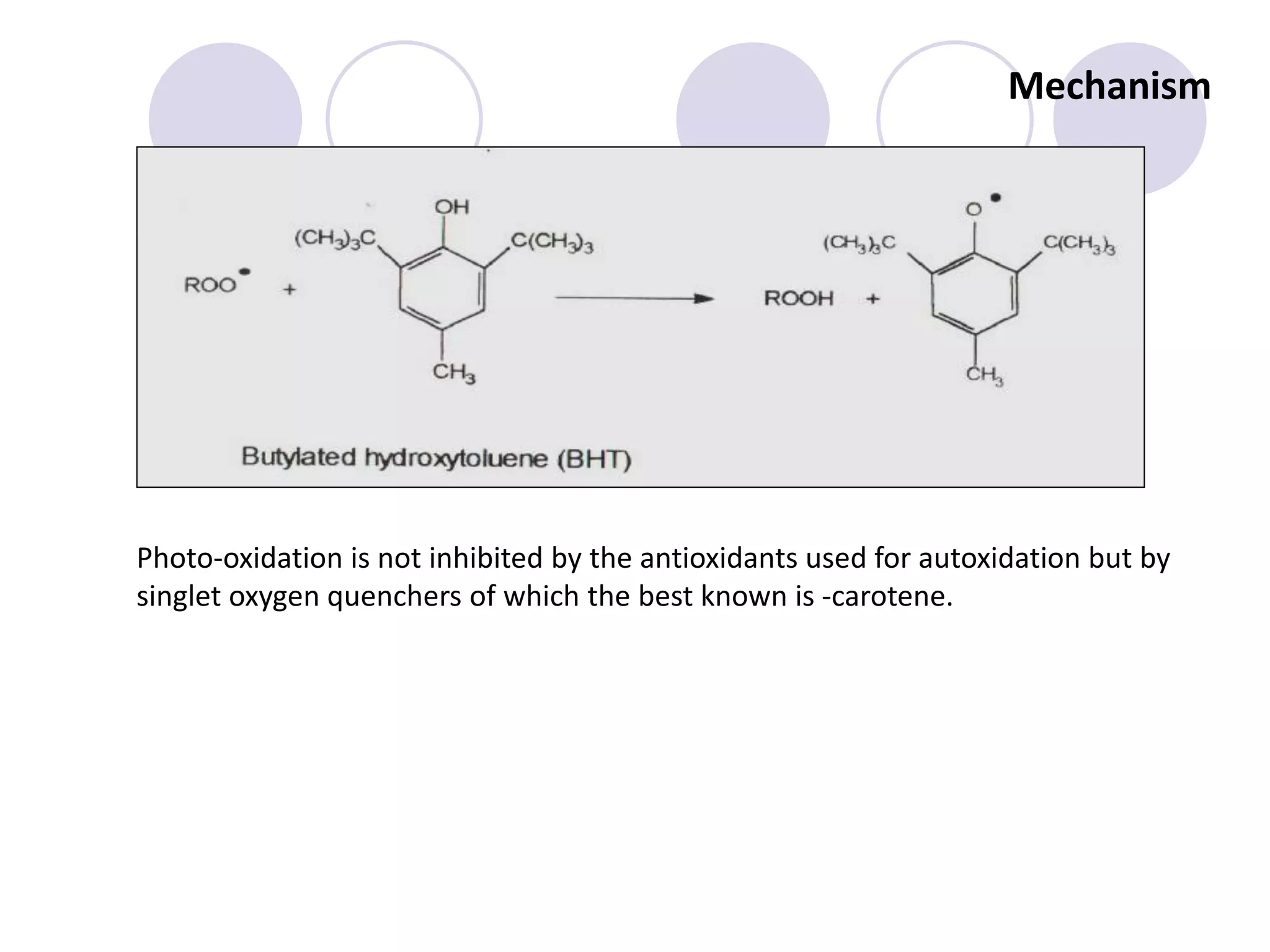
Mechanism
Photo-oxidation is not inhibited by the antioxidants used for autoxidation but by
singlet oxygen quenchers of which the best known is -carotene.
Synthetic
Antioxidants
Natural
Antioxidants
Gossypol
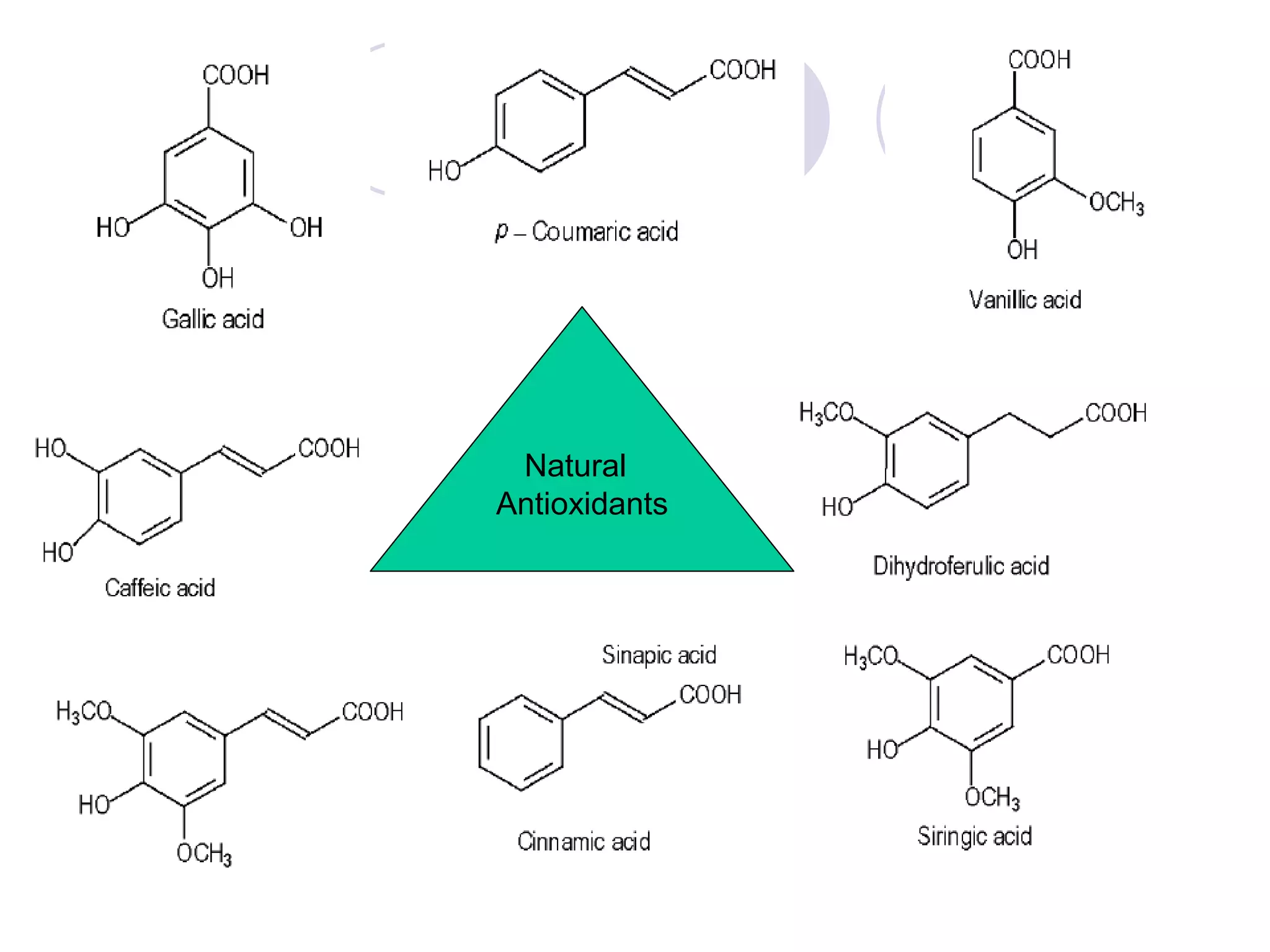
Natural
Antioxidants
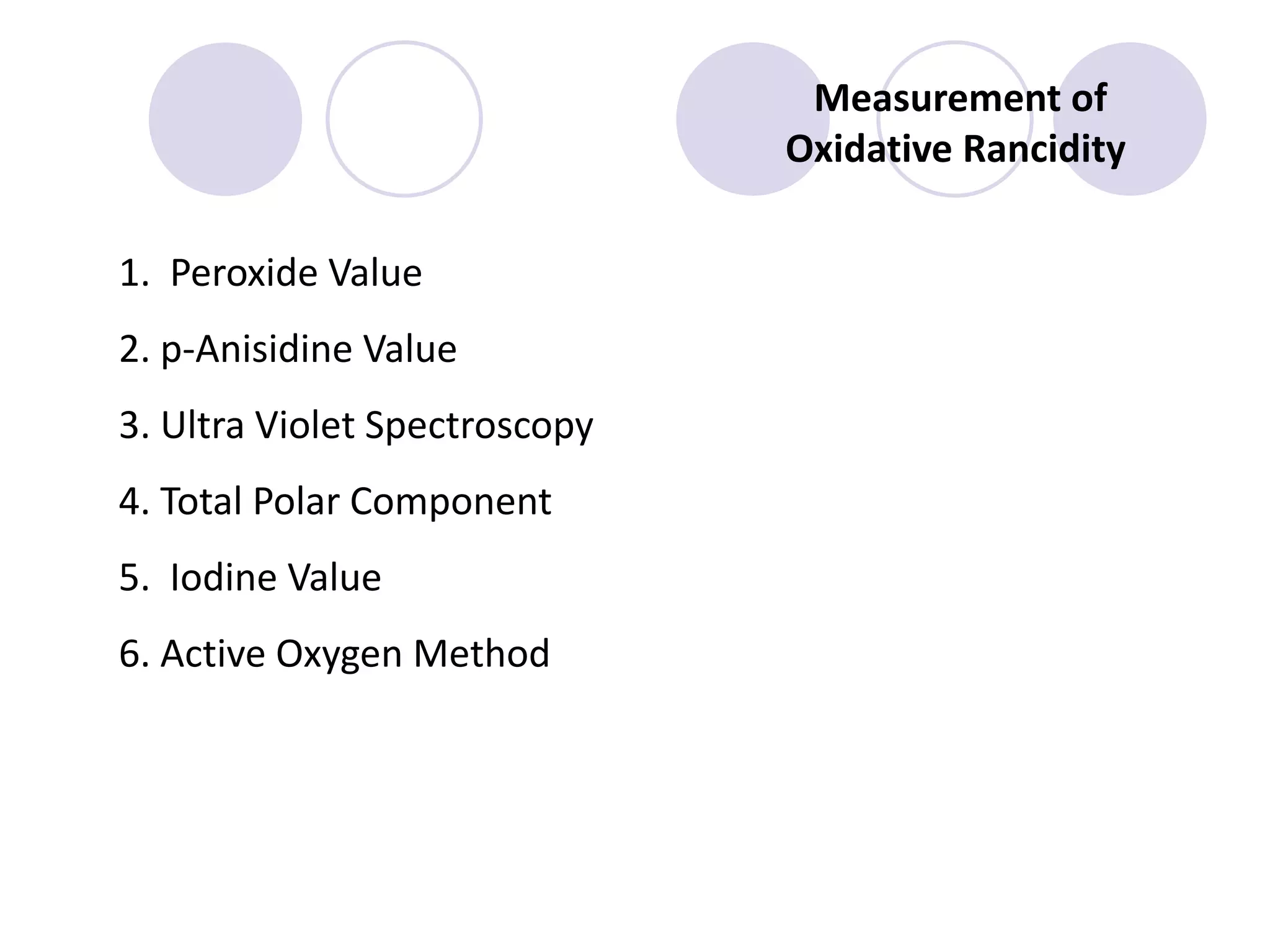
1. Peroxide Value
2. p-Anisidine Value
3. Ultra Violet Spectroscopy
4. Total Polar Component
5. Iodine Value
6. Active Oxygen Method
Measurement of
Oxidative Rancidity
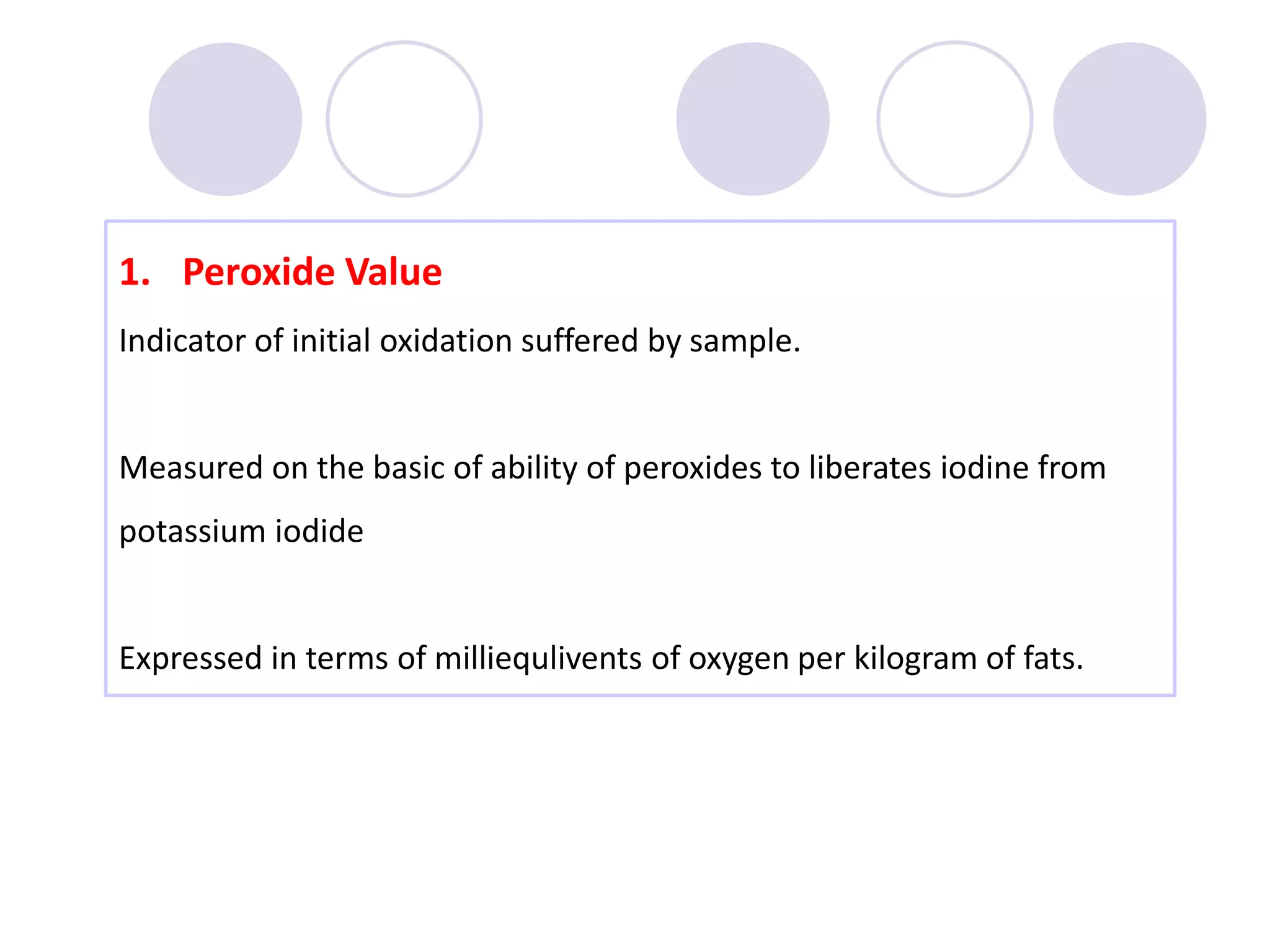
1. Peroxide Value
Indicator of initial oxidation suffered by sample.
Measured on the basic of ability of peroxides to liberates iodine from
potassium iodide
Expressed in terms of milliequlivents of oxygen per kilogram of fats.
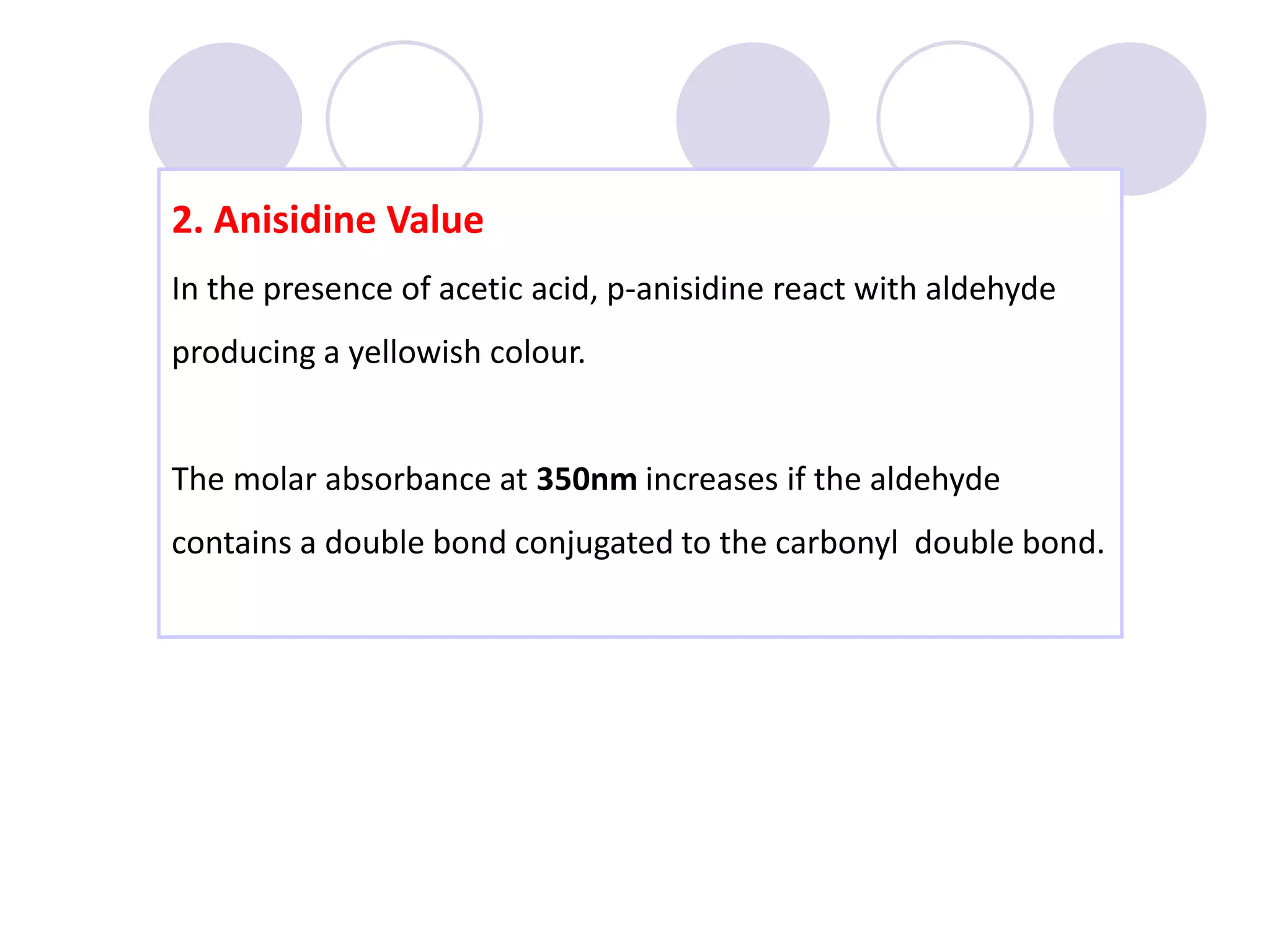
2. Anisidine Value
In the presence of acetic acid, p-anisidine react with aldehyde
producing a yellowish colour.
The molar absorbance at 350nm increases if the aldehyde
contains a double bond conjugated to the carbonyl double bond.
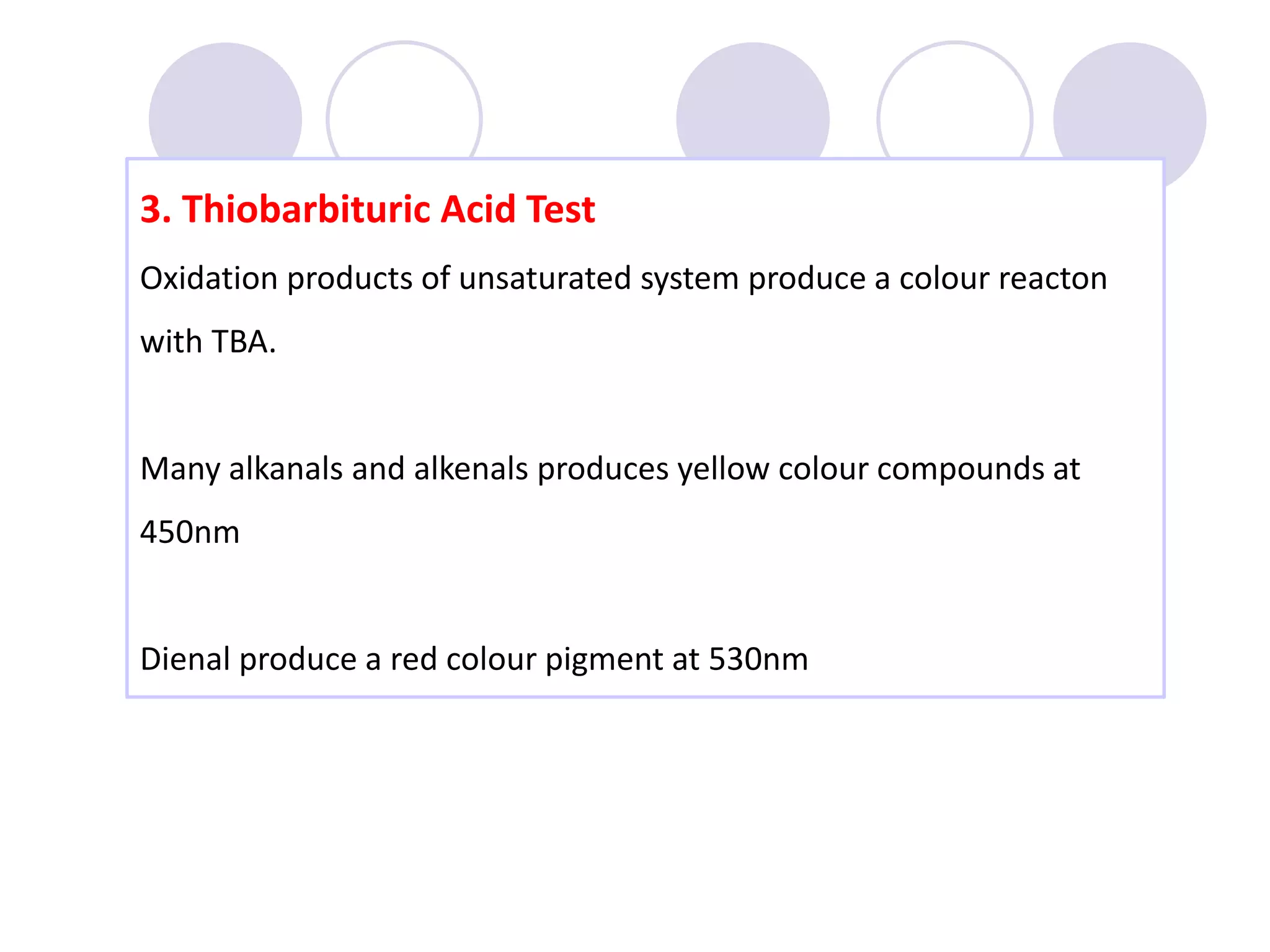
3. Thiobarbituric Acid Test
Oxidation products of unsaturated system produce a colour reacton
with TBA.
Many alkanals and alkenals produces yellow colour compounds at
450nm
Dienal produce a red colour pigment at 530nm
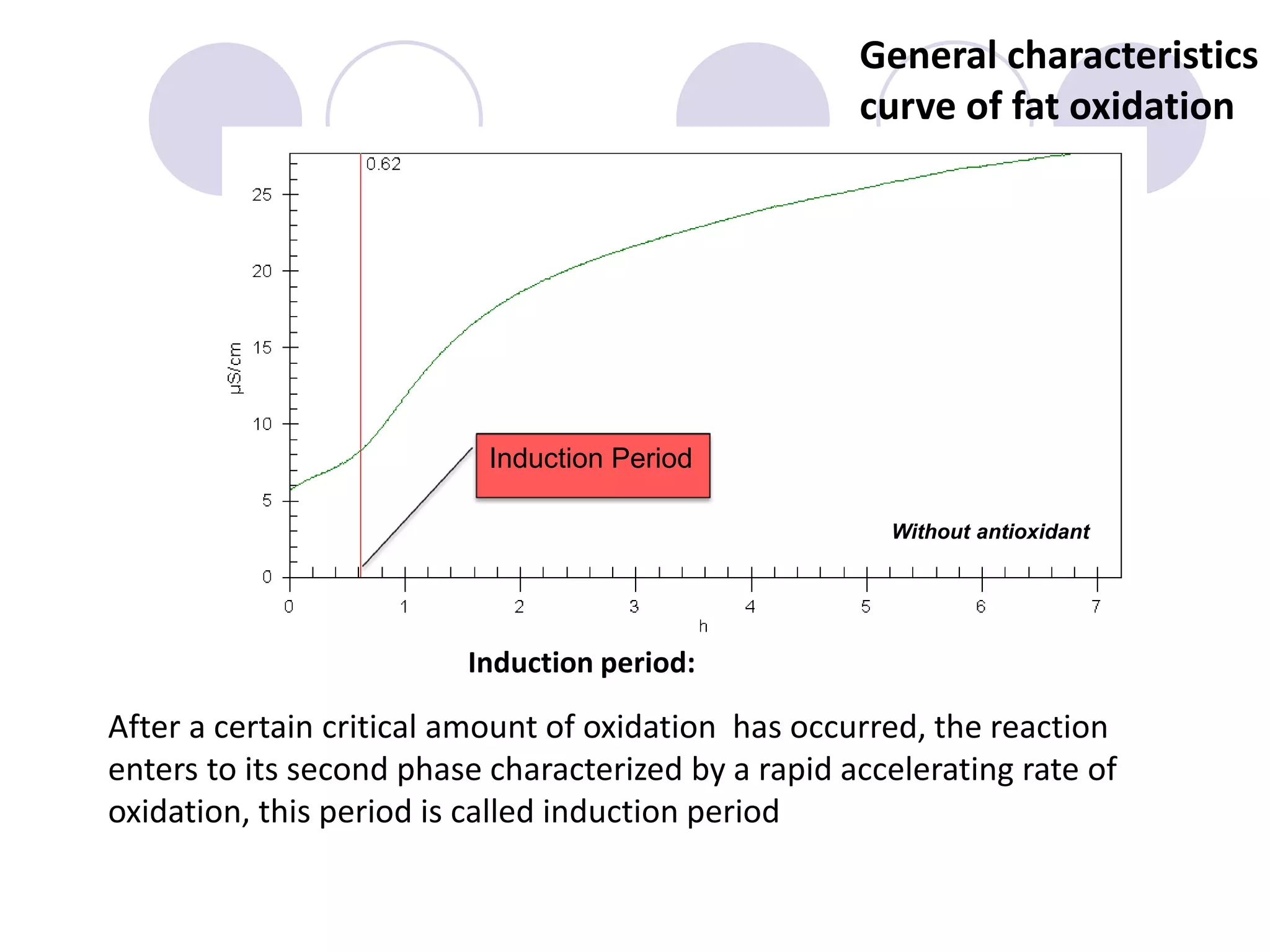
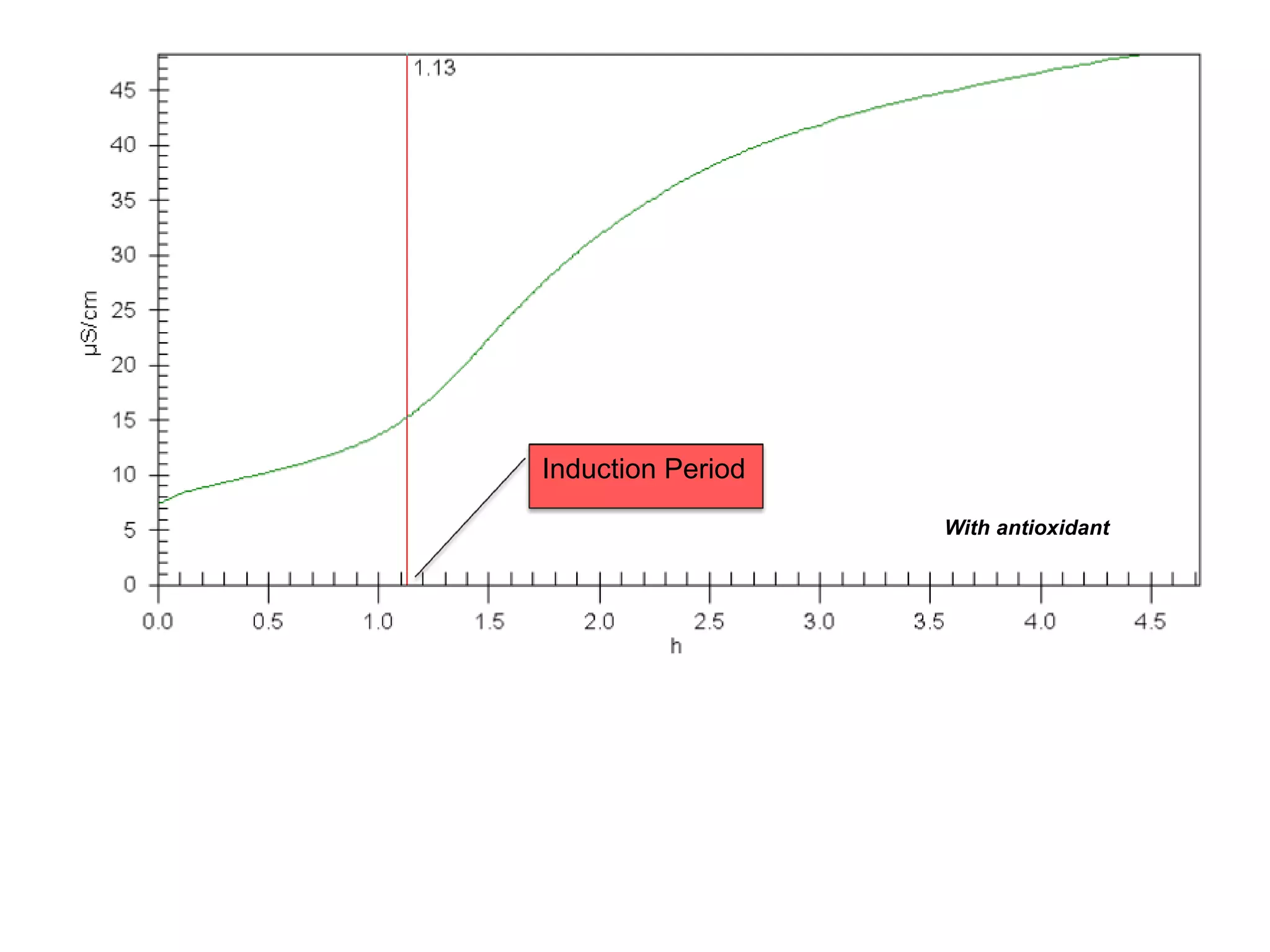
General characteristics
curve of fat oxidation
Induction Period
Without antioxidant
Induction period:
After a certain critical amount of oxidation has occurred, the reaction
enters to its second phase characterized by a rapid accelerating rate of
oxidation, this period is called induction period
With antioxidant
Induction Period
General
Information
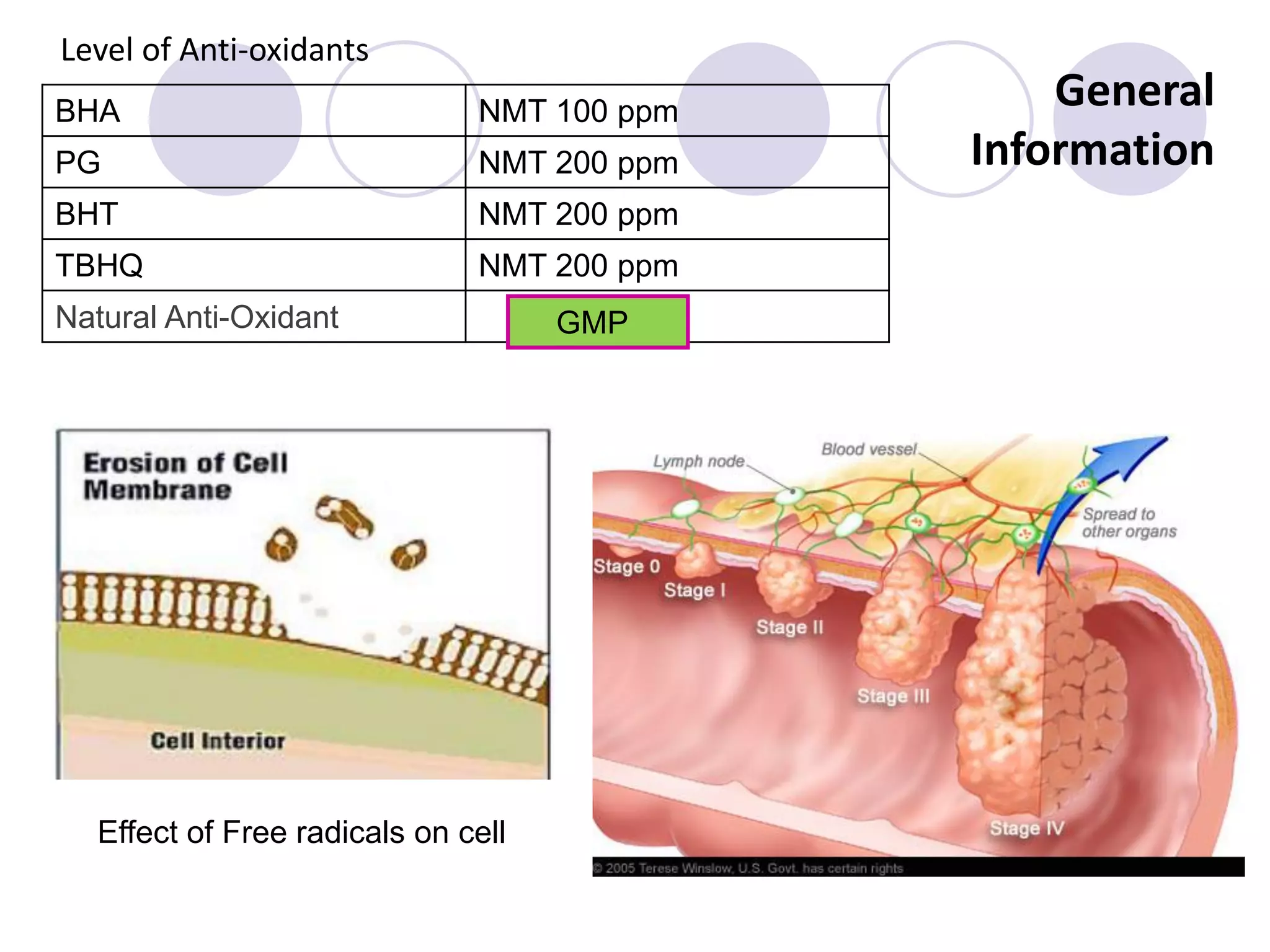
Level of Anti-oxidants
BHA NMT 100 ppm
PG NMT 200 ppm
BHT NMT 200 ppm
TBHQ NMT 200 ppm
Natural Anti-Oxidant GMP
Effect of Free radicals on cell
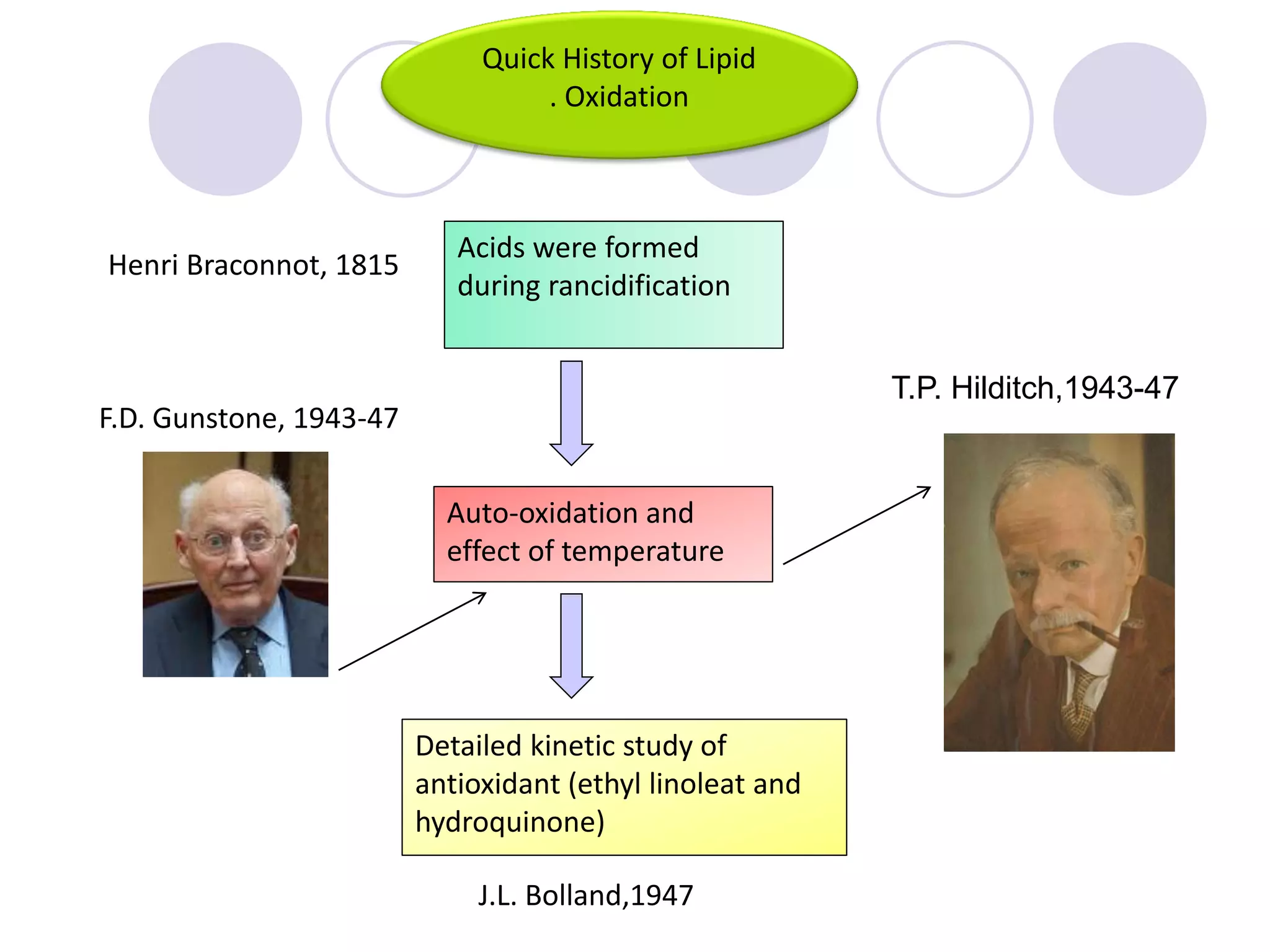
Quick History of Lipid
. Oxidation
Henri Braconnot, 1815
Acids were formed
during rancidification
J.L. Bolland,1947
Detailed kinetic study of
antioxidant (ethyl linoleat and
hydroquinone)
F.D. Gunstone, 1943-47
Auto-oxidation and
effect of temperature
T.P. Hilditch,1943-47
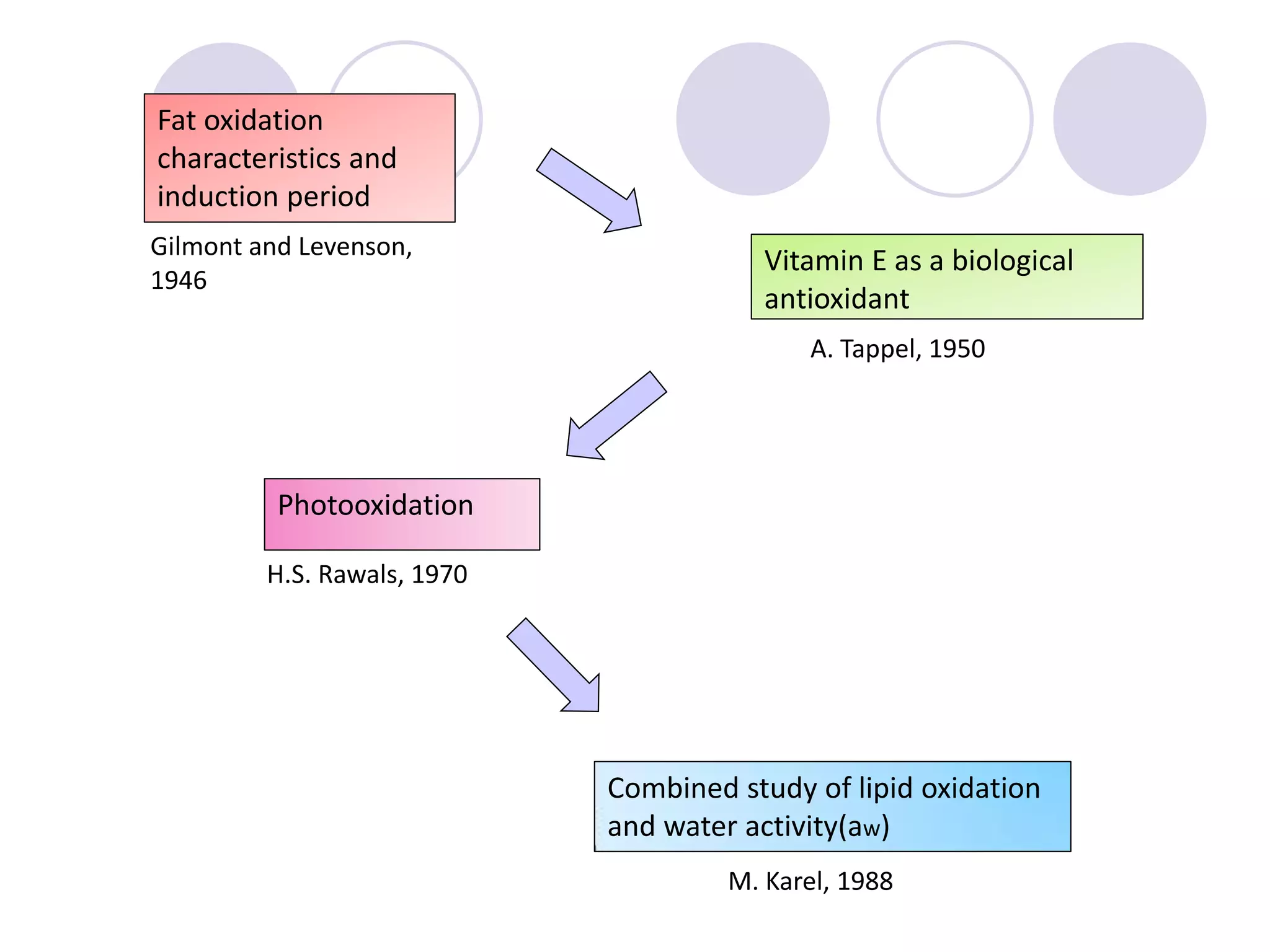
M. Karel, 1988
Combined study of lipid oxidation
and water activity(aw)
A. Tappel, 1950
Vitamin E as a biological
antioxidant
Gilmont and Levenson,
1946
Photooxidation
H.S. Rawals, 1970
Fat oxidation
characteristics and
induction period
BIBLIOGRAPHY
Oxidative Rancidity in Fats and Oils, Causes and Prevention

Oxidative Rancidity in Fats and Oils, Causes and Prevention

  • 1.
  • 2.
  • 3.
    Presentation Pattern  Rancidity(brief),Types  Hydrolytic rancidity(brief)  Oxidative rancidity and ways and outline  Photo-oxidation(detail)  Auto-oxidation(detail)  Feasibility of reactions: Pro-oxidants  Comparison b/w Photo and Auto-oxidation  Hydroperoxides decomposition(brief)  Factors affecting Lipoxidation(detail)  Anti-oxidant, types and mechanism(detail)  Measurement of Oxidative rancidity(brief)  Fat oxidation characteristic curve and induction period  General information  Quick history of Lipoxidation
  • 4.
    What is Rancidity? Rancidityis a term generally used to denote a condition of unpleasant odours and flavours in foods resulting from deterioration in the fat or oil portion of a food. RANCIDITY HYDROLYTIC RANCIDITY OXIDATIVE RANCIDITY MICROBIAL RANCIDITY
  • 5.
  • 6.
    HYDROLYTIC RANCIDITY Partial orComplete Hydrolysis of ester bonds Liberation of FFA DAGs, MAGs,, Glycerol EX: Development of rancid flavour in milk Deep fat frying Enzyme action, Heat, Moisture
  • 7.
    OXIDATIVE RANCIDITY Major causesof food spoilage Extensive research have done, yet to be discovered ……extremely complex subject because 1. Sensitivity of Intermediates Isolation separation and identification 2. Effect of catalyst Pro & anti-oxidants 3. Influence of photo- oxidation and auto-oxidation simultaneously 4. Relation between oxidation rate and stability
  • 8.
    Photo-oxidation Enzymatic oxidationAuto-oxidation Ways Fats &Oils Primary Oxidation Products Secondary Oxidation Products Tertiary Oxidation Products Factors Decomposition Oxidation Hydroperoxides Aldehydes, Ketones, Diene and triene Acids, Epoxides, Dimers, Oxirane rings Outline of the process
  • 9.
    Photo-oxidation Sunlight Photosensitizers Singlet oxygen Natural Pigment Chlorophyll,Pheophytin, Flavin, Porphyrin Dye Stuff Erythrosine, Methylene blue 13 Triplet oxygen Singlet oxygen
  • 10.
  • 11.
    Angular momentum =2s + 1 (s is total spin) For Triplet: 2(1/2+1/2) + 1= 3 For Singlet: 2(1/2- 1/2) + 1 = 1
  • 12.
    sens + RH(sing)+ hv → intermidiates-I(trip) intermediats-I(trip) + O2(trip) + hv → ROOH + sens sens + O2((trip)) + hv → intermidiates-II(sing) intermediats-II(sing) + RH(sing) + hv → ROOH + sens Pathways have been proposed Pathway-I Pathway-II sens - photosensitizes
  • 13.
    Mechanism RH + O2(singlet)+ hv → ROOH Singlet oxygen is more electrophilic than triplet oxygen and can reacts 1500 times greater than triplet oxygen with high electron density moieties like, C=C Hence it’s a type of ene type reaction,
  • 14.
    Evidences show thatit is a Free radical mechanism Inhibition in rate by chemical species known for interfere with Free radical reaction. Catalysed by light High yield of Hydroperoxides Relatively long Induction Period Auto-Oxidation
  • 15.
    Experimental results areexplained in three step free radical scheme RH RH + O2 R’ R’ + O2 ROO’ ROO’ + RH ROOH + R’ + R’ R’ + ROO’ ROO’ + ROO’ K1 K2 K3 K4 K5 K6 Initiation Propgation Termination R’ Nonradical product
  • 16.
    Rate equations: Oxygen Absorption: Eqn(4), (5) can be neglected Eqn (5), (6) can be neglected
  • 17.
    Hydroperoxides and theirDecompositionOxygen-oxygen bond scission Alkoxy and Hydroxyl radicals Aldehyde and acid/ester Or Hydrocarbon and oxoacid / oxoester 1 5 4 3 2 Ketone and 1ᵒ Alcohol 2ᵒ Alcohol and Free radical Ketone and Hydrocarbon
  • 19.
    A thermodynamically difficultreaction because Activation energy is 35kcal/mol Metal Catalysts Prooxidants This reaction is still a considerable mistery
  • 20.
    Pro-oxidants Transition metals, particularlythose having two or more valence states with a suitable oxidation-reduction potential between them are major pro-oxidants. Initiate / Accelerate the reaction Sources 1. Traces metals are naturally occurring components of all food tissues. 2. Originate from the soil where bearing material grow. 3. Metallic equipments used in handling, extraction and processing 4. Residual quantity of Spent bleaching earth, Nickel catalyst etc. 1 3 2
  • 21.
    Factors Influencing the rateof Lipid Oxidation Fatty Acid Composition Free Fatty Acid Temperature At lower content no effect on oxidation but in higher, it promotes Number, position and geometry of double bonds As temperature increase rate of oxidation increase but simultaneously availability of oxygen decrease Pro-oxidants
  • 22.
    Surface Area Oxygen Concentration Rateof oxidation is proportional to the surface area exposed to air or water(in case of emulsion) Supply of oxygen is unlimited so rate is independent of oxygen pressure, but at very low pressure rate is proportional to oxygen pressure Effective promoter of lipid oxidation The Ea’s for C-H and C-C scission reactions are slightly higher than bond energies 98.4 kCal/mol and 83.1 kCal/mol, respectively, and this is equal to photon energy available only at wavelengths <254 nm (UV Region) Radiant Energy
  • 23.
    Synergists Moisture Metal chelating agentdeactivate the metals hence no further initiation takes place Citric acid, Ascorbic acid, EDTA etc. Water activity measurement is a new concept, for dried food aw < 0.1 (No such effect on rate of Oxidation is detected) As increasing the aw and keeping between 0.65 - 0.85 increase the rate and beyond the range oxidation rate is enormously high and constant to aw Anti-oxidant
  • 24.
    Anti-oxidants Monohydric and Polyhydricphenols derivatives are excellent hydrogen or electron donators and their radical are highly stable due to resonance delocalization Natural Anti-oxidants Synthetic Anti-oxidants Sesamol Gossypol Tocopherol Tocotrienol Ginistein Flavonoids BHT BHA TBHQ PG TBHP Antioxidants do not prevent oxidation but they slow it down, thereby extending the induction period and hence the shelf-life of fat-containing foods. Prevention
  • 25.
    Mechanism Photo-oxidation is notinhibited by the antioxidants used for autoxidation but by singlet oxygen quenchers of which the best known is -carotene.
  • 26.
  • 27.
  • 28.
  • 29.
    1. Peroxide Value 2.p-Anisidine Value 3. Ultra Violet Spectroscopy 4. Total Polar Component 5. Iodine Value 6. Active Oxygen Method Measurement of Oxidative Rancidity
  • 30.
    1. Peroxide Value Indicatorof initial oxidation suffered by sample. Measured on the basic of ability of peroxides to liberates iodine from potassium iodide Expressed in terms of milliequlivents of oxygen per kilogram of fats.
  • 31.
    2. Anisidine Value Inthe presence of acetic acid, p-anisidine react with aldehyde producing a yellowish colour. The molar absorbance at 350nm increases if the aldehyde contains a double bond conjugated to the carbonyl double bond.
  • 32.
    3. Thiobarbituric AcidTest Oxidation products of unsaturated system produce a colour reacton with TBA. Many alkanals and alkenals produces yellow colour compounds at 450nm Dienal produce a red colour pigment at 530nm
  • 33.
    General characteristics curve offat oxidation Induction Period Without antioxidant Induction period: After a certain critical amount of oxidation has occurred, the reaction enters to its second phase characterized by a rapid accelerating rate of oxidation, this period is called induction period
  • 34.
  • 35.
    General Information Level of Anti-oxidants BHANMT 100 ppm PG NMT 200 ppm BHT NMT 200 ppm TBHQ NMT 200 ppm Natural Anti-Oxidant GMP Effect of Free radicals on cell
  • 36.
    Quick History ofLipid . Oxidation Henri Braconnot, 1815 Acids were formed during rancidification J.L. Bolland,1947 Detailed kinetic study of antioxidant (ethyl linoleat and hydroquinone) F.D. Gunstone, 1943-47 Auto-oxidation and effect of temperature T.P. Hilditch,1943-47
  • 37.
    M. Karel, 1988 Combinedstudy of lipid oxidation and water activity(aw) A. Tappel, 1950 Vitamin E as a biological antioxidant Gilmont and Levenson, 1946 Photooxidation H.S. Rawals, 1970 Fat oxidation characteristics and induction period
  • 38.