By Erica Pounds
Shelf Life
Analysis Type Shelf Life Length Date Coding
Microbiological changes Short-life (up to 1 wk) “Use by”
Chemical changes Medium to Long (3 wks – 1 yr) “Best Before”
Sensory changes Medium to Long (3 wks – 1 yr) “Best Before”
Shelf-Life is defined as the time during which the food product will:
a) Remain safe;
b) Be certain to retain desired sensory, chemical, physical and
microbiological characteristics;
c) Comply with any label declaration of nutritional data, when
stored under recommended conditions
Factors Affecting Shelf Life
External Conditions influencing shelf-life:
• Raw material selection and quality
• Product formulation and assembly
• Processing environment
• Processing and preservation techniques
• Packaging
• Storage and distribution
• Consumer handling
Internal Changes influencing Shelf-Life:
• Moisture loss and gain
• Physical transfer of oxygen, water vapor, odors and flavors
• Light induced changes
• Chemical changes
• Microbiological changes
Packaging
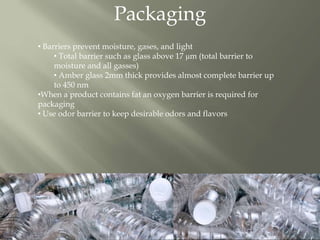
• Barriers prevent moisture, gases, and light
• Total barrier such as glass above 17 μm (total barrier to
moisture and all gasses)
• Amber glass 2mm thick provides almost complete barrier up
to 450 nm
•When a product contains fat an oxygen barrier is required for
packaging
• Use odor barrier to keep desirable odors and flavors
Microbial and Mold Growth
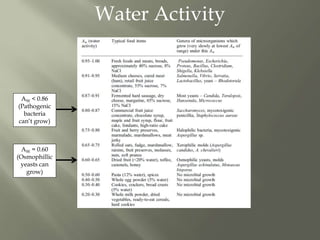
• Water Activity – ability of moisture to migrate in food products.
Major parameter for inhibiting microbial growth and molds
• Equilibrium relative humidity (ERH) – ERH of the environment is
key to surface-growing organisms
Water Activity
AW < 0.86
(Pathogenic
bacteria
can’t grow)
AW = 0.60
(Osmophillic
yeasts can
grow)
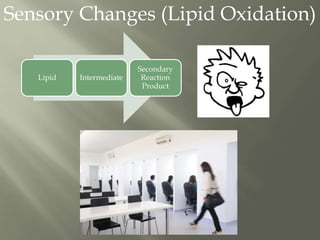
Sensory Changes (Lipid Oxidation)
Lipid Intermediate
Secondary
Reaction
Product
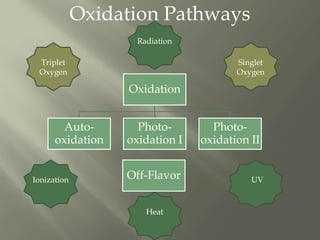
Oxidation Pathways
Oxidation
Auto-
oxidation
Photo-
oxidation I
Photo-
oxidation II
Off-Flavor
Triplet
Oxygen
Singlet
Oxygen
UVIonization
Radiation
Heat
Photo-Oxidation
• Photo-oxidation uses light as a sensitizer with little or no
induction period
• Type I – excitation of lipids
• Type II – excitation of oxygen
Auto-Oxidation
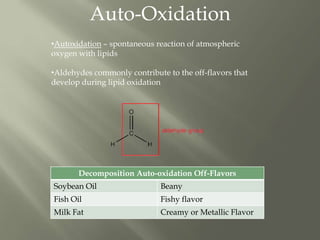
•Autoxidation – spontaneous reaction of atmospheric
oxygen with lipids
•Aldehydes commonly contribute to the off-flavors that
develop during lipid oxidation
Decomposition Auto-oxidation Off-Flavors
Soybean Oil Beany
Fish Oil Fishy flavor
Milk Fat Creamy or Metallic Flavor
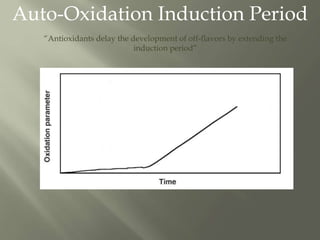
Auto-Oxidation Induction Period
“Antioxidants delay the development of off-flavors by extending the
induction period”
Measure of Oxidation
•Visual
• Oxidative deterioration may cause bleaching of foods due to
the reaction of pigments, especially caratenoids
• Sensory Panel
• Hexanal detection with age
•Qualitative
• Monitor weight
•Quantitative
• Headspace Analysis (Dynamic/Static)
• Solid Phase Microextraction (SPME)
• Peroxide Value (PV)
• Para-anisidine value (absorbs at 350 nm)
• Thiobarbituric acid value (absorbs at 532 – 535 nm)
• Induction Period Tests
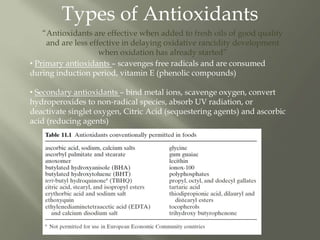
Types of Antioxidants
• Primary antioxidants – scavenges free radicals and are consumed
during induction period, vitamin E (phenolic compounds)
• Secondary antioxidants – bind metal ions, scavenge oxygen, convert
hydroperoxides to non-radical species, absorb UV radiation, or
deactivate singlet oxygen, Citric Acid (sequestering agents) and ascorbic
acid (reducing agents)
“Antioxidants are effective when added to fresh oils of good quality
and are less effective in delaying oxidative rancidity development
when oxidation has already started”
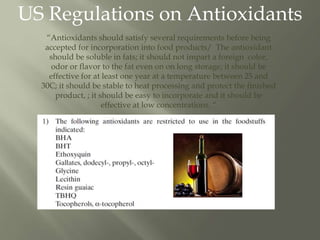
US Regulations on Antioxidants
“Antioxidants should satisfy several requirements before being
accepted for incorporation into food products/ The antioxidant
should be soluble in fats; it should not impart a foreign color,
odor or flavor to the fat even on on long storage; it should be
effective for at least one year at a temperature between 25 and
30C; it should be stable to heat processing and protect the finished
product, ; it should be easy to incorporate and it should be
effective at low concentrations. “
Plan
•Cleaning
• Use of metal chelating agents can be used to prevent
oxidation
• Water activity – measuring and controlling provides a
means of monitoring and controlling pathogenic and
spoilage bacteria
• Mixing
• Check bulk flavorings with GC-MS for quality control
• pH of all e-liquid should be at 6. Maximum degradation
of peroxides occurs in the pH region of 5.0 - 5.5
• Yeasts thrive between a pH of 4.5 – 5.5
• Addition of antioxidants (antioxidants must not exceed
0.02% by weight based on fat content of food)
• Bottling
• Pumping introduces more oxygen
• Opening and closing 5 gallon batches to bottle introduces
more oxygen in lipids and in headspace
• Storage
• Light and Temperature Control

Shelf-Life Presentation update

  • 1.
  • 2.
    Shelf Life Analysis TypeShelf Life Length Date Coding Microbiological changes Short-life (up to 1 wk) “Use by” Chemical changes Medium to Long (3 wks – 1 yr) “Best Before” Sensory changes Medium to Long (3 wks – 1 yr) “Best Before” Shelf-Life is defined as the time during which the food product will: a) Remain safe; b) Be certain to retain desired sensory, chemical, physical and microbiological characteristics; c) Comply with any label declaration of nutritional data, when stored under recommended conditions
  • 3.
    Factors Affecting ShelfLife External Conditions influencing shelf-life: • Raw material selection and quality • Product formulation and assembly • Processing environment • Processing and preservation techniques • Packaging • Storage and distribution • Consumer handling Internal Changes influencing Shelf-Life: • Moisture loss and gain • Physical transfer of oxygen, water vapor, odors and flavors • Light induced changes • Chemical changes • Microbiological changes
  • 4.
    Packaging • Barriers preventmoisture, gases, and light • Total barrier such as glass above 17 μm (total barrier to moisture and all gasses) • Amber glass 2mm thick provides almost complete barrier up to 450 nm •When a product contains fat an oxygen barrier is required for packaging • Use odor barrier to keep desirable odors and flavors
  • 5.
    Microbial and MoldGrowth • Water Activity – ability of moisture to migrate in food products. Major parameter for inhibiting microbial growth and molds • Equilibrium relative humidity (ERH) – ERH of the environment is key to surface-growing organisms
  • 6.
    Water Activity AW <0.86 (Pathogenic bacteria can’t grow) AW = 0.60 (Osmophillic yeasts can grow)
  • 7.
    Sensory Changes (LipidOxidation) Lipid Intermediate Secondary Reaction Product
  • 8.
    Oxidation Pathways Oxidation Auto- oxidation Photo- oxidation I Photo- oxidationII Off-Flavor Triplet Oxygen Singlet Oxygen UVIonization Radiation Heat
  • 9.
    Photo-Oxidation • Photo-oxidation useslight as a sensitizer with little or no induction period • Type I – excitation of lipids • Type II – excitation of oxygen
  • 10.
    Auto-Oxidation •Autoxidation – spontaneousreaction of atmospheric oxygen with lipids •Aldehydes commonly contribute to the off-flavors that develop during lipid oxidation Decomposition Auto-oxidation Off-Flavors Soybean Oil Beany Fish Oil Fishy flavor Milk Fat Creamy or Metallic Flavor
  • 11.
    Auto-Oxidation Induction Period “Antioxidantsdelay the development of off-flavors by extending the induction period”
  • 12.
    Measure of Oxidation •Visual •Oxidative deterioration may cause bleaching of foods due to the reaction of pigments, especially caratenoids • Sensory Panel • Hexanal detection with age •Qualitative • Monitor weight •Quantitative • Headspace Analysis (Dynamic/Static) • Solid Phase Microextraction (SPME) • Peroxide Value (PV) • Para-anisidine value (absorbs at 350 nm) • Thiobarbituric acid value (absorbs at 532 – 535 nm) • Induction Period Tests
  • 13.
    Types of Antioxidants •Primary antioxidants – scavenges free radicals and are consumed during induction period, vitamin E (phenolic compounds) • Secondary antioxidants – bind metal ions, scavenge oxygen, convert hydroperoxides to non-radical species, absorb UV radiation, or deactivate singlet oxygen, Citric Acid (sequestering agents) and ascorbic acid (reducing agents) “Antioxidants are effective when added to fresh oils of good quality and are less effective in delaying oxidative rancidity development when oxidation has already started”
  • 14.
    US Regulations onAntioxidants “Antioxidants should satisfy several requirements before being accepted for incorporation into food products/ The antioxidant should be soluble in fats; it should not impart a foreign color, odor or flavor to the fat even on on long storage; it should be effective for at least one year at a temperature between 25 and 30C; it should be stable to heat processing and protect the finished product, ; it should be easy to incorporate and it should be effective at low concentrations. “
  • 15.
    Plan •Cleaning • Use ofmetal chelating agents can be used to prevent oxidation • Water activity – measuring and controlling provides a means of monitoring and controlling pathogenic and spoilage bacteria • Mixing • Check bulk flavorings with GC-MS for quality control • pH of all e-liquid should be at 6. Maximum degradation of peroxides occurs in the pH region of 5.0 - 5.5 • Yeasts thrive between a pH of 4.5 – 5.5 • Addition of antioxidants (antioxidants must not exceed 0.02% by weight based on fat content of food) • Bottling • Pumping introduces more oxygen • Opening and closing 5 gallon batches to bottle introduces more oxygen in lipids and in headspace • Storage • Light and Temperature Control

Editor's Notes

  • #9  Oxidative deterioration can be initiated by light or metals or the enzyme lipoxygenase Metal ions are the most important pro-oxidant in foods (even in ppm level or less)
  • #10  Sensitizer molecules = pigments such as chlorophyll and riboflavin, and heavy metals which are all naturally occurring in animal and vegetable fats and oils.
  • #12  Lag period or induction period is the lifespan of anti-oxidants until until about 90% has been destroyed where the timespan/length of the lag period is due to anti-oxidant concentration.