1
RANCIDITY
 Deterioration of food products.
 Due to oxidation reaction.
 Effects the quality and shelf life.
 Unfit for consumption.
2
Rancidity
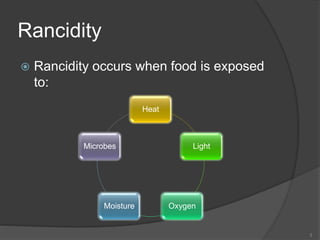
 Rancidity occurs when food is exposed
to:
Heat
Light
Oxygen
Moisture
Microbes
3
Rancidity
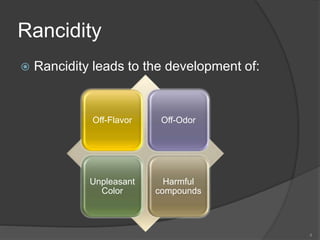
 Rancidity leads to the development of:
Off-Flavor Off-Odor
Unpleasant
Color
Harmful
compounds
4
Types of Rancidity
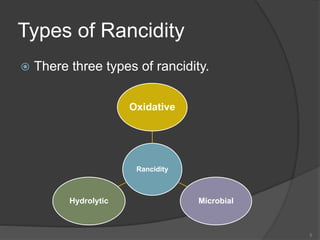
 There three types of rancidity.
Rancidity
Oxidative
Microbial
Hydrolytic
5
Oxidative Rancidity
 Occurs due to oxidation of fats.
 Unsaturated fatty acids react with
oxygen and lead to formation of free
radicals.
 Free radicals further react with oxygen
to form aldehydes and ketons.
6
Oxidative Rancidity
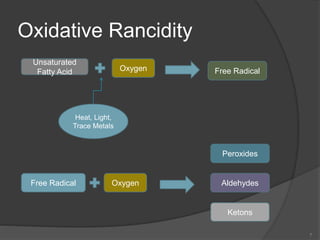
Unsaturated
Fatty Acid Oxygen Free Radical
Heat, Light,
Trace Metals
Free Radical Oxygen
Peroxides
Aldehydes
Ketons
7
Oxidative Rancidity
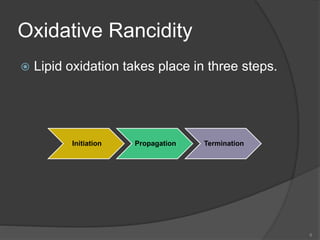
 Lipid oxidation takes place in three steps.
Initiation Propagation Termination
8
Oxidative Rancidity
 Initiation:
 Free radical formation require high
activation energy.
 It is usually initiated in the presence of
light and metal ions.
9
Oxidative Rancidity
 Propagation:
 Free radicals react with oxygen to form
per-oxide radicals.
 Per-oxide free radicals abstract
hydrogen from another unsaturated
molecule to yield new free radical.
10
Oxidative Rancidity
 Termination:
 This step involves stopping of reaction.
 Free radicals generated during chain
reaction are eliminated.
 Factors
 Antioxidants
 Oxygen depletion
11
Oxidative Rancidity
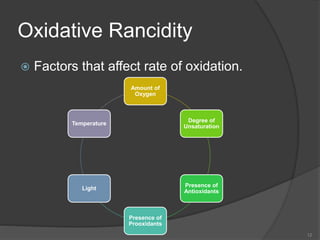
 Factors that affect rate of oxidation.
Amount of
Oxygen
Degree of
Unsaturation
Presence of
Antioxidants
Presence of
Prooxidants
Light
Temperature
12
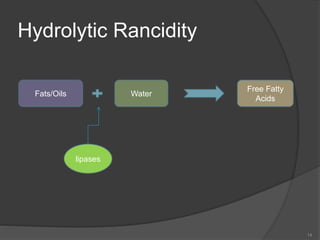
Hydrolytic Rancidity
 Occurs due to hydrolysis of fats.
 Process is catalyzed by enzymes i.e.
lipases.
 Enzymes break down ester bonds.
 Leads to the formation of free fatty
acids.
13
Hydrolytic Rancidity
Fats/Oils Water
Free Fatty
Acids
lipases
14
Microbial Rancidity
 Occurs when microorganisms
breakdown fats.
 Reaction is catalyzed by enzymes,
temperature, humidity.
15
Prevention
Prevention
Proper
Storage
Use of
Antioxidants
Use of
Chelating
Agents
Hydrogenation
16
References
 Lipids by John W. Finley and John M.
deMan
 Osman, M. A., & Al-Nadabi, H. (2014).
Rancidity in foods. Advances in Food
Science and Engineering, 1(1), 13-19.
17

Rancidity and Its Types.pptx