Polymorphism of oils and fats- plasticity
By
T.Raviteja
Lipid technology
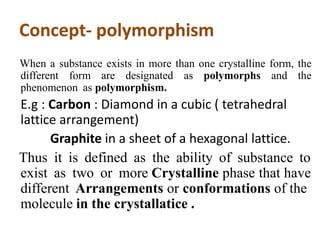
Concept- polymorphism
When a substance exists in more than one crystalline form, the
different form are designated as polymorphs and the
phenomenon as polymorphism.
E.g : Carbon : Diamond in a cubic ( tetrahedral
lattice arrangement)
Graphite in a sheet of a hexagonal lattice.
Thus it is defined as the ability of substance to
exist as two or more Crystalline phase that have
different Arrangements or conformations of the
molecule in the crystallatice .
Basics of polymorphism
• Fats are triglycerides having different forms with
different melting points. Or The occurrence of several
different crystals forms for a same compound.
• Here each form is called polymorph and phenomenon
is called polymorphism.
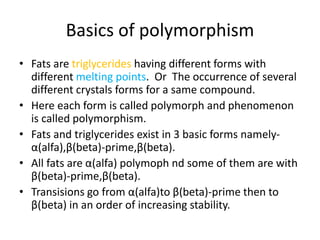
• Fats and triglycerides exist in 3 basic forms namely-
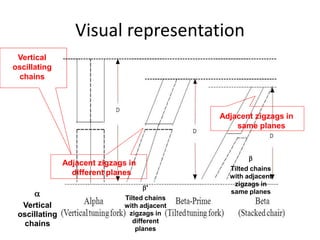
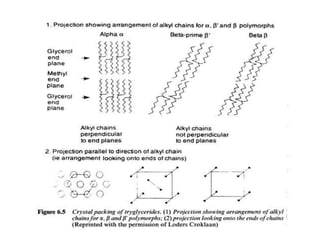
α(alfa),β(beta)-prime,β(beta).
• All fats are α(alfa) polymoph nd some of them are with
β(beta)-prime,β(beta).
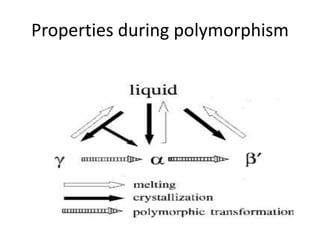
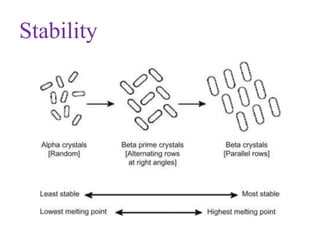
• Transisions go from α(alfa)to β(beta)-prime then to
β(beta) in an order of increasing stability.
Visual representation
Vertical
oscillating
chains
Adjacent zigzags in
different planes
Adjacent zigzags in
same planes

Vertical
oscillating
chains
'
Tilted chains
with adjacent
zigzags in
different
planes

Tilted chains
with adjacent
zigzags in
same planes
Properties during polymorphism
Stability
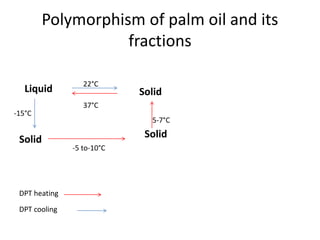
Polymorphism of palm oil and its
fractions
Liquid Solid
SolidSolid
22°C
37°C
5-7°C
-15°C
-5 to-10°C
DPT heating
DPT cooling
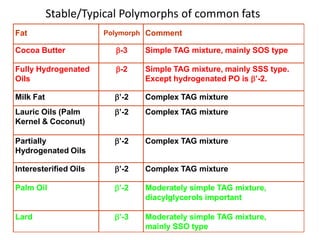
Stable/Typical Polymorphs of common fats
Fat Polymorph Comment
Cocoa Butter -3 Simple TAG mixture, mainly SOS type
Fully Hydrogenated
Oils
-2 Simple TAG mixture, mainly SSS type.
Except hydrogenated PO is ’-2.
Milk Fat ’-2 Complex TAG mixture
Lauric Oils (Palm
Kernel & Coconut)
’-2 Complex TAG mixture
Partially
Hydrogenated Oils
’-2 Complex TAG mixture
Interesterified Oils ’-2 Complex TAG mixture
Palm Oil ’-2 Moderately simple TAG mixture,
diacylglycerols important
Lard ’-3 Moderately simple TAG mixture,
mainly SSO type
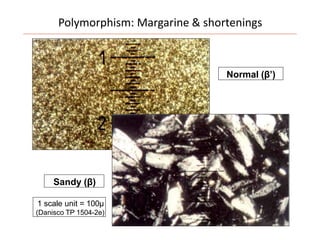
Polymorphism: Margarine & shortenings
Normal (β’)
1 scale unit = 100µ
(Danisco TP 1504-2e)
Sandy (β)
Crystallisation
• Nucleation, Growth
and Supercooling
• Post growth events,
crystal ripening
Unstabl
e
Metastabl
e
Stabl
e
Temperatur
e
Concentration
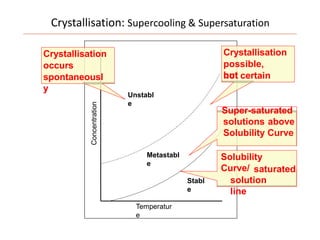
Crystallisation: Supercooling & Supersaturation
Solubility
Curve/ saturated
solution
line
Crystallisation
possible,
butnot certain
Super-saturated
solutions above
Solubility Curve
Crystallisation
occurs
spontaneousl
y
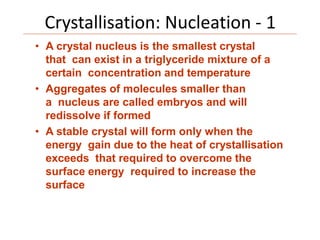
Crystallisation: Nucleation - 1
• A crystal nucleus is the smallest crystal
that can exist in a triglyceride mixture of a
certain concentration and temperature
• Aggregates of molecules smaller than
a nucleus are called embryos and will
redissolve if formed
• A stable crystal will form only when the
energy gain due to the heat of crystallisation
exceeds that required to overcome the
surface energy required to increase the
surface
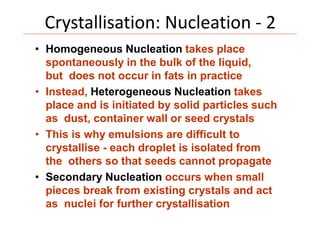
Crystallisation: Nucleation - 2
• Homogeneous Nucleation takes place
spontaneously in the bulk of the liquid,
but does not occur in fats in practice
• Instead, Heterogeneous Nucleation takes
place and is initiated by solid particles such
as dust, container wall or seed crystals
• This is why emulsions are difficult to
crystallise - each droplet is isolated from
the others so that seeds cannot propagate
• Secondary Nucleation occurs when small
pieces break from existing crystals and act
as nuclei for further crystallisation
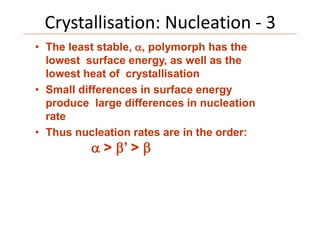
Crystallisation: Nucleation - 3
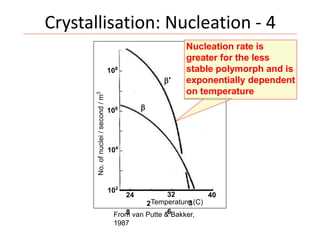
• The least stable, , polymorph has the
lowest surface energy, as well as the
lowest heat of crystallisation
• Small differences in surface energy
produce large differences in nucleation
rate
• Thus nucleation rates are in the order:
 > ’ > 
Crystallisation: Nucleation - 4
No.ofnuclei/second/m3
'

108
106
104
102
24
2
8
32
3
6
40
Temperature (C)
From van Putte & Bakker,
1987
Nucleation rate is
greater for the less
stable polymorph and is
exponentially dependent
on temperature
Crystallisation: Growth
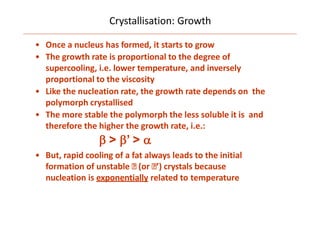
• Once a nucleus has formed, it starts to grow
• The growth rate is proportional to the degree of
supercooling, i.e. lower temperature, and inversely
proportional to the viscosity
• Like the nucleation rate, the growth rate depends on the
polymorph crystallised
• The more stable the polymorph the less soluble it is and
therefore the higher the growth rate, i.e.:
 > ’ > 
• But, rapid cooling of a fat always leads to the initial
formation of unstable (or ’) crystals because
nucleation is exponentially related to temperature
Crystallisation: Post-growth events - 1
• Contraction: Solid fat occupies about 90%
of the volume of liquid fat
• The amount of contraction depends on the
SFC of the fat (the amount of fat crystallised)
and the polymorph - more stable
polymorphs are denser
• Agglomeration: Crystals form agglomerates
of spherulitic crystals with particle sizes of
several hundred m
Crystallisation: Post-growth events - 2
• (Ostwald) Ripening: As nucleation, growth and agglomeration
proceed, the overall supersaturation decreases and the critical
size for a stable crystal or nucleus increases.
• Smaller crystals, which were stable at lower levels of
supersaturation, now become unstable and redissolve.
• In theory, the process would continue indefinitely until
eventually only one large crystal was left in the presence of a
slightly supersaturated liquid.
• In practice, once crystals grow to about 10μm, the
thermodynamic driving force is small
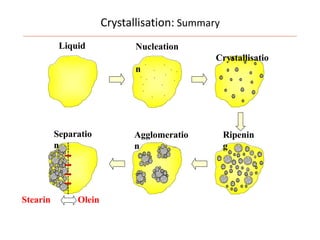
Liquid
.
.
.
.
.
.
.
.
.
.
.
. .
.
.
Nucleation
Crystallisatio
n
Agglomeratio
n
Ripenin
g
Olein
Separatio
n
Stearin
Crystallisation: Summary
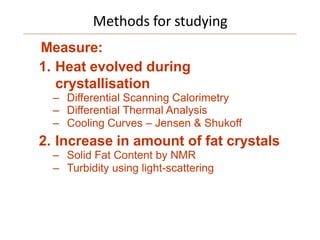
Methods for studying
Measure:
1. Heat evolved during
crystallisation
– Differential Scanning Calorimetry
– Differential Thermal Analysis
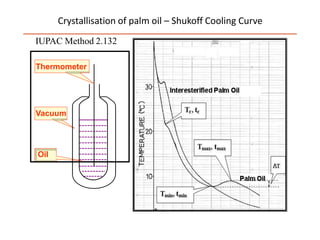
– Cooling Curves – Jensen & Shukoff
2. Increase in amount of fat crystals
– Solid Fat Content by NMR
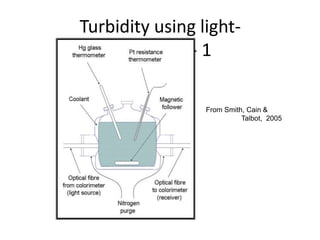
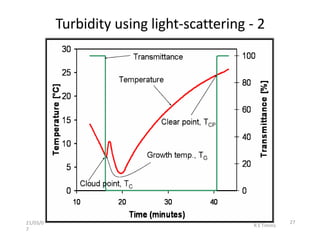
– Turbidity using light-scattering
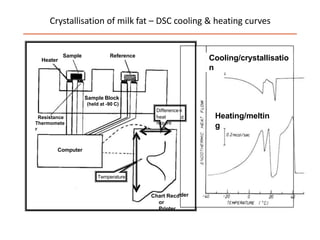
Crystallisation of milk fat – DSC cooling & heating curves
Sample
Heater
Reference
Sample Block
(held at -90 C)
Computer
Difference
iheat
require
n
d
rder
Temperature
Chart Reco
or
Printer
Resistance
Thermomete
r
Cooling/crystallisatio
n
Heating/meltin
g
2 4
2 6
2 8
3 0
3 2
0 1 0 2 0 3 0 4 0
5 0
T i m e ( m i n u t e s )
T
e
m
p
e
r
a
t
u
r
e
/
C
Temp. Rise
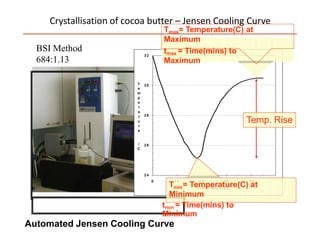
Crystallisation of cocoa butter – Jensen Cooling Curve
Tmax= Temperature(C) at
Maximum
tmax = Time(mins) to
Maximum
minT = Temperature(C) at
Minimum
tmin = Time(mins) to
Minimum
Automated Jensen Cooling Curve
BSI Method
684:1.13
Crystallisation of palm oil – Shukoff Cooling Curve
Thermometer
Vacuum
Oil
IUPAC Method 2.132
0
20
10
40
30
80
70
60
50
0 10 20 30 60 70 8040 50
Minutes
SolidFatContent(%)at20C
Blend 13
Blend 14
Blend 15
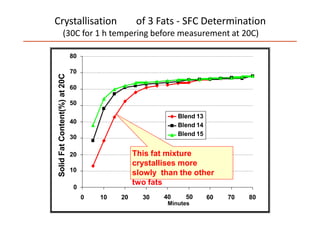
Crystallisation of 3 Fats - SFC Determination
(30C for 1 h tempering before measurement at 20C)
This fat mixture
crystallises more
slowly than the other
two fats
Turbidity using light-
scattering - 1
From Smith, Cain &
Talbot, 2005
Turbidity using light-scattering - 2
R E Timms
2721/03/0
7
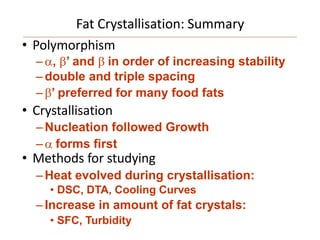
Fat Crystallisation: Summary
• Polymorphism
–, ’ and  in order of increasing stability
– double and triple spacing
– ’ preferred for many food fats
• Crystallisation
–Nucleation followed Growth
– forms first
• Methods for studying
–Heat evolved during crystallisation:
• DSC, DTA, Cooling Curves
–Increase in amount of fat crystals:
• SFC, Turbidity
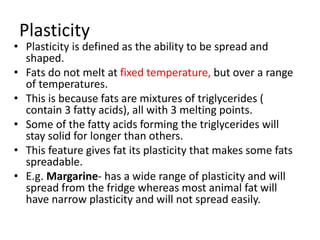
Plasticity
• Plasticity is defined as the ability to be spread and
shaped.
• Fats do not melt at fixed temperature, but over a range
of temperatures.
• This is because fats are mixtures of triglycerides (
contain 3 fatty acids), all with 3 melting points.
• Some of the fatty acids forming the triglycerides will
stay solid for longer than others.
• This feature gives fat its plasticity that makes some fats
spreadable.
• E.g. Margarine- has a wide range of plasticity and will
spread from the fridge whereas most animal fat will
have narrow plasticity and will not spread easily.
Thank you

oil and fat processing

  • 1.
    Polymorphism of oilsand fats- plasticity By T.Raviteja Lipid technology
  • 2.
    Concept- polymorphism When asubstance exists in more than one crystalline form, the different form are designated as polymorphs and the phenomenon as polymorphism. E.g : Carbon : Diamond in a cubic ( tetrahedral lattice arrangement) Graphite in a sheet of a hexagonal lattice. Thus it is defined as the ability of substance to exist as two or more Crystalline phase that have different Arrangements or conformations of the molecule in the crystallatice .
  • 3.
    Basics of polymorphism •Fats are triglycerides having different forms with different melting points. Or The occurrence of several different crystals forms for a same compound. • Here each form is called polymorph and phenomenon is called polymorphism. • Fats and triglycerides exist in 3 basic forms namely- α(alfa),β(beta)-prime,β(beta). • All fats are α(alfa) polymoph nd some of them are with β(beta)-prime,β(beta). • Transisions go from α(alfa)to β(beta)-prime then to β(beta) in an order of increasing stability.
  • 4.
    Visual representation Vertical oscillating chains Adjacent zigzagsin different planes Adjacent zigzags in same planes  Vertical oscillating chains ' Tilted chains with adjacent zigzags in different planes  Tilted chains with adjacent zigzags in same planes
  • 6.
  • 7.
  • 8.
    Polymorphism of palmoil and its fractions Liquid Solid SolidSolid 22°C 37°C 5-7°C -15°C -5 to-10°C DPT heating DPT cooling
  • 9.
    Stable/Typical Polymorphs ofcommon fats Fat Polymorph Comment Cocoa Butter -3 Simple TAG mixture, mainly SOS type Fully Hydrogenated Oils -2 Simple TAG mixture, mainly SSS type. Except hydrogenated PO is ’-2. Milk Fat ’-2 Complex TAG mixture Lauric Oils (Palm Kernel & Coconut) ’-2 Complex TAG mixture Partially Hydrogenated Oils ’-2 Complex TAG mixture Interesterified Oils ’-2 Complex TAG mixture Palm Oil ’-2 Moderately simple TAG mixture, diacylglycerols important Lard ’-3 Moderately simple TAG mixture, mainly SSO type
  • 10.
    Polymorphism: Margarine &shortenings Normal (β’) 1 scale unit = 100µ (Danisco TP 1504-2e) Sandy (β)
  • 11.
    Crystallisation • Nucleation, Growth andSupercooling • Post growth events, crystal ripening
  • 12.
    Unstabl e Metastabl e Stabl e Temperatur e Concentration Crystallisation: Supercooling &Supersaturation Solubility Curve/ saturated solution line Crystallisation possible, butnot certain Super-saturated solutions above Solubility Curve Crystallisation occurs spontaneousl y
  • 13.
    Crystallisation: Nucleation -1 • A crystal nucleus is the smallest crystal that can exist in a triglyceride mixture of a certain concentration and temperature • Aggregates of molecules smaller than a nucleus are called embryos and will redissolve if formed • A stable crystal will form only when the energy gain due to the heat of crystallisation exceeds that required to overcome the surface energy required to increase the surface
  • 14.
    Crystallisation: Nucleation -2 • Homogeneous Nucleation takes place spontaneously in the bulk of the liquid, but does not occur in fats in practice • Instead, Heterogeneous Nucleation takes place and is initiated by solid particles such as dust, container wall or seed crystals • This is why emulsions are difficult to crystallise - each droplet is isolated from the others so that seeds cannot propagate • Secondary Nucleation occurs when small pieces break from existing crystals and act as nuclei for further crystallisation
  • 15.
    Crystallisation: Nucleation -3 • The least stable, , polymorph has the lowest surface energy, as well as the lowest heat of crystallisation • Small differences in surface energy produce large differences in nucleation rate • Thus nucleation rates are in the order:  > ’ > 
  • 16.
    Crystallisation: Nucleation -4 No.ofnuclei/second/m3 '  108 106 104 102 24 2 8 32 3 6 40 Temperature (C) From van Putte & Bakker, 1987 Nucleation rate is greater for the less stable polymorph and is exponentially dependent on temperature
  • 17.
    Crystallisation: Growth • Oncea nucleus has formed, it starts to grow • The growth rate is proportional to the degree of supercooling, i.e. lower temperature, and inversely proportional to the viscosity • Like the nucleation rate, the growth rate depends on the polymorph crystallised • The more stable the polymorph the less soluble it is and therefore the higher the growth rate, i.e.:  > ’ >  • But, rapid cooling of a fat always leads to the initial formation of unstable (or ’) crystals because nucleation is exponentially related to temperature
  • 18.
    Crystallisation: Post-growth events- 1 • Contraction: Solid fat occupies about 90% of the volume of liquid fat • The amount of contraction depends on the SFC of the fat (the amount of fat crystallised) and the polymorph - more stable polymorphs are denser • Agglomeration: Crystals form agglomerates of spherulitic crystals with particle sizes of several hundred m
  • 19.
    Crystallisation: Post-growth events- 2 • (Ostwald) Ripening: As nucleation, growth and agglomeration proceed, the overall supersaturation decreases and the critical size for a stable crystal or nucleus increases. • Smaller crystals, which were stable at lower levels of supersaturation, now become unstable and redissolve. • In theory, the process would continue indefinitely until eventually only one large crystal was left in the presence of a slightly supersaturated liquid. • In practice, once crystals grow to about 10μm, the thermodynamic driving force is small
  • 20.
  • 21.
    Methods for studying Measure: 1.Heat evolved during crystallisation – Differential Scanning Calorimetry – Differential Thermal Analysis – Cooling Curves – Jensen & Shukoff 2. Increase in amount of fat crystals – Solid Fat Content by NMR – Turbidity using light-scattering
  • 22.
    Crystallisation of milkfat – DSC cooling & heating curves Sample Heater Reference Sample Block (held at -90 C) Computer Difference iheat require n d rder Temperature Chart Reco or Printer Resistance Thermomete r Cooling/crystallisatio n Heating/meltin g
  • 23.
    2 4 2 6 28 3 0 3 2 0 1 0 2 0 3 0 4 0 5 0 T i m e ( m i n u t e s ) T e m p e r a t u r e / C Temp. Rise Crystallisation of cocoa butter – Jensen Cooling Curve Tmax= Temperature(C) at Maximum tmax = Time(mins) to Maximum minT = Temperature(C) at Minimum tmin = Time(mins) to Minimum Automated Jensen Cooling Curve BSI Method 684:1.13
  • 24.
    Crystallisation of palmoil – Shukoff Cooling Curve Thermometer Vacuum Oil IUPAC Method 2.132
  • 25.
    0 20 10 40 30 80 70 60 50 0 10 2030 60 70 8040 50 Minutes SolidFatContent(%)at20C Blend 13 Blend 14 Blend 15 Crystallisation of 3 Fats - SFC Determination (30C for 1 h tempering before measurement at 20C) This fat mixture crystallises more slowly than the other two fats
  • 26.
    Turbidity using light- scattering- 1 From Smith, Cain & Talbot, 2005
  • 27.
    Turbidity using light-scattering- 2 R E Timms 2721/03/0 7
  • 28.
    Fat Crystallisation: Summary •Polymorphism –, ’ and  in order of increasing stability – double and triple spacing – ’ preferred for many food fats • Crystallisation –Nucleation followed Growth – forms first • Methods for studying –Heat evolved during crystallisation: • DSC, DTA, Cooling Curves –Increase in amount of fat crystals: • SFC, Turbidity
  • 29.
    Plasticity • Plasticity isdefined as the ability to be spread and shaped. • Fats do not melt at fixed temperature, but over a range of temperatures. • This is because fats are mixtures of triglycerides ( contain 3 fatty acids), all with 3 melting points. • Some of the fatty acids forming the triglycerides will stay solid for longer than others. • This feature gives fat its plasticity that makes some fats spreadable. • E.g. Margarine- has a wide range of plasticity and will spread from the fridge whereas most animal fat will have narrow plasticity and will not spread easily.
  • 30.

Editor's Notes

  • #4 Fats are compounds of ftty acids and triglycerides. It consists of long and short chain fatty acids.triglycerides changes with m.p, structure and form
  • #5 Alpha crystals are vertical oscillating chains (54c-m.p) Beta prime Adjacent zig zag in different planes(64c-m.p)- double spacing Beta crystals are adjacent zig zag in same planes(73-m.p)-triple spacing.