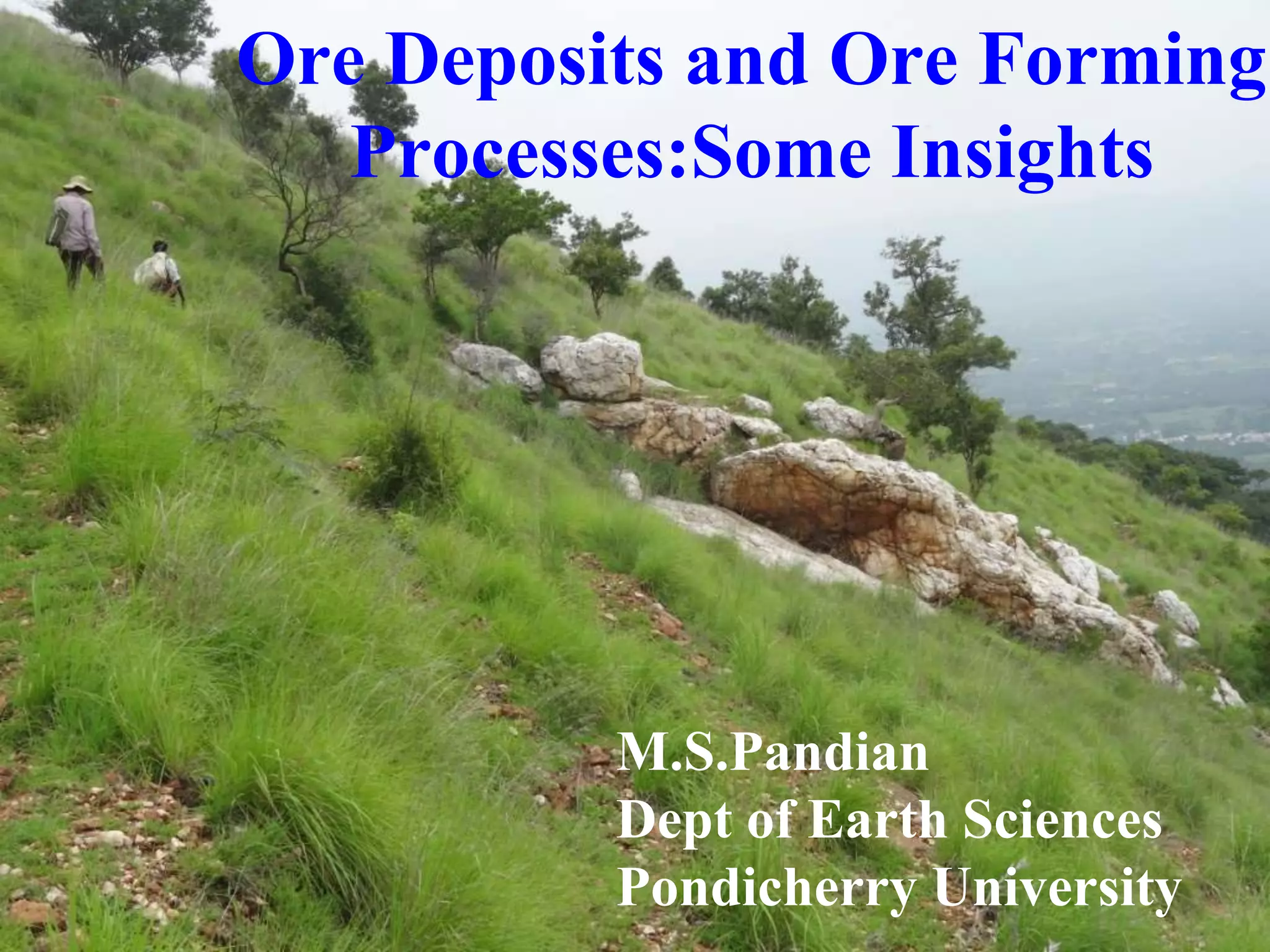
Ore Deposits and Ore Forming
Processes:Some Insights
M.S.Pandian
Dept of Earth Sciences
Pondicherry University
Let us understand some basic terms….
What is mineralisation?
• A geological event when 1 or more
economic minerals were formed in a
lithounit.
Eg: Galena-sphalerite in carbonate
(Pb-Zn mineralisation)
Bastnasite in carbonatite
(REE mineralisation)
• An earth process which makes an
attempt to accumulate 1 or more metals
at a place...
Let us understand some basic terms….
What is not mineralisation?
Presence of 100s-1000s ppm of
• Ni hosted by olivine in peridotite is not Ni
mineralisation;.
• REE in zircon or sphene is not REE
mineralisation.
What is metallogeny?
Mineralisation in a global scale, to such
an extent that it has contributed to crustal
growth.
Eg: Mid-Archean to Early Proterozoic
iron metallogeny (BIF); Late Archean
gold metallogeny (orogenic gold in
greenstone belts);
When does a mineralisation qualify as
mineral deposit?
• When "sufficient" quantity of metal is
accumulated in a place it qualifies as ore deposit.
• Average metal content (=grade) should be ≥
cut-off grade.
• There should be a minimum prescribed tonnage
of "ore".
• Cut-off grade and minimum tonnage of ore are
prescribed by mineral industry based on
rarity/commonality of ore minerals and the price
of metals.
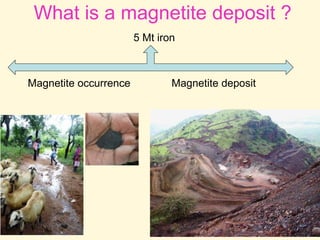
What is a magnetite deposit ?
Magnetite occurrence Magnetite deposit
5 Mt iron
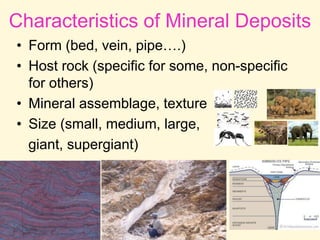
Characteristics of Mineral Deposits
• Form (bed, vein, pipe….)
• Host rock (specific for some, non-specific
for others)
• Mineral assemblage, texture
• Size (small, medium, large,
giant, supergiant)
Ore deposit “types”
Based on geological characteristics and
process of ore formation, ore deposits are
assigned “type" names derived from:
1) Type location (Sudbury type Ni, Carlin
type Au, Lake Superior type BIF)
2) Host rock (sandstone type U, QPC type
Au-U, greisen Sn-W, skarn Sn-W-Mo/Zn-
Pb/Cu/Fe/B, gondite type Mn)
3) Texture of host rock (porphyry Cu-Mo-Au)
Ore deposit “types”
4) Structure of host rock or ore body
(unconformity type U, stratiform chromite,
podiform chromite)
5) Constituent rock(s) of a sedimentary
sequence in which orebody occurs (red
bed Cu, volcanic red bed Cu)
6) Tectonic setting in which ore deposit is
formed (orogenic gold, including
greenstone-hosted, turbidite-hosted and
BIF-hosted varieties)
Ore deposit “types”
7) Element association in ore deposit (IOCG
type U-Au-Cu-REE; IOCG refers to Iron
Oxide Copper Gold)
8) Process of ore formation (SEDimentary
Exhalative type, Volcanogenic Massive
Sulphide type)
Mineral Deposit vs Host Rock
Mineral deposit is either
 part of a rock (e.g. diamond in kimberlite;
pitchblende in sst; sph-gal in dolostone); or
 neighboured/surrounded by certain rock(s)
(e.g. Chromite layers in dunite; Au
mineralised qz vein in amphibolite)
Rock associated with mineral deposit is
designated as “host rock”
Age of Mineral Deposit vs Host Rock
Syngenetic deposits (few types)
 formed by same process and nearly same
time as host rock (e.g. chromite layers in
dunite)
Epigenetic deposits (majority of known deposits)
 host rock is formed first, mineralisation takes
place later by different process (e.g.
carbonate-hosted Pb-Zn deposit)
In both groups, ore metals go through a series of
chemical changes from source, through migration
pathway, to the final site of deposition
Age of Mineral Deposit vs Host Rock
A third group (very few types)
 ore mineral is formed first and later
incorporated into a younger host rock (e.g.
diamond in kimberlite)
In this group, ore mineral is physically transported
from source, through migration pathway, to the
final site of deposition, without any chemical
change.
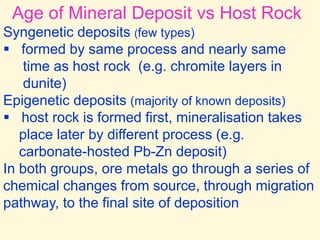
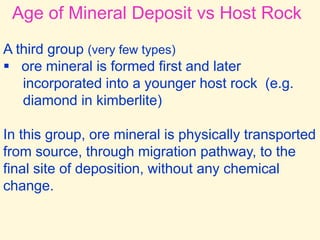
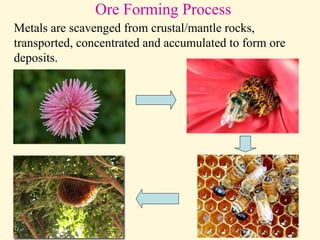
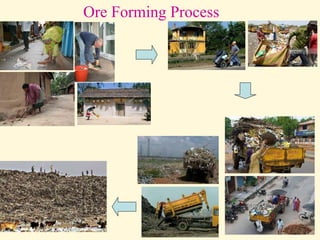
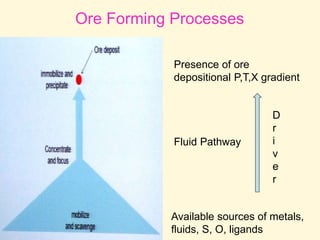
Ore Forming Process
Metals are scavenged from crustal/mantle rocks,
transported, concentrated and accumulated to form ore
deposits.
Ore Forming Process
Available sources of metals,
fluids, S, O, ligands
Fluid Pathway
Presence of ore
depositional P,T,X gradient
D
r
i
v
e
r
Ore Forming Processes
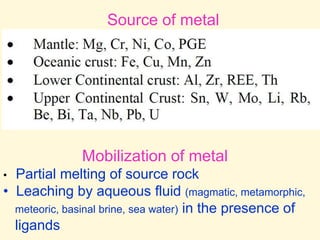
Mobilization of metal
• Partial melting of source rock
• Leaching by aqueous fluid (magmatic, metamorphic,
meteoric, basinal brine, sea water) in the presence of
ligands
Source of metal
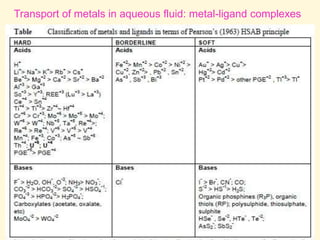
Transport of metals in aqueous fluid: metal-ligand complexes
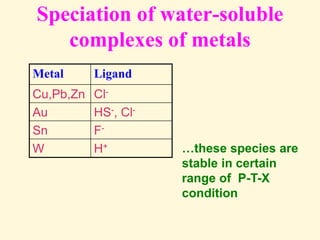
Speciation of water-soluble
complexes of metals
Metal Ligand
Cu,Pb,Zn Cl-
Au HS-, Cl-
Sn F-
W H+ …these species are
stable in certain
range of P-T-X
condition
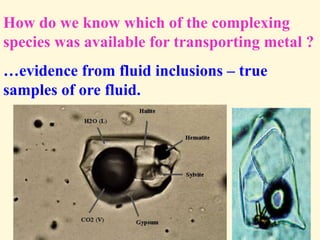
How do we know which of the complexing
species was available for transporting metal ?
…evidence from fluid inclusions – true
samples of ore fluid.
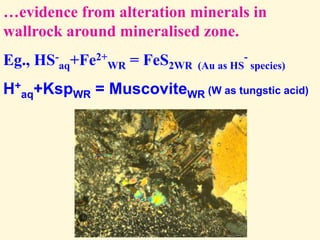
…evidence from alteration minerals in
wallrock around mineralised zone.
Eg., HS-
aq+Fe2+
WR = FeS2WR (Au as HS
-
species)
H+
aq+KspWR = MuscoviteWR (W as tungstic acid)
Pathway
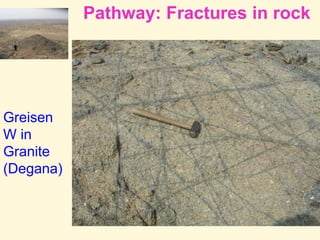
Pathway: Fractures in rock
Greisen
W in
Granite
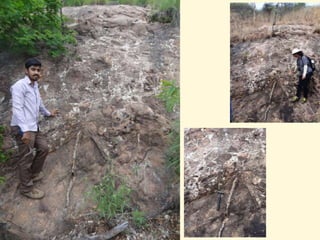
(Degana)
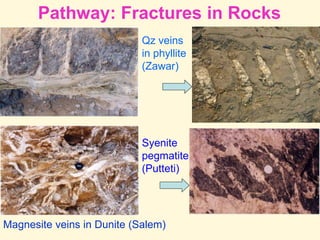
Pathway: Fractures in Rocks
Magnesite veins in Dunite (Salem)
Qz veins
in phyllite
(Zawar)
Syenite
pegmatite
(Putteti)
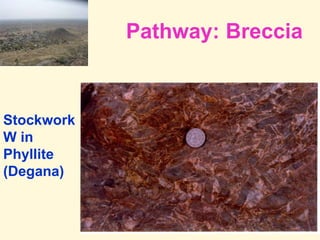
Pathway: Breccia
Stockwork
W in
Phyllite
(Degana)
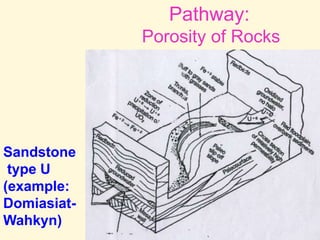
Pathway:
Porosity of Rocks
Sandstone
type U
(example:
Domiasiat-
Wahkyn)
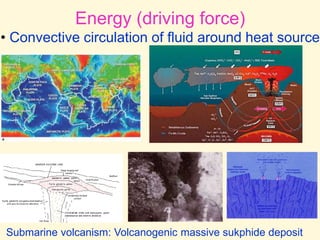
Energy (driving force)
• Convective circulation of fluid around heat source
Submarine volcanism: Volcanogenic massive sukphide deposit
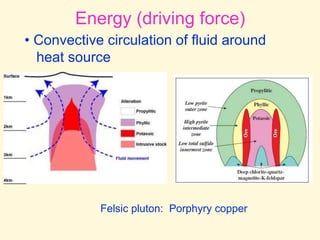
Energy (driving force)
• Convective circulation of fluid around
heat source
Felsic pluton: Porphyry copper
Energy (driving force)
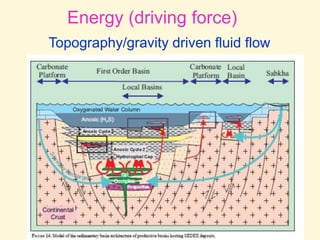
Topography/gravity driven fluid flow
Energy (driving force)
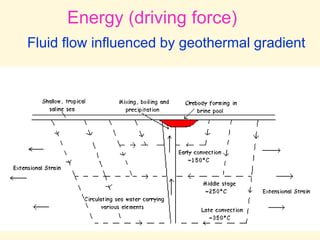
Fluid flow influenced by geothermal gradient
Ore Trap: drastic change in P, T, X
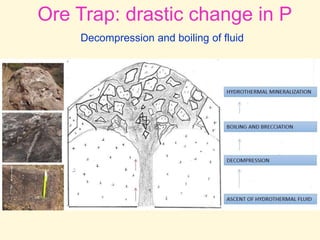
Ore Trap: drastic change in P
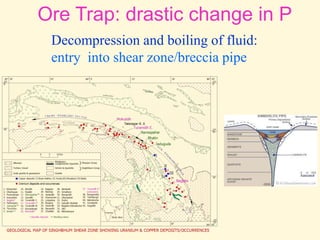
Decompression and boiling of fluid
Ore Trap: drastic change in P
Decompression and boiling of fluid:
entry into shear zone/breccia pipe
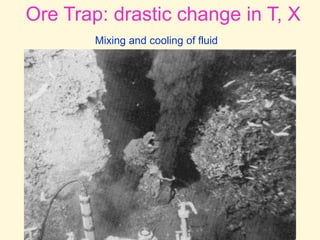
Ore Trap: drastic change in T, X
Mixing and cooling of fluid
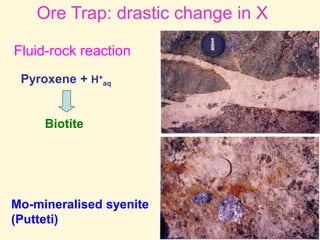
Fluid-rock reaction
Pyroxene + H+
aq
Biotite
Mo-mineralised syenite
(Putteti)
Ore Trap: drastic change in X
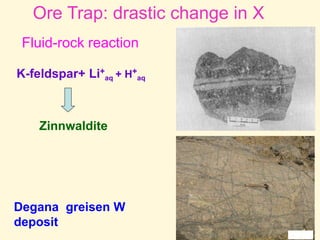
K-feldspar+ Li+
aq + H+
aq
Zinnwaldite
Degana greisen W
deposit
Ore Trap: drastic change in X
Fluid-rock reaction
Thanks for your attention !

Ore_Deposits_and_Ore_Forming_Processes.ppt

  • 1.
    Ore Deposits andOre Forming Processes:Some Insights M.S.Pandian Dept of Earth Sciences Pondicherry University
  • 2.
    Let us understandsome basic terms…. What is mineralisation? • A geological event when 1 or more economic minerals were formed in a lithounit. Eg: Galena-sphalerite in carbonate (Pb-Zn mineralisation) Bastnasite in carbonatite (REE mineralisation) • An earth process which makes an attempt to accumulate 1 or more metals at a place...
  • 3.
    Let us understandsome basic terms…. What is not mineralisation? Presence of 100s-1000s ppm of • Ni hosted by olivine in peridotite is not Ni mineralisation;. • REE in zircon or sphene is not REE mineralisation.
  • 4.
    What is metallogeny? Mineralisationin a global scale, to such an extent that it has contributed to crustal growth. Eg: Mid-Archean to Early Proterozoic iron metallogeny (BIF); Late Archean gold metallogeny (orogenic gold in greenstone belts);
  • 5.
    When does amineralisation qualify as mineral deposit? • When "sufficient" quantity of metal is accumulated in a place it qualifies as ore deposit. • Average metal content (=grade) should be ≥ cut-off grade. • There should be a minimum prescribed tonnage of "ore". • Cut-off grade and minimum tonnage of ore are prescribed by mineral industry based on rarity/commonality of ore minerals and the price of metals.
  • 6.
    What is amagnetite deposit ? Magnetite occurrence Magnetite deposit 5 Mt iron
  • 7.
    Characteristics of MineralDeposits • Form (bed, vein, pipe….) • Host rock (specific for some, non-specific for others) • Mineral assemblage, texture • Size (small, medium, large, giant, supergiant)
  • 8.
    Ore deposit “types” Basedon geological characteristics and process of ore formation, ore deposits are assigned “type" names derived from: 1) Type location (Sudbury type Ni, Carlin type Au, Lake Superior type BIF) 2) Host rock (sandstone type U, QPC type Au-U, greisen Sn-W, skarn Sn-W-Mo/Zn- Pb/Cu/Fe/B, gondite type Mn) 3) Texture of host rock (porphyry Cu-Mo-Au)
  • 9.
    Ore deposit “types” 4)Structure of host rock or ore body (unconformity type U, stratiform chromite, podiform chromite) 5) Constituent rock(s) of a sedimentary sequence in which orebody occurs (red bed Cu, volcanic red bed Cu) 6) Tectonic setting in which ore deposit is formed (orogenic gold, including greenstone-hosted, turbidite-hosted and BIF-hosted varieties)
  • 10.
    Ore deposit “types” 7)Element association in ore deposit (IOCG type U-Au-Cu-REE; IOCG refers to Iron Oxide Copper Gold) 8) Process of ore formation (SEDimentary Exhalative type, Volcanogenic Massive Sulphide type)
  • 11.
    Mineral Deposit vsHost Rock Mineral deposit is either  part of a rock (e.g. diamond in kimberlite; pitchblende in sst; sph-gal in dolostone); or  neighboured/surrounded by certain rock(s) (e.g. Chromite layers in dunite; Au mineralised qz vein in amphibolite) Rock associated with mineral deposit is designated as “host rock”
  • 12.
    Age of MineralDeposit vs Host Rock Syngenetic deposits (few types)  formed by same process and nearly same time as host rock (e.g. chromite layers in dunite) Epigenetic deposits (majority of known deposits)  host rock is formed first, mineralisation takes place later by different process (e.g. carbonate-hosted Pb-Zn deposit) In both groups, ore metals go through a series of chemical changes from source, through migration pathway, to the final site of deposition
  • 13.
    Age of MineralDeposit vs Host Rock A third group (very few types)  ore mineral is formed first and later incorporated into a younger host rock (e.g. diamond in kimberlite) In this group, ore mineral is physically transported from source, through migration pathway, to the final site of deposition, without any chemical change.
  • 14.
    Ore Forming Process Metalsare scavenged from crustal/mantle rocks, transported, concentrated and accumulated to form ore deposits.
  • 15.
  • 16.
    Available sources ofmetals, fluids, S, O, ligands Fluid Pathway Presence of ore depositional P,T,X gradient D r i v e r Ore Forming Processes
  • 17.
    Mobilization of metal •Partial melting of source rock • Leaching by aqueous fluid (magmatic, metamorphic, meteoric, basinal brine, sea water) in the presence of ligands Source of metal
  • 18.
    Transport of metalsin aqueous fluid: metal-ligand complexes
  • 19.
    Speciation of water-soluble complexesof metals Metal Ligand Cu,Pb,Zn Cl- Au HS-, Cl- Sn F- W H+ …these species are stable in certain range of P-T-X condition
  • 20.
    How do weknow which of the complexing species was available for transporting metal ? …evidence from fluid inclusions – true samples of ore fluid.
  • 21.
    …evidence from alterationminerals in wallrock around mineralised zone. Eg., HS- aq+Fe2+ WR = FeS2WR (Au as HS - species) H+ aq+KspWR = MuscoviteWR (W as tungstic acid)
  • 22.
  • 23.
    Pathway: Fractures inrock Greisen W in Granite (Degana)
  • 24.
    Pathway: Fractures inRocks Magnesite veins in Dunite (Salem) Qz veins in phyllite (Zawar) Syenite pegmatite (Putteti)
  • 25.
  • 26.
    Pathway: Porosity of Rocks Sandstone typeU (example: Domiasiat- Wahkyn)
  • 27.
    Energy (driving force) •Convective circulation of fluid around heat source Submarine volcanism: Volcanogenic massive sukphide deposit
  • 28.
    Energy (driving force) •Convective circulation of fluid around heat source Felsic pluton: Porphyry copper
  • 29.
  • 30.
    Energy (driving force) Fluidflow influenced by geothermal gradient
  • 31.
    Ore Trap: drasticchange in P, T, X
  • 32.
    Ore Trap: drasticchange in P Decompression and boiling of fluid
  • 35.
    Ore Trap: drasticchange in P Decompression and boiling of fluid: entry into shear zone/breccia pipe
  • 36.
    Ore Trap: drasticchange in T, X Mixing and cooling of fluid
  • 37.
    Fluid-rock reaction Pyroxene +H+ aq Biotite Mo-mineralised syenite (Putteti) Ore Trap: drastic change in X
  • 38.
    K-feldspar+ Li+ aq +H+ aq Zinnwaldite Degana greisen W deposit Ore Trap: drastic change in X Fluid-rock reaction
  • 39.
    Thanks for yourattention !