
20 ideas to
make change
happen
Idea # 1
Focus.
Do 1 thing at a time
Focus on the one thing that will
have the greatest impact.
Sources
http://blogs.hbr.org/bregman/2009/10/i-lost-18-pounds-in.html
http://blogs.hbr.org/cs/2012/09/ten_ways_to_get_people_to_chan.html
http://hbr.org/tip?date=101612
Source
http://blogs.hbr.org/schwartz/2011/01/six-keys-to-changing-almost-an.html
Be precise and specific about what to do.
Idea # 2
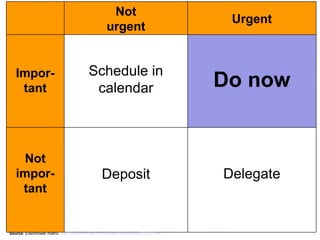
Make what you do
important and
urgent
DelegateDeposit
Not
impor-
tant
Do now
Schedule in
calendar
Impor-
tant
Urgent
Not
urgent
Source: Eisenhower matrix. http://www.mindtools.com/pages/article/newHTE_91.htm
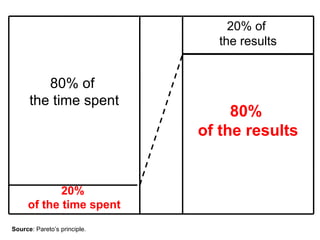
20% of
the results
80%
of the results
80% of
the time spent
20%
of the time spent
Source: Pareto’s principle.
Idea # 3
Be a role model
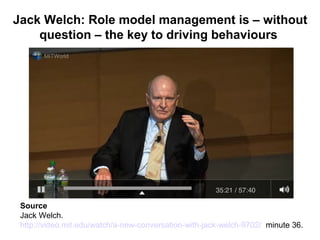
Jack Welch: Role model management is – without
question – the key to driving behaviours
Source
Jack Welch.
http://video.mit.edu/watch/a-new-conversation-with-jack-welch-9702/, minute 36.
One way we learn new ways of looking at things
is to identify ourselves with a role model, boss,
mentor, friend, or consultant, and begin to see
things from that other person’s point of view.
Source: Schein, Edgar H.: Process Consultation, p. 105.
Idea # 4
Sponsor
the initiative
The executive sponsors the idea and
agrees to fund it and back it through the
development and deployment process.
Source
http://www.business-strategy-innovation.com/wordpress/2010/08/four-ways-ideas-are-selected-for-implementation/
Idea # 5
Get power
to do things
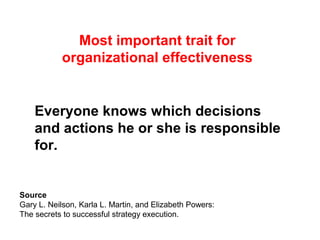
Everyone knows which decisions
and actions he or she is responsible
for.
Most important trait for
organizational effectiveness
Source
Gary L. Neilson, Karla L. Martin, and Elizabeth Powers:
The secrets to successful strategy execution.
Idea # 6
Communicate
continuously
using social media
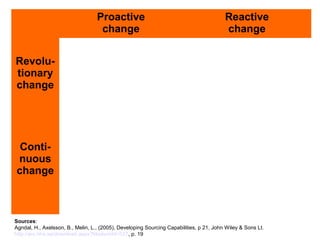
Proactive
change
Reactive
change
Revolu-
tionary
change
Conti-
nuous
change
Sources:
Agndal, H., Axelsson, B., Melin, L., (2005), Developing Sourcing Capabilities, p 21, John Wiley & Sons Lt.
http://arc.hhs.se/download.aspx?MediumId=537, p. 19
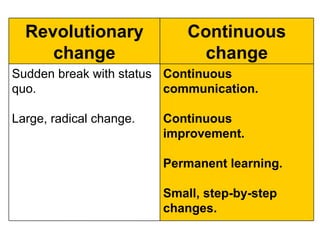
Sudden break with status
quo.
Large, radical change.
Revolutionary
change
Continuous
communication.
Continuous
improvement.
Permanent learning.
Small, step-by-step
changes.
Continuous
change
Create a platform - physical or virtual - that
allows supporters of your idea to connect
and further disseminate your idea.
Source
http://hbr.org/tip?date=090712
In 2005, Toyota received more than
540,000 improvement ideas from
its Japanese employees.
Source:
Dominic O’Connell: Do not disturb: Mr. Watanabe is taking over the World. Car, June 2006.
Idea # 7
Communicate
passionately
To get your ideas heard:
Be passionate, share your enthusiasm.
Source
http://web.hbr.org/email/archive/managementtip.php?date=051211
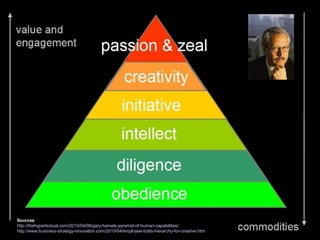
Sources:
http://thehypertextual.com/2010/04/08/gary-hamels-pyramid-of-human-capabilities/
http://www.business-strategy-innovation.com/2010/04/employee-traits-hierarchy-for-creative.htm
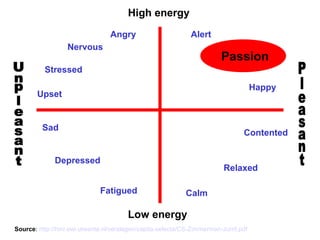
Source: http://hmi.ewi.utwente.nl/verslagen/capita-selecta/CS-Zimmerman-Jurrit.pdf
High energy
Low energy
Alert
Passion
Happy
Nervous
Stressed
Upset
Sad
Depressed
Fatigued Calm
Relaxed
Contented
Angry
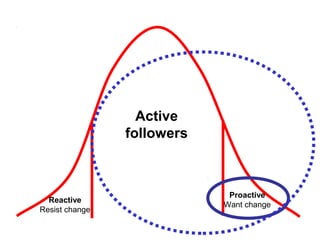
Idea # 8
Work with people
who want change
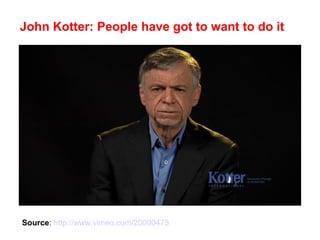
John Kotter: People have got to want to do it
Source: http://www.vimeo.com/20000475
Active
followers
Proactive
Want change
Reactive
Resist change
Essential to this turnaround was his cultivation
of allies within the community.
For example, he [Jamie Oliver] sought out the
most influential teachers – adults who already
had the trust of the school children. Once they
saw better health was possible, it became a
genuine motivator.
Source
http://www.strategy-business.com/article/11205?pg=all
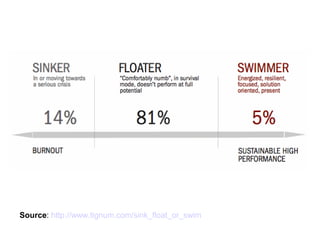
Source: http://www.tignum.com/sink_float_or_swim
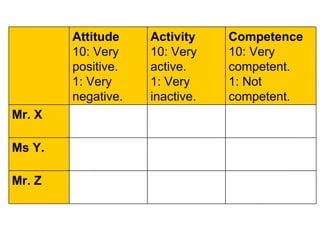
Activity
10: Very
active.
1: Very
inactive.
Ms Y.
Mr. Z
Competence
10: Very
competent.
1: Not
competent.
Attitude
10: Very
positive.
1: Very
negative.
Mr. X
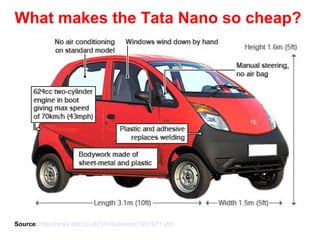
Source: http://news.bbc.co.uk/1/hi/business/7957671.stm
What makes the Tata Nano so cheap?
When we started to connect with what we call the
younger high performers, on the other hand - people
in their late 20s and early 30s - it was very different.
We would have breakfast meetings with a dozen of
them, and we would invite them to give very, very
frank views. We soon realized that they were
suffocated and that they wanted change.
So we started picking out some of these individuals
and giving them challenges.”
Ravi Kant
Source:
Kumra, Gautan: ”Leading Change: An Interview with the managing of Tata Motors.”
mckinseyquarterly.com, January 2007.
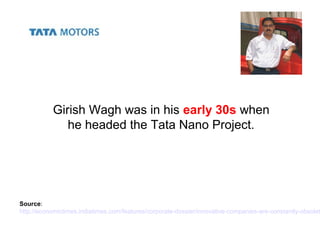
Girish Wagh was in his early 30s when
he headed the Tata Nano Project.
Source:
http://economictimes.indiatimes.com/features/corporate-dossier/innovative-companies-are-constantly-obsolet
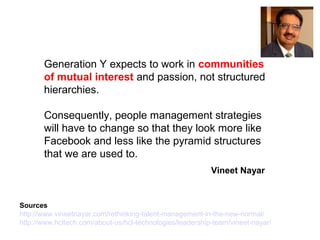
Generation Y expects to work in communities
of mutual interest and passion, not structured
hierarchies.
Consequently, people management strategies
will have to change so that they look more like
Facebook and less like the pyramid structures
that we are used to.
Sources
http://www.vineetnayar.com/rethinking-talent-management-in-the-new-normal/
http://www.hcltech.com/about-us/hcl-technologies/leadership-team/vineet-nayar/
Vineet Nayar
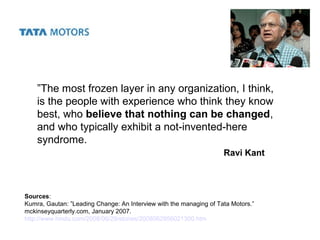
”The most frozen layer in any organization, I think,
is the people with experience who think they know
best, who believe that nothing can be changed,
and who typically exhibit a not-invented-here
syndrome.
Sources:
Kumra, Gautan: ”Leading Change: An Interview with the managing of Tata Motors.”
mckinseyquarterly.com, January 2007.
http://www.hindu.com/2008/06/29/stories/2008062956021300.htm
Ravi Kant
Idea # 9
Set goals for
yourself and
reach them
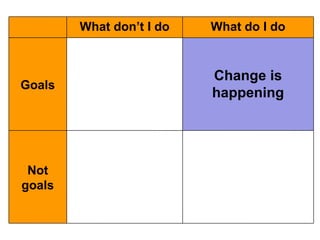
Not
goals
Change is
happening
Goals
What do I doWhat don’t I do
Define a 100-day challenge.
Source
http://blogs.hbr.org/ashkenas/2010/09/dont-let-your-next-crisis-go-t.html
Nadim Matta found that huge amounts of talent and
resources in developing countries were being devoted
to developing top-down solutions for agricultural
productivity, clean water, maternal health, and other
areas.
So instead of experts and officials shaping solutions
and giving them to the recipients, Nadim Matta
worked with local leaders to challenge the ultimate
recipients to come up with their own solutions in
100 days or less, and to use the experts,
government officials, and aid workers as resources.
Source
http://blogs.hbr.org/ashkenas/2012/12/in-a-change-effort-start-with.html
Create a flow of value to customers
by “chunking” feature delivery into
small increments.
Source
http://agile200x.com/2007/agile2007/downloads/handouts/Augustine_474.pdf
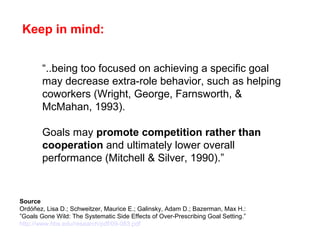
“..being too focused on achieving a specific goal
may decrease extra-role behavior, such as helping
coworkers (Wright, George, Farnsworth, &
McMahan, 1993).
Goals may promote competition rather than
cooperation and ultimately lower overall
performance (Mitchell & Silver, 1990).”
Source
Ordóñez, Lisa D.; Schweitzer, Maurice E.; Galinsky, Adam D.; Bazerman, Max H.:
”Goals Gone Wild: The Systematic Side Effects of Over-Prescribing Goal Setting.”
http://www.hbs.edu/research/pdf/09-083.pdf
Keep in mind:
Idea # 10
Do different
things across
the value chain
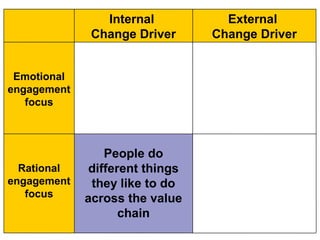
People do
different things
they like to do
across the value
chain
Rational
engagement
focus
Emotional
engagement
focus
External
Change Driver
Internal
Change Driver
Idea # 11
Tell people what
is in it for them
Source
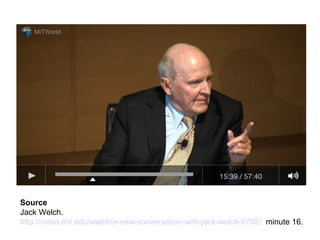
Jack Welch.
http://video.mit.edu/watch/a-new-conversation-with-jack-welch-9702/, minute 16.
Try leading the client toward your idea with a
series of statements he/she agrees with - and
then pitch your idea as if it's his / her idea.
Source
http://99u.com/articles/7207/Why-Great-Ideas-Get-Rejected
Idea # 12
Give and get
feedback
1. Use ”I” language.
2. Be specific / concrete. Use facts.
3. Give positive, helpful feedback.
Give the person a gift.
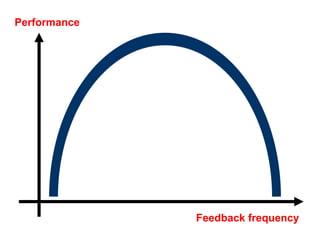
Feedback tips
Feedback frequency
Performance
Schein, Edgar H.: Process Consultation, p. 98.
http://web.hbr.org/email/archive/managementtip.php?date=022610
http://smartblogs.com/leadership/2011/07/20/how-much-feedback-is-too-much/
http://www.fastcompany.com/1753874/feedback-usually-says-more-about-the-giver-than-the-receiver
Sources
Idea # 13
Get inputs from
outside
Source:
Creating an Innovation Mindset. An interview with Vijay Govindarajan.
http://www.youtube.com/watch?v=sNzkmZdM4A4
http://www.economist.com/node/16888745?story_id=16888745
Managers must bring in
fresh voices from outside.
When Jamie Oliver wanted to change the
eating habits of kids at a U.S. school, he got
their attention with a single, disgusting image:
A truckload of pure animal fat.
Source
http://blogs.hbr.org/cs/2012/09/ten_ways_to_get_people_to_chan.html
Source
http://blogs.hbr.org/cs/2012/09/ten_ways_to_get_people_to_chan.html
Only from outside can one be sure of disinterested
criticism, astringent appraisal, the rude question.
Only from outside can one expect judgments untainted
by the loyalty and camaraderie of insiders, undistorted
by the comfortable assumptions held within the walls.
Source: Gardner, John W.: On Leadership, p. 130.
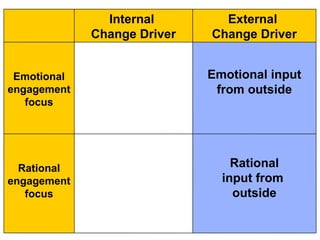
Rational
input from
outside
Rational
engagement
focus
Emotional input
from outside
Emotional
engagement
focus
External
Change Driver
Internal
Change Driver
Idea # 14
Keep trying out
ideas at low costs
Build a just try it culture - emphasize
”test and learn” instead of ”plan and
execute.”
Source
Hamel, Gary: The Future of Management, p. 120.
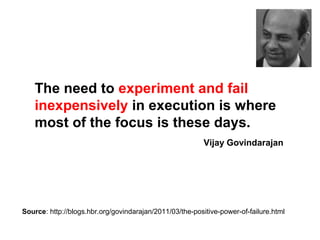
The need to experiment and fail
inexpensively in execution is where
most of the focus is these days.
Source: http://blogs.hbr.org/govindarajan/2011/03/the-positive-power-of-failure.html
Vijay Govindarajan
Source:
http://www.businessweek.com/managing/content/may2009/ca2009058_754247.htm
http://www.buzzmachine.com/about-me/
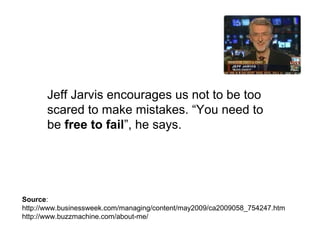
Jeff Jarvis encourages us not to be too
scared to make mistakes. “You need to
be free to fail”, he says.
“Fail often to succeed sooner”
Tom Kelley, IDEO
Source:
http://www.associatedcontent.com/article/1284604/welcome_failure.html?cat=35
http://www.ideo.com/people/tom-kelley
Sources
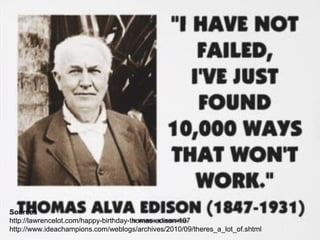
http://lawrencelot.com/happy-birthday-thomas-edison-107
http://www.ideachampions.com/weblogs/archives/2010/09/theres_a_lot_of.shtml
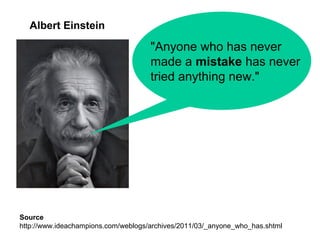
"Anyone who has never
made a mistake has never
tried anything new."
Albert Einstein
Source
http://www.ideachampions.com/weblogs/archives/2011/03/_anyone_who_has.shtml
Idea # 15
Ask for forgiveness
rather than for
permission
”If you see an opportunity, go for it!”
Source
Shona Brown, Google.
Hamel, Gary: The Future of Management, p. 112.
What rules could we get rid of today
that would increase our ability to
create value?
Source
http://www.managementexchange.com/blog/twenty-questions-i-ask-myself-every-day
Idea # 16
Keep things
simple
Source: http://www.business-strategy-innovation.com/2009/08/great-ideas-arent-innovation.html
Usability drives adoptability, and
therefore it pays to keep things simple.
Idea # 17
End each
meeting with
action steps
Source
http://www.innovationmanagement.se/2011/05/09/how-to-make-your-
ideas-actually-happen/
When you do meet with clients or colleagues,
end each meeting with a quick review of
captured action steps. The exercise takes
less than 30 seconds per person. Each
person should share what they captured.
Idea # 18
Signal new era by
using symbols
Source: http://images.businessweek.com/ss/09/06/0624_ads_you_wont_hate/19.htm
Idea # 19
Measure
innovation
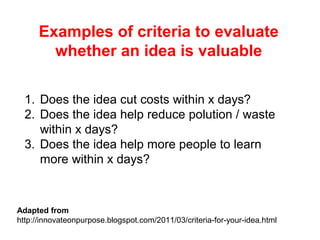
1. Does the idea cut costs within x days?
2. Does the idea help reduce polution / waste
within x days?
3. Does the idea help more people to learn
more within x days?
Examples of criteria to evaluate
whether an idea is valuable
Adapted from
http://innovateonpurpose.blogspot.com/2011/03/criteria-for-your-idea.html
Idea # 20
Celebrate success
experiences
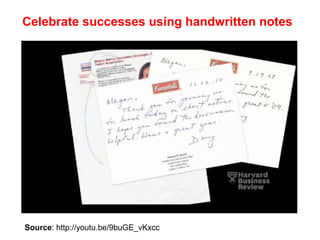
Source: http://youtu.be/9buGE_vKxcc
Celebrate successes using handwritten notes

Owen sound iceberg additional conclusion if needed