How to set up an improvement
platform in less than one hour
Horizons Group, NHS
In partnership with Crowdicity
https://mobile.crowdicity.com/horizons.crowdicity.com/
The plan for the next 55 minutes
The next 55 minutes will be fast and furious as
we work together to develop a crowdsourcing
platform. We will be:-
• Taking the first steps in developing a platform
• Understanding and reframing the problem
• Running sprint 1 and sprint 2
• Building on what we know
• Taking next steps – your role
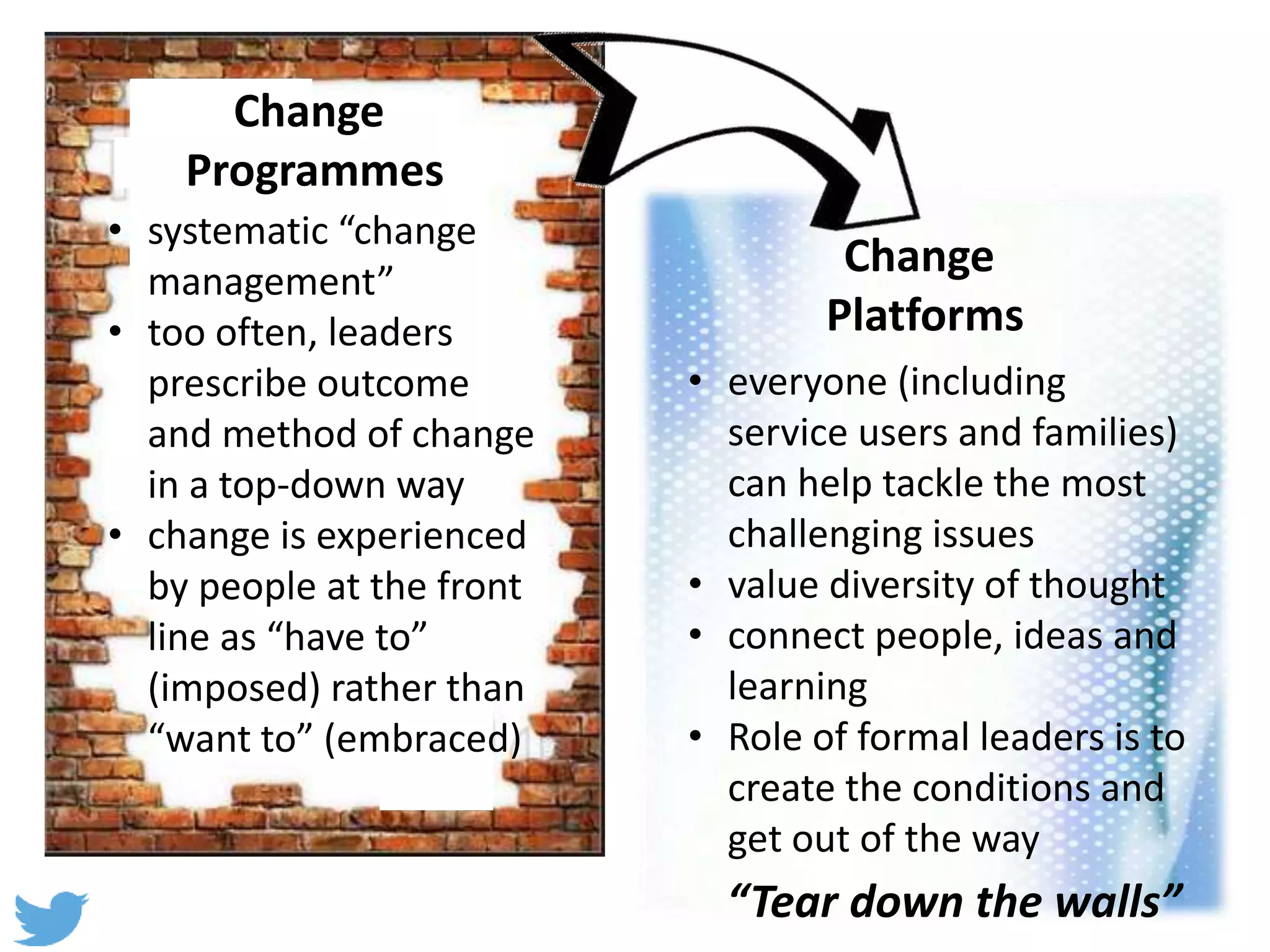
• systematic “change
management”
• too often, leaders
prescribe outcome
and method of change
in a top-down way
• change is experienced
by people at the front
line as “have to”
(imposed) rather than
“want to” (embraced)
Change
Programmes
• everyone (including
service users and families)
can help tackle the most
challenging issues
• value diversity of thought
• connect people, ideas and
learning
• Role of formal leaders is to
create the conditions and
get out of the way
Change
Platforms
“Tear down the walls”
The design sprint – setting the
scene
• The Horizons team has a lot of experience of
developing a variety of change platforms
• Our global healthcare platforms developed for
change - The Edge, Care Design 2016,
Challenge Top down change, NHS Change Day
• Working with partners Crowdicity – we want
to show you how to design, crowdsource,
build the questions and analyse the rich data
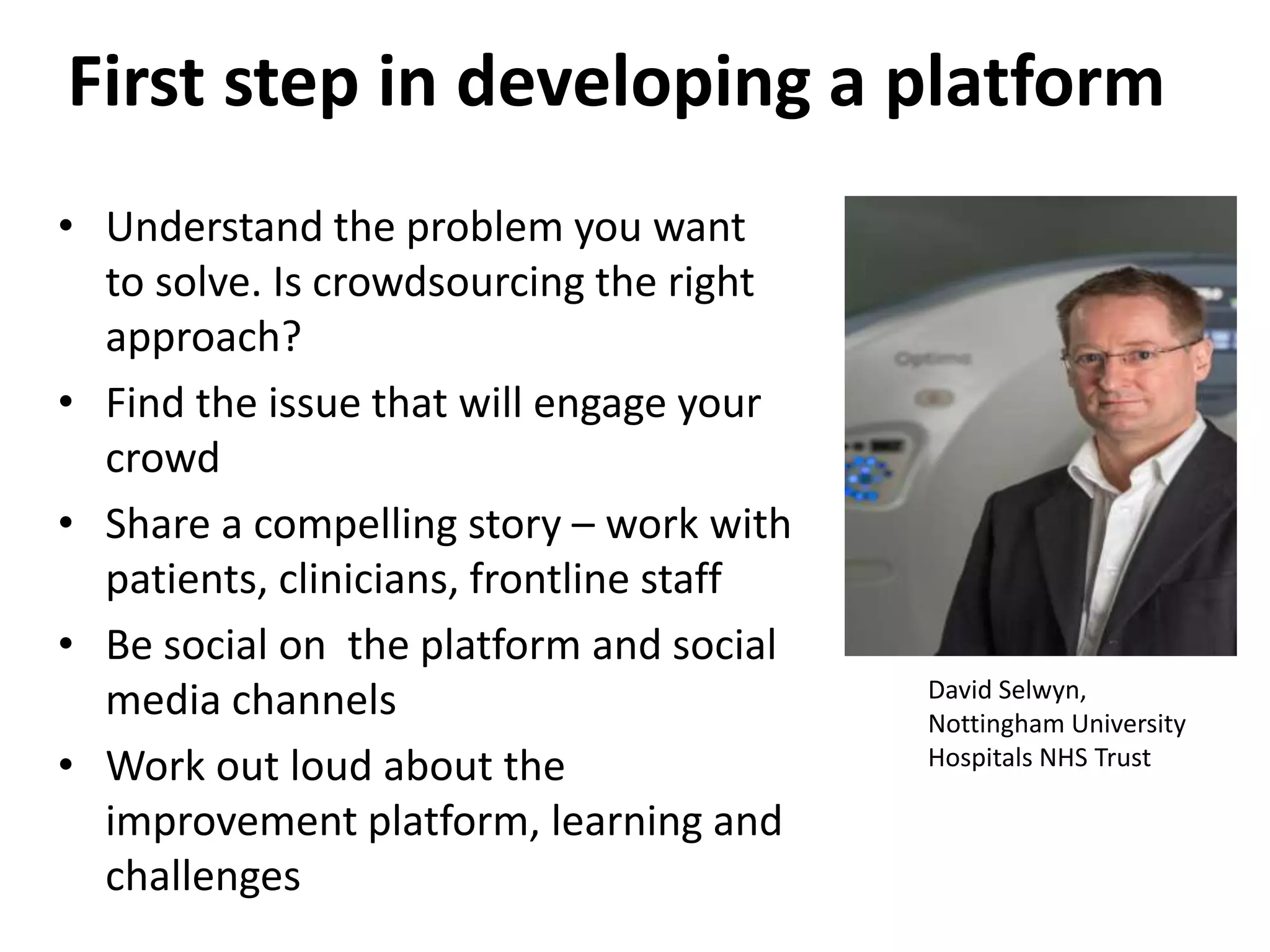
First step in developing a platform
• Understand the problem you want
to solve. Is crowdsourcing the right
approach?
• Find the issue that will engage your
crowd
• Share a compelling story – work with
patients, clinicians, frontline staff
• Be social on the platform and social
media channels
• Work out loud about the
improvement platform, learning and
challenges
David Selwyn,
Nottingham University
Hospitals NHS Trust
Second step in developing resources
• What platform?
– Accessibility e.g. open vs closed access
– Cost vs free platforms (Facebook, Google
community)
• Who will manage the platform?
– Community manager vs self managed
community
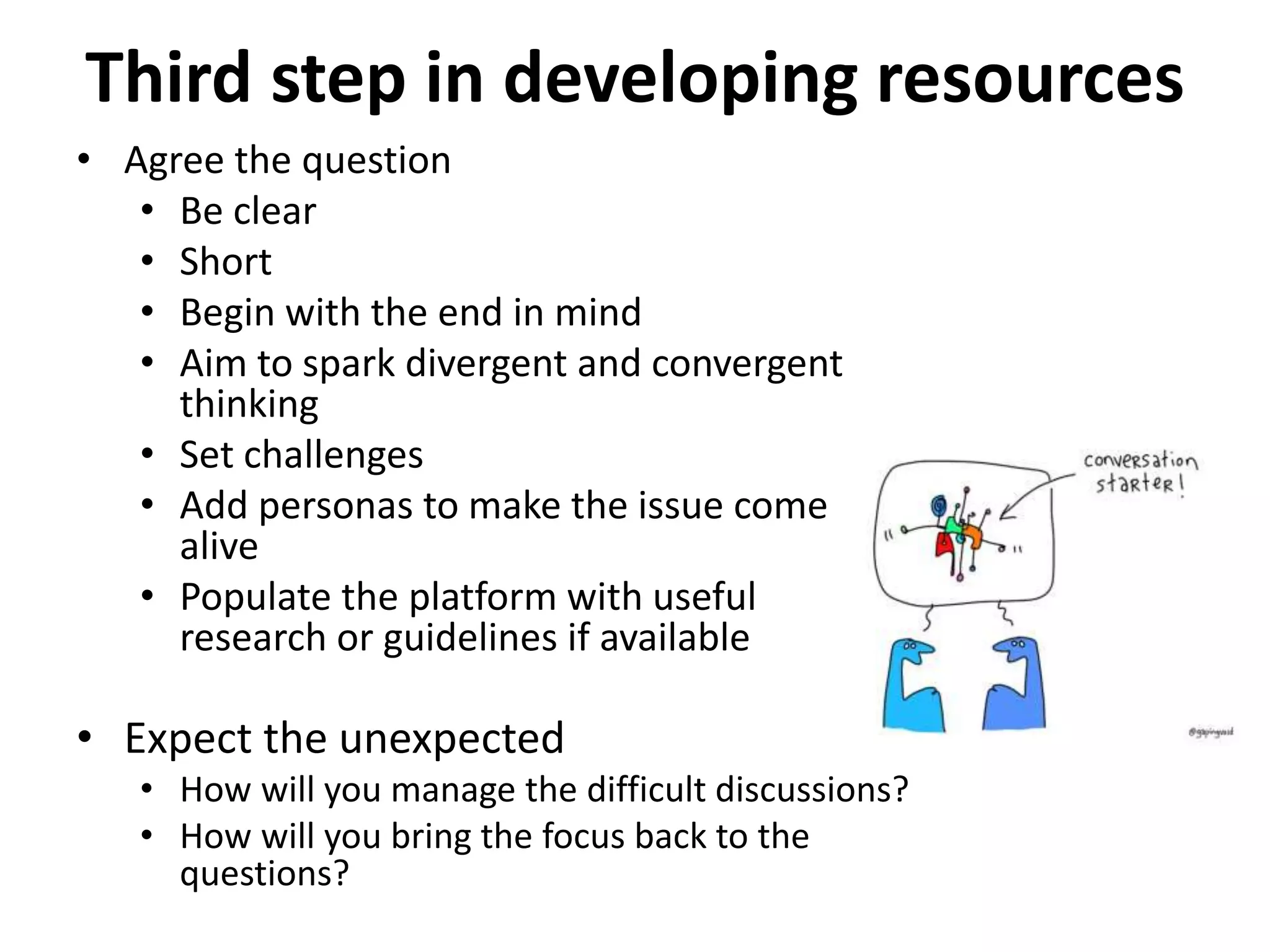
Third step in developing resources
• Agree the question
• Be clear
• Short
• Begin with the end in mind
• Aim to spark divergent and convergent
thinking
• Set challenges
• Add personas to make the issue come
alive
• Populate the platform with useful
research or guidelines if available
• Expect the unexpected
• How will you manage the difficult discussions?
• How will you bring the focus back to the
questions?
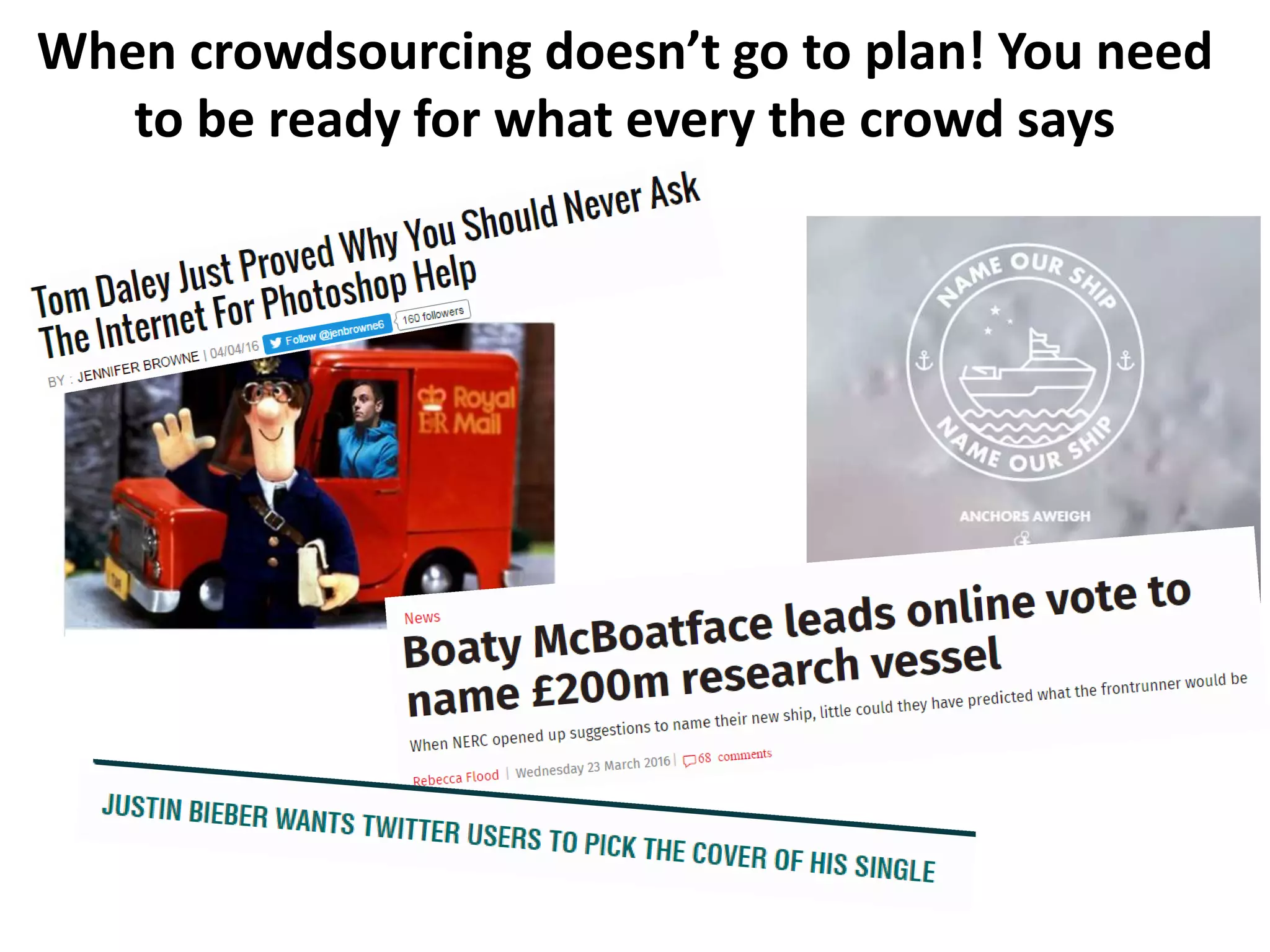
When crowdsourcing doesn’t go to plan! You need
to be ready for what every the crowd says
Final step in developing resources
• Agree the methodology for analysis
– Start with divergent and move to convergent
– Human centred design methodology
– Expert panel vs the crowd
• Always know the end point
• Do not waste the crowd’s time
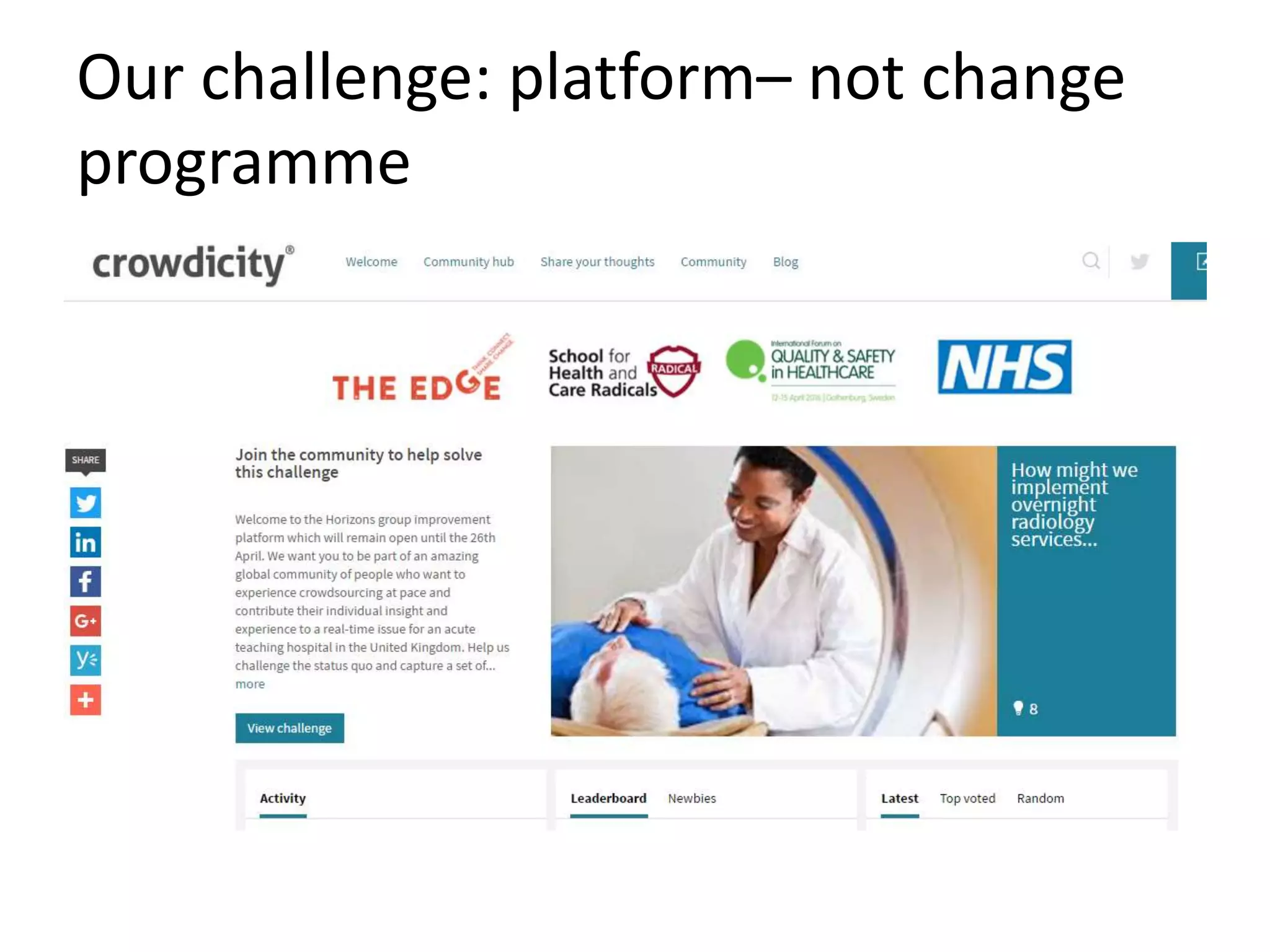
Our challenge: platform– not change
programme
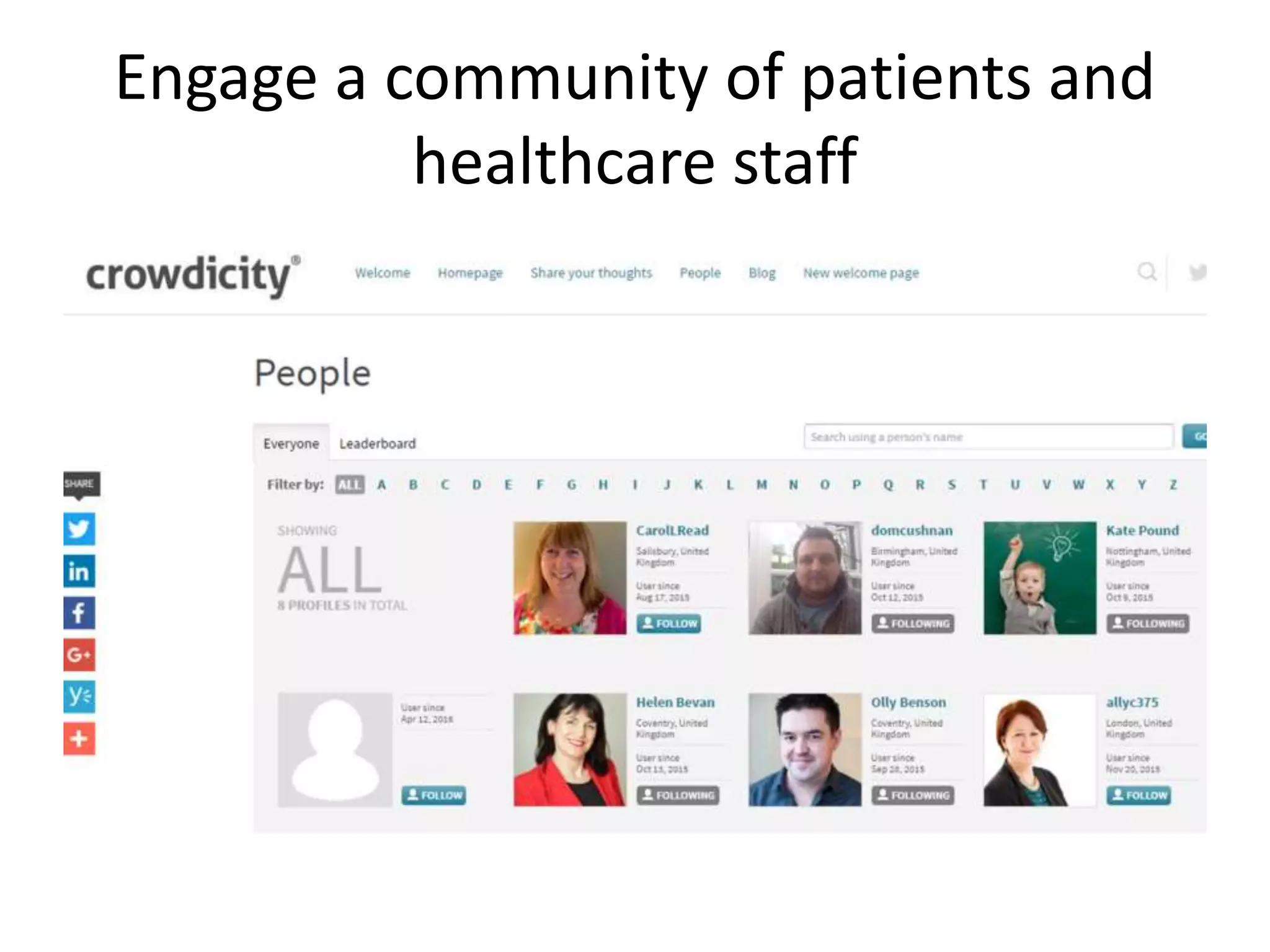
Engage a community of patients and
healthcare staff
Sprint 1
• Spend a few minutes reviewing the platform
so far
• On your table agree a question that will help
Dave find the answer to the problem.
(10mins)
• Vote: which question should be used as an
additional challenge to the crowd?
Sprint 2
You are all now community managers /
facilitators
• What steps will you now take to involve your
community? (10mins)
• Feedback to the room
Sprint 3
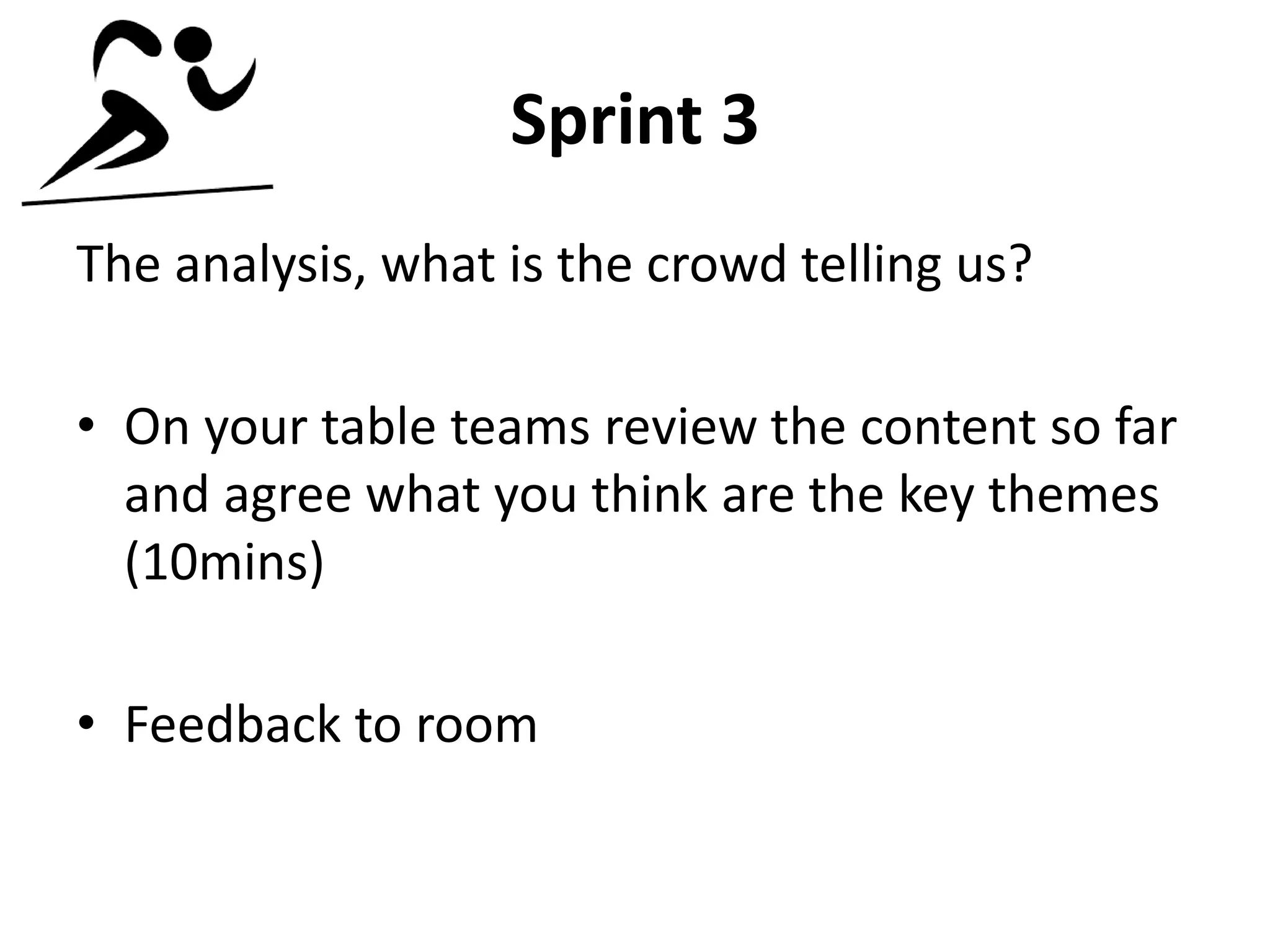
The analysis, what is the crowd telling us?
• On your table teams review the content so far
and agree what you think are the key themes
(10mins)
• Feedback to room
Launch the platform at a great event &
share the details with your community
#qfhorizons
The story so far
• Costs vs Benefits
• Consider reducing the number of investigations,
does the patient really need it?
• Utilisation of the day
– Question asked via twitter last night; ‘How do you
ensure full utilisation of radiology in the hours of 9-5?
Answer this before moving to overnight service.’
• Patient choice; how do we develop this within
our services?
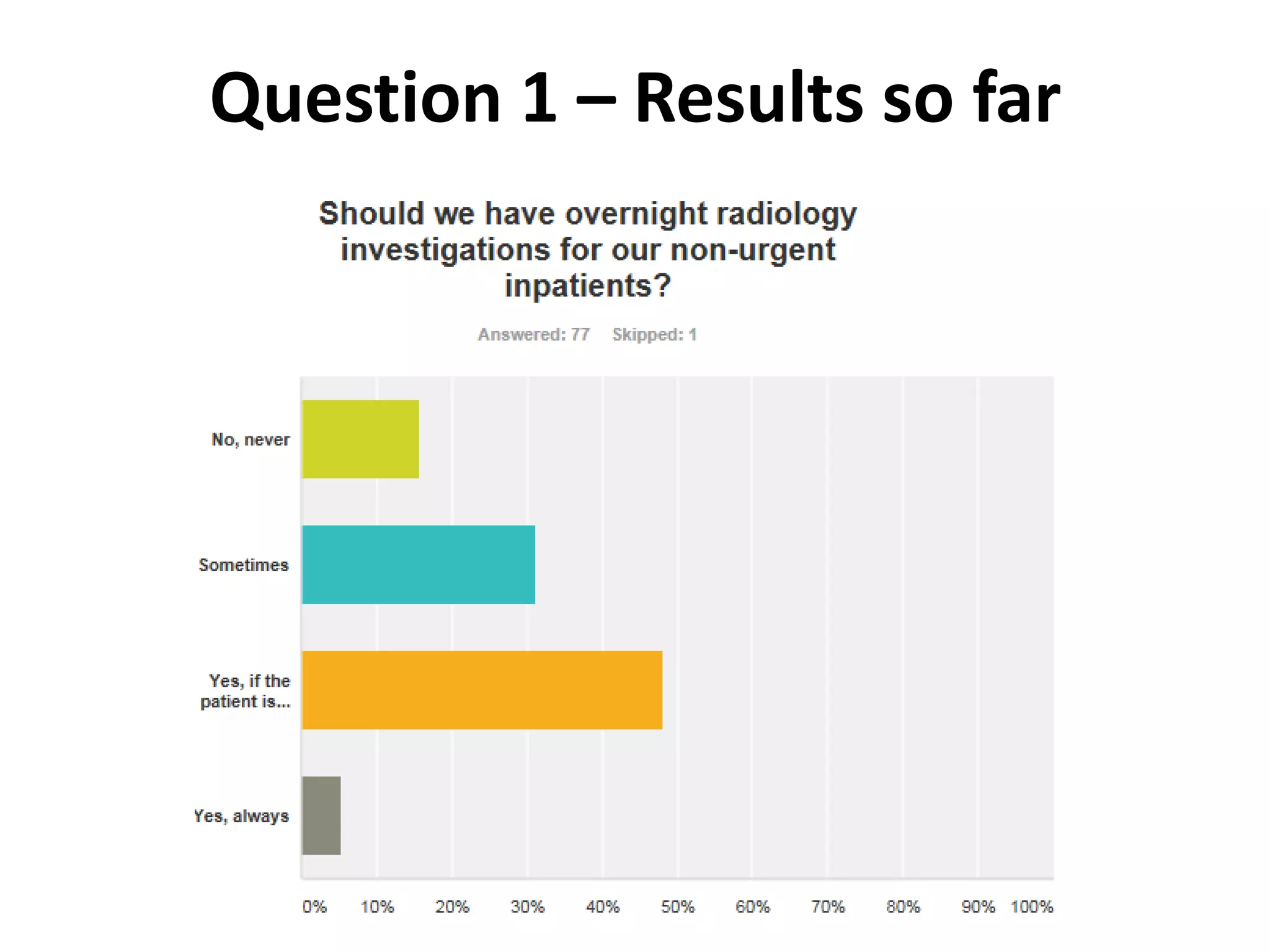
Question 1 – Results so far
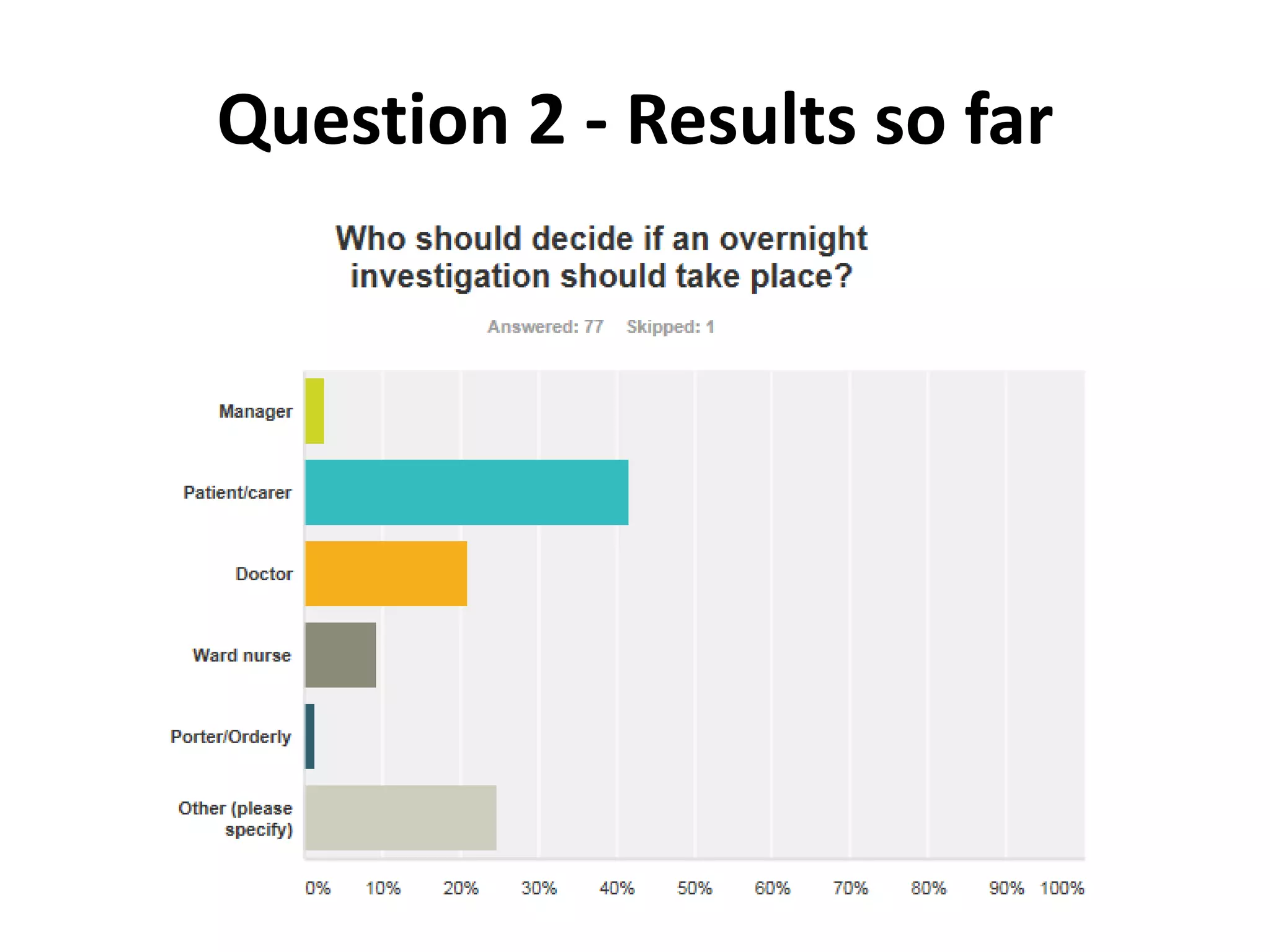
Question 2 - Results so far
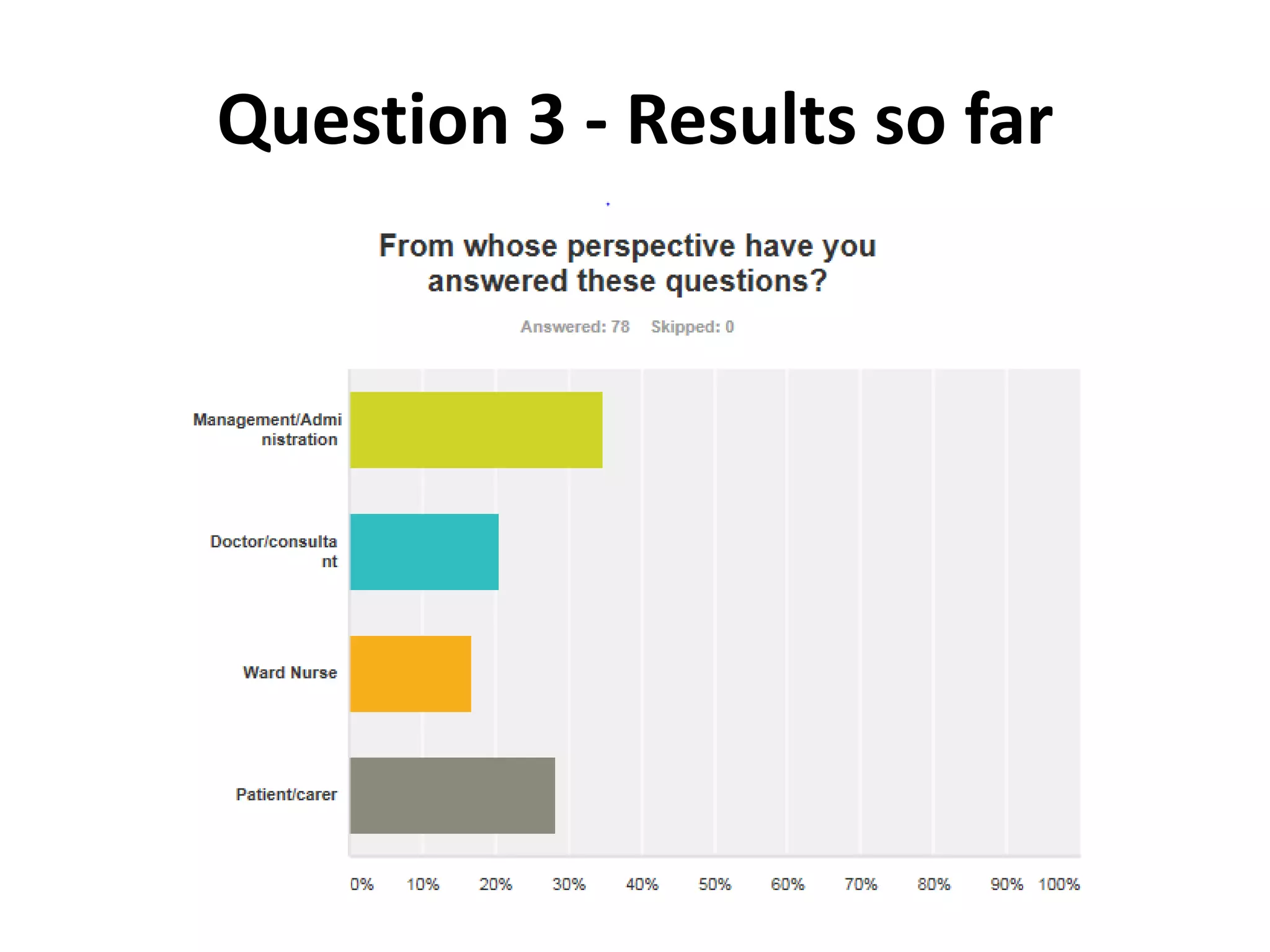
Question 3 - Results so far
● Only 1% participate
fully so start with a big
crowd
● Inject thought
diversity to guard against
groupthink
● Mix high domain
knowledge with those
with high creativity
Choose the right
crowd
Choose the right
incentives
● Crowdsourcing cannot
happen without a
vibrant, committed
community
● Rewards must balance
intrinsic & extrinsic
motivators
Crowds do not
replace the team
● You’ll get volume &
diversity from the crowd
but be prepared to
match it with equal time
& effort to herd, sift &
identify contributions
Crowds need
love too!
● Crowds need
direction & guidance to
help them feel part of
their community & give
of their best
Keep it
simple
● Break complex tasks
down
● Tasks must be small,
simple & fun & fit into
your crowd’s spare time
Remember
Sturgeon’s Law
Communities are
always right!
Fulfilling self-
actualisation
● “90% of everything is
crap / 10% of everything
is not crap”
● Allow the crowd to
surface its best through
voting to the top
● Crowdsourcing
works because
creativity, spontaneity,
problem-solving &
affiliation achieve self-
actualisation (Maslow
/ Howe)
● Top-down
management style does
not work in crowds, nor
does grass-roots anarchy
● Lead with the moral
authority the crowd
allows
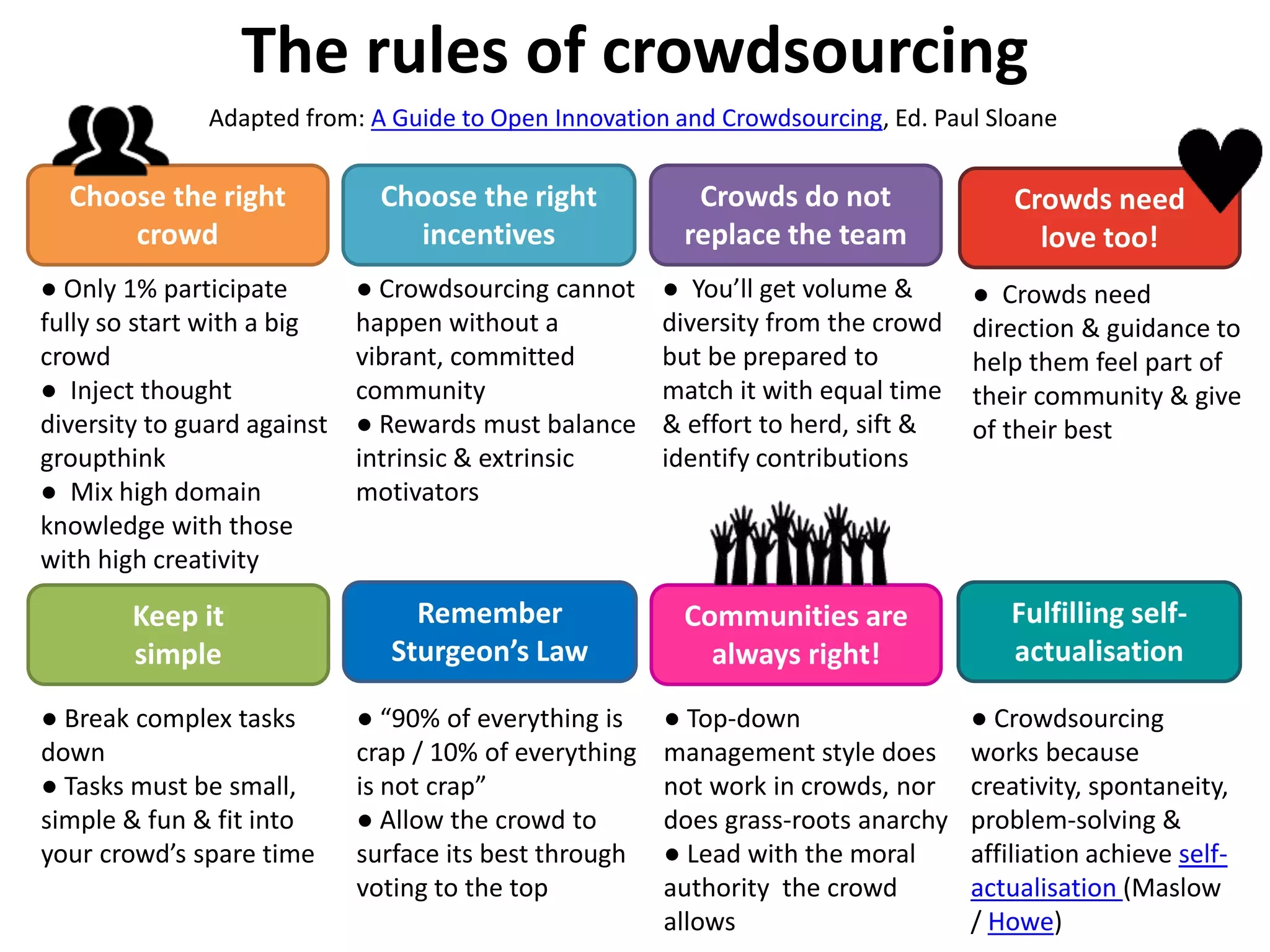
Adapted from: A Guide to Open Innovation and Crowdsourcing, Ed. Paul Sloane
The rules of crowdsourcing
The platform will remain open until
22nd April
• After this date, we will analyse the data
and hand it over to Dave and his
colleagues at Nottingham University
Hospitals so they can use it for action
• Please continue to contribute up to 22nd
April:
https://mobile.crowdicity.com/horizons.crowdicity.com/
Ashoka (2014) What does leadership mean in the 21st century?
Berg O (2014) The Collaboration Pyramid revisited
Bevan H (2015) From change programmes to platforms
Briggs D (2015) The elements of council as a platform
Bromford P (2015) What’s the difference between a test and a pilot?
Chesbrough H et al (2016) Why does open innovation work?
Choudray P (2015) The platform manifesto: 16 principles for digital transformation
Dawson R (2015) The future of work and organisations
Deloitte University Press (2014) A movement in the making
Deloitte University Press (2015) Business ecosystems come of age
Hagel J (2015) The power of platforms
Hagel J (2015) John Hagel at SXSW 2015: Narratives, platforms and movements
Hagel J (2014) Platforms are not created equal: harnessing the full potential of platforms
Hamel G, Zanini J (2014) Build a change platform not a change program
Health Services Journal, Nursing Times, NHS Improving Quality (2015) ‘Change Challenge’
interactive toolkit
Heimans J (2014) What new power looks like [YouTube]
Improvement platform references (1/2)
Heimens J, Timms J (2014) Understanding “New Power”
Innovations- Kontor Väst (2013) Open innovation – a handbook for Researchers
Little J (2016) Change management is dead
Milton N (2014) Why knowledge transfer through discussion is 14 times more effective
than writing
O’Reilly T (2010) Government as a platform
Pearce D (2013) Social business discussions are the new documentation
Raymond E S (2001) The Cathedral and the Bazaar
Satell G (2015) 4 things you should know about platforms
Satell G (2012) How power is shifting from corporations to platforms
Satell G (2015) Leaders must do more than inspire – we must shape networks
Schillinger C (2015) Forget social networks, think social impact [YouTube]
Scrivens J (2015) Enabling the experience of wholeness within enterprise social networks
Sewell S (2015) Stop training our project managers to be process junkies
Shaw K (2015) Placing a digital platform at the heart of organisational change with Oxfam
Simon P (2011) The Age of the Platform
Van Alstyne et al (2016) Pipelines, platforms, and the new rules of strategy
Improvement platform references (2/2)

How to set up an improvement platform in less than one hour - revised slides with results

  • 1.
    How to setup an improvement platform in less than one hour Horizons Group, NHS In partnership with Crowdicity https://mobile.crowdicity.com/horizons.crowdicity.com/
  • 2.
    The plan forthe next 55 minutes The next 55 minutes will be fast and furious as we work together to develop a crowdsourcing platform. We will be:- • Taking the first steps in developing a platform • Understanding and reframing the problem • Running sprint 1 and sprint 2 • Building on what we know • Taking next steps – your role
  • 3.
    • systematic “change management” •too often, leaders prescribe outcome and method of change in a top-down way • change is experienced by people at the front line as “have to” (imposed) rather than “want to” (embraced) Change Programmes • everyone (including service users and families) can help tackle the most challenging issues • value diversity of thought • connect people, ideas and learning • Role of formal leaders is to create the conditions and get out of the way Change Platforms “Tear down the walls”
  • 4.
    The design sprint– setting the scene • The Horizons team has a lot of experience of developing a variety of change platforms • Our global healthcare platforms developed for change - The Edge, Care Design 2016, Challenge Top down change, NHS Change Day • Working with partners Crowdicity – we want to show you how to design, crowdsource, build the questions and analyse the rich data
  • 5.
    First step indeveloping a platform • Understand the problem you want to solve. Is crowdsourcing the right approach? • Find the issue that will engage your crowd • Share a compelling story – work with patients, clinicians, frontline staff • Be social on the platform and social media channels • Work out loud about the improvement platform, learning and challenges David Selwyn, Nottingham University Hospitals NHS Trust
  • 6.
    Second step indeveloping resources • What platform? – Accessibility e.g. open vs closed access – Cost vs free platforms (Facebook, Google community) • Who will manage the platform? – Community manager vs self managed community
  • 7.
    Third step indeveloping resources • Agree the question • Be clear • Short • Begin with the end in mind • Aim to spark divergent and convergent thinking • Set challenges • Add personas to make the issue come alive • Populate the platform with useful research or guidelines if available • Expect the unexpected • How will you manage the difficult discussions? • How will you bring the focus back to the questions?
  • 8.
    When crowdsourcing doesn’tgo to plan! You need to be ready for what every the crowd says
  • 9.
    Final step indeveloping resources • Agree the methodology for analysis – Start with divergent and move to convergent – Human centred design methodology – Expert panel vs the crowd • Always know the end point • Do not waste the crowd’s time
  • 10.
    Our challenge: platform–not change programme
  • 11.
    Engage a communityof patients and healthcare staff
  • 12.
    Sprint 1 • Spenda few minutes reviewing the platform so far • On your table agree a question that will help Dave find the answer to the problem. (10mins) • Vote: which question should be used as an additional challenge to the crowd?
  • 13.
    Sprint 2 You areall now community managers / facilitators • What steps will you now take to involve your community? (10mins) • Feedback to the room
  • 14.
    Sprint 3 The analysis,what is the crowd telling us? • On your table teams review the content so far and agree what you think are the key themes (10mins) • Feedback to room
  • 15.
    Launch the platformat a great event & share the details with your community #qfhorizons
  • 16.
    The story sofar • Costs vs Benefits • Consider reducing the number of investigations, does the patient really need it? • Utilisation of the day – Question asked via twitter last night; ‘How do you ensure full utilisation of radiology in the hours of 9-5? Answer this before moving to overnight service.’ • Patient choice; how do we develop this within our services?
  • 17.
    Question 1 –Results so far
  • 18.
    Question 2 -Results so far
  • 19.
    Question 3 -Results so far
  • 20.
    ● Only 1%participate fully so start with a big crowd ● Inject thought diversity to guard against groupthink ● Mix high domain knowledge with those with high creativity Choose the right crowd Choose the right incentives ● Crowdsourcing cannot happen without a vibrant, committed community ● Rewards must balance intrinsic & extrinsic motivators Crowds do not replace the team ● You’ll get volume & diversity from the crowd but be prepared to match it with equal time & effort to herd, sift & identify contributions Crowds need love too! ● Crowds need direction & guidance to help them feel part of their community & give of their best Keep it simple ● Break complex tasks down ● Tasks must be small, simple & fun & fit into your crowd’s spare time Remember Sturgeon’s Law Communities are always right! Fulfilling self- actualisation ● “90% of everything is crap / 10% of everything is not crap” ● Allow the crowd to surface its best through voting to the top ● Crowdsourcing works because creativity, spontaneity, problem-solving & affiliation achieve self- actualisation (Maslow / Howe) ● Top-down management style does not work in crowds, nor does grass-roots anarchy ● Lead with the moral authority the crowd allows Adapted from: A Guide to Open Innovation and Crowdsourcing, Ed. Paul Sloane The rules of crowdsourcing
  • 21.
    The platform willremain open until 22nd April • After this date, we will analyse the data and hand it over to Dave and his colleagues at Nottingham University Hospitals so they can use it for action • Please continue to contribute up to 22nd April: https://mobile.crowdicity.com/horizons.crowdicity.com/
  • 22.
    Ashoka (2014) Whatdoes leadership mean in the 21st century? Berg O (2014) The Collaboration Pyramid revisited Bevan H (2015) From change programmes to platforms Briggs D (2015) The elements of council as a platform Bromford P (2015) What’s the difference between a test and a pilot? Chesbrough H et al (2016) Why does open innovation work? Choudray P (2015) The platform manifesto: 16 principles for digital transformation Dawson R (2015) The future of work and organisations Deloitte University Press (2014) A movement in the making Deloitte University Press (2015) Business ecosystems come of age Hagel J (2015) The power of platforms Hagel J (2015) John Hagel at SXSW 2015: Narratives, platforms and movements Hagel J (2014) Platforms are not created equal: harnessing the full potential of platforms Hamel G, Zanini J (2014) Build a change platform not a change program Health Services Journal, Nursing Times, NHS Improving Quality (2015) ‘Change Challenge’ interactive toolkit Heimans J (2014) What new power looks like [YouTube] Improvement platform references (1/2)
  • 23.
    Heimens J, TimmsJ (2014) Understanding “New Power” Innovations- Kontor Väst (2013) Open innovation – a handbook for Researchers Little J (2016) Change management is dead Milton N (2014) Why knowledge transfer through discussion is 14 times more effective than writing O’Reilly T (2010) Government as a platform Pearce D (2013) Social business discussions are the new documentation Raymond E S (2001) The Cathedral and the Bazaar Satell G (2015) 4 things you should know about platforms Satell G (2012) How power is shifting from corporations to platforms Satell G (2015) Leaders must do more than inspire – we must shape networks Schillinger C (2015) Forget social networks, think social impact [YouTube] Scrivens J (2015) Enabling the experience of wholeness within enterprise social networks Sewell S (2015) Stop training our project managers to be process junkies Shaw K (2015) Placing a digital platform at the heart of organisational change with Oxfam Simon P (2011) The Age of the Platform Van Alstyne et al (2016) Pipelines, platforms, and the new rules of strategy Improvement platform references (2/2)