CUSTOMER RELATIONSHIP MANAGEMENT 
S Rampradeep
CRM - Definition 
Customer Relationship Management (CRM) is a collective term encompassing all aspects of interaction that a firm has with its customer. 
Managing the relationship for the entire customer lifecycle is the central philosophy of CRM. It includes all systems, processes, people and decisions associated with the same.
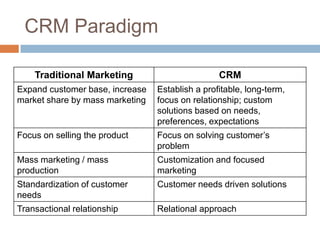
CRM Paradigm 
Traditional Marketing 
CRM 
Expand customer base, increase market share by mass marketing 
Establish a profitable, long-term, focus on relationship; custom solutions based on needs, preferences, expectations 
Focus on selling the product 
Focus on solving customer’s problem 
Mass marketing / mass production 
Customization and focused marketing 
Standardization of customer needs 
Customer needs driven solutions 
Transactional relationship 
Relational approach
CRM Advantage 
CRM enhances a company’s marketing efforts in the areas of : 
Market research 
Price planning 
Product development 
Market assessment 
Customer segmentation 
Product lifecycle 
In short, CRM provides organisations with the platform to obtain a competitive advantage by embracing customer needs and building value-driven long-term relationships.
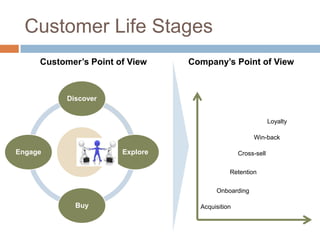
Discover 
Explore 
Buy 
Engage Customer’s Point of View 
Loyalty 
Win-back 
Cross-sell 
Retention 
Onboarding 
Acquisition 
Company’s Point of View 
Customer Life Stages
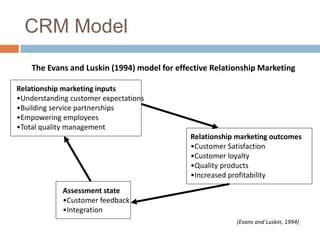
The Evans and Luskin (1994) model for effective Relationship Marketing 
Relationship marketing inputs 
•Understanding customer expectations 
•Building service partnerships 
•Empowering employees 
•Total quality management 
Relationship marketing outcomes 
•Customer Satisfaction 
•Customer loyalty 
•Quality products 
•Increased profitability 
Assessment state 
•Customer feedback 
•Integration 
(Evans and Luskin, 1994) 
CRM Model
The sales personnel are the individuals in any organisation who act both as relationship builders and as relationship promoters and must be involved in the following activities in order to initiate, develop and enhance the process that is aimed at building trust and commitment with the customer. 
Developing the relationship 
Select an appropriate offering 
Link the solutions with the customer’s needs 
Discuss customer concerns 
Summarize the solution to confirm benefits and secure commitment 
Manage customer value 
Act as customer advocate 
Enhance customer loyalty to build a healthy and profitable network of relationships 
Assess customer satisfaction and Take action to ensure satisfaction 
Maintain open, two-way communication and work to add value and enhance mutual opportunities 
Role of Salesforce in CRM
Case Studies 
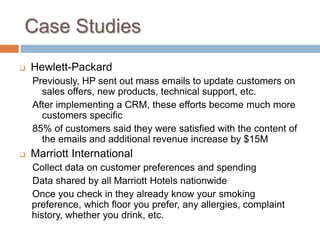
Hewlett-Packard 
Previously, HP sent out mass emails to update customers on sales offers, new products, technical support, etc. 
After implementing a CRM, these efforts become much more customers specific 
85% of customers said they were satisfied with the content of the emails and additional revenue increase by $15M 
Marriott International 
Collect data on customer preferences and spending 
Data shared by all Marriott Hotels nationwide 
Once you check in they already know your smoking preference, which floor you prefer, any allergies, complaint history, whether you drink, etc.
Summary 
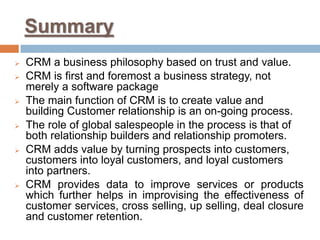
CRM a business philosophy based on trust and value. 
CRM is first and foremost a business strategy, not merely a software package 
The main function of CRM is to create value and building Customer relationship is an on-going process. 
The role of global salespeople in the process is that of both relationship builders and relationship promoters. 
CRM adds value by turning prospects into customers, customers into loyal customers, and loyal customers into partners. 
CRM provides data to improve services or products which further helps in improvising the effectiveness of customer services, cross selling, up selling, deal closure and customer retention.

Customer relationship management

  • 1.
  • 2.
    CRM - Definition Customer Relationship Management (CRM) is a collective term encompassing all aspects of interaction that a firm has with its customer. Managing the relationship for the entire customer lifecycle is the central philosophy of CRM. It includes all systems, processes, people and decisions associated with the same.
  • 3.
    CRM Paradigm TraditionalMarketing CRM Expand customer base, increase market share by mass marketing Establish a profitable, long-term, focus on relationship; custom solutions based on needs, preferences, expectations Focus on selling the product Focus on solving customer’s problem Mass marketing / mass production Customization and focused marketing Standardization of customer needs Customer needs driven solutions Transactional relationship Relational approach
  • 4.
    CRM Advantage CRMenhances a company’s marketing efforts in the areas of : Market research Price planning Product development Market assessment Customer segmentation Product lifecycle In short, CRM provides organisations with the platform to obtain a competitive advantage by embracing customer needs and building value-driven long-term relationships.
  • 5.
    Discover Explore Buy Engage Customer’s Point of View Loyalty Win-back Cross-sell Retention Onboarding Acquisition Company’s Point of View Customer Life Stages
  • 6.
    The Evans andLuskin (1994) model for effective Relationship Marketing Relationship marketing inputs •Understanding customer expectations •Building service partnerships •Empowering employees •Total quality management Relationship marketing outcomes •Customer Satisfaction •Customer loyalty •Quality products •Increased profitability Assessment state •Customer feedback •Integration (Evans and Luskin, 1994) CRM Model
  • 7.
    The sales personnelare the individuals in any organisation who act both as relationship builders and as relationship promoters and must be involved in the following activities in order to initiate, develop and enhance the process that is aimed at building trust and commitment with the customer. Developing the relationship Select an appropriate offering Link the solutions with the customer’s needs Discuss customer concerns Summarize the solution to confirm benefits and secure commitment Manage customer value Act as customer advocate Enhance customer loyalty to build a healthy and profitable network of relationships Assess customer satisfaction and Take action to ensure satisfaction Maintain open, two-way communication and work to add value and enhance mutual opportunities Role of Salesforce in CRM
  • 8.
    Case Studies Hewlett-Packard Previously, HP sent out mass emails to update customers on sales offers, new products, technical support, etc. After implementing a CRM, these efforts become much more customers specific 85% of customers said they were satisfied with the content of the emails and additional revenue increase by $15M Marriott International Collect data on customer preferences and spending Data shared by all Marriott Hotels nationwide Once you check in they already know your smoking preference, which floor you prefer, any allergies, complaint history, whether you drink, etc.
  • 9.
    Summary CRM abusiness philosophy based on trust and value. CRM is first and foremost a business strategy, not merely a software package The main function of CRM is to create value and building Customer relationship is an on-going process. The role of global salespeople in the process is that of both relationship builders and relationship promoters. CRM adds value by turning prospects into customers, customers into loyal customers, and loyal customers into partners. CRM provides data to improve services or products which further helps in improvising the effectiveness of customer services, cross selling, up selling, deal closure and customer retention.